MP Board Class 12th General English Essay Writing

MP Board Class 12th General English Essay Writing

1. The Unemployment Problem [2009, 12, 18]

The Main Reason – Unemployment results when there are more job seekers and less jobs. What are the reasons of its origin and growth? Well, the major reason is our rapidly growing population. Since 1950 our population has grown two and a half times but our economic growth, which creates jobs, could not keep pace with it. Hence, unemployment, which was a problem even in 1950, has acquired gigantic1 proportions and requires some drastic2 measures otherwise it may go out of hand.

The Nature of the Problem – As unemployment is directly linked to population growth, its in-depth analysis may indicate the nature of the problem as well as help in identifying the measures needed to deal with it.

When we look at the pattern of population growth we find that it is growing faster in the rural areas resulting in (a) bigger landless families forcing migration towards town for employment mostly as unskilled workers, and (b) dividing land-holdings into unviable entities resulting in underemployment of youth who need self-employment opportunities.

In the urban areas, though it is not growing that fast, unemployment results from defective educational planning. Our educational system is producing far more matriculates as well as graduates in sciences and humanities who have very little employment potential. Graduates in commerce and agriculture and information technology have better employment potential and there isn’t much unemployment in this group.

Measures to Mitigate it – In the light of the above, the following measures may go a long way in mitigating3, if not eradicating, the problem. For the rural sector a two pronged attack’1′ is required. Projects for infrastructure development leading to industrial development creating jobs for the unskilled workers coming from the landless families. And for the other group, as they would have some money to invest, efforts should be made to promote cottage and village industries.

MP Board Solutions

For the youth of the urban areas, our educational system should be reorganised so as to provide better employable youth. This would need creating more and better opportunities for technical and vocational education.

[1. विशाल। 2. कठोर। 3. कम करना। 4. दो तरफ हमला।]

2. Advantages and Disadvantages of Television
Or
TV as a Medium of Education
Or
Educational Value of Television [2012]

Introduction – On September 13, 1959, AIR set up an experimental television service in India. This was the beginning of the television era’ in our country. The experiment was a success. The TV centres have been set up all over the country, in all the States and in big numbers. There are now TV sets in the cities as well as in the villages. The credit goes to late Smt. Indira Gandhi for spreading TV service so widely.

Advantages – There are mhny advantages of the TV services. The most important ones may be mentioned here.

(a) Education – It can play an important role in furthering the cause of education. It can assist2 teachers to a great extent. What they teach in the classes can be reinforced on the TV. Even additional knowledge can be imparted. The students also retain easily the information received on it because of its visual aid. Television viewing does not demand the strain and discipline needed in reading books. Moreover, dull and dreary things become interesting when viewed and heard on the TV. Thus, Television can vitalize teaching a good deal. For, learning through the eye helps remembering things better.

(b) General knowledge – Besides the students, people in general can benefit from Television. Since it provides words with pictures and sound effects, its programmes are as interesting as cinema-films. It is definitely a better medium than the radio which reproduces only the sound. Thus, the TV can teach people without straining them. It broadcasts messages, it discusses their typical problems, it informs them about national and international happenings. In one word, it keeps the people well informed on all important matters. It also pushes them towards modernization.

(c) Entertainment – Television is perhaps the easiest and the cheapest means of entertainment. It considerably reduces the number of our visits to cinema houses, which is a costly affair. What is there in a cinema house that we cannot enjoy at home with a TV set? Sitting on a sofa we watch along with other members of our family a film, a dramatic play, a mushaira, kavisammelan, various kinds of witty and informative competitions, and so ’ on and so forth, who failed to enjoy the ‘Saas Bhi Kabhi Bahu Thi’ series?

Disadvantages – But it does not mean that the gift of television is all joy and profit. It is attended also by its own disadvantages.

(a) Bad effect on the eyesight – First and foremost long, continuous watching the TV is harmful to the eye, it weakens the eyesight. It is believed that watching the colour TV is more injurious. Watching the TV for long hours is bound to overstrain4 the eye.

(b) Waste of time – All the TV programmes are not good or profitable for the people. But once the TV is on, we do not care to switch it off whether we enjoy the running programme or not. Careless of our valuable time we keep on sitting in front of our TV set. We sometimes forget to do our most important work.

(c) Neglect of duty – TV watching also causes neglect of duty in the case of children and parents. At the cost of their study the students want to watch the TV. They delay going to bed. And when they go to bed late they naturally rise late, which is a bad habit. They do not like to miss day long matches, serials and many other purely entertaining shows. This is also true of the elder people. They find it easier to cancel their visit to a sick friend than to miss their favourite serial. If a visitor comes, nobody talks to him, he is forced to watch the film running on the TV.

Conclusion – These are some of the most important advantages and disadvantages. In fact the television is not bad in itself. The viewers need self-discipline5. They should make a judicious use of this great gift of science, like any other gift of science.

[1. युग। 2. मदद करना। 3. आधुनिकीकरण। 4. जोर देना। 5. आत्म अनुशसन।]

3. The Value of Games and Sports [2009,18]
Or
Importance of Games and Sports [2010,11,13,16]
Or
Advantages of Games and Sports [2017]

Introduction – Games and sports are an important part of education. They help in the development of the physique and mind of the student. A sound body possesses a sound mind. If we are weak and sick we cannot have fertile1 brain. Games and sports keep us healthy. They keep us active, make us smart.

Physical and Mental Education – Gandhiji said, “Physical training should have as much place in curriculum as mental training.” Mere bookish knowledge would not lead to proper development of a personality. All work and no play makes Jack a dull boy. Mere studies would not suffice. Similarly, mere sports won’t do. The two should be blended in a suitable proportion2 so that the students can have the best of them. They should not only develop the mind but also the body. Both are essential for a wholesome personality.

Other Benefits – Games and sports do not merely keep us healthy and physically fit, they also inculcate in young people the duty, of loyalty. These qualities can be summed up in a word ‘sportsmanship’. The first and the foremost thing that games teach us is to take victory and defeat alike. In every game, there are two parties. One wins and the other loses. The winners need not be over-zealous and the loser ones should not get asperated. Both the parties should greet each other heartily after the game. Secondly, games and sports teach us discipline. Every player must obey his or her captain.

He has to play obeying all the rules of the games. He has also to abide by the decision of the referee or umpire. Thirdly, games broaden our outlook. The players need have no bias. They should treat other players alike. The players ought not to differentiate between one another on the basis of nationality, caste, creed or colour. The games promote international brotherhood and affection amongst the people of the world. Thus, they promote world peace too.

International Appeal – Games are beneficial not only to players; they are equally beneficial to the public at large. When a match is being played, spectators3 also enjoy it. They become one with the game and in a way take active part in it. Besides enjoying the game, they learn many things from them. Radio and TV have increased the number of people taking interest in games. Nowadays, people in any part of the world can enjoy listening to running commentaries of matches on radio or watching them on the Television.

MP Board Solutions

Value in Student Life – Games and sports have great value in student’s life. The foundation4 for a virtuous life is laid in school. If at an early age a student develops the taste for studies and sports in a proper way, he can become an ideal citizen in his later life. The sports arena teaches many things to the students. It gives him discipline. It develops his sportsman spirit, mental outlook, cheerful nature, sense of humor and strong physique – all these are important traits5 of a successful life. If a student studies seriously and diligently and still takes part in sports and games he would make an ideal personality.

[1. उपजाऊ। 2. अनुपात। 3. दर्शक। 4. नींव। 5. विशेषताएँ।]

4. The Use of Computers in Modern Age [2016]
Or
Educational Value of Computers [2013]
Or
Advantages of Computers in Our Daily Life [2017]
Or 
Role of Computers in School Education [2014]

Introduction – The computer is the gift of the 20th century. In 1947, India got independence and the world got the first computer called Electronic Delayed Storage and Calculation [EDSAC]. It was fully automatic. It could store data and instructions and execute the stored instructions. Though much progress has been made in the computer technology, we are yet only in the midst of the computer revolution.

Its popularity – Though the history of the computer is very recent; there is hardly any sphere of human acti vity where computers are not being used. The impact of the computer revolution is being felt everywhere and it is bringing many changes in our society.

What is a computer? – To a layman, a computer is an electronic machine with mystical powers, a superhuman that can perform any job and do anything that was impossible before. But, in fact, a computer is much like any other machine used by man. Like any other machine it has its limitations and, like any other machine, it is an obedient servant of man and can do wonders with the help of human intelligence and imagination.

The basic function of a computer – There are three basic functions that a computer can perform. They are :
(i) arithmetic operations – addition, subtraction, multiplication and division of values,
(ii) comparison operations – testing of relationships of two values, and
(iii) storage and retrieval operations – storing and reproducing of values when required. A computer performs these operations at a very high speed and for a very long time, maintaining high level of accuracy, without fatigue. These features make a computer unique and distinctly superior to other machines capable of performing such functions.

Basic components – A computer system has at least three basic components, namely
(a) input device,
(b) central processing unit [CPU], and
(c) output device.

The input device helps the user to give data and instructions to the CPU. The CPU performs the computation and thus is the real computer – the brain of the system. On the output device the computer prints the end results of the data processing.

Types of computers – Various types of computers are being used depending upon the purpose and data processing requirements. In terms of size, computers may be classified in three broad categories :
(i) Main frame, the biggest one with very large memory used only in big organizations,
(ii) Mini computer, the smaller one, and
(iii) Micro computer, the smallest one.

Computers can also be classified on the basis of the type of input they accept:
(i) Digital Computers which accept input in the form of digits,
(ii) Analog Computers which accept physical quantities as their input,

e.g., pressure of air and water, temperature, etc. Robot is a good example of this type.

Conclusion – The development of computer technology is, at present, in its fourth generation where it has witnessed many breakthroughs. It has made computers smaller, cheaper, more efficient, more friendly to the user and easier to maintain. However, this is not the end. Very serious efforts are being made to increase the storage capacity of computers at a substantially reduced cost. The fifth-generation computers, which are about to come in a very big way, shall have the artificial intelligence that shall approach quite close to human intelligence.

5. Science in Daily Life [2011,14,16]
Or
Our Daily Life and Science [2017]
Or
Science : Its Uses and Abuses [2009]
Or
Wonders of Science [2009]
Or
Man’s Journey of Life and Science [2015]
Or
Science and Technology – Boon or Curse [2012,13,18]

Introduction – Science in itself is neither good nor bad. Its use determines1 its character. If it is used for constructive1 purposes, it is good; it is a good servant. If it is used for destructive1 purposes, it is bad; it is a bad master.

A good servant – Many are the gifts of science, which have made life, happy and comfortable. It has given us electricity, the wonder of wonders, cheap and quick transport and countless time and labor-saving devices. It has helped progress in medicine and surgery. It has helped the farmer grow more food. It has relieved human suffering in hundreds of ways. It has brought in the age of plenty and prosperity. These and many other things show that science is a good servant.

A warning – Nobody should question the importance of science. But we should not shut our eyes to the harm that science does or can do. We should always remember that science is meant for man, not man for science. Material progress should be accompanied4 by moral and spiritual progress.

A bad master – If foolish and power-hungry men control the knowledge of science, science becomes a bad master. In their hands science may cause suffering and destruction. It may help colonialism5 and imperialism6 It may keep backward nations in slavery. It may cause mass destruction through nuclear weapons or rockets. It may cause mass poisoning and germ warfare. Then science will no more be a good servant but a bad master.

MP Board Solutions

Conclusion – The truth about science is that, like fire, science is a good servant but a bad master. We should be careful to put science to good uses only. We should remember that science exists7 for man; man does not exist for science.

[1. निश्चित करता है। 2. रचनात्मक। 3. विनाशक। 4. जुड़ी हुई। 5. उपनिवेशवाद। 6. साम्राज्यवाद। 7. अस्तित्व रखता है।]

6. A Great Indian Leader: Mahatma Gandhi [2009]
Or
The Man I admire most [2013]
Or
The Person I like most [2014]
Or
The Person Whom I Respect most [2017]

Introduction – “Some men are bom great, some achieve greatness and some have greatness thrust upon them.” Our beloved leader Mahatma Gandhi belongs to the second category1 of people, that is, he is one of those who achieved greatness by their own effort. He was not only the Father of Indian nation but one of the greatest figures of world history.

His early life – He was bom on October 2, 1869 at Porbandar. After his matriculation, he was sent to England to study law. After a brief practice in India he went to South Africa to plead a legal case.

In South Africa – He was greatly shocked to find Indians suffering from many disabilities in South Africa. The ill-treatment2 given to Indians there hurt his patriotic feelings. He himself was called a ‘Coolie Barrister’. He had read Thoreau and Tolstoy. From them he had learned the doctrine3 of civil disobedience and passive resistance. On these principles he started a peaceful campaign4 against the Government of South Africa. He was sent to jail.

His fights for India’s freedom – Sometime after his release he returned to India. He had tested the mighty force of his weapon of civil disobedience and passive resistance. He applied the same weapon against the injustice of the English rule in India. He was shocked and horrified5 by the massacre of Jallianwala Bagh. In 1920, he started the Non-cooperation Movement which shook India from end to end. His movement attracted worldwide attention. He became the leader of the Indian National Congress. Besides many top ranking IndiAnswer:the masses joined his movement. Under his influence, a silent but powerful revolution took place in mental, social and political life of the country. His efforts for Indian independence were crowned with success in 1947.

His guiding principles – Truth and non-violence were the guiding principles of his life. He himself practiced as-well-as taught these principles to his people and to the world. He also preached6 the noble doctrine that the means should be as clean and pure as the end. The right end did not justify the use of wrong means. This he preached and this he himself practiced.

The last phase – India became free, but India was partitioned1 to Gandhiji’s great sorrow. He was very much pained at the communal riots that followed Independence. He died a martyr’s death when he was shot dead by a fanatic young man.

Conclusion – Not only India but the whole world was made poorer by Gandhiji’s death. His death was rightly mourned all over the world. Long will he live in the history of the world.

[1. श्रेणी। 2. दुर्व्यवहार। 3. सिद्धान्त। 4. आन्दोलन। 5. दुखी। 6. सिखाया। 7. विभाजित हुआ। 8. जातीय दंगे।]

7. The Population Problem in India [2009]
Or
The Most Pressing Problem of Our-Life
Or
Any Current Problem in India [2013,17]

Introduction – The problem of population in India means the problem of over-population in the country. This problem is not peculiar to our country; it is a world-wide problem. But since ours is one of the most populous countries, its problem is the gravest’ one. In order to solve the problem we must think over the cause of problem and find out remedy or remedies for it. But, first let us know the size of the problem.

The size of the problem – India has about 15 percent of the world’s total population. That is, every seventh person in the world is an Indian. In
1971, India’s population was 54-81 crores,butby 1981 it rose to 68-38 crores. The annual increase in India’s population is estimated to be one crore and thirty lakhs of people. These figures show the seriousness of the population problem in our country.

Causes of the problem – The-causes of the increase in population are not far1 to seek.2. High birth rate and low death rate are two main causes. The development of modem medical science has led to a marked decline3 in death rate, many of even those diseases which were considered incurable4 are cured now. The decrease in death rate should have been accompanied by a decrease in birth rate to keep the population under control. This has not been so. The birth rate remains continuously high. The result is constantly rising population. Early marriages and unrestricted growth of families are also among causes of population explosion5.

Harms of over-population – Over-population is a curse because it gives birth to host6 of problems which adversely affect the quality of our life. With every rise in population we need more clothing, more houses, more schools, more hospitals and more jobs. The tremendous8 economic progress made by our country after the achievement of freedom in 1947 has failed to improve’the economic condition of our people. India is still a poor country. To make the condition worse, number of ill-fed, ill-clothed9, illiterate and unemployed people is increasing every day. The ever-increasing population and inadequate employment opportunities are throwing a large section of people below the poverty line. Why is it so? The simple answer is that our production and opportunities of employment fall too short of our rapidly rising population.

The remedy – In order to meet the challenge of over-population we can do only two things. One is to increase food supply and the other thing is that we should check the increase in population besides doing what we can do to increase production of necessaries of life.

Check or reduction in population can be achieved through Family Welfare Planning. It is noteworthy11 that.India was one of the first countries to realize the importance of family planning for general economic development. It started the ‘planning’ as long ago as 1952. But it has not yet been able to achieve the desired result. It needs to be practical and free of all politics and religious biases. It should be imposed12 rigorously13 and on all people irrespective14 of caste and creed. Persuasion would, of course, accompany compulsion.

MP Board Solutions

Conclusion – Our population problem is a matter of top national priority15 and deserves all attention and action. Unless we reduce or control population, we are all going to suffer badly by the turn16 of this century.

[1. गम्भीरतम। 2. खोजना कठिन नहीं है। 3. कमी। 4. असाध्य। 5. जनसंख्या विस्फोट। 6. बहुत-से। 7. विपरीत दिशा में। 8. बड़ी। 9. भोजन और वस्त्र के अभाव में ग्रस्त। 10. जीवन की आवश्यकताएँ। 11. ध्यान देने योग्य। 12. लागू करना। 13. सख्ती से। 14. कोई ध्यान किये बिना, अनपेक्षित। 15. प्राथमिकता। 16. मोड़।]

8. Environment: The Problem of Pollution [2009]
Or
Impact of Pollution on our day to day life [2010]
Or
Pollution and Our Existence [2015]
Or
Pollution Problem : A Great Challenge [2018]

Introduction – Environment1 means all the surrounding conditions which influence the growth and development of life. The environment is composed of gases and substances1 which exist in a certain proportion. When, for any reason, one of the constituents increases or decreases the balance of the whole atmosphere is disturbed. This imbalance of the constituents3 is called pollution of the environment. The pollution4 is chiefly of two kinds – air pollution and water pollution.

Air pollution – Air pollution means loss of balance of proportion of oxygen, carbon dioxide and other gases which are found in the air. To be precise, when carbon dioxide increases and oxygen decreases in the air, air pollution take place. We all know the oxygen in the air is constantly being used up and turned into carbon dioxide when animals breathe and things bum. But nature has its own way to replace the used-up oxygen. The green leaves of all trees and plants absorb5 the carbon dioxide from the air and break it up into carbon and oxygen. The carbon is used to make starch and oxygen is released into the .atmosphere. That is how trees help to replace the used-up oxygen and maintain equilibrium6 in the environment.

Causes of air pollution – But the equilibrium in the environment is being constantly destroyed by man himself. Since long man has been cutting down trees and plants in order to use them as fuel and wood for building. This has resulted in deforestation1 leading to unbalanced or unhealthy environment. Thus, deforestation is the first cause of air pollution.

Another cause is too much use of motor-cycles, scooters, tempos, cars, buses, steamers and aeroplanes. They all burn oil or coal and add to the carbon dioxide in the air.

Yet another cause is the modem industrialization which has given and is giving birth to innumerable mills and factories. Their chimneys incessantly pour out poisonous gas and smoke which spoils the environment.

The effect of air pollution – Air pollution affects our health very badly. While we breathe, poisonous gas and smoke also enter our lungs along with oxygen. They cause diseases of lungs and heart. They cause even such incurable diseases as cancer.

Remedies – In order to prevent air pollution, we should first check deforestation and plant as many trees as we can. Secondly, mills and factories should be built away from human population and their chimnies should open high up in the sky. Finally, the use of coal should be replaced by electricity and solar energy.

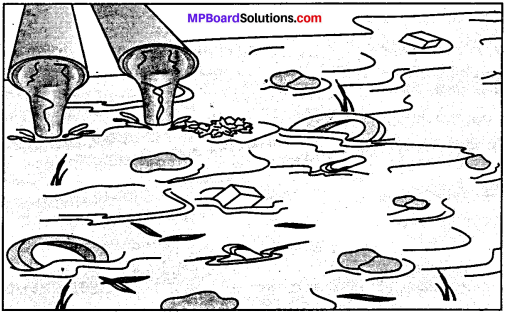
Water pollution and its cause – The second kind of pollution of the environment is water pollution. Water gets polluted when gases, n.inerals and other substances, which exist in it, lose their due proportion. The desired proportion is disturbed mostly when such things as soap, soda, D.D.T., kerosene oil, poisonous medicines, injurious chemicals, and other impurities are poured into wells, rivers and lakes.

The effect of water pollution – Like air pollution, water pollution is also a great danger to our health. When polluted water is drunk, it causes such diseases as jaundice, typhoid, cholera and cancer. It may cause birth of disabled children.

Remedies – The dirty water should be cleaned by mechanical and other devices before it is poured into rivers and lakes. Dirty injurious rubbish8 should not be thrown into water sources. We should purify our drinking water by boiling and filtering it.

Conclusion – The environment is our sacred and invaluable heritage. Our very existence depends on it. It is, therefore, the duty of every man to keep the environment clean, pure and safe. We should set up environment clubs, ecological10 development camps, and organize seminars and symposiums with a view to protecting and developing human environment.

[1. पर्यावरण। 2. पदार्थ। 3. घटक। 4. प्रदूषण। 5. आत्मसात करना। 6. सन्तुलन। 7. वनों का नाश। 8. कूड़ा-कचरा। 9. छानना। 10. पारिस्थितिकी-विज्ञान सम्बन्धी।]

9. Quality Education at Primary Level [2015]

Introduction – Education is a very important factor in the life of people. Most of the people in India are illiterate. After independence, the attention of the government and our leaders was drawn towards this and several steps were taken to educate people.

Primary Education – In our country the condition of Primary Education is poor. Children are not sent to the schools. They are asked to help the family in the work of earning money. Work on fields, factories, construction of buildings etc. is taken from them. Poverty is the reason for this. The number of schools is also not sufficient. Good teaches are not available.

Importance of Primary Education – Primary Education is very important in our education system. It is the nursery where the children are reared as plants. As a building needs firm foundation in the same way the life of individual depends on primary education. The course and syllabus of primary classes is also not proper. There is a great variety in the structure of Indian society. There is no uniformity. There are several languages. The social and cultural structures are also different. The course and syllabus of primary classes should meet the future requirements of the society. The quality and syllabus should be better.

Dropping Problem – Several students leave their education in the middle way. The reasons are failures, illnesses the parents reluctance and nonavailability of the teachers. For this awareness among the people is needed. The teachers should take interest. They should understand the problems of students and make the school an attractive place for students.

Right to Education – On 1 st April 2010 the right of children to Free and Compulsory Education Act has been passed. The act makes it obligatory on the state to guarantee education and pnsure compulsory to admission of children. This act provides some measures to make it successful.

Conclusion – Well educated children are the backbone of society. Child is the future citizen. And on citizens depends the prosperity, progress and well being of the country.

10. An Election Scene

Introduction – An election scene is a common sight in a democratic country like India, where members of Parliament, Legislative Assemblies and local bodies are elected from time to time. They are elected by adult persons who are given the right to vote in public elections. We have laws for conducting elections. For examples, canvassing, which plays an important role in elections, has to be stopped a day before the election; voters are required to go to the fixed polling stations to register their votes.

The Polling Station – A polling station [or a polling booth] is a place where people go to register their votes. At a polling station the voters of only a particular constituency1 can cast their votes. Often a placard2 is exhibited outside the polling station, the constituency for which that station is meant.

Inside the booth a polling officer and his assistants do their work. When a voter comes in, an assistant traces out his name in the electoral roll. When he is satisfied with the identification of the voter, he puts a mark of indelible3 ink on the little finger of the voter. The voter then receives a ballot paper. He puts his signature on its counterfoil. With this’ ballot paper he is asked to go to a closed comer where a stamp and an ink pad are available. The voter stamps the ballot paper against the name of his candidate. Then he folds the ballot paper as required and puts it into the ballot box through a hole on its top and walks out. Nowadays Electronic Voting Machines [E. V. M.] have been introduced. Here you have to push a button and your vote is cast.

Outside the polling station – The main part of an election is accomplished5 inside the polling station. But its live6 and picturesque1 part is seen outside the booth. At a distance of 100 metres from the booth, agents of various candidates contesting election put up their tents. They issue identity slips to those voters who come to them. A volunteer of the particular agent helps the voter reach or enter the polling booth.

MP Board Solutions

This area outside the polling station presents an exciting and . fascinating scene almost like that of a village fair. There are of course, neither merry-go-rounds nor giant wheels nor shops to attract women and children. Instead, we have the tents of polling agents; but they are decorated with colourful buntings8 which give atmosphere of a festive look9. There is hustle and bustle all round here. People, especially women, can be seen in their best clothes, flocking together10 talking and gesticulating11. Some tents have long rows of voters standing in front of them to receive identity cards. But there are also other tents which present a deserted look. To complete the show; there are also policemen posted at all strategic points to guide the crowd and maintain law and order.

Disputes – Sometimes disputes also break out. For example, the identity of a voter is questioned and it is an occasion for quarrel. In such a case, which is called “challenging the vote”, the Presiding Officer hears both the parties of the dispute and decides whether the voter is to cast vote or not. Sometimes a person impersonates12 a voter and casts vote in his place.

If he is caught red-handed he is handed over to the police for action.

Scenes of rowdyism13 – Sometimes great rowdyisms are enacted. The supporters of two contestants sometimes come to blows and sometimes even to bullets when one group or another indulges in mischief. The supporters or goondas of a losing candidate try to temper with a ballot box or run away with it.

Conclusion – On the whole an Indian election scene is a peaceful one, which is indeed, a great thing because India is a vast country with a huge number of voters.

[1. चुनाव-क्षेत्र। 2. इश्तहार, विज्ञापन। 3. अमिट। 4. मतपत्र। 5. पूर्ण किया जाता है। 6. सजीव। 7. नयनाभिराम। 8. झण्डियाँ। 9. उत्सव-सम्बन्धी दृश्य। 10. एक साथ जाते हुए। 11. उँगलियों आदि के संकेत करते हुए। 12. पररूप धारण करना। 13. हुल्लडबाजी, गुण्डागर्दी।]

11. Important of Newspaper [2016]
Or
Newspaper [2009,11]
Or
Power of the Press

Introduction – Newspaper is a powerful mass media. It plays a very important role in a democractic country. It helps people to form their opinion which is the backbone of democracy. Newspaper have proved that pen is more powerful than sword. They are a good means of expressing one’s thought.

Changing Role of Newspaper – Gone are the days when newspaper was read just to know the news. Its role was very narrow and limited. But today news is only a part of the newspaper. It provides classified news. There are different pages for different categories of news. We have separate pages for local news, international news, sport news, commercial news etc.

Knowledge and Entertainment – Newspapers give us both knowledge and entertainment. They publish articles on science, medicine, health, cookery, fashion etc. They also entertain us through short stories, jokes, articles, quiz etc. They publish interesting comic series, picture quiz etc., for children.

Career Guidance – Most of the newspaper publish very important career guidelines once or twice a week. They inform us about the different academic and vocational courses and competitive examinations. They help us to choose a suitable course and career.

Advertisement – Newspaper publish classified advertisements such as situations vacant, educational, matrimonial, sale and purchase of vehicles, property advertisement. Most of them are very useful. Matrimonials provide a wide choice of matches. ‘Situations Vacant’ column helps us to get a job.

Demerits – Newspapers have some demerits as everything else has. Some advertisements are false. They misguide and deceive the reader. Sometimes biased articles are published. They cause communal riots, hatred and disunity.

Conclusion – Healthy censorship removes these demerits to a great extent. The conscious reader cannot be misguided and deceived by yellow journalism.

12. The Festival You Like Most [2014,16]

Introduction – Diwali is a very’ nice festival of the Hindus. It often comes in the month of October or November every year. It is celebrated in the memory of Ram’s return to Ayodhya from forests after 14 years. The people of Ayodhya welcomed Lord Ram heartily. They decorated their houses with flowers. They lighted earthen lamps before their houses. Diwali is a remembrance of that day.

Preparations – Days before the people start preparations for this festival. People clean their houses completely. They whitewash them. The merchants paint their shops and set them. The market gets a new look.

How Celebrated – People buy new clothes and new dresses. They buy many things for this festival. Children buy crackers. Ladies buy sarees and material for preparing sweets. People give presents to friends and relatives. They send greeting cards to their far off friends and relatives. Main days of celebration of Diwali are three ‘Dhan Teras’, ‘Roop Chaudas’ and ‘Diwali’ on Amavasya day. In the evening ladies and children bum candles and lamps. Many electric bulbs of several colours are also lighted. The rows of lamps look very beautiful.

Worship of Goddess Laxmi – On this day, people worship Goddess Laxmi. They pray her for health, wealth and happiness for the whole year. Children let off fireworks. People eat sweets. They distribute ‘Prasad’ of Diwali. The rich and the poor enjoy Diwali. All classes of the society are happy. Diwali also marks the end of the year.

Importance – Diwali is an all-India festival. People of all parts of India and all communities celebrate it. It is a festival of national importance. It promotes national unity also.

For All People – All age groups of people enjoy celebration of Diwali. Children, youth and the old, gents and ladies feel freshness at the coming of Diwali. The rich and the poor all celebrate it as per their capacity.

Conclusion – Diwali is a very nice festival. People forget their differences. There are some bad customs too. Some people gamble and drink wine. This is not good. Some persons get injured during burning of crackers due to carelessness. However, Diwali brings happiness to every home in India.

13. The Problem of Terrorism in India [2014]

Introduction – Terrorism is a great danger to human civilisation. The whole world is faced with this problem and India is no exception1 to it. India has been facing terrorists in Jammu and Kashmir for long. The North-Eastern states including Chhattisgarh, Jharkhand, parts of Bihar and Orissa are also faced with the same problem.

Various terrorist organisations are active and have their own demands and objectives. These organisations have been trained in terror tactics and are supported by other organisations in foreign countries.

Causes : The chief causes of terrorism include acute nationalism as exhibited by Hitler who promoted nationalist feelings among his countrymen and a hatred for others. Second is economic disparity? The charm for leading a luxurious life and be a part of high profile section of the society somehow urges them to make money at any cost. The third and the most important is communal disharmony. When people are discriminated’ on account of caste, colour, creed etc. they rise in resentment and opposition.

MP Board Solutions

Need for Peace: India is a peace loving country. She was always tried to counter terrorism and establish world peace. There is a need to enforce the rule of law and punish the, guilty. Unnecessary delay in judicial process should also be avoided. There are some examples of terrorists who were punished rightly but after much delay.

Conclusion : Nations should also try to curb6 arms race. Energy resources should be used for peaceful purposes and not threatening weaker nations. And lastly to have wisdom to realise our purposes and fight the evil out with the increase in knowledge, power and resources.

[1. अपवाद। 2. राष्ट्रवादी। 3. असमानता। 4. भेदभाव। 5. आक्रोश 6. रोकना।]

14. The Cleanliness Drive
Or
Our India, Clean India [2015]

Introduction – India is a big country. It enjoys a special place in the world. These traditions and customs are rich. These are followed by people all over the world.

Meaning of Cleanliness Drive – When Shri Narendra Modi became The Prime Minister of India, he felt that the people of this country must be inspired for cleanliness crowd them. So he started a nationwide cleanliness drive. He appealed to the countrymen to clean their surroundings. The cleanliness drive covered cleanliness from own houses to the entire nation.

Impact of This Drive – The cleanliness drive received a big applause from people throughout the country. People from all sections of society exhibited great interest in it. Eminent citizens including politicians academicians sports persons, film actors etc. got associated with this drive. In fact the cleanliness drive became national affair within a short period of time.

Its uses – The cleanliness drive has many uses. A clean surrounding always gives better and safer atmosphere to live. Many diseases are automatically removed due to cleanliness. The surroundings look better. As a result, we feel happy and pleasant.

Conclusion – Cleanliness is not a work which we should do forcefully. It is a good habit and healthy way of our healthy life. All type of cleanliness is very necessary for our good health whether it is personal cleanliness, surrounding cleanliness, environment cleanliness, pet animal cleanliness or work place cleanliness [like school, college, office, etc]. We all should be highly aware about how to maintain cleanliness in our daily lives. It is very simple to include cleanliness in our habit. We should never compromise with cleanliness, it is as necessary as food and water for us. It should be practiced from the childhood which can only be initiated by each parent as a first and foremost responsibility.

The cleanliness drive is a wise step by the government. It is in the interest of all the countrymen. It is a good sign that people are becoming aware and are getting associated with this drive.

15. Our Present Prime Minister : Mr. Narendra Modi [2018]

Introduction – Full name of Narendra Modi is Narendra Damodardas Modi. He was bom on 17 September, 1950 in Vadnagar, Mehsana district, Bombay state [present day Gujarat].

Narendra Modi is an Indian Politician and is currently the Prime Minister of our country India. He is a member of Bhartiya Janta Party [B JP]. He was the Chief Minister of Gujarat from 2001-2014. He is the Member of Parliament1 from Varanasi Lok Sabha constituency.

Education – He has been described as an average student and a good debater with keen interest in theatre by his teachers. He completed his higher secondary education from Vadnagar itself in 1967 and obtained a masters degree in Political Science from Gujarat University. His formative years taught him tough lessons as he balanced his studies and non-academic life. He completed his studies against all odds. His saga of struggle began when as a teenager, he alongwith his brother, used to run a tea stall near a railway station in Ahmedabad. He was introduced to Rastriya Swayamsevak Sangh [RSS] when he was just eight years old. After graduating from school, Modi left his home because he rejected an arranged marriage. Modi travelled India for around two years and visited various religious centres. Then after coming back to Gujarat he shifted to Ahmedabad and became a full time worker for RSS.

Political Career – In 1987, Narendra Modi joined Bhartiya Janta Party [BJP] and entered into politics. He was appointed as General Secretary of the partys’ Gujarat Unit within a year. He was appointed as Chief Minister of Gujarat. Modi was Gujarat’s Chief Minister for four consecutive terms.

Due to Modi’s success, fame and style he was declared one of the candidates by BJP in 2014 general elections? BJP won the elections and Modi was announced as India’s 15th Prime Minister on May 26, 2014. As the Prime Minister of India, Modi has emerged as a dynamic, decisive and development-oriented leader who has given a hope of accomplishment to the dreams and aspirations3 of a billion Indians. His love for technology is evident from his presence across different social media platforms. Besides, the government’s ambitious programmes such as Digital India and Make in India vouch for the same. Despite being a Prime Minister of the country, he comes across as a very humble human being.

Through the radio show ‘Mann ki Baat’, he regularly addresses the nation. He is quick to respond to all the questions, that are put across to him by the people of India. He is also famous for ‘Note Bandi’ and G.S.T.

MP Board Solutions

Modi is a big yoga enthusiast and never forgets to do it, no matter how busy he is. During his speech at the United Nations General Assembly, Modi proposed the idea of celebrating International Yoga Day. An unprecedented 172 nations voted in favour of this and now June 21 is celebrated every year as International Yoga Day. The idol of Modi’s is present at London’s Wax Museum in Madam Tussads. Apart from this, he has been given fifth place in Fortune Magazine’s list of the world’s greatest leaders. He has been named among the 30 Most Influential People on the Internet.

Public Welfare Schemes Introduced – Our honourable Prime Minister has inaugurated many schemes for the betterment of different classes of people with extra focus on women empowerment and security.

Some of them are:

  1. Pradhan Mantri Jan Dhan Yojana,
  2. Atal Pension Scheme,
  3. Make in India,
  4. Swachh Bharat Abhiyan – Clean India Movement,
  5. Krishi Bima Yojana,
  6. Digital India,
  7. Skill India.

Conclusion – Mr. Narendra Modi sir has proved that leadership is all. about leading by example. He is an inspiration and hope for millions of Indians. We wish and hope that under his leadership our country will realize its full potential and once again regain the place on top where it once was.

[1. संसद सदस्य। 2. आम चुनाव। 3. आकांक्षाएँ/अपेक्षाएँ।]

MP Board Class 12th English Solutions

MP Board Class 12th Biology Solutions Chapter 11 Biotechnology : Principles And Processes

MP Board Class 12th Biology Solutions Chapter 11 Biotechnology : Principles And Processes

Biotechnology : Principles And Processes NCERT Text Book Questions and Answers

Question 1.
Can you list 10 recombinant proteins which are used in medical practice? Find out where they are used as therapeutics (use the internet).
Answer:
MP Board Class 12th Biology Solutions Chapter 11 Biotechnology Principles And Processes 1

Question 2.
Make a chart (with diagrammatic representation) showing a restriction enzyme, the substrate DNA on which it acts, the site at which it cuts DNA and the products it produces.
Answer:
The substrate DNA on which a restriction enzyme acts :
MP Board Class 12th Biology Solutions Chapter 11 Biotechnology Principles And Processes 2

Question 3.
From what you have learnt, can you tell whether enzymes are bigger or DNA is bigger in molecular size? How did you know?
Answer:
DNA is bigger in molecular size than enzymes. Because DNA is a long double-stranded molecule which can go up to a few meters in length when stretched end to end but enzymes although variable in size, would still be smaller than the DNA.

Question 4.
What would be the molar concentration of human DNA in a human cell? Consult your teacher.
Answer:
Calculate molar concentration by finding the weight of DNA in a cell and the weight of the whole cell.

MP Board Solutions

Question 5.
Do eukaryotic cells have restriction endonucleases? Justify your answer.
Answer:
No. of Eukaryotic cells do not have restriction endonucleases. All the restriction endonucleases have been isolated from die various strains of bacteria and they are also turned according to the genus and species of prokaryotes. The first letter of the enzyme comes from the genus and the second two letters come from the species of the prokaryotic cell from which they have been isolated.

Question 6.
Besides better aeration and mixing properties, what other advantages do stirred tank bioreactors have over shake flasks?
Answer:
Foam control system, a temperature control system, pH control system and sampling port to take small volume of culture periodically are some other advantages of stirred tank bioreactors.

Question 7.
Collect 5 examples of palindromic DNA sequences by consulting your teacher. Better try to create a palindromic sequence by following base-pair rules.
Answer:
Some palindromic DNA sequences and the restriction enzymes which act on them are:
MP Board Class 12th Biology Solutions Chapter 11 Biotechnology Principles And Processes 3

Question 8.
Can you recall meiosis and indicate at what stage recombinant DNA is made?
Answer:
A recombinant DNA is made in the pachytene stage of prophase I by crossing over during meiosis cell division. Recombination nodules are visible in a synaptonemal complex in the pachytene sub-stage. Crossing over occurs in this time between chromatids than recombinant DNA is formed.

MP Board Solutions

Question 9.
Can you think and answer how a reporter enzyme can be used to monitor the transformation of host cells by foreign DNA in addition to a selectable marker?
Answer:
Reporter enzyme can differentiate recombinants from non-recombinants on the basis of their ability to produce a specific colour in the presence of a chromogenic substrate. DNA is inserted within the coding sequence of the enzyme β-galactosidase. This result into the inactivation of the enzyme which is referred to as insertional inactivation.

The presence of a chromogenic substrate gives blue-coloured colonies if the plasmid in the bacteria does not have an insert The presence of the insert results in insertional inactivation of β-galactosidase and the colonies do not produce any colour. These are identified as recombinant colonies.

Question 10.
Describe briefly the followings:
(a) Origin of replication
(b) Bioreactors
(c) Downstream processing.
Answer:
(a) Origin of replication: Origin of replication (ori) is a sequence on the chromosome, from where replication starts, and any place of DNA when linked to this sequence can be made to replicate within the host cells.

This sequence also controls the copy number of the linked DNA.
So, if we want to recover many copies of the target DNA it should be linked to the ‘ori’ site and should be cloned in a vector whose origin supports a high copy number.

(b) Bioreactors: Bioreactors are large vessels in which raw materials are biologically converted into specific products, individual enzymes, etc., using microbial, plant, animal or human cells.

A bioreactor provides the optimal conditions for achieving the desired production levels by providing optimum growth conditions of temperature, pH, substrate, salts, vitamins, oxygen, etc.

(c) Downstream processing: Downstream processes include separation and purification, formulation with suitable preservatives, etc, which are collectively referred to as downstream processing.

Such formulation has to undergo thorough clinical trials as in the case of drugs.
Strict quality control testing for each product is also required. The downstream processing and quality control testing vary from product to product.

Question 11.
Explain briefly
(a) PCR
(b) Restriction enzymes and DNA
(c) Chitinase.
Answer:
(a) PCR : PCR stands for polymerase chain reaction; a method of amplifying fragments of DNA. This method can make multiple copies of even asingle DNA fragment or the gene of interest, in a test tube. The reaction mixture requires.

  • Double-stranded DNA fragment (gene of interest).
  • Primers-small chemically synthesized oligonucleotides that are complementary to the regions of this DNA.
  • The special thermostable DNA polymerase (isolated from a bacterium, Thermus aquaticus), does not denature and remain active even at high temperatures.

The unwinding of two strands of DNA by heating the sample at 92-94°C helps primers to get positioned on the exposed nucleotides as per base-pairing rules. DNA polymerase recognizes primes as ‘start’ tags and begins to extend the primes using the free nucleotides provided in the reaction and the genomic DNA as a template. With each round of reactions, the DNA doubles.

(b) Restriction enzymes and DNA: These enzymes are used in genetic engineering to cut the large DNA molecule into smaller fragments.

When DNA from two different sources are cut by the same restriction enzyme, the resultant DNA fragments have the same kind of sticky ends and these can be joined together (end-to-end) using DNA ligases.

This new DNA created by joining fragments, from two different sources/genomes together is recombinant DNA.

(c) Chitinase: Chitinase is an enzyme that breaks down chitin, a component of the fungal cell wall. It is useful for isolating the fungal cell DNA.

Question 12.
Discuss with your teacher and find out how to distinguish between :
(a) Plasmid DNA and Chromosomal DNA.
(b) RNA and DNA.
(c) Exonuclease and Endonuclease.
Answer:
(a) Distinguish between Plasmid DNA and Chromosomal DNA :
MP Board Class 12th Biology Solutions Chapter 11 Biotechnology Principles And Processes 4
(b) Distinguish between DNA and RNA:
MP Board Class 12th Biology Solutions Chapter 11 Biotechnology Principles And Processes 5
(c) Distinguish between Exonuclease and Endonucleases:
Exonucleases are nucleases which cut off the nucleotides from the 5′ or 3′ ends of a DNA molecule, whereas endonucleases are nucleases which cleave the DNA duplex at any point except at the ends.

MP Board Solutions

Biotechnology: Principles And Processes Other Important Questions and Answers

Biotechnology: Principles And Processes Objective Type Questions

1. Choose the Correct Answers :

Question 1.
Exchange between genetic material in artificial is called:
(a) Gene recombination
(b) Gene transfer
(c) (a) and (b)
(d) None of these.
Answer:
(c) (a) and (b)

Question 2.
When was DNA recombinant technique discovered:
(a) In 1971
(b) In 1972
(c) In 1973
(d) In 1974.
Answer:
(b) In 1972

Question 3.
Which recombinant technique was given by H. Harris and J.F. Watkins:
(a) Transformation
(b) Transduction
(c) Cloning
(d) Protoplast recombination.
Answer:
(d) Protoplast recombination.

Question 4.
An artificial gene is made by scientists of California which capacity was:
(a) For making of Insulin
(b) For making of artificial gene
(c) For protection of pests
(d) For production of food nutrients.
Answer:
(a) For making of Insulin

Question 5.
The process in which a gene of interest is located and copied out of DNA extracted is called:
(a) Animal cloning
(b) Gene cloning
(c) DNA cloning
(d) RNA cloning.
Answer:
(b) Gene cloning

Question 6.
An organism, produced a sexually from one ancestor are called:
(a) Callus
(b) Ovum
(c) Clone
(d) None of these.
Answer:
(c) Clone

Question 7.
Which is used as molecular scissors in genetic engineering :
(a) DNA Polymerase
(b) DNA Ligase
(c) Helicase
(d) Restriction endonuclease.
Answer:
(d) Restriction endonuclease.

Question 8.
Transgenic expression of transgene in target tissue is determined by :
(a) Enhancer
(b) Reporter
(c) Promoter
(d) Transgene.
Answer:
(b) Reporter

Question 9.
First restriction endonuclease is :
(a) EcoRI
(b) Hind II
(c) Hind III
(d) Taq I.
Answer:
(b) Hind II

MP Board Solutions

Question 10.
Cloning vector pBR322 showing restriction site by which :
(a) Ampicillin
(b) Tetracycline
(c) Both (a) and (b)
(d) None of these.
Answer:
(c) Both (a) and (b)

Question 11.
DNA segment (T-DNA) of Agrobacterium tumefaciens is caused the disease in plant cells:
(a) Cancer
(b) Decomposition
(c) Turner
(d) None of these.
Answer:
(c) Turner

2. Fill in the Blanks :

  1. ………………………. is the process by which information from a gene is used in the synthesis of a functional gene product.
  2. Man made insulin is …………………………….
  3. ……………………….. in RNA replaces thymine in DNA.
  4. Formation of m-RNA from DNA is called …………………………
  5. Gene that effects more than one character is called …………………………

Answers:

  1. Gene expression
  2. Humulin
  3. Uracil
  4. Transcription
  5. Polygene.

3. Match the Following:
MP Board Class 12th Biology Solutions Chapter 11 Biotechnology Principles And Processes 6
Answers:

  1. (c)
  2. (d)
  3. (a)
  4. (b).

4. Answer in One Word/Sentence :

  1. Name the plant in which sequence of nucleotide in DNA was read for the first time.
  2. Stickyudy of structural and functional aspects of genome.
  3. Name the scientist who has discovered DNA finger- printing technique.
  4. DNA having similar nucleotide sequence.
  5. Organism in which gene of other organism is inserted.
  6. Where does CCMB situated?
  7. Name of the first cloned animal.
  8. Medical system by which disturbed genes can be replaced by normal genes.
  9. Biomolecule that destroy viruses and produce immunity in human beings.
  10. Source of Ti plasmid.

Answers:

  1. Arabidopsis
  2. Genomics
  3. Alec Jeffrey
  4. Repetitive DNA
  5. Transgenic
  6. Hyderabad
  7. Dolly
  8. Gene therapy
  9. Interferon
  10. Agrobacterium tumefaciens.

MP Board Solutions

Biotechnology: Principles And Processes Very Short Answer Type Questions

Question 1.
Which enzyme is used for the isolation of the target gene?
Answer:
Restriction endonuclease is used for isolation of target gene.

Question 2.
What is biotechnology?
Answer:
It is a branch of science that deals with techniques of using live organisms or enzymes from organisms, to produce products and processes useful to humans.

Question. 3.
Name three Restriction endonuclease enzymes.
Answer:

  1. EcoRI
  2. Hindi II
  3. Hind III.

Question 4.
Name the first restriction endonuclease discovered.
Answer:
Hind II is the first restriction endonuclease.

Question. 5.
What is Bacteriophage?
Answer:
Viruses that are infected with bacteria are called Bacteriophage.

Question 6.
What acts as “molecular scissors” in biotechnology.
Answer:
Restriction enzyme “endonuclease” acts as molecular scissors in biotechnology.

Question. 7.
What are molecular scissors?
Answer:
A restriction enzyme is called molecular scissors.

Question 8.
Name the substance used as the medium in gel electrophoresis.
Answer:
Agarose is the substance used in gel electrophoresis.

Question. 9.
What are the functions of sticky ends?
Answer:
It helps enzyme DNA ligase.

Question 10.
Name the enzymes used to digest the cell wall of bacteria and fungi for genetic engineering.
Answer:

  • Bacteria -Lysozyme
  • Fungi – Chitinase

Question. 11.
How does ethidium bromide cause DNA to fluorescein electrophoresis?
Answer:
The most commonly used stain for detecting DNA is ethidium bromide.

Question 12.
Name any 4 products of Recombinant technology.
Answer:
Human insulin (Humulin). Human growth hormone (HGH) Chorionic gonadotropin Blood dotting factors VIII and IX Erythropoietin Platelet growth factor Interferon (α,β,γ) (any 4)

Question. 13.
Give the function Of circular DNA which is found in the bacterial cell.
Answer:
It works as a vector.

Question 14.
Why does a cloning vector requires a selectable marker?
Answer:
Because it helps in identifying and selecting the recombinants and eliminating the non-recombinants.

Question. 15.
Name two antibiotic restriction gene which found in plasmid pBR322
Answer:
Ampicillin and Tetracycline.

MP Board Solutions

Biotechnology: Principles And Processes Short Answer Type Questions

Question. 1.
What is genetic engineering?
Answer:
It is the process of attaining the DNA in an organism’s genome. Genetic engineering is used by scientists to enhance the characteristics of an individual organism.

Question. 2.
Give any two purposes of genetic engineering.
Answer:

  1. It is a set of technologies used to change the genetic makeup of cells.
  2. Transfer of genes within and across species boundaries to produce improved organisms.

Question. 3.
What is a bacteriophage?
Answer:
Bacteriophages are composed of proteins that encapsulate a DNA genome and may have a relatively simple structure.

Question. 4.
What is restriction endonuclease?
Answer:
An enzyme produced chiefly by certain bacteria, that has the property of cleaving DNA molecules at or near a specific sequence of basis.

Question. 5.
What is vector?
Answer:
A vector is a quantity or phenomenon that has two independent properties. It used to transfer gentic material to a target cell.

Question. 6.
Write the four characters of vector.
Answer:

  1. The plasmid DNA act as vectors to transfer the piece of DNA.
  2. Have compatible restriction site for insertion of DNA molecule.
  3. It should be capable of self reptication.
  4. It is not dergadate in host cell.

Question. 7.
What is plasmid?
Answer:
A plasmid is a small DNA molecule within a cell that is physically separated from chromosomal DNA and can replicate independently.

Question 8.
Name any two cloning vectors. Describe the features required to facilitate cloning into a vector.
Answer:
a.

  • Plasmid
  • Viruses

b.

  • Presence of origin of replication (Ori)
  • Selectable marker for identifying recombinant from non-recombinant
  • Single site recognition site for cloning

Question. 9.
What is C-DNA?
Answer:
C-DNA is a single-stranded RNA. C-DNA is often used to clone eukaryotic genes in prokaryotes.

Question 10.
Name the organism from where the thermostable DNA polymerase is isolated. Write the importance of this enzyme is genetic engineering.
Answer:
Thermits acquaticus. This enzyme can remain active even during the high temperature-induced denaturation of the double-stranded DNA occurs.

Question. 11.
Name of the first clone of the world.
Answer:
Dolly was a female domestic sheep and the first mammal cloned.

Question 12.
List 4 steps to isolate DNA from a bacterial cell. (AI 2008, 2009)
Answer:

  • The bacterial cell is treated with lysozyme to break open the cell.
  • The RNAs associated with the DNA are removed by treatment with ribonuclease (RNases)
  • The proteins are removed by treatment with proteases
  • The purified DNA is precipitated with chilled ethanol.

MP Board Solutions

Question. 13.
What is gene manipulation or genetic engineering? Explain it.
Answer:
Genetic engineering also called genetic modification is the direct manipulation of an organism’s genes using biotechnology. It is a set of technologies used to change the genetic makeup of cells, including the transfer of genes and across species boundaries to produce improved organisms. New DNA is obtained by either isolating and copying the genetic material of interest using recombinant DNA methods or by artificially synthesizing the DNA.

It may also mean extracting DNA from another organism’s genome and combining it with the DNA of that individual. Genetic engineering is used by scientists to enhance or modify the characteristics of individual organisms genetic engineering can be used to produce plants that have a higher nutritional value or can tolerate exposure to herbicides.

Question. 14.
Write application of genetic engineering to crop improvement.
Answer:
Genetic engineering has played an important role in the improvement of plant production. There are the following applications of genetics in plant improvement.

  • Production of polyploidy crops.
  • Hybridization: Hybridization is used to produce plants with desirable traits.
  • Transgenic plants: It helps a lot in improving the yield and Questionualify of crops.
  • Insect and herbicides resistant plants are engineered.

Question. 15.
Write the uses of animal cloning.
Answer:
Applications of Animal cloning:

  • By this techniQuestionue desired genotypes of any organism can be conserved.
  • It produces organisms with better characters.
  • Endangered plant and animal species can be conserved by this techniQuestionue.
  • Animals with good Questionuality of milk and protein can be produced.

Question. 16.
Write applications of genetic engineering in the medical field.
Answer:

  • Hereditary diseases like color-blindness, hemophilia are caused by recessive genes therapy. .
  • Substances like vitamins, hormones, amino acids and antibiotics can be synthesized in bacteria by introducing the genes which code these substances.
  • Production of insulin: It is a medicine used for the treatment of diabetes. It is produced by gene splicing.
  • Hepatitis – B vaccine: Hepatitis-B is a viral disease of the liver, today this vaccine is prepared with the help of genetic engineering.

Question. 17.
What do you understand by gene bank? What are its significances?
Answer:
Gene bank: The institution which conserves the genes of the organisms is called a gene bank. The genetic material (DNA) found in the cells of organisms are conserved in gene banks. The best measure of conserving genes is to conserve endangered organisms. The tissues or cells of organisms is also conserved in gene banks.

Significance: Genes stored in gene banks are used for the production of improved varieties of species and for scientific tests.

Question. 18.
What do you understand by gene cloning? What is its significance?
Or
What is gene cloning? Write its importance.
Answer:
Gene cloning: It is a process in which the DNA of an organism is cut into smaller DNA fragments by the use of restriction endonuclease enzymes. Each DNA fragment is introduced into a bacterial, yeast, insect, plant, or animal cell. The cells are grown on a suitable medium under suitable conditions. Each ceil containing a particular DNA fragment multiplies to give rise a group of cells, all containing the same foreign DNA.

These groups of cells are known as clones of cells. These copies of DNA resulting from the multiplication or recombinant DNA are called cloned DNA and the process is known as gene cloning.
Significance:

  • Useful hereditary characters are obtained by this process.
  • Many diseases are cured by this process.
  • Many medicines are synthesized with the help of this process.
  • This process should also be used in eugenics.

MP Board Solutions

Biotechnology: Principles And Processes Long Answers Type Questions

Question. 1.
Describe the useful and harmful effects of genetic engineering.
Or
Describe the utility of genetic engineering.
Or
Describe the Genetic engineering. Write the importance of it in human life.
Answer:
The branch of molecular genetics in which we can manipulate or transplant the genes or the genetic material or DNA according to our will is called gene manipulation or genetic engineering. The main objective of genetic engineering is to synthesize recombinant DNA (formed of the DNA segments of two different organisms).
The useful and harmful effects of genetic engineering are as follows :
(A) Useful effects or Utility :

1. Industrial uses : Various types of substances such as vitamins, hormones and antibiotics can be synthesized in bacteria by introducing genes that code these substances. In this way, bacteria can function as living factories for the synthesis of these substances. Humulin (human insulin) is synthesized by this method.

2. Treatment of diseases : A new system of medicines, gene therapy may develop to cure several genetic disorders such as haemophilia, colour-blindness, etc. Also many inborn metabolic disorders due to defective genes such as alkaptonuria, phenylketonuria, etc. can be cured.

3. Use in agriculture : The genes for N2 fixation found in symbiotic bacteria Rhizobium leguminosarum or blue-green algae may be transferred to the major food crops, increases food production without using expensive fertilizers. Thus, we can save millions of rupees spent otherwise on fertilizers and manures to boost food production.

4. Changes in the structure and expression of genes : We can obtain new plants, animals having traits tailored according to our will.

(B) Harmful effects:

  • Normal harmless bacteria can be transformed into cancer causing forms thus ushering a new era of biological warfare.
  • During experiments, it is Questionuite possible to obtain super viruses for which we might have no defence.
  • By the use of recombinant DNA, the bacteria may be made resistant to antibiotics.

Question. 2.
Explain the mechanism of recombinant DNA technology in genetic engineering by using plasmid as carrier of genes.
Answer:
Mechanism of Recombinant DNA Technology: Mechanism of recom-binant DNA technology involves the following steps

1. Isolation of desired gene or fun¬ctional DNA segment : From the eukaryotic cell desired DNA segment is isolated with the help of enzyme restriction endo¬nuclease. Now this segment of DNA is known as foreign DNA.

2. Transfer of DNA segment from one organism to other : Plasmid is an extra chromosomal circular DNA found mostly in bacteria over and above the main genome. When bacteria multiplies the plasmid DNA also multiplies along with the chromosomal DNA. These plasmids can be easily isolated from the bacterial cell with the help of restriction endonu¬cleases. Plasmid serves as a vector for transferring the foreign DNA into a suitable recipient.

Foreign DNA and plasmid sliced with the help of endonucleases has free sticky ends through which they join each other with complementary base pairing with the help of enzyme DNA ligase. Thus, a recombinant DNA is formed,

MP Board Class 12th Biology Solutions Chapter 11 Biotechnology Principles And Processes 7
MP Board Class 12th Biology Solutions Chapter 11 Biotechnology Principles And Processes 8
Such a recombinant DNA when introduced into a recipient bacterium (transformation), it replicates and expresses itself, within the bacterial cell, the recombinant DNA molecule replicates along with the endogenous DNA of the host cell and produces copies of cloned DNA. This process is known as gene cloning. The cloned recombinant DNA produced in large Questionuantities can be isolated, purified and analysed.

MP Board Solutions

Question. 3.
Describe the role of genentic engineering in artificial synthesis of human insulin.
Answer:

  • Aldric and his supporter prepared two DNA seQuestionuences corresponding to the A and B chains of human insulin.
  • Sticky ends were produced in the E.coli plasmid and the insulin gene by treating them both with the same restriction endonucleases.
  • These two are then joined together by the enzyme DNA ligase.
  • The bacteria are then grown in sterilised bioreactors in the appropriate growth medium.
  • The chain A and B are produced separately, extracted and purified.

Question 2.
In a bacterial culture, some of the colonies produced blue colour in the presence of a chromogenic substrate and some did not due to the presence or absence of an insert (r DNA) in the coding sequence of (3 – galactosidase).
(a) Mention the mechanism and the steps involved in the above experiment.
(b) How is it advantageous over simultaneous plating on two plates having different antibiotics.
Answer:
(a) The mechanism involved is called insertional inactivation, the phenomenon in which the enzyme becomes inactivated when a recombinant DNA is inserted within the coding sequence of that enzyme.
Steps in the process:

  • A recombinant DNA is inserted into the DNA sequence coding for the enzyme galactosidase, it results in the inactivation of the enzyme.
  • In case of the recombinants, when the plasmid has an insert, there is no blue color produced in the presence of a chromogenic substrate in the medium.
  • In the case of nonrecombinants/non- transformants i.e. when the plasmid has no insert, the blue colour is produced in the presence of a chromogenic substrate in the medium.

(b) Advantage:
The simultaneous plating method is quite cumbersome as it requires two plates whereas this method is simple and easy.

MP Board Class 12th Biology Solutions

MP Board Class 12th Biology Solutions Chapter 9 Strategies for Enhancement in Food Production

MP Board Class 12th Biology Solutions Chapter 9 Strategies for Enhancement in Food Production

Strategies for Enhancement in Food Production NCERT Textbook Questions and Answers

Question 1.
Explain in brief the role of animal husbandry in human welfare.
Answer:
Animal husbandry provides a livelihood for a large number of persons with milk, egg, meat, etc., production.

  • Milk-Only animal protein for vegetarians. It is complete food. Milk is obtained from cows, buffalo, goats, sheep, camel,s and yak.
  • Egg- Chick and duck are major sources. It is also a complete food.
  • Meat – Protein-rich diet obtained from goat, sheep, chicken, fish etc.,
  • Honey – Sweet syrup from honey bees used for sweetening
  • Fibres – wool, silk etc., for clothes etc.,
  • Hides – For hides and leather from animals skin
  • Work animals – To carry men and materials e.g.: Efuffalo, bullock, yak.
  • Employment – For many persons by rearing and feeding camel etc.
  • Waste production – Homs, feathers etc., all used for producing useful products.

Question 2.
If your family owned a diary farm, what measures would you undertake to improve the quality and quantity of milk production?
Answer:
Dairy farm management deals with processes which aim at improving the quality and quantity of milk production. Milk production is primarily dependent on choosing improved cattle breeds, provision of proper feed for cattle, maintaining proper shelter facilities and regular cleaning of cattle. Choosing improved cattle breeds is an important factor of cattle management. Hybrid cattle breeds are produced for improved productivity. Therefore, it is essential that hybrid cattle breeds should have a combination of various desirable genes such, as high milk production and high resistance to diseases, Cattle should also be given healthy and nutritious food consisting of roughage, fibre concentrates and high levels of proteins and other nutrients.

Cattle’s should be housed in proper cattle-houses and should be kept in well ventilated roofs to prevent them from harsh weather conditions such as heat, cold and rain. Regular baths and proper brushing should be ensured to control diseases. Also, time-to-time check-ups by a veterinary doctor for symptoms of various diseases should be undertaken.

MP Board Solutions

Question 3.
What is meant by the term ‘breed’? What are the objective of animal breeding?
Answer:
Breed – Homogeneous group of animals within a species, subspecies or a variety which are related by descent and are similar in general appearance, size, configuration and other features. E.g.: Sahiwal, Brown swiss.
Objectives of Animal Breeding:

  • Increase yield like that of milk, egg, meet and wool.
  • Better quality of animal products
  • Higher growth rate
  • Resistance to diseases
  • Longer productive life
  • Better assimilation efficiency
  • Higher reproductive rate.

Question 4.
Name the methods employed in animal breeding. According to you which of the methods is best? Why?
Answer:
The methods employed in animal breeding are :

  • Natural methods: These can be carried out by inbreeding and outbreeding methods.
  • Artificial methods: These are carried out by artificial insemination and multiple Ovulation embryo transfers (MOET).

The artificial method of animal-plant breeding is best as it ensures good quality of progeny. It is also economic and time saving process to obtain the desirable progeny.

Question 5.
What is apiculture? How is it important in our lives?
Answer:
Apiculture (Bee-keeping) → Rearing, care, and management of honey bees.
Importance:
(a) Honey

  • Natural aromatic sweet syrup
  • Natural sweetener, laxative, blood purifier.
  • Immediate source of energy

(b) Bee wax – Used in cosmetics, creams, ointment
(c) Bee venom – Venom from sting used in Rheumatoid arthritis
(d) Propolis – Derived from plants for antiseptic and antibiotics
(e) Pollination – Honey Bees act as major pollinators

Question 6.
Discuss the role of fishery in enhancement of food production.
Answer:
Fishery is an industry which deals with catching, processing and marketing of fishes and other aquatic animals that have a high economic value. Some commercially important aquatic animals are Prawns, Crabs, Oysters, Lobsters and Octopus.

Fisheries play an important role in the Indian economy. This is because a large part of the Indian population is dependent on fishes as a source of food, which is both cheap and high in animal protein. A fishery is an employment generating industry especially for people staying in the coastal areas.

Question 7.
Briefly describe various steps involved in plant breeding.
Answer:

  • Collection of variability – variability is recorded
  • Evaluation and selection of parents – desirable traits are searched and parents are selected. They are selfed to obtain homozygosity.
  • Cross hybridisation – single to multiple crosses is made between parents of desirable traits to produce a single variety.
    They are protected from contamination
  • Selection – seeds of desired characters are selected. Selection is made at every generation.
    Back cross done if desired characters of one parent is not incorporated.
  • Testing, release and commercialization – Tested by ICAR and released after giving a variety of name.

MP Board Solutions

Question 8.
Explain what is meant by biofortification.
Answer:
Biofortification is a process of breeding crops with higher levels of vitamins, minerals, proteins and fat content. This method is employed to improve public health. Breeding of crops with improved nutritional quality is undertaken to improve the content of proteins, oil, vitamins, minerals and micro-nutrients in crops. It is also undertaken to upgrade the quality of oil and proteins. An example of this is a wheat variety known as Atlas 66, which has high protein content in comparison to the existing wheat. In addition, there are several other improved varieties of crop plants such as rice, carrots, spinach etc. which have more nutrious value and more nutrients than the existing varieties.

Question 9.
Which part of the plant is best suited for making a virus-free plant and why?
Answer:
Shoot tip culture – Apical meristem is always free of virus. So we can obtain virus-free plants.

Question 10.
What is the major advantages of producing plants by micropropagation ?
Answer:
Major advantages of producing plants by micropropagation are :

  • Large number of plants can be grown in short-time.
  • Disease-free plants can be obtained.
  • Plants that have lost the capacity to produce seeds can be grown.
  • The plants where sexual reproduction is absent, may be hybridised by tissue culture.
  • Plants produced are genetically similar to the parent and have all its characteristics.

Question 11.
Find out what the various components of the medium used for propagation of an explant in vitro are?
Answer:
The medium should provide carbon sources such as sucrose, inorganic salts, vitamins, and growth regulators like auxins, cytokinins, etc. It evens give the required moisture.

Question 12.
Name any five hybrid varieties of crop plants which have been developed in India.
Answer:

  • Cauliflower varieties — Pusa shubhra and Pusa snowball K-1
  • Brassica varieties — Pusa swamim (Karan rai)
  • Wheat varieties — Himgiri
  • Rice varieties — Jaya and Ratna
  • Chilli varieties — Pusa Sadabahar.

Strategies for Enhancement in Food Production Other Important Questions and Answers

Strategies for Enhancement in Food Production Objective Type Questions

1. Choose the Correct Answers:

Question 1.
In cattles anthrax disease is caused by:
(a) Bacteria
(b) Fungi
(c) Virus
(d) Ticks.
Answer:
(a) Bacteria

Question 2.
The causal organism of haemorrhagic septicaemia as:
(a) Brucella avartus
(b) Bacillus sp.
(c) Pasterella boviseptica
(d) Clostridium.
Answer:
(c) Pasterella boviseptica

Question 3.
Foot and Mouth disease of cattles is caused by :
(a) Fungi
(b) Bacteria
(c) Virus
(d) Mycoplasma
Answer:
(c) Virus

Question 4.
The disease caused after rainy season is:
(a) Black fever
(b) Haemorrhagic septicaemia.
(c) Ponkni
(d) Anthrax.
Answer:
(c) Ponkni

MP Board Solutions

Question 5.
The vaccination for galghontu animal is:
(a) January and February
(b) March – April
(c) May – June
(d) October – November.
Answer:
(c) May – June

Question 6.
The cause of plague disease of animals is:
(a) Fungi
(b) Bacteria
(c) Virus
Answer:
(c) Virus

Question 7.
Example of cereal plant is:
(a) Wheat
(b) Rice
(c) Maize
(d) All the above
Answer:
(d) All the above

Question 8.
Botanical name of common wheat is :
(a) Triticum aestivum
(b) T. vulgare
(c) T. durum
(d) T. monococcum
Answer:
(b) T. vulgare

Question 9.
Wheat and rice belongs to family :
(a) Gramineae
(b) Papillionaceae
(c) Euphorbiaceae
(d) Compositae.
Answer:
(a) Gramineae

Question 10.
Padma and Jaya are the improved varieties of:
(a) Wheat
(b) Rice
(c) Gram
(d) Groundnut.
Answer:
(b) Rice

Question 11.
Botanical name of Rataiyot is :
(a) Pongamia primate
(b) Ricinus communis
(c) Jatropha curcus
(d) None of these
Answer:
(c) Jatropha curcus

Question 12.
Triticum aestivum wheat is :
(a) Haploid
(b) Diploid
(c) Tetraploid
(d) Hexaploid.
Answer:
(c) Tetraploid

Question 13.
Man-made cereal is :
(a) Potato
(b) Triticale
(c) Triticum
(d) Sugarcane.
Answer:
(b) Triticale

Question 14.
Wheat grain is a:
(a) Fruit
(b) Seed
(c) Embryo
(d) Glume.
Answer:
(b) Seed

Question 15.
Removal of stamens from the flower during hybridization is called:
(a) Cutting
(b) Self-fertilization
(c) Emasculation
(d) Topnin.
Answer:
(c) Emasculation

Question 16.
New crop is :
(a) Triticale
(b) Rye
(c) Winged bean
(d) Wheat.
Answer:
(a) Triticale

Question 17.
Wheat used in bread is:
(a) Triticum aestivum
(b) Triticale
(c) All species of Triticum
(d) Secale.
Answer:
(a) Triticum aestivum

Question 18.
Sonera-64 and Lerma roja-64 A are the varieties of:
(a) Wheat
(b) Rice
(c) Pea
(d) Maize.
Answer:
(a) Wheat

Question 19.
Haploid male plants can be produced by the culturing of:
(a) Filament
(b) Pollen grains
(c) Stamens
(d) Androecium.
Answer:
(b) Pollen grains

2. Fill in the Blanks:

  1. The process of separating animals with desired characters for breeding purpose is called ………………………
  2. Breeding between two genetically different animals is called ………………………
  3. Anthrax fever of cattle is caused by bacterium ………………………
  4. Ranikhet disease of fowls was first observed in ……………………… district.
  5. Fowlpox disease is caused by ………………………
  6. Number of chromosomes in Triticum Vulgare is ………………………
  7. Groundnut belongs to family ………………………
  8. Botanical name of Karanj is ………………………
  9. ……………………… is the first genetically engineered food.
  10. Undifferentiated and unorganised mass of cells is called ………………………
  11. Removal of anthers or stamens from a diploid flower is called ………………………
  12. In tissue culture selected plants are called ………………………
  13. ……………………… discovered totipotency.
  14. Botanical name of Wheat is ………………………
  15. Regeneration capacity of cells is called ………………………
  16. Callus cells differentiate to other cells is called ………………………
  17. ……………………… is known as the rice bowl of India.
  18. ……………………… is the process of interbreeding between individuals of different species.
  19. The best biotechnique of disease-resistant is ………………………
  20. Harmful insects of plants are called ………………………

Answer:

  1. Selection
  2. Outbreeding
  3. Bacillus anthrax is
  4. Ranikhet (Kumau)
  5. Virus
  6. 42
  7. Papillionaceae
  8. Pongamia pinnata
  9. Flavr Savr Tomato
  10. Callus
  11. Emasculation
  12. Elite
  13. Steward
  14. Triticum vulgare
  15. Totipotency
  16. Cell differentiation
  17. Chhattisgarh
  18. Hybridization
  19. Disease resistance variety
  20. Pests.

MP Board Solutions

Question 3.
Match the Following:
I.
MP Board Class 12th Biology Solutions Chapter 9 Strategies for Enhancement in Food Production 1
Answer:

  1. (d)
  2. (e)
  3. (a)
  4. (c)
  5. (b).

II.
MP Board Class 12th Biology Solutions Chapter 9 Strategies for Enhancement in Food Production 2Answer:

  1. (c)
  2. (d)
  3. (e)
  4. (a)
  5. (b).

III.
MP Board Class 12th Biology Solutions Chapter 9 Strategies for Enhancement in Food Production 3
Answer:

  1. (e)
  2. (d)
  3. (a)
  4. (b)
  5. (c).

4. Answer in One Word/Sentence:

  1. When did green revolution start in India?
  2. Name the type of vegetative propagation in the plants having bulb.
  3. Give two examples of cereal
  4. Write the name of any man-made crop.
  5. Name the product of hybridization of two different species.
  6. What is the name of the method for the removal of anthers from flower before maturity?
  7. What we called rearing of bees?
  8. What we called rearing of fishes?
  9. What we called undifferentiated and unorganized mass of cells?
  10. What is operation flood?

Answer:

  1. 1960
  2. Artificial vegetative propagation
  3. Wheat, Rice
  4. Triticale
  5. Hybrid
  6. Emasculation
  7. Apiculture
  8. Fishery
  9. Callus
  10. Milk production.

Strategies for Enhancement in Food Production Very Short Answer Type Questions

Question 1.
Define animal husbandry.
Answer:
It is the science of systematic breeding and raising of domesticated animals as per human requirements.

Question 2.
Name the species of honeybee is used in apiculture.
Answer:
Apis Indica.

Question 3.
Define farm management.
Answer:
It is the controlled and scientific handling of farm animals in their rearing, grooming, breeding, and caring so as to maximize their yield.

Question 4.
What is inbreeding?
Answer:
Inbreeding is the production of offspring from the mating of individuals that are closely related genetically.

Question 5.
Define inbreeding depression. (CBSE 2004)
Answer:
Inbreeding depression refers to the reduced fertility and productivity associated with continued breeding.

Question 6.
Name the pathogens of bird flu.
Answer:
The pathogens are the Influenza-A virus.

Question 7.
Define mutation.
Answer:
Mutations are sudden, stable, inheritable discontinuous variation which develop in the organism due to changes in their genetic system especially base sequence in genes. They produce alleles which were not present in parental type.

Question 8.
Name two plant which are produce by artificially.
Answer:

  1. Kalyan Sona
  2. Shining mung.

Question 9.
Define micro-propagation.
Answer:
The method of producing very large number of plants through tissue culture is known as micro-propagation.

Question 10.
Whose management is called dairy management?
Answer:
Animal management.

MP Board Solutions

Question 11.
What is SCP?
Answer:
Single Cell Protein.

Question 12.
Name the varieties of rice from which semidwarf varieties have been developed.
Answer:
IR-8 and Taichung Native-I

Question 13.
What is green revolution?
Answer:
Green revolution is the movement launched Which was responsible for the increased food production not merely to meet the national requirement of food production but also to export it.

Question 14.
Name any two diseases which are caused by virus in plants.
Answer:

  1. Tobacco mosaic
  2. Himip mosaic.

Question 15.
Name the varieties of rice from which semidwarf varieties have been developed in India.
Answer:

  • 1R – 8 (from the Philippines)
  • TN – 1 (from Taiwan)

Question 16.
Name any two fishes found in freshwater.
Answer:

  1. Catla,
  2. Rohu.

Question 17.
Name the organism commercially used for the production of single-cell protein. (Delhi 2009)
Answer:
Spirulina.

Question 18.
Name the type of vegetative propagation in the plants having bulb.
Answer:
Scaling.

Question 19.
Name the product of hybridization of two different species.
Answer:
Hybrid.

Question 20.
Name the first man-made crop.
Answer:
Triticale.

Question 21.
Give one example of millet.
Answer:
Rye.

Question 22.
What is called breeding between two closely related animals ?
Answer:
Inbreeding.

Question 23.
Name the causal organism of anthrax disease of cows:
Answer:
Bascillus anthracis.

Question 24.
What is the cause of piro plasmosis or chicbadi jwar in cattles ?
Answer:
Babasia bovis.

Question 25.
Write the name of two diseases of dogs.
Answer:
Rabies and Dermatitis.

Question 26.
Name the causal organism of ranikhet disease of fowls.
Answer:
Through virus.

Question 27.
In which animals ranikhet disease occur ?
Answer:
Fowls.

MP Board Solutions

Question 28.
What is the cause of bacillary white disease ?
Answer:
Bacteria.

Strategies for Enhancement in Food Production Short Answer Type Questions

Question 1.
What is meant by the term breed? What are the objectives of animal breeding?
Answer:
The term “breed” refers to a group of animals which are related by descent and are similar in most of their features.
The objectives of animal breeding are

  • Increasing the quantity of yield.
  • Improving the quality of yield.

Question 2.
What is tissue culture ? What are its objectives?
Answer:
“Tissue culture is an experimental process through which a mass of cells (callus) is produced from an explant tissue and the callus produced in this way can be used directly either to regenerate plantlets or to extract to some primary and secondary metabolites.

When appropriate culture conditions were provided, cell masses could then proceed along various developmental pathway, to regenerate shoot and root organs and eventually whole plants.

Aims of Plant Tissue Culture

  • To develop new plants from the plant organ other than seeds.
  • To produce hybrid varieties of plants.
  • To produce disease-free plants from diseased plants.
  • To reduce the period of reproductive cycle.
  • Development of haploid plants.
  • To develop stress resistance plants.

Question 3.
Expand MOET. Explain the procedure of this technology in cattle improvement. (Delhi CBSE 2008)
Answer:
MOET – Multiple ovulation Embryo transfer technology. It is a method to improve the chances of a successful production of hybrids. A cow is administered hormone with FSH like activity to induce follicular maturation and superovulation, i.e. production of 6-8 ova instead of one per cycle

  • The cow is either mated with the selected superior bull or artificially inseminated
  • The fertilized eggs are recovered non surgically at the 8-32 celled stage
  • They are often transferred to the uterus of the surrogate mother and allowed IP develop till birth
  • The genetic mother is now available for another cycle of superior ovulation.

MP Board Solutions

Question 4.
Why aeration is essential in the process of Tissue culture?
Answer:
For any living being, respiration is a must. Through respiration only it can perform various activities. Oxygen is necessary for respiration. Tissue culture also needs oxygen, then only it can grow. Aeration provides oxygen to the plant parts, thus aeration is essential in the process of Tissue culture.

Question 5.
What is inbreeding? Give its advantages.
Answer:
The mating of more closely related individuals within the same breed for 4-6 generation is called inbreeding. It may lead to inbreeding depression i.e„ the loss of fertility, vigour and productivity of the hybrid.

Question 6.
How foot and mouth disease of cattle spread? Write symptoms and control measures of this disease.:
Answer:
Foot and Mouth Disease: This disease is also known to be as paka, khongua, khaira, khura, roda and Athus fever. It is caused by virus A, O and C.

Symptoms:

  • High fever.
  • Blue appearance of the mucosa of mouth and tongue.
  • Severe depression.
  • Erosions in mouth, on the lips, tongue, in the nostrils, etc.

Prevention:

  • Diseased cattles should be kept in isolation.
  • Vaccination before rainy season.
  • The legs of cattles should be washed with copper sulphate or red medicine soultion.

Treatment:
The mouth of cattles should be washed with alum, potassium per magnet, boric acid or carbonic acid twice or thrice in a day.

Question 7.
List the components which are present in honey. Name the three species of honeybee and write the chemical compositions of honey.
Answer:
There are three species of the honeybee:

  1. Apis indica
  2. Trigona species
  3. Malinopa species.

Uses of honey:

  • In the form of medicine.
  • In the form of nutritive food material.

Chemical composition:

Fructose – 41%
Glucose – 35%
Sucrose – 1-9%
Dextrine – 1-5%
Protein – 0-18%
Mineral salts – 3-3%
Water – 17-25%.

Some amount of vitamins B, B6, Coline, Vitamin C and D.

Question 8.
What precautions should be kept in the process of incubation?
Answer:
Incubatary period is 21 days in fowl precautions of incubation of hens are as follows:

  • The eggs chosen should be of good quality.
  • Egg size should be medium.
  • Colour of egg should be white.
  • Eggs should be washed in water.
  • Eggs should not be shaken.
  • In summers eggs should not be kept for more than 30 days.
  • At night, the fowl should be fed before incubation. Incubation of egg should be done by Indian fowl.

Question 9.
Give four significance of poultry farming.
Answer:

  • Poultry provide humans with companionship, food and fiber in the form of eggs, meat, and feathers.
  • Poultry rearing and poultry farming is a good source of income.
  • It provides additional income and job opportunities.

MP Board Solutions

Question 10.
Give the characteristics of meat-providing chickens and give two examples of these.
Answer:
Characters of meat providing chickens are as follows :

  • Size is big.
  • They intake large quantity of nutrition.
  • Their feathers are loose.
  • Their growth rate is low.

Question 11.
Write the examples of three freshwater and three marine water fishes and give its significance.
Answer:
Examples of three freshwater fishes :

  1. Rohu,
  2. Catla,
  3. Singhala.

Significance of Freshwater fishes:

  • Rohu (Labio rohita): Its brain is rich in phospho protein which improve eye sight.
  • Catla (Catla-catla): Its brain is rich in phospho protein which improve eye sight.
  • Singhala (Mystus singhala) : It is rich in Iron and Copper which is good for circulatory system.

Examples of three marine water fishes :

  1. Hilsa
  2. Pomfret
  3. Bombayduck.

Significance of Marine water fishes :

  • Hilsa (Elisha species): It is rich in omega-3 fatty acid.
  • Pomfret (Stromatus niger): High in vitamin D
  • Bombay duck (Harpodon): It is the source of calcium.

Question 12.
Fish meat is better than other animals why?
Answer:

  • Fish meat is better because it is rich in protein.
  • Iodine is found in it which protects against goiter disease.
  • It has low fat so, it protects our heart.
  • Fat-soluble vitamins A and D are found in much quantity.
  • It is digestive so, it is better for children.

MP Board Solutions

Question 13.
Name the developed breed of cow and buffalo. Explain why buffalo milk is better than cows milk. .
Answer:
Developed varieties of Cow:

  • Holstein friesian
  • Jersey
  • Ayer Shayer
  • Brown swiss.

Developed varieties of Buffalo :

  • Murra
  • Surti
  • Bhadavari

Nagpuri. Buffalo’s milk is better than Cows milk because :

  • Buffalo gives a triple quantity of milk than a cow.
  • Buffalo milk is rich in fat.
  • It has much resistance power.

Question 14.
Write the steps in the production of a new variety of plants.
Answer:

  • Collection of variability or germplasm collection
  • Evaluation and selection of parents
  • Cross hybridisation among selected parents
  • Selection of superior in fields
  • Release and commercialization of new varieties.

Question 15.
Name the five species of chicks.
Answer:

  1. Rhode Island Red
  2. New Hampshire
  3. Light Sussex
  4. Australorps
  5. White Leghorn.

Question 16.
What is single-cell culture? Explain paper raft technique and its application.
Answer:
Single Cell Culture: The culturing of a single cell on suitable sterilized culture media under controlled and aseptic conditions is called single-cell culture. Establishment of a single cell culture provides an excellent opportunity to investigate the properties and potentialities of plant cells. Several workers have successfully isolated single-cell division and even raised complete plants from single-cell cultures.

Paper raft technique of single-cell culture:

  • In this technique, the single cells are isolated with the help of micropipette and transferred on to the upper surface of filter paper resting on nurse callus. These active nurse callus and the culture medium provide growth factors to the single cells.
  • The single cells then divides and as a result of proliferation in them, the colonies develop.
  • Colonies formed in the nutrient medium are transferred to the subcultured fresh nutrient media. The callus developing from such single cells are called single-cell clones.
    MP Board Class 12th Biology Solutions Chapter 9 Strategies for Enhancement in Food Production 4

Strategies for Enhancement in Food Production Long Answer Type Questions

Question 1.
What is artificial insemination in animal breeding? What are its advantages?
Answer:
Artificial insemination is the process in which the semen collected from superior male animals is injected into the reproductive tract of the selected females, using surgical instruments under aseptic conditions.
Advantages:

  • A semen cart is used immediately or stored or frozen and used at a later date when the female animal is in the right phase of reproduction.
  • Semen can be transported in the frozen form to where the selected/Superior female animal is present.
  • Semen from a single selected male cow be used for insemination of a number of females.
  • It helps us to overcome several problems associated with normal mating.

Question 2.
Write the method and advantages of artificial breeding in cattle.
Or
What is artificial insemination? Write its importance.
Answer:
Artificial Hybridization: It is a method in which sperms of males are injected into the reproductive tract of female ones. Where they fertilize eggs to produce individuals with new characters.
Artificial hybridization involves the following steps:

1. Selection of Parents: It is the first step of natural hybridization in which male and female individuals with desired characters are selected. Usually, healthy animals with desired characters are selected.

2. Collection of Semen: It is the second step of artificial hybridization. In this step male individuals are stimulated mechanically or electrically so, that they release semen. This semen is collected in vials.

3. Preservation of Semen : Collected semen is diluted with appropriate diluting liquid and is stored in refrigerators.

4. Introduction of Semen into vagina (= Insemination): In this step, the desired semen is injected into the vagina of female individuals when they are heated. This technique was used for the first time by Spallanzani in 1780 in dogs. In India, this technique was used for the first time by Animal Research Institute, Eta Nagar (U.P.). More than 10-70% of species of cattle are developed by this technique.

Precautions are taken during insemination:

  • Insemination should be done in an appropriate period.
  • Only high-quality semen should be used.
  • The correct technique of insemination should be used.
  • The animals should be healthy during insemination.

Advantages of Artificial Insemination:

  • Few semen of healthy males are used for inseminating many female individuals.
  • The transportation of semen in ampules is easier.
  • The problem of the availability of suitable males is solved by the development of this technique.
  • Cattles with desired characters should be used.

MP Board Solutions

Question 3.
How can we provide high living standards for poultry farming?
Answer:
The steps for providing high living standards are as follows:
(1) Protection, (2) Provide proper places, (3) Necessary facility, (4) Cheap and comfortable, (5) Clean, (6) Facility of water and light, (7) Nearness from market, (8) Protection from parasites and other insects.
While the construction of poultry farms see that they are made of low prices and keep in mind the following things:

  • There is no moisture left on the farm.
  • Farm should be in a place where there is proper sunlight because microorganism can not grow in this situation.
  • There should be proper aeration facility because there are no sweat glands present in fowls as they release moisture by the process of breathing.
  • There should be cleanliness on the farm.
  • Fowl is a feasible bird who has lots of enemies this is the reason they should be defended.

Question 4.
How can crop varieties be made disease resistant to overcome the food crisis in India? Explain, Name some disease resistance varieties in India. Give the method of breeding for disease-resistant variety.
Answer:
Crop varieties can be made disease-resistant by conventional breeding methods or by mutation breeding. The germplasm is screened for resistance source or mutations are introduced followed by hybridization of selected parents. The resulting hybrids are evaluated and tested finally, disease-resistant varieties are released.

Disease-resistant variety of:

  • Wheat to leaf and stripe rust-Himgiri.
  • Brassica to white rust-Pusa swamim.

Methods to breeding for disease resistance:

  • Hybridization.
  • Selection.

These steps are involved it:

  • Selections of breed from the resistant source.
  • Hybridization of the selected breed.
  • Selection of Hybrid.
  • Evaluation.
  • Testing of the new variety and its production.

By hybridization and selection some fungi, bacteria, and viruses can be disease resistant. These varieties are given below:
MP Board Class 12th Biology Solutions Chapter 9 Strategies for Enhancement in Food Production 5

Question 5.
How is plant breeding helpful to provide resistance forwards pastes ?
Answer:
Plant breeding for developing resistance to Insect pests :
(1) The host crop plants may be resistant to insect pests due to the morphological,
biochemical or physiological characteristics.
(2) Some characteristics that lead to pest resistance are :

  • Hairy leaves in plant e.g., resistance to Jassids in cotton and cereal leaf beetle in wheat.
  • Solid stem in wheat exhibits non-preference by stem sawfly.
  • In cotton, smooth leaf and absence of nectar repel bollworms.
  • In maize, high aspartic acid, low nitrogen and sugar content protects them from stem borers.

(3) The steps of breeding method is same as for the other agronomic traits.
(4) Some varieties developed by hybridization and selection are as follows :
MP Board Class 12th Biology Solutions Chapter 9 Strategies for Enhancement in Food Production 6

MP Board Class 12th Biology Solutions

MP Board Class 12th Biology Solutions Chapter 9 खाद्य उत्पादन में वृद्धि की कार्यनीति

MP Board Class 12th Biology Solutions Chapter 9 खाद्य उत्पादन में वृद्धि की कार्यनीति

खाद्य उत्पादन में वृद्धि की कार्यनीति NCERT प्रश्नोत्तर

प्रश्न 1.
मानव कल्याण में पशुपालन की भूमिका की संक्षेप में व्याख्यो दीजिए।
उत्तर
पशुपालन, पशुप्रजनन तथा पशुधन वृद्धि की एक कृषि पद्धति है। पशुपालन का संबंध पशुधन जैसे- भैंस, गाय, सूअर, घोड़ा, भेड़, ऊँट, बकरी आदि के प्रजनन तथा उनकी देखभाल से होता है जो मानव के लिए लाभप्रद हैं । इसमें कुक्कुट तथा मत्स्य पालन भी शामिल है। अति प्राचीन काल से मानव द्वारा जैसे-मधुमक्खी, रेशमकीट, झींगा, केकड़ा, मछलियाँ, पक्षी, सूअर, भेड़, ऊँट आदि का प्रयोग उनके उत्पादों जैसे-दूध, अंडे, माँस, ऊन, रेशम, शहद आदि प्राप्त करने के लिए किया जाता रहा है। विश्व की बढ़ती जनसंख्या के साथ खाद्य उत्पादन की वृद्धि एक प्रमुख आवश्यकता है।

पशुपालन खाद्य उत्पादन बढ़ाने के हमारे प्रयासों में मुख्य भूमिका निभाता है। शहद का उच्च पोषक मान तथा इसके औषधीय महत्व को ध्यान में रखते हुए मधुमक्खी पालन अथवा मौन पालन पद्धति में उल्लेखनीय वृद्धि हुई है। डेरी उद्योग से मानव खपत के लिए दुग्ध तथा इसके उत्पाद प्राप्त होते हैं । कुक्कुट का प्रयोग भोजन के लिए अथवा उनके अंडों को प्राप्त करने के लिए किया जाता है। हमारी जनसंख्या का एक बहुत बड़ा भाग आहार के रूप में मछली, मछली उत्पादों तथा अन्य जलीय जन्तुओं पर आश्रित है। हमारे देश की 70 प्रतिशत जनसंख्या पशुपालन उद्योग से किसी-न-किसी रूप में जुड़ी हुई है। पशुपालन हमारी अर्थव्यवस्था का आधार है। अत: मानव कल्याण में पशुपालन की बहुत बड़ी भूमिका है।

MP Board Solutions

प्रश्न 2.
यदि आपके परिवार के पास एक डेयरी फार्म है तब आप दुग्ध उत्पादन में उसकी गुणवत्ता तथा मात्रा में सुधार लाने के लिए कौन-कौन से उपाय करेंगे ?
उत्तर
डेयरी फार्म वह फार्म है जहाँ दुग्ध उत्पादों को प्राप्त करने के लिए दुग्ध उत्पादन करने वाले पशुओं जैसे-गाय, भैंस, ऊँट तथा बकरी आदि का पालन-पोषण किया जाता है। ऐसे कार्य जहाँ दूध का उत्पादन हो, उसे डेयरी प्रबंधन कहते हैं । डेयरी फार्म प्रबंधन में हम उन संसाधनों तथा तन्त्रों के विषय में अध्ययन करते हैं जिनसे दुग्ध की गुणवत्ता में सुधार तथा उसका उत्पादन बढ़ता है। दुग्ध उत्पादन मूल रूप से फार्म में रहने वाले पशुओं की नस्ल की गुणवत्ता पर निर्भर करता है।

अच्छी नस्ल का चयन तथा उनकी अच्छी उत्पादन क्षमता प्राप्त करने के लिए पशुओं की अच्छी देखभाल जिसमें उसके रहने के लिए अच्छा घर तथा पर्याप्त जल तथा रोगाणु मुक्त वातावरण होना चाहिए। पशुओं को भोजन प्रदान करने का तरीका वैज्ञानिक होना चाहिए। इसमें विशेषकर चारे की गुणवत्ता तथा मात्रा पर बल दिया जाना चाहिए। इसके अलावा दुग्धीकरण, दुग्ध उत्पादों का भण्डारण तथा परिवहन के दौरान सफाई तथा पशु एवं पशुपालकों का कार्य सर्वोपरि है। पशु चिकित्सकों से पशुओं की नियमित जाँच होनी चाहिए जिससे उनकी स्वास्थ्य संबंधी परेशानियाँ दूर कराई जा सकें।

प्रश्न 3.
नस्ल शब्द का क्या अर्थ है ? पशु प्रजनन के क्या उद्देश्य हैं ?
उत्तर
नस्ल (Breed)-जन्तुओं का वह समूह जिसके सदस्य कद-काठी,रंग-रूप व अन्य आकारिकी लक्षणों में समान तथा समान पूर्वज परम्परा के हों, नस्ल कहलाते हैं।
पशु प्रजनन के उद्देश्य-

  • पशु उत्पादन को बढ़ाना
  • पशु उत्पाद के वांछित गुणों में सुधार
  • रोग प्रतिरोधी पशुओं का विकास
  • अधिक व्यापक क्षेत्र हेतु अनुकूलन के लिए।

प्रश्न 4.
पशु प्रजनन में प्रयोग में लायी जाने वाली विधियों के नाम बताइये।आपके अनुसार कौनसी विधि सर्वोत्तम
है ? क्यों?
उत्तर
पशु प्रजनन की विभिन्न विधियाँ हैं-अंत:प्रजनन (inbreeding), बहि-प्रजनन (outbreeding), बहि:संकरण (outcrossing), संकरण (cross breeding) तथा अन्तःप्रजाति संकरण (interspecific Hybridization)। इन सब विधियों में संकरण सर्वोत्तम प्रजनन विधि है । इस विधि में दो भिन्न नस्लों के वांछित गुणों का बनने वाले संकर में संयोजन होता है। इस प्रकार बनने वाला संकर हेटेरोसिस (Heterosis) प्रदर्शित करता है। पशुओं की अनेक उन्नत-नस्लें इस विधि से विकसित की गई है, जैसे-करन स्विस व सुनन्दिनी गाय।

प्रश्न.5.
मौन (मधुमक्खी पालन) से आप क्या समझते हैं ? हमारे जीवन में इसका क्या महत्व है?
उत्तर
मधुमक्खी पालन-शहद के उत्पादन के लिए मधुमक्खियों के छत्तों का रख-रखाव ही मधुमक्खी पालन अथवा मौन पालन है। महत्व-मधुमक्खी पालन का हमारे दैनिक जीवन में महत्वपूर्ण स्थान है

  • शहद उच्च पोषक महत्व का आहार है तथा औषधियों में भी इसका प्रयोग किया जाता है।
  • मधुमक्खियाँ मोम भी पैदा करती हैं जिसका कांतिवर्धक वस्तुओं की तैयारी तथा विभिन्न प्रकार के पॉलिश वाले उद्योगों में प्रयोग किया जाता है।
  • मधुमक्खियाँ हमारे बहुत से फसलों जैसे-सूर्यमुखी, सरसों, सेब तथा नाशपाती के लिए परागणक है। पुष्पीकरण के समय यदि इनके छत्तों को खेतों के बीच रख दिया जाये तो इससे पौधों की परागण क्षमता बढ़ जाती है और इस प्रकार फसल तथा शहद दोनों के उत्पादन में सुधार हो जाता है।

प्रश्न 6.
खाद्य उत्पादन को बढ़ाने में मत्स्यकी की भूमिका की विवेचना कीजिए।
उत्तर
मत्स्यकी एक प्रकार का उद्योग है जिसका संबंध मछली अथवा अन्य जलीय जीवों को पकड़ना, उनका प्रसंस्करण तथा उन्हें बेचने से होता है। हमारी जनसंख्या का एक बहुत बड़ा भाग आहार के रूप में मछली, मछली उत्पादों तथा अन्य जलीय जन्तुओं आदि पर आश्रित है। भारतीय अर्थव्यवस्था में मत्स्यकी का महत्वपूर्ण स्थान है। यह तटीय राज्यों में विशेषकर लाखों मछुआरों तथा किसानों को आय तथा रोजगार प्रदान करती है।

बहुत से लोगों के लिए यही जीविका का एक मात्र साधन है। मत्स्यकी की बढ़ती हुई माँग को देखते हुए इसके उत्पादन को बढ़ाने के लिए विभिन्न प्रकार की तकनीकें अपनाई जा रही हैं। मत्स्यकी उद्योग विकसित हुआ है तथा फला-फूला है, जिससे सामान्यत: देश को तथा विशेषत: किसानों को काफी आमदनी हुई। इसकी प्रगति को देखते हुए अब हम ‘हरित क्रांति’ की भाँति ‘नील क्रांति’ की बात करने लगे हैं।

MP Board Solutions

प्रश्न 7.
पादप प्रजनन में शामिल विभिन्न चरणों का संक्षेप में वर्णन कीजिये। .
उत्तर
पादप प्रजनन के विभिन्न चरण-विभिन्नताओं का संग्रह (Collection of variability), जनकों का मूल्यांकन तथा चयन (Evaluation and selection of parents), चयनित जनकों के बीच संकरण (cross hybridization among selected parents)। श्रेष्ठ पुनर्योजन का चयन तथा परीक्षण (selection and testing of superior recombinants), नये कृषकों का परीक्षण, नियुक्ति तथा व्यवसायीकरण (testing, release and commercialization of new cultivars)

प्रश्न 8.
जैव प्रबलीकरण का क्या अर्थ है ? व्याख्या कीजिये।
उत्तर
जैव प्रबलीकरण (Biofortification)-पोषक मान (Nutritional valye) बढ़ाने के उद्देश्य को लेकर किया पादप प्रजनन जैव प्रबलीकरण कहलाता है। पोषक मान से यहाँ तात्पर्य सूक्ष्म पोषक तत्व जैसेविटामिन्स या खनिज, अथवा वांछित अमीनो अम्ल अथवा स्वास्थ्यकारी वसा का स्तर है।
खाद्य पदार्थों में इन पोषक पदार्थों का स्तर बढ़ाकर जन स्वास्थ्य को सुधारने का सार्थक प्रयास किया जा सकता है।
पोषक गुणवत्ता के उन्नयन हेतु किया गया पादप प्रजनन निम्नलिखित को सुधारने के उद्देश्य से किया जाता है

  • प्रोटीन की मात्रा व गुणवत्ता (Protein content and quality)
  • तेल की मात्रा व गुणवत्ता (Oil content and quality)
  • विटामिन्स की मात्रा (Vitamin content)
  • सूक्ष्म पोषक व खनिज मात्रा (Micronutrient and mineral content)

सन् 2000 में मक्का की ऐसी संकर किस्म का विकास किया गया जिसमें महत्वपूर्ण अमीनो अम्ल लाइसिन (lysine) व ट्रिप्टोफेन (tryptophan) की मात्रा मक्का के उपलब्ध संकरों में इन अमीनो अम्लों की मात्रा से दोगुनी थी। शक्ति, रतन व प्रोटीन किस्में लाइसिन से भरपूर हैं।

प्रश्न 9.
विषाणु मुक्त पादप तैयार करने के लिए पादपों का कौन-सा भाग सर्वाधिक उपयुक्त है तथा क्यों?
उत्तर
पौधे के शीर्षस्थ व कक्षस्थ विभज्योतक (Apical and axillary meristem) विषाणुरहित होते हैं। अतः पौधों का शीर्षस्थ (apical) भाग विषाणुमुक्त पादप तैयार करने के लिए उपयुक्त है।

प्रश्न 10.
सूक्ष्म प्रवर्धन द्वारा पादप उत्पादन के मुख्य लाभ क्या हैं ?
उत्तर
सूक्ष्म प्रवर्धन (Micropropagation) द्वारा पादप उत्पादन के निम्न लाभ हैं

  • कम समय में बड़ी मात्रा में पौधे-तैयार किये जा सकते हैं।
  • इस प्रकार बने पौधे विषाणु रहित व स्वस्थ होते हैं।
  • पौधे एक वर्ष में तैयार हो जाते हैं। अनुकूल मौसम आने का इंतजार नहीं करना पड़ता।
  • जो पादप बीज बनाने में असमर्थ हैं उनका उत्पादन इस विधि से करना संभव है।

प्रश्न 11.
पत्ती में कौतक पादप के प्रवर्धन में जिस माध्यम का प्रयोग किया गया है, उसमें विभिन्न घटकों का पता लगाओ।
उत्तर
संवर्धन माध्यम के निम्न प्रमुख घटक होते हैं

  • कार्बन स्रोत-सुक्रोज या अन्य शर्करा।
  • अन्य कार्बनिक पदार्थ-अमीनो अम्ल, विटामिन।
  • अकार्बनिक लवण-पोटैशियम, फॉस्फोरस, कैल्सियम, सल्फर आदि के लवण।
  • वृद्धि नियामक (Growth regulator) हॉर्मोन्स-ऑक्सिन तथा साइटोकाइनिन।
  • जल।
  • अगर-अगर-माध्यम को ठोस बनाने हेतु।

MP Board Solutions

प्रश्न 12.
शस्य पादपों की किन्हीं पाँच संकर किस्मों के नाम बताइए जिनका विकास भारत वर्ष में हुआ है। .
उत्तर

  • धान-IR-36, पूसा, बासमती-1, जया, पदमा, रत्ना।
  • गेहूँ-सोनालिका, कल्यान, सोना, (HD-3090 पूसा अमूल्या 2013 में, (HD-3086 पूसा गौतमी 2013 में)।
  • मक्का -गंगा – 5, रंजीत नवजोत।
  • भिण्डी-पूस आवनी।
  • बैंगन-पूसा बैंगनी, पूसा क्रांति और मुक्तवेशी।

खाद्य उत्पादन में वृद्धि की कार्यनीति अन्य महत्वपूर्ण प्रश्नोत्तर

खाद्य उत्पादन में वृद्धि की कार्यनीति वस्तुनिष्ठ प्रश्न

1. सही विकल्प चुनकर लिखिए

1. पशुओं में गिल्टी रोग या एन्थ्रेक्स फैलता है
(a) जीवाणु द्वारा
(b) फफूंद द्वारा
(c) विषाणु द्वारा
(d) किलनी द्वारा।
उत्तर
(b) फफूंद द्वारा

प्रश्न 2.
गायों के गलघोटू रोग का जनक है
(a) ब्रुसेला एट्सि
(b) बेसीलस प्रजाति
(c) पाश्चुरेला बोवीसेप्टिका
(d) क्लॉस्ट्रीडियम।
उत्तर
(b) बेसीलस प्रजाति

प्रश्न 3.
खुरपका या मुंहपका रोग का रोगजनक जीव है
(a) कवक
(b) जवाणु
(c) विषाणु
(d) माइकोप्लाज्मा।
उत्तर
(a) कवक

प्रश्न 4.
वर्षा ऋतु के पश्चात् पशुओं में फैलने वाला प्रमुख रोग है
(a) काला ज्वर
(b) गलघो
(c) पोकनी
(d) एन्थ्रेक्स।
उत्तर
(b) गलघो

प्रश्न 5.
गलघोटू के टीके लगाये जाते हैं
(a) जनवरी-फरवरी में
(b) मार्च-अप्रैल में
(c) मई-जून में
(d) अक्टूबर-नवम्बर में।
उत्तर
(a) जनवरी-फरवरी में

प्रश्न 6.
पशुओं में प्लेग रोग का कारक है
(a) कवक
(b) जीवाणु
(c) विषाणु
(d) माइकोप्लाज्मा।
उत्तर
(b) जीवाणु

MP Board Solutions

प्रश्न 7.
धान्य पौधे का उदाहरण है
(a) गेहूँ
(b) धान
(c) मक्का
(d) उपर्युक्त सभी।
उत्तर
(d) उपर्युक्त सभी।

प्रश्न 8.
सामान्य गेहूँ का वानस्पतिक नाम है
(a) ट्रिटिकम एस्टाइवम
(b) ट्रि.वल्गेर
(c) ट्रि.ड्यूरम
(d) ट्रि.मोनोकोक्कम।
उत्तर
(b) ट्रि.वल्गेर

प्रश्न 9.
धान किस कुल का सदस्य है
(a) ग्रैमिनी
(b) पैपिलियोनेसी
(c) यूफोर्बिएसी
(d) कम्पोजिटी।
उत्तर
(a) ग्रैमिनी

प्रश्न 10.
पद्मा एवं जया है
(a) गेहूँ
(b) धान
(c) चना
(d) मूंगफली।
उत्तर
(b) धान

प्रश्न 11.
रतनजोत का वानस्पतिक नाम
(a) पोंगेमिया पिन्नाटा
(b) रिसीनस कम्यूनिस
(c) जैट्रोफा करकस
(d) ब्रेसिका कम्पेस्ट्रिस।
उत्तर
(c) जैट्रोफा करकस

प्रश्न 12.
गेहूँ है एक
(a) फल
(b) बीज
(c) भ्रूण
(d) ग्लूम।
उत्तर
(b) बीज

प्रश्न 13.
कॉल्चीसीन निम्न में से कौन-सा प्रभाव डालता है
(a) D.N.A. द्विगुणन
(b) गुणसूत्रों का द्विगुणन
(c) स्पिण्डिल तन्तुओं का बनना
(d) मध्य पटलिका के बनने में अवरोधन।
उत्तर
(b) गुणसूत्रों का द्विगुणन

प्रश्न 14.
वह पौधा जिसमें बीज बनता है फिर भी वर्धी प्रजनन द्वारा उगाया जाता है
(a) आलू
(b) नीम
(c) आभ
(d) सेवन्ती।
उत्तर
(a) आलू

प्रश्न 15.
मानव निर्मित अन्न है
(a) ट्रिटिकम
(b) ट्रिटिकेल
(c) पाइसम
(d) गन्ना
उत्तर
(b) ट्रिटिकेल

प्रश्न 16.
सोनेरा 64 और लौरोजा 64A किस पादप की प्रजातियाँ हैं
(a) गेहूँ
(b) धान
(c) मटर
(d) मक्का ।
उत्तर
(a) गेहूँ

प्रश्न 17.
अगुणित नर पौधे किसके संवर्धन से तैयार किये जा सकते हैं
(a) पुतन्तु
(b) परागकण
(c) पुंकेसर
(d) पुमंग।
उत्तर
(b) परागकण

प्रश्न 18.
संकरण के समय फूल की कली से पुंकेसरों को हटाने की क्रिया कहलाती है
(a) कृप्स करवाना
(b) स्वनिषेचन
(c) विपुंसन
(d) टोपपिन।
उत्तर
(c) विपुंसन

प्रश्न 19.
बीज बुआई निर्भर करती है
(a) तापमान पर
(b) प्रकाश अवधि पर
(c) भूमि की नमी पर
(d) उपर्युक्त सभी पर।
उत्तर
(d) उपर्युक्त सभी पर।

MP Board Solutions

प्रश्न 20.
संकर ज्यादातर जनक से ओजस्वी होते हैं क्योंकि
(a) समयुग्मजता
(b) संकर ओज
(c) जनक ज्यादातर कमजोर होते हैं
(d) उपर्युक्त में से कोई भी नहीं ।
उत्तर
उत्तर

2. रिक्त स्थानों की पूर्ति कीजिए-

1. अच्छे गुणों वाले पशुओं को प्रजनन हेतु चुनना ………………. कहलाता है।
2. दो भिन्न आनुवंशिक गुणों वाले पशुओं के मध्य संकरण ……. कहलाता है।
3. मुर्गियों का रानीखेत रोग सर्वप्रथम उ.प्र. के ………………. जिले में देखा गया।
4. पाउल पॉक्स रोग ………………. के द्वारा होता है।
5. पशुओं का खुरपका-मुँहपका रोग ………………. के द्वारा होता है।
6. कोशिकाओं के अविभाजित एवं असंगठित समूहों को ………………. कहते हैं।
7. पुष्पों से पुंकेसर या परागकोषों को हटाना ………………. कहलाता है।
8. ऊतक संवर्धन हेतु चयनित पौधों को ……………… कहते हैं।
9. टोटीपोटेन्सी की खोज ……………… ने की थी।
10. गेहूँ का वानस्पतिक नाम ……………… है।
11. कोशिका की पुनर्जनन क्षमता को ……………… कहते हैं।
12. कैलस कोशिकाओं का अन्य कोशिकाओं में विभेदन …………. कहलाता है।
13. स्केलिंग ………………. युक्त पौधों में वर्धी प्रसारण की महत्वपूर्ण विधि है।
14. ट्रिटिकम वल्गेर में गुणसूत्र की कुल संख्या ……………… होती है।
15. मूंगफली …………….. कुल की सदस्य है।
16. करंज का वानस्पतिक नाम ………………. है।
17. ………………. प्रथम GM फसल है।’
18. ………………. को देश का धान का कटोरा कहते हैं।
19. कोशिका की पुनर्जनन क्षमता को …………….. कहते हैं।
20. कैलस कोशिकाओं का अन्य कोशिकाओं में विभेदन ………………. कहलाता है।
21. निकट संबंधी में प्रजनन ………………. कहलाता है।
22. किसी पादप को प्राकृतिक आवास से निकालकर नई जलवायु वाले आवास में स्थापित करना …………… कहलाता है।
23. विभिन्न नस्ल के शुद्ध जन्तुओं के नर-मादा के मध्य होने वाले सहवास को …………….. कहते हैं ।
उत्तर

  1. वरण या चयन
  2. बहिः प्रजनन
  3. कुमायूँ
  4. विषाणु
  5. विषाणु
  6. कैलस
  7. विपुंसन
  8. एलीट
  9. स्टीवर्ड
  10. ट्रिटिकम वल्गेर
  11. पूर्णशक्तता
  12. कोशिका विभेदन
  13. शल्ककंद
  14. 42
  15. पैपिलिओनेसी
  16. पोंगेमिया पिन्नाटा
  17. फ्लेवर-सेवर टमाटर
  18. छत्तीसगढ़
  19. पूर्णशक्तता
  20. कोशिका विभेदन
  21. समप्रजनन
  22. पुरःस्थापन
  23.  संकरण।

3. सही जोड़ी बनाइये

I. ‘A’ -‘B’

1. विष ज्वर (एन्थ्रेक्स) – (a) विषाणु
2. क्लॉस्ट्रीडियम स्कर्वी – (b) वैसिलरी सफेद दस्त
3. रानीखेत रोग – (c) मुर्गियों का खूनी दस्त
4. कॉक्सीडिया – (d) गाय
5. साल्मोनेला पुलोरम – (e) लंगड़ी ज्वर।
उत्तर
1. (d), 2. (e), 3. (a), 4. (c), 5. (b)

II. ‘A’ – ‘B’

1. ट्रिटिकेल – (a) हेक्साप्लॉइड
2. ऊतक संवर्धन – (b) परागकोषों को हटाना
3. ट्रिटिकम एस्टीवम – (c) एलीट
4. टोटीपोटेन्सी – (d) गेहूँ एवं राई
5. विपुंसन – (e) स्टीवर्ड।
उत्तर
1. (d), 2. (c), 3. (e), 4. (a), 5. (b)

MP Board Solutions

III. ‘A’ – ‘B’

1. सोनालिका 5308 – (a) जैव ईंधन
2. जिया मेज – (b) जैव पीड़कनाशी
3. जैट्रोफा (रतनजोत) – (c) संवर्धन
4. आक – (d) मक्का
5. अगर – (e) गेहूँ।
उत्तर
1. (e), 2. (d), 3. (a), 4. (b), 5. (c).

4. एक शब्द में उत्तर दीजिए

1. भारतवर्ष में हरित क्रांति का प्रारंभ कब हुआ था ?
2. बल्ब (शल्ककन्द) वाले पौधों में वर्धी प्रसारण को क्या कहते हैं ?
3. किन्हीं दो धान्य के नाम लिखिए।
4. किसी मानवनिर्मित फसल का नाम लिखिए।
5. दो भिन्न जातियों के संकरण से उत्पन्न जीव को क्या कहते हैं ?
6. पुष्प से अपरिपक्व परागकोषों को हटाने को क्या कहते हैं ?
7. संकर प्रोजेनी का अपने जनकों से ओजस्वी होना क्या कहलाता है ?
8. मधुमक्खी पालन को क्या कहते हैं ?
9. मछलीपालन को क्या कहते हैं ?
10. कोशिकाओं के अविभाजित एवं असंगठित समूह को कहते हैं ?
उत्तर

  1. 1960
  2. कृत्रिम पादप प्रसारण
  3. गेहूँ, चावल
  4. ट्रिटिकेल
  5. संकर
  6. विपुंसन
  7. संकर ओज,
  8. एपीकल्चर
  9. फिशरी
  10. कैलस।

खाद्य उत्पादन में वृद्धि की कार्यनीति अति लघु उत्तरीय प्रश्न

प्रश्न 1.
हिसारडैल क्या है ?
उत्तर
हिसारडैल भेड़ की एक नस्ल है।

प्रश्न 2.
पारजीनी गाय रोजी से उत्पन्न दूध की क्या विशेषता है ?
उत्तर
पारजीनी गाय रोजी के दूध में वसा की मात्रा कम तथा प्रोटीन की मात्रा अधिक होती है।

प्रश्न 3.
मधुमक्खी की उस प्रजाति का नाम लिखिए जिन्हें पाला जा सकता है ।
उत्तर
एपिस इंडिका।

प्रश्न 4.
पुष्पीकरण के समय मधुमक्खी के छत्तों को खेत के बीच रखने पर पौधे पर क्या प्रभाव पड़ेगा?
उत्तर
पौधों की परागण क्षमता बढ़ जायेगी।

प्रश्न 5.
अन्तःप्रजनन किसे कहते हैं ?
उत्तर
एक ही नस्ल के पशुओं के मध्य होने वाले प्रजनन को अन्तःप्रजनन कहते हैं।

प्रश्न 6.
पशु प्रजनन का उद्देश्य बताइये।
उत्तर
पशुओं के उत्पादन को बढ़ाना तथा उनके उत्पादों की वांछित गुणवत्ता में सुधार करना है।

MP Board Solutions

प्रश्न 7.
बर्ड-फ्लू के रोगकारक का नाम लिखिए।
उत्तर
बर्ड-फ्लू के रोगकारक का नाम इन्फ्लूएन्जा-A विषाणु या H,N, विषाणु है।

प्रश्न 8.
आनुवंशिक रूपान्तरित पादपों के कोई दो नाम लिखिये।
उत्तर

  • गोल्डन राइस
  • फ्लेवर सेवर।

प्रश्न 9.
ऐसे दो पौधों के नाम लिखिए, जो कृत्रिम वरण द्वारा उत्पन्न किये गये हैं।
उत्तर

  • कल्याण सोना
  • शाइनिंग मूंग।

प्रश्न 10.
इस जीव का नाम लिखिए जिसका प्रयोग एकल कोशिका प्रोटीन के व्यापारिक उत्पादन में किया जाता है।
उत्तर
स्पाइरुलाइना का प्रयोग एकल प्रोटीन के व्यापारिक उत्पादन में किया जाता है।

प्रश्न 11.
डेयरी उद्योग किसका प्रबंधन है ?
उत्तर
पशु प्रबंधन।

प्रश्न 12.
पशुपालन किसे कहते हैं ?
उत्तर
मानव कल्याण के लिए पशुओं की देखभाल को पशुपालन कहते हैं।

प्रश्न 13.
अर्द्धवामन धान की किस्मों को किससे व्युत्पन्न किया जाता है ?
उत्तर
अर्द्धवामन धान की किस्मों को IR-8 तथा थाइचुंग नेटिव-1 से व्युत्पन्न किया गया।

प्रश्न 14.
पोमैटो का निर्माण कैसे होता है ?
उत्तर
पोमैटो का निर्माण टमाटर के प्रोटोप्लास्ट व आलू के प्रोटोप्लास्ट के युग्मन से होता है।

प्रश्न 15.
पादपों में विषाणु द्वारा उत्पन्न होने वाले किन्हीं दो रोगों के नाम लिखिये।
उत्तर

  • तंबाकू मोजैक
  • शलजम मोजैक।

प्रश्न 16.
एस.टी.पी. का पूरा नाम लिखिए।
उत्तर
“एकल प्रोटीन कोशिका” एस.टी.पी. का शब्द विस्तार है।

प्रश्न 17.
अलवण जल में पाई जाने वाली किन्हीं दो मछलियों के नाम लिखिए।
उत्तर

  • कतला
  • रोहू।

प्रश्न 18.
स्पाइरुलाइना का आर्थिक महत्व क्या है ?
उत्तर
यह प्रोटीन का अच्छा स्रोत है तथा प्रदूषण को कम करता है।

प्रश्न 19.
निकट संबंधी पशुओं के मध्य प्रजनन को कहते हैं।
उत्तर
अंतःप्रजनन।

प्रश्न 20.
गायों के विष ज्वर रोग के रोग कारक का नाम लिखिए।
उत्तर
बैसिलस एन्थ्रेसिस।

प्रश्न 21.
रानीखेत किनका प्रमुख रोग है ?
उत्तर
मुर्गियों का।

प्रश्न 22.
पशुओं में वर्षा ऋतु के पश्चात् होने वाला प्रमुख रोग है।
उत्तर
एन्थ्रेक्स।

प्रश्न 23.
कुत्तों के दो प्रमुख रोगों के नाम लिखो।
उत्तर
डर्मेटाइटिस और रेबीज।

प्रश्न 24.
दो भिन्न जातियों के संकरण से उत्पन्न जीव को क्या कहते हैं?
उत्तर
संकर।

प्रश्न 25.
मानव निर्मित प्रथम फसल का नाम लिखिए।
उत्तर
ट्रिटिकेल।

प्रश्न 26.
मिलेट का एक उदाहरण दीजिए।
उत्तर
राई।

प्रश्न 27.
ऊतक संवर्धन के जनक का नाम बताइये।
उत्तर
हैबरलैंड।

प्रश्न 28.
मूंगफली का वानस्पतिक नाम लिखिए।
उत्तर
अरेकिस हाइपोजिया

प्रश्न 29.
साहीवाल किसकी उन्नत नस्ल है ?
उत्तर
गाय की।

खाद्य उत्पादन में वृद्धि की कार्यनीति लघु उत्तरीय प्रश्न

प्रश्न 1.
स्केलिंग क्या है, इसका क्या महत्व होता है ?
उत्तर
स्केलिंग वर्धी प्रसारण की विधि है, जो कि बल्ब (शल्क कंद) वाले पौधे के लिए उपयोगी है। इस विधि में सभी बल्ब पृथक कर लिये जाते हैं तथा उन्हें ऐसी भूमि में रोपित किया जाता है जहाँ उनकी वृद्धि के लिए सभी आवश्यक परिस्थितियाँ उपस्थित होती हैं। इससे शल्क वृद्धि करके अपने आधार पर छोटे-छोटे बल्ब बना लेता है। 3-5 बल्ब (छोटे-छोटे) विकसित होते हैं। यह लिलियेसी कुल के पौधे जैसे लहसुन, लिलियम के लिए उपयोगी है।

प्रश्न 2.
ऊतक संवर्धन क्या है ? इसके उद्देश्य लिखिए।
उत्तर
ऊतक संवर्धन में अलग की गई कोशिका या ऊतक अथवा अंग जैसे परागकोष या परागकण, भ्रूण या भ्रूणिका आदि से संवर्धन माध्यम पर नियंत्रित तथा अजीकृत अवस्था में अत्यधिक संख्या में पौधे विकसित किये जाते हैं।
उद्देश्य

  • इसके द्वारा फसल किसी भी अवस्था से नये पौधे के लिए विकास को सुनिश्चित करता है।
  • अभूतपूर्व संकर किस्मों को उत्पन्न करना।
  • रोगी पौधों से रोगमुक्त पौधों का विकास करना।
  • अगुणित पौधों का संवर्धन।
  • आर्थिक रूप से महत्वपूर्ण पौधों का कम समय में अत्यधिक संख्या में निर्मित करना।

प्रश्न 3.
कैलस संवर्धन क्या है ? इसकी तकनीक लिखिए।
उत्तर
पादप ऊतक संवर्धन के क्रम में संरोप (Explant) के कोशिकाओं द्वारा ऑक्सिन तथा सायटोकायनिन की उपस्थिति में तथा अजर्म स्थिति के होने पर कोशिकाओं के असंगठित समूह के रूप में कैलस का निर्माण होता है यह प्रक्रिया संवर्धन कहलाती है। तकनीक-सोडियम हाइपोक्लोराइड से विसंक्रमणित करते हैं। विसंक्रमणित पौधे को कई बार आसुत जल से धोते हैं। इसे विसंक्रमणित माध्यम में छोटे-छोटे टुकड़ों में विभक्त कर स्थानान्तरित कर देते हैं। संरोपण पश्चात् संवर्धन माध्यम को नियंत्रित प्रकाश व ताप पर ऊष्मायन (Autoclave) के माध्यम में स्थानान्तरित कर देते हैं। कैलस निर्माण हेतु संवर्धन के लिए पोषण माध्यम में ऑक्सिन तथा सायटोकाइनिन समान अनुपात में मिलाया जाता है।

प्रश्न 4.
ऊतक संवर्धन की प्रक्रिया में वातायन क्यों आवश्यक होता है ?
उत्तर
किसी भी जीवन के लिए श्वसन एक प्रमुख लक्षण है। श्वसन के द्वारा ही जीव अपने सभी प्रकार्यात्मक लक्षणों को सुचारू रूप से चलायमान रख पाता है। श्वसन के लिए वायु (ऑक्सीजन) बहुत जरूरी है। ऊतक संवर्धन की प्रक्रिया में ऊतकों को उपयुक्त वायु प्राप्त होनी चाहिए तभी वे ठीक से विकसित हो पायेंगे। वायु की उपलब्धता हेतु किया गया प्रबंध वातायन कहलाता है, अतः ऊतक संवर्धन की प्रक्रिया की सफलता के लिए वातायन बहुत जरूरी है।

MP Board Solutions

प्रश्न 5.
अन्तःप्रजनन किसे कहते हैं ? इससे क्या लाभ होते हैं ?
उत्तर
अन्तःप्रजनन (Inbreeding)-निकट सम्बन्धित या समान प्रजातियों के बीच होने वाले प्रजनन को अन्तःप्रजनन कहते हैं। इस तकनीक के द्वारा जन्तु नस्लों में सुधार किया जाता है। इस प्रजनन से शुद्ध नस्लों के जन्तुओं को पैदा किया जाता है। लेकिन इस प्रजनन के कारण विकास की संभावनाएँ कम होती जाती हैं। प्राचीनकाल से ही इस तकनीक का प्रयोग जन्तुओं के सुधार के लिए किया जा रहा है। उदाहरण-स्पेन में उत्तम ऊन प्राप्त करने के लिए मेरिनो भेड़ों में 170 सालों तक अन्तःप्रजनन किया गया। हमारे देश में उन साँड़ों का प्रयोग अन्तःप्रजनन के लिए चरागाहों में किया जाता है जो बोझ ढोने में उत्तम होते हैं, शेष का जनननाशन (Castration) करके उन्हें बैल बना दिया जाता है।

प्रश्न 6.
पशुओं में खुरपका एवं मुंहपका रोग कैसे फैलता है ? रोग के लक्षण व रोग जनक का नाम लिखिए।
उत्तर
पशुओं में खुरपका एवं मुँहपका रोग रोगी पशुओं के पास रहने से संक्रमण से होता है। यह गाय, भैंस, भेड़, बकरी एवं सुअर में होता है।
लक्षण-

  • पशु के शरीर का ताप काफी बढ़ जाता है। वह सुस्त हो जाता है तथा जुगाली करना बंद कर देता है।
  • पशु के मुँह, पैरों के खुरों, अयन व थनों पर छाले बनकर फूट जाते हैं जिसमें घाव बन जाता है।
  • पशु बार-बार जमीन पर पैर को पटकता है और लंगड़ाकर चलता है।

प्रश्न 7.
शहद में उपस्थित पदार्थों को सूचीबद्ध कीजिये।
अथवा
मधुमक्खी की तीन प्रजातियों के नाम तथा शहद का रासायनिक संगठन लिखिए।
अथवा
मधुमक्खी की तीन प्रजातियों के नाम तथा शहद के दो उपयोग लिखिए।
उत्तर
मधुमक्खी की तीन

प्रजाति

  • ऐपिस इण्डिका
  • ट्राइगोना स्पी.
  • मेलिनोपा स्पी.।

शहद के दो उपयोग

  • इसका उपयोग दवा के रूप में किया जाता है।
  • इसका उपयोग पोषक पदार्थ के रूप में किया जाता है।

प्रोटीन

  • शहद का रासायनिक संघटन
  • फ्रक्टोज (41%)
  • प्रोटीन (0.18%)
  • ग्लूकोज (35%)
  • खनिज लवण (3:3%)
  • सुक्रोज (1.9%)
  • जल (17.25%).
  • डेक्सट्रीन (1.5%).

थोड़ी मात्रायें विटामिन B1, B6, कोलीन, विटामिन C और D होता है।

प्रश्न 8.
अण्डजोत्पत्ति में कौन-कौन-सी सावधानियाँ रखनी चाहिए? उत्तर-मुर्गियों में अण्डजोत्पत्ति 21 दिन में होती है इसके लिए निम्नलिखित सावधानियाँ रखनी चाहिए

  • अण्डजोत्पत्ति के लिए उत्तम किस्म के अण्डों का चयन करना चाहिए।
  • मध्यम माप वाले अण्डे होने चाहिए।
  • चयनित अण्डे का रंग सफेद होना चाहिए।
  • अण्डों को जल से धोना चाहिए ।
  • अण्डों को अधिक हिलाना नहीं चाहिए।
  • गर्मियों में अण्डों को तीन दिन से अधिक नहीं रखना चाहिए।
  • अण्डों का सेचन देशी मुर्गी से कराना चाहिए।
  • रात्रि में मुर्गी को अण्डों पर बैठाने से पहले अच्छा भोजन एवं जल देना चाहिए।

प्रश्न 9.
मुर्गीपालन के चार महत्व लिखिए।
उत्तर
महत्व-

  • इससे हमें मांस तथा अण्डे प्राप्त होते हैं।
  • इस व्यवसाय से कम समय में ही आय होने लगती है।
  • इस व्यवसाय में कम पूँजी लगती है इस कारण यह बेरोजगारी की समस्या का समाधान करता है।

प्रश्न 10.
अण्डे देने वाली कुक्कुट नस्लों की विशेषताएँ बताइए तथा दो उदाहरण दीजिए।
उत्तर
अण्डे देने वाली कुक्कुट नस्लों में निम्नलिखित विशेषताएँ पायी जाती हैं-

  • अण्डे देने वाली कुक्कुटों की त्वचा कोमल होती है और प्यूबिक अस्थि तथा कील के बीच 3-4 उँगलियों का स्थान होता है।
  • अण्डे देने वाले कुक्कुटों का शरीर बड़ा तथा भारी भरकम होता है ।
  • जो कुक्कुट नर के समान दिखाई देते हैं वे अधिक अण्डे नहीं देते ।
  • अण्डे देने वाले कुक्कुटों का निकास (vent) कोमल तथा भीगा हुआ होता है।
  • अण्डे देने वाले कुक्कुटों की कलगी पूर्ण विकसित, उष्ण, गहरे लाल रंग की व मुलायम होती है।

अण्डे देने वाली मुर्गियों के उदाहरण-

  • लेगहार्न
  • मिनोरका
  • एनकोना
  • कैम्पियन

प्रश्न 11.
मांस प्रदान करने वाली कुक्कुट नस्लों की विशेषताएँ बताइए तथा चार उदाहरण दीजिए।
उत्तर
मांस प्रदान करने वाली कुक्कुटों के निम्नलिखित लक्षण होते हैं

  • आकार में बड़ी होती हैं
  • ये आहार अधिक मात्रा में ग्रहण करती हैं।
  • इनके पंख ढीले होते हैं, जिससे ये गोलाकार दिखाई देती हैं।
  • इनकी वृद्धि दर धीमी होती है।
    उदाहरण-असील, ससैक्स, आस्ट्रोलोप्स, कड़कनाथ।

प्रश्न 12.
मीठे जल एवं खारे जल में पाई जाने वाली तीन-तीन मछलियों के नाम लिखिए।
अथवा
निम्नलिखित के वैज्ञानिक नाम लिखकर उनका उपयोग लिखिए।
1. रोहू
2. कतला
3. सिंधारा
4. मृगल।
उत्तर
(a) मीठे जल में पाई जाने वाली मछलियाँ

1. रोहू-लेबियो रोहिता (Labeo rohita)
उपयोग-रोहू के मस्तिष्क में फॉस्फो-प्रोटीन की पर्याप्त मात्रा रहने के कारण इसके सेवन से आँख की रोशनी बढ़ती है।

2. कतला-कतला कतला (Catla catla)
उपयोग-कंतला के मस्तिष्क में फॉस्फो-प्रोटीन की पर्याप्त मात्रा रहने के कारण इसके सेवन से आँख की रोशनी बढ़ती है।

3. सिंधारा-मिस्ट्रिस सिन्धाला (Mystrus seenghala)
उपयोग-सिंघारा मछली में लोहे व ताँबे की काफी मात्रा रहने के कारण रक्त संबंधी विकार में महत्वपूर्ण भूमिका अदा करता है।

4. मृगल-सिरेहीनस मृगल (Cirrhinus mrigala)।
उपयोग-मृगल मछली में लोहे व ताँबे की काफी मात्रा रहने के कारण रक्त संबंधी विकार में महत्वपूर्ण भूमिका अदा करता है।

(b) खारे जल में पाई जाने वाली मछलियाँ

  • हिल्सा-इलिसा जाति (Ilisa species)
  • पामहर्ट-स्ट्रोमेटस (Stromatus)
  • बाम्बेडक-हार्पोडान (Harpodon)

MP Board Solutions

प्रश्न 13.
मछली का मांस अन्य जन्तुओं के मांस की तुलना में सर्वोत्तम क्यों होता है ?
उत्तर

  • मछली का मांस सर्वोत्तम माना जाता है, क्योंकि इसमें प्रोटीन की पर्याप्त मात्रा पायी जाती है।
  • इसमें आयोडीन पाया जाता है जो ग्वायटर रोग से बचाव करता है ।
  • इसमें वसा की मात्रा कम होती है, जिससे हृदय संबंधी बीमारी नहीं होती।
  • इसमें वसा में विलेय विटामिन A एवं D की पर्याप्त मात्रा पायी जाती है।
  • इसे आसानी से पचाया जा सकता है। इस कारण यह बच्चों का अच्छा भोजन है।

प्रश्न 14.
गाय एवं भैंस की उन्नत किस्मों के नाम लिखिए।गाय की तुलना में भैंस का दूध सर्वोत्तम क्यों है ?
उत्तर
(a) गाय की उन्नत किस्म-

  • होल्सटीन फ्रीसियन
  • जर्सी
  • आयर शायर
  • ब्रॉउन स्विस।

(b) भैंस की उन्नत किस्म-

  • मुर्रा
  • सूरती
  • भदावरी
  • नागपुरी।

गाय की तुलना में भैंस का दूध सर्वोत्तम है, क्योंकि

  • गाय की तुलना में भैंस के दूध की मात्रा तिगुनी होती है।
  • भैंस के दूध में वसा की मात्रा अधिक होती है।
  • भैंस का दूध गाय की तुलना में अधिक रोग प्रतिरोधी होता है।

प्रश्न 15.
भेड़ एवं बकरी का महत्वपूर्ण उपयोग क्या होता है ? प्रत्येक के तीन-तीन भारतीय प्रजातियों के नाम लिखिए।
उत्तर
भेड़ का जन्तु वैज्ञानिक नाम क्विस एरीस (Quis aries) है। इसे ऊन, मांस एवं चमड़े के लिए पाला जाता है। भेड़ की महत्वपूर्ण तीन प्रजातियाँ निम्नलिखित हैं

  • लोही-उच्च श्रेणी का ऊन प्राप्त होता है।
  • भाकरावल
  • पटनावड़ी।

बकरी का जन्तु वैज्ञानिक नाम काप्राहिरकस (Caprahircus) है। इसका पालन दूध एवं मांस दोनों के लिए किया जाता है। बकरी की महत्वपूर्ण तीन प्रजातियाँ निम्नलिखित हैं

  • कश्मीरी बकरी
  • कच्छी
  • सिरोही।

प्रश्न 16.
उत्तम किस्म की पाँच मुर्गी प्रजातियों के नाम लिखिए।
उत्तर

  • रोड आइसलैण्ड रेड (Rhode Island Red)
  • न्यू हैम्पशायर (New Hampshires)
  • लाइट ससैक्स (Light Sussex)
  • आस्ट्रेलोप्स (Australops)
  • व्हाइट लैगहान (White Laghorn)

प्रश्न 17.
मुर्गियों में होने वाले पाँच संक्रामक रोगों के नाम लिखिए।
उत्तर
MP Board Class 12th Biology Solutions Chapter 9 खाद्य उत्पादन में वृद्धि की कार्यनीति 1

प्रश्न 18.
एकल कोशिका संवर्धन क्या है ? इसकी पेपर राफ्ट तकनीक तथा उसके महत्व लिखिए।
उत्तर
नियंत्रित वातावरण में अजीकृत, पृथक्कृत एक कोशिका को उचित पोषण माध्यम पर परिवर्धित कराये जाने की प्रक्रिया एकल कोशिका संवर्धन
(Single Cell Culture) कहलाती है।
(1) सर्वप्रथम माइक्रोपिपेट या माइक्रोस्पेचुला की सहायता से अजीकृत पौधे के भाग से अलग किये, एकल कोशिका को लिया जाता है या सस्पेंशन कल्चर से एक कोशिका को पृथक्कृत किया जाता है।

(2) पोषण माध्यम पर एक पुराने कैलस को रखा जाता है, जिसके ऊपर 8 mm x 8 mm साइज के फिल्टर पेपर को कुछ दिनों तक रखकर नम तथा पोषक पदार्थ-युक्त बना लेते हैं, जिसे पेपर राफ्ट कहा जाता है।

(3) अलग किये गये एकल कोशिका को अजीकृत अवस्था में पेपर राफ्ट पर स्थानान्तरित कर दिया जाता है।

(4) समस्त पोषण माध्यम युक्त कोशिका, अर्थात् संवर्धन को 16 घण्टे तक 25°C अंधकार में या श्वेत प्रकाश (3,000 लक्स) में ऊष्मायित (Incubate) कराया जाता है।

(5) पृथक्कृत कोशिका (Isolated cell) क्रमिक विभाजन के फलस्वरूप कोशिका समूह में परिणित हो जाता है, जिसे नये पोषक माध्यम पर स्थानान्तरित कर दिया जाता है, जहाँ इससे कैलस विकसित होता है।

(6) कैलस से सामान्य ऊतक संवर्धन विधि से नये पौधे का तथा अन्ततः विकसित पौधे का परिवर्धन होता
इसकी दूसरी विधि कोशिका सस्पेंशन तकनीक के बारे में भी इसे शोध के आधार पर जानकारी प्राप्त हुई, इससे हर पौधे के छोटे हिस्से से भी एक पूर्ण विकसित पौधे प्राप्त कर सकते हैं।

खाद्य उत्पादन में वृद्धि की कार्यनीति दीर्घ उत्तरीय प्रश्न

प्रश्न 1.
कुक्कुटों के रानीखेत रोग के लक्षण, रोकथाम व उपचार लिखिए।
उत्तर
रानीखेत रोग वाइरस से होता है। इसके निम्न लक्षण हैं

  • श्वास लेने में तकलीफ होती है, इसलिये मुर्गियों का मुँह खुला होता है।
  • मुर्गियों को दस्त लग जाते हैं।
  • सिर, गर्दन तथा टाँगों को लकवा मार जाता है।
  • मुर्गी को भूख नहीं लगती एवं कमजोर हो जाती है।
  • पहले उनका तापक्रम बढ़ता है एवं कुछ समय पश्चात् सामान्य से भी कम हो जाता है।
  • मुँह एवं नासिका रन्ध्रों में से एक लसलसा पदार्थ निकलता है।
  • मुर्गकेश का रंग गहरा बैंगनी हो जाता है।
  • अण्डा देने वाली मुर्गियों में अण्डा तेजी से फटने लगता है एवं रोगी मुर्गी अण्डा देना बिल्कुल बन्द : कर देती है।इस रोग के लक्षण पाचन संस्थान, श्वसन-संस्थान एवं रक्त परिवहन संस्थान पर स्पष्ट दिखायी देने लगते हैं।

रोकथाम एवं उपचार (Control and treatment)

  • रोगी मुर्गियों को तुरंत ही स्वस्थ मुर्गियों से अलग बाड़े में रखना चाहिए।
  • रोग से मरी हुई मुर्गियों को गाड़ देना चाहिए अथवा जला देना चाहिए।
  • पानी में कीटाणुनाशक घोल तैयार करना चाहिए।
  • बीमार मुर्गियों के बर्तन फिनाइल से साफ करके रखना चाहिए।
  • 6 से 8 सप्ताह के बच्चों को रानीखेत का टीका लगवाना चाहिए।
  • रोग से मरी मुर्गी की तिल्ली को थर्मस में (बर्फ के साथ ग्लिसरीन एवं नमक 111 के घोल में) सुरक्षित रखकर प्रयोगशाला में परीक्षण के लिए भेजना चाहिए।

MP Board Solutions

प्रश्न 2.
कृत्रिम गर्भाधान क्या है ? उसका महत्व समझाइए।
उत्तर
संकरण या बहि:प्रजनन दो भिन्न आनुवंशिक गुणों वाले जीवों को जनन की दृष्टि से संयोग कराके नयी संतानों को प्राप्त करने के ढंग को संकरण कहते हैं। जन्तुओं में संकरण कराना पादपों की अपेक्षा थोड़ा कठिन होता है। जन्तुओं के गुणों में सुधार के लिए दो प्रकार का संकरण होता है

1. प्राकृतिक संकरण (Natural hybridization)-इस संकरण में नर तथा मादा प्राकृतिक रूप से आपस में संयोग करते हैं । यह दो भिन्न प्रजातियों में होता है। भारत में दुग्ध उत्पादन बढ़ाने के लिए गाय की कई प्रजातियाँ जैसे-जर्सी (इंग्लैण्ड), ब्राउनस्विस (स्विटजरलैण्ड), होल्स्टीन प्रिंसियन (हॉलैण्ड) विदेशों से मँगायी गयी हैं। इन प्रजातियों तथा देशी प्रजातियों के संकरण से करनस्विस और सुनन्दिनी नामक गाय की प्रजातियाँ क्रमशः राष्ट्रीय दुग्ध अनुसंधान संस्थान करनाल और केरल में विकसित की गयी है। कई दूसरे जन्तुओं की भी अति उत्पादक जातियाँ प्राकृतिक संकरण के द्वारा तैयार की गयी हैं।

2. कृत्रिम संकरण या कृत्रिम गर्भाधान (Artificial hybridization)-कृत्रिम संकरण, संकरण की वह विधि है जिसमें नर के शुक्राणुओं को एकत्र करके मादा के जनन मार्ग में पहुँचा दिया जाता है जो निषेचन करके नयी सन्तति को बनाता है। इस संकरण में निम्न चरण होते हैं

(1) जनकों का चुनाव (Selection of parents)-यह संकरण का पहला चरण है जिसमें इच्छित गुणों वाले नर तथा मादा का चुनाव किया जाता है। इसके लिए स्वस्थ तथा उच्च गुणों वाले जनकों का चुनाव किया जाता है।

(2) वीर्य को एकत्र करना (Collection of semen)-इस चरण में यान्त्रिक या विद्युतीय आवेश द्वारा नर को उत्तेजित किया जाता है और स्खलित होने वाले वीर्य को एकत्र कर लिया जाता है।

(3) वीर्य का संरक्षण (Preservation of semen)-वीर्य को तनु बनाकर फ्रिजों में या विशिष्ट रसायनों के द्वारा परिरक्षित करके जीवित अवस्था में ही रखा जाता है।

(4) वीर्य का जनन मार्ग में प्रवेश (Introduction of semen)-इस चरण में अनुरक्षित वीर्य को मादा पशु के गर्म होने पर उसके योनि मार्ग में डाला जाता है। इस तकनीक का सर्वप्रथम प्रयोग स्प्लैन्जेनी(Spallanzani) ने 1970 में कुत्तों के ऊपर किया। भारत में इसका सर्वप्रथम उपयोग सन् 1944 में पशु अनुसंधान संस्थान एटा नगर, उत्तर प्रदेश में किया गया। आज की लगभग 10%-70% उपयोगी जन्तु प्रजातियों का आविष्कार इसी विधि के द्वारा किया गया है। इस संकरण के समय निम्न सावधानियों को ध्यान में रखना चाहिए

  • वीर्य का मादा में प्रवेश उपर्युक्त समय पर करवाना चाहिए।
  • उच्च कोटि के नर के वीर्य को ही लेना चाहिए।
  • वीर्य प्रवेश के लिए सही तकनीक का प्रयोग करना चाहिए।
  • मादा का स्वास्थ्य वीर्गीकरण के समय ठीक होना चाहिए। कृत्रिम संकरण के लाभ

(महत्व)-

  • स्वस्थ नर के थोड़े से वीर्यन से बहुत अधिक मादाओं में निषेचन कराया जा सकता है।
  • वीर्यन को एम्पुलों में दूर तक बिना किसी असुविधा के ले जाया जाता है।
  • नर की उपलब्धता की कठिनाइयाँ दूर हो जाती हैं और हर जगह अच्छे नर के वीर्य का प्रयोग किया जा सकता है।
  • इच्छित गुणों वाले पशुओं को प्राप्त किया जा सकता है।

MP Board Solutions

प्रश्न 3.
एक्वाकल्चर किसे कहते हैं ? एक्वाकल्चर में उपयोग की जाने वाली प्रक्रियाओं का वर्णन कीजिए।
उत्तर
उपयोगी जलीय पौधे एवं अन्य प्राणियों के उत्पादन को एक्वाकल्चर कहते हैं। एक्वाकल्चर में मछलियों के अतिरिक्त झींगा एवं समुद्री केकड़ा का भी उत्पादन किया जाता है। एक्वाकल्चर के विभिन्न चरण
(Steps Involved in Aquaculture)

  • मत्स्य पालन केन्द्रों से मत्स्य बीज एवं अण्डों को प्राप्त किया जाता है। मछलियों के पीयूष ग्रन्थि से हॉर्मोन्स निकालकर अण्डे देने वाली मछलियों में इन्जेक्शन द्वारा प्रविष्ट कराने से अण्डोत्सर्ग शीघ्र होता है। पीयूष हॉर्मोन को ऐल्कोहॉल में संरक्षित किया जाता है।
  • अण्डों को हेचरी या नर्सरी में डाल दिया जाता है। इसका तापक्रम 27°C से 31°C होता है। 15-18 घण्टे पश्चात् शिशु निकलते हैं, जिसे हैचलिंग कहते हैं।
  • है चलिंग को पानी में रखा जाता है जिससे 4-5 दिनों के बाद यह छोटी मछली में रूपान्तरित हो जाता है, जिसे फ्राई (Fry) कहते हैं।
  • फ्राई 12-14 दिनों में 20-25 cm की हो जाती है इसे फिंगरलिंग कहते हैं।
  • फिंगरलिंग को पोषक तालाबों में स्थानान्तरित किया जाता है। यह फाइटोप्लैंक्टॉन को खाता है।
  • अन्त में इसे उत्पादक तालाबों या जलाशयों में स्थानान्तरित किया जाता है, जहाँ पर इनका वजन बढ़ता है।
  • पूर्ण विकसित मछली का वजन 5-6 किलोग्राम हो जाता है एवं 4 वर्ष के पश्चात् अण्डे देने लगती है।
  • मत्स्याखेट द्वारा इन्हें निकालकर निर्यात किया जाता है। इसका शीत भण्डारण किया जाता है, क्योंकि इसका मांस शीघ्र सड़ जाता है।

प्रश्न 4.
मुर्गीपालन के लिए आप आदर्श आवास का प्रबंध कैसे करेंगे?
उत्तर
मुर्गीपालन व्यवसाय में कुक्कुट भवनों (आवासों) का अपना अलग-अलग महत्व होता है। कुक्कुट भवन आधुनिक एवं महत्वपूर्ण आवश्यकताओं की पूर्ति करने वाले होने चाहिए। अच्छे भवन, वही समझे जाते हैं, जिनमें निम्न महत्वपूर्ण बातें हों, जैसे-

  1. सुरक्षा
  2. पर्याप्त स्थान
  3. उचित सुविधा
  4. सस्ते एवं आरामदायक
  5. स्वच्छ
  6. पानी एवं रोशनी का प्रबन्ध
  7. बाजार की निकटता तथा
  8. परजीवी व अन्य कीड़ों से सुरक्षा।

आवासों (भवनों) को बनाते समय इस बात का ध्यान रखें कि ये कम लागत में तैयार किये जायें और जिनमें निम्नलिखित बातों का होना भी अनिवार्य है-

  1. आवासों में नमी न रहे तथा इनसे पानी निकास की उत्तम व्यवस्था हो
  2. आवास ऐसे स्थानों पर हो जहाँ सूर्य की रोशनी दिन भर पड़ती रहे क्योंकि वह सूक्ष्म जीवों के विकास को रोकती है।
  3. वायु संचार की पर्याप्त व्यवस्था हो, क्योंकि मुर्गियों में पसीने की ग्रन्थियाँ नहीं पायी जाती इस कारण ये श्वास द्वारा ही नमी को निकालती हैं।
  4. आवास के सफाई की पर्याप्त व्यवस्था होनी चाहिए।
  5. मुर्गी एक कमजोर पक्षी है, जिसके बहुत अधिक शत्रु हैं इस कारण इसकी सुरक्षा व्यवस्था अच्छी होनी चाहिए।

प्रश्न 5.
छत्तीसगढ़ के ग्रामीण क्षेत्रों में जलीय संवर्धन के माध्यम से उन्नति के अवसर हैं। विवेचना कीजिए।
उत्तर
छत्तीसगढ़ में जल संवर्धन हेतु ग्रामीण क्षेत्रों में तालाबों, डबरों के निर्माण की परम्परा रही है तथा आज भी समस्त ग्रामों एवं इसके विकसित शहरों में चप्पे-चप्पे पर तालाब देखे जा सकते हैं । विकास के आयामों में नहर, बाँध तथा अन्य जल संग्रहण क्षेत्र विकसित हुए हैं। इन सभी जल संग्रहण क्षेत्रों को वैज्ञानिक तकनीक से प्रबंधित किए जल संवर्धन क्षेत्र में उपयोग किया जाये तो ये उन्नति के द्वार खोलने वाले हैं तथा इसमें छत्तीसगढ़ के विकास के अवसर सन्निहित हैं।

उपयोगी जलीय जीवों को उत्पादित करने की विधि को जलीय संवर्धन कहते हैं । जलीय संवर्धन में कई उपयोगी शैवालों के अलावा जलीय जन्तुओं जैसे—मछली, झींगा, केकड़ा, मोलस्का (खाने वाले और मोती वाले) इत्यादि को पालते या संवर्धित करते हैं । वैसे तो कई जलीय जन्तुओं का संवर्धन किया जाता है, लेकिन इनमें से मत्स्य संवर्धन (Pisciculture), प्रॉन संवर्धन (Prawn culture) तथा मोती संवर्धन (Pearl culture) प्रमुख हैं । मत्स्य संवर्धन में मछलियों का, प्रॉन संवर्धन में झींगों को भोजन के लिए तथा मोती संवर्धन में मुक्ता सीपियों (Pearl oyster) को मोतियों के लिए संवर्धित किया जाता है।

प्रश्न 6.
पादपों में रोग प्रतिरोधकता से आप क्या समझते हैं ? पादपों की कुछ प्रमुख रोग प्रतिरोधी प्रजातियों के नाम बताइये। इसे किस प्रकार उत्पन्न किया जाता है ?
उत्तर
अनेक प्रकार के रोगकारक जैसे-कवक, जीवाणु तथा विषाणु उष्णकटिबन्धीय जलवायु की फसल जातियों को व्यापक रूप से प्रभावित करते हैं । इन कारकों के कारण फसलों को 20-30% तक हानि या कभी-कभी पूर्ण हानि भी हो जाती है। ऐसी परिस्थितियों में रोग के प्रति प्रतिरोधी खेतिहर जातियों में प्रजनन एवं विकास से खाद्य उत्पादन को बढ़ाया जा सकता है। इन्हें उगाने से जीवाणु एवं कवकनाशी पदार्थों का प्रयोग भी कम हो जाता है तथा उन पर निर्भरता भी कम हो जाती है। पोषी पदार्थों की प्रतिरोधकता उसकी रोगजनकों को रोग उत्पन्न करने से रोकने की क्षमता है तथा इसका निर्धारण पोषी पादप के आनुवंशिक ढाँचे द्वारा किया जाता है। प्रजनन की क्रिया अपनाने से पहले रोगकारक जीव के बारे में जानकारी तथा उसके प्रसार की क्रियाविधि की जानकारी महत्वपूर्ण है।

कवकों द्वारा उत्पन्न कुछ रोग हैं-गेहूँ का भूरा किट्ट, गन्ने का रेड रोट रोग तथा आलू में पछेती अंगमारी। विषाणु तथा जीवाणु द्वारा उत्पन्न होने वाले रोग हैं-तम्बाकू मोजैक, शलजम मोजैक, टमाटर का पर्ण बेलन, तथा जीवाणु द्वारा उत्पन्न रोग सिट्रस कैंकर, चावल का किट्ट ।

रोग प्रतिरोधकता के लिए प्रजनन विधियाँ (Methods of Breeding for Disease Resistance)
रोग प्रतिरोधकता उत्पन्न करने की परम्परागत विधियाँ निम्न हैं

  • संकर (Hybridization)
  • चयन (Selection)

इसके अन्तर्गत निम्न पदों को अपनाते हैं

  • प्रतिरोधकता स्रोतों के जनन द्रव्य को छानना।
  • चयनित जनकों का संकरण।
  • संकरों का चयन।
  • मूल्यांकन।
  • नयी किस्मों का परीक्षण तथा उसका उत्पादन।

संकरण तथा चयन द्वारा प्रजनित कुछ शस्य कवकों, जीवाणुओं तथा विषाणुओं के प्रति रोग प्रतिरोधकता होती है। ये शस्य प्रजाति नीचे तालिका में दी गई हैं
तालिका-प्रमुख फसलों की रोग प्रतिरोधक प्रजातियाँ
MP Board Class 12th Biology Solutions Chapter 9 खाद्य उत्पादन में वृद्धि की कार्यनीति 2
रोग प्रतिरोधी जीन जो विभिन्न फसलों की प्रजातियों अथवा उनकी जंग प्रजातियों में उपलब्ध रहती है। लेकिन इनकी सीमित संख्या में उपलब्धि के कारण पारम्परिक प्रजनन प्रायः निरुद्ध होता है। पादपों में विभिन्न प्रक्रियाओं द्वारा उत्परिवर्तन (Mutation) को प्रेरित किया जाता है तथा बाद में प्रतिरोधकता के लिए पादप पदार्थों की स्क्रीनिंग द्वारा वांछनीय जीन की पहचान की जाती है। वांछनीय लक्षण वाले पौधों को सीधे ही गुणित किया जाता है अतः इसका प्रयोग प्रजनन के लिए किया जाता है।

MP Board Solutions

प्रश्न 7.
पीड़कों (नाशी कीट) के प्रति प्रतिरोधकता के विकास के लिए पादप प्रजनन किस प्रकार सहायक है ? व्याख्या कीजिये।
उत्तर
पीड़कों के प्रति प्रतिरोधकता के विकास के लिए पादप प्रजनन (Plant breeding for the development of resistance to insect pests)
पोषी पादप फसलों से कीट प्रतिरोधकता, आकारिकी जैव रसायन या शरीर क्रियात्मक अभिलक्षणों के कारण होती है। अधिकांश पादपों में रोमिल पत्तियाँ पीड़कों के प्रति प्रतिरोधकता से सम्बन्ध रखती है। जैसे कपास में जैसिड तथा गेहूँ में धान्य पर्ण शृंग। इसी प्रकार गेहूँ के विशेष प्रकार के तने के कारण

स्टेमसॉफ्लाई उनके पास नहीं आती तथा चिकनी पत्तियों वाली तथा मकरंद विहीन कपास की प्रजातियाँ बालवर्म को अपनी ओर आकर्षित नहीं करती। उच्च एस्पार्टिक अम्ल, कम नाइट्रोजन तथा शर्करा अंश मक्का में तना छेदक के प्रति प्रतिरोधकता उत्पन्न करते हैं। पीड़क प्रतिरोधकता के लिए प्रजनन विधियों के वही क्रम लागू होते हैं, जो अन्य शस्य संबंधी विशेषकों में पाये जाते हैं । जैसे उत्पादन, गुणवत्ता आदि जिनका वर्णन ऊपर किया जा चुका है। कृषि तथा इसकी जंगली प्रजातियों के प्रतिरोधक जीन का स्रोत कृषक किस्में तथा जनन द्रव्य संग्रहण है।

नाशी कीटों के प्रति प्रतिरोधकता विकसित करने के लिए संकरण तथा चयन द्वारा प्रजनित फसलों की कुछ विमुक्त प्रजातियाँ इस प्रकार हैं
MP Board Class 12th Biology Solutions Chapter 9 खाद्य उत्पादन में वृद्धि की कार्यनीति 3

MP Board Class 12th Biology Solutions

MP Board Class 12th Chemistry Solutions Chapter 1 ठोस अवस्था

In this article, we will share MP Board Class 12th Chemistry Solutions Chapter 1 ठोस अवस्था Pdf, These solutions are solved subject experts from the latest edition books.

MP Board Class 12th Chemistry Solutions Chapter 1 ठोस अवस्था

ठोस अवस्था NCERT पाठ्यनिहित प्रश्नोत्तर

प्रश्न 1.
ठोस कठोर क्यों होते हैं ?
उत्तर
संगठनात्मक कणों के बीच प्रबल अन्तःआण्विक बल की उपस्थिति के कारण ठोस कठोर होते हैं।

प्रश्न 2.
ठोस का आयतन निश्चित क्यों होता है ?
उत्तर
संरचनात्मक कणों के स्थिर होने के कारण ठोस कठोर होते हैं। इस कारण इनका आयतन . निश्चित होता है।

प्रश्न 3.
निम्नलिखित को अक्रिस्टलीय तथा क्रिस्टलीय ठोसों में वर्गीकृत कीजिये –
पॉलियूरिथेन, नैफ्थेलीन, बेन्जोइक अम्ल, टेफ्लॉन, पोटैशियम नाइट्रेट, सेलोफेन, पॉलीविनाइल क्लोराइड, रेशकॉच, ताँबा।
उत्तर
अक्रिस्टलीय ठोस – पॉलियूरिथेन, टेफ्लॉन, सेलोफेन, पॉलिविनाइल क्लोराइड।
क्रिस्टलीय ठोस – बेन्जोइक अम्ल, पोटैशियम नाइट्रेट, कॉपर।

प्रश्न 4.
काँच को अतिशीतित द्रव क्यों माना जाता है ?
उत्तर
द्रव के समान काँच की प्रवृत्ति भी बहने की होती है, परन्तु बहुत धीमी, इसलिये इसे अतिशीतित द्रव कहते हैं।

प्रश्न 5.
एक ठोस के अपवर्तनांक का सभी दिशाओं में समान मान प्रेक्षित होता है। इस ठोस की प्रकृति पर टिप्पणी कीजिए। क्या यह विचलन गुण प्रदर्शित करेगा?
उत्तर
ठोस अक्रिस्टलीय होते हैं, क्योंकि अक्रिस्टलीय ठोस आइसोट्रोपिक प्रकृति के होते हैं। नहीं, ये विदलन गुण नहीं प्रदर्शित करते हैं।

MP Board Solutions

प्रश्न 6.
उपस्थित अंतरा-आण्विक बलों की प्रकृति के आधार पर निम्नलिखित ठोसों को विभिन्न संवर्गों में वगीकृत कीजिए- पोटैशियम सल्फेट, टिन, बेन्जीन, यूरिया, अमोनिया, जल, जिंक सल्फाइड, ग्रेफाइट, रूबिडियम, ऑर्गन, सिलिकन कार्बाइड।
उत्तर
पोटैशियम सल्फेट- आयनिक, टिन-धात्विक, बेंजीन आण्विक (अध्रुवीय) यूरिया-आण्विक (ध्रुवीय), अमोनिया-आण्विक (H-बंधित), पानी-आण्विक (H-बंधित), जिंक सल्फेट-आयनिक, ग्रेफाइटसहसंयोजी या नेटवर्क, रूबिडियम-धात्विक, आर्गन-आण्विक (अध्रुवीय), सिलिकन कार्बाइड – सहसंयोजी या नेटवर्क।

प्रश्न 7.
ठोस A, अत्यधिक कठोर तथा ठोस एवं गलित दोनों अवस्थाओं में विद्युत्रोधी है और अत्यंत उच्च ताप पर पिघलता है। यह किस प्रकार का ठोस है ?
उत्तर –
सहसंयोजी ठोस।

प्रश्न 8.
आयनिक ठोस गलित अवस्था में विद्युत् चालक होते हैं परन्तु ठोस अवस्था में नहीं। व्याख्या कीजिये।
उत्तर –
ठोस अवस्था में आयन स्वतंत्र नहीं होते, अत: आयनिक ठोस अच्छे चालक नहीं होते हैं। जबकि गलित अवस्था में आयन मुक्त रहते हैं अत: विद्युत् धारा प्रवाहित होती है या विद्युत् के चालक होते हैं।

प्रश्न 9.
किस प्रकार के ठोस विद्युत् चालक, आघातवर्ध्य और तन्य होते हैं ?
उत्तर
धात्विक ठोस, विद्युत् के चालक उनमें उपस्थित मुक्त इलेक्ट्रॉनों के कारण होते हैं।

प्रश्न 10.
जालक बिन्दु के महत्व दीजिए।
उत्तर
प्रत्येक जालक बिन्दु ठोस का एक संघटनात्मक कण होता है। ये रचनात्मक कण एक परमाणु एक अणु (परमाणुओं का समूह) या एक आयन होता है।

प्रश्न 11.
एकक कोष्ठिका को अभिलक्षणित करने वाले पैरामीटरों के नाम बताइए।
उत्तर
एक एकक कोष्ठिका अभिलक्षणित होती है –
(i) तीन किनारे के आयामों के साथ, जिन्हें a, b तथा c द्वारा प्रदर्शित किया जाता है।
(ii) किनारे या कोने के बीच के कोण, जिन्हें α , β तथा γ द्वारा प्रदर्शित करते हैं । कोण α, b तथा c के बीच का कोण, β, a तथा c के बीच का और γ, a तथा b के बीच का कोण होता है।

प्रश्न 12.
निम्नलिखित में विभेद कीजिए –
(1) षट्कोणीय और एकनताक्ष एकक कोष्ठिका।
(ii) फलक केन्द्रित और अंत्य-केन्द्रित एकक कोष्ठिका।
उत्तर

  • षट्कोणीय एकक कोष्ठिका के लिये a = b ≠ c, α = β = 90°, γ = 120° एकनताक्ष एकक सेल के लिये a ≠b ≠c, α = γ = 90°, β= 90°
  • फलक केन्द्रित एकक सेल में किनारों पर बिन्दु के साथ-साथ प्रत्येक फलक के केन्द्र पर भी बिन्दु होता है। इसमें प्रत्येक एकक सेल में 4 परमाणु होते हैं।

अंत्य-केन्द्रित एकक कोष्ठिका में प्रत्येक किनारों पर तथा कोई दो विपरीत फलकों के केन्द्र पर भी बिन्दु होता है। इसमें प्रत्येक एकक सेल में 2 परमाणु होते हैं।

प्रश्न 13.
स्पष्ट कीजिए कि एक घनीय एकक कोष्ठिका के – (i) कोने और (ii) अंतःकेन्द्र पर उपस्थित परमाणु का कितना भाग सन्निकट कोष्ठिका से सहभाजित होता है।
उत्तर

  • कोने पर स्थित एक परमाणु का 1/8 भाग सन्निकट कोष्ठिका से सहभाजित होता है।
  • एक घनीय एक सेल का अंतः केन्द्र पर उपस्थित परमाणु किसी भी दूसरी एकक कोष्ठिका या सेल से सहभाजित नहीं होता है। अत: यह पूर्णतः एकक सेल के साथ होता है।

MP Board Solutions

प्रश्न 14.
एक अणु की वर्ग-निविड संकुलित परत में द्विविमीय उपसहसंयोजन संख्या क्या है ?
उत्तर
4.

प्रश्न 15.
एक यौगिक षट्कोणीय निविड संकुलित संरचना बनाता है। इसके 0.5 मोल में कुल रिक्तियों की संख्या कितनी है ? उनमें से कितनी रिक्तियाँ चतुष्फलकीय हैं ?
उत्तर
एक परमाणु की षट्कोणीय निविड संकुलित संरचना में तीन रिक्तियाँ एक अष्टफलकीय तथा दो चतुष्फलकीय होती हैं।
0.5 मोल में परमाणु की संख्या = 0.5 × 6.022 × 1023
= 3.011 × 10²³
कुल रिक्तियों की संख्या = 3 × 3.011 × 1023
= 9.033 × 10²³
चतुष्फलकीय रिक्तियों की संख्या = 2 × 3.011 × 1023
= 6.022 × 10²³

प्रश्न 16.
एक यौगिक दो तत्वों M और Nसे बना है। तत्व N, ccp संरचना बनाता है और M के परमाणु चतुष्फलकीय रिक्तियों के 1/3 भाग को अध्यासित करते हैं। यौगिक का सूत्र क्या है ?
उत्तर
चूँकि ccp संरचना के N रूप में प्रत्येक एकक सेल में 4 परमाणु होते हैं।
इकाई सेल में N परमाणुओं की संख्या = 4
प्रत्येक परमाणु के लिये यहाँ दो चतुष्फलकीय रिक्तिका है। अत: यहाँ प्रति एकक सेल 8 चतुष्फलकीय रिक्तिका होगी।
∴ M परमाणु की संख्या =\(\frac{1}{3} \times 8=\frac{8}{3}\)
सूत्र M8/3N4 या M2N3

प्रश्न 17.
निम्नलिखित में से किस जालक में उच्चतम संकुलन क्षमता है –
(1) सरल घनीय
(ii) अंतः केन्द्रित घन और
(iii) षट्कोणीय निविड संकुलित जालक।
उत्तर
संकुलन क्षमता होती है –
सरल घनीय = 52.4 %
अंतः केन्द्रित घन = 68 %
षट्कोणीय निविड संकुलित जालक = 74%
∴षट्कोणीय निविड संकुलित जालक में उच्चतम संकुलन क्षमता होती है।

प्रश्न 18.
एक तत्व का मोलर द्रव्यमान 2.7 x 10² kg मोल -1 है, यह 405 pm लम्बाई की भुजा वाली घनीय एकक कोष्ठिका बनाता है। यदि उसका घनत्व 2.7 x 10³ kg M3 है तो घनीय एकक कोष्ठिका की प्रकृति क्या है ?
उत्तर
हम जानते हैं –
Z = \(\frac{a^{3} \times \mathrm{N}_{\mathrm{A}} \times d}{\mathrm{M}}\) जहाँ, a = 405 PM .
= 405 x 10-10 cm
d = 2.7 x 10³ किलोग्राम m-3= 2.7 ग्राम सेमी -3
M = 2.7 x 10⁻²kg मोल -1 = 27 ग्राम मोल -1
NA = 6.023 x 10²³
Z = \(\frac{\left(405 \times 10^{-10}\right)^{3} \times 2.7 \times 6023 \times 10^{23}}{27}\)
Z = 4
∴ तत्व fcc (ccp) एकक सेल होगा।

प्रश्न 19.
जब एक ठोस को गर्म किया जाता है, तो किस प्रकार का दोष उत्पन्न हो सकता है, इससे कौन-से भौतिक गुण प्रभावित होते हैं और किस प्रकार ?
उत्तर
जब ठोस को गर्म करते हैं, तो रिक्तिका दोष उत्पन्न होता है। क्योंकि गर्म करने पर कुछ परमाणु या आयन जालक सतह को पूर्णतः छोड़ देते हैं। इस कारण पदार्थ का घनत्व घटता है।

MP Board Solutions

प्रश्न 20.
निम्नलिखित किस प्रकार का स्टॉइकियोमीट्री दोष दर्शाते हैं –
(i) ZnS,
(ii) AgBr.
उत्तर
(i) ZnS, फ्रेंकेल दोष आयनों के आकार में बड़ा अन्तर होने के कारण प्रदर्शित करते हैं।
(ii) AgBr, फ्रेंकेल तथा शॉट्की दोनों दोष दर्शाता है।

प्रश्न 21.
समझाइए कि एक उच्च संयोजी धनायन को अशुद्धि की तरह मिलाने पर आयनिक ठोस में रिक्तिकाएँ किस प्रकार प्रविष्ट होती हैं ?
उत्तर
जब आयनिक ठोस में एक उच्च संयोजकता वाला केटायन अशुद्धि के रूप में मिलाया जाता है, तब मूल केटायन की कुल सतह उच्च संयोजकता वाले केटायन द्वारा घिर जाती है। उदाहरण के लिये – NaCl में Sr+2, प्रत्येक Sr+2 दो Na+ आयनों को प्रतिस्थापित करता है। ये एक Na+ आयन के एक साइट को घेरता तथा दूसरा साइट हमेशा खाली रहता है। इस प्रकार बनी केटायन रिक्तिका Sr+2 आयन की संख्या के बराबर होती है।

प्रश्न 22.
जिन आयनिक ठोसों में धातु-आधिक्य दोष के कारण ऋणात्मक रिक्तिका होती है, वे रंगीन होते हैं। इसे उपयुक्त उदाहरण की सहायता से समझाइए।
उत्तर
आयनिक ठोसों में धातु आधिक्य दोष के कारण बनी ऋणायनिक रिक्तिका विद्युतीय उदासीनता बनाये रखने के लिये मुक्त इलेक्ट्रॉनों द्वारा भरी जाती है। क्रिस्टल पर पड़ने वाले दृश्य प्रकाश की ऊर्जा को इन इलेक्ट्रॉनों द्वारा ग्रहण करके उत्तेजित अवस्था में जाने के कारण से रंगीन हो जाते हैं। उदाहरण के लिये – जब NaCl को सोडियम वाष्प की उपस्थिति में गर्म करने पर, Na+ आयन अधिकता में होते हैं, Clआयन उनके सामान्य स्थान को छोड़कर सतह पर आ जाते हैं । ऐनायन का खाली स्थान इलेक्ट्रॉन द्वारा भर जाता है तथा F-केन्द्र का निर्माण होता है। ये दृश्य प्रकाश से ऊर्जा अवशोषित कर पूरक रंगों का विकिरण करते हैं।

प्रश्न 23.
वर्ग-14 के तत्व कोn-प्रकार के अर्धचालक में उपयुक्त अशुद्धि द्वारा अपमिश्रित करके रूपांतरित करना है। यह अशुद्धि किस वर्ग से संबंधित होनी चाहिये ?
उत्तर
n-प्रकार के अर्धचालक उच्चतम समूह की अशुद्धियों के डोपिंग करने से प्राप्त होते हैं । अतः वर्ग 14 के तत्वों को n-प्रकार अर्धचालक में बदलने के लिये उनमें समूह-15 के तत्वों की डोपिंग की जाती है।

प्रश्न 24.
किस प्रकार के पदार्थों से अच्छे स्थायी चुम्बक बनाये जा सकते हैं ? लौह चुम्बकीय अथवा फेरीचुम्बकीय। अपने उत्तर को सत्यापित या सही सिद्ध कीजिए।
उत्तर
फेरोमैग्नेटिक पदार्थ फेरीमैग्नेटिक पदार्थों की तुलना में ज्यादा स्थायी चुम्बक बनाते हैं क्योंकि फेरोमैग्नेटिक ठोस में अयुग्मित इलेक्ट्रॉनों का चुम्बकीय आघूर्ण उन्हें समान दिशा में सीधे स्वतः प्रवर्तिता द्वारा
आता है। जबकि फेरीमैग्नेटिक ठोस में डोमेन का चुम्बकीय आघूर्ण एक सीध में समानान्तर या असमानान्तर दिशा में असमान संख्या में होता है।
MP Board Class 12th Chemistry Solutions Chapter 1 ठोस अवस्था - 1

ठोस अवस्था NCERT पाठ्य-पुस्तक प्रश्नोत्तर

प्रश्न 1.
‘अक्रिस्टलीय’ पद को परिभाषित कीजिए।अक्रिस्टलीय ठोसों के कुछ उदाहरण दीजिए।
उत्तर
एक ठोस अक्रिस्टलीय कहलाता है, यदि उसके संरचनात्मक कण अव्यवस्थित रूप से होते हैं या बेतरतीब रूप से व्यवस्थित होता है, बिना किसी व्यवस्था के।
उदाहरण के लिये – प्लास्टिक, काँच, रबर।

प्रश्न 2.
काँच, क्वार्ट्स जैसे ठोस से किस प्रकार भिन्न है ? किन परिस्थितियों में क्वार्ट्स को काँच में रूपांतरित किया जा सकता है ?
उत्तर
क्वार्ट्ज़ क्रिस्टलीय ठोस होता है, जबकि काँच एक अक्रिस्टलीय ठोस होता है। क्वार्ट्स को काँच में इसे गलाकर या तेजी से ठंडा करके बदला जा सकता है।

प्रश्न 3.
निम्नलिखित ठोसों का वर्गीकरण आयनिक, धात्विक, आण्विक, सहसंयोजक या अक्रिस्टलीय में कीजिए।
(i) टेट्राफॉस्फोरस डेकॉक्साइड (P4O10)
(ii) अमोनियम फॉस्फेट, (NH4)3 PO4
(iii) SiC
(iv) I2
(v) P4
(vi) प्लास्टिक
(vii) ग्रेफाइट
(viii) पीतल
(ix) Rb
(x) LiBr
(xi) Si.
उत्तर –
आयनिक – (NH4)3 PO4, LiBr
धात्विक – पीतल, Rb
आण्विक – P4O10, I2, P4, ठोस CO2
सहसंयोजक – ग्रेफाइट, SiC, Si
क्रिस्टलीय – प्लास्टिक।

MP Board Solutions

प्रश्न 4.
(i) उपसहसंयोजन संख्या का क्या अर्थ है ?
(ii) निम्नलिखित परमाणुओं की उपसहसंयोजन संख्या क्या होती है –
(a) एक घनीय निविड संकुलित संरचना।
(b) एक अंत:केन्द्रित घनीय संरचना।
उत्तर
(i) एक कण में उसके घनीय पैकिंग (संकुलन) में निकटतम पड़ोसियों की संख्या को उसका उपसहसंयोजन संख्या कहते हैं।
(ii) (a) 12, (b) 8.

प्रश्न 5.
यदि आपको किसी अज्ञात धातु का घनत्व एवं एकक कोष्ठिका की विमाएँ ज्ञात हैं, तो क्या आप उसके परमाण्विक द्रव्यमान की गणना कर सकते हैं ? स्पष्ट कीजिए।
उत्तर
MP Board Class 12th Chemistry Solutions Chapter 1 ठोस अवस्था - 2
या
\(\mathrm{M}=\frac{d \times \mathrm{N}_{\mathrm{A}} \times a^{3}}{Z}\)

प्रश्न 6.
‘किसी क्रिस्टल की स्थिरता उसके गलनांक के परिमाण द्वारा प्रकट होती है’, टिप्पणी कीजिए। किसी आँकड़ा पुस्तक से जल, एथिल ऐल्कोहॉल, डाइएथिल ईथर तथा मेथेन के गलनांक एकत्र करें। इन अणुओं के मध्य अंतर-आण्विक बलों के बारे में आप क्या कह सकते हैं ?
उत्तर –
क्रिस्टल का स्थायित्व आकर्षण बल पर निर्भर करता है। इसलिये क्रिस्टल का गलनांक जितना अधिक होगा, उतना ही अधिक अन्त:आण्विक आकर्षण बल तथा क्रिस्टल का स्थायित्व उतना ही अधिक होगा।
MP Board Class 12th Chemistry Solutions Chapter 1 ठोस अवस्था - 3
H2O, C2H5OH डाइ ईथाइल ईथर तथा मेथेन का गलनांक नीचे दिया गया है।
MP Board Class 12th Chemistry Solutions Chapter 1 ठोस अवस्था - 4
गलनांक के आधार पर इन अणुओं के बीच अंत:आण्विक बल की प्रबलता का क्रम निम्न होगा – पानी > डाइ-ईथाइल ईथर > ईथाइल एल्कोहॉल > मेथेन

प्रश्न 7.
निम्नलिखित युग्मों के पदों में कैसे विभेद करेंगे –
(i) षट्कोणीय निविड संकुलन एवं घनीय निविड संकुलन
(ii) क्रिस्टल जालक एवं एकक कोष्ठिका
(iii) चतुष्फलकीय रिक्ति एवं अष्टफलकीय रिक्ति।
उत्तर
(i) NCERT पाठ्य-पुस्तक देखिए। क्रिस्टल जालक
(ii)
MP Board Class 12th Chemistry Solutions Chapter 1 ठोस अवस्था - 5
(iii)
MP Board Class 12th Chemistry Solutions Chapter 1 ठोस अवस्था - 6

प्रश्न 8.
निम्नलिखित जालकों में से प्रत्येक की एकक कोष्ठिका में कितने जालक बिन्दु होते हैं – (i) फलक-केन्द्रित घनीय, (ii) अंत:केन्द्रित चतुष्कोणीय, (iii) अंत:केन्द्रित।
उत्तर
(a) फलक-केन्द्रित घनीय व्यवस्था में जालक बिन्दुओं की संख्या = 8 (कोने पर) + 6 (फलक केन्द्रों पर) प्रति एकक कोष्ठिका में जालक बिन्दु = \(8 \times \frac{1}{8}+6 \times \frac{1}{2}\) = 4
(b) फलक-केन्द्रित चतुष्कोणीय व्यवस्था में जालक बिन्दुओं की संख्या = 8 (कोने पर) +6 (फलक केन्द्रों पर)
प्रति एकक कोष्ठिका में जालक बिन्दु = \(8 \times \frac{1}{8}+6 \times \frac{1}{2}\) = 4
अंतः केन्द्रित व्यवस्था में जालक, बिन्दुओं की संख्या = 8 (कोनों पर) + 1 या केन्द्रों पर)
प्रति एकक कोष्ठिका में जालक बिन्दु
= \(8 \times \frac{1}{8}+1\)
= 2.

MP Board Solutions

प्रश्न 9.
समझाइए –
(i) धात्विक एवं आयनिक क्रिस्टलों में समानता एवं विभेद का आधार।
(ii) आयनिक ठोस कठोर एवं भंगुर होते हैं।
उत्तर
(i) धात्विक तथा आयनिक क्रिस्टल –
(a) धात्विक तथा आयनिक ठोसों दोनों का गलनांक उच्च होता है।
(b) आयनिक ठोस कठोर तथा भंगुर होते हैं परन्तु धात्विक ठोस कठोर परन्तु भंगुर नहीं होते हैं। धातु आघातवर्धनीय व तन्य होते हैं।
(c) आयनिक ठोस कुचालक परन्तु गलित अवस्था तथा विलयन में अच्छे चालक (सुचालक) होते हैं। धात्विक ठोस, ठोस तथा द्रव व वाष्प अवस्था में भी सुचालक होते हैं।
(d) आयनिक ठोसों में संरचनात्मक (संघटक) इकाई केटायन तथा ऐनायन होते हैं। धात्विक ठोसों में संघटक इकाई करनैल (धनावेशित आयन) जो चारों ओर से विस्थानीकृत इलेक्ट्रॉनों के समृद्ध द्वारा घिरे होते हैं।

(ii) आयनिक ठोस विपरीत आवेशित आयनों के बीच प्रबल स्थिरवैद्युतीय आकर्षण बल होने के कारण कठोर होते हैं । ये भंगुर होते हैं क्योंकि आयनिक बंध अदिशात्मक होता है।

प्रश्न 10.
निम्नलिखित के लिए धातु के क्रिस्टल में संकुलन क्षमता की गणना कीजिए – (i) सरल घनीय, (ii) अंत:केन्द्रित घनीय, (iii) फलक-केन्द्रित घनीय। (यह मानते हुए कि परमाणु एक-दूसरे के सम्पर्क में हैं।)
एक परमाणु का आयतन
उत्तर –
MP Board Class 12th Chemistry Solutions Chapter 1 ठोस अवस्था - 7
\(=\frac{\frac{4}{3} \pi r^{3}}{8 r^{3}} \times 100\)

\(=\frac{\pi}{6} \times 100=52 \cdot 4 \%\)

(ii) अंतः केन्द्रित घनीय में संकुलन क्षमता

MP Board Class 12th Chemistry Solutions Chapter 1 ठोस अवस्था - 8
\(=\frac{2 \times \frac{4}{3} \pi r^{3}}{(4 / \sqrt{3}) r^{3}} \times 100\)
\(=\frac{(8 / 3) \pi r^{3}}{64 /(\sqrt{3}) r^{3}} \times 100=68 \%\)

(iii) फलक केन्द्रित घनीय में संकुलन क्षमता

MP Board Class 12th Chemistry Solutions Chapter 1 ठोस अवस्था - 10
\(=\frac{4 \times \frac{4}{3} \pi r^{3}}{(2 / \sqrt{2}) r^{3}} \times 100\)

\(=\frac{(16 / 3) \pi r^{3}}{16 \sqrt{2} r^{3}} \times 100=70 \%\)

प्रश्न 11.
चाँदी का क्रिस्टलीकरण fcc जालक में होता है। यदि इसकी कोष्ठिका के कोरों की लम्बाई 4.07 10-8cm तथा घनत्व 10.5 g cm-3 हो, तो चाँदी का परमाण्विक द्रव्यमान ज्ञात कीजिए।
उत्तर
MP Board Class 12th Chemistry Solutions Chapter 1 ठोस अवस्था - 11

प्रश्न 12.
एक घनीय ठोस दो तत्वों P एवं Q से बना है। घन के कोनों पर Q परमाणु एवं अंतः केन्द्र पर P परमाणु स्थित हैं। इस यौगिक का सूत्र क्या है ? P एवं Q की उपसहसंयोजन संख्या क्या है ?
उत्तर
परमाणु Q घन के 8 कोनों पर उपस्थित होता है, अतः इकाई सेल Q के परमाणुओं की संख्या = 8 × \(\frac{1}{8}\)=1
परमाणु P काया केन्द्र पर उपस्थित होता है, अतः प्रति इकाई सेल में P परमाणुओं की संख्या = 1
∴ यौगिक का सूत्र = PQ
प्रत्येक P तथा Q की समन्वयन संख्या = 8

प्रश्न 13.
नियोबियम का क्रिस्टलीकरण अंत:केन्द्रित घनीय संरचना में होता है। यदि इसका घनत्व 8:55 g cm-3 हो, तो इसके परमाण्विक द्रव्यमान 93 u का प्रयोग करके परमाणु त्रिज्या की गणना कीजिए।
हल –
घनत्व = 8.55 ग्राम सेमी -3
माना कि कोर की लम्बाई = a cm
प्रति इकाई सेल में परमाणुओं की संख्या = 2(bcc)
परमाण्वीय भार (M) = 93 ग्राम मोल -1
घनत्व \(d=\frac{\mathrm{Z} \times \mathrm{M}}{a^{3} \times \mathrm{N}_{\mathrm{A}}}\)
MP Board Class 12th Chemistry Solutions Chapter 1 ठोस अवस्था - 12
अब काया-केन्द्रित घन की त्रिज्या r =\(\frac{\sqrt{3}}{4} a\)
= \(\frac{\sqrt{3} \times 3306 \times 10^{-10}}{4}\)
= 1.431 x 10⁻¹⁰ M
= 0.143 nm.

MP Board Solutions

प्रश्न 14.
यदि अष्टफलकीय रिक्ति की त्रिज्या हो तथा निविड संकुलन में परमाणुओं की त्रिज्या R हो, तोr एवं R में संबंध स्थापित कीजिए।
हल – अष्टफलकीय रिक्ति को ढंकने वाले ऊपर और नीचे की ओर स्थित परमाणुओं को चित्र में नहीं दर्शाया गया है। अष्टफलकीय रिक्ति का केन्द्र C है तथा उसकी त्रिज्या r के बराबर है। रिक्ति को घेरे हुए जो परमाणु स्थित है, उनकी त्रिज्या R है।
चित्रानुसार,
रिक्ति को घेरने वाले परमाणु की त्रिज्या BA = R
BC = रिक्ति की त्रिज्या + बाह्य परमाणु की त्रिज्या
= R+r
∠ABC = 45°
समकोण त्रिभुज ABC से, \(\frac{\mathrm{AB}}{\mathrm{BC}}\) = cos45° =\(\frac{1}{\sqrt{2}}\) = 0.707
या \(\frac{\mathrm{R}}{\mathrm{R}+r}=0 \cdot 707\)
या 0.707R + 0.707r = R
या 0.293R = 0.707r
\(\frac{r}{\mathrm{R}}=\frac{0 \cdot 293}{0 \cdot 707}\) = 0.414
MP Board Class 12th Chemistry Solutions Chapter 1 ठोस अवस्था - 13

प्रश्न 15.
कॉपर fcc जालक रूप में क्रिस्टलीकृत होता है, जिसके कोर की लम्बाई 3.61 x 10⁻⁶ cm है। यह दर्शाइए कि गणना किए गए घनत्व के मान तथा मापे गए घनत्व 8.92 g cm-3 में समानता है।
हल – हम जानते हैं कि
MP Board Class 12th Chemistry Solutions Chapter 1 ठोस अवस्था - 14
ये मान अंकित मान के बहुत करीब है।

प्रश्न 16.
विश्लेषण द्वारा ज्ञात हुआ कि निकिल ऑक्साइड का सूत्र Ni0.98O1-100 है। निकिल आयनों का कितना अंश Ni2+ और Ni+ के रूप में विद्यमान है ?
हल – माना कि यहाँ Ni2+ के x आयन तथा (0.98 -X) आयन Ni3+ के हैं। यौगिक के विद्युतीय उदासीनता के लिये
Ni3+ तथा Ni3+ आयनों द्वारा कुल धनावेशित
आयनों का योगदान = O-2 आयनों द्वारा कुल ऋणावेश का योगदान
= (+2 × x) + (+3 × (0.98-x) = 2
2x + 2.94 – 3x = 2
x = 0.94
अत: Ni2+ का प्रभाज = \(\frac{0.94}{0.98}\) = 0.96 या 96%
0.98
Ni3+ का प्रभाज = (1 – 0.96) = 0.04 या 4%

प्रश्न 17.
अर्धचालक क्या होते हैं ? दो मुख्य अर्धचालकों की प्राप्ति कीजिए एवं उनकी चालकताक्रियाविधि में विभेद कीजिए।
उत्तर
अर्धचालक – अर्धचालक वे ठोस पदार्थ हैं, जिनकी विद्युत् चालकता चालकों व विद्युत्रोधी पदार्थों के बीच की होती है। इनकी चालकता 10-6 से 10 ohm-im-1 के बीच की होती है। इन पदार्थों में विद्युत् का संचालन अशुद्धियों के उपस्थिति के कारण होती है।

अर्धचालक निम्नलिखित दो प्रकार के होते हैं –

(i) n-प्रकार अर्धचालक-सिलिकॉन और जर्मेनियम में चार संयोजन इलेक्ट्रॉन होते हैं। क्रिस्टलों में इनका प्रत्येक परमाणु अपने निकटस्थ परमाणुओं के साथ चार सहसंयोजन बंध बनाता है। जब 15- वर्ग के तत्व जैसे P अथवा As जिसमें 5 सहसंयोजन इलेक्ट्रॉन होते हैं को अपमिश्रित किया जाता है तो यह सिलिकॉन अथवा जर्मेनियम के क्रिस्टल में कुछ जालक स्थलों में आ जाता है। P व As के पाँच में से चार इलेक्ट्रॉनों का उपयोग चार निकटस्थ Si अथवा Ge परमाणुओं के साथ चार सहसंयोजक बंध बनाने में होता है। पाँचवाँ अतिरिक्त इलेक्ट्रॉन विस्थापित हो जाता है। यह विस्थापित इलेक्ट्रॉन अपमिश्रित सिलिकॉन की चालकता में वृद्धि करता है। यह वृद्धि ऋणावेशित इलेक्ट्रॉन के कारण होती है। इसलिए इसे n-प्रकार का अर्धचालक कहा जाता है।

(ii) p-प्रकार अर्धचालक-सिलिकॉन अथवा जर्मेनियम को वर्ग-13 के तत्व B, AI, Ga के साथ भी अपमिश्रित किया जा सकता है। जिनमें केवल 3 संयोजक इलेक्ट्रॉन होते हैं। वर्ग-14 के तत्वों की तुलना में इनमें एक संयोजक इलेक्ट्रॉन की कमी होती है। वर्ग-13 के तत्व केवल तीन सहसंयोजक बंध बनाता है तथा चौथे इलेक्ट्रॉन के स्थान पर एक छिद्र उत्पन्न होता है जिसे इलेक्ट्रॉन छिद्र कहते हैं। यह छिद्र एक धनावेशित आवेश के समान गमन करके विद्युत् का संचालन करता है इसलिए इन्हें p-प्रकार का अर्धचालक कहा जाता है।

प्रश्न 18.
नॉनस्टॉइकियोमीट्री क्यूप्रस ऑक्साइड, Cu2O, प्रयोगशाला में बनाया जा सकता है। इसमें कॉपर तथा ऑक्सीजन का अनुपात 2 : 1 से कुछ कम है। क्या आप इस तथ्य की व्याख्या कर सकते हैं कि यह पदार्थ p-प्रकार का अर्धचालक है ?
उत्तर
Cu2O में 2 : 1 से कम का अनुपात होना, यह दर्शाता है कि कुछ क्यूप्रस आयन (Cu+) क्यूप्रिक आयन (Cu2+) द्वारा प्रतिस्थापित हो जाते हैं । विद्युतीय उदासीनता बनाये रखने के लिये प्रति दो Cu+ आयनों का एक Cu+2 आयन द्वारा प्रतिस्थापन होने पर एक छेद (होल) बन जाता है। क्योंकि चालकता इन्हीं धनावेशित होल की उपस्थिति के कारण होती है, इसलिये ये एक p-प्रकार का अर्धचालक है।

प्रश्न 19.
फेरिक ऑक्साइड, ऑक्साइड आयन के षट्कोणीय निविड संकुलन में क्रिस्टलीकृत होता है जिसकी तीन अष्टफलकीय रिक्तियों में से दो पर फेरिक आयन होते हैं। फेरिक ऑक्साइड का सूत्र ज्ञात कीजिए।
हल – ऑक्साइड आयनों की संख्या = n
अष्टफलकीय रिक्तियों की संख्या = n
Fe+3 आयनों की संख्या =\(\frac { 2 }{ 3 }\)n
Fe+3.O-2 = \(\frac { 2 }{ 3 }\) n:n
= 2 : 3
सूत्र
Fe3O3

MP Board Solutions

प्रश्न 20.
निम्नलिखित को p-प्रकार या n-प्रकार के अर्धचालकों में वर्गीकृत कीजिए(i) In से डोपित Ge, (ii) B से डोपित Si..
उत्तर
(i) Ge समूह-14 का सदस्य है तथा In समूह-13 का। अतः एक इलेक्ट्रॉन-न्यून होल बनेगा। अत: यह n-प्रकार का अर्धचालक है।
(ii) B समूह 13 तथा Si समूह-14 का सदस्य है। अत: यहाँ एक इलेक्ट्रॉन मुक्त होगा। अत: यह nप्रकार का अर्धचालक होगा।

प्रश्न 21.
सोना ( परमाणु त्रिज्या = 0.144 nm) फलक-केन्द्रित एकक कोष्ठिका में क्रिस्टलीकृत होता है। इसकी कोष्ठिका के कोर की लम्बाई ज्ञात कीजिए।
हल – प्रश्नानुसार, r = 0.144 nm
fcc संरचना के लिये,
कोर लम्बाई (a) = 2√2 x परमाणु की त्रिज्या
=2 x 1.414 x 0.144
= 0.407 nm.

प्रश्न 22.
बैंड सिद्धान्त के आधार पर (i) चालक एवं रोधी, (ii) चालक एवं अर्धचालक में क्या अन्तर होता है ?
उत्तर
(i) एक कुचालक में संयोजी बैंड तथा चालन बैंड के बीच का ऊर्जा का अन्तर बहुत ज्यादा होता है, जबकि सुचालक में ऊर्जातर या तो बहुत कम या यहाँ संयोजी बैंड व चालन बैंड के बीच अतिव्यापन होता है।
(ii) सुचालक में संयोजी बैंड तथा चालन बैंड में ऊर्जातर बहुत कम या यहाँ संयोजी बैंड व चालन बैंड के बीच अतिव्यापन होता है। परन्तु अर्धचालक में इनके बीच हमेशा थोड़ा ऊर्जातर रहता ही है।

प्रश्न 23.
उचित उदाहरणों द्वारा निम्नलिखित पदों को परिभाषित कीजिए – (i) शॉट्की दोष, (ii) फ्रेंकेल दोष, (iii) अंतराकाशी, (iv) F-केन्द्र।
उत्तर
(i) शॉट्की त्रुटि (Schottky defect)—इस प्रकार की त्रुटि में क्रिस्टल जालक से कोई धनायन अपना स्थान छोड़कर लुप्त हो जाता है, अर्थात् वह क्रिस्टल 2 से बाहर हो जाता है । इसके परिणामस्वरूप दो घटनाएँ होती हैं – (i) उस आयन का स्थान रिक्त रह जाता है और (ii) सम्पूर्ण क्रिस्टल की विद्युत् उदासीनता को बनाये रखने के लिए एक अथवा अधिक (संयोजकतानुसार) ऋणायन भी क्रिस्टल से अपना स्थान छोड़कर बाहर निकल जाते हैं । अतः उनका स्थान भी रिक्त रह जाता है । इन दोनों घटनाओं से क्रिस्टल का घनत्व कम हो जाता है । यह त्रुटि मुख्यत: उच्च को-ऑर्डिनेशन संख्या वाले यौगिकों तथा ऐसे यौगिकों से में जिनके धनायन तथा ऋणायन के आकार लगभग बराबर होते हैं, पायी जाती है। उदाहरण-NaCl. CSCl आदि।
MP Board Class 12th Chemistry Solutions Chapter 1 ठोस अवस्था - 15

(ii) फ्रेन्केल त्रुटि (Frenkel defect)-आयनिक क्रिस्टलों में कोई (A धनायन अपना स्थान छोड़कर क्रिस्टल में ही कहीं रिक्त स्थान में चला जाये तो यह फ्रेन्केल दोष कहलाता है । इसमें किसी आयन के अनुपस्थित न होने (B से क्रिस्टल के घनत्व में कोई अन्तर नहीं आता । अवयवी धनायन और ऋणायन के आकार में अधिक अन्तर होने पर यह पाया जाता है; जैसे – ZnS, AgC] आदि।

MP Board Class 12th Chemistry Solutions Chapter 1 ठोस अवस्था - 16

(iii) अन्तराकाशी-अन्तराकाशी परमाणु अथवा आयन जो क्रिस्टल (B) (A)-(B)(A) के समान्यतः रिक्त अन्तराकाशी स्थान को ग्रहण करते हैं, अन्तराकाशी . चित्र-फ्रेन्केल त्रुटि कहलाते हैं।

(iv) F-केन्द्र-अयुग्मित इलेक्ट्रॉनों द्वारा भरी ऋणायनिक रिक्तिका को F-केन्द्र कहते हैं। F = Farthe जो जर्मन शब्द है, जिसका अर्थ रंग होता है। अतः यह F-केन्द्र क्रिस्टलों को रंग प्रदान करता है। यह रंग इलेक्ट्रॉनों द्वारा क्रिस्टल पर पड़ने वाले प्रकाश से ऊर्जा अवशोषित करके उत्तेजित होने के परिणामस्वरुप दिखता है। उदाहरण-यदि सोडियम की आधिक्य को क्लोरीन के वातावरण में गर्म किया जाये तो F-केन्द्र के कारण यह पीला रंग उत्पन्न करता है।

प्रश्न 24.
ऐल्युमिनियम घनीय निविड संकुलित संरचना में क्रिस्टलीकृत होता है। इसका धात्विक अर्ध-व्यास 125 pm है।
(i) एकक कोष्ठिका के कोर की लम्बाई ज्ञात कीजिए।
(ii) 1.0 cm3 ऐल्युमिनियम में कितनी एकक कोष्ठिकाएँ होंगी?
हल –
(i) घनीय निविड संकुलित संरचना के लिये एकक कोष्ठिका के कोर की लम्बाई त्रिज्या से संबंधित होगी –
r = \(\frac{a}{2 \sqrt{2}}\)
या
a =r × 2√2
= 125 ×2 × 1.414 pm
= 353.5 pm
(ii) इकाई सेल का आयतन = (353.5 × 10⁻¹⁰ सेमी)3
= 4.42 × 10⁻²³ सेमी’
1 सेमी3 में एकक कोष्ठिका की संख्या = \(\frac{1}{4.42 \times 10^{-23}} \)
= 2.26 × 10²² इकाई सेल या एकक कोष्ठिका।

प्रश्न 25.
यदि NaCl को SrCl2 के 10-3 मोल % से डोपित किया जाए, तो धनायनों की रिक्तियों का सांद्रण क्या होगा?
हल – हम जानते हैं कि SrCI2 की NaCl में डोपिंग में 2Na+ आयन प्रत्येक Sr+2 आयन द्वारा प्रतिस्थापित होते हैं। परन्तु प्रत्येक Sr+2 केवल एक एकक कोष्ठिका घेरता है। जिससे एक धनावेश रिक्तिका बनती है।
अत: NaCl में 100 मोलों को SrCl2 के 10-3 मोल द्वारा डोपिंग की गई है। .
अत: NaCl धनावेश रिक्तिका बनायेगा = 10-3 मोल
∵ 100 मोल NaCl की डोपिंग के बाद केटायन रिक्तिका = 10-3मोल
∴ 1 मोल NaCl की डोपिंग पर केटायन रिक्तिका होगी
=\(\frac{10^{-3}}{100}\) = 10-5
डोंपिग के बाद कुल केटायनिक रिक्तिका = 10-5 × NA
= 10-5 × 6.023 × 1023
= 6.023 × 10¹⁸ रिक्तिका।

MP Board Solutions

प्रश्न 26.
निम्नलिखित को उचित उदाहरणों से समझाइए –
(i) लौहचुम्बकत्व, (ii) अनुचुम्बकत्व, (ii) फेरीचुम्बकत्व, (iv) प्रतिलौहचुम्बकत्व, (v) 12-16 और 13-15 वर्गों के यौगिक।
उत्तर
पदार्थों को उनके चुम्बकीय क्षेत्र के प्रति व्यवहार के आधार पर निम्न श्रेणियों में बाँटा जा सकता है

(i) प्रति तुम्बकीय पदार्थ (Diamagnetic)-वे पदार्थ जो बाह्य चुम्बकीय क्षेत्र द्वारा प्रतिकर्षित होते हैं, प्रति चुम्बकीय पदार्थ कहलाते हैं। इन पदार्थों के परमाणु, अणुओं या आयनों में सभी इलेक्ट्रॉन युग्मित होते हैं । उदाहरण-TiO2, NaCl आदि।
MP Board Class 12th Chemistry Solutions Chapter 1 ठोस अवस्था - 17

(ii) अनुचुम्बकीय पदार्थ (Paramagnetic)-वे पदार्थ जो चुम्बकीय क्षेत्र के द्वारा आकर्षित होते हैं, अनुचुम्बकीय पदार्थ कहलाते हैं। इन पदार्थों के परमाणुओं, अणुओं या आयनों में कुछ अयुग्मित (unpaired) इलेक्ट्रॉन होते हैं । चुम्बकीय क्षेत्र से पृथक् करने पर अपना चुम्बकत्व खो देते हैं।
उदाहरण-Cu+2, Fe+3, TiO, CuO, O2 आदि।
MP Board Class 12th Chemistry Solutions Chapter 1 ठोस अवस्था - 18

(iii) लौह चुम्बकीय पदार्थ (Ferromagnetic)-वे पदार्थ जो चुम्बकीय क्षेत्र द्वारा तीव्रता से आकर्षित होते हैं, लौह चुम्बकीय पदार्थ कहलाते हैं, इन पदार्थों को चुम्बकीय क्षेत्र से हटा लेने पर भी स्थायी चुम्बकत्व बनाए रखते हैं। उदाहरण- Fe, Co, Ni आदि। इनमें अयुग्मित इलेक्ट्रॉनों की संख्या अधिक तथा संरेखण एक ही दिशा में होता है।
MP Board Class 12th Chemistry Solutions Chapter 1 ठोस अवस्था - 19

(iv) प्रति लौह चुम्बकीय पदार्थ (Anti ferromgnetic)-ऐसे पदार्थ जिनमें आधे इलेक्ट्रॉन चक्रण एक प्रकार से पंक्तिबद्ध तथा आधे इलेक्ट्रॉन चक्रण दूसरे प्रकार से (विपरीत) पंक्तिबद्ध होते हैं, प्रति लौह
चुम्बकीय पदार्थ कहलाते हैं। इन पदार्थों में चुम्बकीय आघूर्ण नहीं होता तथा चुम्बकीय क्षेत्र में अनुचुम्बकीय व्यवहार प्रदर्शित नहीं करते।
उदाहरण-Cr2O3, MnO2, MnO आदि।
MP Board Class 12th Chemistry Solutions Chapter 1 ठोस अवस्था - 20

(v) लघु लौह चुम्बकीय पदार्थ (Ferimagnetic)-ऐसे पदार्थ जो बहुत अधिक अनुचुम्बकीय गुण प्रदर्शित करते हैं, फेरीचुम्बकीय कहलाते हैं। जैसे-Fe3o4 तथा फेराइट। इनका एक नेट चुम्बकीय आघूर्ण होता है।

(vi) वर्ग-12, 16 और 13-15 वर्ग के यौगिक-वर्ग- 13 एवं 15 अथवा वर्ग- 12 तथा 16 के तत्वों के सम्मिश्रण से अनेक प्रकार के ठोस पदार्थ बनाए गए है। जिनकी औसत संयोजकता Ge या Si के समान 4 है। इनमें से वर्ग 13-15 के विशिष्ट यौगिक InSb, AIP तथा GaAs है। गैलियम आर्सेनाइड अर्धचालक त्वरित प्रतिसंवेदी होते हैं। इन्होंने अर्धचालक युक्तियों के निर्माण में क्रांतिकारी हलचल ला दी है। ZnS, Cds, SdSe तथा HgTe वर्ग-12-16 यौगिकों के उदाहरण हैं । इन यौगिकों में बंध पूर्णतः सहसंयोजक नहीं होते तथा इनके आयनिक गुण इनमे उपस्थित दोनो तत्वों के विद्युत् ऋणात्मकता पर निर्भर करते हैं।

ठोस अवस्था अन्य महत्वपूर्ण प्रश्नोत्तर

ठोस अवस्था वस्तुनिष्ठ प्रश्न

1. सही विकल्प चुनकर लिखिए

प्रश्न 1.
फ्रेन्केल दोष के कारण आयनिक ठोसों का घनत्व –
(a) घटता है
(b) बढ़ता है
(c) परिवर्तित नहीं होता है
(d) परिवर्तित होता है।
उत्तर
(c) परिवर्तित नहीं होता है

प्रश्न 2.
CsCl में प्रत्येक Cl कितने Cs से संकुलित है –
(a) 8
(b) 6
(c) 4
(d) 2
उत्तर
(a) 8

प्रश्न 3.
फ्रेन्केल दोष प्रदर्शित नहीं करता है
(a) AgBr
(b) AgCl
(c) KBr
(d) ZnS.
उत्तर
(c) KBr

प्रश्न 4.
NaCI क्रिस्टल में समान दूरी पर स्थित विरोधी आवेश वाले आयनों की संख्या होती है –
(a) 8
(b) 6
(c) 4
(d) 2.
उत्तर
(b) 6

प्रश्न 5.
विद्युत् का सबसे अच्छा सुचालक है –
(a) हीरा
(b) ग्रेफाइट
(c) सिलिकॉन
(d) कार्बन (अक्रिस्टलीय)।
उत्तर
(b) ग्रेफाइट

प्रश्न 6.
NaCl क्रिस्टल में किस प्रकार का बिन्दु दोष पाया जाता है
(a) फ्रेन्केल दोष
(b) शॉट्की दोष
(c) रैखिक दोष
(d) अशुद्धि दोष।
उत्तर
(b) शॉट्की दोष

MP Board Solutions

प्रश्न 7.
विभिन्न क्रिस्टल तन्त्रों से कुल कितने त्रिविम जालक (ब्रेविस जालक ) प्राप्त होते हैं –
(a) 7
(b) 14
(c) 32
(d) 230.
उत्तर
(b) 14

प्रश्न 8.
हीरा है एक –
(a) H बन्ध युक्त ठोस
(b) आयनिक ठोस
(c) सहसंयोजक ठोस
(d) काँच।
उत्तर
(c) सहसंयोजक ठोस

प्रश्न 9.
फ्लुओराइड संरचना में Ca+2 आयनों की कोऑर्डीनेशन संख्या होती है –
(a) 4
(b) 6
(c) 8
(d) 3.
उत्तर
(c) 8

प्रश्न 10.
किस यौगिक से 8 : 8 समन्वय अंक पाया जाता है –
(a) MgO
(b) Al2O3
(c) CsCl
(d) इन सभी में।
उत्तर
(c) CsCl

प्रश्न 11.
काय केन्द्रित घनीय जालक की समन्वय संख्या होती है –
(a) 8
(b) 12
(c) 6
(d) 4
उत्तर
(a) 8

प्रश्न 12.
यूनिट सेल का घनत्व है
(a) \(\frac{\mathrm{ZM}}{a^{3} \mathrm{N}}\)
(b) \(\frac{\mathrm{ZN}}{a^{3} \mathrm{M}} \)
(c) \(\frac{\mathrm{Na}^{3}}{\mathrm{Z}}\)
(d) \(\frac{z}{M N}\)
उत्तर
(a) \(\frac{\mathrm{ZM}}{a^{3} \mathrm{N}}\)

प्रश्न 13.
एक बंद घनीय संकुलित इकाई कोशिका में उपस्थित चतुष्फलकीय रिक्तियों की संख्या होती है –
(a) 4
(b) 8
(c) 6
(d) 2
उत्तर
(b) 8

प्रश्न 14.
सीजियम क्लोराइड क्रिस्टल की अन्तरा आयनिक दूरी होगी –
(a) 1
(b) \(\frac { a }{ 2 }\)
(c) \(\frac{\sqrt{3} a}{2}\)
(d) \(\frac{2 a}{\sqrt{3}}\)
उत्तर
(c) \(\frac{\sqrt{3} a}{2}\)

प्रश्न 15.
अंत: केन्द्रित घनीय यूनिट सेल में परमाणुओं की संख्या होती है –
(a) 1
(b) 2
(c) 3
(d) 4.
उत्तर
(b) 2

प्रश्न 16.
निम्नलिखित में कौन-सा ब्रेग समीकरण है –
(a) nλ = 2θ sinθ
(b) nλ = 2d sinθ
(c) nλ = sinθ
(d) \(\frac{n}{2}=\frac{d}{2} \sin \theta\)
उत्तर
(b) nλ = 2d sinθ

प्रश्न 17.
सहसंयोजक क्रिस्टल का रचक घटक है –
(a) परमाणु
(b) अणु
(c) आयन
(d) उपर्युक्त सभी।
उत्तर
(a) परमाणु

प्रश्न 18.
NaCl क्रिस्टल की इकाई कोशिका में उपस्थित Na परमाणुओं की संख्या है –
(a) 1
(b) 2
(c) 3
(d) 4.
उत्तर
(d) 4.

MP Board Solutions

प्रश्न 19.
Fe, CO, Ni किस प्रकार के चुम्बकीय पदार्थ है –
(a) अनुचुम्बकीय
(b) लौहचुम्बकीय
(c) प्रतिचुम्बकीय
(d) प्रतिलौहचुम्बकीय।
उत्तर
(b) लौहचुम्बकीय

प्रश्न 20.
“फ्रेंकेल दोष” का सही उदाहरण है –
(a) NaCl
(b) CsCI
(c) KC
(d) AgCl.
उत्तर
(d) AgCl.

प्रश्न 21.
शुष्क बर्फ (ठोस CO2) है –
(a) आयनिक क्रिस्टल
(b) सहसंयोजी क्रिस्टल
(c) आण्विक क्रिस्टल
(d) धात्विक क्रिस्टल।
उत्तर
(c) आण्विक क्रिस्टल

प्रश्न 22.
CsCl की संरचना में Cs की समन्वयन संख्या है –
(a) Cl के समान अर्थात् 6 है
(b) Cl के समान अर्थात् 8 है
(c) Cl के असमान अर्थात् 8 है
(d) Cl के असमान अर्थात् 6 है।
उत्तर
(b) Cl के समान अर्थात् 8 है

प्रश्न 23.
NaCl क्रिस्टल की संरचना है –
(a) द्विसमलम्बाक्ष
(b) घनीय
(c) विषमलम्बाक्ष
(d) एकनताक्ष ।
उत्तर
(b) घनीय

प्रश्न 24.
NaCl क्रिस्टल में प्रत्येक Na’ आयन घिरा हुआ है –
(a) तीन Cl आयनों से
(b) आठ Cl आयनों से
(c) चार Cl आयनों से
(d) छ: Cl आयनों से।
उत्तर
(d) छ: Cl आयनों से।

प्रश्न 25.
क्रिस्टल में विद्युत् चालकता उत्पन्न करने हेतु अशुद्धि मिलाने की क्रिया कहलाती है –
(a) शॉट्की त्रुटि
(b) फ्रेन्केल त्रुटि
(c) डोपिंग
(d) इलेक्ट्रॉनिक अपूर्णता ।
उत्तर
(c) डोपिंग

प्रश्न 26.
KCl क्रिस्टल में किस प्रकार का जालक पाया जाता है
(a) फलक केन्द्रित घनाकृति
(b) अन्त:केन्द्रित घनाकृति
(c) साधारण घनाकृति
(d) साधारण चतुष्कोण।
उत्तर
(a) फलक केन्द्रित घनाकृति

प्रश्न 27.
एकपरमाण्विक पदार्थ के अन्तः केन्द्रित घनीय यूनिट सेल में परमाणुओं की संख्या होगी –
(a) 1
(b) 2
(c) 3
(d) 4.
उत्तर
(b) 2

प्रश्न 28.
समचतुष्फलक सममिति के लिए त्रिज्या अनुपात की सीमा है –
(a) 0.155
(b) 0.414
(c) 0.732
(d) 0.225.
उत्तर
(d) 0.225.

प्रश्न 29.
क्रिस्टल जालक में से एक धनायन एवं एक ऋणायन अनुपस्थित होने पर उत्पन्न दोष को कहते –
(a) शॉट्की दोष
(b) फ्रेन्केल दोष
(c) क्रिस्टल दोष
(d) आयनिक दोष।
उत्तर
(a) शॉट्की दोष

MP Board Solutions

प्रश्न 30.
CsCl में यदि Cs+की को-ऑर्डिनेशन संख्या 8 हो तो, Cl आयन की को-ऑर्डिनेशन संख्या होगी –
(a) 8
(b) 4
(c) 6
(d) 12.
उत्तर
(a) 8

2. एक शब्द/वाक्य में उत्तर दीजिए –

  1. धात्विक क्रिस्टल के दो उदाहरण दीजिए।
  2. सहसंयोजी क्रिस्टल के दो उदाहरण दीजिए।
  3. आयनिक क्रिस्टल के दो उदाहरण दीजिए।
  4. CaF2 में F आयन की समन्वय संख्या का मान होता है।
  5. SiC किस प्रकार का ठोस है ?
  6. षट्भुजीय संकुलित संरचना में समन्वय संख्या का क्या मान होता है ?
  7. त्रिज्या अनुपात का सूत्र लिखिए।
  8. NaCl क्रिस्टल की संरचना किस तरह की होती है ?
  9. अन्त:केन्द्रित घनीय सेल का एक उदाहरण लिखिए।
  10. ऐसे यौगिक का उदाहरण दीजिए जिसमें शॉट्की एवं फ्रेंकेल दोनों प्रकार के दोष होते हैं।
  11. आभासी ठोस या अक्रिस्टलीय ठोस के दो उदाहरण दीजिए।
  12. ड्रग समीकरण लिखिए।
  13. शॉट्की त्रुटि से पदार्थ या क्रिस्टल के घनत्व पर क्या प्रभाव होता है ?
  14. CsCl की संरचना का केवल चित्र बनाइए।
  15. CsCl व NaCl की समन्वय संख्या बताइए।
  16. दो अतिचालक पदार्थों के सूत्र लिखिए।
  17. फ्रेन्केल त्रुटि का एक उदाहरण दीजिए।
  18. अतिचालक का एक उदाहरण दीजिए।
  19. चतुष्फलकीय रिक्तिका का त्रिज्या अनुपात होता है।

उत्तर

  1. कॉपर, निकिल
  2. हीरा, ग्रेफाइट
  3. NaCl, NaNO3
  4. चार
  5. सहसंयोजी ठोस
  6. 12
  7. MP Board Class 12th Chemistry Solutions Chapter 1 ठोस अवस्था - 21
  8. घनीय
  9. CsCl,
  10. AgBr,
  11. काँच, प्लास्टिक,
  12. nλ = 2d sinθ
  13. शॉटकी त्रुटि के कारण पदार्थ का घनत्व कम हो जाता है,
  14. MP Board Class 12th Chemistry Solutions Chapter 1 ठोस अवस्था - 22
  15. CsCl की समन्वय संख्या 8 : 8, NaCl की समन्वय संख्या 6 : 6,
  16. (i) γBa2Cu3O7, (ii) Bi2Ca2Sr2Cu3O10
  17. AgCl
  18. Ba0.7K0.3BiO3
  19. 0.225.

3. रिक्त स्थानों की पूर्ति कीजिए –

  1. क्रिस्टल जालक में से एक धनायन व एक ऋणायन अनुपस्थित होने पर उत्पन्न त्रुटि को …………………. कहते हैं।
  2. यदि ठोस क्रिस्टल जालक में एक धनायन अपने स्थान से हटकर अन्तराकाशी स्थान पर उपस्थित हो तो उस त्रुटि को …………………. कहते हैं।
  3. पिघली अवस्था में NaCl के विद्युत् का सुचालक होने का कारण …………………. है।
  4. …………………. त्रुटि के कारण क्रिस्टल का घनत्व कम हो जाता है।
  5. कुल …………………. प्रकार के क्रिस्टल तंत्र होते हैं।
  6. सर्वप्रथम …………………. ने ‘परमाणु’ की अवधारणा प्रस्तुत की थी।
  7. किसी क्रिस्टल में उपस्थित धन आयन तथा ऋण आयन की त्रिज्याओं के अनुपात को …………………. कहते हैं।
  8. किसी तत्व या यौगिक में अशुद्धियों की अल्प मात्रा मिलाने की क्रिया को …………… कहते हैं।
  9. कुल 14 प्रकार की विभिन्न एकक सेलें होती हैं। जिन्हें ………………. कहते हैं।
  10. NaCl क्रिस्टल संरचना में Na+ तथा Cl दोनों आयनों की उप-सहसंयोजन संख्या …………………. होती है।
  11. ZnS एवं AgCl के क्रिस्टल में ………….. दोष पाया जाता है।
  12. शॉट्की त्रुटि के कारण पदार्थ का घनत्व ………… हो जाता है।
  13. धात्विक ठोसों में चालकता …………….की उपस्थिति के कारण होती है।
  14. बिन्दु दोष ……………… क्रिस्टलों में पाये जाते हैं।
  15. चुम्बकीय क्षेत्र द्वारा आकर्षित होने वाला पदार्थ ………………….. कहलाता है।
  16. किसी इकाई सेल के लिए r = a/√8 हो, तो वह ……………… प्रकार का इकाई सेल होगा।
  17. ताप बढ़ाने पर अर्द्धचालकों की चालकता में …………………. होती है।

उत्तर-

  1. शॉट्की त्रुटि
  2. फ्रेंकेल दोष
  3. स्वतंत्र आयन
  4. शॉट्की
  5. सात
  6. कणाद
  7. त्रिज्या अनुपात
  8. डोपिंग
  9. ब्रेविस जालक
  10. छ:
  11. फ्रेंकेल
  12. कम
  13. मुक्त इलेक्ट्रॉन
  14. आयनिक
  15. अनुचुम्बकीय पदार्थ
  16. fcc
  17. वृद्धि।

4. उचित संबंध जोडिए –

I.
MP Board Class 12th Chemistry Solutions Chapter 1 ठोस अवस्था - 23
उत्तर
1. (b), 2. (d), 3. (c), 4. (a).

II.
MP Board Class 12th Chemistry Solutions Chapter 1 ठोस अवस्था - 24
उत्तर
1. (c), 2. (d), 3. (a), 4. (b).

III.
MP Board Class 12th Chemistry Solutions Chapter 1 ठोस अवस्था - 25
उत्तर
1. (d), 2. (c), 3. (b), 4. (a).

MP Board Solutions

IV.
MP Board Class 12th Chemistry Solutions Chapter 1 ठोस अवस्था - 26
उत्तर
1. (c), 2. (d), 3. (a), 4. (b).

ठोस अवस्था अति लघु उत्तरीय प्रश्न

प्रश्न 1.
क्रिस्टलीय ठोस किसे कहते हैं ? क्रिस्टलीय ठोस कितने प्रकार के होते हैं ? –
उत्तर
क्रिस्टलीय ठोस (Crystalline solids)-वे ठोस जिनमें अवयवी कणों (जैसे-परमाणु, अणु या आयन) का नियमित क्रम होता है, इनकी निश्चित ज्यामिति होती है। क्रिस्टलीय ठोस कहलाते हैं। क्रिस्टलीय ठोस चार प्रकार के होते है

  1. आयनिक क्रिस्टल
  2. सहसंयोजी क्रिस्टल
  3. आण्विक क्रिस्टल
  4. धात्विक क्रिस्टल।

प्रश्न 2.
यूनिट सेल के घनत्व का सूत्र लिखिए ।
उत्तर
MP Board Class 12th Chemistry Solutions Chapter 1 ठोस अवस्था - 27
\(=\frac{\mathrm{Z} \times \mathrm{M}}{a^{3} \times \mathrm{N}}\)

प्रश्न 3.
क्रिस्टल जालक किसे कहते हैं ?
उत्तर
किसी क्रिस्टल की वह ज्यामिती जिसमें इकाई कोशिका क्रमबद्ध रूप से व्यवस्थित है, तथा इकाई कोशिका की आकृति के सामान क्रिस्टल बनाती है, क्रिस्टल जालक कहलाती है।

प्रश्न 4.
इकाई कोशिका किसे कहते हैं ? .
उत्तर
इकाई कोशिका-किसी क्रिस्टल में उसके संघटक कणों परमाणु, अणु, आयनों के क्रमबद्ध रूप से व्यवस्थित रहने पर जो सूक्ष्मतम इकाई बनती है, उसे क्रिस्टल की इकाई कोशिका कहते हैं। .

प्रश्न 5.
निम्नलिखित के दो-दो उदाहरण लिखिए –
(i) प्रतिचुम्बकीय पदार्थ (Diamagnetic)
(ii) अनुचुम्बकीय पदार्थ (Paramagnetic)
(iii) लौह चुम्बकीय पदार्थ (Ferromagnetic)
(iv) लघु लौह चुम्बकीय पदार्थ (Ferromagnetic).
उत्तर
(i) TiO2, NaCl
(ii) Cu+2, Fe3+
(iii) Fe, Co
(iv) Fe3O4, फेराइट।

MP Board Solutions

प्रश्न 6.
निम्नलिखित के संरचना व को-ऑर्डिनेशन संख्या लिखिए –
(a) CSCl
(b) NaCI
(c) Zn.
उत्तर
(a) CSCl सरंचना व्यवस्था-घनीय (Cubic)
को-ऑर्डिनेशन संख्या-8
(b) NaCl संरचना व्यवस्था – अष्टफलकीय
को-ऑर्डिनेशन संख्या-6
(c) Zn संरचना व्यवस्था — चतुष्फलकीय
को-ऑर्डिनेशन संख्या-4.

प्रश्न 7.
क्रिस्टल ज्यामिति के आधार पर सात मूल प्रकार के क्रिस्टल कौन-कौन से हैं ? .
उत्तर

  1. घनीय (Cubic)
  2. द्विसमलम्बाक्ष (Teragonal)
  3. विषम लम्बाक्ष (Orthorhombic)
  4. एकनताक्ष (Mono clinic)
  5. षट्कोणीय (Hexagonal)
  6. त्रिसमनताक्ष (Rhombohedral)
  7. त्रिनताक्ष (Triclinic)।

प्रश्न 8.
समचतुर्भुजीय जालक के प्रकारों के नाम लिखिए ।
उत्तर
घनीय अथवा समचतुर्भुजीय क्रिस्टलों के प्रकार

  1. सरल घनीय (Simple cubic)
  2. काय केन्द्रित / अंतः केन्द्रित घनीय (Body centred cubic)
  3. फलक केन्द्रित घनीय (Face centred cubic) ।

प्रश्न 9.
NaCl की संरचना में Na+ और Clआयनों की को-ऑर्डिनेशन संख्या क्या है ?
उत्तर
NaCl की संरचना में Na+ आयन की को-ऑर्डिनेशन संख्या = 6 तथा Cl आयन की कोऑर्डिनेशन संख्या = 6 है ।
अर्थात् प्रत्येक Na+ आयन 6 Cl आयनों से व प्रत्येक CIआयन, 6 Na+आयनों से घिरा रहता है।

MP Board Solutions

प्रश्न 10.
को-ऑर्डिनेशन संख्या क्या है ? को-ऑर्डिनेशन संख्या पर ताप व दाब का क्या प्रभाव पड़ता है ?
उत्तर
“किसी क्रिस्टल जालक में किसी संघटक कण के चारों तरफ पड़ोसी आयनों या परमाणुओं की संख्या उस कण की को-ऑर्डिनेशन संख्या कहलाती है।” उच्च दाब पर को-ऑर्डिनेशन संख्या में वृद्धि होती है एवं उच्च ताप पर को-ऑर्डिनेशन संख्या में कमी होती है ।

प्रश्न 11.
क्रिस्टलों के X- किरण विवर्तन अध्ययन से क्या जानकारी मिलती है ?
उत्तर
क्रिस्टल के X-किरण विवर्तन अध्ययन से ज्ञात होता है कि क्रिस्टल के संघटक कण समान दूरी पर एक सुक्रमित क्रम में पुनरावृत्त होकर पास-पास स्थित समतलों में स्थित रहते हैं ।

प्रश्न 12.
पुरानी बिल्डिंग के विंडो ग्लास दूधिया दिखाई पड़ते हैं, क्यों ?
उत्तर
दिन में काँच गर्म हो जाता है तथा रात में ठण्डा हो जाता है। इस प्रकार एनीलिंग की क्रिया होती है। एनीलिंग के कारण कई वर्षों में काँच में क्रिस्टलीय गुण उत्पन्न हो जाता है तथा विंडो ग्लास दूधिया रंग के दिखाई पड़ते हैं।

प्रश्न 13.
साधारण नमक कभी-कभी रंगहीन के स्थान पर पीला दिखता है, क्यों?
उत्तर
साधारण नमक में धातु अधिक्य त्रुटि के कारण ऋणायन Cl अपने नियत जालक बिंदु से गायब हो जाता है। किन्तु एक इलेक्ट्रॉन वहाँ छोड़ जाता है। जिससे क्रिस्टल विद्युत् उदासीन रहता है । ऋणायन के रिक्त स्थान पर एक छिद्र बनता है। इस छिद्र को F केन्द्र कहते हैं। इस कारण NaCl पीला दिखता है।

प्रश्न 14.
ताप बढ़ने के साथ अर्धचालकों की विद्युत् चालकता बढ़ जाती है क्यों?
उत्तर
अर्धचालको के संयोजक बैण्ड एवं चालक बैण्ड के मध्य अंतराल कम होता है। अतः कुछ इलेक्ट्रॉन ताप बढ़ने पर संयोजक बैण्ड को लाँघ कर चालक बैण्ड में चले जाते है। जिसके कारण ताप बढ़ने के साथ अर्धचालाकों की विद्युत् चालकता बढ़ जाती है।

ठोस अवस्था लघु उत्तरीय प्रश्न

प्रश्न 1.
आयनिक त्रिज्या अनुपात क्या है ?
उत्तर-
आयनिक त्रिज्या अनुपात-किसी क्रिस्टल में उपस्थित धन आयन तथा ऋण आयन की त्रिज्याओं का अनुपात होता है –
MP Board Class 12th Chemistry Solutions Chapter 1 ठोस अवस्था - 28
जैसे – Na+ आयन की त्रिज्या 95 pm और Cl आयन की त्रिज्या 181 pm है, तो NaCl क्रिस्टल में Na+और Cl का त्रिज्या अनुपात 95 / 181 = 0.52 होगा । क्रिस्टल में अन्य बलों के कारण वास्तविक त्रिज्या अनुपात का प्रेक्षित मान कुछ कम आता है I NaCl क्रिस्टल में यह मान 0.52 न होकर 0.414 आता है ।

प्रश्न 2.
सीजियम क्लोराइड क्रिस्टल की संरचना का संक्षेप में वर्णन कीजिए।
उत्तर
यह AB प्रकार का अन्त:केन्द्रित घनीय (bcc) आयनिक क्रिस्टल है। इसमें Cs+ आयन घन के केन्द्र पर तथा Cl आयन घन के कोनों पर (या इसके विपरीत) स्थित होते हैं । इसकी को-ऑर्डीनेशन संख्या 8 : 8 होती है तथा Cs+ तथा Cl की त्रिज्या का अनुपात 0.732 होता है। CsCl के यूनिट सेल में एक Cs+ आयन और एक Cl आयन होता है –
Cs+ = 1 (अन्तः केन्द्र पर) × 1 = 1
Cl= 8 (कोनों पर) × 1/8 = 1.
MP Board Class 12th Chemistry Solutions Chapter 1 ठोस अवस्था - 29

प्रश्न 3.
एकक सेल के घनत्व की गणना कीजिए।
उत्तर
MP Board Class 12th Chemistry Solutions Chapter 1 ठोस अवस्था - 30
यदि एकक सेल के कणों (परमाणु, अणु, आयनों) की संख्या 2 हो एवं प्रत्येक कण का द्रव्यमान हो तब
एकक सेल का द्रव्यमान = m x 2 ……..1
यदि पदार्थ का मोलर द्रव्यमान M हो तब प्रत्येक कण का द्रव्यमान
m =\(\frac{\mathrm{M}}{\mathrm{N}}\) (N0 ऐवोगैड्रो संख्या है)
समी. (1) में m का मान रखने पर
एकक सेल का द्रव्यमान = \(\frac{M}{N_{0}} \times 2\) ……………….2
यदि घनीय एकक सेल के किनारे की लम्बाई a हो तब
एकक सेल का आयतन = a 3 …….. 3
समी. (2) को समी. (3) से विभाजित करने पर एकक सेल का घनत्व (P) प्राप्त होता है।
MP Board Class 12th Chemistry Solutions Chapter 1 ठोस अवस्था - 31

MP Board Solutions

प्रश्न 4.
दो तत्व A तथा B से बना यौगिक घनीय संरचना प्रदर्शित करता है, जिसमें सभी A परमाणु घन के शीर्षों पर तथा B परमाणु घन के फलक के केन्द्रों पर व्यवस्थित हैं। यौगिक का सूत्र क्या होगा?
उत्तर
घन के शीर्षों पर स्थित 8A परमाणु 8 घनों से भागीदारी करते हैं । अत: एकक सेल में,
A परमाणुओं की संख्या = 8 \(\times \frac{1}{8}\) = 1
इसी प्रकार B परमाणु घन के छ: फलकों के केन्द्र पर हैं तथा प्रत्येक फलक दो घनों से भागीदारी करता है । अतः एकक सेल में,
B परमाणुओं की संख्या = 6 \(\times \frac{1}{2}\) = 3.
अतः यौगिक का अणु सूत्र AB3 होगा ।

प्रश्न 5.
सिद्ध करो कि फलक केन्द्रित घनीय संरचना के एकक सेल में चार परमाणु होते हैं ।
उत्तर
फलक केन्द्रित घनीय सेल (Face Centred Cubic Cell) – इसमें घन के कोनों पर स्थित प्रत्येक फलक (छ:) पर एक-एक परमाणु होते हैं, जिनका समीपवर्ती दो फलकों द्वारा साझा होता है । इस
प्रकार –
fcc सेल के प्रति यूनिट सेल में परमाणुओं की संख्या
=\(8 \times \frac{1}{8}\) – (आठों कोनों पर )+ 6 \(\times \frac{1}{2}\) (छ: फलकों के केन्द्र पर होती है)
=1 + 3 = 4.

प्रश्न 6.
बॅग समीकरण लिखिए ।
उत्तर
बॅग समीकरण निम्न है –
2d sinθ= nλ
जहाँ d = क्रिस्टल में दो क्रमागत तलों के बीच की दूरी, θ =X-किरण पुंज का आपतन कोण, N = सरल पूर्णांक और λ = x-किरणों का तरंगदैर्घ्य होते हैं । इससे क्रिस्टल के तलों के बीच की दूरी d ज्ञात की जाती है।

ठोस अवस्था दीर्घ उत्तरीय प्रश्न

प्रश्न 1.
क्रिस्टलीय तथा अक्रिस्टलीय ठोस में क्या अन्तर है ?
उत्तर-
क्रिस्टलीय तथा अक्रिस्टलीय ठोस में अन्तर –
MP Board Class 12th Chemistry Solutions Chapter 1 ठोस अवस्था - 32

प्रश्न 2.
फ्रेन्केल त्रुटि और शॉट्की त्रुटि में अन्तर लिखिए ।
उत्तर
फ्रेन्केल त्रुटि और शॉट्की त्रुटि में प्रमुख अन्तर –

  1. क्रिस्टल जालक में किसी धनायन का अपने स्थान से हटकर जालक में ही किसी अन्य स्थान पर उपस्थित रहने पर फ्रेन्केल त्रुटि उत्पन्न होती है, जबकि शॉट्की त्रुटि में एक-एक धनायन और ऋणायन अनुपस्थित रहते हैं । क्रिस्टल जालक में ये स्थान रिक्त पड़े रहते हैं ।
  2. फ्रेन्केल त्रुटि के कारण पदार्थ के घनत्व पर कोई प्रभाव नहीं पड़ता, लेकिन शॉट्की त्रुटि के कारण पदार्थ का घनत्व कम हो जाता है ।
  3. फ्रेन्केल त्रुटि से पदार्थ में विद्युत् चालकता आ जाती है, किन्तु शॉट्की त्रुटि में ऐसा नहीं होता ।
  4. फ्रेन्केल त्रुटि ऐसे पदार्थों में पायी जाती है, जिनमें केटायन का आकार ऐनायन की तुलना में बहुत छोटा होता है, जबकि शॉट्की त्रुटि उन क्रिस्टलों में पाई जाती है जिनमें केटायनं तथा ऐनायन के आकार लगभग समान होते हैं ।

MP Board Solutions

प्रश्न 3.
क्रिस्टलों में अपूर्णता से क्या समझते हो? इसके क्या कारण हैं ?
उत्तर
क्रिस्टलों की संरचना से ऐसा प्रतीत होता है कि उनमें उनके अवयवी कणों की व्यवस्था पूर्णतः नियमित होती है, किन्तु वास्तविक क्रिस्टलों में ऐसा नहीं होता (क्योंकि एक सम्पूर्ण क्रिस्टल प्राप्त करना लगभग असम्भव है) तथा उनकी संरचना में अपूर्णताएँ होती हैं। क्रिस्टलों में अपूर्णताएँ निम्नलिखित कारणों से होती हैं –

  • ताप–0 K पर क्रिस्टलों की ऊर्जा न्यूनतम होती है । ऐसे क्रिस्टल जिनमें अपूर्णताएँ नहीं होती हैं, आदर्श क्रिस्टल कहलाते हैं । 0 K से अधिक ताप पर क्रिस्टलों की नियमित व्यवस्था से विचलन आरम्भ हो जाता है, जिससे अपूर्णताएँ निर्मित होती हैं ।
  • अशुद्धियों की उपस्थिति—कभी-कभी अशुद्धियों की उपस्थिति के कारण क्रिस्टलों की क्रमबद्ध व्यवस्था अव्यवस्थित हो जाती है, जिससे अपूर्णता या दोष उत्पन्न हो जाते हैं ।

प्रश्न 4.
क्रिस्टल संरचना में त्रिज्या-अनुपात का महत्व बताइए ।
उत्तर
क्रिस्टल संरचना में आयनिक त्रिज्या का महत्व-क्रिस्टल की संरचना में त्रिज्या-अनुपात का संबंध को-ऑर्डिनेशन संख्या से है, जिसकी सहायता से क्रिस्टल की ज्यामिति का निर्धारण किया जा सकता है।
MP Board Class 12th Chemistry Solutions Chapter 1 ठोस अवस्था - 33

प्रश्न 5.
एक ठोस AB की संरचना NaCL जैसी है। यदि धनायन A की त्रिज्या 100 pm है तो ऋणायन की त्रिज्या ज्ञात कीजिए।
हल – NaCl के लिए त्रिज्या अनुपात \(\frac{r^{+}}{r^{-}}\) का मान 0.414 से 0.732 के बीच होना चाहिए। धनायन की त्रिज्या 100 pm है।
अतः ऋणायन की त्रिज्या r =\(\frac{r^{+}}{0 \cdot 414}\) से \(\frac{r^{+}}{0 \cdot 732}\) होगी।
= \(\frac{100}{0 \cdot 414}\) से \(\frac{100}{0.732}\)
= 241.6 से 236.6 pm के बीच होगी।

प्रश्न 6.
Na तथा CI की आयनिक त्रिज्या क्रमश: 95 pm तथा 181 pm है। Na की संयोजन संख्या क्या होगी?
अथवा
A तथा B का अर्द्धव्यास क्रमशः 0.95Ā एवं 1.81 Ā है। A+ की संयोजन संख्या ज्ञात कीजिए।
हल – Na+ की त्रिज्या = 95 pm
Cl की त्रिज्या = 181 pm
त्रिज्या अनुपात =\(\frac{r^{+}}{r^{-}}=\frac{95}{181}\) = 0.524
त्रिज्या अनुपात 0.414 और 0.732 के मध्य है। अत: Na+ अथवा A+ की संयोजन संख्या 6 होगी।

प्रश्न 7.
एक तत्व के फलक केन्द्रित घनीय क्रिस्टल की इकाई लम्बाई 400 pm है। तत्व के घनत्व की गणना कीजिए। तत्व का परमाणु द्रव्यमान 60 है।
हल – d =\(\frac{\mathrm{Z} \times \mathrm{M}}{\mathrm{N}_{0} \times a^{3}}\)
“ Noxa? यहाँ
d = तत्व का घनत्व = ?
Z= कणों की संख्या = 4
M = परमाणु द्रव्यमान = 60
No = ऐवोगेड्रो संख्या = 6-023 x 1023

a = इकाई कोशिका के किनारे की लम्बाई = 400 pm
d=\(\frac{4 \times 60}{\left(400 \times 10^{-10} \mathrm{cm}\right)^{3} \times 6 \cdot 023 \times 10^{23}}\)
= 6.2 gmcm-3

प्रश्न 8.
एक फलक केन्द्रित घन (fcc) वाले तत्व का परमाणु द्रव्यमान 60g mor-‘ है तथा उसके फलक की लम्बाई (Face edge) 400 pm है। उस तत्व का घनत्व ज्ञात कीजिए।
हल – सेल के फलक की लम्बाई = 400 pm = 400 × 10-12m ( ∴1pm = 10-12m)
∴ यूनिट सेल का आयतन (a)3 = (फलक की लम्बाई)3 .
= (400 × 10-12m)3= 64 × 10-30m3
= 64 × 10-30 (102 cm)3 = 64 × 10-24 cm3
fcc सेल में परमाणुओं की संख्या (Z) =4
सूत्र-यूनिट सेल का घनत्व = \(\frac{\mathrm{Z} \times \mathrm{M}}{a^{3} \times \mathrm{N}_{\mathrm{A}}}\)

MP Board Class 12th Chemistry Solutions Chapter 1 ठोस अवस्था - 34

MP Board Solutions

प्रश्न 9.
यौगिक CuCI की Zns के समान घनीय संरचना होती है। यदि CuCI का घनत्व 3-4g cm हो, तो उसके यूनिट सेल के फलक की लम्बाई ज्ञात कीजिए।
हल- ZnS की fcc संरचना होती है, अत: यही संरचना CuCl की होगी। यदि यूनिट सेल के फलक की लम्बाई a, fcc में परमाणुओं की संख्या Z, आण्विक द्रव्यमान M तथा ऐवोगेड्रो संख्या NA हो, तो
MP Board Class 12th Chemistry Solutions Chapter 1 ठोस अवस्था - 35
a=\(\left[\frac{4 \times 99 \mathrm{g}}{6 \cdot 02 \times 10^{23} \times 3 \cdot 4}\right]^{1 / 3}\)
athah
= (193 . 47x 10-24 cm3)1/3
= 5.78 x 10⁻⁸cm = 578pm.

MP Board Class 12th Chemistry Solutions

MP Board Class 12th General English Grammar Parts of Speech

MP Board Class 12th General English Grammar Parts of Speech

The Noun

(i) Definition – A Noun is the name of a person, place or a thing. (संज्ञ किसी व्यक्ति, वस्तु या स्थान के नाम को कहते हैं।)

(ii) Kinds of Nouns
MP Board Class 12th General English Grammar Parts of Speech img 1

(iii) Number (वचन)
MP Board Class 12th General English Grammar Parts of Speech img 2

(iv) Gender (लिंगा)
MP Board Class 12th General English Grammar Parts of Speech img 3
MP Board Class 12th General English Grammar Parts of Speech img 17

(v) Position (स्थिति) or Function (कार्य) –
MP Board Class 12th General English Grammar Parts of Speech img 4

Examples :

  1. Mohan writes a letter.
  2. He is making kites.
  3. Mohan sends his father a parcel.
  4. His father was an engineer.
  5. You brought sweets from the market for my son.
  6. Dr. Manmohan Singh, our Prime Minister, has arrived in the city.
  7. I saw a girl carrying flowers.
  8. Making kites is not easy.
  9. The child wanted to fly a kite.

The Pronoun

(i) Definition – A Pronoun is a word that is used in place of a noun. – (सर्वनाम वह शब्द है, जो किसी noun के स्थान पर प्रयुक्त होता है।)
(ii) Kinds of Pronouns
MP Board Class 12th General English Grammar Parts of Speech img 6
MP Board Class 12th General English Grammar Parts of Speech img 18

(iii) Person (पुरुष)
MP Board Class 12th General English Grammar Parts of Speech img 6

The Adjective

(i) Definition – An Adjective is a word which qualifies a Noun or a Pro noun. (किसी Noun या Pronoun की विशेषता या गुण बताने वाले word को adjective कहते हैं)
(ii) Kinds of Adjectives :
MP Board Class 12th General English Grammar Parts of Speech img 8
MP Board Class 12th General English Grammar Parts of Speech img 19

(iii) Use of Adjectives
1. Attributive use – गुणसूचक उपयोग : जब Adjective को Noun के पूर्व रखा जाता है।
As – Pratap was a brave king.
2. Predicative use – विधेयसूचक उपयोग : जब Adjective को Noun के पश्चात् रखा जाता है।
As – The King was brave.

(iv) Degrees of Adjectives
(a) Positive Degree.
(b) Comparative Degree.
(c). Superlative Degree.

The Article

Articles भी adjectives ही हैं। ये तीन हैं a, an और the A तथा an – Indefinite Articles कहलाते हैं। वास्तव में ये Adjective of Number हैं। The – Definite Article कहलाता है, जो वास्तव में Demonstrative Adjective का काम करता है। इनका प्रयोग Common Nouns के पूर्व होता है।

(1) ‘A’ का प्रयोग – Singular Common Nouns, जिनका General रूप में प्रयोग। होता है तथा Consonant उच्चारण से प्रारम्भ होने वाले nouns के पूर्व ‘a’ का प्रयोग होता है –
As – (i) A boy is coming here.
(ii) He is a European,

(2) ‘An’ का प्रयोग Singular Common Nouns, जिनका General रूप में प्रयोग होता है तथा Vowel उच्चारण से प्रारम्भ होने वाले Nouns के पूर्व ‘an’ का प्रयोग होता है –
An – (i) An elephant reaches 60 years of age.
(ii) He is an M.A.

(3) ‘The’ का प्रयोग परिचित, संदर्भित एवं विशिष्ट Common Nouns के पूर्व ‘the’ का प्रयोग होता है।
As – (i) He is the boy who won the prize.
(ii) The milk of this milkman is pure.
Note – The’ के कुछ विशेष प्रयोग भी होते हैं। e.g., The more, the merrier.

The Verb

(i) Definition – A Verb is a word that denotes some position or action.
(ii) Kinds of Verbs.
MP Board Class 12th General English Grammar Parts of Speech img 9

(iii) Voice (वाच्य)
1. Active Voice – कर्तृवाच्य – जब क्रिया Subject के अनुसार लिखी जाती है –
As – Hari is writing a letter.

2. Passive Voice – कर्तृवाच्य – जब क्रिया subject के अनुसार लिखी जाती है –
As – A kite is being flown by Gopal.

(iv) Tense (काल)

  1. Present Tense वर्तमानकाल
  2. Past Tense भूतकाल
  3. Future Tense भविष्यत्काल

(v) Forms of Verbs ( क्रिया के रूप) –
मूल क्रिया to लहकर लिखी जाती है व Infinitive कहलाती है –
As – to go, to run, to be, to sing, etc.
इनके स्वरूप में पाँच परिवर्तन होते हैं

  1. Present form
  2. Past Tense form
  3. Past Participle form
  4. Present Participle form
  5. s, es, ies form or singular form.

(vi) Subject-Verb Agreement
Verb अपने subject के Number व Person के अनुसार लिखी जाती है।

As –
1. I am playing hockey (न कि playing)
2. Boys are playing hockey (न कि playing)

Three Forms of Some Verbs

(a) वे Verbs जिनकी तीनों Forms एक – सी होती हैं।
MP Board Class 12th General English Grammar Parts of Speech img 10

(b) वे Verbs जिनकी दो Forms एक – सी होती हैं।
MP Board Class 12th General English Grammar Parts of Speech img 20
MP Board Class 12th General English Grammar Parts of Speech img 11
MP Board Class 12th General English Grammar Parts of Speech img 21
MP Board Class 12th General English Grammar Parts of Speech img 13

(c) वे Verbs जिनकी तीनों Forms अलग – अलग होती हैं।
MP Board Class 12th General English Grammar Parts of Speech img 14
MP Board Class 12th General English Grammar Parts of Speech img 15
MP Board Class 12th General English Grammar Parts of Speech img 16

The Adverb

(i) Definition – An Adverb is a word that modifies a verb, an adjective or an adverb. (Adverb वह शब्द है, जो किसी verb, adjective, या adverb की विशेषता बतलाता है।)

(ii) Kinds of Adverbs
1. Simple Adverb

  • of time
  • of place
  • of number
  • of manner
  • of degree
  • of reason
  • of affirmation or negation.

2. Interrogative Adverb
when, where, why, how, how many, how much.
जब वाक्य के प्रारम्भ में आयें।

3. Relative Adverb
when, where, why, how, etc.
जब वाक्य के बीच में आयें।

4. Introductory Adverb
As – Here is Mr. Joshi.
There are 8 peons in our school.

(iii) Degrees of Adverbs
(a) Positive Degree
As – late, near, slowly, etc.

(b) Comparative Degree
As – later, nearer, more slowly, etc.

(c) Superlative Degree
As – latest, nearest, most slowly, etc.

The Preposition

(i) Definition – A Preposition is a word that shows the relation of a noun or a pronoun with other words. (Preposition वह शब्द होताहै, जो किसी noun या pronoun का अन्य शब्दों से सम्बन्ध बतलाता है)

(ii) Kinds of Prepositions

1. Simple Prepositions
As – in, on, to, for, from, out, after, over, through, till, under etc.

2. Compound Prepositions
As – about, above, across, along, before, outside, within etc.

3. Participle Prepositions
As – during, regarding, considering, barring, pending etc.

4. Phrase Prepositions
As – in front of, instead of, in spite of, on account of, in order to, by means of, for the sake of etc.

The Conjunction

(i) Definition – A Conjunction is a word that joins two words or two sentences. (Conjunction वह शब्द होता है जो दो शब्दों या sentences को जोड़ता है)

As –
(i) Ram and Mohan are brothers.
(ii) He did not work hard but he passed his examination.
(iii) She failed because she did not study hard.

Kinds of Conjunctions
1. Coordinating conjunctions
As – And, but, or, nor, for, also, either, neither, etc.

2. Subordinating conjunctions
As – that, after, because, than, though, unless, if, when, where etc.

The Interjection

(i) ‘Definition – Exclamations expressing joy, grief, surprise, approval, contempt, reproof, address, parting etc. are called Interjections.
(दुःख, आश्चर्य, प्रसन्नता को प्रकट करने वाले शब्द Interjection कहलाते हैं।)

As – Hurrah ! Ha! Ha!
Alas! Ah! Oh!
What ! Indeed !
Bravo ! Well done!
Pooh ! Hush !
File ! Shame!
Hello ! Hark!
Farewell, Adieu, Bye-bye, Good bye etc.

MP Board Class 12th English Solutions

MP Board Solutions

MP Board Class 12th Biology Solutions Chapter 6 Molecular Basis of Inheritance

MP Board Class 12th Biology Solutions Chapter 6 Molecular Basis of Inheritance

Molecular Basis of Inheritance NCERT Textbook Questions and answers

Question 1.
Group the following as nitrogenous bases and nucleosides:
Adenine, Cytidine, Thymine, Guanosine, Uracil, and Cytosine.
Answer:
Nitrogenous bases Adenine, Thymine, Uracil, Cytosine. NucleosidesCytidine, Guanosine.

Question 2.
If a double-stranded DN A has 20 % of cytosine, calculate the percent of adenine in the DNA.
Answer:
According to Chargaff’s rule, the DNA molecule should have an equal ratio
Cytosine = 20% therefore, Guanine = 20%
A+T = 100 – (G + C)
A + T = 100 – 40 since, both Adenine and Thymine are in equal amounts.
Thymine = Adenine = \(\frac { 60 }{ 2 }\) = 30%
So, the quantity of Adenine is 30% in the DNA helix.

Question 3.
If the sequence of one strand of DNA is written as follows:
5′ -ATG CATGCA TGC ATG CAT GCA TGCATGC – 3′
Write down the sequence of the complementary strands in 5′-3’direction.
Answer:
5′ – ATGCATGC ATGC ATGC ATGC ATGC ATGC – 3′ (In question)
complement 3′ – TACG TACG TACG TACG TACG TACG – 5′
complement in 5′ – 3′ direction 5′ – GCAT GCAT GCAT GCAT GCAT GCAT GC AT – 3′.

Question 4.
If the sequence of the coding strand in a transcription unit is written as follows:
5’ – ATG CAT GCA TGC ATG CAT GCA TGC ATGC – 3’
Write down the sequence of mRNA.
Answer:
5’ – AUGCAUGCAUGC AUGCAUGCAUGCAUG-3’

Question 5.
Which property of DNA double helix led Watson and Crick to hypothesis semiconservative mode of DNA replication? Explain.
Answer:
2 strands of DNA have complementary base pairs which run in the opposite direction. The property was that during DNA replication one strand was conserved while the complementary is formed new.

MP Board Solutions

Question 6.
Depending upon the chemical nature of the template (DNA or RNA) and the nature of nucleic acid synthesized from it (DNA or RNA) list the types of nucleic acid polymerases.
Answer:
These are two different types of nucleic acid polymerases :

  1. DNA – dependent DNA polymerases
  2. DNA – dependent RNA polymerases

The DNA-dependent DNA polymerases use a DNA template for synthesizing a new strand of DNA, whereas DNA-dependent RNA polymerases use a DNA template strand for synthesizing RNA.

Question 7.
How did Hershey and Chase differentiate between DNA and protein in their experiment while proving that DNA is the genetic material?
Answer:
Hershey and Chase experiment:

  • They grew some bacteriophages on a medium that contained radioactive phosphorus and some in another medium that contained radioactive sulphur.
  • Viruses grown in the presence of radioactive phosphorus contained radioactive DNA but not radioactive protein as phosphorus is present only in DNA.
  • Viruses grown on radioactive sulphur contained radioactive protein but not radioactive DNA because DNA does not contain sulphur.
  • It was found that bacteria which were infected with bacteriophages that had radioactive DNA were radioactive, indicating that DNA was the material that passed from the virus to the bacteria.
  • Bacteria that were infected with viruses that had radioactive proteins were not radioactive. This indicated that proteins did not enter the bacteria from the viruses.
  • This was clear-cut proof that DNA is the dead genetic material that is passed from virus to bacteria.

MP Board Class 12th Biology Solutions Chapter 6 Molecular Basis of Inheritance 1

Question 8.
Differentiate between the followings:
(a) Repetitive DNA and Satellite DNA
(b) mRNA and tRNA
(c) Template strand and Coding strand.
Answer:
(a) Differentiate between Repetitive DNA and Satellite DNA:
MP Board Class 12th Biology Solutions Chapter 6 Molecular Basis of Inheritance 2
(b) Differentiate between mRNA and fRNA:
MP Board Class 12th Biology Solutions Chapter 6 Molecular Basis of Inheritance 3
MP Board Class 12th Biology Solutions Chapter 6 Molecular Basis of Inheritance 4
(c) Differentiate between Template strand and Coding strand:
MP Board Class 12th Biology Solutions Chapter 6 Molecular Basis of Inheritance 5
Question 9.
List two essential roles of ribosomes during translation.
Answer:

  • Provides sites for attachment of m-RNA and charged t – RNA for polypeptide synthesis.
  • One of its r – RNA functions as peptidyl transferase for peptide bond formation.

MP Board Solutions

Question 10.
In the medium where E. coli was growing, lactose was added, which induced the lac operon. Then, why does lac operon shut down sometime after the addition of lactose in the medium?
Answer:
Lactose regulates switching on and off of the lac operon. If lactose is provided in the growth medium of the bacteria, it is transported into the cells through the action of permease.

The lactose then induces the operon in the following manner:

  • The repressor of the operon is synthesized all the time from the is a gene.
  • It binds the repressor protein which binds to the operator region of the operon and prevents RNA polymerase from transcribing the operon.

MP Board Class 12th Biology Solutions Chapter 6 Molecular Basis of Inheritance 6

  • In the presence of an inducer, such as lactose or allolactose, the repressor is inactivated by interaction with the inducer.
  • This allows RNA polymerase access to the promoter and transcription proceeds.

Question 11.
Explain (in one or two lines) the function of the followings:
(a) Promoter
(b) tRNA
(c) Exons.
Answer:
(a) Promoter is an essential component of the transcription unit. It is located at the beginning of 5′ -end.
It provides a site for the attachment of transcription factors and RNA polymerase.
(b) tRNA is a small-sized RNA molecule that takes part in transcription. It physically picks up activated amino acids from the cytoplasm and carries (transfers) them to ribosomes, where they join together through peptide bonds and leave the tRNA to fetch more amino acids.
(c) Exons are the coding sequences of DNA that are transcribed and translated.

Question 12.
Why is the human genome project called a megaproject?
Answer:
The human genome project is called a megaproject because:

  • Its aim was to determine the nucleotide sequence of the complete human genome which was a task of enormous magnitude.
  • A total of 3 x 10⁹ base pairs were to be sequenced and the cost was about 9 billion US dollars.
  • It required bioinformatics database techniques and other contemporary devices for the analysis, storage, and retrieval of information.
  • May countries worked jointly to complete this timed project.

MP Board Solutions

Question 13.
What is DNA Fingerprinting? Mention its application.
Answer:
DNA fingerprinting is a technique of determining the similarity and dissimilarity of VNTR’s between 2 samples of DNA so as to bring out a relationship if any VNTR’s are specific for each individual. They are derived from parents in 50: 50 ratio.
Applications

  • Identification – of criminals
  • Paternity and Maternity disputes.
  • Migrations
  • Human Lineage.

DNA fingerprinting involves the following steps:

The DNA of the organism to be tested is isolated, it is called host DNA.
Host DNA is cleaved with the help of specific restriction enzymes into several fragments.
Double-stranded DNA fragments are denatured to produce single-stranded DNA by alkali treatment.
DNA segments are separated by electrophoresis.

MP Board Class 12th Biology Solutions Chapter 6 Molecular Basis of Inheritance 7

Question 14.
Briefly describe the following:
(a) Transcription
(b) Polymorphism
(c) Translation
(d) Bioinformatics.
Answer:
(a) Transcription: It is the formation of RNA over the template of DNA. It forms single-stranded RNA which has coded information similar to the sense or coding strand of DNA with the exception that thymine is replaced by uracil. One strand of DNA is used as a template strand for the synthesis of a complementary strand of RNA called tRNA.

(b) Polymorphism: Genetic polymorphism means the occurrence of genetic material in more than one form. It is of three major types, i. e„ allelic, SNP and RFLP.

Allelic polymorphism: Allelic polymorphism occurs due to multiple alleles of a gene. Allele possesses different mutations which alter the structure and function of a protein formed by them as a result, change in phenotype may occur.

SNP or single nucleotide polymorphism: Over 1-4 million single-base DNA differences have been observed in human beings. According to SNP, every human being is unique. SNP is very useful for locating alleles, identifying disease-associated sequences, and tracing human history.

(c) Translation: It is the process during which the genetic information which is stored in the sequence of nucleotides in an mRNA molecule is converted, following dictations of the genetic code, into the sequence of amino acids in the polypeptide. It takes place in the cytoplasm in both eukaryotes and prokaryotes.

(d) Bioinformatics: The science which deals with handling storing of huge information of genomics as databases, analyzing, modeling, and providing various aspects of biological information, especially the molecules connected with genomics and proteomics is called bioinformatics.

Molecular Basis of Inheritance Other Important Questions

Molecular Basis of Inheritance Objective Type Questions

1. Choose the Correct Answer:

Question 1.
Which component they have free amino acid and carboxylic group:
(a) Glucose
(b) Nucleotide
(c) Amino acid
(d) None of these.
Answer:
(c) Amino acid

Question 2.
Nucleotide which is participating in energy transfer:
(a) NAD
(b) FAD
(c) FMN
(d) ATP.
Answer:
(d) ATP.

Question 3.
What is the unit of protein:
(a) Fatty acid
(b) Monosaccharides
(c) Amino acid
(d) Glycerol.
Answer:
(c) Amino acid

Question 4.
Nucleic acids are polymers of:
(a) Amino acid
(b) Nucleoside
(c) Nucleotide
(d) Globulin.
Answer:
(c) Nucleotide

Question 5.
Peptide bonds are found in:
(a) Protein
(b) Fat
(c) Nucleic acid
(d) Carbohydrate.
Answer:
(a) Protein

MP Board Solutions

Question 6.
Glycosidic bonds are found in:
(a) Nucleic acid
(b) Protein
(c) Polysaccharides
(c) Monosaccharides.
Answer:
(c) Monosaccharides.

Question 7.
By which the control and coordinate of heredity:
(a) By DNA
(b) By RNA
(c) Mostly DNA but some organisms by RNA
(d) None of these.
Answer:
(c) Mostly DNA but some organisms by RNA

Question 8.
It is not a protein:
(a) Myosin
(b)Actin
(c) Haematind
(d) Albumin.
Answer:
(c) Haematind

MP Board Solutions

Question 9.
A source which gives immediate energy:
(a) Glucose
(b) NADH
(c) AIP
(d) Pyruvic acid.
Answer:
(c) AIP

Question 10.
Who discovered ATP:
(a) Karl Lohmann
(b)Lipman
(c) Bowman
(d) Blackman.
Answer:
(a) Karl Lohmann

Question 11.
Which nitrogenous base is found in the only RNA:
(a) Cytosine
(b) Adenine
(c) Uracil
(d) Guanine.
Answer:
(c) Uracil

Question 12.
A molecule which shows very different from other molecules in the cell:
(a) Mineral salt
(b) Lipids
(c) Proteins
(d) Carbohydrate.
Answer:
(c) Proteins

Question 13.
Who prescribes the double helix structure of DNA:
(a) Nirenberg
(b) Komberg
(c) Holley and Nirenberg
(d) Watson and Crick.
Answer:
(d) Watson and Crick.

Question 14.
Which is non-essential for the plants:
(a) Ca
(b) Zn
(c) Cu
(b) Na.
Answer:
(b) Na.

Question 15.
A number of nucleotides are found in one whorl of DNA:
(a) 9
(b) 10
(c) 11
(d) 12.
Answer:
(b) 10

Question 16.
Which are microelements:
(a) Ca
(b) N
(c) Mg
(d) Mn.
Answer:
(d) Mn.

Question 17.
Which similarities are found in DNA and RNA:
(a) the Same type of pyrimidine is found in both
(b) Thymine is present in both
(c) Some sugar is found in both
(d) Both are polymers of nucleotide.
Answer:
(d) Both are polymers of nucleotide.

MP Board Solutions

Question 18.
Cholesterol is a:
(a) Simple lipids
(b) Complex lipids
(c) Derivatives lipids
(d) Protein.
Answer:
(c) Derivatives lipids

2. Fill in the Blanks:

  1. Cut up and join of polynucleotide chain is called …………………….
  2. Changes ……………………. done by genetic engineering.
  3. UAA, UAG, and UGA are …………………….codon.
  4. …………………….code is universal and non-ambiguous.
  5. Transcription of DNA information is the form of …………………….
  6. ……………………. enzyme is involved in transcription.

Answer:

  1. Genetic engineering
  2. Characters of organisms
  3. Termination
  4. Codon
  5. mRNA
  6. RNA Polymerase.

3. Match the Following:

I.
MP Board Class 12th Biology Solutions Chapter 6 Molecular Basis of Inheritance 8

Answer:

  1. (c)
  2. (e)
  3. (b)
  4. (a)
  5. (d)
  6. (f)

II.
MP Board Class 12th Biology Solutions Chapter 6 Molecular Basis of Inheritance 9
Answer:

  1. (c)
  2. (d)
  3. (a)
  4. (b).

III.
MP Board Class 12th Biology Solutions Chapter 6 Molecular Basis of Inheritance 10
Answer:

  1. (c)
  2. (a)
  3. (b)
  4. (e)
  5. (d).

MP Board Solutions

4. Answer in One Word/Sentence:

  1. Who discovered nucleic acid for the first time?
  2. Name the Indian-American scientist who is well known for the chemical synthesis of genes.
  3. Name the small-RNA which is synthesized before DNA replication.
  4. Which codon is known as the starting codon?
  5. Name the RNA which function as an enzyme.
  6. Who proposed the operon model of gene regulation?
  7. What chemical is produced by the regulator gene of Lac-operon?
  8. What term is used for those genes which are active in all the cells and tissues of an individual?
  9. Name the operon which regulates the metabolism of lactose in E. coli.
  10. Name the organism which contains single-stranded DNA.

Answer:

  1. Friedrich Miescher
  2. H.G. Khorana
  3. RNA-primer
  4. AUG or GUG
  5. Ribozyme
  6. Jacob and Monod
  7. Repressor
  8. Housekeeping genes
  9. Lac-operon
  10. Φ × 174phage.

Molecular Basis of Inheritance Very Short Answer Type Questions

Question 1.
Expand the term DNA, RNA, and tRNA.
Answer:
DNA – Deoxy ribonucleic acid RNA – Ribo nucleic acid tRNA – transfer – RNA

Question 2.
What are the animals that have a foreign gene deliberately inserted into their genome?
Answer:
Transgenic animals.

Question 3.
What are Okazaki fragments?
Answer:
The small stretches of DNA formed due to the opposite running of the DNA template at the time of replication is called Okazaki fragments.

Question 4.
By which the instructions of our DNA are converted into a functional product?
Answer:
Gene expression.

MP Board Solutions

Question 5.
Write the name of sugar found in RNA.
Answer:
Ribose sugar.

Question 6.
Which codon is AUG?
Answer:
Anticodon.

Question 7.
Define Transcription?
Answer:
It is the process of the formation of m-RNA on a DNA template.

Question 8.
Who tell that DNA is a heredity material?
Answer:
Alfred Hershey and Martha Chase. ,

Question 9.
What is the genetic material of the tobacco mosaic virus (TMV)
Answer:
RNA.

Question 10.
Name the segment in which any nucleotide sequence within a gene is removed by RNA splicing during maturation of the final RNA products.
Answer:
Intron.

Question 11.
Who gave the Operon model?
Answer:
Jacob and Monod.

Question 12.
What do you mean by commaless due to genetic code ?
Answer:
Between two codon has no internal punctuation.

MP Board Solutions

Question 13.
If the base sequence of one strand of DNA is CAT TAG TAC GAC, what will be the base sequence
(a) Of complementary DNA strand, and
(b) Of its complementary RNA strand? (CBSE 1991)
Answer:
(a) GTA ATC ATG CTG
(b) GUA AUCAUGCUG.

Molecular Basis of Inheritance Short Answer Type Questions

Question 1.
What are the 5′ end, 3′ end of a polynucleotide chain?
Answer:

  • The polynucleotide chain has at one end a free phosphate at the 5′ end of the pentose sugar. Which is referred to as 5′ end.
  • The other end of the polynucleotide chain has a free. 3′ – OH group at the 3rd end of the pentose sugar which is referred to as 3′ end of a polynucleotide chain.

Question 2.
What are oncogenes?
Answer:
Genes which are responsible for the production of cancer in the host by uncontrolled mitotic cell division are called oncogenes.

Question 3.
What are Okazaki fragments and leadings strands?
Answer:
Okazaki fragments: On the second parental DNA template new complementary DNA strands are formed in smaller fragments starting from an RNA primer. These short fragments are called Okazaki fragments.
Leading strands: Second strand is formed on 5’→ 3’ strand of parental DNA in a continuous stretch in reverse direction 3’→ 5’ and is called a leading strand.

Question 4.
DNA nucleotide is formed which molecule?
Answer:
Components are DNA Nucleotides:
MP Board Class 12th Biology Solutions Chapter 6 Molecular Basis of Inheritance 11
Question 5.
Explain the Watson and Crick model of DNA.
Answer:
The structure of DNA was proposed by Watson and Crick. It is a twisted ladder-like structure. It has got two coiled polynucleotides which are joined together by nitrogen bases with hydrogen bond in the centre. The longitudinal strands of DNA are made of sugars and phosphates of nucleotides. The horizontally placed nitrogen bases are of two types, purine, and pyrimidine. Purines are adenine and guanine whereas pyrimidines are cytosine and thymine.
MP Board Class 12th Biology Solutions Chapter 6 Molecular Basis of Inheritance 12

Question 6.
What is RNA primer ? Why it is necessary from DNA synthesis ?
Answer:
A primer is a short strand of RNA or DNA. RNA primer serves as a starting point for DNA polymerase, which builds complementary DNA. It is reqiured for DNA replication because the enzymes that catalyze this process. DNA polymerase can only add new nucleotide to an existing strand of DNA.

MP Board Solutions

Question 7.
What is a peptide bond?
Answer:
The bond formed between the carboxylic group (- COOH) of one amino acid and the amino group (- NH2) of another amino acid is called a peptide bond. A molecule of water is released during the formation of the peptide bond.

MP Board Class 12th Biology Solutions Chapter 6 Molecular Basis of Inheritance 13

Question 8.
Define Codon and Anticodon.
Answer:
Codon: A specific sequence of three consecutive nucleotides that is a part of the genetic code and that specifies a particular amino acid in a protein or starts or stops protein synthesis e.g., AUG codon which is situated on-die mRNA, code methionine amino acid.

Anticodon: A sequence of three adjacent nucleotides located on one end of transfer RNA. It bounds to the complementary coding triplet of nucleotides in mRNA during the translation phase of protein synthesis.
For example, the anticodon for Glycine is ccc that binds to the codon (which is GGE) of mRNA.

Molecular Basis of Inheritance Long Answer Type Questions

Question 1.
Explain DNA duplication in short
Answer:
Watson and Crick after giving the double-helix model of DNA also postulated the mechanism of DNA duplication, also known as replication. According to them, during duplication, the weak hydrogen bonds between the nitrogenous base of the nucleotides get separated, so that two polynucleotide chains of DNA also separate and uncoil. The chains thus, separated are complementary to one another. These strands act as templates and because of the specificity of base pairing each nucleotide of the separated chain attracts its complementary nucleotide from the cell cytoplasm. Once the nucleotides are attached by their hydrogen bonds their sugar radicals write through their Fig. DNA duplication, phosphate components completing the formation of a new polynucleotide chain. This results in the formation of two double helixes of DNA wherein each molecule has one old strand contributed by parent DNA and one synthesized new. This method of DNA duplication is known as the semi-conservative method.

MP Board Class 12th Biology Solutions Chapter 6 Molecular Basis of Inheritance 14

Question 2.
Describe the functions of nucleic acids.
Or
Explain the utility of nucleic acids.
Answer:
Utility of Nucleic acids:

  • Nucleic acids are the hereditary materials of organisms which involve in the transfer of hereditary characters
  • from one generation to the next.
  • DNA controls the synthesis of enzymes which control the various activities of the body.
  • Nucleic acids also control protein synthesis.
  • Nucleic acids form maximum portion of chromatin network.
  • It causes mutation in living beings.
  • They form enzymes.

Question 3.
Explain the structure of RNA.
Answer:
RNA molecules are single stranded nucleic acids composed of nucleotides. Four types of bases are present in RNA. These nitrogenous bases joint in different manner and form the ribonucleoside. Ribonucleoside joins together and make a polyribonucleotide chain.
AH four types of nucleoside and nucleotide are as follows :
MP Board Class 12th Biology Solutions Chapter 6 Molecular Basis of Inheritance 15

Question 4.
Elaborate the term RNA. Also describe the types and functions of RNA.
Or
Write location and kinds of RNA in the cell.
Answer:
RNA(Ribonucleic acid): RNA located in the nucleus, cytoplasm, ribosomes, and in some other cell organelles.
Types of RNA and their functions: RNA is of three types:

1. Messenger RNA (mRNA): It makes a small fraction of 5-10%. This RNAdirects the sequence of amino acids in protein synthesis after joining with ribosomes. It carries the genetic information contained in DNA. It is short-lived and has rapid turnover. It is formed of 700-1500 nucleotides and has a molecular weight from 5,00,000 to 20,00,000. The sequence of three nitrogenous bases of mRNA forms a codon which is responsible for coding one amino acid.

2. Ribosomal RNA (rRNA): It makes 80% of total cell RNA. It is the most stable type of RNA and is associated with ribosomes.

3. Transfer RNA (tRNA): It makes a small fraction (10-15%) of RNA. These are the smallest molecules formed of 73-93 nucleotides with a molecular weight ranging between 25,000 to 30,000. rRNA works as adaptor molecules for carrying amino acids to the mRNA template during protein synthesis.

Question 5.
Describe the structure of nucleotides.
Answer:
Structure of Nucleotides: Nucleotides are the basic unit of nucleic acids and, they are also involved in the energy transfer reactions of the body. A nucleotide consists of a nitrogenous base, a pentose sugar and a phosphate group. A nucleotide possessing two groups of nitrogenous bases :

  1. Purines and
  2. Pyrimidines.

MP Board Class 12th Biology Solutions Chapter 6 Molecular Basis of Inheritance 16

Purines are double-ringed nitrogenous bases, e.g., Adenine and Guanine. Pyrimidines are single-ring nitrogenous bases like cytosine, thymine, and uracil.

The pentose sugar of nucleotides is also of two types:

  • Ribose sugar [CH2OH(CHOH)2.CHOH.CHO].
  • Deoxyribose sugar [CH2OH(CHOH2.CH2CHO].

A nucleotide may have one, two, or three phosphates to form a nucleotide. A combination of a base and sugar is called nucleoside and a combination of a base, a sugar, and phosphate group is known as a nucleotide. As there are five bases so, five different kinds of nucleosides and nucleotides are known. These are listed in the table given below:
MP Board Class 12th Biology Solutions Chapter 6 Molecular Basis of Inheritance 17

MP Board Solutions

Question 6.
Give the functions of nucleotides.
Answer:
Functions of Nucleotides:

  • It works as an activated precursor of DNA and RNA.
  • They perform the storage and conduction of energy to the form of ATP.
  • It required for the activation of intermediates in many biosynthetic pathways.
  • It works as a Carrier of the methyl group in the form of SAM.
  • Its Components of co-enzyme: NAD, FAD, and Co A.
  • Some functions are as a vitamin. ,
  • They are controlled and coordinates different activities in our bodies.

Question 7.
Write four features of genetic code.
Answer:
According to Nirenberg, Khorana, and Holley, a genetic code is a sequence of nitrogenous bases of DNA in which genetic information for the synthesis of protein is coded.

Characteristic features of genetic code:

  1. The code is a triplet: The codon is a specific sequence of three nitrogenous bases of mRNA.
  2. The code is commaless: The sequence of bases read in blocks of three at a time from a particular position. There is no gap between the two subsequent codons.
  3. Code is degenerating: The presence of more than one codon for one amino acid is called as degeneracy of codons, e.g., Serine having three codons UCU, UCA, AGU.
  4. Codes are universal: Codons are similar in all organisms, e.g., serine is coded by UCU codon in all the living beings.
  5. Codes are non-ambiguous: The position of genetic code in the cellular medium is nonambiguous because a codon always codes only one amino acid. Sometimes a codon codes more than one amino acid, e.g., in E. coli. UUV codon generally codes phenylalanine, after treatment of their ribosome with streptomycin. It can also code isoleucine, leucine and serine.
  6. Initiation and termination codon: Codons responsible for the initiation of the polypeptide chain are called initiation codons, e.g., AUG. Likewise, codons responsible for the termination of the polypeptide chain are called chain termination codon, e.g., UAA, UAG, UGA.

Question 8.
Write five characters of the gene hypothesis.
Answer:
Sutton, Bridges, Muller and Morgan suggest this theory. The character’s of the gene of this theory are as follows:

  • Genes are situated on the chromosome.
  • They make the physiological character of organisms.
  • These are called a functional unit of specific characters.
  • Genes have the capacity of self-transcription.
  • They perform mutation.
  • Characters are goes to one generation to other by parents.

Question 9.
Write the functions of DNA polymerase.
Answer:

  • DNA polymerase catalyses the polymerisation of nucleotides into a polynucleotide strand of DNA.
  • It carries out proof reacting in prokaryotes; it moves back and removes any wrong bases added before polymerisation continues.

MP Board Solutions

Question 10.
What is proofreading and repair of DNA?
Answer:
A variety of environmental factors such as radiation, chemicals, etc. may cause damage to the DNA of a cell. The bacterial DNA polymerase III can do proofreading, in the sense that it can go back and remove the wrong base before it proceeds to add new bases in the 5′ → 3′ direction. It is called proofreading. Obviously, the survival of the cell depends on its availability of damages:

(i) Monoadduct: Which involves alterations in a single nitrogenous base.
(ii) Diadducts: They are the alterations involving more than one nitrogenous base. Number of nucleases have been found to be involved in repair replication such as Exonucleases (defined as phosphodiesterases which require a terminus for hydrolysis and cut off terminal nucleotides), Endonucleases (which are also phosphodiesterases which do not require a terminus for hydrolysis and break internal bonds). The endonucleases which act on the damaged DNA and cause repair or correction of this molecule are referred to as correctional nucleases. The following steps are said to be involved in the repair replication i.e., Incision, Excision, Reinsertion, and joining of newly formed strands.

Question 11.
Write any four differences between DNA and RNA.
Answer:
Differences between DNA and RNA:
MP Board Class 12th Biology Solutions Chapter 6 Molecular Basis of Inheritance 18

Question 12.
Write the names of enzymes used in DNA replication.
Ans.
The names of enzymes used in DNA replication are as follows :

  • DNA helicase: For unwinding of two strands.
  • DNA gyrase: For relieving tension.
  • Primase: For formation of primer.
  • DNA polymerase: For DNA synthesis.
  • RNA primer: For initiation of the synthesis of DNA segments.
  • DNA ligase: For joining of DNA Okazaki segments.

Question 13.
Why is it essential that RNA binds to both an amino acid and an mRNA codon, during protein synthesis?
Answer:
(a) By binding an amino acid at its 3′ end the tRNA transports the amino acid to the site of protein synthesis.

(b) It binds to the codon on mRNA through hydrogen bonds with its anticodon as it is recognized by the codon of the amino acid it carries, it is to release the amino acid at the correct site for polypeptide elongation.

Question 14.
What is translation? Explain it
Answer:
Translation: The translation step of protein synthesis involves the translation of the language of nucleic acids (available in the form of mRNA) into language of protein. The sequence of bases in mRNA, decides the sequence of amino acids in proteins. Each amino acid is programmed by a triplet code. It consists of a sequence of three bases in the DNA and the complementary bases in mRNA. The synthesis of protein occurs in three steps, initiation, elongation and termination. After the final step i.e., termination, the proteins are transported out of the cell or translocated within the cell. Thus, the transformation of the nucleotides chain of RNA into a polypeptide chain of protein is called as translation.

It is completed in the following steps:

  1. Activation of amino acids.
  2. Binding of activated amino acids with rRNA.
  3. Binding of mRNA with smaller unit of ribosome.
  4. Initiation of polypeptide chain.
  5. Elongation of polypeptide chain.
  6. Termination of polypeptide chain.

MP Board Solutions

Question 15.
Describe the evidence given by Griffith in support of DNA as genetic material. Explain it along with a suitable diagram.
Answer:
Griffith had done transformation experiments in mice to prove that DNA is the genetic material. He took the virulent strain of Diplococcus pneumonae (S-III) which causes pneumonia in mice and injected it into mice which resulted in the production of pneumonia in mice. He also injected a non-virulent strain of that bacteria in the body of mice and found that all the mice were unaffected.

In third experiment he injected heat-killed (S-III) strain and non-virulent strain R-II strain together in the body of mice and found that all the mice suffered from pneumonia and became dead. After analysis it was found that these mice contained both the strains of Diplococcus pneumonae. Thus, this experiment proved that any substance of S-III strain is transferred into R-II strain due to which R-II strain become virulent. Later, McLeod, Avery and McCarty observed that DNA molecules are transferred from S-III to R-II strain and make virulent. Thus, it is proved that DNA is the genetic material.
MP Board Class 12th Biology Solutions Chapter 6 Molecular Basis of Inheritance 19

MP Board Class 12th Biology Solutions

MP Board Class 12th General English Composition Based on Verbal Input

MP Board Class 12th General English Composition Based on Verbal Input

Some Examples

Based on the verbal inputs given below, write a paragraph.

1. With the help of the words given below, produce a write-up on ‘Grow More Trees’ : [2013, 16]
Importance of trees, the usefulness of trees in life, to survive in life trees are necessary, useful for animals and birds shelter, protect and development of our trees.
Or
Write an article on “Importance of Trees/Forests with the help of the following input:
Useful for Human lives/causes for rain/usefulness for all creatures/ other importance/Need and value/celebration of Van Mahotsava.
Answer:

Grow More Trees

Trees existed on Earth before man. They are the refuge for birds, animals and even many tribals. They give us wood for fuel and furniture.

Fruits like apple, banana, mango grow on trees. Besides, they provide many herbs haying medicinal value. They bring rains and help to maintain ecological balance. They absorb carbon dioxide and release oxygen during photosynthesis. They provide shade to animals, birds, human beings and protect them from sun and rain. They holdjsoil firmly, reduce soil erosion and thus prevent flood and draught. There are different kinds of trees like neem, mango, walnut, oak, bamboo, sesame, teak, eucalyptus etc.

It is very unfortunate that man has indulged in deforestation for his greed. This has disturbed ecological balance and resulted in extinction of rare species of birds, animals, plants, herbs. Thus, the need of hour is adoption of afforestation programme like Van Mahotsava coupled with environmental awareness drive. Judicious and eco-friendly strategies of industrialisation, mining, construction and other development-oriented activities should be adopted.

MP Board Solutions

2. With the help of the words given below, produce a write-up on the ‘Corruption—A Fast-Growing Malady’. [2012, 18]
A little bit always existed, increased during licence, permit raj, now growing very fast, officials and politicians making easy money, have assets beyond their own source of income, easy to take action against them.
Answer:

Corruption—A Fast-Growing Malady

The country is facing the biggest problem these days in the form of corruption. In fact corruption is not a new phenomenon. It existed in ancient times also. There are examples of corruption after that also. It is unfortunate that corruption increased during licence system. The facility for the people was misused by some people of vested interest. Permit raj met the same fate. Instead of extending facilities to the people, it became a tool of earning money with some people. The situation today is very grim. Corruption is growing very fast these days. No department on section of life is untouched by it. Even officials and politicians are making easy money. They are misusing their authority and making money from all sides. As a result of this, the officials and politicians have assets beyond their own source of income. They have shot into prosperity overnight-through illegal means. It is not difficult to take action against corrupt people. But the government lacks will power. Thus the evil of corruption is fastly growing and is unstoppable.

3. With the help of the words given below, produce a write-up on the Advantages of Small Family : [2011]
Population growth, Problems of a large family, One or two children, Better facilities, Enjoy life.
Answer:

Advantages of a Small Family

As per the recent demographic figures, India’s current population is 121 crores and it is estimated that by 2050 India will be most populated country. This clearly indicates that India is over populated. It affects the economy and living standard adversely. It causes poverty and unemployment. Contrary to the belief of uneducated multitude, large families are burden. On the earning hands of a family. It is the moral and social responsibility of parents to provide good life, food, health, education and other facilities to their children and an increase in the number of family members means an increase in the cost of living and responsibilities.

With high cost of living, rising prices and unemployment it is advisable to have small family with one or two children. China too was faced with a similar problem but she was alarmed in time and resorted to preventive measures. People should understand that in a small family they can give better opportunities, care and attention to each child. They can fulfil their duty towards their family properly and lead a blissful life. And all this can happen if people are educated enough to plan ‘a small and happy family-’

4. Man—good, bad qualities/anger—bad quality/causes of anger/ evils of anger/anger to be avoided.
Answer:

Dangers from Anger [2009]

Man is made up of many qualities, both good and bad, and among the latter is anger. The nature of every human being is such that anything that gives offence to his sentiments or goes against his principles, excites his anger. The evils which result from anger are many. Under its influence a man loses his power of reasoning and judgement. Not being able to retain control over himself when angry, he does not know what he is doing or saying. Under its influence a man puts off his balance so much that he forgets his duty towards his superiors and may even go to the extent of saying things which are extremely insulting to them.

5. 26th of January/students assembled/headmaster and other/National Anthem/speeches/games and sports/sweets [2009]
Answer:

The Republic Day Celebrations

We celebrate the Republic Day every year on 26th of January. This year we were asked to reach the school at 7.30 in the morning. All the students assembled on the school playground. We were asked to stand in rows in froni pf the flag post. Soon the headmaster, and other members of the staff arrived there. The P.T.I. gave a caution to stand at attention. The headmaster hoists^ the National Flag. We all sang the National Anthem. Then there was a short speech by the headmaster. He explained the importance of the day^All the members of the staff and the students took a vow to serve our motherland.

Then there were games and sports. In the evening there was a cultural programme. Some students sang patriotic songs and recited other poems. There were monoactings and a one act play also. Then the headmaster distributed sweet and we all dispersed.

6. Write an article on ‘Man, Computer and Mobile’ for your school magazine. You are Rakesh Shukla, a student of Government Higher Secondary School, Barwani. You can take help of following hints : [2015, 18]

So many technical devices, computer a great invention, stores large data, a reliable device, mobile: a basic necessity, wonderful, various purposes, internet: a home of knowledge.
Answer:

Man, Computer and Mobile

Modem age is the age of technology. It touches all aspects of human life. It has made life fast and comfortable. Nowadays, life seems impossible without gadgets like computer and mobile. Computers save time, money and energy. The official work that was one manually is now done with computer. Computer is capable of processing the data efficiently in no time. It can keep the data safe for a long time. Computer can also be used to make voice and video calls, play music, edit photos, calculate, predict weather, treatment and diagnosis of patients, prepare maps, operate planes & missiles, control traffic, broadcast programmes and what not.

Invention of Internet has proved to be a boon for it provides much information at a click. No doubt, the reliability of the information is questionable at times. Computers are followed by laptops, notebooks, palmtops, tablets and now mobiles. The mobiles now available in their new incarnation of Smart Phones are in no way less than a mini-computer. Besides performing the basic function of a phone making or receiving calls and sending or receiving messages it is a digital camera, radio, calculator, alarm clock, calendar, torch, photo editor, music player too. There are various apps adding to its utility.

MP Board Solutions

The invention of mobile has made the internet portable too. The mobiles once considered to be the possession of the privileged few has now become the necessity of a common man. The mobile is a mini-computer. Computer and mobile have revolutionised the world of communication.
Rakesh Shukla Govt. H. S. School, Barwani

Exercises For Practice

Write an article in about 100 words on the following topics.

  1. Good Citizens
    Good citizens essential in good country/characteristics of a good citizen/beginning from school days/spread to larger areas.
  2. Uses of Wealth.
    ManifoldJproper use of money/food and clothing for the poor/ orphanages for the helpless children/wastage should be avoided.

MP Board Class 12th English Solutions

MP Board Class 12th General English Composition Based on Visual Input

MP Board Class 12th General English Composition Based on Visual Input

Visual और Verbal Inputs की सहायता से अच्छा Paragraph कैसे लिखें-

Hints : परीक्षा में किसी घटना (event), दृश्य (scene), कार्य (action) अथवा किसी नियमित रूप से होने वाले कार्य (habitual action) के सम्बन्ध में दो पैराग्राफ लिखाये जाते हैं। प्रत्येक प्रश्न में पैराग्राफ लिखने के लिए कुछ शब्द दिये होते हैं। इन शब्दों की सहायता से दिये गये विषय पर 80-100 शब्दों का एक पैराग्राफ लिखना पड़ता है। छोटे एवं सरल वाक्य बनाकर पैराग्राफ लिखना चाहिए। Paragraph के विषय तीन प्रकार के होते हैं-

MP Board Solutions

1. भूतकाल की घटना (event), दृश्य (scene) अथवा कार्य (action), जिनका वर्तमान से कोई सम्बन्ध नहीं होता है।
2. नियमित रूप से होने वाले कार्य (habitual actions) या किसी संज्ञा की विशेषताओं का वर्णन। जैसे
Habitual actions My Daily Routine, The Morning Assembly in Our School, The Recess Period in Our School आदि।

Describing a Noun-The Teacher I Like Most, My Best Friend, Our New School आदि।
इनके लिए निम्न का प्रयोग करते हुए छोटे सरल वाक्य लिखने चाहिए।

  • There का प्रयोग।
  • Be का प्रयोग।
  • Have का प्रयोग।
  • Present Indefinite Tense
  • उपयुक्त Structures का प्रयोग।

3. भविष्य की योजनाओं (Future Plans) का वर्णन। जैसे-How I shall Spend My Next Summer Vacation?
4. सबसे पहले यह देखना चाहिए कि प्रस्तुत घटना, दृश्य अथवा कार्य भूतकाल की घटना है या नियमित रूप से होने वाला कोई कार्य है। फिर दिये गये शब्दों की सहायता से छोटे और सरल वाक्य इस प्रकार लिखने चाहिए कि घटनाओं का वर्णन क्रमबद्ध हो जाए।

Some Examples

1. Watch the visual input very carefully and write an article in about 100 words on‘Water Pollution’. [2017]
आगे दिये गये चित्र को देखकर उसका संक्षेप में वर्णन कीजिए :
MP Board Class 12th General English Composition Based on Visual Input img 1
Answer:
Environment pollution is one of the major problems that our country is facing today—water pollution being a part of it. It has come as a result of rapid industrialisation. Industrial waste and sewage are freely discharged into rivers and lakes. Harmful chemicals and other unhygienic materials make their water unfit for drinking and other household purposes. The polluted water is also not suitable for irrigation and fishery or other allied activities. Efforts should be made to create awareness among people and check water pollution.

2. Give a short description covering the details of the picture given below:
नीचे दिये गये चित्र को देखकर उसका संक्षेप में वर्णन कीजिए:
MP Board Class 12th General English Composition Based on Visual Input img 2
Answer:

Birthday Celebration

Last month, I celebrated my birthday with great pomp and show. The house was beautifully and colourfully decorated. Pictures were hung on the walls. The floor was washed. Chairs and tables were arranged in a big hall. The party started’at 6 pm. with joy and laughter, I cut the cake and put out the candlesticks. The guests sang in chorus, “Happy Birthday to you”. They blessed me. They gave me good gifts. Then my brother served tea, biscuits and sweets to the guests. My father thanked all the guests for their kind visit and good wishes. In this way, we had a jolly good time.

3. Give a short description covering the details of the picture given below:
नीचे दिये गये चित्र के आधार पर एक संक्षिप्त पैराग्राफ लिखिए:
MP Board Class 12th General English Composition Based on Visual Input img 3
Answer:

Unity Is Strength

A king had three sons. But the king was not happy as his sons were always quarrelling among themselves. One day the king brought a bundle of sticks and asked his sons to break it. Each of them tried his best but could not break it. Then the king untied the bundle and asked his sons to break the sticks separately: They broke the sticks very easily. The king told them that none of them could break the sticks when they were tied together. But when they were untied, they were broken easily. Remember, ‘united we stand, divided we fall’. Real strength lies in unity.

4. Give a short description covering the details of the picture given ahead.
आगे दिये गये चित्र के आधार पर एक संक्षिप्त पैराग्राफ लिखिए।
MP Board Class 12th General English Composition Based on Visual Input img 4
Answer:

Save Trees, Save Life

As we all know that trees are very useful for us. They provide food and act as a shelter for human beings and animals. They keep the environment clean and healthy by taking in harmful carbon dioxide gas and exhaling life-giving gas oxygen. Thus, they maintain the balance of these gases in nature. They also help in bringing rain, which fulfils our need of water. Hence we can say that trees are very essential for life. Yet, today trees are being cut numberlessly and mercilessly for personal and commercial benefits. Big forests are now cleared at one shot. This mass clearing of trees is called deforestation. The rate of deforestation, today is highly increasing without caring about how will life be possible on earth without them. We can imagine what will happen without oxygen and water. Thus, we must save trees from being cut if we want life on earth. Hence, we must always say—Save Trees, Save Life.

MP Board Solutions

5. The picture below shows the various forms of child labour. Write in about 150 to 200 words describing the picture and give at least two suggestions how to educate these children continuously. [2015]
MP Board Class 12th General English Composition Based on Visual Input img 5
Answer:

Child Labour

Childhood is the best period of life. It is tragic that millions of children are forced to work instead of enjoying this period of life. It is ironic that while the youth is at large unemployed children are forced to work. Bare footed lean and thin children can be seen working at dhabas, industries, construction sites and even houses. Others can be seen selling newspapers, assisting motor mechanics & masons, working in factories and even begging. They are forced to work in unhealthy conditions for even fifteen to sixteen hours. They are ill fed and ill clad. They are beaten on trivial issues. They are ill-treated and underpaid. They are engaged in firecracker, match factories, chemical factories, carpet industry, silk industry and mining.

Moreover, they are bought and sold like commodities. Poverty and lack of education are the chief causes of it. Girls are more likely to be kept away from school, made to do the household work and. fall prey to child trafficking. The child labour act 1986, The Juvenile Justice of children Act 2000 and Right of children to Free and Compulsory Education Act 2009 besides the efforts of NGOs like Bachpan Bachao Andolan, Care India, Pratham are not sufficient to tackle this problem. It requires an effort from all the people. People should be made aware of the problems of the deprived and exploited children. The defaulters should be punished.

Exercises For Practice

1. Write a short description based on the picture given ahead :
आगे दिये गये चित्र के आधार पर एक संक्षिप्त पैराग्राफ लिखो:
MP Board Class 12th General English Composition Based on Visual Input img 6

MP Board Class 12th English Solutions

MP Board Class 12th Biology Solutions Chapter 5 Principles of Inheritance and Variation

MP Board Class 12th Biology Solutions Chapter 5 Principles of Inheritance and Variation

Principles of Inheritance and Variation NCERT Textbook Questions and Answers

Question 1.
Mention the advantage of selecting pea plant for experiment by MendeL
Answer:
Advantages of selecting pea plant:

  • Pea plant showed visible contrasting characters, e.g., seed colour, texture, plant height, flower colour, etc, it was easy to track the passing on of these characters in the progeny.
  • The pea flower remains closed and stamens and carpel are both present on the same flower. Therefore, it undergoes self-pollination and breeds true for traits (no mixing of gene pool).
  • It was easy to manipulate cross-pollination.
  • Many offspring’s produced in one generation.
  • Pea plant has short life cycle.
  • It is easy to grow.

Question 2.
Differentiate between the foifowing:
(a) Dominance and Recessive
(b) Homozygous and Heterozygous
(c) Monohybrid andDihybrid.
Answer:
(a) Dominance and Recessive:
When a cross is made between single pair of contrasting characters then the character one which expresses itself phenotypically in F1 generation is known as dominant whereas other allele or trait which fails to express itself is recessive, e.g., when cross is made between two plants of pea, one having pure red flowers (RR) and other having pure white flowers (rr). In F1 generation only red-flowered has appeared.
MP Board Class 12th Biology Solutions Chapter 5 Principles of Inheritance and Variation 1
(b) Differences between Homozygous and Heterozygous:
MP Board Class 12th Biology Solutions Chapter 5 Principles of Inheritance and Variation 2
(c) Differences between Monohybrid cross and Dihybrid cross:
MP Board Class 12th Biology Solutions Chapter 5 Principles of Inheritance and Variation 3

Question 3.
A diploid organism is heterozygous for 4 loci, how many types of gametes can be produced?
Answer:
Here, we apply the formula 2n where, n = number of loci. The organism is heterozygous for 4 loci
n=4
So, 2n = 24 = 2 × 2 × 2 × 2 = 16
The organism will produce 16 types of gametes.

Question 4.
Explain the law of Dominance using a monohybrid cross.
Answer:
MP Board Class 12th Biology Solutions Chapter 5 Principles of Inheritance and Variation 4
Monohybrid cross : Crossing between single pair of contrasting character, is known as monohybrid cross, e.g., hybridization between tall and dwarf plant of pea. All offspring of F1 generation of this cross will be tall. In F2 generation tall, hybrid tall and dwarf plants are produced in the ratio of 1:2:1. Thus, the genotypic ratio will be 1 TT: 2 Tt: 1 tt (1:2:1). The phenotypic ratio of F2 generation will be 3 : 1 (3TTand 1tt).

MP Board Solutions

Question 5.
Define and design a test-cross.
Answer:
Crossing of F1 individual having dominant phenotype with its homozygous recessive parent is called test cross. The test cross is used to determine whether the individuals exhibiting dominant character are homozygous or heterozygous.
MP Board Class 12th Biology Solutions Chapter 5 Principles of Inheritance and Variation 5

Question 6.
Using a punnett square, workout the distribution of phenotypic features in the first filial generation after a cross between a homozygous female and a heterozygous male for a single locus. .
Answer:
A cross between a homozygous female and heterozygous male follow two conditions :

Condition (1) : Homozygous female – TT (Tall)
Heterozygous male – Tt (Tall)
MP Board Class 12th Biology Solutions Chapter 5 Principles of Inheritance and Variation 6
Condition (2) : Homozygous female – tt (dwarf)
Heterozygous male – Tt (Tall)
MP Board Class 12th Biology Solutions Chapter 5 Principles of Inheritance and Variation 7

Question 7.
When a cross is made between tall plant with yellow seed (TtYy) and tall plant with green seed (Ttyy), what proportion of phenotype in the offspring could be expected to be:
(a) Tall and green
(b) Dwarf and green.
Answer:
MP Board Class 12th Biology Solutions Chapter 5 Principles of Inheritance and Variation 8
MP Board Class 12th Biology Solutions Chapter 5 Principles of Inheritance and Variation 9

Question 8.
Two heterozygous parents are crossed. If the two loci are linked what would be the distribution of phenotypic features in F1 generation for a dihybrid cross.
Answer:
In case two heterozygous parents, showing linkage result will be :
Parents BbLl × Bb Ll
Genotype : Blue long Blue long
Phenotype In F1 all the combinations may show parental characters as the genes are completely linked. With all possible genotypes in Fj progeny may exhibit blue long type of phenotype in above case. However in case of incomplete linkage parental combinations will be less in number.

Question 9.
Briefly mention the contribution of T.H. Morgan in genetics.
Answer:
T.H. Morgan (1866-1945) was given the Nobel prize. His contributions are:

  • Morgan worked on fruit fly Drosophila melanogaster and proposed the chromsomal theory of linkage.
  • He stated and established that genes are located on the chromosome.
  • He established the principle of linkage, crossing over, sex-linked inheritance and discovered the relationship between gene and chromosome.
  • He established the technique of chromosome mapping.
  • He observed and worked on mutation.

MP Board Solutions

Question 10.
What is pedigree analysis ? Suggest how such an analysis can be useful.
Answer:
1. Pedigree analysis is an important method to study human genetics because :

  • Human beings cannot be crossed at will.
  • The generation time is very long (about 20 years).
  • The number of offspring produced is small.

2. For pedigree analysis, information about the family’s history for a particular trait is first collected.
3. The expression of the trait is constructed in the form of a family tree.
4. In a pedigree, by convention :

  • Circles denote females.
  • Squares denote males.
  • Solid symbols represent the trait being studied.
  • Open symbols denote normal form.
  • Symbol with a cross line indicates a carrier for a recessive trait.
  • Parents are joined by horizontal lines.
  • The offsprings are connected to a horizontal line below the parents in the order of birth and the line is
  • connected to the parental line by a vertical line.

5. Pedigree analysis can yield valuable information about the possible genetic make up of a person for a trait.
MP Board Class 12th Biology Solutions Chapter 5 Principles of Inheritance and Variation 10
Functions : From pedigree analysis, we can find out, what kind of characters a new born baby is having. If this practice is done before marriage, we can be safe from many problems. It helps in finding the solution of hereditary problems.

Question 11.
How is sex-determined in human beings?
Answer:
Each cell of human beings contains 23 pairs of chromosomes. Out of 23 pairs, 22 pairs are similar and called as autosomes whereas 23rd pair is different from autosomes which are called as sex-chromosomes because they play important role in the determination of sex. In the cells of man, there are two types of sex chromosomes (XY) present while the cells of women have two similar sex chromosomes (XX). After spermatogenesis two types of sperms are formed, (i) One having 22 + X chromosomes and (ii) Other having 22 + Y chromosomes. But in woman there is only one type of ovum formed which contains 22 + X chromosomes only. At the time of fertilization when a sperm having 22 + X chromosomes is fused with ovum they produce a female child having two ‘XX’ chromosomes. But when a sperm having 22 + Y chromosomes is fused with ovum then resulting offspring will contain ‘XY’ sex chromosomes hence, it is male child.
MP Board Class 12th Biology Solutions Chapter 5 Principles of Inheritance and Variation 11

Question 12.
A child has blood group ‘O’. If the father has blood group ‘A’ and mother blood group ‘B’. Workout the genotypes of the parents and the possible genotypes of the other off springs.
Answer:
MP Board Class 12th Biology Solutions Chapter 5 Principles of Inheritance and Variation 12

Question 13.
Explain the following terms with example:
(a) Co-dominance
(b) Incomplete dominance.
Answer:
(a) Co-dominance : When the F1 generation resembles both the parents and both the parental characters are expressed simultaneously, then a phenomenon is called co-dominance.
For example: ‘AB’ type blood group is possible when allele ‘A’ and ‘B’ come together and since, both the alleles are expressing their effects in F1 generation, they are co-dominants.

(b) Incomplete dominance : It is a condition which occurs between dominant alleles in which one may be slightly more dominant than the other.
Example : As in Mirabilis jalapa if a red flowered plant is crossed with white flowered plant, then the resulting F1 hybrid bears pink coloured flowers only. This intermediate inheritance is called incomplete dominance. The F1 pink flowered plants when self-pollinated, give F2 progeny which contains red, pink and white flowers in the ratio of 1 : 2 : 1. The phenotypic and genotypic ratio is same in case of incomplete dominance.

Question 14.
What is point mutation? Give example.
Answer:
Point mutation: Gene mutation that occurs due to change in single base pair of DNA. It results in the incorporation of different DNA. Eg: Valine instead of glutamic acid in [3 -peptide in sickle cell anemia.]

MP Board Solutions

Question 15.
Who has proposed the chromosomal theory of inheritance?
Answer:
In 1902 Walter Sutton and Theodor Boveri proposed the ‘Chromosomal theory of inheritance’.

Question 16.
Mention 2 autosomal genetic disorders with their symptoms.
Answer:
(a) Sickle Cell Anaemia:- Autosomal Recessive (chr. 11)
Symptoms:- Anaemia due to RBC destruction.

(b) Phenylketonuria:- Autosomal Recessive (Chr.12)
Symptoms:- Brain fails to develop in infancy, mental retardation.

(c) Cystic Fibrosis:- Autosomal Recessive (Chr.7)
Symptoms:- Mucus clogging in lungs, liver, and pancreas.

Principles of Inheritance and Variation Other Important Questions and Answers

Principles of Inheritance and Variation Objective Type Questions

Choose the Correct Answer

Question 1.
What will the percent of ab types of gamete by the Aa Bb parents:
(a) 75%
(b) 50%
(c) 25%
(d) 12-5%.
Answer:
(d) 12-5%.

Question 2.
Who evolved DNA segregation and refinement techniques:
(a) Beadle and Tatum
(b) Carl Correns
(c) Watson and Crick
(d) Sutton and Boveri.
Answer:
(c) Watson and Crick

Question 3.
Who prescribed the word chromosome:
(a) Johannsen
(b) Waldeyer
(c) Benda
(d) de Duve.
Answer:
(b) Waldeyer

Question 4.
Two types of proteins which found in the eukaryotic chromosome:
(a) Conjugated and Complex protein
(b) Histone and Non-histone protein
(c) DNA and RNA
(d) Histone and DNA.
Answer:
(b) Histone and Non-histone protein

Question 5.
Heredity material which is found in the cytoplasm:
(a) Genome
(b) Plasmon
(c) Nucleosome
(d) Chromatid.
Answer:
(b) Plasmone

Question 6.
The main functions of the chromosome:
(a) Transfers of characters from parents to children
(b) Growth
(c) Respiration
(d) Reproduction.
Answer:
(a) Transfers of characters from parents to children

Question 7.
A bacteriophage is a heredity material:
(a) Single helix RNA
(b) Single helix DNA
(c) Double helix DNA
(d) Single helix RNA and Double helix DNA.
Answer:
(d) Single helix RNA and Double helix DNA.

MP Board Solutions

Question 8.
Word gene is indicated to:
(a) Part of DNA which is coded to the polypeptide
(b) A part of RNA
(c) Linkage group
(d) Sequence of amino acid of the protein.
Answer:
(a) Part of DNA which is coded to the polypeptide

Question 9.
What method of arrangement of genes on the chromosome is:
(a) Linear
(b) Oval
(c) Scattered
(d) Spiral.
Answer:
(a) Linear

Question 10.
The features do not appear in the first generation called:
(a) Dominant
(b) Recessive
(c) Special
(d) General.
Answer:
(b) Recessive

Question 11.
Who described the heredity of chlorophyll first:
(a) Correns
(b) Mendel
(c) Watson
(d) Sutton and Boveri.
Answer:
(c) Watson

Question 12.
Who observed the jumping genes of Maize:
(a) Jacob and Monod
(b) Beadle and Tatum
(c) Khurana
(d) Barbara Me Clintock.
Answer:
(d)Barbara Me Clintock

Question 13.
Genetic information which goes to offsprings from parents:
(a) Cytoplasmic heredity
(b) Nucleus heredity
(c) Genetic code
(d) All of these.
Answer:
(b) Nucleus heredity

Question 14.
What is the cytoplasmic unit of parental inheritance:
(a) Hormogon
(b) Plasmagene
(c) Genome
(d) None of these.
Answer:
(d) None of these.

Question 15.
All parental characters which are inherited by cytoplasm are called:
(a) Plasmone
(b) Caryotype
(c) Ideogram
(d) Phenotype
Answer:
(a) Plasmone

Question 16.
Which are found in cytoplasmic control and sterility:
(a) Maize
(b) Wheat
(c) Gram
(d) Rice.
Answer:
(b) Wheat

Question 17.
The model of sex determination in honeybees are called:
(a) Female monoploidy
(b) Single diploidy
(c) Gamete diploidy
(d) Gametogenesis.
Answer:
(a) Female monoploidy

Question 18.
Which are found in the unfertilized egg of human:
(a) Single Y Chromosome
(b) X and Y Chromosome
(c) XX Chromosome
(d) Single X Chromosome.
Answer:
(d) Single X Chromosome.

Question 19.
A hemophilic male and a normal female have married then offsprings are:
(a) Allhaemophilic
(b) Haemophilic female
(c) Haemophilic male
(d) All the normal.
Answer:
(d) All the normal.

Question 20.
Amniocentesis is a technique which is used in:
(a) Determine any disease in the heart
(b) Know about any disease in the brain
(c) Determine any hereditary disease in an embryo
(d) All of these.
Answer:
(c) Determine any hereditary disease in an embryo

Question 21.
Which base is not found in DNA:
(a) Guanine
(b) Cytosine
(c) Uracil
(d) Adenine.
Answer:
(c) Uracil

Question 22.
Plasmids are:
(a) Extra chromosome
(b) Extra nuclei
(c) Extra metabolic
(d) All of these.
Answer:
(a) Extra chromosome

MP Board Solutions

2. Fill in the Blanks:

  1. Genes which are found in some chromosomes are called …………………….
  2. Chromosomes are the carrier of …………………….
  3. ……………………. is the unit of mutation.
  4. ……………………. model is prescribed by Komberg.
  5. Without any changes, characters are transferred from one generation to another this process is called …………………….
  6. A ……………………. map is a graphic representation of the relative distance of genes.
  7. Sex-determination in a human occurs by ……………………. chromosome.
  8. The number of chromosomes in man’s sperm is …………………….

Answer:

  1. Linked chromosome
  2. Hereditary characters
  3. Muton
  4. Nucleosome
  5. Complete linkage
  6. Chromosome map
  7. Y
  8. Two.

3. Match the Following :
I.
MP Board Class 12th Biology Solutions Chapter 5 Principles of Inheritance and Variation 13
Answer:

  1. (c)
  2. (d)
  3. (a)
  4. (b)

II.

MP Board Class 12th Biology Solutions Chapter 5 Principles of Inheritance and Variation 14
Answer:

  1. (c)
  2. (d)
  3. (a)
  4. (b)

III.

MP Board Class 12th Biology Solutions Chapter 5 Principles of Inheritance and Variation 15
Answer:

  1. (c)
  2. (d)
  3. (a)
  4. (b)

IV.

MP Board Class 12th Biology Solutions Chapter 5 Principles of Inheritance and Variation 16
Answer:

  1. (d)
  2. (e)
  3. (a)
  4. (c)
  5. (b)

V.

MP Board Class 12th Biology Solutions Chapter 5 Principles of Inheritance and Variation 17
Answer:

  1. (c)
  2. (e)
  3. (a)
  4. (b)
  5. (d)

Question 4.
Answer in One Word/Sentence:

  1. Give an example of multiple allelism.
  2. Removal of anther from a floral bud.
  3. Name the set of two crosses in which two plants are used as parents of apposite-Sex one by one.
  4. The external appearance of an individual.
  5. What is the ratio of a dihybrid test cross?
  6. What is the genotypic ratio of a monohybrid cross?
  7. The allelic gene interaction in which homozygous dominant individual does not survive.
  8. Name the plant in which the inheritance of flower colour shows incomplete dominance.
  9. Who discovered the chromosomes?
  10. Name a chromosome having no centromere.
  11. What will be the sex of an individual (Human) having 44 + XX chromosomes?
  12. The chromatin part stains lightly on staining with basic dyes.
  13. Who proposed the nucleosome model of chromosomal structure?
  14. Who discovered Y-chromosome?
  15. What is another name of Bleeder’s disease?
  16. Name a plant in which genic sex determination is found.
  17. What type of male children are produced from a carrier mother and a normal father (For colour blindness)?
  18. Which type of sex determination is found in Coccinia Indica?
  19. Name the syndrome having XXY sex chromosomes.
  20. Name the twin’s development from two different fertilized ova.
  21. Which law is useful in the study of the frequency distribution of a gene in a population?
  22. Name the pigment lack of which cause albinism in human beings.
  23. Name the group of characteristics that identified a particular set of chromosomes.

Answer:

  1. Blood group in humans
  2. Emasculation
  3. Reciprocal crosses
  4. Phenotype,
  5. 1:1:1:1,
  6. 1:2:1
  7. Lafliality
  8. Mirabilis jalapa
  9. Strasburger
  10. Acentric
  11. Female
  12. Euchromatin
  13. Kornberg
  14. Stevens
  15. Haemophilia
  16. Asparagus
  17. 50% normal and 50% colour blind
  18. XX female and XY male mechanism
  19. Klinefelter’s syndrome
  20. Heterozygotic,
  21. Hardy-Weinberg law
  22. Melanin
  23. Karyotype.

MP Board Solutions

Principles of Inheritance and Variation Very Short Answer Type Questions

Question 1.
Name the method in which removal of the male reproductive organ from any bisexual flower.
Answer:
Emasculation.

Question 2.
What is pleiotrophy? Give one example.
Answer:
A phenomenon where one gene controls more than one phenotypic characters of an organism. Eg: In Pisum sativum, a gene that regulates colour of flowers also regulates the colour of seed coat.

Question 3.
What is one, two or more genes that when present together produce effect qualitatively distinct from the separate effect of any one of them?
Answer:
Complementary gene.

Question 4.
What is variation in genetics?
Answer:
The degree by which the progeny differs from the parents in a character.

Question 5.
What do you mean by the act or process of mating organisms of different varieties or species to create a hybrid?
Answer:
Hybridization.

Question 6.
What is a true-breeding line?
Answer:
It is one that has undergone continuous self-pollination and shows the stable trait inheritance and expression of it for several generations.

Question 7.
What do you mean by a factor which shows the single character in the cell?
Answer:
Allele.

Question 8.
Define genotype.
Answer:
The genetic constitution of an organism is called the genotype.

Question 9.
Which type of true breeding varities are selected by Mendel?
Answer:
14 types of true breeding verities are selected by mendel.

Question 10.
What is a dihybrid cross?
Answer:
The cross made between individuals of a species considering the inheritance of the contrasting pairs of 2 characters.

Question 11.
What is the phenotypic and genotypic ratio in dihybrid test cross?
Answer:
There are 1:1:1:1 ratio found in genotype and phenotype.

Question 12.
What is the importance of pedigree analysis?
Answer:
It reveals the ancestral history of an individual and its possible genotype for a trait.

Question 13.
What is the reason for frameshift mutation?
Answer:
A frameshift mutation is a genetic mutation caused by a deletion or insertion in a DNA sequence.

Question 14.
What are codominant alleles? Give one example.
Answer:
The genes of an allele morphs pair are not related as dominant or recessive but both are equally potent to express themselves in F1 hybrid. Eg: Blood group AB where alleles
IA and IB are codominant.

Question 15.
What is point mutation?
Answer:
A point mutation is a genetic mutation where a single nucleotide base is changed.

Question 16.
When a tall pea plant was self-pollinated, one-fourth of the progeny were dwarf. Give the genotype of all the parents + the dwarf progenies.
Answer:

  • Parent: Tt Dwarf
  • progenies: tt

Question 17.
Name the method in which the breakdown of a segment of a chromosome.
Answer:
Segregation.

Question 18.
Define the term heterozygous.
Answer:
It is an individual who possesses two different alleles of a character on its homologous chromosome.

Question 19.
When a third sex chromosome is added to the normal two in mammals, are called?
Answer:
Trisomic.

Question 20.
Define the law of the independent assortment of genes.
Answer:
The two genes of each character assort independently of the genes of other characters at the time of gamete formation and gets randomly rearranged in the offspring.

Question 21.
Disease in which blood clotting does not occur when injured any part
Answer:
Haemophilia.

Question 22.
Why is no glycoprotein found on the RBC’s of a person with ‘O’ blood groups?
Answer:
Glycoprotein found on the RBCs are coded by the dominant alleles, (IA and IB); since the person with the blood group “O” is homozygous recessive, no glycoprotein is found on RBCs.

Question 23.
What is the name of cell chromosome except sex chromosome?
Answer:
Autosomes.

Question 24.
What is gene pool?
Answer:
It is the genotypes of all the individuals in a population.

Question 25.
Write one example of sex-linked inheritance.
Answer:
Colour blindness.

Question 26.
Which type of sex determination found in human and Drosophila?
Answer:
X, Y type.

Question 27.
Which disease caused by point mutation?
Answer:
Sickle cell anaemia.

Question 28.
Why is Drosophila (male) referred to as heterogametic?
Answer:
Male drosophila produces 2 types of gametes i.e., X and Y. Therefore they are heterogametic.

Question 29.
What is a mutation?
Answer:
A mutation occurs when a DNA gene is damaged or changed in such a way as to alter the genetic message carried by that gene.

Question 30.
Define mutation.
Answer:
It is defined as the sudden heritable change in the base sequence of DNA or structure of chromosome or a change in the number of chromosomes, that changes the phenotype of an organism.

MP Board Solutions

Principles of Inheritance and Variation Short Answer Type Questions

Question 1.
Give reasons for Mendel’s success.
Answer:
Reasons for Mendel’s success are as follows :

  • Mendel selected seven pairs of traits in garden pea and used all the seven pairs of different characters individually.
    • He provided correct information of the quantitative method.
  • He explained correct ratio of phenotype.
  • Mendel did his experiment by correcting the previous work of scientists.
  • Experiment was done systematically and explained result clearly.

Question 2.
Explain test cross and back cross.
Answer:
Crossing of F1 hybrid with either of two parents is called as back cross. For example, when tall plant (TT) was crossed with dwarf plant (tt) then in Fi generation all plants are long (Tt) and when this F1 plants are crossed with any individual then called back cross. Whereas crossing of F1 individual with recessive parent is called test cross because it is used to test whether parents are homozygous or heterozygous.

Question 3.
What are plasmagenes?
Answer:
Genetic material presents outside the nucleus is called as plasmon or plasmagene e.g., Genetic material (DNA and RNA) present within mitochondria and chloroplast belonging to this category.

Question 4.
Explain the ratio of genotype and phenotype. (In non-hybrid cross).
Answer:
Monohybrid cross :

MP Board Class 12th Biology Solutions Chapter 5 Principles of Inheritance and Variation 18

Question 5.
Why did Mendel choose garden pea plants as experimental material?
Answer:
Mendel selected garden pea as experimental material because of the following reasons :

  • The life cycle of pea plant is short and is completed in few months and gives results in short-time.
  • Plants are easily cross-pollinated.
  • Presence of 7 pairs of contrasting characters.
  • The flowers of pea are bisexual and naturally self-pollinated.
  • The hybrids obtained from cross were fertile.
  • Emasculation can be easily done when androecium (anthers) are removed before maturity, then the plant
  • exhibits like a unisexual plant.

Question 6.
When a colour-blind man is married with a normal wpman, then work-out the progeny of these parents with the help of diagram only.
Answer:
MP Board Class 12th Biology Solutions Chapter 5 Principles of Inheritance and Variation 19

Question 7.
What is Down’s Syndrome?
Answer:
Down’s Syndrome: It is a common human karyotype in which trisomy occur at 21st chromosome. This type of person contains 47 chromosomes. It was first studied by Down (1866) and was popularly known as Mongolian idiocy because the facial features of persons suffering from Down’s syndrome resembled Mongolians. They have broad forehead, flat hands, short neck, projecting lips, stubby fingers and long extending tongue. The Mongoloid individuals are feeble minded and their mental age never exceeds to those of six to seven year’s old children.

Question 8.
Write Differences between Genotype and Phenotype.
Answer:
Differences between Genotype and Phenotype:
MP Board Class 12th Biology Solutions Chapter 5 Principles of Inheritance and Variation 20

Question 9.
What are plasmids? Describe its characters.
Answer:
Plasmids: Plasmids are extrachromosomal, extranuclear, self-replicating, covalently closed DNA molecules. These plasmids also play an important role in the transmission of hereditary characters. Plasmids are generally found in bacterial cell in addition to bacterial chromosomes. The discoverer of plasmid is William Hays and Lederberg.

Characters of plasmids:

  • Plasmids are extranuclear DNA molecules.
  • These are smaller than chromosomes.
  • These possess the capacity of self-replication.
  • They can transfer the genes from donor to recipient cells, they act as the vector molecule of DNA.
  • They have a capacity of integration with host DNA hence, it is used in genetic engineering.

Question 10.
What is pedigree analysis? How such an analysis can be useful?
Answer:
In human genetics controlled crosses are not possible. Pedigree analysis provide a strong tool to study the family history inheritance of a particular trait. It is uitlised to trace the inheritance of any particular abnormality or disease.

Question 11.
What do you understand by the reciprocal cross?
Answer:
Reciprocal cross: A set of two reciprocal crosses means that the same two parents are used in two experiment in such a way that:

  1. In one experiment, ‘A’ is used as the female parent and ‘B’ is used as the male parent.
  2. In the other experiment, ‘A’ will be the male parent and ‘B’ the female parent.

Question 12.
What is point mutation? Give an example.
Answer:
The mutation that arises due to change in a single base pair of DNA, is known as a point mutation. Eg: sickle cell anemia.

Question 13.
What do you understand by Multiple alleles? Explain it with an example.
Answer:
Multiple alleles: There are two alternative forms of each trait for the seven pairs of contrasting characters studied by Mendel. It means that there are two alleles for each trait. The first allele will be dominant and the other will be recessive. But further studies show that there are two or more alternative forms of a gene or allele, which are known as multiple alleles.

Example: (i) The skin colour of rabbit is due to the presence of four alleles of a gene.
(ii) A well-known example of multiple alleles is ABO blood type in human beings. The four human blood groups ‘A’, ‘B’ ‘AB’ and ‘O’ are the four phenotypes for this trait. Persons having ‘A’ blood group have ‘A’ type of glycoprotein (antigen) coating the red blood cells and persons having ‘B’ blood group have ‘B’ type of glycoprotein (antigen) coating the red blood cells. Persons having ‘AB’ blood group have both types of glycoproteins i.e., ‘A’ and ‘B’ antigens coating the red blood cells, while persons having ‘O’ blood group do not have any glycoprotein on R.B.Cs.

MP Board Solutions

Question 14.
Give the chromosomal constitution and the resulting sex in each of the following syndromes.
(a) Turner’s syndrome
(b) Klinefelter’s syndrome
Answer:
Turner’s syndrome – 22 pairs of autosomes and one X chromosome.
(44 + XO = 45 chromosome)
The resulting individual is female. Klinefelter’s syndrome – 22 pairs of autosomes and XXY = [44 + XX Y = 47 chromosomes].
The resulting individual is male with more female character.

Question 15.
Explain recessive epistasis with example.
Answer:
Recessive epistasis (9: 3 :4): In case of recessive epistasis, the epistatic gene is recessive to its own allele. Thus, in this condition, the epistatic gene can have its inhibiting influence only when it is in homozygous condition.

The inheritance of body colour in mice is an example of recessive epistasis. It may have three body colours i.e., agouti, coloured and albino. The agouti body colour is controlled by a dominant gene ‘A’. Another dominant gene ‘C’ gives coloured body only in the absence of dominant ‘A’ gene. The expression of agouti body colour by gene ‘C’ is inhibited by recessive gene ‘C’. Therefore, even in the presence of ‘A’ gene, the mice develop albino body colour if recessive genes ‘CC’ are present.

Question 16.
The human male never passes on the gene for hemophilia to his son. Why?
OR
Why do sons of hemophilia father never suffer from this trait?
Answer:
The genes for hemophilia are present on the ‘X’ chromosome only. A male has only one ‘X’ chromosome. Which he receives from his mother. He receives the ‘Y’ chromosome from his father. The human male passes the ‘X’ chromosomes to his daughters, not to the male progeny.

Question 17.
What is Turner’s Syndrome?
Answer:
Turner’s Syndrome: It is a disorder arising from chromosomal abnormalities. The cells of a person suffering from this disease contain 45 chromosomes (44 A + X) only. Cytologically, they can be recognized by the presence of only one X-chromosome (XO female). They are female in general appearance with underdeveloped breasts, broad chest, webbed neck, low set ears, poorly developed ovaries. They are sterile females, often short and of subnormal intelligence.

Question 18.
When a hemophilic man is married to a normal woman then workout the progeny of these parents with the help of a diagram only.
Answer:
When a hemophilic man is married to a normal woman, all sons will be normal whereas daughters will be carriers.
MP Board Class 12th Biology Solutions Chapter 5 Principles of Inheritance and Variation 21
Fig. Offspring of hemophilic man and normal woman.

Question 19.
Why human males are generally suffering from baldness but women are not suffering from it?
Answer:
The genes responsible for baldness are found in autosomes but are expressed by sex-linked genes. The baldness is also caused due to irradiation, abnormal functioning of thyroid gland and abnormality in heredity. Genetical baldness depends upon an autosomal allelomorph (Bb). When ‘BB’ occurs in the form of dominant homozygous then man and woman both suffer from this disease whereas it occurs in heterozygous stage (Bb) in man only because a male hormone is required for their development, hence woman does not suffer from baldness. Baldness is not expressed in the recessive homozygous stage (bb).

Question 20.
Describe the inheritance of color-blindness in the offspring of a color-blind man and carrier woman with the help of suitable ray diagram.
Answer:
When a colour-blind man is married with a carrier woman, 25% boys will be colour-blind and 25% boys will be normal whereas 25% girls will be colour-blind and 25% girls offspring become carrier of colour-blindness. In other words, we can say that 50% offspring would be colour-blind, 25% normal and the remaining 25% offspring will be carrier of colour-blindness.
MP Board Class 12th Biology Solutions Chapter 5 Principles of Inheritance and Variation 22

MP Board Solutions

Question 21.
Explain the inheritance of haemophilia when a haemophilic woman is married to normal man with the help of diagram.
Answer:
When a haemophilic woman is married with a normal man, all the boys offspring will be haemophilic whereas all the girls offspring will be carrier of haemophilia. In other words, 50% offsprings will be haemophilic and 50% offsprings will be carrier.
MP Board Class 12th Biology Solutions Chapter 5 Principles of Inheritance and Variation 23

Question 22.
What are the reasons for success of Mendel’s experiment on pea plant.
Answer:

  • Mendel studied one or two characters at a time for his breeding experiment
  • He selected only those traits for his experiments which did not exhibit linkage or incomplete dominance.
  • He performed the reciprocal crosses to confirm the validity of the correct ratio.
  • He performed his experiment on F2 + F3 generation.
  • He selected true-breeding varieties of pea plant for cross-pollination.
  • He performed an emasculation process to prevent self-pollination.
  • He maintained complete records of all his ‘ experiments and used statistical method and law of probability for analysing his results.
  • He took great care in finding and choosing the true-breeding plants genetically.

Principles of Inheritance and Variation Long Answer Type Questions

Question 1.
Write down the law of segregation.
Or
Describe Mendel’s law of segregation with example.
Answer:
According to law of segregation, two genes of a character separate and get distributed randomly to different gametes and then to different offspring as per the law of probability. In other words, genes for each trait segregate without mixing.

When a cross is made between pure tall pea plant and dwarf pea plant, it gives rise to tall plant in the F1 generation. On self-breeding both tall and dwarf plants appear in F2 generation in the ratio of 3 : 1. This ratio can be achieved only if the two factors separate at the time of gamete formation and only one factor passes into gamete. Therefore, this law is also called as law of purity of gametes.

Question 2.
Explain Complementary gene (9:7) with example.
Answer:
Complementary genes (9:7): The complementary genes are the two pairs of non-allelic genes which are present on separate loci and interact to produce only one phenotypic trait but either of them if present alone produces the phenotypic trait in the absence of other.

The example of complementary gene interaction was provided by Bateson and Punnet in sweet pea (Lathyrus odoratus). He demonstrated that two dominant genes ‘C’ and ‘P’ are responsible for the development of purple coloured flowers in a plant of sweet pea. The dominant gene ‘P’ or ‘C’ in homozygous (PP and CC) and heterozygous (Pp and Cc) state are unable to produce their effect if they are present alone. They observed that when two white-flowered plants are crossed with each other, the F1 have coloured flowers.

This is due to the fact that crossing between two white-flowered plants brought together two non-allelic dominant genes in Ft. On intercrossing, these Fi progenies produced coloured and white-flowered plants in 9:7 ratio (Fig.).
MP Board Class 12th Biology Solutions Chapter 5 Principles of Inheritance and Variation 24
MP Board Class 12th Biology Solutions Chapter 5 Principles of Inheritance and Variation 24a

Question 3.
Explain the Law of Independent Assortment of Characters.
Answer:
The gametes and zygotes usually carry several chromosomes which are different in appearance and perhaps in contents. The genotype consists of many pairs of genes. Although chromosomes were not known to Mendel yet he felt the need of finding out how different characters would behave in relation to each other in their passing from generation to generation. This also could be demonstrated with two pairs of opposite characters. Such a cross which involves two character differences separable in inheritance is termed as a dihybrid cross. For example, taking parents round yellow pea and a wrinkled green pea (Fig.).

Round, yellow (RY) : Dominant characters Wrinkled,
green (ry) : Recessive characters.
MP Board Class 12th Biology Solutions Chapter 5 Principles of Inheritance and Variation 25

Question 4.
What is the chromosomal theory of inheritance?
Answer:
In 1902, Sutton and Boveri proposed a theory to explain the inheritance of characters. This theory is known as the chromosomal theory of inheritance.

The main points of this theory are as follows:

  • Chromosomes and factors are found in pairs in diploid cells.
  • Chromosomes and factors get separated during the formation of gametes.
  • During transmission of characters, only one chromosome and factor is transmitted to offspring.
  • The pairing between homologous chromosomes and factor occurs after fertilization.

Question 5.
What is crossing over?
Or
Explain crossing over.
Or
Write the process of crossing over with diagram that occurs during meiosis.
Answer:
Exchange of chromosomal segments between two homologous chromosomes during diplotene of meiosis I division is called as crossing over. When homologous chromosomes tend to start their separation due to repulsion during diplotene, they are bounded
MP Board Class 12th Biology Solutions Chapter 5 Principles of Inheritance and Variation 26

In some places. These places are called Chiasmata. Due to the process of terminalization chiasmata start to move along the length of the chromosome from the centromere. The terminalization of chiasmata will result in the formation of ‘X’-shaped configuration in which breakage of chromosomal segments takes place, then these segments are reunited in a manner in which the segments of non-sister chromosomes are exchanged. This exchange of chromosomal segments or genes of homologous chromosomes is termed as crossing over. This process is very important because it originates new characters and causes variations in the organisms.

MP Board Solutions

Question 6.
Explain sex-linkage by giving example of haemophilia.
Or
What is sex-linkage? Describe the inheritance of haemophilia on the basis qf sex linkage.
What is sex-linkage? Explain with suitable example.
Answer:
Genes that are formed on sex chromosomes and are inherited together are called linked genes and the process is called sex-linked inheritance of sex-linkage.

Inheritance of haemophilia in man : Haemophilia is a sex-linked disease in which patient losses the capacity of blood clotting during bleeding. This disease is caused by a recessive gene present on the X-chromosomes (Xh). A man possessing a single recessive gene suffers from the disease because the Y-chromosome does not contain any gene (XhY). A carrier women shall have only one gene of the disease (XXh). She does not suffer from the disease because of the presence of the normal gene on the second sex chromosomes.
MP Board Class 12th Biology Solutions Chapter 5 Principles of Inheritance and Variation 27

We can understand the process of inheritance of haemophilia by the following examples:

1. Inheritance of haemophilia in offspring of a normal father and carrier mother: 50%
children (25% boys + 25% girls) of these parents are normal, 25% boys are haemophilic and 25% girls are carrier of this disease.

2. Inheritance of haemophilia in the offspring of haemophilic man and normal woman : All the boys of these parents will be normal while all the girls will be carrier of the disease.

3. Inheritance of haemophilia in the offspring of normal man and haemophilic woman : All die boys of these parents will be haemophilic and all the girls will be carrier of the disease.

4. Inheritance ofhaemophilia in the offspring ofhaemophilic man and carrier woman : The 25% boys of this parents will be haemophilic and 25% boys will be normal while 25% girls will be haemophilic and remaining 25% girls will be carrier of the disease.

Question 7.
What is linkage? It is of how many types?
Answer:
Linkage : The tendency of genes inherited together, without independent assortment is called linkage and such genes are linked genes. Such genes are closely situated showing a strong attraction between them. Linkage always reduces the changes of crossing over. All those genes which are located in the single chromosome from one linkage
group. The linkage groups correspond to the haploid number of chromosomes of a species or number of chromosomes pairs. Thus, the linkage groups in maize would be 10,7 in pea, 4 in Drosophila, 23 in man etc.

Types of Linkages :

T.H. Morgan along with Castle working on Drosophila discovered the following types of linkage:

1. Complete linkage : It is the phenomenon in which parental combination of characters appear together for two or more generations continuously.
Example: Genes for bent wings and shaven bristles in Drosophila melanogaster.

2. Incomplete linkage : In this phenomenon the linked genes may remain together for one generation only and have chances of separation in subsequent generation, because of crossing over.
Example : Genes for grey body and long wings characters.

Question 8.
What is gene mutation ? Explain the causes of gene mutation.
Answer:
Gene mutation : Genes are responsible for the transmission of hereditary characters from generation to generation. Sometimes few sudden changes in the structure and arrangement of genes take place which result in the production of new characters. These sudden changes in genes are called as gene mutation.

Causes of gene mutation :

  • According to Beadle and Tatum, mutations occurs due to the physical and chemical changes in genes during reproduction.
  • According to Rasowsky, X-rays also cause mutation.
  • According to Muller, radioactive radiations also cause mutations.
  • According to Guber and Smith, some antibiotics also cause mutation.
  • Sudden changes during reproduction also cause mutation.
  • Changes in the number of chromosomes.

Question 9.
What is incomplete linkage and complete linkage ?
Answer:
When there are chances of separation of linked genes, it is called incomplete linkage. In this type of linkage, genes are situated at distance. During crossing over in meiosis, probability of separation of genes increases. In maize incomplete linkage is found.

When there are no chances of separation of linked genes, it is called complete linkage. Complete linkage takes place due to the non-break in the gene combination, situated on any chromosome. It is found is Drosophila and other insects.

Question 10.
Explain the types of sex chromosomes.
Answer:
Mainly sex chromosomes are of two types :
(A) Autosomes
(B) Sex chromosomes or Allosomes.

(A) Autosomes : That carry genes for body characters and general physiological activities. The two members of each homologous pair are similar in shape and size.
(B) Sex chromosomes : That carry genes for sex. A pair of them determines the sex. They are of following types :

1. XX and XY method of sex determination: In majority of animals female have XX sex-chromosome and male have XY. The females are homogametic and produce ova of one type of X chromosome. Male are heterogametic, they produce two types of sperms X and Y chromosomes. It means sex chromosomes in female are homomorphic and of male are heteromorphic.
Examples: Drosophila and man.

2. XX-XO method of sex determination: In this case female have two homomorphic sex chromosomes XX. They produce all ovas with X chromosomes. The males have only one X chromosomes, there is no Y chromosome. Example: Birds, Butterflies, Fishes and etc.

MP Board Solutions

Question 11.
Explain the chromosomal theory of linkage.
Answer:
Chromosomal theory of linkage was produced by Morgan and Castle in 1911. The main points of this hypothesis are :

  1. Linked genes are found on a chromosome.
  2. The strength of linkage depends upon the distance between genes.
  3. Two nearest genes exhibit linkage while genes exhibit crossing over.
  4. All linked genes are found on a particular place on the chromosomes and are arranged in a linear fashion.

Question 12.
Explain the inheritance of colour-blindness when the man is blind and woman is normal.
Answer:
Colour blindness : It is a genetic disease. It is an inability to distinguish red from green. The recessive gene C, for the trait is carried by ‘X’ chromosomes, ‘Y’ chromosome has no corresponding gene. A single gene C, on ‘X’ chromosome is sufficient to express itself in the male. Female are generally carrier of the disease in such cases.
Example : The inheritance of colour-blindness in the offspring of a normal woman and colour blind man are as follow:
MP Board Class 12th Biology Solutions Chapter 5 Principles of Inheritance and Variation 28
Ratio : 50% offsprings are carrier and 50% offsprings are normal. In other words all the girls will be carrier of colour blindness whereas all the boys will be normal.

MP Board Class 12th Biology Solutions