MP Board Class 6th Maths Solutions Chapter 5 प्रारंभिक आकारों को समझना Ex 5.3

MP Board Class 6th Maths Solutions Chapter 5 प्रारंभिक आकारों को समझना Ex 5.3

पाठ्य-पुस्तक पृष्ठ संख्या # 104

प्रश्न 1.
निम्न को सुमेलित (match) कीजिए :
MP Board Class 6th Maths Solutions Chapter 5 प्रारंभिक आकारों को समझना Ex 5.3 image 1
उत्तर-
(i) → (c),
(ii) → (d),
(iii) → (a),
(iv) → (e),
(v) → (b).

प्रश्न 2.
निम्न में से प्रत्येक कोण को समकोण, ऋजुकोण, न्यूनकोण, अधिक कोण और प्रतिवर्ती कोण के रूप में वर्गीकृत कीजिए:
MP Board Class 6th Maths Solutions Chapter 5 प्रारंभिक आकारों को समझना Ex 5.3 image 2
उत्तर-
(a) न्यूनकोण
(b) अधिककोण
(c) समकोण
(d) प्रतिवर्ती कोण
(e) ऋजुकोण
(f) न्यून कोण।

MP Board Solutions

पाठ्य-पुस्तक पृष्ठ संख्या # 105

सोचिए, चर्चा कीजिए एवं लिखिए

प्रश्न 1.
\(\frac { 1 }{ 2 }\) घूर्णन में कितनी डिगरी हैं ? 1 समकोण में कितनी डिगरी हैं ?
हल :
\(\frac { 1 }{ 2 }\) घूर्णन में डिगरी = \(\frac { 1 }{ 2 }\) x 360° = 180°
1 समकोण में डिग्री = \(\frac { 1 }{ 4 }\) घूर्णन में डिग्री
= \(\frac { 1 }{ 4 }\) x 360° = 90°

प्रश्न 2.
1 ऋजुकोण में कितनी डिगरी (अंश) हैं ? कितने समकोणों से 180° बनते हैं ? कितने समकोणों से 360° बनते हैं ?
हल :
(i) 1 ऋजुकोण में डिगरी = \(\frac { 1 }{ 2 }\) घूर्णन
= \(\frac { 1 }{ 2 }\) x 360° = 180°

(ii) 180° से, \(\frac { 180 }{ 90 }\) = 2 समकोण
∴2 समकोणों से 180° बनते हैं।

(iii) 360° से. \(\frac { 360 }{ 90 }\) = 4 समकोण
∴4 समकोणों से 360° बनते हैं

MP Board Class 6th Maths Solutions

MP Board Class 6th Social Science Solutions Chapter 14 Tribal Society

MP Board Class 6th Social Science Solutions Chapter 14 Tribal Society

MP Board Class 6th Social Science Chapter 14 Text Book Exercise

MP Board Class 6th Social Science Chapter 14 Short Answer type Questions

Question 1.
Question (a)
What is meant by the word “Adivasi”?
Answer:
The word “Adivasi” means the original habitants of an area.

Question (b)
What a tribe?
Answer:
A tribe lives in a certain geographical area. Tribes have their own life – style, language, culture and tradition. They have a limited contact with the urban society.

MP Board Solutions

Question (c)
Write the names of any two tribes in Madhya Pradesh?
Answer:
The Gond and Bhil tribes mainly live in Madhya Pradesh.

Question (d)
What is social organisation?
Answer:
The social organisation means “systematization of social relations”. The social organisation of the tribes is marked by kinship, marriage, family, race and clan.

MP Board Class 6th Social Science Chapter 14 Long Answer type Questions

Question 2.
Question (a)
Give four characteristics of the tribal people?
Answer:
The four characteristics of the tribal people are:

  1. A tribe lives in a certain geographical area.
  2. They have their own language (dialect).
  3. The members of a tribe follow a culture and life style unique to them. They follow the rules of their tribe.
  4. The tribal people marry within the tribe.

Question (b)
What provision has been made in the Indian constitution for tribal development?
Answer:
The makers of our constitution were well aware of tribal – development. Therefore they made constitutional provisions for tribal welfare. Some of the provisions are:

  1. The state shall not discriminate on the grounds of religion, race, caste, gender, etc.
  2. No one will be stopped from using public places like roads, ponds, wells, shops, etc.
  3. Everybody/is free to choose any occupation.
  4. Admissions to educational institutions will not be prohibited on the grounds of religion, race, caste or language.
  5. Seats have been reserved in the Lok Sabha, Vidhan Sabha, Panchayats and Local bodies for the tribal people.
  6. Reservation has been made in the Central and State Government services also.

MP Board Solutions

Question (c)
Describe the economic arid social life of the tribes with example?
Answer:
The economy of the tribes is different from the economy of the developed societies. The needs of the tribal people are limited. They depend on nature to fulfill their needs. They earn their livelihood from agriculture, collection of forest wealth and labour. A large number of these people live in forests. The economic condition of these tribes have improved due to the endeavours and attempts made by the government.

The expansion of trade and industry has attracted the tribal people to cities and they have engaged themselves in services like mining, construction, trade and transport. The economy has developed due to the participation of the tribal people in the above services.

The Gond and Bhils tribes mainly live in Madhya Pradesh. Their economic activity includes the collection of forest wealth like chironji, baheda, tendu, myrobaian, mahua, sal and tuberaus roofs and honey. The tribal people live in a simple life in the lap of nature. The tribal society has its own traditions and beliefs. In some of the tribes, the father and in some the mother is the head of the family.

The girls are not considered as a burden in the tribal society. Traditions, customs and social prohibition are followed in a tribal society. Bhils celebrate chhathi on the sixth day of a child’s birth. Pregnant women and feeding mothers are given a dish of maize and ghee. In the Gond tribes women sing songs at night after the birth of a child.

MP Board Solutions

Question (d)
Describe the cultural life of the tribes?
Answer:
Music and dance are inseparable part of their life. There are different songs for different occasions like festivals and cultivation. The head or the elders in a tribe confirm the compliance of cultural rules. They also decide the punishment to be given.

Now – a – days changes have occurred in the culture of the tribes due to change in occupation and place of a dwelling. The persons who neglect the rules related to culture are given harsh social punishment. Bhills celebrate Bhagoriya Hat during Holi. It is an important celebration of the Bhills.

Question 3.
Fill in the blanks:

  1. ‘Bhagoriya’ is popular among ……………….
  2. The tribal woman consider ……………….. as the life – long ornament.
  3. Seats have been ……………. for tribes in Lok Sabha, Vidhan Sabha and local bodies.
  4. Pithora is the fresco style of the ……………. tribes.

Answer:

  1. Bhils
  2. tattoos
  3. reserved
  4. Bhils

MP Board Solutions

Project Work

Question 1.
Write the names of any four tribal populated districts and the name of one tribe living in each of these districts?
Answer:
Please do with the heip of your teacher.

Question 2.
Describe the cultural life of any one tribe?
Answer:
The social organisation means “systematization of social relations”. The social organisation of the tribes is marked by kinship, marriage, family, race and clan.

MP Board Class 6th Social Science Solutions

MP Board Class 6th Maths Solutions Chapter 5 प्रारंभिक आकारों को समझना Ex 5.2

MP Board Class 6th Maths Solutions Chapter 5 प्रारंभिक आकारों को समझना Ex 5.2

पाठ्य-पुस्तक पृष्ठ संख्या # 100-101

प्रश्न 1.
घड़ी की घण्टे वाली सुई एक घूर्णन में कितना घूम सकती है, जब वह :
(a) 3 से 9 तक पहुँचती है ?
(b) 4 से 7 तक पहुँचती है ?
(c) 7 से 10 तक पहुँचती है ?
(d) 12 से 9 तक पहुँचती है ?
(e) 1 से 10 तक पहुँचती है ?
(f) 6 से 3 तक पहुँचती है ?
हल :
(a) \(\frac { 1 }{ 2 }\) घूर्णन
(b) \(\frac { 1 }{ 4 }\) घूर्णन
(c) \(\frac { 1 }{ 4 }\) घूर्णन
(d) \(\frac { 3 }{ 4 }\) घूर्णन
(e) \(\frac { 3 }{ 4 }\) घूर्णन
(f) \(\frac { 3 }{ 4 }\) घूर्णन

प्रश्न 2.
एक घड़ी की सुई कहाँ तक जाएगी, यदि वह :
(a) 12 से प्रारम्भ करे और घड़ी की दिशा में \(\frac { 1 }{ 2 }\) घूर्णन करे?
(b) 2 से प्रारम्भ करे और घड़ी की दिशा में \(\frac { 1 }{ 2 }\) घूर्णन करे?
(c) 5 से प्रारम्भ करे और घड़ी की दिशा में \(\frac { 1 }{ 4 }\) घूर्णन करे?
(d) 5 से प्रारम्भ करे और घड़ी की दिशा में \(\frac { 3 }{ 4 }\) घूर्णन करे ?
हल :
(a) 12 से प्रारम्भ करके सुई \(\frac { 1 }{ 2 }\) घूर्णन में 6 पर पहुँचगी।
(b) 2 से प्रारम्भ करके सुई \(\frac { 1 }{ 2 }\) घूर्णन में 8 पर पहुँचेगी।
(c) 5 से प्रारम्भ करके सुई \(\frac { 1 }{ 4 }\) घूर्णन में 8 पर पहुँचेगी।
(d) 5 से प्रारम्भ करके सुई \(\frac { 3 }{ 4 }\) में घूर्णन में 2 पर पहुँचेगी।

प्रश्न 3.
आप किस दिशा में देख रहे होंगे यदि आप प्रारम्भ में:
(a) पूर्व की ओर देख रहे हों और घड़ी की दिशा में \(\frac { 1 }{ 2 }\) घूर्णन करें ?
(b) पूर्व की ओर देख रहे हों और घड़ी की दिशा में \(1\frac { 1 }{ 2 }\) घूर्णन करें ?
(c) पश्चिम की ओर देख रहे हों और घड़ी की विपरीत दिशा में \(\frac { 3 }{ 4 }\) घूर्णन करें?
(d) दक्षिण की ओर देख रहे हों और एक घूर्णन करें।
(क्या इस अंतिम प्रश्न के लिए, हमें घड़ी की दिशा या घड़ी की विपरीत दिशा की बात करनी चाहिए? क्यों नहीं ?)
हल :
(a) यदि हम पूर्व में देख रहे हों, तो \(\frac { 1 }{ 2 }\) घूर्णन में हम पश्चिम की आर देखेंगे।
MP Board Class 6th Maths Solutions Chapter 5 प्रारंभिक आकारों को समझना Ex 5.2 image 1
(b) यदि हम पूर्व की ओर देख रहे हों, तो \(1\frac { 1 }{ 2 }\) घूर्णन में हम पश्चिम की ओर देखेंगे।
(c) यदि हम पश्चिम की ओर देख रहे हों, तो घड़ी की विपरीत दिशा में \(\frac { 3 }{ 4 }\) घूर्णन में हम उत्तर दिशा में देखेंगे।
(d) यदि हम दक्षिण की ओर देख रहे हों तो एक घूर्णन के बाद दक्षिण दिशा में देखेंगे।
अंतिम प्रश्न में घड़ी की दिशा और विपरीत दिशा की कोई आवश्यकता नहीं है। क्योंकि एक घूर्णन के बाद हम मूल स्थिति में वापस पहुँच जाएँगे।

प्रश्न 4.
आप एक घूर्णन का कितना भाग घूम जाएँगे, यदि आप:
(a) पूर्व की ओर मुख किए खड़े हों और घड़ी की दिशा में घूमकर उत्तर की ओर मुख कर लें ?
(b) दक्षिण की ओर मुख किए खड़े हों और घड़ी की दिशा में घूमकर पूर्व की ओर मुख कर लें।
(c) पश्चिम की ओर मुख किए खड़े हों और घड़ी की दिशा में घूमकर पूर्व की ओर मुख कर लें ?
हल :
(a) पूर्व से प्रारम्भ करते हुए उत्तर की ओर तक पहुँचने के लिए अभीष्ट घूर्णन = \(\frac { 3 }{ 4 }\)
(b) दक्षिण से प्रारम्भ करते हुए पूर्व की ओर तक पहुँचने के लिए अभीष्ट घूर्णन = \(\frac { 3 }{ 4 }\)
(c) पश्चिम से प्रारम्भ करते हुए पूर्व की ओर तक पहुँचने के लिए अभीष्ट घूर्णन = \(\frac { 1 }{ 2 }\)
MP Board Class 6th Maths Solutions Chapter 5 प्रारंभिक आकारों को समझना Ex 5.2 image 2

MP Board Solutions

प्रश्न 5.
घड़ी की घण्टे की सुई द्वारा घूमे गए समकोणों की संख्या ज्ञात कीजिए, जब वह :
(a) 3 से 6 तक पहुँचती है।
(b) 2 से 8 तक पहुँचती है।
(c) 5 से 11 तक पहुँचती है।
(d) 10 से 1 तक पहुँचती है।
(e) 12 से 9 तक पहुँचती है।
(f) 12 से 6 तक पहुँचती है।
हल :
(a) 1 समकोण
(b) 2 समकोण
(c) 2 समकोण
(d) 1 समकोण
(e) 3 समकोण
(f) 2 समकोण।

प्रश्न 6.
आप कितने समकोण घूम जाएँगे, यदि आप प्रारम्भ में :
(a) दक्षिण की ओर देख रहे हों और घड़ी की दिशा में पश्चिम की ओर घूम जाएँ?
(b) उत्तर की ओर देख रहे हों और घड़ी की विपरीत (वामावत) दिशा में पूर्व की ओर घूम जाएँ?
(c) पश्चिम की ओर देख रहे हों और पश्चिम की ओर घूम जाएँ?
(d) दक्षिण की ओर देख रहे हों और उत्तर की ओर घूम जाएँ?
हल :
(a) दक्षिण की ओर देख रहे हों और घड़ी की दिशा में पश्चिम की ओर घूम जाएँ, तो अभीष्ट समकोण = 1 समकोण
MP Board Class 6th Maths Solutions Chapter 5 प्रारंभिक आकारों को समझना Ex 5.2 image 3
(b) उत्तर की ओर देश रहे हों और घड़ी की विपरीत दिशा में पूर्व की ओर घूम जाएँ, तो अभीष्ट समकोण = 3 समकोण
(c) पश्चिम की ओर देख रहे हों और पश्चिम की ओर घूम जाएँ, तो अभीष्ट समकोण = 4 समकोण
(d) दक्षिण की ओर देख रहे हों और उत्तर की ओर घूम जाएँ, तो अभीष्ट समकोण = 2 समकोण

प्रश्न 7.
घड़ी की घण्टे वाली सुई कहाँ रुकेगी, यदि वह प्रारम्भ करे:
(a) 6 से और 1 समकोण घूम जाए ?
(b) 8 से और 2 समकोण घूम जाए ?
(c) 10 से और 3 समकोण घूम जाए ?
(d) 7 से और 2 ऋजु कोण घूम जाए ?
हल :
(a) 6 से प्रारम्भ करके सुई 1 समकोण घूम जाए
∴ 6 + 1 समकोण = 6 + 3 = 9
अत: घड़ी की सुई 9 पर रुकेगी।

(b) 8 से प्रारम्भ करके सुई 2 समकोण घूम जाए,
∴ 8 + 2 समकोण = 8 + 2 x 3 = 14 = 12 + 2
अत: घड़ी की सुई 2 पर रुकेगी।

(c) 10 से प्रारम्भ करके सुई 3 समकोण घूम जाए,
∴ 10 + 3 समकोण = 10 + 3 x 3 = 19 = 12 + 7
अतः घड़ी की सुई 7 पर रुकेगी।

(d) 7 से प्रारम्भ करके सुई 2 समकोण घूम जाए,
∴ 7 + 4 समकोण = 7 + 4 x 3 = 19 = 12 + 7
अतः घड़ी की सुई 7 पर रुकेगी।

पाठ्य-पुस्तक पृष्ठ संख्या # 101

सोचिए, चर्चा कीजिए एवं लिखिए

प्रश्न 1.
क्या कुछ ऐसे कोण हैं जो समकोण से छोटे हैं ?
हल :
हाँ, ऐसे कोण हैं जो समकोण से छोटे हैं। ये कोण न्यून कोण कहलाते हैं।

प्रश्न 2.
क्या कुछ ऐसे कोण हैं जो समकोण से बड़े हैं ?
हल :
हाँ, ऐसे कोण हैं जो समकोण से बड़े हैं। ये कोण अधिक कोण कहलाते हैं।

पाठ्य-पुस्तक पृष्ठ संख्या # 102

प्रयास कीजिए

प्रश्न 1.
घड़ी की घण्टे वाली सुई 12 से 5 तक चलती है। क्या इसका घूर्णन 1 समकोण से अधिक है ?
MP Board Class 6th Maths Solutions Chapter 5 प्रारंभिक आकारों को समझना Ex 5.2 image 4
हल :
हाँ, घण्टे वाली सुई का घूर्णन 1 समकोण से अधिक है।

प्रश्न 2.
घड़ी पर यह कोण कैसा दिखता है ? घड़ी की घण्टे वाली सुई 5 से 7 तक चलती है। क्या इस सुई द्वारा घूमा गया कोण 1 समकोण से अधिक है ?
MP Board Class 6th Maths Solutions Chapter 5 प्रारंभिक आकारों को समझना Ex 5.2 image 5
हल :
नहीं, इस सुई द्वारा घूमा गया कोण 1 समकोण से कम है।

MP Board Solutions

प्रश्न 3.
घड़ी पर सुइयों की स्थिति निम्न प्रकार बनाकर कोणों की जाँच RA टेस्टर द्वारा कीजिए :
(a) 12 से 2 तक जाना
(b) 6 से 7 तक जाना
(c) 4 से 8 तक जाना
(d) 2 से 5 तक जाना।
हल :
(a) 12 से 2 तक जाना – 1 समकोण से कम।
(b) 6 से 7 तक जाना – 1 समकोण से कम।
(c) 4 से 8 तक जाना – 1 समकोण से अधिक
(d) 2 से 5 तक जाना – 1 समकोण
MP Board Class 6th Maths Solutions Chapter 5 प्रारंभिक आकारों को समझना Ex 5.2 image 6

प्रश्न 4.
कोने वाले पाँच भिन्न-भिन्न आकार लीजिए। कोनों के नाम लिखिए। अपने टेस्टर द्वारा इन कोणों की जाँच कीजिए और प्रत्येक स्थिति के परिणाम को एक सारणी के रूप में निम्न प्रकार लिखिए :
हल:
MP Board Class 6th Maths Solutions Chapter 5 प्रारंभिक आकारों को समझना Ex 5.2 image 7

पाठ्य-पुस्तक पृष्ठ संख्या # 104

प्रयास कीजिए

प्रश्न 1.
आप अपने आस-पास देखिए और कोनों पर मिलने वाले किनारों को पहचानिए, जो कोण बना रहे हों। ऐसी दस स्थितियाँ लिखिए।
उत्तर-

  • कमरे की दो दीवारों के कोने,
  • परकार की दोनों भुजाओं का मिलान बिन्दु,
  • घड़ी की दो सुइयों के बीच का भाग,
  • फोटोफ्रेम के आसन्न किनारों के कोने,
  • खुली हुई कैंची के फलक,
  • दीवार के सहारे फर्श पर रखी सीढ़ी,
  • राज मिस्त्री का वर्ग,
  • चतुष्फलक के किनारे,
  • प्रिज्म के फलक,
  • श्यामपट के किनारे।

MP Board Solutions

प्रश्न 2.
ऐसी दस स्थितियाँ लिखिए, जहाँ न्यूनकोन बन रहे हों।
उत्तर-

  • परकार की भुजाओं से बना कोण,
  • स्टेपलर;
  • बतख की खुली चोंच,
  • पीसा की झुकी हुई मीनार द्वारा बना कोण,
  • मगरमच्छ का खुला हुआ जबड़ा,
  • चिमटी के सिरे पर बना कोण,
  • लेपटॉप की फलकों के बीच बना कोण,
  • घड़ी की सुइयों द्वारा दो अंकों के बीच बना कोण,
  • सीढ़ी द्वारा फर्श या दीवार के साथ बनाया गया कोण,
  • दो उँगलियों के बीच बना हुआ कोण।

प्रश्न 3.
ऐसी दस स्थितियाँ लिखिए जहाँ समकोण बन रहे हों।
उत्तर-

  • बन्द किताब के किनारे,
  • दरवाजे के मिलने वाले किनारे,
  • अलमारी के किनारे,
  • दरवाजे पर लगी चौखट के किनारे,
  • बक्से के किनारे,
  • कमरे के फर्श तथा दीवार के बीच बना कोण,
  • बढ़ई का वर्ग,
  • अंग्रेजी का अक्षर T,
  • डस्टर के किनारे,
  • चॉक के डिब्बे के दो फलकों के बीच बना कोण।

प्रश्न 4.
ऐसी पाँच स्थितियाँ लिखिए, जहाँ अधिक कोण बन रहे हों।
उत्तर-

  • मकड़ी का जाल,
  • पंखे की दो पंखुड़ियों के बीच बना हुआ कोण,
  • खुले हुए लेपटॉप के स्क्रीन और आधार के बीच बना हुआ कोण,
  • खुली हुई पुस्तक,
  • पुस्तक पढ़ने की डेस्क।

प्रश्न 5.
ऐसी पाँच स्थितियाँ लिखिए, जहाँ प्रतिवर्ती कोण बन रहे हों।
उत्तर-

  • अंग्रेजी अक्षर V के बाहरी ओर कोण,
  • झुकी हुई छत के बाहरी ओर कोण,
  • घड़ी की सुइयों द्वारा आधे से अधिक घूर्णन,
  • शंकु के शीर्ष पर बाह्य ओर बना कोण,
  • बढ़ई के वर्ग के बाह्य ओर बना कोण।

MP Board Class 6th Maths Solutions

MP Board Class 6th Social Science Solutions Chapter 23 District Administration

MP Board Class 6th Social Science Solutions Chapter 23 District Administration

MP Board Class 6th Social Science Chapter 23 Text Book Exercise

MP Board Class 6th Social Science Short Answer Type Questions

Question 1.
Question (a)
What is the head of the district administration called?
Answer:
The head of the District Administration is called the Collector or the District Magistrate. He/she is from the Indian Administrative Services.

Question (b)
Name two important departments in the district.
Answer:
The two important departments in the district are the Education Department, the Health Department.

Question (c)
Why has the state been divided into districts and tehsils?
Answer:
For an effective administration states are divided into districts and tehsils. A district is the most important unit. The district administration implements the government policies and maintains law and order in the district. The administration includes the collector, various officers and employees.

MP Board Solutions

Question (d)
Write the name of your neighboring district.
Answer:
The name of neighboring district is Bhopal.

MP Board Class 6th Social Science Long Answer Type Questions 

Question 2.
Question (a)
Write any four functions of the collector.
Answer:
The four functions of the district administration are:

  1. To maintain law and order.
  2. To maintain land record and realize land revenue.
  3. To provide civic amenities and the development of district in every sphere.
  4. To supervises all functioning of all departments and offices of the government.

Question (b)
What are civil cases? Which court decided these case?
Answer:
The civil cases are related to property and money disputes. These are heard in Civil Courts (Civil Judge).

Question (c)
What are criminal cases? Which court decides these cases?
Answer:
The criminal cases are related to thefts, criminal assaults and murders. These are heard by the criminal courts (Session Judge).

MP Board Solutions

Question (d)
What system has been developed in the districts for the monitoring of educational activities?
Answer:
For monitoring the educational activities Jan Shiksha Kendra, Janpad Shiksha Kendra and Zila Shiksha Kendra have been formed in all the districts. Jan Shikshaks, District Project Coordinator, Block Resource Center Coordinator and Principal, District Institute of Education and Training work in these institutions.

Question 3.
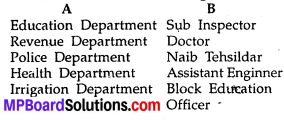
Match the following
MP Board Class 6th Social Science Solutions Chapter 23 District Administration img 1
Answer:
MP Board Class 6th Social Science Solutions Chapter 23 District Administration img 2

Project Work:

Question 1.
Look the chart given in this chapter and with the help of your teacher make a list of the persons working in the area you live along with their designation.
Answer:
Do with the help of your teacher.

MP Board Class 6th Social Science Solutions

MP Board Class 6th Maths Solutions Chapter 5 प्रारंभिक आकारों को समझना Ex 5.1

MP Board Class 6th Maths Solutions Chapter 5 प्रारंभिक आकारों को समझना Ex 5.1

प्रश्न 1.
रेखाखण्ड की तुलना केवल देखकर करने से क्या हानि है ?
हल :
रेखाखण्ड की तुलना केवल देखकर करने पर अधिक त्रुटियाँ होने की सम्भावना है।

प्रश्न 2.
एक रेखाखण्ड की लम्बाई मापने के लिए रूलर की अपेक्षा डिवाइडर का प्रयोग करना क्यों अधिक अच्छा है ?
हल :
रूलर की अपेक्षा डिवाइडर का उपयोग करने से रेखाखण्ड की सही माप सम्भव है।

प्रश्न 3.
कोई रेखाखण्ड \(\overline{A B}\) खींचिए। A और B के बीच स्थित कोई बिन्दु C लीजिए। AB, BC और CA की लम्बाई मापिये। क्या AB = AC + CB है ?
(टिप्पणी: यदि किसी रेखा पर बिन्दु A, B, C इस प्रकार स्थित हों कि AC + CB = AB है, तो निश्चित रूप से बिन्दु C बिन्दु A और B के बीच स्थित होता है।)
हल :
रेखाखण्डों AB, BC और AC की लम्बाइयाँ निम्नलिखित हैं
\(\overline{A B}\) = 4.6 सेमी,
AC = 3.2 सेमी,
BC = 1.4 सेमी,
MP Board Class 6th Maths Solutions Chapter 5 प्रारंभिक आकारों को समझना Ex 5.1 image 1
∵AC + BC = 3.2 सेमी + 1.4 सेमी
= 4.6 सेमी = AB
AB = AC + BC है।

प्रश्न 4.
एक रेखाखण्ड पर बिन्दु A, B और C इस प्रकार स्थित हैं कि AB = 5 सेमी, BC = 3 सेमी और AC = 8 सेमी है। इनमें से कौन-सा बिन्दु अन्य दोनों बिन्दुओं के बीच स्थित है ?
हल :
∵AB = 5 सेमी, BC = 3 सेमी
लेकिन AC = 8 सेमी
∴AB + BC = 5 सेमी + 3 सेमी
= 8 सेमी = AC
MP Board Class 6th Maths Solutions Chapter 5 प्रारंभिक आकारों को समझना Ex 5.1 image 2
∴बिन्दु B, A और C के बीच में है।

MP Board Solutions

प्रश्न 5.
जाँच कीजिए कि संलग्न आकृति में D रेखाखण्ड \(\overline{A G}\) का मध्य-बिन्दु है।
MP Board Class 6th Maths Solutions Chapter 5 प्रारंभिक आकारों को समझना Ex 5.1 image 3
हल :
∴AD = AB + BC + CD = 3 इकाई
और DG = DE + EF + FG = 3 इकाई
∴AD = DG (प्रत्येक = 3 इकाई)
अत: D, \(\overline{A G}\) का मध्य-बिन्दु है।

प्रश्न 6.
B रेखाखण्ड \(\overline{A C}\) का मध्य-बिन्दु है, जहाँ A, B, C और D एक ही रेखा पर स्थित हैं। बताइए कि AB = CD क्यों है?
MP Board Class 6th Maths Solutions Chapter 5 प्रारंभिक आकारों को समझना Ex 5.1 image 4
हल :
∵ B, AC मध्य का मध्य-बिन्दु है,
∴AB = BC
इसी प्रकार C, BD का मध्य-बिन्दु है,
∴BC = CD
अतः AB = BC = CD
अर्थात् AB = CD

प्रश्न 7.
पाँच त्रिभुज खींचिए और इनकी भुजाओं को मापिए। प्रत्येक स्थिति में जाँच कीजिए कि किन्हीं दो भुजाओं की लम्बाइयों का योग तीसरी भुजा की लम्बाई से सदैव बड़ा है।
हल :
(1) ABC में,
AB = 1.7 सेमी, BC = 3 सेमी
और
AC = 2.3 सेमी
MP Board Class 6th Maths Solutions Chapter 5 प्रारंभिक आकारों को समझना Ex 5.1 image 5
∴AB + BC = 1.7 सेमी + 3 सेमी = 4.7 सेमी
और BC + CA = 3 सेमी + 2.3 = 5.3 सेमी;
AC + AB = 2.3 सेमी + 1.7 सेमी = 4.0 सेमी
∵4.7 सेमी > 2.3 सेमी
∴ AB + BC > AC इसी प्रकार (BC + AC) > AB ; (AB + AC) > BC

MP Board Solutions

(2) ∆PQR में,
PQ = 3 सेमी, QR = 3 सेमी और PR = 3 सेमी
MP Board Class 6th Maths Solutions Chapter 5 प्रारंभिक आकारों को समझना Ex 5.1 image 6
∴PQ + QR= 3 सेमी + 3 सेमी = 6 सेमी
∵6 सेमी > 3 सेमी
∴(PQ + QR) > RP
इसी प्रकार, (QR + RP) > PQ
(RP + PQ) > QR

(3) ∆XYZ में,
XY = 3 सेमी, YZ = 4 सेमी और ZX = 5 सेमी
MP Board Class 6th Maths Solutions Chapter 5 प्रारंभिक आकारों को समझना Ex 5.1 image 7
अब ∵ XY + YZ = 3 सेमी + 4 सेमी = 7 सेमी
YZ + ZX= 4 सेमी + 5 सेमी = 9 सेमी
ZX + XY = 5 सेमी + 3 सेमी = 8 सेमी
∴(XY + YZ) > ZX ,
(YZ + ZX) > XY
और (ZX + XY) > YZ

(4) ∆KLM में,
∵KL = 1.5 सेमी, LM = 2.5 सेमी, और MK = 2 सेमी
अब, ∵LK + LM = 1.5 सेमी + 2.5 सेमी = 4 सेमी
MP Board Class 6th Maths Solutions Chapter 5 प्रारंभिक आकारों को समझना Ex 5.1 image 8
LM + MK = 2.5 सेमी + 2 सेमी = 4.5 सेमी
MK + KL = 2 सेमी + 1.5 सेमी = 3.5 सेमी
∴(KL + LM) > MK
(LM + MK) > KL
और (MK + KL) > LM

(5) ∆ABC में,
∵AB = 2.5 सेमी, BC = 2.8 सेमी और CA = 4.8 सेमी
MP Board Class 6th Maths Solutions Chapter 5 प्रारंभिक आकारों को समझना Ex 5.1 image 9
अब, ∵AB + BC = 2.5 सेमी + 2.8 सेमी = 5.3 सेमी
BC + CA = 2.8 सेमी + 4.8 सेमी = 7.6 सेमी
CA + AB = 4.8 सेमी + 2.5 सेमी = 7.3 सेमी
∴(AB + BC) > CA
(BC + CA) > AB
और (CA + AB) > BC
उपर्युक्त सभी स्थितियों में त्रिभुज की किन्हीं दो भुजाओं की लम्बाइयों का योग तीसरी भुजा की लम्बाई से बड़ा है।

MP Board Solutions

पाठ्य-पुस्तक पृष्ठ संख्या # 99

प्रयास कीजिए

प्रश्न 1.
आधे घूर्णन के लिए कोण का नाम क्या है?
उत्तर-
आधे घूर्णन के लिए कोण का नाम सरल कोण (दो समकोण) है। .

प्रश्न 2.
एक-चौथाई घूर्णन के लिए कोण का नाम क्या है?
उत्तर-
एक-चौथाई धूर्णन के लिए कोण का नाम एक समकोण है।

प्रश्न 3.
एक घड़ी पर आधे घूर्णन, एक-चौथाई घूर्णन और तीन-चौथाई घूर्णन के लिए पाँच अन्य स्थितियाँ दीजिए।
हल :
(1) आधे घूर्णन के लिए स्थितियाँ :
(i) 12 से 6
(ii) 3 से 9
(iii) 1 से 7
(iv) 2 से 8
(v) 4 से 10
MP Board Class 6th Maths Solutions Chapter 5 प्रारंभिक आकारों को समझना Ex 5.1 image 10

(2) एक-चौथाई घूर्णन के लिए स्थितियाँ :
(i) 12 से 3
(ii) 1 से 4
(iii) 2 से 5
(iv) 9 से 12
(v) 7 से 10
MP Board Class 6th Maths Solutions Chapter 5 प्रारंभिक आकारों को समझना Ex 5.1 image 11

MP Board Solutions

(3) तीन-चौथाई घूर्णन के लिए स्थितियाँ :
(i) 2 से 11
(ii) 3 से 12
(iii) 4 से 1
(iv) 5 से 2
(v) 6 से 3
MP Board Class 6th Maths Solutions Chapter 5 प्रारंभिक आकारों को समझना Ex 5.1 image 12

MP Board Class 6th Maths Solutions

MP Board Class 6th Maths Solutions Chapter 7 भिन्न Ex 7.1

MP Board Class 6th Maths Solutions Chapter 7 भिन्न Ex 7.1

पाठ्य-पुस्तक पृष्ठ संख्या # 147

प्रश्न 1.
छायांकित भाग को निरूपित करने वाली भिन्न लिखिएहल :
MP Board Class 6th Maths Solutions Chapter 7 भिन्न Ex 7.1 image 1
MP Board Class 6th Maths Solutions Chapter 7 भिन्न Ex 7.1 image 2
हल :
छायांकित भाग को निरूपित करने वाली भिन्नः
MP Board Class 6th Maths Solutions Chapter 7 भिन्न Ex 7.1 image 3

प्रश्न 2.
दी हुई भिन्न के अनुसार छायांकित कीजिए
हल :
MP Board Class 6th Maths Solutions Chapter 7 भिन्न Ex 7.1 image 4

प्रश्न 3.
निम्न में कोई गलती है, तो पहचानिएयह है।
यह \(\frac { 1 }{ 2 }\) है। यह \(\frac { 1 }{ 4 }\) है। यह \(\frac { 3 }{ 4 }\) है।
MP Board Class 6th Maths Solutions Chapter 7 भिन्न Ex 7.1 image 6
हल :
(i) ∵ भाग समान नहीं हैं।
∴ छायांकित भाग \(\frac { 1 }{ 2 }\) नहीं है।

(ii) ∵ भाग समान नहीं हैं।
∴ छायांकित भाग \(\frac { 1 }{ 4 }\) नहीं है।

(iii) ∵ भाग समान नहीं हैं।
∴ छायांकित भाग \(\frac { 3 }{ 4 }\) नहीं है।

MP Board Solutions

प्रश्न 4.
8 घण्टे एक दिन की कौन-सी भिन्न है?
हल :
∵ 1 दिन में 24 घण्टे होते हैं।
∴ अभीष्ट भिन्न \(=\frac{8}{24}=\frac{1}{3}\)

प्रश्न 5.
40 मिनट एक घण्टे की कौन-सी भिन्न है?
हल :
∵ 1 घण्टे में 60 मिनट होते हैं।
∴ अभीष्ट भिन्न \(=\frac{40}{60}=\frac{2}{3}\)

प्रश्न 6.
आर्या, अभिमन्यु और विवेक एक साथ, बाँट कर खाना खाते हैं। आर्या दो सैंडविच लेकर आता है-एक सब्जी वाला और दूसरा जैम (Jam) वाला। अन्य दो लड़के अपना खाना लाना भूल गए। आर्या अपने सैंडविचों को उन दोनों के साथ बाँटकर खाने को तैयार हो जाता है, ताकि प्रत्येक व्यक्ति को प्रत्येक सैंडविच में से बराबर भाग मिले।
(a) आर्या अपनी सैंडविचों को किस प्रकार बाँटे कि प्रत्येक को बराबर भाग मिले ?
(b) प्रत्येक लड़के को एक सैंडविच का कौन-सा भाग मिलेगा?
हल :
(a) आर्या प्रत्येक सैंडविच को तीन बराबर भागों में बाँटेगा।
(b) प्रत्येक लड़के को सैंडविच का \(\frac { 1 }{ 3 }\) भाग मिलेगा।

प्रश्न 7.
कंचन ड्रेसों (Dresses) को रँगती है। उसे 30 ड्रेस रँगनी थीं। उसने अब तक 20 ड्रेस रंग ली हैं। उसने ड्रेसों की कितनी भिन्न रँग ली हैं ?
हल :
कंचन की ड्रेस रँगनी थीं = 30
उसने ड्रेस रंग ली = 20
∴ रँगी हुई ड्रेसों की अभीष्ट भिन्न = \(\frac { 1 }{ 2 }\)

प्रश्न 8.
2 से 12 तक की प्राकृत संख्याएँ लिखिए। अभाज्य संख्याएँ इनकी कौन-सी भिन्न हैं ?
हल :
2 से 12 तक की प्राकृत संख्याएँ हैं- 2, 3, 4, 5, 6, 7, 8, 9, 10, 11, 12
अभाज्य संख्याएँ हैं- 2, 3, 5, 7 और 11
दी हुई कुल संख्याएँ = 11,
अभाज्य कुल संख्याएँ = 5
∴ अभीष्ट भिन्न = \(\frac { 5 }{ 11 }\)

प्रश्न 9.
102 से 113 तक की प्राकृत संख्याएँ लिखिए। अभाज्य संख्याएँ इनकी कौन-सी भिन्न हैं ?
हल :
102 से 113 तक की प्राकृत संख्याएँ हैं
102, 103, 104, 105, 106, 107, 108, 109, 110, 111, 112, 113.
∴ दी हुई कुल प्राकृत संख्याएँ = 12
अभाज्य संख्याएँ = 103, 107, 109, 113
∴ कुल अभाज्य संख्याएँ = 4
अतः अतः अभीष्ट भिन्न = \(\frac { 4 }{ 12 }\)

प्रश्न 10.
इन वृत्तों की कौन-सी भिन्नों में × है?
MP Board Class 6th Maths Solutions Chapter 7 भिन्न Ex 7.1 image 7
हल :
वृत्तों की कुल संख्या = 8
× वाले वृत्तों की संख्या = 4
अभीष्ट भिन्न = \(\frac { 4 }{ 8 }\)

MP Board Solutions

प्रश्न 11.
क्रिस्टिन अपने जन्म-दिन पर एक सीडी प्लेयर (CD Player) प्राप्त करती है। वह तब से सीडी इकट्ठी करना प्रारम्भ कर देती है। वह 3 सीडी खरीदती है और 5 सीडी उपहार के रूप में प्राप्त करती है। उसके द्वारा खरीदी गई सीडी की संख्या, कुल सीडी की संख्या की कौन-सी भिन्न है ?
हल :
बाजार से खरीदी गई सीडी की संख्या = 3
उपहार में प्राप्त सीडी की संख्या = 5
∴ सीडी की कुल संख्या = 3 + 5 = 8
∴ खरीदी गई सीडी की अभीष्ट भिन्न = \(\frac { 3 }{ 8 }\)
उपहार से प्राप्त सीडी की अभीष्ट भिन्न = \(\frac { 5 }{ 8 }\)

पाठ्य-पुस्तक पृष्ठ संख्या # 150

प्रयास कीजिए

प्रश्न 1.
संख्या रेखा पर \(\frac { 3 }{ 5 }\) को दर्शाइए।
हल :
\(\frac { 3 }{ 5 }\)
MP Board Class 6th Maths Solutions Chapter 7 भिन्न Ex 7.1 image 8

प्रश्न 2.
संख्या रेखा पर \(\frac{1}{10}, \frac{0}{10}, \frac{5}{10}\) और \(\frac { 10 }{ 10 }\) को दर्शाइए।
हल :
MP Board Class 6th Maths Solutions Chapter 7 भिन्न Ex 7.1 image 9

प्रश्न 3.
क्या आप 0 से 1 के बीच कोई अन्य भिन्न को दर्शा सकते हैं ? ऐसी पाँच भिन्नें और लिखिए जिन्हें आप दर्शा सकते हैं और उन्हें संख्या रेखा पर दर्शाइए।
हल :
हाँ, 0 और 1 के बीच में अन्य भिन्न को दर्शा सकते हैं, ऐसी 5 भिन्नै निम्न हैं
MP Board Class 6th Maths Solutions Chapter 7 भिन्न Ex 7.1 image 10
इन्हें संख्या रेखा पर क्रमश: A, B, C, D और E द्वारा दर्शाया गया है।
MP Board Class 6th Maths Solutions Chapter 7 भिन्न Ex 7.1 image 11

प्रश्न 4.
0 से 1 के बीच में कितनी भिन्नें स्थित हैं ? सोचिए, चर्चा कीजिए और अपने उत्तर को लिखिए।
हल :
0 और 1 के बीच में असंख्य भिन्न हैं।

MP Board Solutions

पाठ्य-पुस्तक पृष्ठ संख्या # 151

प्रयास कीजिए

प्रश्न 1.
एक उचित भिन्न लिखिए
(a) जिसका अंश 5 और हर 7 है।
(b) जिसका हर 9 है और अंश 5 है।
(c) जिसके अंश और हर का योग 10 है। आप इस प्रकार की कितनी भिन्न लिख सकते हैं ?
(d) जिसका हर उसके अंश से 4 अधिक है।
(कोई पाँच भिन्न बनाइए। आप और कितनी भिन्न बना सकते हैं ?)
हल :
(a) अंश = 5, हर = 7.
∴अभीष्ट भिन्न = \(\frac { 5 }{ 7 }\)

(b) हर = 9, अंश = 5
∴अभीष्ट भिन्न = \(\frac { 5 }{ 9 }\)

(c) सम्भव युग्म जिनके अंश और हर का योग 10 है- 0, 10; 1, 9; 2, 8; 3, 7; 4, 6;
∴अभीष्ट भिन्ने है- \(\frac{0}{10}, \frac{1}{9}, \frac{2}{8}, \frac{3}{7}, \frac{4}{6}\)

(d) अभीष्ट भिन्ने है- \(\frac{1}{5}, \frac{2}{6}, \frac{3}{7}, \frac{4}{8}, \frac{5}{9}\) इत्यादि।
दी हुई परिस्थिति के अनुसार भिन्नों की संख्या असंख्य हो सकती है।

प्रश्न 2.
एक भिन्न दी हुई है। इसे देखकर आप कैसे बता सकते हैं कि यह भिन्न
(a) 1 से छोटी है?
(b) 1 के बराबर है?
हल :
(a) यदि अंश हर से छोटा है, तो भिन्न 1 से छोटी है।
(b) यदि अंश और हर बराबर हैं तो भिन्न 1 के बराबर है।

प्रश्न 3.
संकेत ‘>’, ‘<‘ या ‘=’ का प्रयोग करके रिक्त स्थानों को भरिए
हल :
(a) \(\frac { 1 }{ 2 }\) < 1
(b) \(\frac { 3 }{ 5 }\) < 1 (c) 1 > \(\frac { 7 }{ 8 }\)
(d) \(\frac { 4 }{ 4 }\) = 1
(e) \(\frac { 0 }{ 6 }\) < 1
(f) \(\frac { 2005 }{ 2005 }\) = 1

पाठ्य-पुस्तक पृष्ठ संख्या # 152

प्रश्न 1.
हर 7 वाली पाँच विषम भिन्नै लिखिए।
हल :
हर 7 वाली पाँच विषम भिन्नें हैं–
\(\frac{8}{7}, \frac{9}{7}, \frac{10}{7}, \frac{11}{7}, \frac{12}{7}\)

प्रश्न 2.
अंश 11 वाली पाँच विषम भिन्नै लिखिए।
हल :
अंश 11 वाली विषम भिन्नें हैं
\(\frac{11}{5}, \frac{11}{6}, \frac{11}{7}, \frac{11}{8}\) और \(\frac { 11 }{ 9 }\)

MP Board Class 6th Maths Solutions

MP Board Class 6th Maths Solutions Chapter 5 प्रारंभिक आकारों को समझना Intext Questions

MP Board Class 6th Maths Solutions Chapter 5 प्रारंभिक आकारों को समझना Intext Questions

पाठ्य-पुस्तक पृष्ठ संख्या # 96

सोचिए, चर्चा कीजिए एवं लिखिए

प्रश्न 1.
अन्य कौन-सी त्रुटियाँ और कठिनाइयाँ हमारे सम्मुख आ सकती हैं ?
उत्तर-

  • प्रेक्षण लेने में त्रुटियाँ हो सकती हैं। हमारे प्रेक्षण सदैव सही नहीं होते।
  • रेखाओं को ट्रेस करने में, तुलना करने में कठिनाई हो सकती है।
  • पैमाने की मोटाई अधिक होने से लम्बाई नापने में त्रुटि हो सकती है। पैमाने को उचित चिह्न पर न रखने पर अथवा दूसरे कोने पर चिह्न को पढ़ने में त्रुटि हो सकती है।

इन त्रुटियों से बचने के लिए डिवाइडर का प्रयोग कर सकते हैं।

प्रश्न 2.
यदि रूलर पर अंकित चिन्हों को ठीक प्रकार से न पढ़ा जाए, तो किस प्रकार की त्रुटि हो सकती है ? इससे कैसे बचा जा सकता है ?
उत्तर-
रूलर से सही माप लेने के लिए आँख सही स्थान पर स्थित होनी चाहिए। आँख को चिह्न के ठीक ऊपर रखना चाहिए। आँख से तिरछा देखने पर चिह्न को पढ़ने में त्रुटि हो सकती है।

MP Board Solutions

पाठ्य-पुस्तक पृष्ठ संख्या # 97

प्रयास कीजिए

प्रश्न 1.
एक पोस्टकार्ड लीजिए। उपर्युक्त तकनीक का प्रयोग करके, उसकी दो आसन्न भुजाओं को मापिए।
हल :
पोस्टकार्ड की दो आसन्न भुजाओं की लम्बाई क्रमशः 14 सेमी व 9 सेमी है।

प्रश्न 2.
कोई तीन वस्तुएँ चुनिए जिनके ऊपरी सिरे सपाट हों। डिवाइडर और रूलर का प्रयोग करते हुए, इन ऊपरी सिरों की सभी भुजाओं को मापिए।।
हल :
तीन वस्तुएँ-

  • गणित की कक्षा 6 की पुस्तक,
  • अभ्यास पुस्तिका,
  • फोटो फ्रेम।

इनकी माप निम्नांकित है

  • गणित की कक्षा 6 की पुस्तक : 27.5 सेमी, 21 सेमी, 27-5 सेमी, और 21 सेमी।
  • अभ्यास पुस्तिका : 20 सेमी, 16 सेमी, 20 सेमी और 16 सेमी।
  • फोटोफ्रेम : 25 सेमी, 20 सेमी, 25 सेमी और 20 सेमी।

MP Board Class 6th Maths Solutions

MP Board Class 6th Maths Solutions Chapter 4 आधारभूत ज्यामितीय अवधारणाएँ Ex 4.2

MP Board Class 6th Maths Solutions Chapter 4 आधारभूत ज्यामितीय अवधारणाएँ Ex 4.2

पाठ्य-पुस्तक पृष्ठ संख्या # 84-85

प्रश्न 1.
पाठ्य-पुस्तक में दी हुई वक्रों को
(i) खुली या
(ii) बंद वक्रों के रूप में वर्गीकृत कीजिए :
हल :
(i) खुली वक्र – (a) व (c)
(ii) बन्द वक्र – (b), (b) व (e)

प्रश्न 2.
निम्न को स्पष्ट करने के लिए रफ आकृतियाँ बनाइए:
(a) खुला वक्र
(b) बन्द वक्र
हल :
MP Board Class 6th Maths Solutions Chapter 4 आधारभूत ज्यामितीय अवधारणाएँ Ex 4.2 image 1

MP Board Solutions

प्रश्न 3.
कोई भी बहुभुज खींचिए और उसके अभ्यन्तर को छायांकित (Shade) कीजिए।
हल :
ABCDE एक बहुभुज है जिसके अभ्यंतर को छायांकित किया गया है।
MP Board Class 6th Maths Solutions Chapter 4 आधारभूत ज्यामितीय अवधारणाएँ Ex 4.2 image 2

प्रश्न 4.
संलग्न आकृति को देखकर निम्न प्रश्नों के उत्तर दीजिए :
(a) क्या यह एक वक्र है ?
(b) क्या यह बन्द है?
MP Board Class 6th Maths Solutions Chapter 4 आधारभूत ज्यामितीय अवधारणाएँ Ex 4.2 image 3
हल :
(a) हाँ, यह एक वक्र है।
(b) हाँ, यह बन्द वक्र है।

MP Board Solutions

प्रश्न 5.
रफ आकृतियाँ बनाकर, यदि सम्भव हो, तो निम्न को स्पष्ट कीजिए :
(a) एक बन्द आकृति जो बहुभुज नहीं है।
(b) केवल रेखाखण्डों से बनी हुई खुली वक्र
(c) दो भुजाओं वाला एक बहुभुज।
हल :
(a) बन्द आकृति जो बहुभुज नहीं है।
MP Board Class 6th Maths Solutions Chapter 4 आधारभूत ज्यामितीय अवधारणाएँ Ex 4.2 image 4

(b) रेखाखण्डों से बनी हुई खुली वक्र
MP Board Class 6th Maths Solutions Chapter 4 आधारभूत ज्यामितीय अवधारणाएँ Ex 4.2 image 5

(c) दो भुजाओं वाला बहुभुज असम्भव है।

MP Board Class 6th Maths Solutions

MP Board Class 8th Maths Solutions Chapter 11 क्षेत्रमिति Ex 11.1

MP Board Class 8th Maths Solutions Chapter 11 क्षेत्रमिति Ex 11.1

प्रश्न 1.
जैसा कि संलग्न आकृति में दर्शाया गया है, एक आयताकार और एक वर्गाकार खेत के माप दिए हुए हैं। यदि इनके परिमाप समान हैं, तो किस खेत का क्षेत्रफल अधिक होगा?
MP Board Class 8th Maths Solutions Chapter 11 क्षेत्रमिति Ex 11.1 img-1
हल:
माना कि आयताकार खेत की चौड़ाई = b m है।
आयताकार खेत की लम्बाई = 80 m
वर्गकार खेत की भुजा = 60 m
वर्गाकार खेत का परिमाप = 4 x 60 m = 240 m
अब, प्रश्नानुसार, आयत का परिमाप – वर्ग का परिमाप
2(80 + b) = 240
80 + b = \(\frac{240}{2}\) = 120
b = (120 – 80) m = 40 m.
अतः आयत की चौड़ाई = 40 m.
अब, वर्गाकार खेत का क्षेत्रफल = (भुजा)2 = (60)2 m2
= 60 x 60 m2 = 3600 m2
आयताकार खेत का क्षेत्रफल = l x b = 80 m x 40 m
= 3200 m2
3600 m2 > 3200 m2
अतः वर्गाकार खेत का शेत्रफल अधिक है।

प्रश्न 2.
श्रीमती कौशिक के पास चित्र में दर्शाए गए मापों वाला एक वर्गाकार प्लॉट है। वह प्लॉट के बीच में एक घर बनाना चाहती हैं। घर के चारों ओर एक बगीचा विकसित किया गया है। ₹ 55 प्रति वर्ग मीटर की दर से इस बगीचे को विकसित करने का व्यय ज्ञात कीजिए।
MP Board Class 8th Maths Solutions Chapter 11 क्षेत्रमिति Ex 11.1 img-2
हल:
वर्गाकार प्लॉट की भुजा = 25 m
वर्गाकार प्लॉट का क्षेत्रफल= (भुजा) = (25 m)2
= 25 m x 25 m = 625 m2
भीतरी आयत की लम्बाई l = 20 m, चौड़ाई = 15 m
भीतरी आयत का क्षेत्रफल = l x b = 20 m x 15 m
= 300 m2
∴ बगीचे का क्षेत्रफल = वर्गाकार प्लॉट का क्षेत्रफल – भीतरी आयत का क्षेत्रफल
= 625 m2 – 300 m2
= 325 m2
₹ 55 प्रति वर्ग मीटर की दर से बगीचे को विकसित करने का व्यय
= ₹ 55 x 325
= ₹ 17,875

MP Board Solutions

प्रश्न 3.
जैसा कि आरेख में दर्शाया गया है, एक बगीचे का आकार मध्य में आयताकार है और किनारों पर अर्धवृत्त के रूप में है। इस बगीचे का परिमाप और क्षेत्रफल ज्ञात कीजिए। (आयत की लम्बाई 20 – (3.5 + 3.5) मीटर है।)
MP Board Class 8th Maths Solutions Chapter 11 क्षेत्रमिति Ex 11.1 img-3
हल:
आयत की लम्बाई = 20 – (3.5 + 3.5) मीटर
= (20 – 7) मीटर = 13 मीटर
आयत की चौड़ाई = 7 मीटर ; वृत्त की त्रिज्या
= \(\frac{7}{2}\) मीटर = 3.5 मीटर
बगीचे का परिमाप = 2 x आयताकार भाग की
लम्बाई + दो अर्धवृत्तों का परिमाप
2 x l + 2πr = 2 x 13 + 2 x \(\frac{7}{2}\) x 3.5 मीटर
= 26 + 22 मीटर
= 48 मीटर
अतः बगीचे का परिमाप = 48 मीटर
बगीचे का क्षेत्रफल = आयताकार भाग का क्षेत्रफल + 2 अर्धवृत्तों का क्षेत्रफल
= l x b + 2 x \(\frac{1}{2}\)πr2
= 13 x 7 + 2 x \(\frac{1}{2}\) x \(\frac{22}{7}\) x 3.5 x 3.5
= 91 + 38.5 मीटर2 = 129.5 मीटर2
अतः बगीचे का क्षेत्रफल = 129.5 मीटर2

प्रश्न 4.
फर्श बनाने के लिए उपयोग की जाने वाली एक टाइल का आकार समान्तर चतुर्भुज का है जिसका आधार 24 cm और संगत ऊँचाई 10 cm है। 1080 वर्ग मीटर क्षेत्रफल के एक फर्श को ढकने के लिए ऐसी कितनी टाइलों की आवश्यकता है? फर्श के कोनों को भरने के लिए आवश्यकतानुसार आप टाइलों को किसी भी रूप में तोड़ सकते हैं।
हल:
समान्तर चतुर्भुज का आधार = 24 सेमी
ऊँचाई = 10 सेमी।
एक टाइल का क्षेत्रफल = आधार x ऊँचाई
= 24 सेमी x 10 सेमी
= 240 सेमी2
फर्श का क्षेत्रफल = 1080 वर्ग मीटर
= 1080 x 100 x 100 वर्ग सेमी
MP Board Class 8th Maths Solutions Chapter 11 क्षेत्रमिति Ex 11.1 img-4
= 45,000 टाइलें
अतः फर्श को ढकने के लिए आवश्यक टाइलों की संख्या = 45,000

प्रश्न 5.
एक चींटी किसी फर्श पर बिखरे हुए विभिन्न आकारों के भोज्य पदार्थ के टुकड़ों के चारों ओर घूम रही है।
भोज्य पदार्थ के किस टुकड़े के लिए चींटी को लम्बा चक्कर लगाना पड़ेगा? स्मरण रखिए, वृत्त की परिधि c = 2πr, जहाँ r वृत्त की त्रिज्या है, की सहायता से प्राप्त की जा सकती है।
MP Board Class 8th Maths Solutions Chapter 11 क्षेत्रमिति Ex 11.1 img-5
हल:
दी गई आकृतियों पर बिन्दु A, B, C और D अंकित किए। माना कि चींटी प्रत्येक आकृति में भोज्य पदार्थों के टुकड़ों के चारों ओर घूमने के लिए बिन्दु A से प्रारम्भ करके पुनः उसी बिन्दु पर पहुँचती है।

1. भोज्य पदार्थ के (a) टुकड़े के लिए;
यहाँ r = \(\frac{2.8}{2}\) सेमी = 1.4 सेमी
चींटी द्वारा चली गई दूरी= चाप AB + दूरी BA
\(\frac{1}{2}\) x 2πr + BA
= \(\frac{1}{2}\) x 2 x \(\frac{22}{7}\) x 14 + 2.8 सेमी
= 4.4 + 2.8 = 7.2 सेमी

1. भोज्य पदार्थ के (b) टुकड़े के लिए,
चींटी द्वारा चली गई दूरी = चाप AB + दूरी BC + CD + DA
= \(\frac{1}{2}\) x 2πr + 1.5 सेमी + 2.8 सेमी + 1.5 सेमी
= \(\frac{1}{2}\) x 2 x \(\frac{22}{7}\) x 1.4 + 1.5 + 2.8 + 1.5 सेमी
= 4.4 सेमी + 5.8 सेमी
= 10.2 सेमी

3. भोज्य पदार्थ के (c) टुकड़े के लिए,
चींटी द्वारा चली गई दूरी = चाप AB + BC + CA
= \(\frac{1}{2}\) x 2πr + 2 सेमी + 2 सेमी
= \(\frac{22}{7}\) x 1.4 सेमी + 2 सेमी + 2 सेमी
= 4.4 सेमी + 4 सेमी = 8.4 सेमी
स्पष्ट है कि चींटी को भोज्य पदार्थ (b) टुकड़े के लिए लम्बा चक्कर लगाना पड़ेगा।

पाठ्य-पुस्तक पृष्ठ संख्या # 180

MP Board Solutions

प्रयास कीजिए (क्रमांक 11.2)

प्रश्न 1.
नजमा की बहन के पास भी एक समलम्ब के आकार का प्लॉट है जैसा कि संलग्न आकृति में दर्शाया गया है। इसे तीन भागों में बाँटिए। दर्शाइए कि समलम्ब WXYZ का क्षेत्रफल = h \(\frac{a+b}{2}\).
MP Board Class 8th Maths Solutions Chapter 11 क्षेत्रमिति Ex 11.1 img-6
हल:
माना कि Y और Z से लम्ब WX पर क्रमशः L तथा M पर मिलते हैं।
तब, समलम्ब WXYZ का क्षेत्रफल
= समकोण ∆LXY का क्षेत्रफल + आयत MLYZ का क्षेत्रफल + समकोण ∆WMZ का क्षेत्रफल
= \(\frac{1}{2}\) x LX x YL + ML x LY + \(\frac{1}{2}\) x WM x ZM
= \(\frac{1}{2}\) x d x h + h x h + \(\frac{1}{2}\) + x c x h
= \(\frac{1}{2}\)h (d + 2b + c)
= \(\frac{1}{2}\)h (2b + c + d)
= \(\frac{1}{2}\)h (b + b + c + d)
= \(\frac{1}{2}\)h (b + a)
(∴ a = b + c + d)
अतः समलम्ब WXYZ का क्षेत्रफल = h \(\frac{a+b}{2}\)

प्रश्न 2.
यदि h = 10 cm, c = 6 cm, b = 12 cm, d = 4cm, तो इसके प्रत्येक भाग का मान अलग-अलग ज्ञात कीजिए और WXYZ का क्षेत्रफल ज्ञात करने के लिए इनका योग कीजिए। h, a तथा b का मान व्यंजक \(\frac{h(a+b)}{2}\) में रखते हुए इसका सत्यापन कीजिए।
हल:
यहाँ h = 10 cm, c = 6 cm, b = 12 cm, d = 4 cm.
समलम्ब WXYZ का क्षेत्रफल = समकोण ∆LXY का क्षेत्रफल + आयत MLYZ का क्षेत्रफल + समकोण ∆WMZ का क्षेत्रफल
= \(\frac{1}{2}\) x d x h + b x h + \(\frac{1}{2}\) x c x h
= \(\frac{1}{2}\) x 4 x 10 + 12 x 10 + \(\frac{1}{2}\) x 6 x 10
= 20 + 120 + 30 = 170 cm2
सत्यापन:
समलम्ब WXYZ का क्षेत्रफल = h \(\frac{a+b}{2}\)
यहाँ, a = c + b + d = 6 cm + 12 cm + 4 cm = 22 cm
∴ समलम्ब का क्षेत्रफल = 10 x \(\frac{22+12}{2}\) cm2
= 5 x 34 cm2 = 170 cm2
अतः सूत्र द्वारा क्षेत्रफल का सत्यापन होता है।

पाठ्य-पुस्तक पृष्ठ संख्या # 181

इन्हें कीजिए (क्रमांक 11.1)

प्रश्न 1.
1. आलेख कागज (ग्राफ पेपर) के अन्दर कोई भी समलम्ब WXYZ खींचिए जैसाकि संलग्न आकृति 11.9 में दर्शाया गया है और इसे काटकर बाहर निकालिए।
MP Board Class 8th Maths Solutions Chapter 11 क्षेत्रमिति Ex 11.1 img-7
2. भुजा XY को मोड़कर इसका मध्य बिन्दु ज्ञात कीजिए और इसे A नाम दीजिए (आकृति 11.10)।
MP Board Class 8th Maths Solutions Chapter 11 क्षेत्रमिति Ex 11.1 img-8
3. भुजा ZA के साथ-साथ काटते हुए समलम्ब WXYZ को दो भागों में काटिए। ∆ZYA को ऐसे रखिए जैसा कि आकृति 11.11 में दर्शाया गया है जिसमें AY को AX के ऊपर रखा गया है। बड़े त्रिभुज के आधार की लम्बाई क्या है? इस त्रिभुज के क्षेत्रफल का व्यंजक लिखिए (आकृति 11.11)।
MP Board Class 8th Maths Solutions Chapter 11 क्षेत्रमिति Ex 11.1 img-9
4. इस त्रिभुज और समलम्ब WXYZ का क्षेत्रफल समान है। (कैसे)? त्रिभुज के क्षेत्रफल के व्यंजक का उपयोग करते हुए समलम्ब के क्षेत्रफल का व्यंजक प्राप्त कीजिए।
हल:
3 बड़े त्रिभुज के आधार की लम्बाई
= WB = WX + XB
= WX + ZY
= a+b
∆WBZ का क्षेत्रफल = \(\frac{1}{2}\) x आधार x ऊँचाई
= \(\frac{1}{2}\) x WB x h
= \(\frac{1}{2}\) (a + b) x h
परन्तु समलम्ब WXYZ का क्षेत्रफल = \(\frac{1}{2}\) x (a + b) h
∴ समलम्ब का क्षेत्रफल = ∆WBZ का क्षेत्रफल अतः समलम्ब का क्षेत्रफल = \(\frac{1}{2}\) x त्रिभुज का आधार x इसकी ऊँचाई

MP Board Solutions

प्रयास कीजिए (क्रमांक 11.3)

प्रश्न 1.
निम्नलिखित समलम्बों का क्षेत्रफल ज्ञात कीजिए (आकृति : 11.12)।
MP Board Class 8th Maths Solutions Chapter 11 क्षेत्रमिति Ex 11.1 img-10
हल:
(i) यहाँ, a = 9 सेमी
b = 7 सेमी तथा
h = 3 सेमी
∴ समलम्ब का क्षेत्रफल = h \(\frac{a+b}{2}\)
∴ समलम्ब का क्षेत्रफल = 3 x \(\frac{9+7}{2}\) वर्ग सेमी
= 3 x \(\frac{16}{2}\) वर्ग सेमी
= 24 वर्ग सेमी
अतः समलम्ब का क्षेत्रफल = 24 वर्ग सेमी

(ii) यहाँ, a = 10 सेमी
b = 5 सेमी तथा
h = 6 सेमी
समलम्ब का क्षेत्रफल = h \(\frac{a+b}{2}\)
समलम्ब का क्षेत्रफल = 6 x \(\frac{10+5}{2}\) वर्ग सेमी
= 3 x 15 = 45 वर्ग सेमी
अतः समलम्ब का क्षेत्रफल = 45 वर्ग सेमी

इन्हें कीजिए (क्रमांक 11.2)

प्रश्न 1.
1. कक्षा VII में हमने विभिन्न परिमापों लेकिन समान क्षेत्रफलों वाले समान्तर चतुर्भुजों की रचना करना सीखा है। क्या यह समलम्बों के लिए भी किया जा सकता है? जाँच कीजिए क्या विभिन्न परिमापों वाले निम्नलिखित समलम्ब क्षेत्रफल में समान हैं (आकृति 11.13)
MP Board Class 8th Maths Solutions Chapter 11 क्षेत्रमिति Ex 11.1 img-11
2. हम जानते हैं। कि सभी सर्वांगसम आकृतियाँ क्षेत्रफल में समान होती हैं। क्या हम कह सकते हैं कि समान क्षेत्रफल वाली आकृतियाँ सर्वांगसम भी होती हैं? क्या ये आकृतियाँ सर्वांगसम हैं?
3. एक वर्गाकार शीट पर कम से कम तीन ऐसे समलम्ब खींचिए जिनके परिमाप समान हों परन्तु क्षेत्रफल विभिन्न हों।
हल:
1. हाँ, यह समलम्बों के लिए भी किया जा सकता है।
पहले समलम्ब का क्षेत्रफल = \(\frac{1}{2}\)h(a+b)
= \(\frac{a+b}{2}\) x 4 x (10 + 14) वर्ग इकाई
MP Board Class 8th Maths Solutions Chapter 11 क्षेत्रमिति Ex 11.1 img-12
= 2 x 24 वर्ग इकाई
= 48 वर्ग इकाई।
दूसरे समलम्ब का क्षेत्रफल = \(\frac{1}{2}\) x (4 + 8) x 8 वर्ग इकाई
= 4 x 12 वर्ग इकाई
= 48 वर्ग इकाई
तीसरे समलम्ब का क्षेत्रफल = \(\frac{a+b}{2}\) x (6 + 10) x 6 वर्ग इकाई
= 3 x 16 वर्ग इकाई
= 48 वर्ग इकाई
पहले समलम्ब का परिमाप = 5 + 10 + 4 + 14 इकाई
= 33 इकाई
दूसरे समलम्ब का परिमाप = 8 + 4 + 8 + 8 इकाई
= 28 इकाई
तीसरे समलम्ब का परिमाप = 6 + 6 + 10 + 7 इकाई
= 29 इकाई
अतः स्पष्ट है कि विभिन्न परिमाप वाले समलम्ब क्षेत्रफल में समान हैं।
2. यह आवश्यक नहीं कि समान क्षेत्रफल वाली आकृतियाँ सर्वांगसम भी हों।
3. ऐसी आकृतियाँ जिनके परिमाप समान हैं परन्तु क्षेत्रफल विभिन्न हैं

MP Board Solutions

पाठ्य-पुस्तक पृष्ठ संख्या # 182

प्रयास कीजिए (क्रमांक 11.4)

प्रश्न 1.
हम जानते हैं कि समान्तर चतुर्भुज भी एक चतुर्भुज है। आइए, इसे भी हम दो त्रिभुजों में विभक्त करते हैं और इन दोनों त्रिभुजों का क्षेत्रफल ज्ञात करते हैं। इस प्रकार समान्तर चतुर्भुज का क्षेत्रफल भी ज्ञात करते हैं। क्या यह सूत्र आपको पूर्व में ज्ञात सूत्र से मेल खाता है (आकृति 11.15)?
MP Board Class 8th Maths Solutions Chapter 11 क्षेत्रमिति Ex 11.1 img-13
हल:
समान्तर चतुर्भुज का क्षेत्रफल = ∆ABC का क्षेत्रफल + ∆BCD का क्षेत्रफल
\(\frac{1}{2}\) = x b x h + \(\frac{1}{2}\) x b x h
= \(\frac{1}{2}\) x (b + b) x h
\(\frac{1}{2}\) x 2b x h = b x h = bh
समान्तर चतुर्भुज ABCD का क्षेत्रफल = \(\frac{1}{2}\) (समान्तर भुजाओं का योग) – उनके बीच की दूरी
= \(\frac{1}{2}\) x (b + b) x h
\(\frac{1}{2}\) x 2b x h = bh
हाँ, यह सूत्र पूर्व में ज्ञात सूत्र से मेल खाता है।

पाठ्य-पुस्तक पृष्ठ संख्या # 183

सोचिए, चर्चा कीजिए और लिखिए (क्रमांक 11.1)

प्रश्न 1.
समान्तर चतुर्भुज का विकर्ण खींचकर इसे दो सर्वांगसम त्रिभुजों में बाँटा जाता है। क्या समलम्ब को भी दो सर्वांगसम त्रिभुजों में बाँटा जा सकता है?
उत्तर:
नहीं, समलम्ब को दो सर्वांगसम त्रिभुजों में नहीं बाँटा जा सकता है।

प्रयास कीजिए (क्रमांक 11.5)

प्रश्न 1.
निम्नलिखित चतुर्भुजों का क्षेत्रफल ज्ञात कीजिए (आकृति 11.16)
MP Board Class 8th Maths Solutions Chapter 11 क्षेत्रमिति Ex 11.1 img-14
हल:
(i) यहाँ d = 6 सेमी,
h1 = 3 सेमी,
h2 = 5 सेमी
चतुर्भुज ABCD का क्षेत्रफल = \(\frac{1}{2}\) x d x (h1 + h2)
चतुर्भुज ABCD का क्षेत्रफल = \(\frac{1}{2}\) x 6 x (3 + 5)
वर्ग सेमी = 3 x 8 वर्ग सेमी
= 24 वर्ग सेमी।

(ii) यहाँ, d1 = 7 सेमी तथा
d2 = 6 सेमी
चतुर्भुज PQRS का क्षेत्रफल = \(\frac{1}{2}\) – विकर्णों का गुणनफल
= \(\frac{1}{2}\) x d1 x d2
समचतुर्भुज PQRS का क्षेत्रफल = \(\frac{1}{2}\) x 7 x 6 वर्ग सेमी
= 21 वर्ग सेमी।

(iii) चतुर्भुज MLNO का क्षेत्रफल = समान्तर चतुर्भुज MLNO का क्षेत्रफल
= 2 x ∆LMN का क्षेत्रफल
= 2 x \(\frac{1}{2}\) x LN x MP x
= 2 x \(\frac{1}{2}\) x 8 सेमी x 2 सेमी
= 16 वर्ग सेमी।

MP Board Solutions

पाठ्य-पुस्तक पृष्ठ संख्या # 184

प्रयास कीजिए (क्रमांक 11.6)

प्रश्न 1.
1. निम्नलिखित बहुभुजों (आकृति 11.17) का क्षेत्रफल ज्ञात करने के लिए इन्हें विभिन्न भागों (त्रिभुजों एवं समलम्बो) में विभाजित कीजिए।
MP Board Class 8th Maths Solutions Chapter 11 क्षेत्रमिति Ex 11.1 img-15
2. बहुभुज ABCDE को विभिन्न भागों में बाँटा गया है जैसा कि आकृति 11.18 में दर्शाया गया है। यदि AD = 8 cm, AH = 6cm, AG = 4cm, AF = 3cm और लम्ब BF = 2cm, CH = 3 cm, EG = 2.5 cm तो इसका क्षेत्रफल ज्ञात कीजिए।
बहुभुज ABCDE का क्षेत्रफल = ∆AFB का क्षेत्रफल + …
MP Board Class 8th Maths Solutions Chapter 11 क्षेत्रमिति Ex 11.1 img-16
∆AFB का क्षेत्रफल = \(\frac{1}{2}\) x AF x BF
= \(\frac{1}{2}\) x 3 x 2 = …..
समलम्ब FBCH का क्षेत्रफल = FH x \(\frac{(BH+CH)}{2}\) = 3 x \(\frac{(2+3)}{2}\)
[FH = AH – AF]
∆CHD का क्षेत्रफल = F x HD x CH = …, ∆ADE का क्षेत्रफल = \(\frac{1}{2}\) x AD x GE = …
इसलिए बहुभुज ABCDE का क्षेत्रफल = ….

3. यदि MP = 9 cm, MD = 7 cm, MC = 6 cm, MB=4cm, MA=2 cm तो बहुभुज MNOPQR(आकृति 11.19) का क्षेत्रफल ज्ञात कीजिए। NA, OC, QD एवं RB विकर्ण MP पर खींचे गए लंब हैं।
MP Board Class 8th Maths Solutions Chapter 11 क्षेत्रमिति Ex 11.1 img-17
हल:
1. दिए गए बहुभुज EFGHI को निम्नांकित भागों में विभाजित किया गया है।
बहुभुज का क्षेत्रफल = ∆FGL का क्षेत्रफल + समलम्ब LGHN का क्षेत्रफल + ∆NHI का क्षेत्रफल + ∆EFI का क्षेत्रफल
MP Board Class 8th Maths Solutions Chapter 11 क्षेत्रमिति Ex 11.1 img-18
= \(\frac{1}{2}\) x FL x GL + \(\frac{1}{2}\) (GL + HN) x LN + \(\frac{1}{2}\) x NI x HN + \(\frac{1}{2}\) x FI x ME
MP Board Class 8th Maths Solutions Chapter 11 क्षेत्रमिति Ex 11.1 img-19
बहुभुज MNOPQR को विभिन्न भागों में विभाजित किया गया है।
बहुभुज MNOPQR का क्षेत्रफल = ∆MTN का क्षेत्रफल + ∆OSN का क्षेत्रफल + समलम्ब OPUS का क्षेत्रफल + ∆PQU का क्षेत्रफल + ∆RVQ का क्षेत्रफल + समलम्ब MTVR का क्षेत्रफल
= \(\frac{1}{2}\) x NT x TM + \(\frac{1}{2}\) x SN x OS + \(\frac{1}{2}\) (OS + PU) x SU + \(\frac{1}{2}\) x UQ x PU + \(\frac{1}{2}\) x QV x VR + \(\frac{1}{2}\) = (TM X VR) x TV

2. यहाँ, AD = 8 सेमी
AH = 6 सेमी
AG = 4 सेमी
AF = 3 सेमी
लम्ब BF = 2 सेमी
CH = 3 सेमी
EG = 2.5 सेमी।
बहुभुज ABCDE का क्षेत्रफल = ∆AFB का क्षेत्रफल + समलम्ब FBCH का क्षेत्रफल + ∆CHD का क्षेत्रफल + ∆ADE का क्षेत्रफल
∆AFB का क्षेत्रफल = \(\frac{1}{2}\) x AF x BF
= 1 x 3 x 2 = 3 सेमी
समलम्ब FBCH का क्षेत्रफल = FH x \(\frac{(BF+CH)}{2}\)
= 3 x \(\frac{2+3}{2}\) = \(\frac{15}{2}\) सेमी2
= 7.5 सेमी2 (FH = AH – AF)
∆CHD का क्षेत्रफल= \(\frac{2+3}{2}\) x HD x CH
= \(\frac{1}{2}\) x 2 x 3 = 3 सेमी2 (HD = AD – AH)
∆ADE का क्षेत्रफल = \(\frac{1}{2}\) x AD x BE = \(\frac{1}{2}\) x 8 x 2.5
= 10.0 सेमी2
इसीलिए बहुभुज ABCDE का क्षेत्रफल
= 3 सेमी2 + 7.5 सेमी2 + 3 सेमी2 + 10.0 सेमी2
= 23.5 सेमी2

3. यहाँ, MP= 9 सेमी
MD = 7 सेमी
MC = 6 सेमी
MB = 4 सेमी
MA = 2 सेमी।
बहुभुज MNOPQR का क्षेत्रफल = ∆MNA का क्षेत्रफल + समलम्ब ANOC का क्षेत्रफल + ∆OCP का क्षेत्रफल + AQDP का क्षेत्रफल + समलम्ब BDQR का क्षेत्रफल + ∆RBM का क्षेत्रफल
= \(\frac{1}{2}\) AM x MN + \(\frac{1}{2}\) x (AN + OC) x AC + \(\frac{1}{2}\) CP x OC + \(\frac{1}{2}\)DP x DQ + \(\frac{1}{2}\) (BN + DQ) – BD + \(\frac{1}{2}\) BM x BR
= \(\frac{1}{2}\) x 2 x 2.5 वर्ग सेमी + \(\frac{1}{2}\) 2x (2.5 + 3) x 4 वर्ग सेमी + \(\frac{1}{2}\) x 3 x 3 वर्ग सेमी + \(\frac{1}{2}\) x 2 x 2 वर्ग सेमी + \(\frac{1}{2}\) x (2.5 + 2) x 3 वर्ग सेमी + \(\frac{1}{2}\) x 4 x 2.5 वर्ग सेमी।
= 2.5 + 11.0 + 4.5 + 2 + 6.75 + 500 वर्ग सेमी
= 31.75 वर्ग सेमी।
(∴AC = MC – MA = 6 – 2 = 4 सेमी
CP = MP – MC = 9 – 6 = 3 सेमी
BD = MD – MB = 7 – 4 = 3 सेमी
DP = MP – MD = 9 – 7 = 2 सेमी)

MP Board Class 8th Maths Solutions

MP Board Class 9th Social Science Solutions Chapter 5 India: Climate

MP Board Class 9th Social Science Solutions Chapter 5 India: Climate

MP Board Class 9th Social Science Chapter 5 Text Book Questions

Choose the Correct Answer:

Questions 1.
The time of the south – west moons – in India is –
(a) October to November
(b) june to September
(c) March to May
(d) December to February
Answer:
(b) june to September

Questions 2.
Which state does receive the lowest rainfall due to southwest monsoon?
(a) Rajasthan
(b) Karnataka
(c) Tamilanadu
(d) Punjab
Answer:
(a) Rajasthan

Questions 3.
Coromandal coast in India receives maximum rainfall in –
(a) January – February
(b) June – September
(c) March – May
(d) October – November
Answer:
(d) October – November

Questions 4.
Maximum variation in the amount of rainfall is found in –
(a) Maharashtra
(b) Assam
(c) Andhra Pradesh
(d) Rajastan
Answer:
(d) Rajastan

Match the following:
MP Board Class 9th Social Science Solutions Chapter 5 India Climate - 1
Answer:
1. (d) Area of very high rainfall.
2. (c) The region which receives rainfall from retreating monsoon.
3. (b) Area of less then 50 cm. rainfall.
4. (a) Hot winds of the summer season in Northern India.

MP Board Solutions

MP Board Class 9th Social Science Chapter 5 Very Short Answer Type Questions

Question 1.
What do yon mean by climate?
Answer:
The average weather conditions, over a long period of time of a’ particular place are known as climate.

Question 2.
Which type of climate region is India called?
Answer:
India called a monsoon type of climate.

Question 3.
What is the meaning of “Monsoon”?
Answer:
Monsoon means the winds bowing on the earths surface’ which change their direction in Summer and Winter season

Question 4.
What are the main branches of Monsoon?
Answer:
There are two main branches of monsoon:

  • The Arabian sea branch.
  • The Bay of Bengal branch.

MP Board Solutions

MP Board Class 9th Social Science Chapter 5 Short Answer Type Questions

Question 1.
How do the relief features of India affect the climate?
Answer:
The relief features of India influence the temperatures as well as the rainfall. The Himalayas on the northern boundary of the country extending from east to west protect India from cold breeze coming from the North in winter season. They intercept the moisture bearing monsoon winds and help in precipitation.

Question 2.
Why is the climate of northern India uneven?
Answer:
The climate of northern India is of Continental type. Distance from the sea and temperate climate effect its climate. Hence the climate here is uneven.

Question 3.
Why does the Tamilnadu coast receive rainfall in the winter season?
Answer:
Tamilnadu coast receives most of the rainfall by they retreating monsoons. These winds blow in the months of October and November from the land to sea through north – east direction. When they cross over Bay of Bengal they pick up moisture and cause rainfall in Tamilnadu.

Question 4.
Which are the high rainfall areas of India?
Answer:
Bihar, Jharkhand, Orissa, Eastern Uttar Pradesh, Tamilnadu and West Bengal are the highland rainfall areas of India.

Question 5.
Why is Indian agriculture called a gamble of monsoon?
Answer:
In India agriculture depends on monsoon which is most uncertain. Sometimes it arrives on time and it rains in adequate amount. But sometimes it is late and the amount of rainfall is less. It adversely affects the agriculture. That is why Indian agriculture is said to be a gamble of monsoon.

Question 6.
How does climate affect the health?
Answer:
It has been seen that sultry hot weather is followed by widespread rains which give rise to many diseases. Water is stored in the pots and ponds, which becomes the birthplace of mosquitoes and spread diseases. Thus, climate affects our health too.

MP Board Solutions

Question 7.
How do monsoon winds originate?
Answer:
Monsoon winds are related to weather because they blow from land to sea for six months and from sea to land for next six months. There are several concepts of the origin of monsoon but the thermal concept is important. According to this concept, monsoon winds are in fact land and sea breezes on a large scale.

By differential heating of the land and the sea winds blow from sea to land in the daytime and from land to ,sea in the night. Similarly in summer season winds blow’ from high pressure system on sea to low pressure system on lands. During winters, a complete reversal takes place with high pressure on the land and the low pressure over the sea. At this time winds start blowing from land to sea. This is called monsoon.

MP Board Class 9th Social Science Chapter 5 Long Answer Type Questions

Question 1.
Explain the factors influencing the Indian Climate.
Answer:
The factors influencing Indian climate are:
1. Latitude:
India is situated in the northern hemisphere in the south of Asia continent. Tropic of cancer passes through the center of the country. Due to this specific location, its southern part has tropical climate and northern part has continental type of climate.

2. Distance from the sea:
The effect of the distance from the sea is very clearly seen on the distribution of temperature of India. That is northern plains have continental type of climate.

3. Relief features:
Relief features of the country influence the temperatures as well as the rainfall. The Himalayas on the northern boundary of the country extending from east to west protects India from cold breeze coming from the north in winter season. They intercept the moisture bearing monsoon winds and help in precipitation.

4. Distribution of water and land:
India is a part of Asia continent. During summers the north – western plains of India gets more heated and center of low pressure is established here. This low – pressure area attracts the winds coming from the Indian Ocean. During winters this area becomes more colder and center of high pressure develops here and wind starts blowing from land to sea. These winds influence the climate of India. Rainfall occurs due to the winds coming from the sea.

5. Jet streams blowing in the upper atmosphere:
A westerly jet stream blows above northern India in winter season but in rainy season it moves northwards above Tibetan plateau. Easterly jet stream develops at about 15°N latitude. Nature of these jet streams is responsible for summer monsoon. Shifting of jet streams towards north and south is the cause of uncertainty and irregularity of south-west monsoon in India.

6. Monsoon winds:
In India monsoon winds blow in summer from sea to landmass and in winter season from landmass to sea. This change in monsoon winds changes the weather and seasons in India.

MP Board Solutions

Question 2.
Explain the main characteristics of the monsoon and describe the different seasons.
Answer:
Main characteristics of monsoon –

  1. Monsoon winds are seasonal winds. They blow according to season.
  2. Seasonal winds blowing in summer season are called summer monsoon and winds blowing in winter season arc called winter monsoon.
  3. Due to the peninsular shape of India summer monsoon winds divide into two parts. The Arabian Sea Monsoon and the Bay of Bengal Monsoon.
  4. In summer season these winds blow from south – west to north – east and in winters from north – east to south – west in India.
  5. These winds are hot and humid in summer season as they blow from sea to land whereas in winters they are cold and dry because they blow from land to sea.
  6. Rainfall in India is due to monsoon winds. Maximum amount of rainfall is received from south – west monsoon winds.
  7. Time of monsoon and amount of rainfall vary.

Different Seasons Of India:
Four main seasons are:

  1. Cold Weather Season
  2. Hot Weather Season
  3. Advancing Monsoon Season
  4. Retreating Monsoon Season

1. Cold Weather Season:
December to February. The cold weather persists from December to February throughout India. January is the coldest month. Temperature varies from 10°C to 25°C. Temperature is between 10°C to 15°C in the northern plains and 25°C in the southern parts of the country. There is high pressure the northern plains due to the cold climatic conditions. The cold dry winds blow from the high pressure towards the low pressure equatorial regions.

These winds are north – westerly in the Ganga Plains and north- easterly over the Bay of Bengal. Culy two parts of the country receive rain in this season. First is the north – west part of India which receives rainfall from the Mediterranean cyclones. Second is tire Coast of Tamilnadu which gets rainfall in winter because of the north – east winds which blow over the Bay of Bengal. But in other parts of the country, the weather is pleasant with clear skies and bright sun – shine.

2. Hot Weather Season:
March to May. During this period there is a rapid shift of the belt of heat from south to north. In March, April and May the highest day temperatures occur in the Deccan Plateau (38°C), Gujarat (43°C) and North-West of India (48°C) respectively.

In May the rising temperature leads to low pressure in a wider area from the Thar Desert to Chhotanagpur. Because of this low pressure the moisture – laden winds from the Arabian Sea are attracted towards this area and consequently there is (about 158 ems) rainfall in the Rajmahal and Chhotanagpur Hills lying between the Satpuras and the Vindhyas.

Kerala and Western Ghats also experience the pre – monsoons showers. Assam and Bengal also receive some rainfall by means of evening thunderstorms. Bid the north – west areas remains dry, and hot winds, called the too, engulf the whole areas. Sometimes dust storms in Punjab, Haryan and U.P. are followed by light rain and cool breeze.

3. Advancing Monsoon season:
This season runs from June to September. During these mouths Me south – west monsoon winds blow northwards in two branches from the Arabian Sea and the Bay of Bengal. They make rainfall almost in the whole of northern India.

These winds blow from the oceanic high pressure areas towards the low pressure areas of land and make a heavy rainfall. The Arabian Sea branch causes heavy rainfall exceeding 300 ems along the coastal areas of the Western Ghats but this rainfall decreases as the monsoons go further.

As such Kutch receives less than 40 cm of rainfall. The Bay of Bengal branch causes heavy rainfall in the hills of Assam. Cherrapunji receives more than 1,000 cm of rainfall annually. As the monsoon winds take a turn from east to west because of the Himalayas, the rain goes on decreasing. As such when Kolkata gets, a rainfall of 119 cm Allahabad gets 76 cm due to the uncertainty and uneven distribution of rainfall,, floods and droughts are common during this season.

4. Retreating Monsoon Season:
This seasons is in October and November. In this season the monsoons start to retreat back. Passing over from Bay of Bengal they strike on the coast of Tamilnadu and give sufficient rainfall. This rainfall is not certain and equally distributed.

MP Board Solutions

Question 3.
Show the distribution of rainfall in the Map of India and name the different areas.
Answer:
Areas of Very High Rainfall. Assam, the Ganga Delta, the Western Ghats and the Western Coastal Regions and the north mountainous regions (the Himalayas) receive heavy rainfall of 200 cm and above annually.

MP Board Class 9th Social Science Solutions Chapter 5 India Climate - 2

Areas of High Rainfall:
Areas which get annual rainfall between 100 cm to 200 cm roughly come under this group. Madhya Pradesh, Onssa, Chhota Nagpur, Western Bengal, Bihar, Eastern U.P., North Eastern Punjab, Eastern parts of Tamilnadu and the eastern slopes of Western Ghats receive moderate rainfall.

Area of Normal Rainfall:
The areas receiving rainfall between 50 cm and 100 cm come under this category. This category consists of Deccan Plateau, Western U.P., South Eastern Punjab, Eastern Rajasthan and parts of Kashmir.

Areas of Low Rainfall:
Western Rajasthan, Kutch, South Eastern parts of Haryana, North-Eastern Kashmir receive annual rainfall of less than 50 cm and hence called areas of scanty rainfall.

Question 4.
Describe the effect of climate on human life.
Answer:
The climate of a country affects its socioeconomic life. The effect of diversities of climatic conditions can be seen in our country also. Monsoon is said to be the center of Indian Economic life.

  1. Due to the climates of India agriculture is normally possible throughout the year.
  2. Amount of monsoon rainfall is sufficient for agriculture.
  3. Different climates create favorable environment for the production of various crops.
  4. Maximum rainfall is in the months of June, July and August which is beneficial for early ripening crops like jawar, bazra, and maize.
  5. Fodder is also available due to rains which helps in cattle rearing.
  6. The country remains dry or there are no rains for long period of the year, during which the grasses dry up resulting in scarcity of fodder. That is why there is no evergreen pastures or grazing land in the country.
  7. Sultry hot weather is followed by widespread rains, which give rise to many diseases.
  8. The uncertainty of rainfall highly affects the agriculture.
  9. Drought and famine are the serious problems of Indian farmers. Heavy rainfall sometimes causes floods.
  10. ‘Loo’ in the summer season makes the outdoor life very difficult.
  11. Good quality is produced when adequate amount of rain is received in proper time. But if monsoon is late and amount of rainfall is less it adversely affects the agriculture.
  12. Climate diversities result in the diversity in the forest resources, animal resources, industries, transport and human life.

MP Board Solutions

MP Board Class 9th Social Science Chapter 5 Other Important Questions

Choose the correct answer:

Question 1.
Tropic of cancer divides India into –
(a) Two zones
(b) Three zones
(c) Four Zones
(d) Seven zone
Answer:
(a) Two zones

Question 2.
Monsoon winds are related to –
(a) Weather
(b) Climate
(c) Season
(d) None of the above
Answer:
(a) Weather

Question 3.
Retreating, monsoon season ranges from –
(a) March to May
(b) June to September
(c) October to November
(d) May to August
Answer:
(c) October to November

Question 4.
The state which receives sufficient rainfall during retreating monsoon is –
(a) Kerala
(b) Tamilnadu
(c) Bihar
(d) Assam
Answer:
(b) Tamilnadu

Question 5.
Which one is not the area of high rainfall?
(a) Western Ghats
(b) Jharkhand
(c) Bihar
(d) Orissa
Answer:
(a) Western Ghats

MP Board Solutions

Match the – following:

MP Board Class 9th Social Science Solutions Chapter 5 India Climate - 3
Answer:
1. (c) Tropical climate
2. (a) Formed from the Arabic word
3. (d) Meghalaya
4. (b) Mango shower

MP Board Class 9th Social Science Chapter 5 Very Short Answer Type Questions

Question 1.
What is weather?
Answer:
Weather is the study of the atmospheric conditions like temperature, pressure, wind, humidity and rainfall over a short period of time or at a specific time at a particular place.

Question 2.
What is climate?
Answer:
The average weather conditions over a long period of time of a particular place is known as climate.

Question 3.
Name the type of climate found in India?
Answer:
Monsoon type of climate.

Question 4.
What are the factors responsible for a great diversity of climatic conditions?
Answer:
There are two factors which are responsible for a great diversity of climatic conditions.

  • The typical geographical location
  • Vast area of India.

Question 5.
Tropic of Cancer divides India into two zones. Name these zones
Answer:

  • Tropical zone
  • Sub-tropical zone.

Question 6.
Name the three highest rainfall months.
Answer:
June, July and August.

MP Board Solutions

Question 7.
What are ‘Mango Showers’?
Answer:
Towards the end of the summer season, pre – monsoon showers are a common phenomenon in Kerala and the coastal areas of Karnataka. These showers are locally known as ‘Mango Showers’, since they help in early ripening of mangoes.

Question 8.
What is Kalbaishaki?
Answer:
Kalbaishaki in the local nomenclature means Calamity of the month of Baisakh. The north westerly and northerly winds in Bengal and Assam cause very sharp showers. They are essentially evening thunderstorms.

Question 9.
What are ‘Blossom Showers’?
Answer:
Thunderstorms developed in hot weather season cause some rainfall in Kerala. These rains are known as ‘Blossom Showers’ in Kerala because they are beneficial to the coffee plantation of the state.

Question 10.
Which state in India receives bulk of its rainfall from retreating monsoon?
Answer:
Tamilnadu.

Question 11.
Give one most striking characteristic feature of the monsoons?
Answer:
The most striking characteristic feature of the monsoons is the complete reversal of winds.

Question 12.
What is the average annual rainfall of India?
Answer:
It is 105 cm.

MP Board Solutions

Question 13.
Name the areas of very high rainfall?
Answer:
Western Ghats (Kerala, Goa, Coastal Karnataka and Coastal Maharashtra) Assam, Mehgalaya and Eastern Himalayas.

Question 14.
What are jet streams?
Answer:
Jet streams are fast flowing winds blowing in a narrow zone in the upper atmosphere.

MP Board Class 9th Social Science Chapter 5 Short Answer Type Questions

Question 1.
What is meant by western disturbances?
Answer:
The shallow cyclonic depressions which originate over the Mediterranean and travel eastwards across Iran and Pakistan. These winds ultimately reaching the north – west part of India cause rainfall and other weather disturbances.

Question 2.
Name the states on the eastern coast which are frequently – struck by tropical cyclones.
Answer:
The states of Andhra Pradesh, Orissa and Tamilnadu are frequently struck by the tropical cyclones.

Question 3.
Name the four seasons of India.
Answer:
On the basis of the monsoon variations the year is divided into four seasons:

  • The cold weather season – December to February.
  • The hot weather season – March to May.
  • The South-west monsoon season – June to September.
  • The retreating south – west monsoon season – October to November.

Question 4.
Write a note on retreating monsoons.
Answer:
The months of October and November are known for the retreating monsoons. During this season the pressure in north – west India becomes weaker and shifts southward. In the first week of September they withdraw from Rajasthan. In November it is above Karnataka and Tamilnadu. By mid – December it retires completely from the peninsular plateau. Tamilnadu receives sufficient rainfall during retreating monsoon. But the rest part of India remains dry.

MP Board Solutions

Question 5.
Describe the cold weather season or winter season of India,
Answer:
The Cold Weather Season. Cold weather season lasts from December to February. Temperature varies from 10° to 15°C in Northern plains to 22°C in the southern part of the Peninsula. Due to cold, high pressure is created in the plains. So the winds blow out towards the equatorial low pressure.

These winds are dry and cold. Most parts of India experience fine weather with clear skies and bright sunshine. This season is dry season for India except North – west part of India which receives rainfall from the Mediterranean and the coast of Tamilnadu which gets rainfall from the Bay of Bengal.

MP Board Class 9th Social Science Chapter 5 Long Answer Type Questions

Question 1.
Narrate the mechanism of the monsoons.
Answer:
The word ‘monsoon’ is derived from the Arabic word ‘mausim’ which means season. The formation of season is the chief characteristic feature of this climate. The world ‘monsoon denotes a season in which the wind regime is completely reversed. The direction of wind is reversed periodically. The reversal of direction of the monsoon winds is attributed to the difference in annual temperature on the land and on the sea.

Tire variation in temperature on the land and the sea creates high atmospherics pressure on the sea during summer and on the land during winter season which gives rise to the change in direction of the winds with a change in pressure of tire land. Thus, India which basically falls in the Trade winds zone experiences sudden reversal of winds from Indian Ocean to the land area.

This wind picks up moisture from the sea and enters the country through Arabian Sea and the Bay of Bengal. The Arabian Sea branch of the monsoons – is obstructed by the Western Ghats. The windward side of the Sahyadries receive very heavy rain. These winds then cross over the Western Ghats and cause rainfall in the Deccan Plateau, and Madhya Pradesh.

Thereafter they enter tire Ganga Plains and mingle with the Bay of Bengal branch. An other part of the Arabian Sea passes over the west Rajasthan and along the Aravallis, causing only a scanty rainfall. The Bay of Bengal branch moves towards the north – eastern coast and strikes the Arakan Hill along the Burmese coast.

But a big chunk of these winds is deflected and enters into the Indian sub – continent. This branch also splits into two parts, one part moving towards Ganga Plains and other towards Brahmputra Valley. Thus by July the entire country comes under the influence of monsoons.

MP Board Class 9th Social Science Solutions