MP Board Class 12th Biology Solutions Chapter 3 मानव जनन

In this article, we will share MP Board Class 12th Biology Solutions Chapter 3 मानव जनन Pdf, These solutions are solved subject experts from the latest edition books.

MP Board Class 12th Biology Solutions Chapter 3 मानव जनन

मानव जनन NCERT प्रश्नोत्तर

प्रश्न 1.
रिक्त स्थानों की पूर्ति कीजिए

1. मानव …………… उत्पत्ति वाला है। (अलैंगिक/लैंगिक)
2. मानव ……………. हैं। (अंडप्रजक/सजीव प्रजक/अंडजरायुज)
3. मानव में ……………. निषेचन होता है। (बाह्य/आंतरिक)
4. नर एवं मादा युग्मक …………… होते हैं। (अगुणित/द्विगुणित)
5. युग्मनज ……………. होता है। (अगुणित/द्विगुणित)
6. एक परिपक्व पुटक से अंडाणु (ओवम) के मोचित होने की प्रक्रिया को ……………. कहते हैं।
7. अंडोत्सर्ग (ओव्यूलेशन) ……………. नामक हॉर्मोन द्वारा प्रेरित (इन्ड्यू स्ड) होता है।
8. नर एवं स्त्री के युग्मक के संलयन (फ्यूजन) को …………… कहते हैं।
9. निषेचन ……………. में संपन्न होता है।
10. युग्मनज विभक्त होकर ……………. की रचना करता है जो गर्भाशय में अंतर्रोपित (इंप्लांटेड) होता है।
11.भ्रूण और गर्भाशय के बीच संवहनीय सम्पर्क बनाने वाली संरचना को ……………. कहते हैं।
उत्तर

  1. लैंगिक
  2. सजीव प्रजक
  3. आंतरिक
  4. अगुणित
  5. द्विगुणित
  6. अंडोत्सर्ग
  7. LH एवं FSH
  8. निषेचन
  9. फैलोपियन नलिका
  10. भ्रूण
  11. अपरा (प्लेसैन्टा)।

प्रश्न 2.
पुरुष जनन तंत्र का नामांकित आरेख बनाएँ।
उत्तर
MP Board Class 12th Biology Solutions Chapter 3 मानव जनन 1

प्रश्न 3.
स्त्री जनन तंत्र का नामांकित आरेख बनाइए।
उत्तर
MP Board Class 12th Biology Solutions Chapter 3 मानव जनन 2

प्रश्न 4.
वृषण तथा अण्डाशय के बारे में प्रत्येक के दो-दो प्रमुख कार्यों का वर्णन कीजिए।
उत्तर-वृषण के कार्य-

  • शुक्राणुओं का निर्माण करना।
  • वृषण में स्थित अन्तराली कोशिकाओं द्वारा नर हॉर्मोन (टेस्टोस्टेरॉन) उत्पन्न करना जिसके कारण नर में द्वितीयक लैंगिक लक्षणों का विकास होता है।

अण्डाशय के कार्य-

  • अण्डाणु का निर्माण करना।
  • एस्ट्रोजन हॉर्मोन का स्त्रावण करना जो मादा में द्वितीयक लैंगिक लक्षणों के लिए उत्तरदायी है।

MP Board Solutions

प्रश्न 5.
शुक्रजनक नलिका की संरचना का वर्णन कीजिए।
उत्तर
प्रत्येक वृषण पालिका के अंदर एक से लेकर तीन अतिकुंडलित शुक्रजनक नलिकाएँ (सेमिनिफेरस ट्यूबुल्स) होती है जिनमें शुक्राणु पैदा किए जाते हैं। प्रत्येक शुक्रजनक नलिका का भीतरी भाग दो प्रकार की कोशिकाओं से स्तरित होता है जिन्हें नर जर्म कोशिकाएँ (शुक्राणुजन/स्पर्मेटोगोनिया) और सर्टोली कोशिकाएँ कहते हैं । (चित्र (a) देखें)। र जर्म कोशिकाएँ अर्द्धसूत्री विभाजन (या अर्धसूत्रण) के फलस्वरूप शुक्राणुओं का निर्माण करती है जबकि सर्टोली कोशिकाएँ जर्म कोशिकाओं को पोषण प्रदान करती है। शुक्रजनक नलिकाओं के बाहरी क्षेत्र को अंतराली अवकाश (इंटरस्टीशियल स्पेस) कहा जाता है।

इसमें छोटी-छोटी रूधिर वाहिकाएँ और अंतराली कोशिकाएँ (इंटरस्टीशियल सेल्स) या लीडिंग कोशिकाएँ होती हैं (चित्र देखें)। लीडिंग कोशिकाएँ पुंजन (एंड्रोजन) नामक वृषण हॉर्मोन संश्लेषित व स्त्रावित करती हैं। यहाँ पर कुछ अन्य कोशिकाएँ भी होती हैं जो प्रतिरक्षात्मक कार्य करने में सक्षम होती हैं । वृषण की शुक्रजनक नालिकाएँ वृषण नलिकाओं के माध्यम से शुक्रवाहिकाओं में खुलती हैं। यह शुक्रवाहिका वृषण से चलकर अधिवृषण में खुलती हैं, जो प्रत्येक वृषण के पश्च सतह पर स्थित होती हैं। यह अधिवृषण शुक्रवाहक की ओर बढ़ते हुए उदर की ओर ऊपर जाती हैं और
MP Board Class 12th Biology Solutions Chapter 3 मानव जनन 3
चित्र
मूत्राशय के ऊपर की ओर लूप बनाती हैं । इसमें शुक्राशय से एक वाहिनी आती है और मूत्र मार्ग में स्खलनीय वाहिनी के रूप में खुलती है। ये नलिकाएँ वृषण से प्राप्त शुक्राणुओं का भंडारण तथा मूत्र मार्ग से इनका बाहर स्थानांतरण करती हैं।

प्रश्न 6.
शुक्राणुजनन क्या है ? संक्षेप में शुक्राणुजनन की प्रक्रिया का वर्णन कीजिए।
उत्तर

  • शुक्राणुजनन (Spermatogenesis)-
    प्रजनन अंगों में युग्मकों के निर्माण की प्रक्रिया को युग्मकजनन कहते हैं। जब युग्मकजनन की क्रिया वृषण में होती है तथा शुक्राणुओं का निर्माण होता है तब इसे
  • शुक्राणुजनन (Spermatogenesis) –
    कहते हैं। शुक्राणुओं का निर्माण जनन उपकला (Germinal Epithilium) द्वारा होता है। शुक्राणुजनन की क्रिया निम्नलिखित चरणों में पूर्ण होती है

MP Board Class 12th Biology Solutions Chapter 3 मानव जनन 4

1. द्विगुणन प्रावस्था (Multiplication Phase)-
वृषण में शुक्राणु नलिकाओं (Seminiferous tubules) की दीवार जर्मिनल एपिथीलियम से स्तरित होती है। कुछ जर्मिनल एपिथीलियम बड़े आकार की हो जाती हैं, जिसे स्पर्मेटोगोनियम (Spermatogonium) कहते हैं। जर्मिनल एपिथीलियम में समसूत्री विभाजन द्वारा स्पर्मेटोगोनियम का निर्माण होता है।

2. वृद्धि प्रावस्था (Growth Phase) –
इस प्रावस्था में स्पर्मेटोगोनियम भोज्य पदार्थ का संचय करके बड़े आकार की हो जाती है, जिसे प्राथमिक स्पर्मेटोसाइट (Primary spermatocyte) कहते हैं।

3. परिपक्वन प्रावस्था (Maturation Phase)-
इस प्रावस्था में प्राथमिक स्पर्मेटोसाइट का दो बार विभाजन होता है। प्रथम विभाजन अर्द्धसूत्री होता है, जिससे गुणसूत्र की संख्या आधी रह जाती है। इन अगुणित कोशिकाओं को द्वितीयक स्पर्मेटोसाइट (Secondary spermatocyte) कहते हैं। द्वितीयक स्पर्मेटोसाइट का दूसरा परिपक्वन विभाजन होता है, जिससे 4 कोशिकाएँ बनती हैं। इन कोशिकाओं को स्पर्मेटिड (Spermatid) कहते हैं। इन 4 स्पर्मेटिड से 4 शुक्राणुओं (Sperms) का निर्माण होता है।

प्रश्न 7.
शुक्राणुजनन की प्रक्रिया के नियमन में शामिल हॉर्मोनों के नाम बताइए।
उत्तर
शुक्राणुजनन की प्रक्रिया के नियमन में निम्न हॉर्मोन शामिल होते हैं-

  • गोनैडोट्रॉपिन रिलीजिंग हॉर्मोन
  • ल्यूटीनाइजिंग हॉर्मोन (LH)
  • फॉलिकल स्टीमुलेटिंग हॉर्मोन (FSH)
  • टेस्टोस्टेरॉन।

MP Board Solutions

प्रश्न 8.
शुक्राणुजनन एवं वीर्यसेचन (स्परमियेशन) की परिभाषा लिखिए।
उत्तर

  • शुक्राणुजनन (Spermatogenesis)-
    अगुणित, अचल व शुक्राणु कोशिकाओं का चल (Motile) व प्रारुपिक शुक्राणु कोशिका में रूपान्तरण शुक्राणुजनन (Spermatogenesis) कहलाता है।
  • वीर्यसेचन (Spermiation)-
    शुक्राणुजनन के पश्चात् शुक्राणु का शीर्ष सरटोली कोशिकाओं में धंस जाते हैं तथा अंत में शुक्राणुजनन नलिका से मुक्त हो जाते हैं, यह प्रक्रिया वीर्यसेचन (Spermiation) कहलाती है।

प्रश्न 9.
शुक्राणु का नामांकित आरेख बनाइए।
अथवा
शुक्राणु की संरचना का नामांकित चित्र बनाइए एवं विभिन्न भागों का वर्णन कीजिए।
उत्तर
संरचना-शुक्राणु नर युग्मक है। यह अगुणित संरचना एवं नर जनन इकाई है। शुक्राणु जनन (Spermatogenesis) द्वारा शुक्राणु का निर्माण होता है।
शुक्राणु का शरीर तीन भागों में विभाजित किया जा सकता है

  1. सिर भाग (Head piece)
  2. मध्य भाग (Middle piece)
  3. पूँछ (Tail)

1. सिर भाग (Head piece)—सिर का .. आकार शंक्वाकार होता है। इस भाग पर ऐक्रोसोम पाया जाता है। यह शुक्राणु को अण्डाणु में प्रवेश के लिए सहायता करता है। इस भाग में केन्द्रक (Nucleus) एवं केन्द्रकीय पदार्थ (Nuclear mate- Middle piece Axial filament rial) पाये जाते हैं। इस भाग में समीपस्थ सेन्ट्रिओल पाया जाता है।

MP Board Class 12th Biology Solutions Chapter 3 मानव जनन 5

2. मध्य भाग (Middle piece)—इसमें अक्षीय तन्तु के आधारकाय (Basal body) पाया जाता है। अक्षीय तन्तु के चारों ओर माइटोकॉण्ड्रिया चित्र-शुक्राणु की संरचना का आवरण पाया जाता है। यह भाग शुक्राणु का ऊर्जा केन्द्र है।

3. पूँछ (Tail)—यह शुक्राणु का पिछला एवं पतला भाग है। इसमें अक्षीय तन्तु पाये जाते हैं । यह ऊर्जा की सहायता से प्रचलन कर सकता है।

MP Board Solutions

प्रश्न 10.
शुक्रीय प्रद्रव्य (सेमिनल प्लाज्मा) के प्रमुख संघटक क्या है ?
उत्तर
शुक्रीय प्रद्रव्य (सेमिनल प्लाज्मा ) के प्रमुख संघटक हैं-फ्रक्टोज, कैल्सियम आयन, कुछ एन्जाइम व प्रोस्टाग्लैंडिन्स।

प्रश्न 11.
पुरुष की सहायक नलिकाओं एवं ग्रन्थियों के प्रमुख कार्य क्या हैं ?
उत्तर
पुरुष की सहायक नलिकाओं एवं ग्रन्थियों के प्रमुख कार्य निम्न हैं
1. सहायक नलिकाओं के कार्य

  • वृषण जालिका (Rete Testis)-
    शुक्रजनन नलिका से प्राप्त शुक्राणुओं को वास इफेरेन्शिया (Vas efferentia) तक पहुँचाना।
  • वास इफेरेन्शिया (Vas efferentia)-
    अधिवृषण तक शुक्राणुओं को पहुँचाना।
  • अधिवृषण (Epididymis)-
    शुक्राणुओं को अधिवृषण में संगृहीत किया जाता है । यहाँ शुक्राणुओं का परिपक्वन होता है।
  • शुक्रवाहक (Vas deference)-
    शुक्राणुओं का वहन करना तथा मूत्रमार्ग द्वारा बाहर स्थानान्तरित करना।

2. ग्रंथियों के कार्य

  • प्रोस्टेट ग्रन्थि (Prostate gland)-
    इस ग्रंथि का स्राव शुक्राणुओं को सक्रिय बनाता है एवं वीर्य को स्कंदन से रोकता है।
  • बल्बोयूरेथल ग्रन्थियाँ (Bulbourethral glands)-
    इसका स्राव मादा की योनि को चिकना कर मैथुन क्रिया को सुगम बनाता है।
  • शुक्राशय (Seminal vesicle)-
    इसका स्राव योनि मार्ग की अम्लीयता को समाप्त कर शुक्राणुओं की सुरक्षा करता है।

प्रश्न 12.
अण्डजनन क्या है ? अण्डजनन की संक्षिप्त व्याख्या कीजिए।
उत्तर
अण्डजनन-वह क्रिया है, जिसके द्वारा अण्डाशय के अन्दर अण्डाणु का निर्माण होता है। ये निम्नलिखित चरणों में पूर्ण होती हैं
MP Board Class 12th Biology Solutions Chapter 3 मानव जनन 6

  • प्रोलीफरेशन प्रावस्था-
    इस प्रावस्था में अण्डाशय के जनन स्तर की कोशिकाएँ विभाजित होकर कोशिका गुच्छ बनाती हैं, जिसे पुटिका (Follicle) कहते हैं। पुटिका की एक कोशिका बड़ी होकर ऊगोनियम बना देती है।
  • वृद्धि प्रावस्था-
    इस प्रावस्था में ऊगोनिया आकार में बढ़ जाती है, जिसे प्राथमिक ऊसाइट कहते हैं।
  • परिपक्वन प्रावस्था-
    इस प्रावस्था में प्राथमिक ऊसाइट में अर्द्धसूत्री विभाजन होता है। प्रथम अर्द्धसूत्री विभाजन असमान होता है, जिसमें से बड़ी कोशिका को द्वितीयक ऊसाइट तथा छोटी कोशिका को ध्रुवीय काय कहते हैं । द्वितीय अर्द्धसूत्री विभाजन में द्वितीयक ऊसाइट में फिर से असमान विभाजन होता है, जिसमें से बड़ी कोशिका अण्डाणु का निर्माण करती है। शेष बनी तीनों छोटी कोशिकाओं को ध्रुवीय काय कहते

MP Board Solutions

प्रश्न 13.
अण्डाशय की अनुप्रस्थ काट (ट्रांसवर्स सेक्शन) का एक नामांकित आरेख बनाइए।
उत्तर
MP Board Class 12th Biology Solutions Chapter 3 मानव जनन 7

प्रश्न 14.
ग्राफी पुटक (ग्राफियन फॉलिकिल) का एक नामांकित आरेख बनाइए।
उत्तर
MP Board Class 12th Biology Solutions Chapter 3 मानव जनन 8

प्रश्न 15.
निम्नलिखित के कार्य बताएँ
(1) पीत पिंड (कॉर्पस ल्यूटियम)
(2) गर्भाशय अंत:स्तर (इंडोमैट्रियम)
(3) अग्रपिंडक (एक्रोसोम)
(4) शुक्राणु पुच्छ (स्पर्मटेल)
(5) झालर (फिम्ब्री)।
उत्तर
(1) पीत पिंड (कॉर्पस ल्यूटियम)-यह पीत पिंछ भारी मात्रा में प्रोजेस्ट्रॉन स्रावित करता है, जो कि गर्भाशय अंत:स्तर को बनाए रखने के लिए आवश्यक है।

(2) गर्भाशय अंतःस्तर (इंडोमैट्रियम)-गर्भाशय अंत:स्तर निषेचित अण्डाणु के अंतर्रोपण (इम्प्लांटेशन) तथा सगर्भता की अन्य घटनाओं के लिए आवश्यक है।

(3) अग्रपिंडक (एक्रोसोम)-अग्रपिंडक उन प्रक्रिण्वों (एंजाइम्स) से भरा होता है, जो अण्डाणु के निषेचन में मदद करते हैं।

(4) शुक्राणु पुच्छ (स्पर्म टेल)-शुक्राणु के मध्य खंड में असंख्य सूत्रकणिकाएँ (माइटोकॉन्ड्रिया) होती हैं, जो पूँछ को गति प्रदान करने के लिए ऊर्जा उत्पन्न करती हैं जिसके कारण शुक्राणु को निषेचन करने के लिए आवश्यक गतिशीलता प्रदान करना सुगम बनाता है।

(5) झालर (फिम्ब्री)-अण्डोत्सर्ग के दौरान अण्डाशय से उत्सर्जित अण्डाणु को संग्रह करने में ये झालर सहायक होते हैं।

MP Board Solutions

प्रश्न 16.
सही या गलत को पहचानें
1. पुंजनों (एंड्रोजेन्स) का उत्पादन सर्टोली कोशिकाओं द्वारा होता है। (सही/गलत)
2. शुक्राणु को सर्टोली कोशिकाओं से पोषण प्राप्त होता है। (सही/गलत)
3. लीडिग कोशिकाएँ अण्डाशय में पाई जाती हैं। (सही/गलत)
4. लोडिग कोशिकाएँ पुंजनों (एंड्रोजेन्स) को संश्लेषित करती हैं। (सही/गलत)
5. अण्डजनन पीत पिंड (कार्पस ल्यूटियम) में सम्पन्न होता है। (सही/गलत)
6. सगर्भता के दौरान आर्तव चक्र (मेन्स्ट्रअल साइकिल) बंद होता है। (सही/गलत)
7. योनिच्छद (हाइमेन) की उपस्थिति अथवा अनुपस्थिति कौमार्य (वर्जिनिटी) या यौन अनुभव का विश्वसनीय संकेत नहीं है। (सही/गलत)
उत्तर

  1. गलत
  2. सही
  3. गलत
  4. सही
  5. गलत
  6. सही
  7. सही।

प्रश्न 17.
आर्तव चक्र क्या है ? आर्तव चक्र का नियमन कौन-से हॉर्मोन करते हैं ?
उत्तर
आर्तव चक्र (Menstruation)-प्राइमेट्स के मादाओं में पाये जाने वाले जनन चक्र को आर्तव चक्र/मासिक धर्म या रजोधर्म कहते हैं। स्त्रियों में रजचक्र/रजोधर्म/ऋतुस्राव 28/29 दिन का होता है। प्रथम रजचक्र तरुणावस्था (Puberty) में प्रारंभ होता है। इसे रजो दर्शन (Menarche) कहते हैं। आर्तव चक्र के समय स्त्रियों की योनि से महीने में एक बार रक्त स्राव होता है जो 3-5 दिनों तक जारी रहता पचास वर्ष की उम्र में यह चक्र लगभग समाप्त हो जाता है। इस अवस्था को रजोनिवृत्ति (Menopause) कहते हैं । गर्भवती महिलाओं में आर्तव चक्र रुक जाता है। आर्तव चक्र का नियमन निम्नलिखित हॉर्मोन करते हैं

  • गोनैडोट्रॉपिन
  • ऐस्ट्रोजन
  • ल्यूटीनाइजिंग हॉर्मोन
  • फॉलिकल स्टीमुलेटिंग हॉर्मोन (FSH) तथा
  • प्रोजेस्ट्रॉन।

प्रश्न 18.
प्रसव क्या है ? प्रसव को प्रेरित करने में कौन-से हॉर्मोन शामिल होते हैं ?
उत्तर
गर्भवती मादाओं के गर्भस्थ शिशु के बाहर निकलने की क्रिया को शिशु जन्म या प्रसव कहा जाता है। प्रसव एक जटिल तंत्रि-अंत:स्रावी (Neuro-endocrine) क्रियाविधि द्वारा प्रेरित होता है। प्रसव के लिए संकेत पूर्ण विकसित गर्भ एवं अपरा से उत्पन्न होते हैं, जो गर्भाशय में हल्के संकुचन को प्रेरित करते हैं। जिन्हें गर्भ उत्क्षेपन प्रतिवर्त (फीटल इंजेक्शन रिफ्लेक्स) कहते हैं । यह मातृ पीयूष ग्रंथि से ऑक्सीसीटोसीन गर्भाशय पेशी पर क्रिया करता है और इसके कारण गर्भाशय में तीव्र संकुचन प्रारंभ हो जाता है। गर्भाशय संकुचनों तथा ऑक्सीटोसीन स्राव के बीच लगातार उद्दीपक प्रतिवर्त के कारण यह संकुचन अत्यधिक तीव्र होता जाता है। इसके परिणामस्वरूप शिशु माता के गर्भाशय से जनन नाल द्वारा बाहर आ जाता है, इस प्रकार प्रसव की क्रिया सम्पन्न होती है। प्रसव क्रिया को प्रेरित करने वाले प्रमुख हॉर्मोन्स हैं

  • कार्टिसॉल
  • एस्ट्रोजन
  • ऑक्सीटोसीन।

प्रश्न 19.
“हमारे समाज में लड़कियों को जन्म देने का दोष महिलाओं को दिया जाता है।” बताइए कि यह क्यों सही नहीं है ?
उत्तर
स्त्री के गुणसूत्र का स्वरूप XX है तथा पुरुष में XY होता है । इसलिए स्त्री द्वारा उत्पादित सभी अगुणित युग्मकों में X लिंग गुणसूत्र होते हैं जबकि पुरुष युग्मकों (शुक्राणुओं)में लिंग गुणसूत्र या तो X या Y होते हैं, इसलिए 50% शुक्राणु में x लिंग गुणसूत्र होते हैं और दूसरे 50% शुक्राणु में Y लिंग गुणसूत्र होते हैं। इसलिए पुरुष एवं स्त्री युग्मकों के संलयन के पश्चात् युग्मनज में या तो XX या XY लिंग गुणसूत्र की संभावना होगी। यह इस बात पर निर्भर करेगा कि X या Y लिंग गुणसूत्र वाले शुक्राणुओं में से कौन अण्डाणु का निषेचन करता है। जिस युग्मनज में XX गुणसूत्र होंगे वह एक मादा (लड़की)के रूप में जबकि XY गुणसूत्र वाला युग्मनज नर शिशु (लड़का) के रूप में विकसित होगा। इसी कारण वैज्ञानिक रूप से यह कथन सत्य है कि एक शिशु के लिंग का निर्धारण उसके पिता द्वारा होता है। अत: लड़कियों को जन्म देने का दोष महिलाओं को देना सर्वथा अनुचित है।

MP Board Solutions

प्रश्न 20.
एक माह में मानव अण्डाशय से कितने अण्डे मोचित होते हैं ? यदि माता ने समरूप जुड़वा बच्चों को जन्म दिया हो तो आप क्या सोचते हैं कि कितने अण्डे मोचित हुए होंगे? क्या आपका उत्तर बदलेगा यदि जन्मे हुए जुड़वा बच्चे, द्विअण्डज यमज हों?
उत्तर
प्रतिमाह आर्तव चक्र में अण्डाशय से एक अण्डा मोचित होता है। समरूप जुड़वा बच्चों को यदि किसी माता ने जन्म दिया हो तो दो अण्डे मोचित हुए होंगे। यदि जुड़वा बच्चे, द्विअण्डज यमज हों तो भी मेरा उत्तर नहीं बदलेगा।

प्रश्न 21.
क्या आप सोचते हैं कि कुतिया, जिसने 6 बच्चों को जन्म दिया है, के अण्डाशय के कितने अण्डे मोचित हुए थे ?
उत्तर
कुतिया जिसने 6 बच्चों को जन्म दिया है, के अण्डाशय से 6 अण्डे मोचित हुए थे।

मानव जनन अन्य महत्वपूर्ण प्रश्नोत्तर

मानव जनन वस्तुनिष्ठ प्रश्न

1. सही विकल्प चुनकर लिखिए

प्रश्न 1.
निषेचन का सम्बन्ध किससे है-

(a) जनद से युग्मक कोशिकाओं का निकलना
(b) नर युग्मक कोशिका का मादा युग्मक कोशिका पर स्थानान्तरण
(c) नर तथा मादा के जनन अंगों का जुड़ जाना
(d) नर युग्मक के केन्द्रक का मादा युग्मक के केन्द्रक से जुड़ जाना।
उत्तर
(d) नर युग्मक के केन्द्रक का मादा युग्मक के केन्द्रक से जुड़ जाना।

प्रश्न 2.
विदलन निषेचित अण्डों के विभाजन की ऐसी प्रक्रिया है जिसमें अण्डा
(a) विभाजित नहीं होता, केवल आकार में वृद्धि होती है
(b) लगातार विभाजित होता है, लेकिन आकार में वृद्धि नहीं होती है
(c) लगातार विभाजित होता है और आकार में वृद्धि होती है
(d) इनमें से कोई नहीं।
उत्तर
(b) लगातार विभाजित होता है, लेकिन आकार में वृद्धि नहीं होती है

प्रश्न 3.
भ्रूणीय झिल्लियाँ उपलब्ध कराती हैं
(a) भ्रूण की रक्षा
(b) भ्रूण का पोषण
(c) भ्रूण की रक्षा और पोषण
(d) उपर्युक्त में से कोई नहीं।
उत्तर
(c) भ्रूण की रक्षा और पोषण

प्रश्न 4.
जरावस्था (वयता) का विज्ञान कहलाता है
(a) कालक्रम विज्ञान
(b) दन्त विज्ञान
(c) स्त्री रोग विज्ञान
(d) वृद्ध रोग विज्ञान।
उत्तर
(d) वृद्ध रोग विज्ञान।

MP Board Solutions

प्रश्न 5.
पुरुष की प्रोस्टेट ग्रन्थि का प्रतिरूप मादा में क्या है
(a) बर्थोलिन ग्रन्थि
(b) गर्भाशय
(c) भगशिश्न
(d) उपर्युक्त में से कोई नहीं।
उत्तर
(d) उपर्युक्त में से कोई नहीं।

प्रश्न 6.
मनुष्य होता है
(a) अण्डयुज
(b) जरायुज
(c) अण्डजरायुज
(d) उपर्युक्त में से कोई नहीं।
उत्तर
(b) जरायुज

प्रश्न 7.
मद चक्र होता है
(a) ऋतुस्राव का
(b) एस्ट्रोजन स्रावण का
(c) गर्भाधान का
(d) रजोनिवृत्ति का।
उत्तर
(a) ऋतुस्राव का

प्रश्न 8.
मानव सहित बहुत से स्तनियों में जरावस्था का कारण है
(a) वातावरण में विपरीत परिवर्तन
(b) आनुवंशिक कारकों तथा वातावरण के मध्य पारस्परिक प्रभाव
(c) कुपोषण तथा तनाव
(d) उपर्युक्त सभी।
उत्तर
(b) आनुवंशिक कारकों तथा वातावरण के मध्य पारस्परिक प्रभाव

प्रश्न 9.
मानव शरीर का कौन-सा अंग पुनर्जनन को प्रदर्शित करता है
(a) प्लीहा
(b) वृक्क
(c) मस्तिष्क
(d) यकृत।
उत्तर
(b) वृक्क

प्रश्न 10.
स्तनधारियों में निषेचन होता है
(a) अण्डवाहिनी कीप में
(b) फैलोपियन नलिका में
(c) गर्भाशय में
(d) योनि में।
उत्तर
(d) योनि में।

प्रश्न 11.
स्तनधारियों के वृषण को ढकने वाले सम्पुट का नाम है
(a) ट्यूनिका एल्बूजीनिया
(b) ट्यूनिका वैसकुलोसा
(c) ट्यूनिका वेजाइनेलिस
(d) ट्यूनिका झिल्ली।
उत्तर
(a) ट्यूनिका एल्बूजीनिया

प्रश्न 12.
सरटोली कोशिका पायी जाती है
(a) शशक के वृषण में
(b) मेढक के वृषण में
(c) स्तनधारी के वृषण में
(d) कॉकरोच केवृषण में।
उत्तर
(a) शशक के वृषण में

MP Board Solutions

प्रश्न 13.
गैस्ट्रला की गुहा कहलाती है–
(a) ब्लास्टोसील
(b) सीलोम
(c) आर्केन्टेरॉन
(d) हीमोसील।
उत्तर
(c) आर्केन्टेरॉन

प्रश्न 14.
इम्प्लान्टेशन वह क्रिया है जिसमें
(a) अण्डे का निषेचन
(b) अण्डे की गति होती है
(c) अण्डे का विलोपन होता है
(d) गर्भाशय की भित्ती से ब्लास्टोसिस्ट बनता है।
उत्तर
(a) अण्डे का निषेचन

प्रश्न 15.
सेमिनिफेरस नलिकाएँ पायी जाती हैं—
(a) वृषण में
(b) अण्डाशय में
(c) वृक्क में
(d) फेफड़े में।
उत्तर
(a) वृषण में

2. सही जोड़ी बनाइए’

‘A’ – ‘B’

1. एक्रोसोम – (a) यूरेथ्रा
2. सरटोली कोशिकाएँ – (b) अण्डाशय
3. प्रोस्टेट ग्रंथि – (c) प्रोजेस्टीरॉन
4. कार्पस ल्यूटियम – (d) वृषण
5. ग्रैफियन पुटिकाएँ – (e) शुक्राणु।
उत्तर
1.(e), 2.(d), 3.(a), 4.(c), 5. (b).

‘A’ -‘B’

1. प्राथमिक जननांग – (a) रिलैक्सिन
2. अपरास्तनी अण्डे – (b) वृषण
3. पुनर्जनन – (c) अपीतकी
4. डिम्ब पुटिकाएँ – (d) यकृत
5. प्रसव – (e) अण्डाशय।
उत्तर
1.(b), 2.(c), 3.(d),4.(e), 5.(a)

3. एक शब्द में उत्तर दीजिए

1. शुक्राणु जनन के समय 24 प्राथमिक स्पर्मेटोसाइट से कितने शुक्राणु बनेंगे? .
2. स्तनियों में निषेचन कहाँ सम्पन्न होता है ?
3. अण्डजनन के दौरान एक अण्डे के बनने में कितने ध्रुवीय पिण्ड निकलते हैं ?
4. उस पदार्थ का नाम बताइए जो शुक्राणु को अण्डाणु में प्रवेश की सहायता के लिए शुक्राणुओं में बनता है।
5. डिम्ब पुटिका अण्डाशय से अण्डाणु के मुक्त होने की क्रिया का नाम बताइए।
6. 100 प्राथमिक स्पर्मेटोसाइट से कितने शुक्राणु तथा 100 प्राथमिक ऊसाइट से कितने अण्डाणु पैदा होंगे?
7. स्तनी शुक्राणु का कौन-सा भाग प्रकिण्व का स्रावण करता है, जिससे यह अण्डाणु में प्रवेश कर सके ?
8. मनुष्य की उस विकासीय अवस्था का नाम बताइए जिसमें यह गर्भाशय की दीवार में प्रत्यारोपित होता है।
9. एक अण्डाणु के निर्माण में कितने ध्रुवीय काय बनते हैं ? ।
10. शुक्राणु के द्वारा अण्डाणु के कोरोना रेडिएटा में प्रवेश करने के लिए कौन-सा प्रकिण्व स्रावित किया जाता है ?
11. किस अंग में कॉर्पस ल्यूटियम का निर्माण होता है ?
12. मानव निषेचन कहाँ होता है ?
13. मानव गर्भावस्था कितने दिनों की होती है ?
14. मनुष्य के शुक्राणु में कितने ऑटोसोम होते हैं ?
15. उस अवस्था का नाम बताइये जिसमें विकास कर रहा भ्रूण अण्डाशय की दीवार पर स्थापित होता है।
16. ग्रेफियन फॉलिकल से अण्ड के.बाहर निकलने की प्रक्रिया क्या कहलाती है ?
उत्तर

  1. 96
  2. अण्डवाहिनी,
  3. 2
  4. स्पर्मलाइसिन
  5. अण्डोप्सर्ग
  6. 400, 100
  7. सिर
  8. फीटल अवस्था,
  9. 3.
  10. स्पर्मलाइसिन
  11. अण्डाशय
  12. अण्डवाहिनी
  13. 240 दिन
  14. 22
  15. ब्लास्टुला
  16. अण्डोत्सर्ग।

मानव जनन अति लघु उत्तरीय प्रश्न

प्रश्न 1.
जायगोट से मॉरुला के बनने की क्रिया किस नाम से सूचित की जाती है ?
उत्तर
विदलन (Cleavage)।

प्रश्न 2.
प्रथम ऋतुस्राव को कहते हैं ?
उत्तर
मिनार्की (Menarche)।

प्रश्न 3.
स्पर्मेटोजेनेसिस उदाहरण है।
उत्तर
युग्मकजनन का।

प्रश्न 4.
गर्भाशय के अंदर फीटस का पोषण कौन करता है ?
उत्तर
अपरा (Placenta)।

प्रश्न 5.
गैस्ट्रला अवस्था में कितने जनन स्तर होते हैं ?
उत्तर
तीन।

MP Board Solutions

प्रश्न 6.
गैस्टुला के मध्य जनन स्तर को किस नाम से सूचित किया जाता है ?
उत्तर
मीसोडर्म।

प्रश्न 7.
मानव शिशु का जन्म निषेचन के कितने दिन बाद होता है ?
उत्तर
280 दिन (9 माह 10 दिन)।

प्रश्न 8.
अपनी ही तरह के नयी पीढ़ी के जीवों को उत्पन्न करने की क्रिया कहलाती है।
उत्तर
प्रजनन।

प्रश्न 9.
दो अलग-अलग प्रभेद की कोशिकाओं के संलयन से होने वाला जनन किस नाम से सूचित किया जाता है ?
उत्तर
लैंगिक जनन।

प्रश्न 10.
यौवनारम्भ पश्चात् मनुष्य में कौन-सा युग्मकजनन जीवनपर्यन्त चलता रहता है ?
उत्तर
शुक्राणुजनन (Spermatogenesis)।

प्रश्न 11.
एक पचास वर्षीय स्त्री का रजचक्र समाप्त होना क्या कहलाता है ?
उत्तर
रजोनिवृत्ति (Menopause)

प्रश्न 12.
गर्भावस्था किसे कहते हैं ?
उत्तर
निषेचन से शिशु के जन्म (प्रसव) के बीच के समय को गर्भावस्था कहते हैं।

प्रश्न 13.
कॉर्पोरा केवरनोसा कहाँ पाया जाता है ?
उत्तर
कॉर्पोरा केवरनोसा शिश्न (Penis) में पाया जाता है।

प्रश्न 14.
हाथी, कुत्ता एवं बिल्ली का औसत गर्भकाल क्या है ?
उत्तर
हाथी 641 दिन, कुत्ता और बिल्ली 63 दिन।

प्रश्न 15.
उस हॉर्मोन का नाम लिखिए जो प्रसव के समय प्यूबिक सिम्फाइसिस का शिथिलन करता है।
उत्तर
रिलैक्सिन हॉर्मोन।

मानव जनन लघु उत्तरीय प्रश्न

प्रश्न 1.
रजोनिवृत्ति किसे कहते हैं ? समझाइये।
उत्तर
रजोनिवृत्ति–प्रत्येक स्त्री के प्रजनन काल (12-13 वर्ष की उम्र से 45-50 वर्ष की उम्र तक) में गर्भावस्था को छोड़कर प्रति 26 से 28 दिनों की अवधि पर गर्भाशय से रक्त तथा इसकी आन्तरिक दीवार की श्लेष्म का स्राव होता है। यह स्राव 3 या 4 दिन तक चलता है। इसे ऋतु स्त्राव, रजोधर्म, आर्तव या मासिक धर्म (Menses of Menstruation) कहते हैं, चूँकि यह एक निश्चित समयान्तराल पर बार-बार होता है, इस कारण इसे मासिक ऋतु स्राव चक्र (Menstruation Cycle) भी कहते हैं। स्त्रियों में 45-50 वर्ष के बाद ऋतु स्राव नहीं होता, इस अवस्था को रजोनिवृत्ति (Menopause) कहते हैं। रजोनिवृत्ति के बाद गर्भधारण की क्षमता समाप्त हो जाती है तथा स्तन भी ढीले हो जाते हैं। –

प्रश्न 2.
मनुष्य के वृषण के अनुप्रस्थ काट का केवल नामांकित चित्र बनाइए।
उत्तर
MP Board Class 12th Biology Solutions Chapter 3 मानव जनन 9

प्रश्न 3.
मादा प्रजनन तन्त्र में फैलोपियन नलिका कहाँ स्थित होती है ? इसका क्या महत्व है ?
उत्तर
मादा प्रजनन तन्त्र में फैलोपियन नलिका दो की संख्या में उदरगुहा के निचले प्रतिपृष्ठ हिस्से में अण्डाशय तथा गर्भाशय के बीच में स्थित होती है। प्रत्येक नलिका की लम्बाई लगभग 10 cm होती है। इसका एक सिरा स्वतंत्र तथा कीप के समान होता है, जबकि दूसरा सिरा गर्भाशय से जुड़ा रहता है । कोप के समान सिरा अण्डोत्सर्ग से निकले अण्डाणु को ग्रहण करके इसे अपने अन्दर की सीलिया की गति के प्रभाव से गर्भाशय में पहुँचाता है । अण्डाणु देहगुहा में स्वतंत्र होते समय पूर्णतः परिपक्व नहीं होता, अत: इसका परिपक्वन फैलोपियन नलिका में ही होता है। इन दो कार्यों के अलावा अण्डवाहिनी में ही निषेचन की क्रिया भी सम्पन्न होती है। इस प्रकार नलिका मादा प्रजनन तन्त्र का मुख्य भाग है।

प्रश्न 4.
पुरुषों में होने वाले द्वितीयक लैंगिक लक्षण लिखिए।
उत्तर

  1. आवाज भारी हो जाता है।
  2. चेहरे पर मूंछ व दाढ़ी निकल आता हैं तथा शरीर के अन्य भागों पर बाल निकल आते हैं।
  3. शरीर सुडौल और बलशाली हो जाता है।
  4. कंधे चौड़े हो जाते हैं।
  5. वृद्धि के कारण शरीर लम्बाई में बढ़ जाता है। उपरोक्त लैंगिक लक्षणों का विकास युवावस्था प्रारंभ होने का संकेत होता है । यह वृष्ण में टेस्टोस्टीरॉन बनना प्रारंभ होने के कारण होता है। यह परिवर्तन 12 वर्ष से 16 वर्ष की आयु में होता है।

मानव जनन दीर्घ उत्तरीय प्रश्न

प्रश्न 1.
स्पर्मेटोजिनेसिस और ऊजेनेसिस में अन्तर समझाइये।
उत्तर
स्पर्मेटोजिनेसिस और ऊजेनेसिस में अन्तर.
MP Board Class 12th Biology Solutions Chapter 3 मानव जनन 10

प्रश्न 2.
मनुष्य में कॉर्पस ल्यूटीयम के निर्माण तथा कार्य को समझाइए।
उत्तर
कॉर्पस ल्यूटीयम का निर्माण अण्डाशय में होता है। अण्डोत्सर्ग अर्थात् अण्डाणु के डिम्ब पुटिका तथा अण्डाशय से बाहर निकलने के बाद डिम्ब पुटिका में एक घाव बन जाता है, जिसमें रुधिर भरा रहता है। इस समय पुटिका को कॉर्पस हीमोरेजिकम (Corpus Haemorrhagicum) कहते हैं। जल्दी ही इस पुटिका की रुधिर से भरी गुहा में पुटिका कोशिकाएँ भर जाती हैं। अब इस पुटिका को कॉर्पस ल्यूटीयम (Corpus Lutium) कहते हैं।

कॉर्पस ल्यूटीयम के बनने और संरक्षण तथा अण्डोत्सर्ग (आदि पुटिका से डिम्ब पुटिका तक का बनना) का नियंत्रण पीयूष ग्रन्थि के हॉर्मोनों E.S.H. और L.H. के द्वारा होता है। यदि अण्डोत्सर्ग के बाद अण्डाणु का निषेचन हो जाता है तब तो कॉर्पस ल्यूटीयम गर्भ के सातवें महीने तक रहता है, लेकिन जब निषेचन नहीं हो पाता, तब यह विलुप्त हो जाती है। यह कॉर्पस ल्यूटीयम कुछ हॉर्मोन्स का निर्माण करता है जो गर्भधारण तथा दुग्ध निर्माण को प्रेरित करते हैं।

MP Board Solutions

प्रश्न 3.
फैलोपियन नलिका की रचना एवं कार्य लिखिए।
उत्तर
स्त्री में लगभग 10-10 सेमी लम्बी दो नलिकाएँ उदर गुहा में जननांगों से संबंधित होती हैं जिनका एक सिरा स्वतंत्र तथा झालरदार होता है और अण्डाशय के पास स्थित होता है, इसे फिम्ब्री कहते हैं। इनका दूसरा सिरा गर्भाशय से जुड़ा रहता है । ये नलिकाएँ अण्डाशय से निकले अण्डाणु को फिम्ब्री द्वारा ग्रहण करके गर्भाशय में पहुँचाती हैं। अण्डाणुओं का निषेचन इन्हीं नलियों में होता है। इनकी दीवार पेशीय होती है तथा इनकी आन्तरिक सतह पर सिलिया पाये जाते हैं, जिनकी गति के कारण ही अण्डाणु फिम्बी में आता है। इन नलिकाओं को फैलोपियन नलिका या अण्डवाहिनी कहते हैं। कार्य–अण्डाणुओं को अण्डोत्सर्ग के बाद गर्भाशय में पहुँचाती हैं तथा निषेचन के लिए स्थान प्रदान करती हैं।

प्रश्न 4.
अण्डाशय की रचना लिखिए।
उत्तर
प्रत्येक स्त्री में गर्भाशय के दोनों तरफ एक-एक की संख्या में एक जोड़ी अण्डाशय मीजोवेरियम झिल्ली द्वारा सधे रहते हैं। प्रत्येक अण्डाशय के चारों तरफ एक कोशिका स्तर मोटी जनन उपकला पायी जाती है। इसके अन्दर दो भागों में विभाजित संयोजी ऊतक पाया जाता है, इसके बाहरी भाग को कॉर्टेक्स तथा भीतरी भाग को मेड्यूला कहते हैं। कॉर्टेक्स में हजारों की संख्या में विशिष्ट कोशिकाओं के समूह पाये जाते हैं, जिन्हें अण्डाशयी पुटिकाएँ कहते हैं। ये पुटिकाएँ चार विकासात्मक अवस्थाओं में होती हैं

MP Board Class 12th Biology Solutions Chapter 3 मानव जनन 11

  • आदि पुटक-इनके मध्य में एक अपेक्षाकृत बड़ी कोशिका होती है। इसको घेरे हुए अपेक्षाकृत छोटी कोशिकाएँ स्थित होती हैं।
  • प्राथमिक पुटक-ये आदि पुटकों से विकसित होते हैं।
  • वेसिकुलर पुटक-यह प्राथमिक पुटकों से बनता है। इसमें ऊसाइट के चारों तरफ कई कोशिका की मोटी स्तर पायी जाती है।

प्रश्न 5.
निषेचन की क्रिया-विधि का वर्णन एवं इसके महत्व को समझाइये।
उत्तर
निषेचन (Fertilization)—शुक्राणु (नर युग्मक) तथा अण्डाणु (मादा युग्मक) से मिलकर युग्मनज (Zygote) बनने की क्रिया को निषेचन कहते हैं। मनुष्य में अन्त:निषेचन पाया जाता है, अर्थात् इसके शुक्राणु और अण्डाणु मादा के शरीर के अन्दर मिलते हैं। जब मैथुन के अन्तिम चरण में नर अपने वीर्य को योनि में स्खलित कर देता है, तब गर्भाशय की ग्रीवा की सिरिंज अवशोषण क्रिया के कारण वीर्य गर्भाशय में चला जाता है । इस चलन में शुक्राणु की पूँछ इसकी मदद करती है। स्खलन के समय वीर्य में 20 करोड़ की संख्या में शुक्राणु होते हैं, लेकिन इनमें से अधिकांश योनि की दीवार के अम्लीय स्राव के कारण मर जाते हैं। इसके अलावा कुछ शुक्राणुओं की हानि मादा के जनन मार्ग के सँकरे और इसकी दीवार के चिपके होने के कारण होती है। शुक्राणुओं की इस बड़ी संख्या में से केवल कुछ शुक्राणु ही गर्भाशय में आते हैं और गर्भाशय में पूँछ की सहायता से 1.5 से 3 मिमी प्रति मिनट की चाल से चलते हुए अण्डवाहिनी में पहुँचते हैं यहाँ तक शुक्राणुओं की संख्या हजारों या सैकड़ों में ही रह जाती हैं ।

अण्डवाहिनी में आकर ये अण्डाणु के चारों तरफ अपने सिर के द्वारा चिपक जाते हैं। इन शुक्राणुओं में से एक शुक्राणु से सम्पर्क स्थान पर अण्डाणु की बाहरी दीवार फूलकर एक निषेचन शंकु (Fertilization cone) बना देती है। निषेचन शंकु सम्भवतः उसी शुक्राणु के साथ बनता है जो सबसे पहले अण्डाणु के सक्रिय भाग (Animal pole = अण्डाणु में एक तरफ कोशिकाद्रव्य की मात्रा अधिक होती है, इस भाग को सक्रिय ध्रुव लेकिन दूसरे अर्धांश में अपेक्षाकृत कम सान्द्र कोशिकाद्रव्य होता है, इस भाग को निष्क्रिय ध्रुव (Vegetal pole) कहते हैं) को स्पर्श करता है। एक शंकु के बनने के बाद अण्डाणु दूसरा शंकु नहीं बनाता जिससे अण्डाणु में केवल एक ही शुक्राणु प्रवेश कर सकता है ।

MP Board Solutions

अण्डाणु की दीवार से चिपकने के बाद शुक्राणु का एक्रोसोम कुछ प्रकिण्वों को स्रावित करता है, जिन्हें सामूहिक रूप से स्पर्म लाइसिन (Sperm lysin) कहते हैं । इसके कारण अण्डाणु की दीवार घुलती जाती है और शुक्राणु धीरे-धीरे अण्डाणु में प्रवेश करता जाता है। ज्यों ही एक शुक्राणु अण्डाणु में प्रवेश करता है अण्डाणु में कुछ ऐसे परिवर्तन हो जाते हैं कि इसमें दूसरा शुक्राणु प्रवेश नहीं करता। शुक्राणु का पूँछ भाग अण्डाणु में प्रवेश नहीं करता, बल्कि अण्डाणु की सतह पर ही विलुप्त हो जाता है और इसका सिर अण्डाणु के केन्द्रक की तरफ आगे बढ़ जाता है। अण्डाणु के चारों तरफ की पुटिका कोशिकाएँ म्यूकोपॉलीसैकेराइड (Mucopolysaccharide) और हाइलूरोनिक अम्ल द्वारा एक-दूसरे से चिपकी रहती हैं।

इसके लिये शुक्राणु हाइलूरोनिडेज (Hyaluronidase) प्रकिण्व स्रावित करता है जो इन्हें अपघटित कर देता है। स्तनियों के शुक्राणुओं में होने वाले उन परिवर्तनों को जो निषेचन में मदद करते हैं, कैपेसिएशन कहते हैं। इस कैपेसिएशन (Capaciation) क्रिया के दौरान एक्रोसोम के चारों तरफ की झिल्ली टूट जाती है जिसके कारण एक्रोसोम द्वारा स्पर्म लाइसिन का स्राव होता है, जिसकी सहायता से अण्डाणु जोना रेडिएटा और जोना पेलुसिडा का भेदन होता है। इन दोनों के बाद अण्डाणु तथा शुक्राणु के सिर की प्लाज्मा झिल्लियाँ भी घुल जाती हैं, फलतः नर तथा मादा युग्मकों के केन्द्रक पास-पास आ जाते हैं और दोनों के कोशिकाद्रव्य मिल जाते हैं।

अब शुक्राणु का केन्द्रक अण्डाणु के केन्द्रक की ओर जाता है और दोनों मिलकर एक द्विगुणित केन्द्रक बना देते हैं इस अण्डाणु को युग्मनज कहते हैं। निषेचन की क्रिया पूर्ण होने में लगभग 2 – 2- 1/2 घण्टे का समय लगता है। अब निषेचित अण्डाणु गर्भाशय की गुहा की ओर बढ़ता है और लगभग सात दिनों में यह गर्भाशय की गुहा में पहुँच जाता है और यह यहीं पर गर्भाशय की दीवार में स्थापित हो जाता है। निषेचन के

बाद भ्रूणीय प्रावस्था प्रारम्भ होती है।
निषेचन का महत्व (Significance of Fertilization)
MP Board Class 12th Biology Solutions Chapter 3 मानव जनन 12

  • शुक्राणु के प्रवेश से ही अण्डाणु सक्रिय होता है।
  • निषेचन झिल्ली का निर्माण होता है, जिससे अन्य शुक्राणु अन्दर प्रवेश न कर सकें। मनुष्य में निषेचन झिल्ली का निर्माण नहीं होता है। .
  • निषेचन द्वारा गुणसूत्र की संख्या द्विगुणित हो जाती है।
  • यह आनुवंशिक लक्षणों को धारण करता है।
  • विभिन्न जीव जातियों में भिन्नताएँ निषेचन द्वारा होती हैं।
  • निषेचन के द्वारा अण्डे में घूर्णन होता है। .
  • अण्डाणु में सेन्ट्रिओल नहीं पाया जाता है, जिसे शुक्राणु से प्राप्त करता है एवं बार-बार विभाजित होता

प्रश्न 6.
निषेचित अण्डाणु से तीन जनन स्तरों के निर्माण को समझाइए। तीन जनन स्तरों से बनने वाले अंगों का नाम लिखिए।
उत्तर
निषेचित अण्डाणु में तीन जनन स्तर निर्माण का क्रम निम्नलिखित है

1. मॉरुला (Morula)-
निषेचित अण्डाणु फैलोपियन नलिका में पाया जाता है। निषेचन के बाद निषेचित अण्डाणु में विभाजन प्रारम्भ हो जाता है । विदलन (Cleavage) की क्रिया होलोब्लास्टिक (Holoblastic) होती है। इस क्रिया द्वारा गेंद के समान कोशिकाओं का समूह बनता है, जिसे मॉरुला (Morula) कहते हैं। 3 या 4 दिन के पश्चात् इसका रोपण गर्भाशय में होता है।

2. ब्लास्टुला (Blastula)—
जब गेंद के समान मॉरुला में ब्लास्टोसील (Blastocoel) गुहा का निर्माण हो जाता है, तब भ्रूण की इस अवस्था को ब्लास्टुला (Blastula) कहते हैं।
MP Board Class 12th Biology Solutions Chapter 3 मानव जनन 13

3. गैस्टुला अवस्था (Gastrula)-
भ्रूण की इस अवस्था में तीन जनन स्तर का निर्माण होता है। इसमें उपस्थित गुहा को आर्केण्ट्रॉन (Archenteron) एवं उपस्थित छिद्र को ब्लास्टोपोर (Blastopore) कहते हैं। इसमें तीन स्तर एक्टोडर्म, मीसोडर्म एवं एण्डोडर्म का निर्माण होता है।

MP Board Solutions

तीन जनन स्तर का निर्माण (Formation of three Germinal layer)

1. एण्डोडर्म का निर्माण (Formation of Endoderm) –
एम्बियोब्लास्ट (Embryoblast) की कुछ कोशिकाएँ अलग होकर ब्लास्टोसील (Blastocoel) में आ जाती हैं। इन कोशिकाओं में तेजी से विभाजन होकर एककोशिकीय स्तर का निर्माण होता है। इस स्तर को एण्डोडर्म (Endoderm) कहते हैं। एम्बियोब्लास्ट की कोशिकाएँ जो एण्डोडर्म स्तर निर्माण में भाग नहीं लेती हैं, एक मोटे स्तर में एक बिम्ब के समान व्यवस्थित हो जाती हैं, जिसे भ्रूणीय बिम्ब (Embryonic disc) कहते हैं।

2. मीसोडर्म का निर्माण (Formation of Mesoderm)-
एण्डोडर्म के निर्माण के पश्चात् भ्रूण लम्बाई में वृद्धि करता है। इसका एक सिरा पतला एवं दूसरा सिरा मोटा हो जाता है। भ्रूणीय डिम्ब में उपस्थित कोशिकाएँ अलग होना प्रारम्भ कर देती हैं। डिम्ब डिस्क से अलग कोशिकाएँ मोटाई में वृद्धि करती हैं एवं भ्रूणीय डिम्ब सं अलग होकर मीसोडर्म स्तर का निर्माण करती हैं।

3. एक्टोडर्म का निर्माण (Formation of Ectoderm) –
भ्रूणीय डिस्क में बची हुई कोशिकाएँ विभाजित होती हैं एवं एक क्रम में व्यवस्थित होकर एक्टोडर्म का निर्माण करती हैं।
तीन जनन स्तर से बनने वाले अंग

1. एक्टोडर्म (Ectoderm) त्वचा की एपिडर्मिस, तंत्रिका तंत्र अंतरांग, ऐड्रीनल ग्रन्थि का मेड्यूलरी भाग, पीनियल काय, आँख की रेटिना, लेन्स, कॉर्निया, नेसल एपिथीलियम, मुखगुहा, मलाशय।

2. मीसोडर्म (Mesoderm) त्वचा का डर्मिस भाग, वृक्क, जनन अंग, हृदय, लसीका तंत्र, प्लीहा।
MP Board Class 12th Biology Solutions Chapter 3 मानव जनन 14

3. एण्डोडर्म (Endoderm)-आहार नाल का म्यूकोसा, आमाशय, आँत की ग्रन्थियाँ, यकृत, अग्नाशय, थायरॉइड, अग्र पीयूष, थायमस, फेफड़े, गिल, प्राथमिक जनन कोशिका।

MP Board Class 12th Biology Solutions

MP Board Class 12th General English Poster Writing

MP Board Class 12th General English Poster Writing

  1. Posters में Advertisements और Invitations सभी सम्मिलित होते हैं। अतः इनको लिखने में सावधानी बरतनी चाहिए।
  2. Posters आकर्षक होने चाहिए, ताकि सार्वजनिक स्थलों पर चिपकाये जा सकें।
  3. Posters में यथासंभव अक्षर बड़े होने चाहिए ताकि दूर से पढ़े जा सकें।
  4. Posters संक्षिप्त और मुख्य बिन्दुओं पर केन्द्रित होने चाहिए।

Some Examples

1. You are the social secretary of your school. The school is organising a Science Exhibition from 18th to 24th April, 2011. It will be open to everybody from 9 a.m. to 1 p.m. and 4 p.m. to 8 p.m. Design a poster to be put up in front of various schools for publicity. [2011]
Answer:
MP Board Class 12th General English Poster Writing img 1

MP Board Solutions

2. Design and attractive and instructive poster of the Delhi Police to educate and warn the people against-unclaimed articles like dolls, tiffin boxes, suitcases, bags, transistors, mobiles lying in public places/trains/ buses. [2017]
Answer:
MP Board Class 12th General English Poster Writing img 2

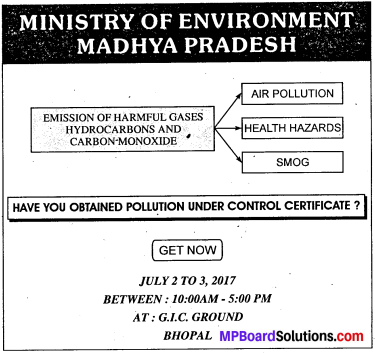
3. Design an advertisement on behalf of the Ministry of Environment M.P. for publication in a newspaper urging the people to get ‘Pollution under Control Certificate ’for their vehicles. Mention the date, venue, place and time of the program. Make the people aware about the harmful effects of hydrocarbons and carbon monoxide. [2017]
Answer:
The Times of India
Sunday, July 20………..
MP Board Class 12th General English Poster Writing img 3

4. Design an attractive and effective poster against the use of Drugs.
Or
Write out a poster on Drug Addiction. [2009, 13]
Or
Prepare a poster on ‘Say no to Drugs. [2016, 18]
Answer:
MP Board Class 12th General English Poster Writing img 4

MP Board Solutions

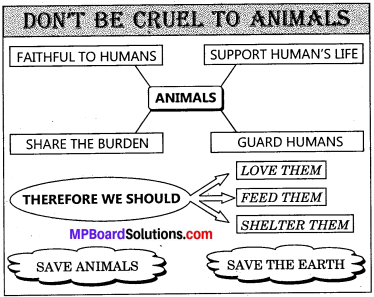
5. With the help of the clues given, design a poster in a suitable box entitled ‘Don’t Be Cruel to animals. [2015]
Love them, feed them, shelter them, ‘save animals, save the earth.
Answer:
MP Board Class 12th General English Poster Writing img 5

MP Board Class 12th English Solutions

MP Board Class 12th General English Notice Writing

MP Board Class 12th General English Notice Writing

  1. Notice लिखना सूचित करने का एक सशक्त माध्यम है।
  2. Notices प्रायः समाचार-पत्रों में या पत्रिकाओं में अथवा स्कूल-कॉलेज के Notice-board पर चिपकाये जाते हैं।
  3. Notice के माध्यम से कोई सूचना थोड़े समय में जनसाधारण तक पहुँच जाती है।
  4. Notices सरल भाषा में लिखे जाने चाहिए।
  5. Notice निकालने वाले के हस्ताक्षर Notice के नीचे होने चाहिए।
  6. Notice में तारीख अवश्य होनी चाहिए।

MP Board Solutions

Some Examples

1. Joining a Historical Tour [2009, 10]

N. K. Gupta, Senior History teacher, invites applications from the students of class X who want to go to a historical tour during the vacation. He gave May 15, as the last date for the applications to reach the undersigned. In this connection, he puts up a Notice on the school Notice- board. Write this Notice in about 40 words.
Answer:

Notice

Joining a Historical Tour
Applications are invited from the students of class X who want to go on a Historical Tour during the vacation. The applications should reach the undersigned on or before 15th May, 20………

N. K. Mishra
Senior History Teacher

2. Selection to the Volley-ball Team
Mohan Singh has been selected the captain of the School Volley¬ball Team. He is to invite applications from the students of class X for selection to the Volley-ball team. So he puts up a Notice on the school Notice-board in that connection. Write this Notice in about 40 words.
Answer:

Notice

Selection to the Volley-ball Team
Applications are invited from the students of class X for selection to the Volley-ball team. Apply before 15th September, 20 giving details of your proficiency in the game.

Narendra Singh
Captain Volley-ball Team

3. Participation in English Debate [2009, 13 11]

Madam Seema Mittal, Vice-Principal has invited names of the students who want to take part in the English debate competition to be held in Govt. Inter College, Indore. The last date for submitting the names has been fixed as January, 24th. In this connection, she has put up a Notice on the school Notice-board. Write her Notice in the space given below in about 40-50 words. Try to make the Notice such as to catch everyone’s attention.
Answer:

Notice

Participation in English Debate
1st January, 20………

Applications are invited from the students who want to participate in the English debate competition to be held in Government Inter College, Indore. They should send their applications to the undersigned by 24th of this month so that proper selection can be made. They should write their names and details of proficiency, if any, they have attained.

Seema Mittal
Vice-Principal

MP Board Solutions

4. Selection in Inter-School debate Competition [2012, 14]
You are Alok Gupta, the secretary of the cultural activities of your school. Draft a Notice giving information about the selection of two s participants from your school to take part in the inter-school debate competition,
Answer:

Notice

Gandhi Memorial School, Bhopal
21st January, 20…………

You will be glad to know that Rekha Bhardwaj (Class XI) and Amit Singh (Class XII) have been selected to take part and represent the school in the Inter-school debate competition to behold on March 23, 20…………..

Alok Gupta
Cultural Secretary

5. An Educational Tour [2009]
You are Raju, the Secretary of the English Club of your school. You plan to organise an educational tour to Manali during the autumn vacation. Mentioning the schedule of the tour and the expenses to be incurred, write a Notice Jn about 40 words inviting the names of the members who are interested in joining the tour.
Answer:

Notice

An Educational Tour
28st Feb., 20………

The English club of the school is organising an educational tour to Manali during the autumn vacation. The expenses to be incurred will be Rs. 500 per head. The members who are interested in going to the tour should meet the undersigned as early as possible.

Raju
(Secretary) English Club

MP Board Solutions

6. Lost and Found (2016)
You are Ankit Gautam. You have found a school bag in the playground of your school. Prepare a lost and found Notice.
Answer:

Notice

Lost and Found
21 Oct. 20……………..

A blue and red colored school bag has been found in the playground. It contains a pink tiffin and a red water bottle. It may be claimed from the staff room after proving the identity.

Ankit Gautam
Senior Maths Teacher

MP Board Class 12th English Solutions

MP Board Class 12th Biology Solutions Chapter 14 Ecosystem

MP Board Class 12th Biology Solutions Chapter 14 Ecosystem

Ecosystem NCERT Text Book Questions and Answers

Question 1.
Fill in the Blanks:

  1. Plants are called…………….. because they fix carbon dioxide.
  2. In an ecosystem dominated by trees, the pyramid (of numbers) is ………………… type.
  3. In an aquatic ecosystem, the limiting factor for productivity is …………………….
  4. Common detritivores in our ecosystem are ………………………..
  5. The major reservoir of carbon on earth is ………………………

Answer:

  1. Producer
  2. Inverted
  3. Light
  4. Earthworm
  5. Ocean and Biosphere.

Question 2.
Which one of the following has the largest population in the food chain:
(a) Producers
(b) Primary consumers
(c) Secondary consumers
(d) Decomposers.
Answer:
(d) Decomposers.

Question 3.
The second trophic level in a lake is:
(a) Phytoplankton
(b) Zooplankton
(c) Benthos
(d) Fishes.
Answer:
(b) Zooplankton

Question 4.
Secondary producers are:
(a) Herbivores
(b) Producers
(c) Carnivores
(d) None of the above.
Answer:
(a) Herbivores

MP Board Solutions

Question 5.
What is the percentage of photosynthetically active radiation (PAR) in the incident solar radiation:
(a) 100%
(b) 50%
(c) 1 – 5%
(d) 2 -10%.
Answer:
(b) 50%

Question 6.
Distinguish between:
(a) Grazing food chain and detritus food chain
(b) Production and decomposition
(c) Upright and inverted pyramid
(d) Food chain and Food web
(e) Litter and Detritus
(f) Primary and Secondary productivity.
Answer:
(a) Grazing food chain and detritus food chain
MP Board Class 12th Biology Solutions Chapter 14 Ecosystem 1
(b) Production and decomposition
MP Board Class 12th Biology Solutions Chapter 14 Ecosystem 2
(c) Upright and inverted pyramid
MP Board Class 12th Biology Solutions Chapter 14 Ecosystem 3
(d) Food chain and Food web
MP Board Class 12th Biology Solutions Chapter 14 Ecosystem 4
(e) Litter and Detritus
MP Board Class 12th Biology Solutions Chapter 14 Ecosystem 5
(f) Primary and Secondary productivity.
MP Board Class 12th Biology Solutions Chapter 14 Ecosystem 6

MP Board Solutions

Question 7.
Describe the components of an ecosystem.
Answer:
An ecosystem has two types of components biotic and abiotic.
1. Biotic components:- There are living organisms present in an ecosystem. On the basis of their obtaining food, biotic components are of 3 types – produces, consumers and decomposers.

  • Producers – They are autotrophic components that include phytoplankton, some algae floating, submerged, and marginal plants.
  • The consumers are the organism like zooplankton, free-swimming animals, bottom-dwelling animals, etc consumes producers as their food.
  • The decomposers are organisms (saprophytic) which obtain nourishment from organic remains they digest the organic remains by digestive enzyme and liberates inorganic nutrients. Because of this decomposers are called mineralizers.

2. Abiotic components:- They are factors and materials of the physical environment. The materials include inorganic nutrients and organic remains. The organic remains consist of human substances, carbohydrates, lipids, proteins, etc. The abiotic materials are air, water, and soil.

Question 8.
Define ecological pyramids and describe with examples, pyramids of number and biomass.
Answer:
Ecological Pyramid: The relation between producers and consumers in an ecosystem can be graphically represented in the form of a pyramid called an ecological pyramid. The base always represent the producers or the first trophic level and the apex represents top-level consumer or the lost trophic level ecological pyramids are of three types:

  1. Pyramid of number
  2. Pyramid of biomass
  3. Pyramid of energy

MP Board Class 12th Biology Solutions Chapter 14 Ecosystem 7

The biomass, i.e., the living weight of the organisms in the food-chain present at different trophic levels in an ecosystem forms the pyramid of biomass.

When biomass of consumers is greater than biomass of producer then pyramid is called as an inverted pyramid of biomass.eg., pyramid of biomass of pond ecosysyem is always inverted.

Ecosystem: The system resulting from the interaction between organisms and the environment is called an ecosystem.
MP Board Class 12th Biology Solutions Chapter 14 Ecosystem 8

Question 9.
What is primary productivity? Give a brief description of factors that affect primary productivity.
Answer:
Primary productivity:- It is the rate of synthesis of biomass by producers per unit time per unit area through, the process of photosynthesis.
Factors:- It depends up on sunlight, temperature moisture, nutrients and photosynthesis efficiency of producers.

  1. Sunlight:- In tropical regions maximum sunlight is available. It reduces towards the pole. Therefore more photosynthesis and high productivity occurs in tropics.
  2. Temperature:- Temperate forest have lesser productivity as compared to tropical forests due to the cold climate during winter. Alpine and arctic regions have very low productivity because of low temperatures almost throughout the year.
  3. Moisture:- Good rain and humidity increase productivity of the ecosystem with the fall in availability of water the productivity decreases.
  4. Nutrients:- A regular availability of nutrients is required for sustaining plant growth and hence the productivity of an ecosystem. Coral reefs and esturies are highly productive as the nutrient supply is rich.
  5. Photosynthetic efficiency:- Some plants are photosynthetically more efficient in trapping sunlight than others. eg: Sugarcane.

Question 10.
Define decomposition and describe the processes and products of decomposition.
Answer:
Decomposition is the process that involves the breakdown of complex organic matter or biomass from the body of dead plants and animals with the help of decomposers into inorganic raw materials such as carbon dioxide, water, and other nutrients.
The various processes involved in decomposition are as follows:
1. Fragmentation: It is the first step in the process of decomposition. It involves the breakdown of detritus into smaller pieces by the action of detritivores such as earthworms.

2. Leaching: It is a process where the water-soluble nutrients go down into the soil layers and get locked as unavailable salts.

3. Catabolism: It is a process in which bacteria and fungi degrade detritus through various enzymes into smaller pieces.

4. Humification: The next step is humification which leads to the formation of a dark coloured colloidal substance called humus, which acts as reservoir of nutrients for plants.

5. Mineralization: The humus is further degraded by the action of microbes, which finally leads to the release of inorganic nutrients into the soil. This process of releasing inorganic nutrients from the humus is known as mineralization. Decomposition produces a dark coloured, nutrient-rich substance called humus. Humus finally degrades and releases inorganic raw materials such as CO2, water, and other nutrient in the soil.

MP Board Solutions

Question 11.
Given the account of Explain energy flow in ecosystem.
Answer:
Energy flow: In die ecosystem, energy is transferred in an orderly sequence. The flow of solar energy from producers to consumers and to decomposers subsequently in an ecosystem is known as energy flow. Energy flow is an ecosystem is always unidirectional. Sun is the sole source of solar energy in an ecosystem. Green plants utilize this energy in photosynthesis and convert it in the form of chemical energy and store it. Plants utilize the maximum part of this energy to do its biological functions. Some of it is converted into heat and released in the environment. The remaining part of the energy is stored in various components of the body.

When a consumer eats these producer plants, the energy is then transferred into its body. In any food-chain energy flows from primary producers to primary consumers, from primary consumers to secondary consumers and secondary consumers to tertiary consumers and so on. Because every organism of a trophic level continuously converts chemical energy into heat, there is always a loss of energy with each step in a food-chain. According to an estimate only 10% of the total energy obtained is transferred from one trophic level to another.

Question 12.
Write important features of a sedimentary cycle in an ecosystem.
Answer:
Sedimentary cycles have their reservoirs in the earth’s crust or rocks. Nutrient elements are found in the sediments of the earth. Elements such as sulphur, phosphorus, potassium, and calcium have sedimentary cycles.

Sedimentary cycles are very slow. They take a long time to complete their circulation and are considered as less perfect cycles. This is because during recycling, nutrient elements may get locked in the reservoir pool, thereby taking a very long time to come out and continue circulation. Thus, it usually goes out of circulation for a long time.

Question 13.
Outline salient features of carbon cycling in an ecosystem.
Answer:
Carbon constitutes 49 percent of the dry weight of organisms.

  • 71 percent of the carbon is found dissolved in oceans which is responsible for its regulations in the atmosphere.
  • The carbon cycle occurs through the atmosphere, oceans, and through the living and dead organisms.
  • It is estimated that 4xl013 kg of Carbon is fixed in the biosphere through photosynthesis annually.
  • Carbon is returned to the atmosphere as CO2 by animals and plants through respiration and the activities of decomposers.
  • Some amount of fixed carbon is lost as sediments and removed from circulation.
  • Burning of wood, forest fire, volcanic activity, and combustion of organic matter and fossil fuels are some essential sources for releasing CO2 into the atmosphere.
  • Human activities like deforestation and vehicular burning of fossil fuels have caused an increase in the amount of CO2 in the atmosphere.

MP Board Solutions

Ecosystem Other Important Questions and Answers

Ecosystem Objective Type Questions

Choose the Correct Answer

Question 1.
The position of man in the food chain of all ecosystem is as:
(a) Consumer
(b) Producer
(c) Producer and consumer
(d) Decomposer.
Answer:
(a) Consumer

Question 2.
The flow of energy in an ecosystem is:
(a) Unidirectional
(b) Bi-directional
(c) Three directional
(d) Quadri-directional.
Answer:
(a) Unidirectional

Question 3.
The word “ Ecosystem” was first used by :
(a) Tansley
(b) Odum
(c) Writer
(d) Mishra and Puri.
Answer:
(a) Tansley

Question 4.
The Source of energy in an ecosystem is:
(a) Solar energy
(b) Green plants
(c) Food substances
(d) All of the above.
Answer:
(a) Solar energy

Question 5.
Pyramid of number of trees in an ecosystem is always:
(a) Inverted
(b) Upward
(c) Both (a) and (b)
(d) None of these.
Answer:
(a) Inverted

Question 6.
Correct food chain is:
(a) Grass → Grasshopper → Frog Snake → Hawk
(b) Grass → Frog → Snake → Peacock
(c) Grass → Peacock → Grasshopper → Hawk
(d) Grass → Snake → Rabbit.
Answer:
(a) Grass → Grasshopper → Frog Snake → Hawk

Question 7.
Pyramid of biomass of an ecosystem of lake is:
(a) Upward
(b) Inverted
(c) Inverted and Upward both
(d) None of these.
Answer:
(b) Inverted

Question 8.
Man is:
(a) Producer
(b) Carnivore
(c) Herbivore
(d) Omnivorous.
Answer:
(d) Omnivorous.

Question 9.
Decomposer is:
(a) Rats
(b) Algae
(c) Bacteria and Fungi
(d) Goats.
Answer:
(c) Bacteria and Fungi

Question 10.
Man-made ecosystem is:
(a) Pond
(b) Aquarium
(c) Forest
(d) Lake.
Answer:
(b) Aquarium

Question 11.
Pyramid of energy is a forest ecosystem is:
(a) Always Inverted
(b) Always upward
(c) First upward than Inverted
(d) None of the above.
Answer:
(b) Always upward

Question 12.
Study of the ecosystem of species is called:
(a) Ecology
(b) Autecology
(c) Synecology
(d) None of these.
Answer:
(b) Autecology

MP Board Solutions

Question 13.
Food chain starts from:
(a) Respiration
(b) Photosynthesis
(c) Decomposition
(d) Nitrogen fixation.
Answer:
(b) Photosynthesis

Question 14.
Flow of energy and food in a food web is:
(a) Unidirectional
(b) B i-directional
(c) Multidirectional
(d) None of these.
Answer:
(c) Multidirectional

Fill in the Blanks:

  1. The transitional zone between two adjacent communities is called ………………………
  2. The term ecosystem was proposed for the first time by ………………………..
  3. The brief source of energy in the ecosystem is …………………….
  4. Bacteria which fix the nitrogen is called ……………………
  5. All ecosystem are dependent on energy on …………………….
  6. Balance of ecosystem is called ………………………
  7. Pyramid of energy is always …………………………
  8. All the plant of a particular geographic area constitute ………………………. of the place.

Answer:

  1. Ecotone,
  2. Tansley,
  3. Sunlight,
  4. Rhizobium,
  5. Solar energy,
  6. Ecological balance,
  7. Upright,
  8. Flora.

3. Match the Following:
MP Board Class 12th Biology Solutions Chapter 14 Ecosystem 9
MP Board Class 12th Biology Solutions Chapter 14 Ecosystem 9a
Answer:

  1. (b)
  2. (e)
  3. (d)
  4. (a)
  5. (c).

MP Board Class 12th Biology Solutions Chapter 14 Ecosystem 10
Answer:

  1. (b)
  2. (e)
  3. (d)
  4. (a)
  5. (c)

MP Board Solutions

Question 4.
Answer in One Word/Sentence:

  1. Mention the two names of biotic components of the ecosystem.
  2. Who proposed the term ecosystem?
  3. Which ecosystem is more stable?
  4. Name the relatively loss stable ecosystem.
  5. Name the ecosystem showing maximum stratification.
  6. Give two examples of artificial ecosystems.
  7. Give the name of any two food chains.
  8. Write the name of the basic unit of ecology.
  9. Name the organisms found on the surface of water bodies.
  10. Name the transitional zone of two adjacent communities.
  11. Name the process of establishment of organisms in any new area.
  12. From where xerosere started?
  13. Who has proposed the term succession?
  14. Name the succession starting from the naked rock.

Answer:

  1. Biotic, Abiotic
  2. Tansley
  3. Ocean
  4. Desert
  5. Aquatic
  6. Aquarium, crop¬land
  7. Grazing, Detritus
  8. Producer
  9. Benthos
  10. Ecotone
  11. Succession
  12. Rocks
  13. Hult(1885)
  14. Lithosere.

MP Board Solutions

Ecosystem Very Short Answer Type Questions

Question 1.
Name the process of soil formation.
Answer:
Pedogenesis.

Question 2.
What is the orientation of the pyramid of energy?
Answer:
Upright.

Question 3.
Which ecosystem is most established?
Answer:
Complex ecosystem.

Question 4.
When many food chains operates simultaneously and interlock such a pattern is formed.
Answer:
Food web.

Question 5.
Name the ecosystem which shows the most productivity.
Answer:
Tropical ecology.

Question 6.
What are fungi and bacteria called in an ecosystem?
Answer:
Micro consumer or Decomposer.

Question 7.
Which part of the energy is transferred from one trophic level to other in ecosystem?
Answer:
10 %.

Question 8.
Name the type of chemosynthetic bacteria.
Answer:
Autotrophic.

Question 9.
Name the word which is similar to ecosystem given by Pro. R. Mishra.
Answer:
Ecocosm.

Question 10.
Name the trophic level in which green plants are found.
Answer:
Primary trophic level.

Question 11.
Who gave the word transformer for producer?
Answer:
By E. J. kormondy.

Question 12.
Name any two sedimentary cycle.
Answer:

  1. Phosphorus cycle
  2. Sulpher cycle.

Question 13.
The energy pyramids are always.
Answer:
Upright.

Question 14.
Give examples of decomposers.
Answer:
Bacteria and Fungi.

Question 15.
Who gave 10% rule of energy?
Answer:
Lindeman.

Question 16.
Which form of nitrogen is absorbed by plants?
Answer:
In the form of nitrate ion (No3).

Question 17.
Name two types of food chain.
Answer:

  1. Grazing food chain,
  2. Detritus food chain.

MP Board Solutions

Ecosystem Short Answer Type Questions

Question 1.
Differentiate between food chain and food web.
Answer:
MP Board Class 12th Biology Solutions Chapter 14 Ecosystem 11
Question 2.
Write the names of important components of atmosphere.
Answer:
(A) Abiotic components:

  • Energy: Light, temperature, energy of chemical substances.
  • Materials: Water, soil, salts etc.

(B) Biotic components:

  • Producers: e.g., green plants.
  • Consumers: Primary, secondary and tertiary.
  • Decomposers: Bacteria, fungi.

Question 3.
Write the name and ratio of different components of biosphere.
Answer:
Name and ratio of different components of biosphere is :
MP Board Class 12th Biology Solutions Chapter 14 Ecosystem 12
Some gases are also found in the biosphere e.g., Helium, Neon and Crypton are found in less quantity.

Question 4.
Differentiate between detritivore and decomposer.
Answer:
Detritivore is organisms which feed on detritus and break them into smaller particles, e.g., the earthworm. And decomposers are organisms which by secreting enzymes break down complex organic matter into organic substances e.g. some bacteria and fungi.

Question 5.
Name a dominant producer in a deep aquatic ecosystem. What other name could you give to a primary consumer, (AT 2007)
Answer:
Phytoplanktons or certain algae are the dominant producers in a deep aquatic ecosystem.
Primary consumers are known as herbivores.

Question 6.
Differentiate between biome and ecosystem.
Answer:
An ecosystem is the interaction of living and non-living things in an environment. A biome is a specific geographic area notable for the species living there.

Question 7.
Draw a pyramid of the energy of grassland in the ecosystem.
Answer:
MP Board Class 12th Biology Solutions Chapter 14 Ecosystem 13

Question 8.
Explain the nitrogen cycle in nature.
Answer:
MP Board Class 12th Biology Solutions Chapter 14 Ecosystem 14

Question 9.
Explain sulphur cycle by the diagram.
Answer:
MP Board Class 12th Biology Solutions Chapter 14 Ecosystem 15

Question 10.
Explain the effect of light on plants.
Answer:
Effect of light on plants: Light is the source of energy. It is essential for life. It is an important factor of an ecosystem. The existence of life on earth is because of light obtained from sun. Sunlight is essential for photosynthesis, help in the preparation of food for the whole living world. Light effects biological activities of plants by its intensity, period and duration. Plants are classified into the following two categories on the basis of the requirement of light intensity:

  • Heliophytes: Plants, which can grow better in bright light are called heliophytes.
  • Sciophytes: Plants, which require relatively less of light and they can grow better in shades are called sciophytes.

Question 11.
Explain the meaning of food web and draw its diagram.
Answer:
Food Web: In nature, food-chains are not isolated sequences, but are interrelated and interconnected with one another. When many food-chains operate simultaneously and interlock such pattern is termed as food web. Thus, the food web is a description of feeding connections between the organisms which make up a community. Energy passes through one trophic level to next via these food web links, e.g., a rat feeds on various kinds of grains, fruits, stems, roots, etc.

A rat in its turn is consumed by a snake which is eaten by a falcon. The snakes feed on both frogs and rats. Thus, a network of food-chains exists and this is called food web. The food web gets more complicated because of variability in taste and preference availability and compulsion and several other factors at each level. For example, tigers normally do not feed on fishes or crabs but in Sunderbans they are forced to eat them.
MP Board Class 12th Biology Solutions Chapter 14 Ecosystem 16

Question 12.
Explain Calcium cycle with well labelled diagram.
Answer:
MP Board Class 12th Biology Solutions Chapter 14 Ecosystem 17

Question 13.
Draw ecological pyramid of number of a tree ecosystem and grassland ecosystem.
Answer:
MP Board Class 12th Biology Solutions Chapter 14 Ecosystem 18

MP Board Solutions

Question 14.
What do you mean by ecosystem? Describe the important components of a pond ecosystem.
Or
Write about role of decomposers in an ecosystem with example.
Answer:
Ecosystem: The system resulting from the interaction between organisms and their environment is called as ecosystem.

Components of a pond ecosystem:
A pond ecosystem should contain all components of ecosystems like:

(a) Producers: Organism, which can synthesize their own food are included under producers, e.g., Volvox, Pandorina, Oedogonium, Saggitaria, Utricularia, Azolla, Trapa, Lemna, Typha, Nymphaea etc. form the producer class of the pond ecosystem.

(b) Consumers:

  • Primary consumer: Animals, which feed on producers are included into this category e.g., Daphnia, Cyclops, Paramoecium, Amoeba and small fishes.
  • Secondary consumers: Primary consumers also serve as food for water sn’akdls, a few tortoise, few types of fish etc. hence, these are carnivores.
  • Tertiary consumers : Secondary consumers also serve as food for aquatic birds like kingfisher, cranes, big fish and these together form a top class carnivorous group and called as tertiary consumers.

(c) Decomposers: All producers and consumers die and accumulate on the floor of the pond. Even the waste material and faeces of these animals get accumulated on the floor of the pond. Similarly, the floor of pond is also occupied by decomposers, which include bacteria and fungi. These decomposers decompose complex organic compounds of then- bodies into simpler forms which are finally mixed with soil of floor of ponds. These are again absorbed by the roots of producer plants and thus matter is recycled.

Question 15.
Explain pyramid of biomass of pond ecosystem.
Answer:
The biomass, i.e., the living weight of the organisms in the food-chain present at different trophic levels in an ecosystem forms the pyramid of biomass.

When biomass of consumers is greater than biomass of producer then pyramid is called as inverted pyramid of biomass. eg. pyramid of biomass of pond ecosysyem is always inverted.

Ecosystem: The system resulting from the interaction between organisms and the environment is called an ecosystem.
MP Board Class 12th Biology Solutions Chapter 14 Ecosystem 19

Ecosystem Long Answer Type Questions

Question 1.
What are ecological pyramids? Explain various types of ecological pyramids.
Answer:
Trophic level: In an ecosystem, the producer-consumer arrangement is a kind of structure known as trophic structure, and each food level in the food chain is called a trophic level or energy level. In other, words each level of food in the food chain is called its trophic level. The first trophic level (T,) in an ecosystem is occupied by producers. Herbivores (primary consumers) form the second trophic level (T2), secondary consumers form the third trophic level (T3), tertiary consumers form the fourth trophic level (T4) and decomposers form the fifth trophic level (T5) in an ecosystem.
MP Board Class 12th Biology Solutions Chapter 14 Ecosystem 20
Food or Ecological Pyramids: If we express the organisms of various trophic levels according to their number, biomass and ratio of energy stores within it, then we obtain ac6ne or pyramid-like structure which is known as food or ecological pyramid. Ecological pyramids represent the trophic structure and function of an ecosystem. In base and successive trophic levels the tiers which make up the apex. Ecological pyramids are of the following three types :

  1. Pyramid of Biomass
  2. Pyramid of number
  3. Pyramid of energy.

1. Pyramid of Biomass: Biomass is the dry weight of living organisms per unit of space. The ecological pyramid, which shows the quantitative relationship of the standing crop at each trophic level. The pyramid of biomass shows a gradual reduction in biomass at each trophic level from base to apex. The pyramid of biomass may be:

  • Upright: e.g., all terrestrial ecosystems.
  • Inverted: e.g., all aquatic ecosystems.

MP Board Class 12th Biology Solutions Chapter 14 Ecosystem 21

2. Pyramid of Number: The ecological pyramid shows the number of individual organisms at each trophic level. It represents the numerical relationship between the different trophic levels of a food chain. In this pyramid, more abundant species from the first trophic level and from the base of the pyramid and the less abundant species remain near the top. The pyramid of number may be:

  • Upright: e.g. grassland, pond, forest ecosystem.
  • Inverted: e.g. ecosystem of the tree.

MP Board Class 12th Biology Solutions Chapter 14 Ecosystem 22

3. Pyramid of Energy: It indicates the total amount of energy at each trophic level of the food chain. At each producer level, the total energy available is relatively more than at the higher trophic levels because of the loss of the energy at each trophic level. Thus, there is a gradual loss of energy at each trophic level. The pyramid of the energy of each type of ecosystem is always upright.

MP Board Class 12th Biology Solutions Chapter 14 Ecosystem 23

Question 2.
What is meant by terrestrial biomes? What are its types? Explain any one biomes in detail.
Answer:
Terrestrial Biome: Large areas occupying ecosystems in nature are called biomes. If biomes are on land then they are called Terrestrial biomes.
Terrestrial biomes may be:
(a) Forest Biomes: They may be as below;

  • Topical rain forest
  • Cold tropical forest
  • Taiga forest.

(b) Grassland biomes: They may be as below:

  • Tropical rain forest
  • Cold tropical forest.

(c) Desert Biomes
(d) Tundra Biomes.
Grassland Biome or Ecosystem has long grasses, Its, land is fertile. It receives approximately 25 to 75 cm average rainfall. Its component is:

(a) Abiotic component: All organic, inorganic substances and climatic factors together form the abiotic component.

(b) Biotic component:

  • Producers: Grasses, herb, shrubs.
  • Primary consumers: Herbivore like a cow, buffalo, goats, sheep, deer, rabbit, rat insect.
  • Secondary consumers: Carnivore animals which eat primary consumers-like snakes, birds, foxes, jackal, etc.
  • Tertiary consumers: This organism eats secondary consumers because no other one eats them like Hawk, Peacock, etc.
  • Decomposers: Micro-Fungus, Bacteria, actinomycetes are decomposers of grassland biomes and recycle the material back to the soil and used by producers.

MP Board Solutions

Question 3.
What are Biogeochemical cycles? Write in short sulphur and calcium cycle.
Answer:
All living organisms get matter from the biosphere components i.e„ lithosphere, hydrosphere, and atmosphere. Essential elements or inorganic substances are provided by the earth and are required by organisms for their bodybuilding and metabolism, they are known as Biogeochemical or biogenetic nutrients.

Sulphur Cycle: Producers (green plants) need sulphur in the form of sulphates from soil or from water (aquatic plants). The animals get sulphur through food. Some animals get sulphur from water also. Sulphur is found in three amino acids hence, sulphur is a component of most proteins, some vitamins and enzymes. Plants pick up sulphur in the form of sulphates. They are converted to organic form mostly as components of some amino acids. It is found in nature as an element and also as sulphates in soil, water and rocks. After the death of plants and animals, they are decomposed by microbes like Aspergillus, Neurospora and Escherichia releasing hydrogen sulphide.
MP Board Class 12th Biology Solutions Chapter 14 Ecosystem 24
Calcium cycle: Calcium is slowly released from the rocks by water and wind action. These are either blown into the air or absorbed by plants through their roots. Animals obtain it directly as compounds and also from plants. Calcium is released from plant and animal bodies by decomposition after death. Mollusks and corals deposit a large quantity of calcium in their shells and skeletons making it unavailable for quick cycling.
MP Board Class 12th Biology Solutions Chapter 14 Ecosystem 25

MP Board Class 12th Biology Solutions

MP Board Class 12th Biology Solutions Chapter 4 Reproductive Health

MP Board Class 12th Biology Solutions Chapter 4 Reproductive Health

Reproductive Health NCERT Textbook Questions and Answers

Question 1.
What do you think is significance of reproductive health in a society?
Answer:
Reproductive health means total well being in all aspects of reproduction i.e., physical, emotional, behavioural, social.

  • Awareness is provided to both males and females to lead healthy and satisfying reproductive life.
  • To make individuals aware of fertility regulating methods.
  • Protect against STD’s.
  • Planning children and family planning.
  • Proper hygiene of genitalia and treat for reproductive diseases.

Question 2.
Suggest the aspects of reproductive health which need to be given special attention in the present scenario.
Answer:
Special attention needs to be given to the following aspect :

  • Introduction of sex education in a school that to help in eradicating myths and misconceptions regarding sex-related aspects.
  • Proper information about reproductive organs, safe and hygienic sexual practices, and sexually transmitted diseases.
  • Awareness of problems due to uncontrolled population growth, social evils like sex abuse and sex-related crimes etc.
  • Strong infrastructural facilities, professional expertise and material support to provide medical assistance and care to people in reproduction-related problems.
  • Educating people about available birth control options, care of pregnant mothers, post-natal care of mother and child, the importance of breastfeeding, equal opportunities for the male and female child.

Question 3.
Is sex education necessary in schools? Why?
Answer:
Yes, it is necessary for schools because:

  • It will provide correct information about sex and reproductive organs.
  • Changes during adolescence are fully explained.
  • Changes in behaviour are predicted.
  • Horns of early life and marriage are explained.
  • Cleanliness of genitalia are explained and misconceptions and myths are removed if any.
  • Information is provided about STD’s
  • Family planning and hygienic sexual practices are explained.

MP Board Solutions

Question 4.
Do you think that reproductive health in our country has improved in the past 50 year’s? If yes, mention some such areas of improvement
Answer:
Yes, Reproductive health in our country has improved in the last 50 years.

Some areas of improvement are:

  • Better awareness about sex-related matters.
  • Increased number of medically assisted deliveries and better post-natal care of child and mother leading to decreased maternal and infant mortality rates.
  • Increased number of couples with small families.
  • Better direction and cure of STDs and overall increased medical facilities for all sex-related problems.

Question 5.
What are the suggested reasons for the population explosion?
Answer:
The situation where the population exceeds productive capacity is known as population explosion. In nature, the number of resources is limited hence, if the population increases at the present rate and increasing beyond the limit, they (Resources) would get exhausted.
Reasons for population explosion: Following are the reasons for population explosion:

  • Increasing birth rate.
  • Decreasing death rate.
  • Higher rate of reproduction.
  • Medical services have brought down mortality due to fatal diseases and epidemics.
  • Lack of predator in the civilized world today, the only predator of man is the man himself.

Question 6.
Is the use of contraceptives justified? Give reasons.
Answer:
Yes, the use of contraceptives is justified because it helps to control the rapid growth of the human population. It will also help in preventing unwanted pregnancies and STDs. Contraceptive also helps in controlling the population growth rate.

Question 7.
Removal of gonads cannot be considered as contraceptive options? Why?
Answer:
Contraception is meant for preventing conceptions. But removal of gonads can lead to non-secretion of sex hormones. Virilism can appear in ladies and gents may have soft contour.

Question 8.
Amniocentesis for sex determination is banned in our country. Is this ban necessary? Comment
Answer:
Yes, the ban is necessary because amniocentesis is misused for determining the sex of the fetus and then aborting the child of it is a female. This process is illegal it causes harm to the fetus as well as the mother it can also disturb the sex ratio.

Question 9.
Suggest some methods to assist infertile couples.
Answer:
They are some Assisted Reproductive Technologies (ART) to assist infertile couples.
Some ARTs are:

  • Test tube baby / IVF-ET (Invitro fertilization and Embryo transfer): Ova and sperms are collected and fused (induced) to form a zygote in laboratory conditions and transferred into a fallopian tube (ZIFT – Zygote intrafallopian transfer) or Uterus (IUT – Intrauterine transfer). Here male/female / both may be donors.
  • GIFT – (Gamete intrafallopian transfer). A gamete is from a donor.
  • ICSI – (Intra Cytoplasmic sperm injection). Sperm is directly injected into the ovum.
  • AI (Artificial Insemination). Semen from husband ( AIH) or donor (AID) is injected directly into the vagina or uterus (IUI – Intrauterine insemination)

MP Board Solutions

Question 10.
What are the measures one has to take to prevent contracting STDs?
Answer:
STDs can be prevented by the following methods :

  • Avoid sex with unknown partners/multiple partners.
  • Always use condoms during coitus.
  • Always contact a qualified doctor for any doubt in the early stage of infection and get complete treatment if diagnosed with the disease.

Question 11.
State True / False with an explanation.
(a) Abortion could happen spontaneously too.
Answer:
True

  • Due to lack of hormonal support.
  • Due to congenital malformation of the uterus.

(b) Infertility is defined as the inability to produce viable offsprings and is always due to abnormality/defect in female partners.
Answer:
False. Infertility may be due to male or female partners.

c) Complete location could help as a natural method of contraception.
Answer:
True. Effective for a period of 6 months due to the absence of menstruation.

(d) Creating awareness about sex-related aspects is an effective method to improve the reproductive health of people.
Answer:
True. It can reduce STDs and help practice hygienic sexual practices.

Question 12.
Correct the following statements:
(a) Surgical methods of contraception prevent gamete formation.
Answer:
It prevents the transportation of gametes, not their formation.

(b) All sexually transmitted diseases are completely curable.
Answer:
Hepatitis-Band AIDS is not curable.

(c) Oral pills are very popular contraceptives among rural women.
Answer:
Oral pills are not popular among rural women. They require sex education.

(d) In E.T. techniques, embryos are always transferred into the uterus.
Answer:
In E.T. techniques 8-called blastomere is transferred into the fallopian tube. While more than 8-celled blastomere is transferred into the uterus.

Reproductive Health Other Important Questions and Answers

Reproductive Health Objective Type Questions

1. Choose the Correct Answer
Question 1.
Removal of Fallopian tube in females are called :
(a) Vasectomy
(b) Tubectomy
(c) Ovariectomy
(d) Castration (Gonadectomy).
Answer:
(b) Tubectomy

Question 2.
Main region ofthe population growth are :
(a) Less death rate
(b) Growth of birth rate
(c) Drought
(d) Less war.
Answer:
(a) Less death rate

MP Board Solutions

Question 3.
The causes of popülatîon explosion in large cities is :
(a) Chances of education
(b) Available facilities
(c) Sources of income
(d) All of these.
Answer:
(d) All of these.

Question 4.
Population density is more in :
(a) USA
(b) India
(c) China
(d) Japan.
Answer:
(c) China

Question 5.
AIDS disease caused by :
(a) From bacteria
(b) From protozoa
(c) From virus
(d) From fungus.
Answer:
(c) From virus

Question 6.
Sex transmitted diseases are caused by :
(a) Virus
(b) Bacteria
(c) Protozoa
(d) All of these.
Answer:
(a) Virus

Question 7.
Population calculated in India :
(a) In 1891
(b) In 1947
(c) In 1950
(d) In 1961.
Answer:
(a) In 1891

Question 8.
The technique of the control of birth rate is called :
(a) TUD
(b) GIFT
(c) MIF
(d) IVEET.
Answer:
(a) TUD

Question 9.
Alcohol affected organ is :
(a) Liver
(b) Cerebrum
(c) Cerebellum
(d) Heart
Answer:
(a) Liver

Question 10.
Population growth rate of world is :
(a) 2-4%
(b) 2%
(c) 3%
(d) 4%.
Answer:
(b) 2%

2. Fill in the Blanks :

  1. Statistical study of population is called ……………….
  2. According to MALTHUS, Population grows ……………….whereas the means of its subsistences grows ……………….
  3. The entry and exit of member in any population is called ……………….
  4. Cutting and ligating ends of segments of vas deferens is called ……………….
  5. The population density of terrestrial animals, the area is represented by ……………….
  6. Birth rate and migration ………………. the population density.
  7. Revised birth fate is always greater than ………………. birthrate.
  8. Vital index = ………………. /Mortality x 100.
  9. Population ………………. with time and place.
  10. From the population point of view, every ………………. person in the world, is an Indian.

Answer:

    1. Demography
    2. Geometrically
    3. Migration
    4. Vasectomy
    5. Meter2 (m2)
    6. Growth
    7. Unrevised
    8. Natality
    9. Changes
    10. Sixth.

MP Board Solutions

3. Match the Following :

MP Board Class 12th Biology Solutions Chapter 4 Reproductive Health 1
Answer:

  1. (c)
  2. (e)
  3. (a)
  4. (b)
  5. (d).

MP Board Class 12th Biology Solutions Chapter 4 Reproductive Health 2
Answer:

  1. (c)
  2. (d)
  3. (e)
  4. (b)
  5. (a).

III. Answer in One Word/Sentence:

  1. Write two such causes by which unchecked growth takes place. (SSCE 1992)
  2. Write the full name of IUCD. (SSCE 1992!)
  3. What we called the study of human population?
  4. What type of chemical contraceptive is found in Mala-D and N?

Answer:

  1. Early marriage, illiteracy
  2. Intra-Uterine Contraceptive Devices
  3. Demography
  4. Oestrogen and Progesteron hormone.

Reproductive Health Very Short Answer Type Questions

Question 1.
What is the other name of family planning?
Answer:
The other name of family planning is “Parivar Kalyan”.

Question 2.
Where is Central Drug Research Institute located ?
Answer:
Central Drug Research Institute (CDRI) is located in Lucknow (Uttar Pradesh).

Question 3.
Write one benefit of condom.
Answer:
Condom provided protection from Sexually Transmitted Diseases (STDs).

Question 4.
What is the name of contraceptive pills which is taken only in once in a week ?
Answer:
“Saheli.”

Question 5.
Write the full form of IUCD.
Answer:
Intra Uterine Contraceptive Device.

Question 6.
Write the full form of STDs.
Answer:
Sexually Transmitted Disease.

Question 7.
What is the legal age for marriage of male and female in India ?
Answer:
For male 21 Year and for female 18 years.

Question 8.
Write the name of two STDs which are spread through infected blood.
Answer:
AIDS, Hepatitis-B.

Question 9.
Write the name of two disease which are caused by sexual contact
Answer:
Gonorrhoea, Syphilis.

Question 10.
Write the full form of HIV and AIDS.
Answer:
HIV : Human Immunodeficiency Virus.
AIDS : Acquired Immuno Deficiency Syndrome.

Question 11.
Write the full form of ZIFT.
Answer:
Zygote Intra Fallopian Transfer.

Question 12.
What is the process for surgical sterilization in males called ?
Answer:
Vasectomy.

MP Board Solutions

Reproductive Health Short Answer Type Questions

Question 1.
What is test-tube baby ?
Answer:
In some cases, a woman is unable to have a normal fertilization to bear the child. In such cases, test-tube technique may be successful. In this technique, the unfertilized eggs of such woman is isolated in aseptic condition and fertilized it in test-tube by the sperms of her husband. The fertilized egg or blastocyst can be maintained in vitro till it gets 32 celled stage. It can be implanted in the uterus of the female. The female remains under the supervision of doctor till completion of gestation period of 280 days. The baby produced in such a way is called a test-tube baby.

Question 2.
What is GIFT ? Explain in brief.
Answer:
GIFT (Gametes Intra Fallopian Transfer): It is a latest technique to produce a child. In this technique, the gametes are kept separately in a catheter and injected directly into the fallopian tube of the woman using laproscopy. Thus, in this case, fertilization occurs inside the body of woman. Prior to injection of gametes, the mother would be given hormones for about a week to stimulate follicle formation. This causes development of several eggs i.e,, super ovulation. The first GIFT in India was done in Mumbai and twins were born in August, 1990.

Question 3.
Explain the following:

  1. Tubectomy
  2. Vasectomy.

Answer:

  1. Tubectomy : The surgical removal of a segment of oviduct and then ligating the cut end is called tubectomy. It is applied in females to check the pregnancy.
  2. Vasectomy : Surgical cutting and ligating ends of segments of vas deferens is called vasectomy.

Question 4.
What is amniocentesis ? Write its ill effects and two advantages.
Answer:
Amniocentesis : It is prenatal diagnostic technique in which amniotic fluid of uterus is isolated by a surgical needle and foetus cells are cultured on a culture medium and chromosomes are examined. This technique is used to understand the following things or Advantages :

  • Chromosomal abnormalities like that of Down’s syndrome, Philadelphia syndrome and Edward’s syndrome.
  • Metabolic disorders like that of PKV, Cretinism, Alkaptonuria, etc.
  • Sex of the embryo can be examined by this technique.
  • Effects of amniocentesis: Due to this type of test, the female embryos are being eradicated. This leads into the
  • decrease in number of females which may cause a serious problem.

MP Board Solutions

Question 5.
Explain the social causes of human population growth.
Answer:
Social causes of human population growth rate are:

  • Illiteracy in society.
  • Low level of society.
  • Various orthodox tradition like son leads to progeny.
  • Social barriers.
  • Early child marriage presuming that after mid-age marriage reproductive capacity degenerates.
  • Social backwardness.
  • Social set-up that “Putra Ratan se Moksh milta hai”.

MP Board Class 12th Biology Solutions

MP Board Class 12th Biology Solutions Chapter 15 Biodiversity And Conversation

MP Board Class 12th Biology Solutions Chapter 15 Biodiversity And Conversation

Biodiversity and Conversation NCERT Text Book Question and Answers

Question 1.
Name the three important components of biodiversity.
Answer:
Three important components of biodiversity are :

  1. Genetic diversity.
  2. Species diversity.
  3. Ecosystem diversity.

Question 2.
How do ecologists estimate the total number of species present in the world?
Answer:
A total number of species is estimated by:

  • Rate of discovery of new species
  • Determination of species richness is an area.

Question 3.
Give three hypotheses for explaining why tropics show the greatest levels of species richness.
Answer:
There are three different hypotheses proposed by scientists for explaining species richness in the tropics :

  1. Tropical latitudes receive more solar energy than temperate regions, which leads to high productivity and high species diversity.
  2. Tropical regions have fewer seasonal variations and have a more or less constant environment. This promotes niche specialization and thus, high species richness.
  3. Temperate regions were subjected to glaciations during the ice age, while tropical regions remained undisturbed which led to an increase in the species diversity in this region.

Question 4.
What is the significance of the slope of regression in a species-area relationship?
Answer:
The slope regression (z) has a great significance in order to find a species-area relationship, it has been found that in smallar areas (where the species-area relationship is analyzed), the value of slopes of regression is similar regardless of the taxonomic group or the region. However, when a similar analysis done in larger areas, then the slope of regression is much steeper.

MP Board Solutions

Question 5.
What are the major causes of species losses in geographical regions?
Answer:
The following are the major causes for the loss of biodiversity around the world:
1. Habitat loss and fragmentation: Habitats of various organisms are altered or destroyed by uncontrolled and unsustainable human activities such as deforestation, slash and burn agriculture, mining, and urbanization. This results in the breaking up of the habitat into small pieces, which affects the movement of migratory animals and also, decreases the genetic exchange between populations leading to a declination of species.

2. Over-exploitation: Due to the over-hunting and over-exploitation of various plants and animals by humans, many species have become endangered or extinct (such as the tiger and the passenger pigeon).

3. Alien species invasions: Accidental or intentional introduction of non-native species into a habitat has also led to the declination or extinction of indigenous species. For example, the Nile perch introduced in lake Victoria in Kenya led to the extinction of more than two hundred species of native fish in the lake.

4. Co-extinction: In a native habitat, one species is connected to the other in an intricate network. The extinction of one species causes the extinction of other species, which is associated with it in an obligatory way. For example, the extinction of the host will cause the extinction of its parasites.

Question 6.
How is biodiversity important for ecosystem functioning?
Answer:

  • Biodiversity is important for the productivity, stability, resilience and health of ecosystems.
  • Biodiversity is important not only for ecosystem function but also for very survival of the human race on earth.

Question 7.
What are sacred groves? What is their role in conservation?
Answer:
Sacred groves are forest patches for worship in several parts of India. All the trees and wildlife in them are again treated and given total protection. They are found in khasi and jointia hills in Meghalaya. Westen Ghat regions of Karnataka and Maharashtra, etc. Tribals do not allow anyone to cut even a single branch of tree in these sacred groves thus sacred groves have been free form all types of exploitations.

Question 8.
Among the ecosystem services are control of floods and soil erosion, how is this achieved by the biotic components of the ecosystem?
Answer:
Ecosystem services regulate and protect ecosystems that is essential for maintaining the climate and ecology of the area.
Control of soil erosion:

  • Plant roots hold soil particles firmly.
  • Plant cover protects soil from erosion by wind and water.
  • Plants increase the porosity and fertility of the soil.

Control of floods It is carried by retention of water and prevention of runoff. Litter and humus of plants acts as sponge to retain rainwater. Plants hold soil, so prevents soil erosion. Rainwater does not run – off, so prevents flood as they filter water into soil.

Question 9.
The species diversity of plants (22 %) is much less than that of animals (72 %). What could be the explanations to how animals achieved greater diversifications?
Answer:
Animals have achieved greater diversification than plants due to following reasons:
1. They are mobile and thus can move away from their predators or unfavourable environments. On the other hand plants are fixed and have fewer adaptations to obtain optimum amount of raw materials and sunlight therefore, they show lesser diversity.

2. Animals have well developed nervous system to receive stimuli against external factors and thus can respond to them. On the other hand, plants do not exhibit any such mechanism, thus they show lesser diversity than animals.

Question 10.
Can you think of a situation where we deliberately want to make a species extinct? How would you justify it?
Answer:
Some species are harmful to humans eg: HIV, Smallpox vires, etc. Such species are not part of any food chains or webs. So, their extinction will not affect the ecosystem. And also their extinction can be beneficial to humans. eg:- HIV, smallpox vires, Plasmodium species etc.

MP Board Solutions

Biodiversity and Conversation Other Important Questions and Answers

Biodiversity And Conversation Objective Type Questions

Choose the Correct Answer:

Question 1.
Wildlife conservation act was enforced in India in:
(a) 1883
(b) 1972
(c) 1973
(d) 1982.
Answer:
(b) 1972

Question 2.
Indian board of wildlife was established in:
(a) 1952
(b) 1981
(c) 1971
(d) 1972.
Answer:
(a) 1952

Question 3.
NBPGR is situated at:
(a) Delhi
(b) Kolkata
(c) Lucknow
(d) Mumbai.
Answer:
(a) Delhi

Question 4.
Number of biosphere in our country is :
(a) 73
(b) 7
(c) 416
(d) 23
Answer:
(b) 7

Question 5.
National park related to white tiger is:
(a) Kanker
(b) Satipada
(c) Bandhavgarh
(d) Kanha.
Answer:
(c) Bandhavgarh

Question 6.
The first national park of Madhya Pradesh is :
(a) Shivpuri
(b) Bandhavgarh
(c) Kanha
(d) Kanker.
Answer:
(c) Bandhavgarh

Question 7.
Plant fossils national park is situated in :
(a) Shivpuri
(b) Mandala
(c) Kanha
(d) Kanker.
Answer:
(b) Mandala

Question 8.
Kanha national park is famous for:
(a) Rhinoceros
(b) Tiger
(c) Birds
(d) Aligator.
Answer:
(b) Tiger

MP Board Solutions

Question 9.
Bandipur national park is the habitat of:
(a) Deer Project
(b) Peacock Project
(c) Elephant Project
(d) Tiger Project
Answer:
(d) Tiger Project

Question 10.
Animal which is extinct in india:
(a) Hippopotamus
(b) National Park
(c) Cheetah
(d) Wolf
Answer:
(c) Cheetah

Question 11.
Which is the in-situ conservation method:
(a) Tissue culture’
(b) National park
(c) Botanical garden
(d)Cryotest.
Answer:
(b) National park

Question 12.
Which of the following are not done in a wild sanctuary:
(a) Conservation of flora
(b) Conservation of fauna
(c) Use of soil and flora
(d) Prohibition of hunting.
Answer:
(c) Use of soil and flora

Question 13.
In India maximum area covered by forest
(a) Odisha
(b) Arunachal Pradesh
(c) Madhya Pradesh
(d) All of the above
Answer:
(b) Arunachal Pradesh

Question 14.
Forest destruction:
(a) Destruction of natural sources
(b) Environmental Pollution
(c) Genetic disorder
(d) All of the above
Answer:
(b) Environmental Pollution

Question 15.
Forest Research Institute (FRI) is situated in:
(a) Shimla
(b) Chennai
(c) Dehradun
(d) Kolkata.
Answer:
(c) Dehradun

Question 16.
World environmental day is celebrated on :
(a) 15th March
(b) 15th April
(c) 4th May
(d) 5th June.
Answer:
(d) 5th June.

MP Board Solutions

Question 17.
Species which are continuously distinct:
(a) Long lasting animal
(b) Dangerous animal
(c) Simple animal
(d) None of these.
Answer:
(c) Simple animal

Question 18.
Kaziranga national park is situated in:
(a) West Bengal
(b) Kerala
(c) Assam
(d) Umariya.
Answer:
(c) Assam

Question 19.
Bandhavgarh national park is situated in:
(a) Satana
(b) Shivpuri
(c) Mandla
(d) Umariya.
Answer:
(d) Umariya.

Question 20.
Kanha national park is located in :
(a) Uttar Pradesh
(b) Rajasthan
(c) Gujrat
(d) Madhya Pradesh.
Answer:
(a) Uttar Pradesh

Question 21.
National wildlife (Protection) Act was formulated during:
(a) 1972
(b) 1974
(c) 1976
(d) 1978.
Answer:
(a) 1972

MP Board Solutions

Question 2.
Fill in the Blanks:

  1. Planting of trees and forests on waste land is called ……………………..
  2. Wildlife protection act comes in force in …………………….
  3. UNESCO has started Man and Biosphere programme in ……………………..
  4. ………………….. is the first Biosphere Reserve of India.
  5. Kajiranga wildlife sanctuary is famous for ………………………
  6. Red Data book is related with ……………………..
  7. World Environment Day is celebrated on ………………………… of every year.
  8. FRI is situated at ……………………..
  9. …………………….. is the main source of energy.
  10. National parks are made for the conservation of ……………………….
  11. ………………………….. is the main region of forest depletion.
  12. Indian Lion and Cheetah is ……………………….. animal.
  13. ………………………….. is called the development of forest on barren land.
  14. World environment day celebrated on ………………………

Answer:

  1. Afforestation
  2. 1972
  3. 1971
  4. Nilgiri
  5. Rhinoceros
  6. Endangered species
  7. 5th June
  8. Dehradun
  9. Sun
  10. Threatened species
  11. Growing population
  12. Rare
  13. Frustration
  14. 5th June.

Question 3.
Match the Following:
MP Board Class 12th Biology Solutions Chapter 15 Biodiversity And Conversation 1
Answer:
1. (c)
2. (d)
3. (e)
4. (b)
5. (a).

MP Board Class 12th Biology Solutions Chapter 15 Biodiversity And Conversation 2
Answer:
l.(e)
2. (d)
3. (a)
4. (b)
5. (c).

Question 4.
Answer in One Word/Sentence:

  1. In which place of India, lion is found?
  2. When does World Environment Day is celebrated?
  3. When does Wildlife Protection Act was formed in India?
  4. In which state Ghana bird Sanctuary is situated?
  5. Where is Tiger Project situated?
  6. Name any two National Parks of India.
  7. Where does Kanha National Park situated?
  8. Name any two threatened species.
  9. Name the state having maximum forest area.
  10. Name the National Animal and National Bird of India.
  11. Name any one book associated with the conservation of wildlife.

Answer:

  1. Gir forest, Gujarat
  2. 5th June
  3. 1972
  4. Bharatpur, Rajasthan,
  5. Kanha, M.P.
  6. Rajaji Park and Gir National Park
  7. M.P.
  8. Lion, Wild buffalo
  9. Chattisgarh (C.G.)
  10. Tiger and Peacock
  11. Red Data Book.

MP Board Solutions

Biodiversity And Conversation Very Short Answer Type Questions

Question 1.
When does WLF-India was established?
Answer:
1962.

Question 2.
Define biodiversity?
Answer:
The totality of genes, species, and ecosystem of a given region i.e. the combined diversity at all the levels of biological organization is called biodiversity.

Question 3.
Where does wild Ass is found?
Answer:
Runn of Kutch.

Question 4.
Which are three important components of biodiversity?
Answer:
The three components or levels of biodiversity are

  • Genetic diversity
  • Species diversity and
  • Ecological diversity.

Ecological diversity has again 3 components – alpha diversity (within community diversity), beta diversity (between community diversity), and gamma diversity (regional diversity).

Question 5.
Write other name of biodiversity.
Answer:
Biological diversity.

Question 6.
In the pie chart (A) and (B) drawn below to show the global animal diversity, which groups of animals would you name and write on the areas shaded black in (A) and (B). In which kind of habitat would you find these groups of animals
Answer:
(A) Insects Habitat, Mostly terrestrial
(B) Fishes Habitat, Aquatic.

Question 7.
What is the basic concept of biodiversity of biosphere?
Answer:
Gene.

MP Board Solutions

Question 8.
Name the two plants which are worshiped in any two states.
Answer:

  1. Kadamba in Rajasthan.
  2. Mango in Odisha.

Question 9.
Which part of the world has more biodiversity?
Answer:
In Brazil.

Question 10.
Write the full form of IUCN.
Answer:
International Union for Conservation of Nature and Natural Resources.

Question 11.
Who performs an important role in nature balancing?
Answer:
Forest animals.

Question 12.
Name the branch of science in which do the study of forest animal conservation.
Answer:
Forestry.

Question 13.
When, started the programme of social forestry?
Answer:
1976

Question 14.
Write the modern name of sanctuary.
Answer:
Shelter.

Biodiversity And Conversation Short Answer Type Questions

Question 1.
Explain conservation of biodiversity.
Answer:
Conservation of biodiversity: India is one of the richest (among the 12 mega centres of the world) countries in biological diversity. This rich biodiversity is due to a variety of climatic conditions prevailing on different ecological habits ranging from tropical, subtropical, temperate, alpine to the desert. These varied conditions harbour a plethora of organisms, which form an important natural wealth, responsible for the socio-economic development of life in our country. But the biodiversity of organisms is under serious threat and there is an urgent need for biodiversity conservation on a war foot level.

Question 2.
What does the term genetic diversity refer to? What is the significance of large genetic diversity in the population?
Answer:
The term genetic diversity refers to the diversity of genes within a species.
It is important because

  • Greater the genetic diversity among the organisms of a species, more sustenance, has against environmental perturbations.
  • Genetically uniform populations are highly prone to diseases and harsh environments.

Question 3.
Write the importance of forests.
Answer:
Importance of forests:
1. Forests play a vital role in the life and economy of all tribes living in forests, by providing food, medicines, and other products of commercial value.

2. Forests are large biotic communities. It provides shelter and sustenance to a larger number of diverse species of plants, animals and microorganisms.

3. Forests prevent soil erosion by wind and water. The trees provide shade which prevents the soil from drying during summer. Trees reduce the velocity of raindrops or wind striking the ground so that dislodging of the slil partiles is reduces. The root system of plants firmly binds the soil.

Question 10.
Name the following

  1. The group of animals that is maximum among vertebrates
  2. The scientist who coined the term biodiversity
  3. The lungs of the planet earth
  4. The region in India where a maximum number of amphibians are present.
  5. The most species-rich taxonomic group of animals.

Answer:

  1. Fishes
  2. Edward Wilson
  3. Amazon forest
  4. Western ghat
  5. Insect

Question 5.
Enumerate any five reasons for the destruction of wildlife (animals).
Answer:
The main reason for the destruction of wildlife (animals) are:

  • Entertainment, personal profit, earning money by wrong methods are the human illattitudes, unkindness toward wild animals has brought the animals at endanger level.
  • Huge reduction in the natural habitat of the wild animal so.it has reduced their living area due to urbanization, industrialization, and deforestation.
  • Exhorbitant extraction and consumption are harmful to wild animals like the skin of animals, the Teeth of elephants etc.
  • Various types of pollution have forced the reduction of wild animals.
  • Very loose and unpunishable, wildlife act which has increase poaching, huntidg of wild animals.

MP Board Solutions

Biodiversity And Conversation Long Answer Type Questions

Question 1.
What do you understand by Threatened species? Explain its types.
Answer:
Species that have been greatly reduced in their number or whose natural habitats have been disturbed due to which these are near extinction and may become extinct if the causative factors continue are called threatened species. It is estimated that about 25,000 plant species and 1,000 vertebrate species and subspecies and many invertebrate species are threatened with extinction. It is believed that at least 10% of the living species are in danger.
The organisms which are near extinction are of following types :

1. Endangered (E) species: The species which are facing danger of extinction and whose survival is unlikely if the causal factors continue to operate. These are the species whose number have been reduced to a critical level or whose habitats have been so drastically reduced that they are deemed to be in immediate danger of extinction. For example, Indian rhinoceros, Asiatic lion and the great Indian bustard, snow leopard, etc.

2. Vulnerable (V) species: These are the species having a sufficient number of individuals in their natural habitats. However, in the near future, they might represent the category of endangered species if unfavourable factors in the environment continue to operate. e.g„ Musk deer, black buck, golden langur, etc.

3. Rare (R) species: These are species with a small population in the world. At present these are not endangered and vulnerable but are at risk. These species are usually localized within geographical areas or habitats or are thinly scattered over a more extensive range. e.g., Indian elephant, Asiatic wildass, gharial, wild yak, etc.

4. Threatened (T) species: The species which do not fall under the endangered or vulnerable categories but indications are available that such species may come under any of these two categories if appropriate measures are not taken to protect them.

Question 2.
How is the sixth episode of extinction ‘of species on earth now currently in progress different from the five earlier episodes? Explain the various causes that have brought about this difference.
Answer:
Five episodes of mass extinction have occurred during the past geological history of the earth due to natural phenomena like a continental draft, ice age, hitting of large asteroids, global warming, etc. But the sixth episode of mass extinction is due to human activities knowingly or unknowingly ie. it is anthropogenic in origin, eg:- Destruction of tropical forests leads to destroying 14000-40000 species every year, or 295% of species every hour.
The causes of this extinction may be.

  • Habitat loss
  • Habitat fragmentation
  • Overexploitation of natural resources
  • Introduction of alien species or exotic species which invade maximum space.
  • Pollution due to human activity
  • Commercial forestry.

Question 3.
Write in brief, the reasons necessary for the conservation of wild species.
Answer:
Necessity for wildlife conservation : The conservation of wildlife is required . for the following reasons:

1. To maintain balance in nature: The wildlife helps us in maintaining the balance of nature. Once this equilibrium is disturbed it leads to many problems. The destruction of carnivores or insectivores often leads to an increase in the herbivores which in turn affects the forest vegetation or crop.

2. Economic value: The wildlife can be used commercially to earn money e.g., Animal products like hides, ivory, fur etc. are of tremendous economic value. The collection and supply of dead or living specimens of wildlife for museums and zoos fetches good amount of money. Wildlife can increase our earning of foreign exchange if tourism is promoted properly.

3. Scientific value: The preservation of wildlife helps many naturalists and behaviour biologists to study the morphology, anatomy, physiology, ecology and behaviour biology of the wild animals under their natural surroundings.

4. Recreational value: The wildlife of any country provides best means of sports and recreation. Bird-watching is a hobby of many people all over the world. A visit to the parks and sanctuaries is an enjoyable proposition for children as well as for adults.

5. Cultural value: The wildlife of India is our cultural asset and has deep-rooted impact on Indian art, sculpture, literature andreligion. Indus valley civilization shows the use of animals symbols in their seals.

6. Preservation of human race: The destruction of wildlife in an area may eventually lead to the end of human civilization.

Question 4.
Describe different methods of Ex-situ conservation
Answer:
In ex – situ conservation the threatened species of plants and animals are taken out of their natural habitat and placed in special settings where they can be protected and given special care.

  1. Zoological parks – The places where many animals that have become extinct in the wild, continue to be maintained.
  2. Botanical gardens – The place where many endangered and threatened species of plants are kept. It allows other plants which are used for reference or project purposes. In India, there are 35 botanical gardens.
  3. Cryopreservation  – It is the storage of materials at an ultra-low temperature of -196°C either by rapid cooling or by gradual cooling and simultaneous dehydration at low temperature.
  4. Tissue culture and micropropagation – This method is used for preserving the germplasm and growing a number of plants from small parts of organs.
  5. Seed banks – Seeds of different genetic varieties of commercially important plants can be kept for long periods.

MP Board Solutions

Question 5.
Write a short note on wild animals in India.
Answer:
India as a country has a diverse range of wildlife. India is home for many species of wild animals. More than 25% land are dense forest in India and around 400 national parks. Some of the most important and popular wild animals in India are as follows :
(A) Animals: In Indian forest, below mentioned animals are found :

  1. Deer: Its many species are found in India-e.g. Musdeer, Sambhar deer, chital, etc.
  2. Antelope: These are the same as deer e.g.-Nilgai, Barasingha (Swamp Deer), four-homed antelope (chousingha) etc.
  3. Elephant: Elephants are large mammals of the family elephantidae. It is found in Kerela and North India.
  4. Rhinoceros: It is found in Himalayas region and in the forest of Bengal and Assam. Humans are the biggest threat to
  5. the Indian rhinoceros as having been hunted to the brink of extinction for their horns.
  6. Wild Ass: Wild asses are not found in any part of the world. Now in India, it is found in die little Rann of Kutch in the Gujrat state of India.

Carnivorous animals: Some India wild carnivores are:

  • Indian lion (Asiatic lion): Now it is confined to forests in the fall.
  • Cheetah: It is on the verge of extinction.
  • Lion: Lion is a national animal, at present, its population in our country are more than 3,000.
  • Leopard: It is similar in cheetah but smaller than cheetah.

(B) Birds: Peacock, wild fowl, many types of duck, stork, pigeons, partridge, quail, vulture, kite, piquant, owl, indian paradise flycatcher (dudhraj) are found in forests of our country.

(C) Reptiles: Crocodiles, alligators, tortoise, lizards, snakes and other reptilians are found in Indian forest.
Many vertebrates and invertebrates are also found in Indian forest.

Question 6.
What is the main rules of Indian forest act?
Answer:
The Indian forest act, 1927 was largely based on previous Indian forest acts implemented under the British. Things which are included in this act are as follows :

  • Forest arrangement: Due to this act give the protection and arrangement to forest and wildlife.
  • Appropriate use of forest land: Uses of extra land for forest animals and grow some plant these are useful in wild animals.
  • Act for protection of forest: This act, stop passion of deforestation and must be conservation of forest and wild animals.
  • Increasing of forest product: Due to this act try to increasing of forest product and discovered new information which are better for wildlife.

Question 7.
Write an essay on measures of forest conservation.
Answer:
Forest conservation: Forest conservation and management are essential to maintain the forests in their natural state and also to prevent the depletion of wildlife and forest wealth. For the success of conservation it is necessary to know the cause of depletion and destruction of forests. Forests are generally destroyed by fire, improper cutting of trees and by animals.

Essentiality of forest conservation: Forest is a complex system which is responsible for the ecological balance in nature. Deforestation causing natural imbalance and affects the biotic components of the environment resulting floods, drought, epidemics, environmental pollution. Many ecologically important species of plants and animals are lost due to which economically important substance like wood, medicines, resin, lac and various food materials will not be available for us.

Measures of forest conservation: The following measures or efforts are prescribed for reforestation:

  • Establishment of conserved forests and their conservation in proper way.
  • Reforestation on deforested land. Old and damaged plants would be replaced by new plants.
  • Proper management of forests.
  • By promoting public awareness about forests.
  • Replacement of burnt off areas of the forests.
  • Plantation of trees that increase forest productivity.
  • Forestation of plants on hills and wastelands and prevention of grazing by cattle.
  • Prevent forests from fire, diseases and insects.
  • Providing basic protection for all forests by law.
  • Regulating human activity in the forest such as grazing by cattle and collection of firewood and fodder etc.
  • Provide special attention for the conservation of endangered plant and animal species under the inspection of specialists.
  • Removal of undesirable trees and vegetation for the better growth of desirable species.
  • Forestation of industrially useful plants.
  • The government will arrange the management of useful forests.

MP Board Class 12th Biology Solutions

MP Board Class 12th Biology Solutions Chapter 3 Human Reproduction

MP Board Class 12th Biology Solutions Chapter 3 Human Reproduction

Human Reproduction NCERT Textbook Questions and Answers

Question 1.
Fill in the blanks:

(a) Humans reproduce ………
Answer:
sexually

(b) Humans are ……………..
Answer:
viviparous

(c) Fertilization is …………….. in humans.
Answer:
internal

(d) Male and female gametes are ……….
Answer:
haploid

(e) Zygote is ………..
Answer:
diploid

(f) The process of release of ovum from a mature follicle is called ………
Answer:
ovulation.

(g) Ovulation is induced by a hormone called ………
Answer:
Luteinizing hormone

(h) The fusion of male and female gamete is called ……….
Answer:
fertilization

(i) Fertilization takes place in …………
Answer:
ampullary isthmus in fallopian tube.

(j) Zygote divides to form which is implanted in uterus.
Answer:
Blastocyst

(k) The structure which provides vascular connection between foetus and uterus is
Answer:
umbilical cord.

Question 2.
Draw a labelled diagram of male reproductive system.
Answer:
MP Board Class 12th Biology Solutions Chapter 3 Human Reproduction 1

MP Board Solutions

Question 3.
Draw a labelled diagram of female reproductive system.
Answer:
MP Board Class 12th Biology Solutions Chapter 3 Human Reproduction 2

Question 4.
Write two major functions each of testis and ovary
Answer:
Functions of testis functions:

  • Production of sperms by seminiferous tubules.
  • Production of male sex hormone, testosterone by leydig cells.

Functions of Ovary

  • Production of ova (eggs).
  • Production of female sex harmones, estrogen and progesterone.

Question 5.
Describe the structure of a seminiferous tubuls.
Answer:
Seminiferous tubules are highly coiled tubes, which are lined on the inside by :

  • Male germ cells called spematogonia that undergo meiotic division to form sperm celts.
  • Sertoli cells provides nutrition and molecular signals to the germ cells.
    MP Board Class 12th Biology Solutions Chapter 3 Human Reproduction 3

Question 6.
What is spermatogenesis? Briefly describe the process of spermatogenesis.
Answer:
Spermatogenesis : Formation of sperms in the testis is called as spermatogenesis. It involves in the following steps :

1. Multiplication phase : In this phase, sperm cells are formed in testes.
The inner layer of seminiferous tubules of testes is formed of germinal epithelium.
Some of these cells called primary germ cells divide mitotically into spermatogo¬nia which become separated in the germi¬nal layer. Other cells of this layer serve as nutrition for the dividing cells.

2. Growth phase : In this phase, spermatogonia starts growing, absorbing nutrient substances. These large cells are called primary spermatocytes.

3. Maturation phase : It is a very important phase. Primary spermatocytes divide twice. The first division is meiotic due to which the number of chromosomes is reduced to half. In this process, primary spermatocyte divides into two halves which are known as secondary spermatocytes. The second division is mitotic and no change takes place in the number of chromosomes. Thus, from two secondary spermatocytes four spermatids are formed. In this manner from one primary spermatocyte four spermatids are formed. These spermatids change into sperm cells of spermatozoa by a process called metamorphosis.
MP Board Class 12th Biology Solutions Chapter 3 Human Reproduction 4

Question 7.
Name the hormones involved in regulation of spermatogenesis.
Answer:
The hormones involved in regulation of spermatogenesis are:

  • Gonadotropin releasing hormone
  • Luteinizing hormone (LH)
  • Follicle stimulating hormone
  • Testosteron.

Question 8.
Define spcrmiogenesis and spermiation.
Answer:
Spermiogenesis: The process involving transformation of spermatid into spermatozoa is called spermiogenesis.
Spermiation: After spermiogenesis sperm heads became embedded in the sertoli cells and are finally released from the seminiferous tubules by the process called spermiation.

Question 9.
Draw a labelled diagram of human sperm and explain its defferent parts.
Answer:
Structure of sperm: A mature sperm is a delicate microscopic, motile structure. A typi¬cal mammalian sperm consists of the following three parts:

  1. Head,
  2. Middle piece and
  3. Tail.

(1) Head: Head is knob like terminal part of the sperm. It is composed of a large nucleus and an acrosome. At die time of entry of the sperm into egg acrosome Secretes spermlysin which dis¬solve the egg membrane and thus facilitates entry of sperm into the egg or ovum.

(2) Middle Piece : It is short and lies between head and tail. It contains two granules called the proximal and distal centrioles in front side and towards posterior side cylindrical middle part of sperm. It is considered as the power house of sperm as it contains compact mass of mitochondria, which provides energy for metabolism and movement of sperm.

(3) Tail: It is situated on posterior part of sperm. It moves with the help of axial filament. The posterior part of the tail is called as end piece and it is not covered by membrane.
MP Board Class 12th Biology Solutions Chapter 3 Human Reproduction 5

Question 10.
What are the major components of seminal plasma?
Answer:
The main components of the seminal plasma are fructose, calcium ion, some enzymes and prostagladines.

Question 11.
What are the major functions of male accessory ducts and glands?
Answer:
Male accessory ducts:
(i) Intratesticular Genital Duct system (till vasa efferentia) – Cilia lining them fails in the passage of sperms.
(ii) Extra testicular / Excretory Genital Duct system:

  • Epididymis – Store sperms, ejects sperms during ejaculation, destroys older sperms.
  • Vasa deferentia – conduction of sperms
  • Ejaculatory ducts – conduct sperms and secretion of seminal vesicles are also conducted
  • Urinogenital duct – conduct sperms.

Male accessory glands:

  • Seminal resides – produce seminal plasma (60 – 70 %)
  • Prostate Gland – seminal plasma (20 – 30%)
  • Bulbourethral gland – 5% seminal plasma

MP Board Solutions

Question 12.
What is oogenesis ? Give a brief account of oogenesis. .
Answer:
Oogenesis is the process of formation of mature female gametes from primordial germ cells.

  • This process is initiated during embryonic developmental stage when about two million gamete mother cells (oogonia) are formed in each foetal ovary.
  • Oogonia start meiotic division which gets arrested at prophases-I stage. They are referred to as primary oocytes.
  • Each of these gets covered with layers of granulose cells and are then called primary follicle.
  • Many of the primary follicles degenerate from birth to puberty, leaving about 60000-80000 in each ovary at puberty.
  • More layers of granulose cells and another theca layer surround it and now it is called secondary follicle. Theca layer is arranged as inner theca-intema and outer theca- extema.
  • Secondary follicle transforms into tertiary follicle that has a fluid filled cavity called antrum.
  • The primary oocyte within the tertiary follicle grows in size and completes its first meiotic division now.
  • This is an unequal division resulting in the formation of:
    • A large haploid cell (that keeps the majority of nutrient rich cytoplasm) called secondary oocyte.
    • A tiny cell, with haploid nucleus and almost no cytoplasm, called the first polar body.
  • The tertiary follicle undergoes certain changes to mature into graafian follicle.
    Secondary oocyte forms a new membrane around it, called zona pellucida.
  • Under the influence of LH, the Graaffian follicle now ruptures to release secondary oocyte from the ovary by a process called ovulation.

Summary of oogenesis:

Oogonia Meiosis-I initiated -4 Primary oocyte (arrested at prophase-I) → Granu¬losa layer builds → Primary follicle → More granulose and theca layer added → Secondary follicle → Fluid filled cavity develops → Tertiary follicle → Primary oocyte completes meio- sis-I → Secondary oocyte (haploid)+ polar body → Tertiary follicle transforms to Graafian follicle → Zona pellucida builds around secondary oocyte Graafian follicle ruptures → Secondary oocyte (ovum) released.
Meiosis-II will occur only at the time of penetration of sperm into the ovum.

Question 13.
Draw a labelled diagram of a section through ovary.
Answer:
MP Board Class 12th Biology Solutions Chapter 3 Human Reproduction 6

Question 14.
Draw a labelled diagram of a graafian follice.
Answer:
MP Board Class 12th Biology Solutions Chapter 3 Human Reproduction 7

Question 15.
Name the function of the following:
(a) Corpus luteum
(b) Endometrium
(c) Acrosome
(d) Sperm tail
(e) Fimbriae.
Answer:
(a) Corpus luteum: Secretion of mainly progesterone and small quantity of estrogen. Some androgens are also formed by theca cells.

(b) Endometrium: Nourishment and implantation of the blastocyst and later foetus if fertilization has occurred. Otherwise cyclic changes of growth and degeneration.

(c) Acrosome: Contains sperm lysin for separating cells of corona radiata and piercing through zona pellucida.

(d) Sperm Tail: Vibratile part that helps in swimming of sperm in the genital tract of female for reaching the ovum.

(e) Fimbriae: The finger-like projection occurs at the edges of the infundibulum which helps in the collection of ovum after ovulation.

Question 16.
Identify true/ false statement to make it true.

  1. Androgens are produced by sertoli cells. (True / False)
  2. Spermatozoa get nutrition from sertoli cells. (True / False)
  3. Leydig cells are found in ovaiy. (True / False)
  4. Leydig cells synthesise androgens. (True / False)
  5. Oogenesis takes place in corpus luteum. (True / False)
  6. Menstrual cycle ceases during pregnancy. (True / False)
  7. Presence or absence of hymen is not a reliable indicator of virginity or sexual experience. (True /False)

Answer:

  1. Flase
  2. True
  3. False
  4. True
  5. False
  6. True
  7. True.

Question 17.
What is mentrual cycle? Which hormones regulate menstrual cycle?
Answer:
A series of cyclic changes found in the reproductive tract of human female during her reproductive life recur at intervals of about 28 days and is characterized by menstruation in the first 3-4 days.
Hormone :

  • GnRH (Gonadotropin-Releasing Hormone)
  • FSH (Follicle Stimulating Hormone)
  • LH (Luteinizing Hormone)
  • Estrogen
  • Progesterone

Question 18.
What is parturition? Which hormones are involved in induction of parturition?
Answer:
The process of delivery of the foetus (Child birth) at the end of the pregnancy is called parturition. The signals for parturition originate from the fully developed foetus and the placenta, which trigger the release of oxytocin from the maternal pitutary. Oxytocin acts on the uterine muscles and induces stronger uterine contractions leading to expulsion of the baby. Relaxin hormone released by the ovary widens the vagina to facilitate birth.
Following hormones are involved in induction of parturition:

  1. Cartisol
  2. Estrogen
  3. oxytocin.

MP Board Solutions

Question 19.
In our society the women are often blamed for giving bird) to daughters. Can you explain why this is not correct?
Answer:
Women are blamed for giving birth to daughters. This is wrong because sex of the baby is determined by the sperm that can have either X or Y-chromosome. Women have only one type of chromosome (X) in all the ova.
If the sperm having X-chromosome fertillises the ovum (X), the resulting zygote (XX) will become a female.
If the sperm having Y-chromosome fertillises the ovum (X), the resulting zygote (XY) will become a male.

Question 20.
(a) How many eggs are released by a human ovary in a month?
(b) How many eggs do you think would have been released if the mother gave birth to identical twins?
(c) Would your answer change if the twins born were fraternal?
Answer:
(a) One
(b) One
(c) Yes, fraternal twins are born due to the fertilization of 2 or more eggs.

Question 21.
How many eggs do you think were released by the ovay of the female dog which gave birth to 6 puppies?
Answer:
Six eggs are released by the ovary of a female dog if it gave birth to six puppies.

Human Reproduction Other Important Questions and Answers

Human Reproduction Objective Type Questions

1. Choose the Correct Answers:

Question 1.
Fertilization is related by: (CBSE PMT 2007)
(a) Realizing & gamete cells from gonad
(b) Transfer of male gametophy te to female gamete
(c) Fusion of male and female sex organs
(d) Fusion of nucleus of male gametes and nucleus of female gamete.
Answer:
(d) Fusion of nucleus of male gametes and nucleus of female gamete.

Question 2.
Cleavage is a process of fertilized egg, in which egg.
(a) Does not divide, but grows in sizes
(b) Divides continuously but does not grow in size
(c) Divided continuously and grows in size
(d) None of these.
Answer:
(b) Divides continuously but does not grow in size

Question 3.
Foetal membranes provide:
(a) Protection of embryo
(b) Nutrition to embryo
(c) Protection and nutrition to embryo
(d) None of these.
Answer:
(c) Protection and nutrition to embryo

Question 4.
Science of ageing is called:
(a) Chronology
(b) Odontology
(c) Gynecology
(d) Gerontology.
Answer:
(d) Gerontology.

MP Board Solutions

Question 5.
The female counterpart of prostate gland in male (man) is:
(a) Bertholin’s gland
(b) Uterus
(c) Clitoris
(d) None of these
Answer:
(d) None of these

Question 6.
Humanis:
(a) Oviparous
(b) Viviparous
(c) Ovoviviparous
(d) None of these
Answer:
(b) Viviparous

Question 7.
Periodic cycle is:
(a) Of menstrual phase
(b) Of estrogen secretion
(c) Of fertilization
(d) None of these
Answer:
(a) Of menstrual phase

Question 8.
Ageing in mammals including man is due to:
(a) Adverse changes in environment
(b) Interaction between hereditary factors (genes) and the environment
(c) Malnutrition and stress
(d) All of these.
Answer:
(b) Interaction between hereditary factors (genes) and the environment

Question 9.
The part of the human body shows regeneration is:
(a) Spleen
(b) Kidney
(c) Brain
(d) Liver
Answer:
(d) Liver

Question 10.
Fertilization in mammals occurs in:
(a) Oviduct funnel
(b) Fallopian tubule
(c) Uterus
(d) Vagina.
Answer:
(b) Fallopian tubule

Question 11.
The capsule enclosing testes of mammal is called:
(a) Tunica albugenia
(b) Tunica membrana
(c) Tunica vaginalis
(d) Tunica vesculosa
Answer:
(a) Tunica albugenia

MP Board Solutions

Question 12.
Sertoli cells are found in:
(a) Testes of Earthworm
(b) Testes of Frog
(c) Testes of Mammals
(d) Testes of Cockroach
Answer:
(a) Testes of Earthworm

Question 13.
The cavity of gastrula is known as:
(a) Blastocoel
(b) Coelome
(c) Archenteron
(d) Haemocoel
Answer:
(c) Archenteron

Question 14.
Implantation is the process in which
(a) Fertilization of egg
(b) Movemènt of egg
(c) Disappear of egg
(d) Blastosyst is formed by uterus.
Answer:
(a) Fertilization of egg

Question 15.
Seminiferous tubule is found in: ‘
(a) In testes
(b) In ovary
(c) In kidney
(d) In lungs.
Answer:
(a) In testes

MP Board Solutions

2. Match the Following:
MP Board Class 12th Biology Solutions Chapter 3 Human Reproduction 8
Answer:
1. (e)
2. (d)
3.(a)
4. (c)
5.(b).

MP Board Class 12th Biology Solutions Chapter 3 Human Reproduction 9
Answer:

  1. (b)
  2. (c)
  3. (d)
  4. (e)
  5. (a).

3. Answer in One Word/Sentence:

  1. How many sperms will be produced from 24 spermatocytes during spermatogenesis ?
  2. Where does fertilization takes place in mammals ? (SSCE1993, CBSE 95)
  3. Write the name of various phases of embryogenesis.
  4. How many polar bodies are formed during the formation of one gamete?
  5. Write die name of three layers of gastrula.
  6. How many polar bodies are formed during the formation of ovum during oogenesis? (CBSE 1993)
  7. Name the substance formed in sperms and which helps the sperms to enter into ovum. (AISB1991)
  8. How many sperms and ova are formed from 100 primary spermatocytes and primary oocyte respectively ? (SSCE 1992)
  9. Name the part of sperm secreting enzyme for the entrance of sperms into ovum. (SSCE 1992)
  10. Name the organ where corpus luteum is formed. (SSCE 1995)
  11. Write the duration of gestation period in human cases.
  12. How many autosomes are found in human sperm ?
  13. Where is corpus luteum formed ?
  14. Name the developmental stage of man in which it is transplanted of uterus wall.(SSCE 1993)
  15. Name the process of release of ovum from graafian follicle.

Answer:

  1. 96,
  2. Fallopian tube
  3. Cleavage
  4. Blastula and Gastrula Infant, 4.3
  5. Ectoderm, mesoderm and endodenn
  6. 2
  7. Spermlysin
  8. 400,100
  9. Head
  10. Ovary
  11. 240 days
  12. 22
  13. Ovary
  14. Blastula
  15. Ovulation.

Human Reproduction Very Short Answer Type Questions

Question 1.
By which term, the process of the formation of morulla from zygote is referred?
Answer:
Cleavage.

Question 2.
What is called first menstrual stage or phase in the girls age 12-14 years?
Answer:
Menarche.

Question 3.
What is the example of spermatogenesis?
Answer:
Male gametogenesis.

Question 4.
What provides nourishment to foetus inside the uterus?
Answer:
Placenta.

Question 5.
How many germinal layers are there in gastrula stage?
Answer:
Three.

Question 6.
By which term, the middle germinal layer of gastrula is referred?
Answer:
Mesoderm.

Question 7.
After Fertilization, how many days are needed for the birth of human child?
Answer:
280 days (9 months and 10 days).

Question 8.
To produce the new organisms of their own kind is called by a term, name it
Answer:
Reproduction.

Question 9.
By which name, the reproduction happens by means of fusion of two different gametes?
Answer:
Sexual reproduction.

Question 10.
Which gametogenesis goes on till life span in human beings after attaining puberty?
Answer:
Spermatogenesis.

MP Board Solutions

Question 11.
The stoppage of menstrual cycle in a 50 yrs old female is known as.
Answer:
Menopause.

Question 12.
What is pregnancy?
Answer:
The time period between fertilization to the birth of child is called pregnancy.

Question 13.
Where is carpora cavernosa found?
Answer:
Carpora cavernosa is found in penis.

Question 14.
What is the gestation period in elephant, dog and cat ?
Answer:
Elephant 641 days dog 58-68 days, cat 63 days.

Question 15.
Name the hormone that relaxes public symphysis during parturition.
Answer:
Relax in hormone.

Human Reproduction Short Answer Type Questions

Question 1.
Explain menarchy or menopause.
Answer:
Menopause: In every human female, puberty period starts from 12-13 yrs of age to 45-50 yrs of the age. During this period except pregnancy at every interval of a month during 26th day to 28th day. If pregnancy does not occur then the internal wall of the uterus secretes out mucilaginous liquid along with blood. Secretion continues for 3-4 days called menses. As it comes at definite period so, it is called menstruation cycle. At the age of 40-50 yrs. menses stop and females reach to a stage called menopause. Ability pregnancy also stops after attaining menopause.

Question 2.
Draw a well labelled diagram of the T.S. of human testis.
Answer:
MP Board Class 12th Biology Solutions Chapter 3 Human Reproduction 10

Question 3.
Draw a well labelled diagram of Oogenesis.
Answer:
MP Board Class 12th Biology Solutions Chapter 3 Human Reproduction 11

Question 4.
What is the position of fallopian tubule in female reproductive organs? What are their significance ?
Answer:
Fallopian tubules are a pair of small muscular tubes, one each on either side ol*the uterus. These tubules extend from the vicinity of the ovary to the ovary. Each tubule is about 10 cm in length. The free end of each tube lies near the ovary of its side. This end is funnel shaped and fimbriated. It is called ostium and infundibulum. Infundibulum opens in the abdominal cavity by means of abdominal ostium. The fallopian tubule is kept in position by a mesentery which is attached to the uterus.

Significance of Function of Fallopian Tubes:

  • By their lashing movement of the cilia present in the lining of infundibulum and nearby area help in pulling the released ovum into fallopian tube.
  • Passage of ovum into uterus is aided by muscular movement of fallopian tube as well as beating of cilia present in the lining layer of tube.
  • Fertilization of ovum mostly takes place in the ampulla part of fallopian tube.

MP Board Solutions

Human Reproduction Long Answer Type Question

Question 1.
Write differences between spermatogenesis and oogenesis
Answer:
Differences between Spermatogenesis and Oogenesis:

Spermatogenesis Oogenesis
1. Sperms are produced by this process. 1. Ovums are produced by this process.
2. In this process primary spermatocytes are formed by maturation of germinal epithelium cells. 2. In this process primary oocytes are formed by maturation of germinal epithelium.
3. Primary spermatocyte divides to form four spermatids. 3. Primary oocytes divides to form one ovum and three polar bodies.
4. There is equal division. 4. There is unequal division.
5. Large number of sperms are formed by this 5. Less number of ovums are formed by this process.

Question 2.
Describe the process of the formation and functions of corpus luteum.
Answer:
Corpus luteum is formed within ovary. It is a yellow body or structure which develops from ruptured Graafian follicle after the release of ovum. The cells become enlarged and conical. They are filled with a fluid called as luteum. It is developed under influence of L.H. of anterior pituitary. If fertilization do not occur it degenerates but if fertilization occurs, it remains for seven months during pregnancy and is responsible for the formation of some hormones which stimulates pregnancy and lactation.

Question 3.
Describe the structure and function of fallopian tubes.
Answer:
Fallopian tubules are a pair of small muscular tubes, one each on either side of the uterus. These tubules extend from the vicinity of the ovary to the ovary. Each tubule is about 10 cm in length. The free end of each tube lies near the ovary of its side. This end is funnel shaped and fimbriated. It is called ostium and infundibulum. Infundibulum opens in the abdominal cavity by means of abdominal ostium. The fallopian tubule is kept in position by a mesentery which is attached to the uterus.

Function of Fallopian Tubes:
By their lashing movement of the cilia present in the lining of infundi-bulum and nearby area help in pulling the released ovum into fallopian tube. ,
Passage of ovum into uterus is aided by muscular movement of fallopian tube as well as beating of cilia present in the lining layer of tube.
Fertilization of ovum mostly takes place in the ampulla part of fallopian tube.

Question 4.
In our society the women are often blamed for giving birth to daughters. Can you explain why this is not correct ?
Answer:
It is not correct to blame women for giving birth the daughters. The male sperm contains either X or Ychromosome whereas the female egg contains only x chromosomes. At the time of fertilisation when sperm carrying x chromosome combines with egg carring x chromosome of female Xygote z is formed which would be a female and when sperm with Y chromosome combines with egg containing X chromosome XY zygote is formed which would be a male. Thus scientifically sex of the baby is determined by the father and not by the mother as blamed in our society.

Question 5.
Describe the structure of ovary.
Answer:
These are a pair of female gonads or primary sex-organs lying one on each side of uterus. Ovary is attached to abdominal wall as well as uterus by means of ligaments. It is surrounded by a fold by peritoneum named mesovarium. Ovary is internally differentiated into four parts: germinal epithelium, tunica albuginea, cortex and medulla. Germinal epithelium is the outermost layer of cuboidal to flattened cells. Germinal epithelium is followed by a sheath of condensed connective tissues which is termed as tunica albuginea. It is followed by cortex. The central part of ovary contains medulla. A large number of groups of specialized cells are present in the cortex which are termed as ovarian follicles. These follicles are found in four development stages :

Incipient follicle : The central part of these follicles contain a large cell which is covered by smaller cells.
Primary follicle: These follicles are developed from incipient follicles.
Vascular follicle: It is formed from primary follicles. The oocyte of these follicle is covered by a many layered thick wall.

Graafian follicle: Mature ovarian follicle is termed as graafian follicle. It is covered by two sheaths derived from cortex. The follicle contains a single oocyte. A group of follicular cells surrounds the oocyte or ovum. It is called cumulus ovaricus. Another group produces membrane granulosa. Oocyte has two non-cellular membranes, inner vitelline membrane and outer zona peUucida.
MP Board Class 12th Biology Solutions Chapter 3 Human Reproduction 12

Question 6.
Describe the process of fertilization and give its significance.
Answer:
Fertilization: Fertilization is the fusion of male and female gametes to produce a single diploid cell, called zygote. Fertilization in human female takes place in fallopian tube.

In a sexual mating or coitus the male ejaculates semen into the vaginal passage of the female using the copulatory organ, the penis. In a single coitus as many as 200 million sperms are introduced into the female genital tract but out of this huge number of sperms only one is destined to fuse with the ovum, provided the fallopian tube lodges of fully developed seqondary oocyte.Sperms travel through the vaginal passage and enter the uterus through the cervix.

They travel further through the uterus and finally enter the fallopian tube.The vaginal passage is highly acidic to prevent any bacterial infection but this acidic medium is not suitable for the survival of sperms. Many sperms die on the way. The liquid medium of the semen is alkaline which can neutralize the acidity of vagina to some extend and keep the. sperms alive and active. The sperms move with the speed of 1 -5 to 3 mm per minute.
MP Board Class 12th Biology Solutions Chapter 3 Human Reproduction 13

The ovum gets surrounded by a large number of sperms but usually only one fuses with the ovum. The sperm penetrates the ovum using certain chemical substances of enzymatic nature.These chemicals are called spermlysins which are present in the acrosome. Certain receptors on the cell surface of the ovum enable the sperms to penetrate the wall of ovum. The ovum is surrounded by follicle cells. These cells are joined together by a glue like substance known as mucopolysaccharide, an acid, called hyaluronic acid. The sperm pro¬duces spermlysin, known as hyaluronidase. The over all changes in a sperm before the fertilization is called capacitation.

The hyaluronidase enzyme facilitates the sperm to pen¬etrate through the corona radiata (follicle cells), zona pellucida and the plasma membrane of ovum. The nucleus and the cytoplasmic components get inside the ovum, leaving the tail outside. The entry of sperm stimulates the ovum and the signal is transmitted to the egg surface incapacitating all the other cells surrounding the ovum. Nucleus of sperm move towards the nucleus of ovum and they fuses with each other to form zygote. It takes 2 \(\frac { 1 }{ 2 }\) hours to complete fertilization process. Once the ovum has been fertilized a barrier forms around it that normally prevents other sperms from entering.

Now fertilized egg reaches to the uterus and within seven days of fertilization it is transplanted to the wall of the uterus.

Significance of Fertilization
Egg become active after entry of sperm and completes its second maturation division.
Formation of fertilization membrane prevent entry of other sperms in the ovum. In human this membrane is not formed.
It restores the diploid number (2n) of chromosomes in the zygote.
It combines characters of male and female resulting in the introduction of variations. These variations make the offspring better equipped for struggle against environmental conditions to ensure the existence.
The ovum is stimulated to cleavage.
After fertilization ovum rotate inside the membrane.
Ovum do not contain centriole and obtain it from sperm during this process thus zygote continuously divides.
It is necessary for the egg to attain maturity.

MP Board Solutions

Question 7.
Describe development of embryo up to the formation of three germ layer. Give the names of organs formed by three germ layer.
Or
Define cleavage. Describe the changes that occur in embryo till gastrulation.
Answer:
The term cleavage refers to a series of rapid mitotic divisions of the zygote following fertilization forming a many celled blastula. Following are the various steps of embryonic development in human up to the formation of three germ layer:

1. Formation of morula : The fertilized zygote divides. It undergoes successive quick mitotic cell divisions called cleavage. First cleavage is holoblastic, unequal and meridional. It divides the ovum completely into two unequal blastomeres. The plane of cleavage passes through animal vegetal axis, i.e., it is meridional. Large blastomere divides little earlier than the small one giving a transitional three cell stage. As a result of further cleavages, a solid mass of mulberry-shaped embryo is formed called morula.
Morula is of the size of zygote but consists of 32 cells. These cells are of two types : The outer layer of smaller cells around, inner larger cells. Within 72 hours of fertilization, morula reaches the uterus.
MP Board Class 12th Biology Solutions Chapter 3 Human Reproduction 14

2. Formation of blastula : Transformation of morula into a blastula starts by the rearrangement of blastomeres. This leads to the formation of a central cavity inside the morula. The outer cells of morula absorb the nutritive fluid secreted by the uterine mjueous membrane and transform into trophoblast. The fluid absorbed by these cells collects in the central cavity called blastocoel. This cavity separates the trophoblast from the inner mass of larger cells except on one side and is termed blastocyst. The inner cell mass is pushed to one pole as a small knob. This knob gives rise to the embryo and is termed as embryonal knob.

3. Formation of gastrula : In this embryonic stage development of three germ layer occurs. In this stage morphogenic movement of cells of embryo occurs, as a result of this three germ layers are formed. A cavity develops at the centre called as archenteron which open outside through blastopore.

4. Formation of three germ layers :
MP Board Class 12th Biology Solutions Chapter 3 Human Reproduction 15

Formation of endoderm : The enlargement of blastodermic vesicle is followed by the separation of few cells from the inner cell mass. These cells push out from the blastocoel to become the initial cells of the innermost layer of gastrula, the pattern of a tube within a tube. The inner tube is called primitive gut. It is differentiated into gut tract which is within the body and a yolk sac that communicates with the gut of the embryo. The remaining cells of the inner Cell mass are organized to form the embryonic disc.

Formation of mesoderm : After the formation of endoderm an increased rate of cell proliferation takes place at the caudal end of the embryonic disc. This results in the localised increase in the thickness of the disc. These cells subsequently get detached from the embryonic disc and get organized to a well demarcated mesodermal layer.
Formation of ectoderm: After the formation of endoderm and mesoderm, the remain¬ing cells of the embryonic disc arrange themselves in a layer to form ectoderm.

Fate of three germinal layer : Three germ layers differentiated at the time of gastrula- tion give rise to all the tissues and organs of the body of adult by the process of differentia¬tion and organogenesis.
Germ layers

1. Germ layers : Ectoderm
Tissue or organs of adult :

  • Epidermis and its derivatives.
  • Cutaneous sensory organs.
  • Olfactory organs.
  • Lens of eye.
  • Membranous labyrinth (internal ear).
  • Anterior lobe of pituitary gland.
  • Lining of buccal cavity.
  • Enamel of teeth.
  • Endoderm
  • Lining of proctodaeum.
  • Brain, spinal cord, spinal and cranial nerves.

2. Germ layer : Endoderm
Tissue or organs of adult :

  • Lining of alimentary canal except buccal cavity and rectum.
  • Lining of larynx, trachea and lungs.
  • Urinary bladder.
  • Parathyroid, thyroid and thymus.
  • Liver and pancreas.

3. Germ layer : Mesoderm
Tissue or organs of adult :

  • Dermis.
  • Vertebral column.
  • Muscles of the body.
  • Excretory organs.
  • Reproductive tracts.
  • Peritoneum.
  • Circulatory system, heart, blood vessels, blood, lymph and spleen.

MP Board Class 12th Biology Solutions

MP Board Class 12th Chemistry Solutions Chapter 5 Surface Chemistry

MP Board Class 12th Chemistry Solutions Chapter 5 Surface Chemistry

Surface Chemistry NCERT Intext Exercises

Question 1.
Why are substance like platinum and palladium used for carrying electrolysis of aqueous solutions ?
Answer:
These metals are not attacked by the ions of the electrolytes or the products of electrolysis. Electrodes of such metals are called inert electrodes.

Question 2.
Why does physisorption decreases with the increase of temperature?
Answer:
It is an exothermic process
MP Board Class 12th Chemistry Solutions Chapter 5 Surface Chemistry 1
Thus, when temperature is raised, reaction proceeds in backward direction and gas adsorbed gets released. It is in accordance with Le-Chatelier’s principle.

Question 3.
Why are powdered substances more effective adsorbent than their crystalline forms?
Answer:
Adsorption increases with increase of surface area of the adsorbent. Powdered substances have greater surface area than their crystalline forms and are thus more effective adsorbents.

Question 4.
Why is it necessary to remove CO when ammonia is obtained by Haber’s process?
Answer:
For the preparation of ammonia in Haber’s process solid catalyst is used. It is necessary to remove the CO produced because the gas reacts with iron and forms Fe(CO)5 which exist in liquid state at the temperature of the chamber and obstructs in the production of NH3 because at high temperature CO and H2 react by which production of ammonia decreases.
In short CO acts as poison for the iron catalyst used in the process. It is therefore, necessary to remove CO.

Question 5.
Why is the ester hydrolysis slow in the beginning and becomes faster after sometime ?
Answer:
When an ester is treated with mineral acid, gives an acid and an alcohol. The organic acid undergoes dissociation to give hydrogen ions. These hydrogen ions act as catalyst and hence the hydrolysis becomes faster.

Question 6.
What is the role of desorption in the process of catalysis ?
Answer:
The product formed leaves the surface of catalyst and makes it available for adsorption of mole reactants molecules.

Question 7.
What modifications can you suggest in the Hardy-Schulze law?
Answer:
The coagulating ion has charge opposite to that on the colloidal particles. Thus, when coagulating ion is added to colloidal solution, the change on colloidal particle is neutralised and coagulation occurs. According to the Hardy-Schulze rule, greater the volume of the oppositely charged ions of the electrolyte faster is the coagulation the Hardy-Schulze law, consider the coagulation of colloidal sols because of neutralisation of charge on colloidal particles. We know that neutralisation and coagulation also takes place by mixing two oppositely charged colloidal solutions.

Thus, Hardy-Schulze law should also include the following when oppositely charged sols are mixed in right proportions, they neutralize charges of each other and undergo coagulation.

Question 8.
Why is it essential to wash the precipitate with water before estimating it quantitatively?
Answer:
The precipitate must be washed to remove the flocculation causing electrolyte so that its ions do not interfere with the reactions involved in the quantitative estimation of the precipitate.

MP Board Solutions

Surface Chemistry NCERT Text Book Exercises

Question 1.
Distinguish between the meaning of the terms adsorption and absorption.
Answer:
Adsorption is a surface phenomenon of accumulation of molecules of a substance at – the surface rather than in the bulk of a solid or liquid. The substance that gets adsorbed is called the ‘adsorbate’ and the substance on whose surface the adsorption takes place is called the “adsorbent”. Here, the concentration of the adsorbate on the surface of the adsorbent increases. In adsorption, the substances get concentrated at the surface only.

It does not penetrate through the surface to the bulk of the solid or liquid for example when we dip a chalk stick into an ink solution, only its surface becomes coloured. If we break the chalk stick, it will be found to be white from inside. On the other hand, the process of absorption is a bulk phenomenon. In absorption, the substance gets uniformly distributed throughout the bulk of the solid or liquid.

Question 2.
What is the difference between physisorption and chemisorption?
Answer:
Differences between Physical adsorption and Chemical adsorption:

Physical adsorption:

  1. Low value of enthalpy of adsorption (20-40 kJ mol-1)
  2. This type of adsorption involves weak Vander Waal’s forces between adsorbent and adsorbate.
  3. Usually takes place at low temperatures and decreases with an increase in temperature.
  4. It is reversible in nature.
  5. The extent of adsorption is approximately related to the case of liquidation of the gas.
  6. Forms multimolecular layers.
  7. On increasing pressure, adsorption also increases.

Chemical adsorption:

  1. High value of enthalpy of adsorption (40-400kJmol-1 ).
  2. This type of adsorption involves strong forces of attraction due to chemical bond formation.
  3. Takes place at high temperature.
  4. It is irreversible.
  5. No such correlation.
  6. Forms monomolecular layers.
  7. No any effect of pressure.

Question 3.
Give a reason why a finely divided substance is more effective as an adsorbent?
Answer:
Adsorption is a surface phenomenon. Therefore, adsorption is directly proportional to the surface area. A finely divided substance has a large surface area. Both physisorption and chemisorption increase with an increase in the surface area. Hence, a finely divided substance behaves like a good absorbent.

Question 4.
What are the factors which influence the adsorption of a gas on a solid?
Answer:
Adsorption of gases on a solid depends on

  1. Nature of gas
  2. Nature of adsorbent
  3. Temperature
  4. Pressure
  5. Activation of the adsorbent

Question 5.
What is an adsorption isotherm? Describe Freundlich adsorption isotherm.
Answer:
The graph showing the extent of adsorption versus pressure at constant tempera¬ture is known as adsorption isotherm. Adsorption isotherm graphs are of two types :
(a) Freundlich isotherm graph.
(b) Langmuir isotherm graph.

Freundlich isotherm: Freundlich gave an experimental relation between the amount of gas adsorbed by a unit mass of adsorbent with pressure at a definite temperature. This relation can be represented by the following equation:
\(\frac{x}{m}=\mathrm{K.P}^{1 / n}(n>1)\) …..(1)
Where m is the mass of gas adsorbed on adsorbent x at pressure P, K and n are constants which depend on the nature of adsorbent and gas at a definite temperature.
These graphs indicate at the definite pressure, physical adsorption decreases with the increase in temperature.
Taking log of equation (1)
log \(\frac { x }{ m } \) = log K + \(\frac { 1 }{ n } \) log P …..(2)
When a graph is drawn by taking log \(\frac { x }{ m } \) on y-axis and log P on x-axis, a straight line is obtained. This verifies Freundlich isotherm.
Slope = \(\frac { 1 }{ n } \) and intercept on y-axis = log K
value of \(\frac { 1 }{ n } \) can be between 0 and 1, thus eqn. (2) can be applicable only upto a limited extention of pressure.
MP Board Class 12th Chemistry Solutions Chapter 5 Surface Chemistry 2
(i) When \(\frac { 1 }{ n } \) = 0, \(\frac { x }{ m } \) = constant, then adsorption is independent of pressure.
(ii) When \(\frac { 1 }{ n } \) = 1, \(\frac { x }{ m } \) = Kp, \(\frac { x }{ m } \) α P, then change in adsorption is proportional to pressure.

Question 6.
What do you understand by activation of adsorbent? How is it achieved?
Answer:
The extent of adsorption can be further increased by ‘activation’ of the adsorbent in various ways. For example, wood charcoal can be activated by heating between 650 K. and 1300 K in vacuum, air or steam. During activation, the hydrocarbon impurities are distilled out from the charcoal. This results in the formation of a large free surface area for adsorption.

Question 7.
What role does adsorption play in heterogeneous catalysis?
Answer:
In heterogeneous catalysis, the reactants are generally gases while catalysts are solids. The reactant molecules are adsorbed on the surface of solid catalyst by physical adsorption or chemical adsorption. As a result, the concentration of the reactant molecules on the surface of the catalyst increases and hence the rate of reaction also increases.

Question 8.
Why is adsorption always exothermic?
Answer:
During adsorption, there is always a decrease in residual forces of the surface, i.e., there is decrease in surface energy which appears as heat. Thus adsorption is always exothermic.

Question 9.
How are the colloidal solutions classified on the basis of physical states of the dispersed phase and dispersion medium?
Answer:
Classification on the basis of physical state of the dispersed phase and dispersion medium: Depending upon the physical state of dispersed phase and dispersion medium whether these are solids, liquids or gases, eight types of colloidal systems are possible. The examples of the various types of colloids and their typical names are given in Table.

It may be noted that a gas mixed with another gas forms a homogeneous mixture and therefore it is not a colloidal system.

Different Types of Colloidal Systems

S.No. Dispersed phase Dispersion medium System name Example
1. Solid Solid Solid sol Some colored glasses, gemstone.
2. Solid Liquid Sol Gold or silver sol, muddy water, paint, cell fluids.
3. Solid Gas Aerosol of solid Smoke, dust.
4. Liquid Solid Gel Jelly, curd, cheese
5. Liquid Liquid Emulsion Milk, hair cream
6. Liquid Gas Aerosol of liquid Fog, cloud, mist, insecticide spray.
7. Gas Solid Solid foam Pumice-stone, foam, rubber cork
8. Gas Liquid Foam or froth Froth, whipped cream, soap lather.

Out of the different types of colloids, the most common are sols (solid in liquids), gels (liquid in solids) and emulsions (liquid in liquid).

Question 10.
Discuss the effect of pressure and temperature on the adsorption of gases on solids.
Answer:
Effect of pressure: Adsorption is a reversible process and is accompanied by a decrease in pressure. Therefore, adsorption increases with an increase in pressure.
Effect of temperature: Adsorption is an exothermic process. Thus, in accordance with Le-Chatelier’s principle, the magnitude of adsorption decreases with an increase in temperature.

Question 11.
What are lyophilic and lyophobic sols? Give one example of each type. Why are hydrophobic sols easily coagulated?
Answer:
(i) Lyophilic Sols:
Colloidal sols that are formed by mixing substances such as gum, gelatin, starch etc. with a suitable liquid (dispersion medium) are called lyophilic sols. These sols are reversible in nature i.e. if two constituents of the sol are separated by any means (such as evaporation), then the sol can be prepared again by simply mixing the dispersion medium with the dispersion phase and shaking the mixture.

(ii) Lyophobic sols:
When substances such as metals and their sulphides etc. are mixed with the dispersion medium, they do not form colloidal sols. Their colloidal sols can be prepared only by special methods. Such sols are called lyophobic sols. These sols are irreversible in nature. For example sols of metals.

Now, the stability of hydrophilic sols depends on two things the presence of a charge and the salvation of colloidal particles on the other hand, the stability of hydrophobic sols is only because of the presence of a charge. Therefore, the latter are very much less stable than the former. If the charge of hydrophobic sols is removed (by addition of electrolytes), then the particles present in them some closer and form aggregate leading to precipitation.

Question 12.
What is the difference between multimolecular and macromolecular colloids? Give one example of each. How are associated colloids different from these two types of colloids?
Answer:
Based on the nature of particle size, colloids are classified as multimolecular colloids, macromolecular colloids and associated colloids.

(a) Multimolecular colloids:
In these colloids, the individual particles consist of an aggregate of atoms or small molecules with molecular size less than 1 nm. In these the particles are held together by vander Waal’s forces, e.g. Sulphur sol, gold sol, platinum sol etc.

(b) Macromolecular colloids:
In these colloids, the particles of dispersed phase are sufficiently big in size to be of colloidal dimensions, e.g. Sols of starch, cellulose, proteins etc. Such colloidal particles have very high molecular mass.

(c) Associated colloids:
These are the colloids which behave as normal electrolytes at low concentration but get associated at higher concentration and behave as colloidal solutions. Such colloids are called associated colloids and aggregated particles are called micelles.

Surface-active substances like soaps, synthetic detergents etc. are examples of associated colloids. Such substances which form miceller system when dissolved in water, dissociate to give ions.

Question 13.
What are enzymes? Write in brief the mechanism of anzyme catalysis.
Answer:
Enzymes are complex nitrogenous organic compounds present in living beings. Enzymes catalyse many biochemical reactions taking place inside the human body like digestion, i.e., why enzymes are also called biocatalysts. For example,

Inversion of cane sugar is catalysed by invertase.
MP Board Class 12th Chemistry Solutions Chapter 5 Surface Chemistry 3

Mechanism of enzyme catalysis: There are present a number of cavities of characteristic shape on the surface of enzymes. The molecules of the reactant (substrate) which have complementary shape, fit into these cavities just as a key fits into a lock. An activated enzyme-substrate complex is formed which then decomposes to yield products. It involves the following steps:

Step-I → Binding enzyme to substrate (reactant) to form a complex.
MP Board Class 12th Chemistry Solutions Chapter 5 Surface Chemistry 4
Step-II → Product formation from the complex
MP Board Class 12th Chemistry Solutions Chapter 5 Surface Chemistry 5
Step-III → Release of the product from the enzyme product complex.
MP Board Class 12th Chemistry Solutions Chapter 5 Surface Chemistry 6

Question 14.
How are colloids classified on the basis of:
(i) Physical states of components
(ii) Nature of dispersion medium and
(iii) Interaction between the dispersed phase and dispersion medium?
Solution:
Colloids can be classified on various bases as:
(i) On the basis of the physical state of the components (by components we mean the dispersed phase and dispersion medium). Depending on whether the components are solids, liquids, or gases, we can have eight types of colloids.
(ii) On the basis of the dispersion medium, sols can be divided as :

No. Dispersion medium Name of sol
1. Water Aquasol or hydrosol
2. Alcohol Alcosol
3. Benzene Benzeosol
4. Gases Aerosol

(iii) On the basis of the nature of the interaction between the dispersed phase and dispersion medium, the colloids can be classified as lyophilic (solvent attracting) and lyophobic (solvent repelling).

Question 15.
Explain, what is observed:
(i) When a beam of light is passed through a colloidal sol?
(ii) An electrolyte, NaCl is added to hydrated ferric oxide sol?
(iii) Electric current is passed through a colloidal sol?
Answer:
(i) When a beam of light is passed through a colloidal solution, then a scattering of light is observed. This is known as the Tyndall effect. This scattering of light illuminates the path of the beam in the colloidal solution.

(ii) When NaCl is added to ferric oxide sol, it dissociates to give Na+ and Cl ions. Particles of ferric oxide sol are
positively charged. Thus, they get coagulated in the presence of negatively charged Cl ions.

(iii) The colloidal particles are charged and carry either a positive or negative charge. The dispersion medium carries an equal and opposite charge. This makes the whole system neutral. Under the influence of an electric current, the colloidal particles move towards the oppositely charged electrode. When they come in contact with the electrode they lose their charge and coagulate.

Question 16.
What are emulsions? What are their different types? Give examples of each type.
Answer:
The colloidal system in which dispersed phase and dispersion medium both are liquid is called emulsion.

Types of emulsions:
1. Oil in Water-type (O/W) : In this type of emulsion small droplets of oil are dispersed in the water or dispersion medium, e.g., Milk, vanishing cream.
MP Board Class 12th Chemistry Solutions Chapter 5 Surface Chemistry 7
2. Water in Oil (W/O): In this type of emulsion, small quantity of water is dispersed in the form of droplets in oil (dispersion medium), e.g., Butter, Cod-liver.

Question 17.
What is demulsification? Name two demulsifiers.
Answer:
The process of decomposition of an emulsion into its constituent liquids is called demulsification. Examples of demulsifiers are surfactants, ethylene oxide, etc.

Question 18.
Action of soap is due to Emulsification or formation of micelle formation. Comment
Answer:
Cleaning action of soaps: The cleaning action of soap and detergents are based on micellar activity. Soaps are sodium salt of higher fatty acids e.g., sodium stearate which ionises as:
MP Board Class 12th Chemistry Solutions Chapter 5 Surface Chemistry 8
The anionic head of stearate ion (-COO) is hydrophilic and hence has great affinity for water. The hydrocarbon part is hydrophobic and has great affinity for oil, grease etc.

When soap dissolves in water the anions (C17H35COO) form micelle encapsulating oil or grease inside. These micelles are removed by rinsing with water. Thus the main function of soap is to convert oily and greasy dirt to colloidal particles by forming an emulsion. Soaps, therefore, act as emulsifying agents. This mechanism of cleaning is also applicable to synthetic detergents like sodium lauryl sulfate CH3(CH2)11 SO4 Na+. Repulsion of similar charge -COO or -SO4 covering each oil (grease) micelle prevents them to come together. Thus oil or grease remains in the suspension.

Question 19.
Give four examples of heterogeneous catalysis.
Answer:
Four examples of heterogeneous catalysis: (i) Oxidation of sulphur dioxide to form sulphur trioxide. In this reaction, Pt acts as catalyst.
MP Board Class 12th Chemistry Solutions Chapter 5 Surface Chemistry 9
(ii) Formation of ammonia by the combination of dinitrogen and dihydrogen in the presence of finely divided iron.
MP Board Class 12th Chemistry Solutions Chapter 5 Surface Chemistry 10
This process is called the Haber’s process.
(iii) Ostwald’s process : Oxidation of ammonia to nitric oxide in the presence of platinum.
MP Board Class 12th Chemistry Solutions Chapter 5 Surface Chemistry 11
(iv) Hydrogenation of vegetables is in the presence of Ni.
MP Board Class 12th Chemistry Solutions Chapter 5 Surface Chemistry 12

Question 20.
What do you mean by activity and selectivity of catalysts?
Answer:
According to this theory gases are adsorbed by solids forming a unimolecular layer on the surface. Then the adsorbed molecules form a kind of activated complex with the surface atoms. The molecules are adsorbed only at some definite positions known as active centres.

The activated complex formed at these active centres decomposes forming the product. Finally, the products get desorbed from the surface. Fresh molecules of the reactants then get adsorbed again and are converted into the products.

For example, the formation of SO3 in contact process due to reaction between SO2 and O2 gases on the surface of Pt catalyst.

The number of active sites on the surface of a catalyst may be increased either by subdivision of the catalyst or by making rough surface on the catalyst. This theory can explain why the catalyst remains unchanged in mass and composition at the end of the reaction. But it fails to explain the action of catalytic promoters and catalytic poisons.

Nature of solid catalysts:
Substances such as metals, alloys of metals, metal oxides, metal suiphides etc. act as solid catalysts. Two important aspects of solid catalysts are discussed below.

(a) Activity:
Activity is the ability of catalysts to accelerate a chemical reaction. A good example of catalytic activity is that of the reaction of H2 and O2 to form H2O in the presence of platinum takes place with explosive violence. A mixture of pure hydrogen and oxygen does not react at all in the absence of a catalyst.

(b) Selectivity:
It is the ability of a catalyst to direct a reaction to yield a particular product. For example, acetylene on reaction with H2 in the presence of Pt as catalyst gives ethane while in the presence of Lindlar’s catalyst (palladium partially inactivated by quinoline or heavy metal ions) it gives ethylene (ethene).

Question 21.
Describe some features of catalysis by zeolites.
Answer:
Zeolites are aluminosilicates that are micro-pores in nature. Zeolites have a honeycomb-like structure, which makes them shape-selective catalysts. They have an extended 3D network of silicates in which some silicon atoms are replaced by aluminium atoms, giving them an Al-O-Si framework. The reactions taking place in zeolites are very sensitive to the pores and cavity size of the zeolites. Zeolites are commonly used in the petrochemical industry.

Question 22.
What is shape-selective catalysis?
Answer:
The catalytic action that depends upon the pore structure of the catalyst and the size of the reactant and product molecules is called shape-selective catalysis. Zeolites are examples of this type because of their honeycomb-like structures.

Question 23.
Explain the following terms:
(i) Electrophoresis
(ii) Coagulation
(iii) Dialysis
(iv) Tyndall effect.
Answer:
(i) Electrophoresis: Colloidal particles are either positively charged or negatively charged. When this colloidal solution is put in an electric field, colloidal particles move towards the electrodes of opposite charge and on reaching there deposited and get precipitated As, AS2S3 particles being negatively charged move towards anode and precipitated there.
MP Board Class 12th Chemistry Solutions Chapter 5 Surface Chemistry 13
The movement of colloidal particles towards the electrodes of opposite charge is called electrophoresis. This electrophoresis is also known as cataphoresis and anaphoresis depending upon movement towards cathode and anode respectively.

(ii) Coagulation: Colloidal particles are either positively charged or negatively charged. It is seen that adding some oppositely charged ions or electrolyte, which cancels the charge of colloidal particles and these particles aggregate and change into precipitates. The precipitation of colloidal particles by electrolytes is called coagulation.

(iii) Dialysis: The process of separating impurity of crystalloids from colloidal sol by means of diffusion of the former through an animal or vegetable membrane, placed in running water, is called dialysis and the apparatus used for effecting such separation is called dialyser.
MP Board Class 12th Chemistry Solutions Chapter 5 Surface Chemistry 14
Graham’s dialyser consist [See Fig] of a parchment (or cellophone or cellulose acetate) bag, half immersed in water. The impure colloidal solution (i.e., a mixture of colloidal solution and crystalloids) is placed in the dialyser and the outside water is continuously renewed. The crystalloids slowly pass freely through the membrane into outside water, while pure colloidal solution is left inside the dialyser. This is, however, a very slow process. By allowing the process to continue over a period and pumping fresh water continually into the container, most the ions are eventually removed and the sols get purified. The membrane used is called a semipermeable membrane, because it allows selectively the passage of only crystalloids particle and not colloidal particles.

(iv) Tyndall effect: In 1869 Tyndall noted that when a beam of light passes through colloidal solution, in a dark place, path of light is illu¬minated by bluish light. Colloidal particles scatter light and due to this scattering the light path, way is seen like a bright cone.
MP Board Class 12th Chemistry Solutions Chapter 5 Surface Chemistry 15
This effect is known as Tyndall effect. The same phenomenon is observed when a beam of sunlight passes through a small slit or hole in a dark room. This cone is perpendicular to light path.

MP Board Solutions

Question 24.
Give four uses of emulsions.
Answer:
Applications or uses of emulsion:

  1. Most of the medicines and pharmaceutical preparations are emulsions.
  2. Emulsions are used in oil and fat industry, paints and varnishes etc.
  3. Milk and vanishing creams are emulsions.
  4. Cleansing action of soaps and detergents are by emulsification.

Question 25.
Explain the terms with suitable examples :
(i) Alcosol
(ii) Aerosol
(iii) Hydrosol.
Answer:
(i) Alcosol: A colloidal solution having alcohol as the dispersion medium and a solid substance as the dispersed phase is called an alcosol.

(ii) Aerosol: A colloidal solution having gas as the dispersion medium and a solid as the dispersed phase is called an aerosol.
For e.g.: Fog.

(iii) Hydrosol: A colloidal solution having water as the dispersion medium and a solid as the dispersed phase is called a hydrosol.
For example starch sol or gold sol.

Question 27.
Comment on the statement that “Colloid is not a substance but a state of substance”.
Answer:
Colloids are heterogeneous systems in which one substance is dispersed as very fine particles in another substance. Thus colloid is not a substance but a state of the substance.

MP Board Solutions

Surface Chemistry Other Important Questions and Answers

Surface Chemistry Objective Type Questions

Choose the correct answer:

Question 1.
In the adsorption process of acetic acid on activated charcoal, acetic acid is:
(a) Adsorber
(b) Absorber
(c) Adsorbent
(d) Adsorbate.

Question 2.
Cause of stability of lyophobic sol is :
(a) Brownian movement
(b) Tyndall effect
(c) Electric charge
(d) Brownian movement and Electric charge.

Question 3.
In the coagulation of As2S3 colloidal solution value of whose coagulating power will be minimum:
(a) NaCl
(b) KCl
(c) BaCl2
(d) AlCl3.

Question 4.
Adsorption process is :
(a) Endothermic
(b) Exothermic
(c) No heat change
(d) None of these.

Question 5.
Size of colloidal particles in the range of:
(a) 10-7 to 10-9 cm
(b) 10-9 to 10-1 cm
(c) 10-5 to 10-7 cm
(d) 10-2 to 10-8 cm.

Question 6.
Which of the following is not used for the preparation of lyophilic colloid :
(a) Starch
(b) Gum
(c) Gelatin
(d) Metal sulphide.

Question 7.
Sol which can act like a protective colloid :
(a) As2S3
(b) Gelatin
(c) Au
(d) Fe(OH)3

Question 8.
Fog is an example of colloidal system of:
(a) Liquid dispersed in gas
(b) Gas dispersed in gas
(c) Solid dispersed in gas
(d) Solid dispersed in liquid.

Question 9.
Gelatin is mostly used in making ice creams in order to :
(a) Prevent forming a colloidal sol.
(b) Enrich the fragrance
(c) Prevent crystallization and stabilize the mixture
(d) Modify the taste.

Question 10.
In the reaction
MP Board Class 12th Chemistry Solutions Chapter 5 Surface Chemistry 16
(a) Auto catalyst
(b) Poison
(c) Negative catalyst
(d) Positive catalyst.

Question 11.
The migration of colloidal particles under the influence of electric fields is :
(a) Cataphoresis
(b) Electrodialysis
(c) Electrophoresis
(d) Electrical dispersion.

Question 12.
Hardy-Schulze law is related with :
(a) Solution
(b) Coagulation
(c) Solids
(d) Gases.

Question 13.
How many phases are present in a colloidal solution :
(a) 1
(b) 2
(c) 3
(d) 4.

Question 14.
Which is an emulsion among the following :
(a) Air
(b)Wood
(c) Butter
(d) Milk.

Question 15.
Butter is:
(a) A gel
(b) An emulsion
(c) A sol
(d) Not a form of colloid.

Question 16.
Sol which acts as protective colloid is :
(a) Gelatin
(b) Au
(c) As2S3
(d) Fe(OH)2

Question 17.
Which is not correct for physisorption :
(a) A reversible process
(b) Needs low heat of adsorption
(c) Needs activation energy
(d) Needs low temperature.

Question 18.
In which among the following is Tyndall effect not expected :
(a) Suspension
(b) Emulsion
(c) Sugar solution
(d) Gold sol.

Answers:

1. (d), 2. (d), 3. (d), 4. (b), 5. (c), 6. (d), 7. (b), 8. (a), 9. (c), 10. (b), 11. (c), 12. (b), 13. (b), 14. (d), 15. (a), 16. (a), 17. (c), 18. (c).

Question 2.
Fill in the blanks :

  1. Rate of physical adsorption ………………………… with the increase in temperature.
  2. Particles of As2S3 sol are …………………………
  3. In the contact process of manufacture of H2SO4 for Pt catalyst ………………………… act as …………………………
  4. Oxidation of oxalic acid by KMnO4 is an example of …………………………
  5. Biological catalysts are necessarily …………………………
  6. Movement of colloidal particles under the effect of electric field is called …………………………
  7. Scattering of light by colloidal particles is called ………………………… effect|
  8. Intermediate compound theory is applicable to ………………………… catalyst
  9. The substance on whose surface adsorption takes place is called an …………………………
  10. Milk is an example of …………………………
  11. Blood is a ………………………… charged colloid.
  12. Adsorption is an ………………………… process.
  13. Colloidal solution of solid in liquid is called …………………………
  14. Catalytic promoter substance is …………………………
  15. On adding electrolyte, precipitation of colloidal particles is known as …………………………
  16. According to Hardy Schulze law, coagulating capacity of ions depend on the ………………………… of ions

Answers:

  1. Decreases
  2. Negatively charged
  3. As2O3, poison
  4. Auto catalysis
  5. Enzyme
  6. Electrophoresis
  7. Tyndall effect
  8. Homogeneous
  9. Adsorbent
  10. Emulsion
  11. Negatively
  12. Exothermic
  13. Gel
  14. Molybdenum
  15. Coagulation
  16. Charge.

MP Board Solutions

Question 3.
Match the following :

I.
MP Board Class 12th Chemistry Solutions Chapter 5 Surface Chemistry 17
Answers:

  1. (f)
  2. (d)
  3. (a)
  4. (c)
  5. (g)
  6. (e)
  7. (b).

II.
MP Board Class 12th Chemistry Solutions Chapter 5 Surface Chemistry 18
Answers:

  1. (d)
  2. (a)
  3. (b)
  4. (e)
  5. (c)
  6. (f)
  7. (g).

Question 4.
Answer in one word/sentence :

  1. What happen when gelatin is mixed into gold sol ?
  2. The substance which increases the strength of the catalyst but do not work as catalyst.
  3. Dissociation of emulsion into its constituent liquid is known as :
  4. The catalyst which is used for hydrogenation of oils ?
  5. The decomposition of hydrogen peroxide by phosphoric acid represents which kinds of catalysis ?
  6. Which catalyst converts glucose into alcohol ?
  7. Among Na+, Ba+2, Al+3, Sn+4 ions which one has the strongest coagulation power ?
  8. Cl2 gas mask works on which principle ?
  9. Conversion of a precipitate into colloidal particles is known as:
  10. Cleansing action of soap based on which principle ?
  11. Who used the word catalyst for the first time ?
  12. Write the size of colloidal particles.
  13. Write nature of catalyst used in oxidation of oxalic acid by KMnO4.
  14. Give an example of catalytic poisoning.
  15. Movement of particles of colloids is called.
  16. Which one catalyst is used for hydrolysis of cane sugar.

Answer:

  1. Protection
  2. Catalyst promotor
  3. Demulsification
  4. Ni
  5. Negative catalyst
  6. Zymase
  7. Sn+4
  8. Adsorption
  9. Peptization
  10. Emulsification
  11. Bergellius
  12. 10-5 to 10-7 cm
  13. Auto catalyst
  14. As2O3 in contact process
  15. Brownian motion
  16. Invertase enzyme.

MP Board Solutions

Surface Chemistry Very Short Answer Type Questions

Question 1.
Which inert gas is adsorbed in (i) Minimum amount and (ii) Maximum amount on the surface of gas charcoal ?
Answer:

  1. Helium because of its lower atomic mass and the weakest van der Waals’ forces of attraction is adsorbed on gas charcoal in minimum amount.
  2. Xenon because of its high atomic mass and the strongest van der Waals’ forces of attraction is adsorbed on gas charcoal in maximum amount.

Question 2.
Why is sky blue in colour ?
Answer:
Dust particles present in air forms colloidal solution whose particles shows Tyndall effect and hence sky appears blue in colour.

Question 3.
KMnO4 decolourises slowly initially and then rapidly when added to oxalic acid. Why ?
Answer:
Addition of KMnO4 to oxalic acid oxidises it. Mn+2 ion produced in this reaction acts as autocatalyst and hence decolourisation occur rapidly.
2MnO4 + 5C2O-24 + 16H → 2Mn+2 + 10CO2 + 8H2O

Question 4.
What is Colloidal solution ?
Answer:
The heterogeneous solution in which solute particles of 10-7 cm to 10-4 cm diameter and solvent particles are within 10-8 cm to 10-7 cm are called colloidal solution.
e.g. Milk, blood, cloud, smoke, etc.

Question 5.
What is adsorbent ?
Answer:
Solid substances which adsorb the gases or solution are called adsorbent. Like : animal charcoal, silica etc.

Question 6.
What are adsorbate ?
Answer:
Gas molecules, vapours or ions which are adsorbed on the surface of solids are called adsorbate.

Question 7.
Delta is formed when river water meets sea water. Explain.
Answer:
In the river water negatively charged particles of soil and sand are present. When river water meets sea-water, various ions Na+, K+ or Mg++ present in sea water causes coagulation and soil particles etc. are settle down. Thus a delta is formed.

Question 8.
How is rain possible by spraying silver iodide on clouds ?
Answer:
Clouds are charged due to colloidal nature. Silver iodide is an electrolyte. Spray¬ing it on clouds lead to coagulation by which it rains.

Question 9.
How is the adsorption of a gas related to its critical temperature ?
Answer:
Higher is the critical temperature of a gas, greater is the ease of liquification of gas i.e., larger are the van der Waals’ forces of attraction. Therefore, greater is the adsorption.

Question 10.
What happen when a freshly precipitated Fe(OH)3 is shaken with little amount of dilute solution of FeCl3 ?
Answer:
A reddish brown colloidal solution of Fe(OH)3 is obtained. This process is called peptization. The Fe+3 ions from FeCl3 are absorbed on the surface of the precipitate and form positively charged colloidal solution.
Fe(OH)3 + Fe+3 → [Fe(OH)3]Fe+3

MP Board Solutions

Surface Chemistry Short Answer Type Questions

Question 1.
What is meant by colloidal solution ? What is dialysis ? What is its principle ?
Answer:
Colloidal solution: The solutions in which solute particles are of 10-7 cm. to 10-4 cm. iameter and solvent particles are within 10-8 cm. to 10-7 cm., are called colloidal solution. Colloidal solutions are heterogeneous in nature.
Dialysis : The process by which dissolved impurities are removed with the help of parchment paper or membrane, is called dialysis.
Colloidal solution is filled in a bag, made of parchment paper and suspended in distilled water. Particles of dissolved crystalloids come out of the bag and are diffused in the water. Thus, the colloidal solution is purified.

Question 2.
Define Sol, Gel and Emulsion with example.
Answer:
When the dispersed phase of colloidal solution is solid and dispersion medium is liquid, it is called sol.
e.g., Colloidal solutions of ferric hydroxide, gold etc. in water.
Gel: When any liquid is dispersed in solid and form colloidal solution, is called gel.
e.g., Paneer, butter etc.
Emulsion : When dispersed state and dispersion medium both are liquid, it is called emulsion.
e.g., Milk, Cream etc.

Question 3.
What is homogeneous and heterogeneous catalysis ? Explain with example.
Answer:
Homogeneous catalysis : The chemical reaction in which reactants and catalysts are in same physical state, are example of homogeneous catalysis.
Example : In lead chamber process of manufacturing of sulphuric acid reactant and catalyst NO are in same physical state – gaseous.
MP Board Class 12th Chemistry Solutions Chapter 5 Surface Chemistry 19
Heterogeneous catalysis : The chemical reactions in which reactants and catalysts are in different physical state, are examples of heterogeneous catalysis.
Example: In Haber process manufacture of Ammonia.
MP Board Class 12th Chemistry Solutions Chapter 5 Surface Chemistry 20

Question 4.
What is ‘Gold number’ ? Explain with example.
Answer:
Gold Number: Protective actions of different lyophilic colloids are compared with gold number. Gold number can be defined as :

“Gold number is the number of miligrams of protective colloid (Lyophilic) which on adding prevents the coagulation of 10 ml. standard gold sol by addition of 1 ml. of 10% NaCl solution.”

Thus smaller the value of gold number, higher is it’s protecting action.

For example, gold number of gelatin and gum arobic are 0.005 and 015 respectively. It means gelatin is better protective colloid because it’s only 0-005 mg quantity is required to prevent coagulation if 10 ml Au sol by addition of 1 ml. 10% NaCl.

Question 5.
What is the importance of emulsifying agents in emulsifications ?
Answer:
The process of making emulsions is called emulsification. Emulsions are formed when suitable liquids are mixed and shaked, but the emulsions are thus formed are not stable. To make these emulsions stable some other substances are added, which are known as emulsifying agents. Soap, gum, starch etc. act as emulsifying agents. In absence of emulsifying agents, disperse drops of liquid meet each other to distroy emulsion state. It is supposed that emulsifying agents form membrane at interphase of oil and water which checks the union of droplets.

Question 6.
What is adsorption ? Give its two example and explain its mechanism.
Answer:
Adsorption is a surface phenomenon in which particles of different substances or gases are temporary linked with the surface of liquid or solids to satisfy the free valencies of solid surfaces.
Examples of adsorption :
(i) In sugar industry, animal charcoal adsorbs coloured materials.
(ii) In permutit process, Ca2+, Mg2+ ions are adsorbed and Na+ ion are released by which hardness of water is removed.

Mechanism of adsorption : Atoms or molecules present on the surface of solid con¬tain free valencies. These free valencies attract the molecules of adsorbate.

Question 7.
What do you understand by Electro-dialysis ?
Answer:
Electro-dialysis : Particles of true solutions pass through parchment paper or cellophane but sol particles cannot pass through such membranes. In dialysis, the sol filled in a bag of parchment or cellophane is suspended in pure water. This process is very slow and takes a long time for completion. However, it can be quickened under the influence of an electric field and the process is known as Electro-dialysis.
MP Board Class 12th Chemistry Solutions Chapter 5 Surface Chemistry 21
Artificial kidney used in medical science works on the principle of dialysis.

Question 8.
What do you understand by protective colloids ?
Answer:
Protective colloid: On adding small quantity of electrolyte, Lyophobic colloids easily coagulated but if some quantity of hydrophillic colloid is added in Lyophobic colloids, it minimize the effect of addition of electrolyte and coagulation is prevented or very slowly coagulated. This process is called protection of colloid. The hydrophillic colloid which is responsible for protection against coagulation is called protective colloid.

Example: If a small amount of gum, gelatin or starch is added to As2S3 sol, its coagulation of NaCl solution is prevented. Thus starch, gum or gelatin protects the As2S3 sol.

Question 9.
Give the method of preparation of colloidal solution of ferric hydroxide and sulphur in water.
Answer:
(i) To prepare sol of ferric hydroxide, FeCl3 solution is added in the boiling water dropwise with shaking. Excess of FeCl3 and HCl are separated by electrodialysis and sol is also stabilized by this.
FeCl3 + 3H2O → Fe(OH)3 + 3HCl

(ii) H2S gas is passed in the solution of nitric acid (oxidising agent) and colloidal solution of sulphur is obtained.
2HNO3 + H2S → S + 2H2O + 2NO2.

Question 10.
Explain physical and chemical adsorption.
Answer:
In physical adsorption the adsorbate molecules are all reacted by van der Waals’ forces on the surface of adsorbent. These van der Waals’ forces are weak in nature. The physical adsorption is also known as van der Waals’ adsorption or physical adsorption.
In chemical adsorption, the adsorbate molecules are attached with adsorbent through some chemical bonds, because some unsatisfied free valencies exist m the surface of adsorbent. This adsorption is also known as chemisorption.

Question 11.
What do you understand with enthalpy of adsorption ?
Answer:
In adsorption process, when one mole of adsorbate is adsorbed on the surface of adsorbent, the enthalpy change in this is called enthalpy of adsorption or heat of adsorption. The enthalpy of adsorption for chemisorption as about 400 kJ/mol while in physical adsorption it is about 40 kJ/mol.

Question 12.
What is catalysis ? Explain induced catalysis with an example.
Answer:
Catalysis : A catalyst is a substance which alters the rate of chemical reaction without being used in the reaction and the phenomenon is known as catalysis.
Induced Catalysis : In induced catalysis, one reaction already taking place, catalyse the other reaction also which does not occur separately.
Example : Sodium sulphite (Na2SO3) oxidise in the atmosphere easily while sodium arsenite (Na3AsO3) does not oxidise in atmosphere separately. When (Na2SO3) and Na3AsO3 both are kept together, both are oxidised.

Question 13.
Explain positive and negative catalysis with example.
Answer:
Positive Catalysis : When the velocity of any chemical reaction increases with the presence of catalyst, this type of catalysis is called positive catalysis.
MP Board Class 12th Chemistry Solutions Chapter 5 Surface Chemistry 22
Negative Catalysis : Catalysts when decrease the velocity of chemical reaction are called negative catalysts or retarders and the process is known as negative catalysis.
MP Board Class 12th Chemistry Solutions Chapter 5 Surface Chemistry 23

Question 14.
What is peptization ? Explain.
Answer:
Peptization : Peptization is a good method of preparing colloidal sols from precipitates. A fresh precipitate is taken for the purpose and a suitable reason or peptizing agents are added. These peptizing agents are generally dilute solutions of electrolytes of common ion. Peptization process is op-posite of the process of coagulation.
MP Board Class 12th Chemistry Solutions Chapter 5 Surface Chemistry 24
Example : When fresh precipitate of aluminium hydroxide is boiled with dilute HCl mixed water, colloidal solution of Al(OH)3 is obtained.

When an electrolyte is added to a fresh precipitate then the particles of the electrolyte preferentially adsorbs an ion and due to electrostatic repulsion undergo in colloidal state. On adding electrolyte ferric chloride to ferric hydroxide precipitate, sol of ferric hydroxide is obtained.

Question 15.
Deduce the origin of electrical charge on colloidal particles.
Answer:
Colloidal particles have electrical charge and all colloidal particles of any colloidal solution have similar positive or negative charge. To explain origin of charge, following theories are given :
(i) Due to internal friction : According to this theory charge on colloidal particles originates due to mutual friction of dispersion medium and dispersed phase.
(ii) By ionisation of groups present in surface: Colloidal particles may also acquire charge by direct ionisation of different groups present in the surface. These groups may be either colloidal particles or any electrolyte added to prevent coagulation.
(iii) Electrical double layer theory : According to this theory electrical charge on colloidal particles is double layered. One layer is consist of absorbed ions and other layer is diffused layer which is consist of oppositely charged ions in dispersion medium.

Question 16.
Give reason :
(i) Milk turns sour on adding acid to it.
(ii) Alum is added to purify water.
(iii) Delta is formed where river water meets sea.
Answer:
(i) Milk is an emulsion of fats dispersed in water. Albumin and caesin are emulsifiers. Addition of acid destroys emulsifiers and hence milk gets coagulated.
(ii) In impure water, soil particles, bacteria and other soluble impurities are dissolved.
When alum is added, the Al+3 ion present in alum destroys the negative charge of impure water. Due to neutralization of charge the impurities are coagulated and settle down.
(iii) In the river water negatively charged particles of soil and sand are present. When river water meets sea-water, various salts present in sea water causes coagulation and soil particles etc. are settle down. Thus a delta is formed.

Question 17.
Write characteristics of catalysts.
Answer:
Characteristics of catalysts :

  1. No participation : Catalysts do not participate in the chemical reaction. Only it’s physical state may be changed.
  2. Small quantity : A small quantity of catalyst is always required for catalysing reaction.
  3. No effect in equilibrium: Catalysts do not affect equilibrium state because catalyse both forward and backward reactions.
  4. Specific nature: Catalysts are of specific nature and catalyse only definite reaction not all.
  5. Effective temperature : There is a optimum temperature in which catalyst’s activity is maximum
  6. Promotors and Catalytic poisons : There are some substances which increase the activity of catalyst, by their presence. These substances are known as promotors. Catalytic poisons are substances which destroy the catalytic activity.

Question 18.
Coloured glass, smoke, milk, cream, fog, jelly, pumic stone and soap lather belongs to which type of colloidal system? Name them.
Answer:
MP Board Class 12th Chemistry Solutions Chapter 5 Surface Chemistry 25

Question 19.
Compare the properties of true solution, colloidal solution and suspension.
Answer:
Distinction between True solution, Colloidal solution and Suspension :
MP Board Class 12th Chemistry Solutions Chapter 5 Surface Chemistry 26

Question 20.
What do you understand by activation of the adsorbent ? How is it obtained ?
Answer:
Activation of adsorbent means, increasing the activation power of adsorbent. It can be done by increasing the surface area of adsorbent which can be obtained as follows :

  1. By removing the adsorbed gases or by heating charcoal in vacuum to extremely high temperature in steam at 650K to 1330K temperature.
  2. By breaking the adsorbate into small pieces.
  3. By making the surface of adsorbent rough.

Question 21.
What is the role of adsorbent in heterogenous catalysis ?
Answer:
Generally in heterogenous catalysis, adsorbate is in gaseous where as catalyst is in solid state. Adsorbate molecules are adsorbed on the surface of solid catalyst by physical or chemical adsorption. Due to increase in concentration of adsorbed molecules or by the formation of active species due to breaking up of adsorbed molecules due to reaction occurs fast. Product molecules are desorbed and catalytic surface again becomes available for the adsorption of reactant molecules. This principle is known as adsorption of heterogenous catalysis.

MP Board Solutions

Surface Chemistry Long Answer Type Questions

Question 1.
Explain the following :
(i) Brownian movement
(ii) Autoca-talysis.
Answer:
(i) Brownian movement : It is observed by an ultra-microscope that colloidal particles move in a zig-zag path in all possible directions. Thus, zig-zag or random motion of sol particles is called Brownian movement. It is caused due to unequal bombardment of Small particle the molecules of dispersion medium on the sol particles. First of all this type of movement is reported by Robert Brown so it is known as Brownian movement. On increasing the size of particles, their movements also decreases and in suspension it is finished.
MP Board Class 12th Chemistry Solutions Chapter 5 Surface Chemistry 27
(ii) Autocatalysis: In autocatalysis, one of the product behave as catalyst and increases the velocity of reaction.
Example : Hydrolysis of Ethyl acetate forms Acetic acid which act as autocatalyst.
CH3COOC2H5 + H2O → [CH3COOH] + C2H5OH
Acetic acid

Question 2.
Write differences between lyophilic and lyophobic colloids.
Answer:
Differences between Lyophilic and Lyophobic colloids :


Property Lyophilic colloid Lyophobic colloid
1. Stabilization Self stabilized. Do not need any electrolyte for stabilization. Low stability, carry small quantities of electrolytes added for stabilization.
2. Method of preparation Easily prepared by dissolving in the solvent. Colloidal solution is prepared by special methods.
3. Nature Reversible. It can be re con­verted to the sol state by simply agitating them with the dis­persion medium. Irreversible. Once coagulated cannot be reconverted.
4. Hydration Particles are heavily hydrated. Particles are usually poorly hydrated.
5. Viscosity and surface tension Surface tension generally lower and viscosity much higher than that of water. Surface tension and viscosity almost equal to that of water.

Question 3.
Write Hardy Schulze’s law.
Answer:
Hardy-Schulze’s law : Coagulating power of an ion is governed by this law according to which, “Greater the valency of an ion greater will be its coagulating power.”

Thus, to coagulate negative sol, the coagulating power of different cations are found to be in the order :
\(\mathrm{Sn}^{4+}>\mathrm{Al}^{3+}>\mathrm{Ba}^{2+}>\mathrm{Na}^{+}\)
Similarly for the coagulation of a positive sol of Fe(OH)3, the coagulating power of different anions is found to be in the order :
\(\mathrm{PO}_{4}^{3-}>\mathrm{SO}_{4}^{2-}>\mathrm{Cl}^{-}\)

Question 4.
Explain intermediate compound theory of catalysis.
Answer:
Intermediate compound theory of catalysis : Various theories are given to explain the mechanism of catalysis. This theory explains the mechanism of liquid and gaseous catalysts. According to this theory catalyst combines with one of the reactant and form an intermediate compound. This intermediate compound then reacts with other reactant and form aspected compound and catalyst is released which again acts as catalyst.

For example, if A and B combine and form a compound AB where X is catalyst then AX is intermediate compound.
A + X → AX (intermediatecompound)
AX + B → AB + X
The time in this reaction is less than time required when A and B combine directly.

Example: In lead chamber process of manufacturing of H2SO4, NO acts as catalyst. NO combines with oxygen to form NO2 as intermediate compound. NO2 now reacts with other reagent SO2 and form SO3, the catalyst NO released which further enhance the chain.
MP Board Class 12th Chemistry Solutions Chapter 5 Surface Chemistry 28

Question 5.
Write any five differences between enzyme catalyst and normal catalyst.
Answer:
Differences between enzyme catalyst and normal catalyst:

Enzyme catalyst:

  1. Is the catalyst for biochemical reactions.
  2. These are active at normal body temperature and pH.
  3. These are produced in living cells and are protein in normal form.
  4. Their molecular mass are high.
  5. These become inactive at low temperature.

Normal catalyst

  1. Is the catalyst for normal chemical reactions.
  2. These function at a definite favourable temperature.
  3. These can be metals, non-metals or compounds of non-metals.
  4. Their molecular mass are low. These are also ineffective at low temperature.

Question 6.
What is adsorption ? Explain the factors affecting it
(a) On what factors does the extent of adsorption of gases on solid depend ?
(b) Write five applications of adsorption.
Answer:
Adsorption: Refer Short Answer Type Q. No. 6.
(a) The extent of adsorption of a gas on a solid adsorbent is affected by the following factors:

  1. Nature of the gas: Under given conditions of temperature and pressure, the easily liquefiable gases like NH3, C02, HC1, etc. are adsorbed to a greater extent than permanent gas.
  2. Nature of the adsorbent: Activated charcoal is the most common adsorbent for the gases which are easily liquefied.
  3. Specific area of the solid : Greater the specific area of the solid, greater will be its adsorption power.
  4. Pressure of the gas : The extent of adsorption increases with increase in pres¬sure.
  5. Effect of temperature: Adsorption at a surface initially increases till a saturation point is achieved and to this point equilibrium is developed. The magnitude of adsorption decreases with rise in temperature.
  6. Activation of adsorbent: The adsorption power can be increase by making the surface of adsorbent rough or by breaking it into small pieces. Adsorption power decreases if the particles are made very small because the interparticle space will be two small to allow penetration.

(b) Various applications of adsorption are in our daily life. Some important applications are:

  1. In Catalysis : In industries various catalysts are used to promote the reaction. These catalysts are generally based on adsorption principle. e.g., Haber process of ammonia, preparation of sulphuric acid by contact process etc.
  2. In gas masks : Activated charcoal is used to adsorb harmful gases as CO,CH4 etc. Activated charcoal or any other suitable adsorbent are kept in gas masks.
  3. In creating vacuum : High vacuum can be created by adsorbing gases by adsorbents.
  4. For decolourising and de-odourising sugar : Animal charcoal is used for decolourising sugar and in de-odourising process.
  5. In chromatography: Purification of compounds by chromatography is also based on adsorption theory.

Question 7.
Write five applications of colloidal chemistry.
Answer:
The five applications of colloidal chemistry are as follows :
1. In medicines : Colloidal medicines are easily adsorbed by body tissue and are more effective, e.g., Argyrol, colloidal antimony, colloidal gold etc.

2. Smoke precipitation : Smoke and dust are also colloidal in nature and smoke precipitation is based on the principle of electrophoresis. Cottrell precipitator is nowadays commonly used in various industries.

3. Colloids in nature : Different forms of colloidal solutions can be seen in nature. Delta formation, fertile soil, rain, blue colour of sky are some examples of colloidal solutions.

4. Action of Soap: Cleaning action of soap is explained on the basis that soap solution is colloidal. Soap emulsifies greasy and oily materials sticking on the surface of body or clothes.

5. In leather industry: The colloidal particles in hides are positively charged and on soaking the hide in tannin solution (a negative solution) mutual coagulation takes place. This process is called tanning and it makes the hide hard. Solutions of chromium salts are used in place of tannin with advantage and the process is called chrome-tanning.

MP Board Class 12th Chemistry Solutions

MP Board Class 12th General English Advertisement Writing

MP Board Class 12th General English Advertisement Writing

विज्ञापन लिखना या तैयार करना एक कला है। निम्नलिखित निर्देशों को ध्यान से देखिए :

  1. विज्ञापन ऐसा होना चाहिए जिसे पढ़ने के लिए पाठक आकर्षित हो सके।
  2. विज्ञापन लिखने में भाषा सदैव सरल, प्रभावशाली व शुद्ध होनी चाहिए।
  3. विज्ञापन में मुख्य बात पर ध्यान केन्द्रित होना चाहिए।
  4. विज्ञापन संक्षिप्त व विषय पर केन्द्रित होना चाहिए।
  5. विज्ञापन में विषय व भाषा का सुन्दर सम्मिश्रण होना चाहिए।

MP Board Solutions

Classified Advertisements

प्रत्येक समाचार-पत्र में classified विज्ञापनों के लिए अलग sections होते हैं। विद्यार्थियों के लिए आवश्यक classified advertisements नीचे दिए जा रहे हैं।

Some Examples

(I) Situation Vacant
(नौकरी से सम्बन्धित)

1. Shankar Engineering Works, Industrial Area, Chennai need two typists for their Delhi office. Write an advertisement for the ‘Situation Vacant’ column of a local newspaper.
Answer:
Wanted two typists, either sex for our Delhi office. Candidates should be graduates with the knowledge of typing and shorthand. They must be well-versed in English and have at least two years’ experience of service in some reputed concern. Salary according to qualifications and experience. Apply with detailed Bio-data within seven days to the Manager, Shankar Engineering Works, Industrial Area, Chennai-600010.

2. You are Personnel Manager of Jpgpal Sons Ltd., Industrial Area, Phase-1, Bhopal, Madhya Pradesh. You need a typist for your office. Write an advertisement for the ‘Situation Vacant ’ column of a local daily newspaper.
Answer:
Wanted an efficient and experienced typist for our head-office at Delhi. Only graduates with excellent command over English and minimum speed of 50 WPM need apply. Salary no bar for the right candidate. Apply within 10 days to Personnel Manager, Jagpal Sons Ltd., Industrial Area, Bhopal, Madhya Pradesh.

3. With the help of the description given below prepare an advertisement in a suitable box entitled ‘Required’ in about 20 words. [2015]
I. T. Professional, Full Time Basis, C++, 2-3 yrs experience, age not more than 30 yrs, Salary in 5 figures p.m. Contact-0001-234560001 Director, Kash & Co. Bhopal (M.P.)
Answer:

Required

I.T. Professional, Full Time, Knowledge of C++, 2-3 years experience, Age – Not more than 30 years. Salary in 5 figures p.m.
Contact: +001-23460001.

Director
Kash & Co., Bhopal (M.P.)

(II) Matrimonials
(विवाह से सम्बन्धित)

1. A very high-status professional and IIT educated 31 years old NRI settled in London seeks alliance with an exceptionally beautiful, educated and cultured girl.
Answer:
A very handsome, tall and cultured 31 years old IIT educated Managing Director of a reputed firm, based in London, seeks alliance with an exceptionally beautiful, highly educated and cultured girl between 19 and 25 years of age and 5’3″ to 5’7″ tall. Caste no bar. Reply in confidence with latest colour photograph to : Box No. 4378, Times of India, Mumbai-400001.

2. You are looking for a suitable match for your smart, convent-educated daughter. Write out a matrimonial advertisement for publication in a newspaper.
Answer:
Proposals invited for smart, intelligent, charming, convent-educated daughter of Punjabi Retd, army officer from highly qualified, business/professional well placed boy in India/Abroad. Caste no bar. Write to Box No. BBC 558C, The Times of India, Mumbai-400001.

(III) Lost and Found
(खोया-पाया)

1. Your younger brother has been missing for a month. Write an advertisement for the ‘Lost Persons ’ column of a newspaper in about 50 words.
Answer:
Missing since 20 March, a young boy of 15 years, height 140 cm, fair complexion, long curly hair and a scar on the right cheek. He was
in blue jeans, white shirt and dark brown shoes. He speaks English and Tamil. Anyone giving his whereabouts will be suitably rewarded. Please contact : R. K. Shankaran, R-5, Government Quarters, Kilapauk, Indore.

MP Board Solutions

2. You have lost your pet dog. Write an advertisement for the ‘Lost and Found’ column of a newspaper.
Answer:
A German Shepherd male dog missing since last Monday, 2 years old, dark brown complexion with white stripes and a cut on the left ear. Strapped with a black leather belt. Anyone giving his whereabouts will be suitably rewarded. Contact : Dr. R. C. Dahiya, 27-Rajouri Garden, Bhopal or Dial 25248967.

(IV) To Let
(किराये पर देने हेतु)

1. You are B. Reddy of Bhopal. You want to let out a house. Write out an advertisement to be published in the classified column of a newspaper.
Answer:
To let, exquisitely designed, self-contained 5 bedroom house with ultra-modem amenities. 24 Hours power back up facility. Spacious lawns and servant quarters. Only reputed businessmen or doctors need contact :’B. Reddy, 26/L-Kanke Road, Bhopal or Phone : 24015678.

2. You want to let out a portion of your newly constructed independent . house. Write a suitable advertisement to be published in the ‘Tolet’ classified column of the ‘Indian Express’, New Delhi. (Word limit: 50 words)
Answer:
To let, a portion of a newly constructed independent house in Gulmohar Park, New Delhi. Three bedrooms, drawing, dining with family lounge and parking. Rent around Rs. 15000 pm. Government employees or South Indians preferred. Contact : M. Ganesh, A-12, Gulmohar Park, New Delhi or Phone : 26252140.

(V) For Sale
(बेचने हेतु)

1. Your father has been transferred to another city. You want to sell certain household goods. Write a suitable advertisement to be published in local newspapers. [2014, 18]
Answer:
For sale a three-piece sofa set with foam seats with a glass top table, price expected Rs. 12,000; a brand new LG refrigerator 280 litres, price expected Rs. 12,000; Sony LCD 32″, price expected Rs. 25,000 and many other household items. Please contact: Sanjeev Sharma, 12-Nikhil Enclave, Jabalpur, Ph.: 2234567.

MP Board Class 12th English Solutions

MP Board Class 12th General English Note Making and Summary Writing Examples

MP Board Class 12th General English Note Making and Summary Writing Examples

इस खण्ड में आपको लगभग 200 शब्दों में एक unseen passage दिया जाएगा। इन Passage पर आपको Notes बनाने होंगे। अर्थात् इस Passage से आपको महत्त्वपूर्ण point निकालने हैं जिनकी सहायता से आप Passage की Summary या Precise या Abstraction बना सकें।

Division Of Marks
Note Making – 05 Marks
Abstraction – 03 Marks

MP Board Solutions

Note Making & Abstraction के फायदे

1. Focus of attention-When we read an article or a lesson, our mind and attention slip away and we lose the grip and interest in reading. Taking notes keeps your mind and attention fixed and busy. They do not loiter here and there. You achieve concentration which is very essential in learning.
यह हमारे ध्यान को एकाग्र रखता है।

2. Improvement of Memory-Taking notes helps you in memorizing facts and figures, quotations, main points etc., which makes it easy to keep the whole article in mind. Writing makes an exact man.
यह हमारी स्मृति को तेज रखता है।

3. Helps in Writing Summary or Precise-By rearranging the ideas from notes, you may prepare a gist or precise of the article.
सारांश लिखने में सहायता मिलती है।

4. Useful Quotations-The notes help us in quoting important things to support our speech or expressions.
उद्धरण हमारे कथन या लेख को पुष्ट करते हैं।

5. Dictionary Consultation Habit–While taking notes you must consult the dictionary. This habit will increase your vocabulary and knowledge.
शब्दकोश देखने की उपयोगी आदत हमारे ज्ञान को विस्तृत करती है।

6. Art of Editing-We learn the art of editing which proves to be very useful in future.
सम्पादन कला सीखने को मिलती है।

7. Keep Books or Magazines Neat and CleanOur book or magazine remains clean of markings or underlining.
पुस्तकें साफ, स्वच्छ रहती हैं।

8. Helpful in Examination-While solving the question paper answers spring up in our mind.
परीक्षा में उत्तर हमें याद आ जाते हैं।

9. Help in Composition—This bit helps us in composing an original article.
मौलिक रचना करने में सहायता मिलती है।

10. Improves Handwriting-Our handwriting improves because of practice.
हस्तलेखन सुन्दर होता है।

Solved Examples

Read the following passages and answer the questions given as under:

1. Laughter yoga makes a clear distinction between happiness and joy. Happiness is a conditional response of the mind which is totally dependent on the fulfillment of certain desires of mind by its very nature, it is related to how ones life had been in the past or how it will be in the future. It is not there in the present moment. The ironical and sad fact is that even if some dreams, goals or aspirations fulfilled happiness disappears quite quickly as the mind starts chasing new goal posts a new job, a new house, a bigger car etc. On the other hand, joyfulness is the unconditional commitment to be happy each moment, to have fun for the moment despite the problems and challenges of life, no matter how insurmountable they seem to the mind. It is the promise that body makes to the mind to indulge in playfulness moment by moment and there by give relaxation to it. During these periods of playfulness triggered by the plethora of physical activities like dancing, singing, playing and laughing, psychological and biochemical changes take place within our body that gives us a sense of well being that completely alters a negative outlook towards life and its challenges replacing it with confident positive moment by moment. [2016]

Questions :
A. On the basis of reading the passage make notes on it and supply a title. [5]
B. Prepare the summary of the passage. [3]
Answers :
A. Notes:

  • Happiness is a conditional response of the mind.
  • It is totally dependent on the fulfillment of certain desires of mind.
  • If some dreams are fulfilled, happiness disappears quickly.
  • The mind, then, starts chasing new goals.
  • On the other hand, joyfulness is the unconditional commitment to be happy each moment.
  • This condition relaxes the mind.
  • Such a combination of body and mind replaces negative moment into positive one.

B. Summary : Happiness, a conditional response of the mind is totally dependent on the fulfillment of certain desires of mind. Happiness disappears with the fulfillment of dreams. Then the mind begins to chase new goals. Contrary to it, joyfulness is the unconditional commitment to be happy each moment. This condition relaxes the mind, replacing the negative moments by positive ones.

2. Pollution is the fouling of the environment, land, water and air by waste, smoke, chemicals and other harmful substances. The most serious pollution occurs where there are large cities and many factories. As factories produce new goods for people to buy old ones are thrown out with household rubbish. Burning the refuse pollutes the air, dumping it in rivers and seas pollute the water and rubbish tips are unpleasant sights and take up much needed space. Getting rid of plastics is particularly difficult. Wood and paper decay after some time but plastics never decay.

The world’s oceans have been used as dustbins with millions of tonnes of rubbish being dumped into the sea every year harming marine life. If too much untreated sewage is poured into the seas, lakes and rivers from sewers, the water can no longer dilute it. All the oxygen in the water is used up and the fish die.

Smoke from factories, chimneys and exhausts, gases from motor vehicles pollute the air. Chemicals in the air combine with moisture to make acids which eat away stone and brick and so damage buildings. Carbon monoxide gas and other substances given out by the engines of cars and buses can damage people’s health. Ridding our world of pollution is an unimaginably big task. [2015]

MP Board Solutions

Questions :
A. Make notes in points from the given passage, using abbreviations, where necessary with title. [5]
B. Write a summary of the above passage in about 60 words. [3]
Answers :
A. Notes:

  • Pollution is the fouling of the entire environment.
  • Burning the refuse pollutes the air.
  • Its dumping in the rivers pollutes water.
  • Oceans have been used as dustbins.
  • It harms marine life.
  • Smoke and gases pollute the air.
  • Getting rid of pollution is an extremely difficult task.

B. Summary : Waste, smoke, chemicals and other harmful substances pollute the environment. Air is polluted by burning the refuse, rivers are polluted by its dumping into them. Plastic is also a major cause of concern as it is not destroyed oceans have been used as dustbins. They harm marine life. Smoke and other gases damage people’s health. Indeed it is a very difficult task to get rid of pollution.

3. ‘Where there’s a will, there’s a way’, is an old saying. He who resolves upon doing a thing, by that very resolution overcomes the obstacles to it. It is so in all the occupations of life—at school, at college or in the world. To determine to succeed is the surest way to success. Difficulties disappear before an unswerving resolution. This was well exemplified in the life of Napoleon. He threw his whole force of body and mind upon his work. He was told that the Alps stood in the way of his armies. ‘There shall be no Alps’, he said, and a road was made across them, over heights previously considered inaccessible. ‘Impossible’, said he, ‘is a word only to be found in the dictionary of fools’. And so it is; a determination not to give in is the surest condition of success in any undertaking. But the young student must carefully guard himself against the errors of mistaking a mere undisciplined energy and self-will for the needful firmness and self-command on which success depends. [2014]

Questions :
A. Make notes in points, from the above passage, using abbreviations, where necessary. [5]
B. Write a summary of the above passage in about 50-60 words. Suggest a suitable title also for it. [3]
Answers :
A. Notes:

  • Resolution for doing anything overcomes all obstacles.
  • Applicable everywhere.
  • Napoleon exhibited this. Made road across Alps.
  • He said,‘impossible’ is found in dictionary of fools.
  • Determination—surest condition of success.
  • Students must throw off undisciplined energy.
  • Should focus on firmness of self-will and self-command.

B. Summary: A firm determination is the key to success. Resolution to do a thing overcomes all obstacles and makes the impossible—possible. This is why Napoleon succeeded in making road even across the Alps. He said, “impossible is the word only to be found in the dictionary of fools.” Youngsters must focus on needful firmness and self-command and shake off undisciplined energy and self will to succeed in life.
Title: ‘Where there’s a will, there’s a way’.

4. At the end of the Second World War, Japan was defeated, her economy was in ruins. Until 1952, she was occupied by Allied troops, mostly American. For the first three years, the Americans aimed at making sure that Japan could never start a war, she was forbidden from having armed forces and was given a democratic Constitution. Americans did not at this stage seem concerned about restoring the Japanese economy.

Then, they felt a strong need for an ally in South-east Asia and began to encourage Japanese economic recovery. From 1950, industry developed rapidly and by 1953 production had reached a high level. American occupying forces were almost withdrawn in April, 1952. Japan’s rapid recovery was possible because Americans gave them vital help. Japanese goods were allowed into American markets on favorable terms and the U.S.A. supplied aid and equipment. An economically healthy Japan meant a buffer against communism in South-east Asia.

The Korean war brought orders for military equipment and supplies and American firms began to co-operate with the Japanese on the development of new industries. The alliance with the U.S.A. protected Japan and she was able to invest money in industry instead of defence. [2013]

Questions :
A. From the above passage make notes in points, using abbreviations wherever necessary. [5]
B. Make a summary in 50 words of the above passage. Also suggest a suitable title. [3]
Answers :
A. Notes :

  • Japan was defeated at the end of the Second World War.
  • The Allied troops, led by the Americans, did not care for the economy of Japan.
  • The Americans withdrew their forces later on realising they needed a strong ally in that area.
  • Japan’s economy improved after American help.
  • The cooperation with America helped Japan and the country started investing money in industry.

B. Summary : The end of the Second World War saw the defeat of Japan. The Americans who led the Allied troops ensured that the Japanese economy did not improve. As time passed, the Americans needed a friend in South-east Asia. They withdrew their forces from Japan and started helping Japan. As a result Japan’s economy improved. Later on the Americans cooperated with Japan in the industrial area also.

5. The form of government, in which political power rests with the people is known as democracy. Abraham Lincoln, a former President of the United States, gave a brief and clear definition of this form of government. According to him, “Democracy is the government of the people, by the people and for the people,” According to Prof. Puntambekar, “Democracy is that government in which power of the state is exercised by the elected representatives of the people and they enjoy sopport of the majority,” Similarly, on the basis of definitions given by Dicey and many other scholars it can be easily said that democracy as a form of government is a system in which people govern themselves either directly, or indirectly through their representatives, in the interest of the entire country. The government is not an end in itself but it is a means for the social good.

Many political scientists use the term ‘democracy’ not only as a form of government, but also as a kind of state, Democracy as a kind of state implies such a state in which the supreme political power rests with the people. The people are ultimate decision makers in all political matters. In this respect democracy is considered to be a type of state. A democratic state allows people to freely set up their political institutions, If they do not function properly and effectively, they can be modified or replaced by the people.

MP Board Solutions

There are scholars who would not like to limit democracy only to the form of government, kind of state and political aspects of the individual. They consider it to be a form of society which is based on social equality, liberty of the individual and fraternity, thus extending the scope of democracy to various aspects of the life of the individual. [2013]

Questions :
A. Read the above passage carefully, make notes on it and supply a title. [5]
B, Prepare an abstraction (summary! of the above passage. [3]
Answers :
A. Notes :

  • In democracy, the political power lies with people.
  • In it, people govern themselves directly or indirectly through their elected representatives.
  • Democracy is also defined as a kind of state in which supreme political power remains with people.
  • Some scholars define it as a form of society based on social equality, liberty of the individual and fraternity.

Title : Meaning of Democracy.

B. Abstraction : Democracy is a form of government in which people govern themselves directly or indirectly through their elected representatives and the government works for the welfare of people.

Many political scientists believe that Democracy is a kind of state in which the supreme power remains in the hand of people who take the final decision in all matters. To some scholars it is a form of society based on social equality, individual freedom and brotherhood.

6. Life is not a bed of rosfes, but a bed of thorns. It is full of dangers and difficulties. In the race of life, we should not be afraid of the risk which is but natural. Success in any work in life goes to those persons who welcome risk. Science would not have made such wonderful achievements if our scientists had not risked their lives and comforts. The more difficult a work is, the harder should be our efforts to perform it. Life is not a smooth sailing. Petty difficulties frighten a weak heart, who is not prepared to take a risk. But brave hearts achieve fame and honour because they enjoy taking risks. In short, risk brings success and works miracles. [2017]

Questions :
A. Make notes in points from the given passage, using abbreviation, where necessary with title. [5]
B. Write a summary of the above passage in about 60 words. [3]
Answers :
A. Notes :

  • Life is not a bed of roses.
  • Life is full of dangers, difficulties and risks.
  • Success goes to people who take risk.
  • The more difficult a work, the harder be efforts.
  • Brave hearts achieve fame and honour.
  • Risk brings success and works miracles.

B. Summary:
Life is not easy. It is full of dangers, difficulties and risks. People who take risk and sacrifice comfort achieve success. A difficult work requires harder effort. Brave people achieve fame and honour. Risk brings success and works miracles.

7. At the end of the Second World War, Japan was defeated, her economy was in ruins. Unit 1952, she was occupied by Allied troops, mostly American for the first three years, the Americans aimed at making sure that Japan could never start a war; she was forbidden from having armed forces and was given a democratic constitution. Americans did not, at this stage, seem concerned about restoring the Japanese economy.

Then, they felt a strong need for an ally in South-East Asia and began to encourage Japanese economic recovery. From 1950, industry developed rapidly and by 1953 production had reached a high level. American occupying forces were almost withdrawn in April 1952.

Japan’s rapid recovery was possible because Americans gave them vital help. Japanese goods were allowed into American markets on favourable terms and the U.S.A. supplied aid and equipment. An economically healthy Japan meant a buffer against communism in South-East Asia.

The Korean war brought orders for military equipment and supplies and American firms began to co-operate with the Japanese in the development of new industries. The alliance with the U.S.A. protected Japan and she was able to invest money in industry instead of defence. [2018]

MP Board Solutions

Questions :
A. Make notes in points, from the above passage, using abbreviations, where necessary and supply a suitable title also. [5]
B. Write a summary in 90 words of the above passage. [3]
Answers :
A. Title-Japaf and its Economic Recovery.
Notes :

  • At the end of World War II Japan was defeated.
  • Until 1952 she was occupied by allied troops.
  • She was forbidden from having armed forces and given a democratic constitution.
  • Americans felt a need for an ally in South East Asia and began to encourage Japan’s economic recovery.
  • From 1950 industry developed and by 1953 production reached a high level.
  • American occupying forces were almost withdrawn in April 1952.
  • U.S.A. supplied aid and equipment. Japanese goods were allowed in American markets.
  • It meant a buffer against communism in S.E. Asia.
  • The Korean war brought orders for military equipment. Alliance with U.S.A. protected Japan. She could invest money in industry instead of defence.

B. Summary :
Japan was defeated in the World War II. Her economy was ruined. She was occupied by Allied forces until 1952 and was forbidden from having armed forces. Then they felt the need for an ally in South East Asia and began to encourage Japan’s economic recovery. From 1950 industry developed rapidly. The American troops were withdrawn in April 1952. U.S.A. supplied aid and equipment. Japanese goods were allowed in American markets. It was a buffer against communism in South East Asia. The Korean war brought orders for military equipment. The American alliance protected Japan. She could invest money in industry instead of defence.

MP Board Class 12th English Solutions