MP Board Class 12th General English Composition Based on Visual Input

MP Board Class 12th General English Composition Based on Visual Input

Visual और Verbal Inputs की सहायता से अच्छा Paragraph कैसे लिखें-

Hints : परीक्षा में किसी घटना (event), दृश्य (scene), कार्य (action) अथवा किसी नियमित रूप से होने वाले कार्य (habitual action) के सम्बन्ध में दो पैराग्राफ लिखाये जाते हैं। प्रत्येक प्रश्न में पैराग्राफ लिखने के लिए कुछ शब्द दिये होते हैं। इन शब्दों की सहायता से दिये गये विषय पर 80-100 शब्दों का एक पैराग्राफ लिखना पड़ता है। छोटे एवं सरल वाक्य बनाकर पैराग्राफ लिखना चाहिए। Paragraph के विषय तीन प्रकार के होते हैं-

MP Board Solutions

1. भूतकाल की घटना (event), दृश्य (scene) अथवा कार्य (action), जिनका वर्तमान से कोई सम्बन्ध नहीं होता है।
2. नियमित रूप से होने वाले कार्य (habitual actions) या किसी संज्ञा की विशेषताओं का वर्णन। जैसे
Habitual actions My Daily Routine, The Morning Assembly in Our School, The Recess Period in Our School आदि।

Describing a Noun-The Teacher I Like Most, My Best Friend, Our New School आदि।
इनके लिए निम्न का प्रयोग करते हुए छोटे सरल वाक्य लिखने चाहिए।

  • There का प्रयोग।
  • Be का प्रयोग।
  • Have का प्रयोग।
  • Present Indefinite Tense
  • उपयुक्त Structures का प्रयोग।

3. भविष्य की योजनाओं (Future Plans) का वर्णन। जैसे-How I shall Spend My Next Summer Vacation?
4. सबसे पहले यह देखना चाहिए कि प्रस्तुत घटना, दृश्य अथवा कार्य भूतकाल की घटना है या नियमित रूप से होने वाला कोई कार्य है। फिर दिये गये शब्दों की सहायता से छोटे और सरल वाक्य इस प्रकार लिखने चाहिए कि घटनाओं का वर्णन क्रमबद्ध हो जाए।

Some Examples

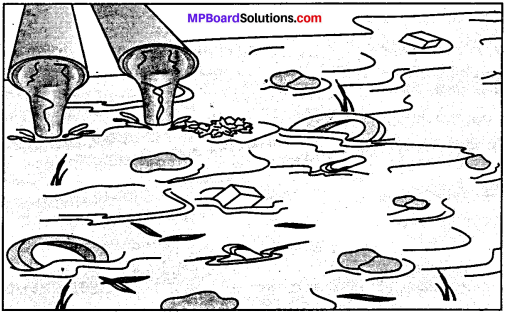
1. Watch the visual input very carefully and write an article in about 100 words on‘Water Pollution’. [2017]
आगे दिये गये चित्र को देखकर उसका संक्षेप में वर्णन कीजिए :
MP Board Class 12th General English Composition Based on Visual Input img 1
Answer:
Environment pollution is one of the major problems that our country is facing today—water pollution being a part of it. It has come as a result of rapid industrialisation. Industrial waste and sewage are freely discharged into rivers and lakes. Harmful chemicals and other unhygienic materials make their water unfit for drinking and other household purposes. The polluted water is also not suitable for irrigation and fishery or other allied activities. Efforts should be made to create awareness among people and check water pollution.

2. Give a short description covering the details of the picture given below:
नीचे दिये गये चित्र को देखकर उसका संक्षेप में वर्णन कीजिए:
MP Board Class 12th General English Composition Based on Visual Input img 2
Answer:

Birthday Celebration

Last month, I celebrated my birthday with great pomp and show. The house was beautifully and colourfully decorated. Pictures were hung on the walls. The floor was washed. Chairs and tables were arranged in a big hall. The party started’at 6 pm. with joy and laughter, I cut the cake and put out the candlesticks. The guests sang in chorus, “Happy Birthday to you”. They blessed me. They gave me good gifts. Then my brother served tea, biscuits and sweets to the guests. My father thanked all the guests for their kind visit and good wishes. In this way, we had a jolly good time.

3. Give a short description covering the details of the picture given below:
नीचे दिये गये चित्र के आधार पर एक संक्षिप्त पैराग्राफ लिखिए:
MP Board Class 12th General English Composition Based on Visual Input img 3
Answer:

Unity Is Strength

A king had three sons. But the king was not happy as his sons were always quarrelling among themselves. One day the king brought a bundle of sticks and asked his sons to break it. Each of them tried his best but could not break it. Then the king untied the bundle and asked his sons to break the sticks separately: They broke the sticks very easily. The king told them that none of them could break the sticks when they were tied together. But when they were untied, they were broken easily. Remember, ‘united we stand, divided we fall’. Real strength lies in unity.

4. Give a short description covering the details of the picture given ahead.
आगे दिये गये चित्र के आधार पर एक संक्षिप्त पैराग्राफ लिखिए।
MP Board Class 12th General English Composition Based on Visual Input img 4
Answer:

Save Trees, Save Life

As we all know that trees are very useful for us. They provide food and act as a shelter for human beings and animals. They keep the environment clean and healthy by taking in harmful carbon dioxide gas and exhaling life-giving gas oxygen. Thus, they maintain the balance of these gases in nature. They also help in bringing rain, which fulfils our need of water. Hence we can say that trees are very essential for life. Yet, today trees are being cut numberlessly and mercilessly for personal and commercial benefits. Big forests are now cleared at one shot. This mass clearing of trees is called deforestation. The rate of deforestation, today is highly increasing without caring about how will life be possible on earth without them. We can imagine what will happen without oxygen and water. Thus, we must save trees from being cut if we want life on earth. Hence, we must always say—Save Trees, Save Life.

MP Board Solutions

5. The picture below shows the various forms of child labour. Write in about 150 to 200 words describing the picture and give at least two suggestions how to educate these children continuously. [2015]
MP Board Class 12th General English Composition Based on Visual Input img 5
Answer:

Child Labour

Childhood is the best period of life. It is tragic that millions of children are forced to work instead of enjoying this period of life. It is ironic that while the youth is at large unemployed children are forced to work. Bare footed lean and thin children can be seen working at dhabas, industries, construction sites and even houses. Others can be seen selling newspapers, assisting motor mechanics & masons, working in factories and even begging. They are forced to work in unhealthy conditions for even fifteen to sixteen hours. They are ill fed and ill clad. They are beaten on trivial issues. They are ill-treated and underpaid. They are engaged in firecracker, match factories, chemical factories, carpet industry, silk industry and mining.

Moreover, they are bought and sold like commodities. Poverty and lack of education are the chief causes of it. Girls are more likely to be kept away from school, made to do the household work and. fall prey to child trafficking. The child labour act 1986, The Juvenile Justice of children Act 2000 and Right of children to Free and Compulsory Education Act 2009 besides the efforts of NGOs like Bachpan Bachao Andolan, Care India, Pratham are not sufficient to tackle this problem. It requires an effort from all the people. People should be made aware of the problems of the deprived and exploited children. The defaulters should be punished.

Exercises For Practice

1. Write a short description based on the picture given ahead :
आगे दिये गये चित्र के आधार पर एक संक्षिप्त पैराग्राफ लिखो:
MP Board Class 12th General English Composition Based on Visual Input img 6

MP Board Class 12th English Solutions

MP Board Class 12th Biology Solutions Chapter 5 Principles of Inheritance and Variation

MP Board Class 12th Biology Solutions Chapter 5 Principles of Inheritance and Variation

Principles of Inheritance and Variation NCERT Textbook Questions and Answers

Question 1.
Mention the advantage of selecting pea plant for experiment by MendeL
Answer:
Advantages of selecting pea plant:

  • Pea plant showed visible contrasting characters, e.g., seed colour, texture, plant height, flower colour, etc, it was easy to track the passing on of these characters in the progeny.
  • The pea flower remains closed and stamens and carpel are both present on the same flower. Therefore, it undergoes self-pollination and breeds true for traits (no mixing of gene pool).
  • It was easy to manipulate cross-pollination.
  • Many offspring’s produced in one generation.
  • Pea plant has short life cycle.
  • It is easy to grow.

Question 2.
Differentiate between the foifowing:
(a) Dominance and Recessive
(b) Homozygous and Heterozygous
(c) Monohybrid andDihybrid.
Answer:
(a) Dominance and Recessive:
When a cross is made between single pair of contrasting characters then the character one which expresses itself phenotypically in F1 generation is known as dominant whereas other allele or trait which fails to express itself is recessive, e.g., when cross is made between two plants of pea, one having pure red flowers (RR) and other having pure white flowers (rr). In F1 generation only red-flowered has appeared.
MP Board Class 12th Biology Solutions Chapter 5 Principles of Inheritance and Variation 1
(b) Differences between Homozygous and Heterozygous:
MP Board Class 12th Biology Solutions Chapter 5 Principles of Inheritance and Variation 2
(c) Differences between Monohybrid cross and Dihybrid cross:
MP Board Class 12th Biology Solutions Chapter 5 Principles of Inheritance and Variation 3

Question 3.
A diploid organism is heterozygous for 4 loci, how many types of gametes can be produced?
Answer:
Here, we apply the formula 2n where, n = number of loci. The organism is heterozygous for 4 loci
n=4
So, 2n = 24 = 2 × 2 × 2 × 2 = 16
The organism will produce 16 types of gametes.

Question 4.
Explain the law of Dominance using a monohybrid cross.
Answer:
MP Board Class 12th Biology Solutions Chapter 5 Principles of Inheritance and Variation 4
Monohybrid cross : Crossing between single pair of contrasting character, is known as monohybrid cross, e.g., hybridization between tall and dwarf plant of pea. All offspring of F1 generation of this cross will be tall. In F2 generation tall, hybrid tall and dwarf plants are produced in the ratio of 1:2:1. Thus, the genotypic ratio will be 1 TT: 2 Tt: 1 tt (1:2:1). The phenotypic ratio of F2 generation will be 3 : 1 (3TTand 1tt).

MP Board Solutions

Question 5.
Define and design a test-cross.
Answer:
Crossing of F1 individual having dominant phenotype with its homozygous recessive parent is called test cross. The test cross is used to determine whether the individuals exhibiting dominant character are homozygous or heterozygous.
MP Board Class 12th Biology Solutions Chapter 5 Principles of Inheritance and Variation 5

Question 6.
Using a punnett square, workout the distribution of phenotypic features in the first filial generation after a cross between a homozygous female and a heterozygous male for a single locus. .
Answer:
A cross between a homozygous female and heterozygous male follow two conditions :

Condition (1) : Homozygous female – TT (Tall)
Heterozygous male – Tt (Tall)
MP Board Class 12th Biology Solutions Chapter 5 Principles of Inheritance and Variation 6
Condition (2) : Homozygous female – tt (dwarf)
Heterozygous male – Tt (Tall)
MP Board Class 12th Biology Solutions Chapter 5 Principles of Inheritance and Variation 7

Question 7.
When a cross is made between tall plant with yellow seed (TtYy) and tall plant with green seed (Ttyy), what proportion of phenotype in the offspring could be expected to be:
(a) Tall and green
(b) Dwarf and green.
Answer:
MP Board Class 12th Biology Solutions Chapter 5 Principles of Inheritance and Variation 8
MP Board Class 12th Biology Solutions Chapter 5 Principles of Inheritance and Variation 9

Question 8.
Two heterozygous parents are crossed. If the two loci are linked what would be the distribution of phenotypic features in F1 generation for a dihybrid cross.
Answer:
In case two heterozygous parents, showing linkage result will be :
Parents BbLl × Bb Ll
Genotype : Blue long Blue long
Phenotype In F1 all the combinations may show parental characters as the genes are completely linked. With all possible genotypes in Fj progeny may exhibit blue long type of phenotype in above case. However in case of incomplete linkage parental combinations will be less in number.

Question 9.
Briefly mention the contribution of T.H. Morgan in genetics.
Answer:
T.H. Morgan (1866-1945) was given the Nobel prize. His contributions are:

  • Morgan worked on fruit fly Drosophila melanogaster and proposed the chromsomal theory of linkage.
  • He stated and established that genes are located on the chromosome.
  • He established the principle of linkage, crossing over, sex-linked inheritance and discovered the relationship between gene and chromosome.
  • He established the technique of chromosome mapping.
  • He observed and worked on mutation.

MP Board Solutions

Question 10.
What is pedigree analysis ? Suggest how such an analysis can be useful.
Answer:
1. Pedigree analysis is an important method to study human genetics because :

  • Human beings cannot be crossed at will.
  • The generation time is very long (about 20 years).
  • The number of offspring produced is small.

2. For pedigree analysis, information about the family’s history for a particular trait is first collected.
3. The expression of the trait is constructed in the form of a family tree.
4. In a pedigree, by convention :

  • Circles denote females.
  • Squares denote males.
  • Solid symbols represent the trait being studied.
  • Open symbols denote normal form.
  • Symbol with a cross line indicates a carrier for a recessive trait.
  • Parents are joined by horizontal lines.
  • The offsprings are connected to a horizontal line below the parents in the order of birth and the line is
  • connected to the parental line by a vertical line.

5. Pedigree analysis can yield valuable information about the possible genetic make up of a person for a trait.
MP Board Class 12th Biology Solutions Chapter 5 Principles of Inheritance and Variation 10
Functions : From pedigree analysis, we can find out, what kind of characters a new born baby is having. If this practice is done before marriage, we can be safe from many problems. It helps in finding the solution of hereditary problems.

Question 11.
How is sex-determined in human beings?
Answer:
Each cell of human beings contains 23 pairs of chromosomes. Out of 23 pairs, 22 pairs are similar and called as autosomes whereas 23rd pair is different from autosomes which are called as sex-chromosomes because they play important role in the determination of sex. In the cells of man, there are two types of sex chromosomes (XY) present while the cells of women have two similar sex chromosomes (XX). After spermatogenesis two types of sperms are formed, (i) One having 22 + X chromosomes and (ii) Other having 22 + Y chromosomes. But in woman there is only one type of ovum formed which contains 22 + X chromosomes only. At the time of fertilization when a sperm having 22 + X chromosomes is fused with ovum they produce a female child having two ‘XX’ chromosomes. But when a sperm having 22 + Y chromosomes is fused with ovum then resulting offspring will contain ‘XY’ sex chromosomes hence, it is male child.
MP Board Class 12th Biology Solutions Chapter 5 Principles of Inheritance and Variation 11

Question 12.
A child has blood group ‘O’. If the father has blood group ‘A’ and mother blood group ‘B’. Workout the genotypes of the parents and the possible genotypes of the other off springs.
Answer:
MP Board Class 12th Biology Solutions Chapter 5 Principles of Inheritance and Variation 12

Question 13.
Explain the following terms with example:
(a) Co-dominance
(b) Incomplete dominance.
Answer:
(a) Co-dominance : When the F1 generation resembles both the parents and both the parental characters are expressed simultaneously, then a phenomenon is called co-dominance.
For example: ‘AB’ type blood group is possible when allele ‘A’ and ‘B’ come together and since, both the alleles are expressing their effects in F1 generation, they are co-dominants.

(b) Incomplete dominance : It is a condition which occurs between dominant alleles in which one may be slightly more dominant than the other.
Example : As in Mirabilis jalapa if a red flowered plant is crossed with white flowered plant, then the resulting F1 hybrid bears pink coloured flowers only. This intermediate inheritance is called incomplete dominance. The F1 pink flowered plants when self-pollinated, give F2 progeny which contains red, pink and white flowers in the ratio of 1 : 2 : 1. The phenotypic and genotypic ratio is same in case of incomplete dominance.

Question 14.
What is point mutation? Give example.
Answer:
Point mutation: Gene mutation that occurs due to change in single base pair of DNA. It results in the incorporation of different DNA. Eg: Valine instead of glutamic acid in [3 -peptide in sickle cell anemia.]

MP Board Solutions

Question 15.
Who has proposed the chromosomal theory of inheritance?
Answer:
In 1902 Walter Sutton and Theodor Boveri proposed the ‘Chromosomal theory of inheritance’.

Question 16.
Mention 2 autosomal genetic disorders with their symptoms.
Answer:
(a) Sickle Cell Anaemia:- Autosomal Recessive (chr. 11)
Symptoms:- Anaemia due to RBC destruction.

(b) Phenylketonuria:- Autosomal Recessive (Chr.12)
Symptoms:- Brain fails to develop in infancy, mental retardation.

(c) Cystic Fibrosis:- Autosomal Recessive (Chr.7)
Symptoms:- Mucus clogging in lungs, liver, and pancreas.

Principles of Inheritance and Variation Other Important Questions and Answers

Principles of Inheritance and Variation Objective Type Questions

Choose the Correct Answer

Question 1.
What will the percent of ab types of gamete by the Aa Bb parents:
(a) 75%
(b) 50%
(c) 25%
(d) 12-5%.
Answer:
(d) 12-5%.

Question 2.
Who evolved DNA segregation and refinement techniques:
(a) Beadle and Tatum
(b) Carl Correns
(c) Watson and Crick
(d) Sutton and Boveri.
Answer:
(c) Watson and Crick

Question 3.
Who prescribed the word chromosome:
(a) Johannsen
(b) Waldeyer
(c) Benda
(d) de Duve.
Answer:
(b) Waldeyer

Question 4.
Two types of proteins which found in the eukaryotic chromosome:
(a) Conjugated and Complex protein
(b) Histone and Non-histone protein
(c) DNA and RNA
(d) Histone and DNA.
Answer:
(b) Histone and Non-histone protein

Question 5.
Heredity material which is found in the cytoplasm:
(a) Genome
(b) Plasmon
(c) Nucleosome
(d) Chromatid.
Answer:
(b) Plasmone

Question 6.
The main functions of the chromosome:
(a) Transfers of characters from parents to children
(b) Growth
(c) Respiration
(d) Reproduction.
Answer:
(a) Transfers of characters from parents to children

Question 7.
A bacteriophage is a heredity material:
(a) Single helix RNA
(b) Single helix DNA
(c) Double helix DNA
(d) Single helix RNA and Double helix DNA.
Answer:
(d) Single helix RNA and Double helix DNA.

MP Board Solutions

Question 8.
Word gene is indicated to:
(a) Part of DNA which is coded to the polypeptide
(b) A part of RNA
(c) Linkage group
(d) Sequence of amino acid of the protein.
Answer:
(a) Part of DNA which is coded to the polypeptide

Question 9.
What method of arrangement of genes on the chromosome is:
(a) Linear
(b) Oval
(c) Scattered
(d) Spiral.
Answer:
(a) Linear

Question 10.
The features do not appear in the first generation called:
(a) Dominant
(b) Recessive
(c) Special
(d) General.
Answer:
(b) Recessive

Question 11.
Who described the heredity of chlorophyll first:
(a) Correns
(b) Mendel
(c) Watson
(d) Sutton and Boveri.
Answer:
(c) Watson

Question 12.
Who observed the jumping genes of Maize:
(a) Jacob and Monod
(b) Beadle and Tatum
(c) Khurana
(d) Barbara Me Clintock.
Answer:
(d)Barbara Me Clintock

Question 13.
Genetic information which goes to offsprings from parents:
(a) Cytoplasmic heredity
(b) Nucleus heredity
(c) Genetic code
(d) All of these.
Answer:
(b) Nucleus heredity

Question 14.
What is the cytoplasmic unit of parental inheritance:
(a) Hormogon
(b) Plasmagene
(c) Genome
(d) None of these.
Answer:
(d) None of these.

Question 15.
All parental characters which are inherited by cytoplasm are called:
(a) Plasmone
(b) Caryotype
(c) Ideogram
(d) Phenotype
Answer:
(a) Plasmone

Question 16.
Which are found in cytoplasmic control and sterility:
(a) Maize
(b) Wheat
(c) Gram
(d) Rice.
Answer:
(b) Wheat

Question 17.
The model of sex determination in honeybees are called:
(a) Female monoploidy
(b) Single diploidy
(c) Gamete diploidy
(d) Gametogenesis.
Answer:
(a) Female monoploidy

Question 18.
Which are found in the unfertilized egg of human:
(a) Single Y Chromosome
(b) X and Y Chromosome
(c) XX Chromosome
(d) Single X Chromosome.
Answer:
(d) Single X Chromosome.

Question 19.
A hemophilic male and a normal female have married then offsprings are:
(a) Allhaemophilic
(b) Haemophilic female
(c) Haemophilic male
(d) All the normal.
Answer:
(d) All the normal.

Question 20.
Amniocentesis is a technique which is used in:
(a) Determine any disease in the heart
(b) Know about any disease in the brain
(c) Determine any hereditary disease in an embryo
(d) All of these.
Answer:
(c) Determine any hereditary disease in an embryo

Question 21.
Which base is not found in DNA:
(a) Guanine
(b) Cytosine
(c) Uracil
(d) Adenine.
Answer:
(c) Uracil

Question 22.
Plasmids are:
(a) Extra chromosome
(b) Extra nuclei
(c) Extra metabolic
(d) All of these.
Answer:
(a) Extra chromosome

MP Board Solutions

2. Fill in the Blanks:

  1. Genes which are found in some chromosomes are called …………………….
  2. Chromosomes are the carrier of …………………….
  3. ……………………. is the unit of mutation.
  4. ……………………. model is prescribed by Komberg.
  5. Without any changes, characters are transferred from one generation to another this process is called …………………….
  6. A ……………………. map is a graphic representation of the relative distance of genes.
  7. Sex-determination in a human occurs by ……………………. chromosome.
  8. The number of chromosomes in man’s sperm is …………………….

Answer:

  1. Linked chromosome
  2. Hereditary characters
  3. Muton
  4. Nucleosome
  5. Complete linkage
  6. Chromosome map
  7. Y
  8. Two.

3. Match the Following :
I.
MP Board Class 12th Biology Solutions Chapter 5 Principles of Inheritance and Variation 13
Answer:

  1. (c)
  2. (d)
  3. (a)
  4. (b)

II.

MP Board Class 12th Biology Solutions Chapter 5 Principles of Inheritance and Variation 14
Answer:

  1. (c)
  2. (d)
  3. (a)
  4. (b)

III.

MP Board Class 12th Biology Solutions Chapter 5 Principles of Inheritance and Variation 15
Answer:

  1. (c)
  2. (d)
  3. (a)
  4. (b)

IV.

MP Board Class 12th Biology Solutions Chapter 5 Principles of Inheritance and Variation 16
Answer:

  1. (d)
  2. (e)
  3. (a)
  4. (c)
  5. (b)

V.

MP Board Class 12th Biology Solutions Chapter 5 Principles of Inheritance and Variation 17
Answer:

  1. (c)
  2. (e)
  3. (a)
  4. (b)
  5. (d)

Question 4.
Answer in One Word/Sentence:

  1. Give an example of multiple allelism.
  2. Removal of anther from a floral bud.
  3. Name the set of two crosses in which two plants are used as parents of apposite-Sex one by one.
  4. The external appearance of an individual.
  5. What is the ratio of a dihybrid test cross?
  6. What is the genotypic ratio of a monohybrid cross?
  7. The allelic gene interaction in which homozygous dominant individual does not survive.
  8. Name the plant in which the inheritance of flower colour shows incomplete dominance.
  9. Who discovered the chromosomes?
  10. Name a chromosome having no centromere.
  11. What will be the sex of an individual (Human) having 44 + XX chromosomes?
  12. The chromatin part stains lightly on staining with basic dyes.
  13. Who proposed the nucleosome model of chromosomal structure?
  14. Who discovered Y-chromosome?
  15. What is another name of Bleeder’s disease?
  16. Name a plant in which genic sex determination is found.
  17. What type of male children are produced from a carrier mother and a normal father (For colour blindness)?
  18. Which type of sex determination is found in Coccinia Indica?
  19. Name the syndrome having XXY sex chromosomes.
  20. Name the twin’s development from two different fertilized ova.
  21. Which law is useful in the study of the frequency distribution of a gene in a population?
  22. Name the pigment lack of which cause albinism in human beings.
  23. Name the group of characteristics that identified a particular set of chromosomes.

Answer:

  1. Blood group in humans
  2. Emasculation
  3. Reciprocal crosses
  4. Phenotype,
  5. 1:1:1:1,
  6. 1:2:1
  7. Lafliality
  8. Mirabilis jalapa
  9. Strasburger
  10. Acentric
  11. Female
  12. Euchromatin
  13. Kornberg
  14. Stevens
  15. Haemophilia
  16. Asparagus
  17. 50% normal and 50% colour blind
  18. XX female and XY male mechanism
  19. Klinefelter’s syndrome
  20. Heterozygotic,
  21. Hardy-Weinberg law
  22. Melanin
  23. Karyotype.

MP Board Solutions

Principles of Inheritance and Variation Very Short Answer Type Questions

Question 1.
Name the method in which removal of the male reproductive organ from any bisexual flower.
Answer:
Emasculation.

Question 2.
What is pleiotrophy? Give one example.
Answer:
A phenomenon where one gene controls more than one phenotypic characters of an organism. Eg: In Pisum sativum, a gene that regulates colour of flowers also regulates the colour of seed coat.

Question 3.
What is one, two or more genes that when present together produce effect qualitatively distinct from the separate effect of any one of them?
Answer:
Complementary gene.

Question 4.
What is variation in genetics?
Answer:
The degree by which the progeny differs from the parents in a character.

Question 5.
What do you mean by the act or process of mating organisms of different varieties or species to create a hybrid?
Answer:
Hybridization.

Question 6.
What is a true-breeding line?
Answer:
It is one that has undergone continuous self-pollination and shows the stable trait inheritance and expression of it for several generations.

Question 7.
What do you mean by a factor which shows the single character in the cell?
Answer:
Allele.

Question 8.
Define genotype.
Answer:
The genetic constitution of an organism is called the genotype.

Question 9.
Which type of true breeding varities are selected by Mendel?
Answer:
14 types of true breeding verities are selected by mendel.

Question 10.
What is a dihybrid cross?
Answer:
The cross made between individuals of a species considering the inheritance of the contrasting pairs of 2 characters.

Question 11.
What is the phenotypic and genotypic ratio in dihybrid test cross?
Answer:
There are 1:1:1:1 ratio found in genotype and phenotype.

Question 12.
What is the importance of pedigree analysis?
Answer:
It reveals the ancestral history of an individual and its possible genotype for a trait.

Question 13.
What is the reason for frameshift mutation?
Answer:
A frameshift mutation is a genetic mutation caused by a deletion or insertion in a DNA sequence.

Question 14.
What are codominant alleles? Give one example.
Answer:
The genes of an allele morphs pair are not related as dominant or recessive but both are equally potent to express themselves in F1 hybrid. Eg: Blood group AB where alleles
IA and IB are codominant.

Question 15.
What is point mutation?
Answer:
A point mutation is a genetic mutation where a single nucleotide base is changed.

Question 16.
When a tall pea plant was self-pollinated, one-fourth of the progeny were dwarf. Give the genotype of all the parents + the dwarf progenies.
Answer:

  • Parent: Tt Dwarf
  • progenies: tt

Question 17.
Name the method in which the breakdown of a segment of a chromosome.
Answer:
Segregation.

Question 18.
Define the term heterozygous.
Answer:
It is an individual who possesses two different alleles of a character on its homologous chromosome.

Question 19.
When a third sex chromosome is added to the normal two in mammals, are called?
Answer:
Trisomic.

Question 20.
Define the law of the independent assortment of genes.
Answer:
The two genes of each character assort independently of the genes of other characters at the time of gamete formation and gets randomly rearranged in the offspring.

Question 21.
Disease in which blood clotting does not occur when injured any part
Answer:
Haemophilia.

Question 22.
Why is no glycoprotein found on the RBC’s of a person with ‘O’ blood groups?
Answer:
Glycoprotein found on the RBCs are coded by the dominant alleles, (IA and IB); since the person with the blood group “O” is homozygous recessive, no glycoprotein is found on RBCs.

Question 23.
What is the name of cell chromosome except sex chromosome?
Answer:
Autosomes.

Question 24.
What is gene pool?
Answer:
It is the genotypes of all the individuals in a population.

Question 25.
Write one example of sex-linked inheritance.
Answer:
Colour blindness.

Question 26.
Which type of sex determination found in human and Drosophila?
Answer:
X, Y type.

Question 27.
Which disease caused by point mutation?
Answer:
Sickle cell anaemia.

Question 28.
Why is Drosophila (male) referred to as heterogametic?
Answer:
Male drosophila produces 2 types of gametes i.e., X and Y. Therefore they are heterogametic.

Question 29.
What is a mutation?
Answer:
A mutation occurs when a DNA gene is damaged or changed in such a way as to alter the genetic message carried by that gene.

Question 30.
Define mutation.
Answer:
It is defined as the sudden heritable change in the base sequence of DNA or structure of chromosome or a change in the number of chromosomes, that changes the phenotype of an organism.

MP Board Solutions

Principles of Inheritance and Variation Short Answer Type Questions

Question 1.
Give reasons for Mendel’s success.
Answer:
Reasons for Mendel’s success are as follows :

  • Mendel selected seven pairs of traits in garden pea and used all the seven pairs of different characters individually.
    • He provided correct information of the quantitative method.
  • He explained correct ratio of phenotype.
  • Mendel did his experiment by correcting the previous work of scientists.
  • Experiment was done systematically and explained result clearly.

Question 2.
Explain test cross and back cross.
Answer:
Crossing of F1 hybrid with either of two parents is called as back cross. For example, when tall plant (TT) was crossed with dwarf plant (tt) then in Fi generation all plants are long (Tt) and when this F1 plants are crossed with any individual then called back cross. Whereas crossing of F1 individual with recessive parent is called test cross because it is used to test whether parents are homozygous or heterozygous.

Question 3.
What are plasmagenes?
Answer:
Genetic material presents outside the nucleus is called as plasmon or plasmagene e.g., Genetic material (DNA and RNA) present within mitochondria and chloroplast belonging to this category.

Question 4.
Explain the ratio of genotype and phenotype. (In non-hybrid cross).
Answer:
Monohybrid cross :

MP Board Class 12th Biology Solutions Chapter 5 Principles of Inheritance and Variation 18

Question 5.
Why did Mendel choose garden pea plants as experimental material?
Answer:
Mendel selected garden pea as experimental material because of the following reasons :

  • The life cycle of pea plant is short and is completed in few months and gives results in short-time.
  • Plants are easily cross-pollinated.
  • Presence of 7 pairs of contrasting characters.
  • The flowers of pea are bisexual and naturally self-pollinated.
  • The hybrids obtained from cross were fertile.
  • Emasculation can be easily done when androecium (anthers) are removed before maturity, then the plant
  • exhibits like a unisexual plant.

Question 6.
When a colour-blind man is married with a normal wpman, then work-out the progeny of these parents with the help of diagram only.
Answer:
MP Board Class 12th Biology Solutions Chapter 5 Principles of Inheritance and Variation 19

Question 7.
What is Down’s Syndrome?
Answer:
Down’s Syndrome: It is a common human karyotype in which trisomy occur at 21st chromosome. This type of person contains 47 chromosomes. It was first studied by Down (1866) and was popularly known as Mongolian idiocy because the facial features of persons suffering from Down’s syndrome resembled Mongolians. They have broad forehead, flat hands, short neck, projecting lips, stubby fingers and long extending tongue. The Mongoloid individuals are feeble minded and their mental age never exceeds to those of six to seven year’s old children.

Question 8.
Write Differences between Genotype and Phenotype.
Answer:
Differences between Genotype and Phenotype:
MP Board Class 12th Biology Solutions Chapter 5 Principles of Inheritance and Variation 20

Question 9.
What are plasmids? Describe its characters.
Answer:
Plasmids: Plasmids are extrachromosomal, extranuclear, self-replicating, covalently closed DNA molecules. These plasmids also play an important role in the transmission of hereditary characters. Plasmids are generally found in bacterial cell in addition to bacterial chromosomes. The discoverer of plasmid is William Hays and Lederberg.

Characters of plasmids:

  • Plasmids are extranuclear DNA molecules.
  • These are smaller than chromosomes.
  • These possess the capacity of self-replication.
  • They can transfer the genes from donor to recipient cells, they act as the vector molecule of DNA.
  • They have a capacity of integration with host DNA hence, it is used in genetic engineering.

Question 10.
What is pedigree analysis? How such an analysis can be useful?
Answer:
In human genetics controlled crosses are not possible. Pedigree analysis provide a strong tool to study the family history inheritance of a particular trait. It is uitlised to trace the inheritance of any particular abnormality or disease.

Question 11.
What do you understand by the reciprocal cross?
Answer:
Reciprocal cross: A set of two reciprocal crosses means that the same two parents are used in two experiment in such a way that:

  1. In one experiment, ‘A’ is used as the female parent and ‘B’ is used as the male parent.
  2. In the other experiment, ‘A’ will be the male parent and ‘B’ the female parent.

Question 12.
What is point mutation? Give an example.
Answer:
The mutation that arises due to change in a single base pair of DNA, is known as a point mutation. Eg: sickle cell anemia.

Question 13.
What do you understand by Multiple alleles? Explain it with an example.
Answer:
Multiple alleles: There are two alternative forms of each trait for the seven pairs of contrasting characters studied by Mendel. It means that there are two alleles for each trait. The first allele will be dominant and the other will be recessive. But further studies show that there are two or more alternative forms of a gene or allele, which are known as multiple alleles.

Example: (i) The skin colour of rabbit is due to the presence of four alleles of a gene.
(ii) A well-known example of multiple alleles is ABO blood type in human beings. The four human blood groups ‘A’, ‘B’ ‘AB’ and ‘O’ are the four phenotypes for this trait. Persons having ‘A’ blood group have ‘A’ type of glycoprotein (antigen) coating the red blood cells and persons having ‘B’ blood group have ‘B’ type of glycoprotein (antigen) coating the red blood cells. Persons having ‘AB’ blood group have both types of glycoproteins i.e., ‘A’ and ‘B’ antigens coating the red blood cells, while persons having ‘O’ blood group do not have any glycoprotein on R.B.Cs.

MP Board Solutions

Question 14.
Give the chromosomal constitution and the resulting sex in each of the following syndromes.
(a) Turner’s syndrome
(b) Klinefelter’s syndrome
Answer:
Turner’s syndrome – 22 pairs of autosomes and one X chromosome.
(44 + XO = 45 chromosome)
The resulting individual is female. Klinefelter’s syndrome – 22 pairs of autosomes and XXY = [44 + XX Y = 47 chromosomes].
The resulting individual is male with more female character.

Question 15.
Explain recessive epistasis with example.
Answer:
Recessive epistasis (9: 3 :4): In case of recessive epistasis, the epistatic gene is recessive to its own allele. Thus, in this condition, the epistatic gene can have its inhibiting influence only when it is in homozygous condition.

The inheritance of body colour in mice is an example of recessive epistasis. It may have three body colours i.e., agouti, coloured and albino. The agouti body colour is controlled by a dominant gene ‘A’. Another dominant gene ‘C’ gives coloured body only in the absence of dominant ‘A’ gene. The expression of agouti body colour by gene ‘C’ is inhibited by recessive gene ‘C’. Therefore, even in the presence of ‘A’ gene, the mice develop albino body colour if recessive genes ‘CC’ are present.

Question 16.
The human male never passes on the gene for hemophilia to his son. Why?
OR
Why do sons of hemophilia father never suffer from this trait?
Answer:
The genes for hemophilia are present on the ‘X’ chromosome only. A male has only one ‘X’ chromosome. Which he receives from his mother. He receives the ‘Y’ chromosome from his father. The human male passes the ‘X’ chromosomes to his daughters, not to the male progeny.

Question 17.
What is Turner’s Syndrome?
Answer:
Turner’s Syndrome: It is a disorder arising from chromosomal abnormalities. The cells of a person suffering from this disease contain 45 chromosomes (44 A + X) only. Cytologically, they can be recognized by the presence of only one X-chromosome (XO female). They are female in general appearance with underdeveloped breasts, broad chest, webbed neck, low set ears, poorly developed ovaries. They are sterile females, often short and of subnormal intelligence.

Question 18.
When a hemophilic man is married to a normal woman then workout the progeny of these parents with the help of a diagram only.
Answer:
When a hemophilic man is married to a normal woman, all sons will be normal whereas daughters will be carriers.
MP Board Class 12th Biology Solutions Chapter 5 Principles of Inheritance and Variation 21
Fig. Offspring of hemophilic man and normal woman.

Question 19.
Why human males are generally suffering from baldness but women are not suffering from it?
Answer:
The genes responsible for baldness are found in autosomes but are expressed by sex-linked genes. The baldness is also caused due to irradiation, abnormal functioning of thyroid gland and abnormality in heredity. Genetical baldness depends upon an autosomal allelomorph (Bb). When ‘BB’ occurs in the form of dominant homozygous then man and woman both suffer from this disease whereas it occurs in heterozygous stage (Bb) in man only because a male hormone is required for their development, hence woman does not suffer from baldness. Baldness is not expressed in the recessive homozygous stage (bb).

Question 20.
Describe the inheritance of color-blindness in the offspring of a color-blind man and carrier woman with the help of suitable ray diagram.
Answer:
When a colour-blind man is married with a carrier woman, 25% boys will be colour-blind and 25% boys will be normal whereas 25% girls will be colour-blind and 25% girls offspring become carrier of colour-blindness. In other words, we can say that 50% offspring would be colour-blind, 25% normal and the remaining 25% offspring will be carrier of colour-blindness.
MP Board Class 12th Biology Solutions Chapter 5 Principles of Inheritance and Variation 22

MP Board Solutions

Question 21.
Explain the inheritance of haemophilia when a haemophilic woman is married to normal man with the help of diagram.
Answer:
When a haemophilic woman is married with a normal man, all the boys offspring will be haemophilic whereas all the girls offspring will be carrier of haemophilia. In other words, 50% offsprings will be haemophilic and 50% offsprings will be carrier.
MP Board Class 12th Biology Solutions Chapter 5 Principles of Inheritance and Variation 23

Question 22.
What are the reasons for success of Mendel’s experiment on pea plant.
Answer:

  • Mendel studied one or two characters at a time for his breeding experiment
  • He selected only those traits for his experiments which did not exhibit linkage or incomplete dominance.
  • He performed the reciprocal crosses to confirm the validity of the correct ratio.
  • He performed his experiment on F2 + F3 generation.
  • He selected true-breeding varieties of pea plant for cross-pollination.
  • He performed an emasculation process to prevent self-pollination.
  • He maintained complete records of all his ‘ experiments and used statistical method and law of probability for analysing his results.
  • He took great care in finding and choosing the true-breeding plants genetically.

Principles of Inheritance and Variation Long Answer Type Questions

Question 1.
Write down the law of segregation.
Or
Describe Mendel’s law of segregation with example.
Answer:
According to law of segregation, two genes of a character separate and get distributed randomly to different gametes and then to different offspring as per the law of probability. In other words, genes for each trait segregate without mixing.

When a cross is made between pure tall pea plant and dwarf pea plant, it gives rise to tall plant in the F1 generation. On self-breeding both tall and dwarf plants appear in F2 generation in the ratio of 3 : 1. This ratio can be achieved only if the two factors separate at the time of gamete formation and only one factor passes into gamete. Therefore, this law is also called as law of purity of gametes.

Question 2.
Explain Complementary gene (9:7) with example.
Answer:
Complementary genes (9:7): The complementary genes are the two pairs of non-allelic genes which are present on separate loci and interact to produce only one phenotypic trait but either of them if present alone produces the phenotypic trait in the absence of other.

The example of complementary gene interaction was provided by Bateson and Punnet in sweet pea (Lathyrus odoratus). He demonstrated that two dominant genes ‘C’ and ‘P’ are responsible for the development of purple coloured flowers in a plant of sweet pea. The dominant gene ‘P’ or ‘C’ in homozygous (PP and CC) and heterozygous (Pp and Cc) state are unable to produce their effect if they are present alone. They observed that when two white-flowered plants are crossed with each other, the F1 have coloured flowers.

This is due to the fact that crossing between two white-flowered plants brought together two non-allelic dominant genes in Ft. On intercrossing, these Fi progenies produced coloured and white-flowered plants in 9:7 ratio (Fig.).
MP Board Class 12th Biology Solutions Chapter 5 Principles of Inheritance and Variation 24
MP Board Class 12th Biology Solutions Chapter 5 Principles of Inheritance and Variation 24a

Question 3.
Explain the Law of Independent Assortment of Characters.
Answer:
The gametes and zygotes usually carry several chromosomes which are different in appearance and perhaps in contents. The genotype consists of many pairs of genes. Although chromosomes were not known to Mendel yet he felt the need of finding out how different characters would behave in relation to each other in their passing from generation to generation. This also could be demonstrated with two pairs of opposite characters. Such a cross which involves two character differences separable in inheritance is termed as a dihybrid cross. For example, taking parents round yellow pea and a wrinkled green pea (Fig.).

Round, yellow (RY) : Dominant characters Wrinkled,
green (ry) : Recessive characters.
MP Board Class 12th Biology Solutions Chapter 5 Principles of Inheritance and Variation 25

Question 4.
What is the chromosomal theory of inheritance?
Answer:
In 1902, Sutton and Boveri proposed a theory to explain the inheritance of characters. This theory is known as the chromosomal theory of inheritance.

The main points of this theory are as follows:

  • Chromosomes and factors are found in pairs in diploid cells.
  • Chromosomes and factors get separated during the formation of gametes.
  • During transmission of characters, only one chromosome and factor is transmitted to offspring.
  • The pairing between homologous chromosomes and factor occurs after fertilization.

Question 5.
What is crossing over?
Or
Explain crossing over.
Or
Write the process of crossing over with diagram that occurs during meiosis.
Answer:
Exchange of chromosomal segments between two homologous chromosomes during diplotene of meiosis I division is called as crossing over. When homologous chromosomes tend to start their separation due to repulsion during diplotene, they are bounded
MP Board Class 12th Biology Solutions Chapter 5 Principles of Inheritance and Variation 26

In some places. These places are called Chiasmata. Due to the process of terminalization chiasmata start to move along the length of the chromosome from the centromere. The terminalization of chiasmata will result in the formation of ‘X’-shaped configuration in which breakage of chromosomal segments takes place, then these segments are reunited in a manner in which the segments of non-sister chromosomes are exchanged. This exchange of chromosomal segments or genes of homologous chromosomes is termed as crossing over. This process is very important because it originates new characters and causes variations in the organisms.

MP Board Solutions

Question 6.
Explain sex-linkage by giving example of haemophilia.
Or
What is sex-linkage? Describe the inheritance of haemophilia on the basis qf sex linkage.
What is sex-linkage? Explain with suitable example.
Answer:
Genes that are formed on sex chromosomes and are inherited together are called linked genes and the process is called sex-linked inheritance of sex-linkage.

Inheritance of haemophilia in man : Haemophilia is a sex-linked disease in which patient losses the capacity of blood clotting during bleeding. This disease is caused by a recessive gene present on the X-chromosomes (Xh). A man possessing a single recessive gene suffers from the disease because the Y-chromosome does not contain any gene (XhY). A carrier women shall have only one gene of the disease (XXh). She does not suffer from the disease because of the presence of the normal gene on the second sex chromosomes.
MP Board Class 12th Biology Solutions Chapter 5 Principles of Inheritance and Variation 27

We can understand the process of inheritance of haemophilia by the following examples:

1. Inheritance of haemophilia in offspring of a normal father and carrier mother: 50%
children (25% boys + 25% girls) of these parents are normal, 25% boys are haemophilic and 25% girls are carrier of this disease.

2. Inheritance of haemophilia in the offspring of haemophilic man and normal woman : All the boys of these parents will be normal while all the girls will be carrier of the disease.

3. Inheritance of haemophilia in the offspring of normal man and haemophilic woman : All die boys of these parents will be haemophilic and all the girls will be carrier of the disease.

4. Inheritance ofhaemophilia in the offspring ofhaemophilic man and carrier woman : The 25% boys of this parents will be haemophilic and 25% boys will be normal while 25% girls will be haemophilic and remaining 25% girls will be carrier of the disease.

Question 7.
What is linkage? It is of how many types?
Answer:
Linkage : The tendency of genes inherited together, without independent assortment is called linkage and such genes are linked genes. Such genes are closely situated showing a strong attraction between them. Linkage always reduces the changes of crossing over. All those genes which are located in the single chromosome from one linkage
group. The linkage groups correspond to the haploid number of chromosomes of a species or number of chromosomes pairs. Thus, the linkage groups in maize would be 10,7 in pea, 4 in Drosophila, 23 in man etc.

Types of Linkages :

T.H. Morgan along with Castle working on Drosophila discovered the following types of linkage:

1. Complete linkage : It is the phenomenon in which parental combination of characters appear together for two or more generations continuously.
Example: Genes for bent wings and shaven bristles in Drosophila melanogaster.

2. Incomplete linkage : In this phenomenon the linked genes may remain together for one generation only and have chances of separation in subsequent generation, because of crossing over.
Example : Genes for grey body and long wings characters.

Question 8.
What is gene mutation ? Explain the causes of gene mutation.
Answer:
Gene mutation : Genes are responsible for the transmission of hereditary characters from generation to generation. Sometimes few sudden changes in the structure and arrangement of genes take place which result in the production of new characters. These sudden changes in genes are called as gene mutation.

Causes of gene mutation :

  • According to Beadle and Tatum, mutations occurs due to the physical and chemical changes in genes during reproduction.
  • According to Rasowsky, X-rays also cause mutation.
  • According to Muller, radioactive radiations also cause mutations.
  • According to Guber and Smith, some antibiotics also cause mutation.
  • Sudden changes during reproduction also cause mutation.
  • Changes in the number of chromosomes.

Question 9.
What is incomplete linkage and complete linkage ?
Answer:
When there are chances of separation of linked genes, it is called incomplete linkage. In this type of linkage, genes are situated at distance. During crossing over in meiosis, probability of separation of genes increases. In maize incomplete linkage is found.

When there are no chances of separation of linked genes, it is called complete linkage. Complete linkage takes place due to the non-break in the gene combination, situated on any chromosome. It is found is Drosophila and other insects.

Question 10.
Explain the types of sex chromosomes.
Answer:
Mainly sex chromosomes are of two types :
(A) Autosomes
(B) Sex chromosomes or Allosomes.

(A) Autosomes : That carry genes for body characters and general physiological activities. The two members of each homologous pair are similar in shape and size.
(B) Sex chromosomes : That carry genes for sex. A pair of them determines the sex. They are of following types :

1. XX and XY method of sex determination: In majority of animals female have XX sex-chromosome and male have XY. The females are homogametic and produce ova of one type of X chromosome. Male are heterogametic, they produce two types of sperms X and Y chromosomes. It means sex chromosomes in female are homomorphic and of male are heteromorphic.
Examples: Drosophila and man.

2. XX-XO method of sex determination: In this case female have two homomorphic sex chromosomes XX. They produce all ovas with X chromosomes. The males have only one X chromosomes, there is no Y chromosome. Example: Birds, Butterflies, Fishes and etc.

MP Board Solutions

Question 11.
Explain the chromosomal theory of linkage.
Answer:
Chromosomal theory of linkage was produced by Morgan and Castle in 1911. The main points of this hypothesis are :

  1. Linked genes are found on a chromosome.
  2. The strength of linkage depends upon the distance between genes.
  3. Two nearest genes exhibit linkage while genes exhibit crossing over.
  4. All linked genes are found on a particular place on the chromosomes and are arranged in a linear fashion.

Question 12.
Explain the inheritance of colour-blindness when the man is blind and woman is normal.
Answer:
Colour blindness : It is a genetic disease. It is an inability to distinguish red from green. The recessive gene C, for the trait is carried by ‘X’ chromosomes, ‘Y’ chromosome has no corresponding gene. A single gene C, on ‘X’ chromosome is sufficient to express itself in the male. Female are generally carrier of the disease in such cases.
Example : The inheritance of colour-blindness in the offspring of a normal woman and colour blind man are as follow:
MP Board Class 12th Biology Solutions Chapter 5 Principles of Inheritance and Variation 28
Ratio : 50% offsprings are carrier and 50% offsprings are normal. In other words all the girls will be carrier of colour blindness whereas all the boys will be normal.

MP Board Class 12th Biology Solutions

MP Board Class 11th Maths Solutions Chapter 11 शंकु परिच्छेद Ex 11.3

MP Board Class 11th Maths Solutions Chapter 11 शंकु परिच्छेद Ex 11.3

निम्नलिखित प्रश्नों 1 से 9 तक प्रत्येक दीर्घवृत्त में नाभियों और शीर्षों के निर्देशांक, दीर्घ और लघु अक्ष की लंबाइयाँ, उत्केंद्रता तथा नाभिलंब जीवा की लम्बाई ज्ञात कीजिए।
प्रश्न 1.
\(\frac{x^{2}}{36}+\frac{y^{2}}{16}\) = 1
हल:
MP Board Class 11th Maths Solutions Chapter 11 शंकु परिच्छेद Ex 11.3 img-1

प्रश्न 2.
\(\frac{x^{2}}{4}+\frac{y^{2}}{25}\) = 1
हल:
MP Board Class 11th Maths Solutions Chapter 11 शंकु परिच्छेद Ex 11.3 img-2
दीर्घ अक्ष की लंबाई = 2a = 2 × 5 = 10
लघु अक्ष की लंबाई = 2b = 2 × 2 = 4
उत्केंद्रता = e = \(\frac{c}{a}=\frac{\sqrt{21}}{5}\)
नाभिलंब जीवा की लंबाई = \(\frac{2 b^{2}}{a}=\frac{2 \times 4}{5}=\frac{8}{5}\).

MP Board Solutions

प्रश्न 3.
\(\frac{x^{2}}{16}+\frac{y^{2}}{9}\) = 1
हल:
MP Board Class 11th Maths Solutions Chapter 11 शंकु परिच्छेद Ex 11.3 img-3

प्रश्न 4.
\(\frac{x^{2}}{25}+\frac{y^{2}}{100}\) = 1
हल:
दीर्घवृत्त का समीकरण \(\frac{x^{2}}{25}+\frac{y^{2}}{100}\) = 1
∴ a2 = 100, b2 = 25
∴ a = 10, b = 5
∴ c2 = a2 – b2 = 100 – 25 = 75
∴ c = 5\(\sqrt{3}\)
नाभि के निर्देशांक (0, ± c) या (0, ± 5\(\sqrt{3}\))
शीर्षों के निर्देशांक (0, ± a) या (0, ± 10)
दीर्घ अक्ष की लंबाई = 2a = 2 × 10 = 20
लघु अक्ष की लंबाई = 2b = 2 × 5 = 10
MP Board Class 11th Maths Solutions Chapter 11 शंकु परिच्छेद Ex 11.3 img-4

प्रश्न 5.
\(\frac{x^{2}}{49}+\frac{y^{2}}{36}\) = 1
हल:
दीर्घवृत्त का समीकरण \(\frac{x^{2}}{49}+\frac{y^{2}}{36}\) = 1
∴ a2 = 49, b2 = 36
∴ a = 7, b = 6
दीर्घ अक्ष, x-अक्ष के अनुदिश है
c2 = a2 – b2 = 49 – 36 = 13
c = \(\sqrt{13}\)
नाभियों के निर्देशांक (± c, 0) या (± \(\sqrt{13}\), 0)
शीर्षों के निर्देशांक (± a, 0) या (± 7, 0)
दीर्घ अक्ष की लंबाई = 2a = 2 × 7 = 14
लघु अक्ष की लंबाई = 2b = 2 × 6 = 12
MP Board Class 11th Maths Solutions Chapter 11 शंकु परिच्छेद Ex 11.3 img-5

MP Board Solutions

प्रश्न 6.
\(\frac{x^{2}}{100}+\frac{y^{2}}{400}\) = 1
हल:
दीर्घवृत्त का समीकरण \(\frac{x^{2}}{100}+\frac{y^{2}}{400}\) = 1
∴ a2 = 400, b2 = 100
∴ a = 20, b = 10
c2 = a2 – b2 = 400 – 100 = 300
∴ c = 10\(\sqrt{3}\)
दीर्घ अक्ष, y- अक्ष के अनुदिश है
नाभियों के निर्देशांक (0, ± c) या (0, ± 10\(\sqrt{3}\))
शीर्षों के निर्देशांक (0, ± a) या (0, ± 20)
दीर्घ अक्ष की लंबाई = 2a = 2 × 20 = 40
लघु अक्ष की लंबाई = 2b = 2 × 10 = 20
MP Board Class 11th Maths Solutions Chapter 11 शंकु परिच्छेद Ex 11.3 img-6

प्रश्न 7.
36x2 + 4y2 = 144.
हल:
दीर्घवृत्त का समीकरण 36x2 + 4y2 = 144
या \(\frac{x^{2}}{4}+\frac{y^{2}}{36}\) = 1
∴ a2 = 36, b2 = 4
∴ a = 6, b = 2
∴ c2 = a2 – b2 = 36 – 4 = 32
∴ c = 4\(\sqrt{2}\)
दीर्घवृत्त का अक्ष, y-अक्ष के अनुदिश है
नाभियों के निर्देशांक (0, ± c) या (0, ± 4\(\sqrt{2}\))
शीर्षों के निर्देशांक (0, ± a) या (0, ± 6)
दीर्घ अक्ष की लंबाई = 2a = 2 × 6 = 12
लघु अक्ष की लंबाई = 2b = 2 × 2 = 4
MP Board Class 11th Maths Solutions Chapter 11 शंकु परिच्छेद Ex 11.3 img-7

प्रश्न 8.
16x2 + y2 = 16.
हल:
दीर्घवृत्त का समीकरण 16x2 + y2 = 16
या \(\frac{x^{2}}{1}+\frac{y^{2}}{16}\) = 1
∴ दीर्घवृत्त का अक्ष, y-अक्ष के अनुदिश है।
a2 = 16, b2 = 1
∴ a = 4, b = 1
c2 = a – b2 = 16 – 1 = 15
∴ c = \(\sqrt{15}\)
नाभियों के निर्देशांक (0, ± c) या (0, ± \(\sqrt{15}\))
शीर्षों के निर्देशांक (0, ± a) या (0, ± 4)
दीर्घ अक्ष की लंबाई = 2a = 2 × 4 = 8
लघु अक्ष की लंबाई = 2b = 2 × 1 = 2
MP Board Class 11th Maths Solutions Chapter 11 शंकु परिच्छेद Ex 11.3 img-8

MP Board Solutions

प्रश्न 9.
4x2 + 9y2 = 36.
हल:
दीर्घवृत्त का समीकरण 4x2 + 9y2 = 36
या \(\frac{x^{2}}{9}+\frac{y^{2}}{4}\) = 1
दीर्घ अक्ष, x-अक्ष के अनुदिश है।
∴ a2 = 9, b2 = 4
∴ a= 3, b = 2
c2 = a2 – b2 = 9 – 4 = 5
∴ c = \(\sqrt{5}\)
नाभियों के निर्देशांक (± c, 0) या (± \(\sqrt{5}\), 0)
शीर्षों के निर्देशांक (± a, 0) या (± 3,0)
दीर्घ अक्ष की लंबाई = 2a = 2 × 3 = 6
लघु अक्ष की लंबाई = 2b = 2 × 2 = 4
MP Board Class 11th Maths Solutions Chapter 11 शंकु परिच्छेद Ex 11.3 img-9

निम्नलिखित प्रश्नों 10 से 20 तक प्रत्येक में, दिए प्रतिबंधों को संतुष्ट करते हुए दीर्घवृत्त का समीकरण ज्ञात कीजिए।
प्रश्न 10.
शीर्षों (± 5, 0), नाभियाँ (± 4, 0).
हल:
a = 5, c = 4, c2 = a2 – b2
या 16 = 25 – b2
∴ b2 = 25 – 16 = 9
और a2 = 25
दीर्घवृत्त का समीकरण,
\(\frac{x^{2}}{25}+\frac{y^{2}}{9}\) = 1

प्रश्न 11.
शीर्षों (0, ± 13), नाभियाँ (0, ± 5).
हल:
दीर्घ अक्ष, y-अक्ष के अनुदिश है।
∴ c = 5, a = 13, c2 = a2 – b2
∴ 25 = 169 – b2
∴ b2 = 169 – 25 = 144,
और a2 = 132 = 169
∴ दीर्घवृत्त का समीकरण
\(\frac{x^{2}}{144}+\frac{y^{2}}{169}\) = 1

प्रश्न 12.
शीर्ष (± 6, 0), नाभियाँ (± 4, 0).
हल:
दीर्घ अक्ष x-अक्ष के अनुदिश है।
a= 6, ∴ a2 = 36, c = 4
c2 = a2 – b2 या 16 = 36 – b2
∴ b2 = 36 – 16 = 20
∴ दीर्घवृत्त का समीकरण
\(\frac{x^{2}}{36}+\frac{y^{2}}{20}\) = 1.

MP Board Solutions

प्रश्न 13.
दीर्घ अक्ष के अंत्य बिन्दु (± 3, 0), लघु अक्ष के अंत्य बिन्दु (0, ± 2).
हल:
दीर्घ अक्ष x-अक्ष के अनुदिश है।
a = 3, b = 2, ∴ a2 = 9, b2 = 4
दीर्घवृत्त का समीकरण,
\(\frac{x^{2}}{9}+\frac{y^{2}}{4}\) = 1

प्रश्न 14.
दीर्घ अक्ष के अंत्य बिन्दु (0, ± \(\sqrt{5}\)), लघु अक्ष के अंत्य बिन्दु (± 1, 0).
हल:
दीर्घ अक्ष, y-अक्ष के अनुदिश है।
a = \(\sqrt{5}\), b = 1, ∴ a2 = 5, b2 = 1
दीर्घवृत्त का समीकरण,
\(\frac{x^{2}}{1}+\frac{y^{2}}{5}\) = 1

प्रश्न 15.
दीर्घ अक्ष की लंबाई = 26, नाभियाँ (45, 0).
हल:
दीर्घ अक्ष, x-अक्ष के अनुदिश है।
और 2b = 26, ∴ b = 13 या a2 = 169,
c = 5, c2 = 25 = a2 – b2 = 169 – b2
∴ b2 = 169 – 25 = 144
अतः a2 = 169, b2 = 144
∴ दीर्घवृत्त का समीकरण,
\(\frac{x^{2}}{169}+\frac{y^{2}}{144}\) = 1.

प्रश्न 16.
दीर्घ अक्ष की लंबाई = 16, नाभियाँ (0, ± 6).
हल:
दीर्घ अक्ष, y-अक्ष के अनुदिश है।
2b = 16, ∴ b = 8 या b2 = 64,
c = 6, c2 = 36,
c2 = a2 – b2
या 36 = a2 – 64
∴ a2 = 64 + 36 = 100
∴ दीर्घवृत्त का समीकरण
\(\frac{x^{2}}{64}+\frac{y^{2}}{100}\) = 1

प्रश्न 17.
नाभियाँ (± 3, 0), a = 4.
हल:
दीर्घ अक्ष, x-अक्ष के अनुदिश है।
∴ c = 3, a = 4
अब c2 = a2 – b2
या 9 = 16 – b2
∴ b2 = 16 – 9 = 7
∴ दीर्घवृत्त का समीकरण,
\(\frac{x^{2}}{16}+\frac{y^{2}}{7}\) = 1

MP Board Solutions

प्रश्न 18.
b = 3, c = 4, केन्द्र मूल बिन्दु पर, नाभियाँ x-अक्ष पर है।
हल:
दीर्घ अक्ष, x-अक्ष के अनुदिश है
c2 = a2 – b2
16 = a2 – 9
a2 = 16 +9 = 25
∴ दीर्घवृत्त का समीकरण,
\(\frac{x^{2}}{25}+\frac{y^{2}}{9}\) = 1

प्रश्न 19.
केंद्र (0, 0) पर, दीर्घ अक्ष y-अक्ष पर और बिन्दुओं (3, 2) और (1, 6) से जाता है।
हल:
MP Board Class 11th Maths Solutions Chapter 11 शंकु परिच्छेद Ex 11.3 img-10

प्रश्न 20.
दीर्घ अक्ष,x-अक्ष पर और बिन्दुओं (4, 3), (6, 2) से जाता है।
हल:
मान लीजिए दीर्घवृत्त का समीकरण \(\frac{x^{2}}{a^{2}}+\frac{y^{2}}{b^{2}}\) = 1
MP Board Class 11th Maths Solutions Chapter 11 शंकु परिच्छेद Ex 11.3 img-11
∴ दीर्घवृत्त का समीकरण,
\(\frac{x^{2}}{52}+\frac{y^{2}}{13}\) = 1

MP Board Class 11th Maths Solutions

MP Board Class 12th Biology Solutions Chapter 12 Biotechnology And its Application

MP Board Class 12th Biology Solutions Chapter 12 Biotechnology And its Application

Biotechnology And its Application NCERT Text Book Questions and Answers

Question 1.
Crystals of Bt toxin produced by some bacteria do not kill the bacteria themselves because:
(a) Bacteria are resistant to the toxin,
(b) Toxin is immature
(c) Toxin is inactive
(d) Bacteria enclose toxin in a special sac
Answer:
(c) Toxin is inactive. This is because it exists as protoxin, inactive form in bacteria.

Question 2.
What are transgenic bacteria? Illustrate using any one example.
Answer:
The bacteria whose DNA is manipulated to carry and express a foreign DNA is called transgenic bacteria. These microbes are used for producing important biochemicals. They have been synthesizing alcohol, enzymes, steroids and antibiotics. Example: Bacillus thuringiensis for Bt cotton, hirudin from transgenic Brassica napus seed. Hirudin is a protein which prevents blood clotting. Its gene was chemically synthesized and introduced in Brassica napus, in which hirudin accumulates in the seed from where it is extracted, purified and used as a medicine.

Question 3.
Compare and contrast the advantages and disadvantages of the production of genetically modified crops.
Answer:
Advantages:

  • Crop plants can be made to grow fast and produce high yields through genetic modification.
  • G.M crops increased the efficiency of mineral usage by plants.
  • G.M crops helped to reduce post-harvest losses.
  • It enhances the nutritional value of food, eg: Vitamin A enriched rice.
  • Transgenic plants can produce pharmaceuticals like insulin, interferons blood clotting factors, hormones, etc.
  • Resistance to viral diseases has been introduced in Tobacco, potato, tomato, and rice. Cry gene from bacillus has been introduced in Bt. cotton and Bt. Corn. Nematode infection has been overcome in some plants through RNA interference.
  • Plants have been modified genetically to produced biodiesel and other commercial products.

Disadvantages:

  • G.M. crops may cause problems in human health by supplying allergens and transferring antibiotic resistance markers.
    (b)These crops may come damage to the natural environment.
  • Weedicide genes are being introduced into crop plants some of these crops may become superweeds
  • Trans genes can be transferred from one plant to another plant, microbes, and even animals. It shall disturb the genetic set of organisms and cause ecological imbalance.
  • Cry genes being introduced in crop plants can pass into wild vegetation. Insects feeding on pollen and other parts will be killed resulting in the destruction of pollination and disseminators.

MP Board Solutions

Question 4.
What are Cry proteins? Name an organism which produces it How has man exploited this protein to his benefit?
Answer:
Cry proteins are toxic proteins (insecticidal proteins) secreted by Bacillus thuringiensis in crystal form during a particular phase of their growth. The toxin is coded by a gene called cry.

The genes encoding cry proteins called Bt-toxin genes were isolated from B. thuringiensis and incorporated into several crop plants such as Bt cotton, Bt com, etc. to provide resistance against insect pests.

Question 5.
What is gene therapy? Illustrate using the example of adenosine deaminase (ADA) deficiency.
Answer:
It is the therapeutic treatment of defective heredity by the introduction of healthy and functional gene which also silence the defective genes of an individual.
OR
The replacement of a nonfunctional or defective gene with a normal functional gene is called gene therapy. A person with defect in the gene for the enzyme adenosine deaminase (ADA) suffers with SC1D (Severe Combined Immuno Deficiency) The enzyme ADA is crucial for the immune system. Ideally gene therapy should be applied to the zygotes so that the progeny of defective individual also gets rid of effect. It is, however, generally applied to somatic cells where the defect occurs.

At first step towards gene therapy, lymphocytes from the blood of the patient are grown in a culture outside the body. A functional ADA cDNA (using a retrovirus vector) is then introduced into these lymphocytes which are subsequently returned to the patient. Since these cells are not immortal, the patient requires periodic infusion of such genetically engineered lymphocytes.

Question 6.
Diagrammatically represent the experimental steps in cloning and expressing a human gene (say the gene for growth hormone) into a bacterium like E. coli.
Answer:
MP Board Class 12th Biology Solutions Chapter 12 Biotechnology And its Application 1

Question 7.
Can you suggest a method to remove oil (hydrocarbon) from seeds based on your understanding of rDNA technology and chemistry of oil?
Answer:
Oil is synthesized by the condensation of 3 fatty acids with a molecule of glycerol. Fatty acids are formed through an enzyme complex called fatty acid synthetase. The oil from the seeds can be removed by preventing the synthesis of either glycerol or the enzyme lipase which catalyzes the synthesis of oil. It can be achieved by knocking out the genes coding for the enzyme lipase or the enzyme fatty acid synthetase.

Question 8.
Find out from the internet what is golden rice.
Answer:
Golden rice is a variety of rice produced through genetic engineering to biosynthesize β-carotene, a precursor of vitamin ‘A’ in the edible parts of rice. It is intended to produce a fortified food to be grown and consumed in areas with a shortage of dietary vitamin ‘A’.

Question 9.
Does our blood have proteases and nucleases?
Answer:
No, our blood does not contain enzymes proteases and nucleases. If these two enzymes were there in the blood, it causes the degeneration of blood cells and lining cells of blood cells.

Question 10.
Consult the internet and find out how to make orally active protein pharmaceuticals. What is the major problem to be encountered?
Answer:
For making any oral drug or nutritional supplement, the action of digestive enzymes has to be taken into account. Most of the antibiotics and vitamin supplements are made in capsule form to prevent the action of HC1 in the stomach. For protein preparation, the major source is groundnut shells. The protein extracted from the source is predigested so, as to make it absorbable by the digestive system.

MP Board Solutions

Biotechnology And its Application Other Important Questions and Answers

Biotechnology And its Application Objective Type Questions

1. Choose the Correct Answer:

Question 1.
Triticum aestivum wheat is:
(a) Haploid
(b) Diploid
(c) Tetraploid
(d) Hexaploid.
Answer:
(c) Tetraploid

Question 2.
Man-made cereal is:
(a) Potato
(b) Triticale
(c) Triticum
(d) Sugarcane.
Answer:
(b) Triticale

Question 3.
Wheat grain is a:
(a) Fruit
(b) Seed
(c) Embryo
(d) Glume.
Answer:
(b) Seed

Question 4.
Removal of stamens from the flower during hybridization is called:
(a) Cutting
(b) Self-fertilization
(c) Emasculation
(d) Topnin.
Answer:
(c) Emasculation

Question 5.
New crop is:
(a) Triticale
(b) Rye
(c) Winged bean
(d) Wheat.
Answer:
(a) Triticale

Question 6.
Wheat used in bread is:
(a) Triticum aestivum
(b) Triticale
(c) All species of triticum
(d) Secale.
Answer:
(a) Triticum aestivum

Question 7.
Sonera-64 and Lerma roja-64 A are the varieties of:
(a) Wheat
(b) Rice
(c) Pea
(d) Maize.
Answer:
(a) Wheat

Question 8.
Haploid male plants can be produced by the culturing of:
(a) Filament
(b) Pollen grains
(c) Stamens
(d) Androecium.
Answer:
(b) Pollen grains

Question 9.
Ti plasmid which is used in genetic engineering is found in:
(a) Escherichia coli
(b) Bacillus thuringiensis
(c) Agrobacterium rhizogenes
(d) Agrobacterium tumefaciens.
Answer:
(d) Agrobacterium tumefaciens.

Question10.
Bt-Toxin is:
(a) Intercellutar lipid
(b) Intercellular crystal protein
(c) Extracellular crystal protein
(d) Lipid.
Answer:
(c) Extracellular crystal protein

Question 11.
The function of Bacillus thuringiensis is:
(a) Bio-metallurgy technique
(b) Bio-insecticides plant
(c) Bio-fertilizers
(d) Bio-mineralization process.
Answer:
(b) Bio-insecticides plant

Question 12.
Non-toxic crystal of Bt are made by bacteria but bacterias are not killed by own because:
(a) Non-toxic is immature
(b) Bacteria is immune resistant
(c) Non-toxic is inactive
(d) Bacteria has non-toxic sac.
Answer:
(c) Non-toxic is inactive

MP Board Solutions

Question 13.
Genetic transfer through viruses is called:
(a) Sexduction
(b) Transduction
(c) Conjugation
(d) Transformation.
Answer:
(b) Transduction

Question 14.
Biopiracy is realated with:
(a) Discovery of biomolecules and genes
(b) Cultural knowledge
(c) Bio-research
(d) All of these.
Answer:
(d) All of these.

Question 15.
Golden rice is rich in which vitamin:
(a) Vitamin A
(b) Vitamin B
(c) Vitamin C
(d) Vitamin D.
Answer:
(a) Vitamin A

2. Fill in the Blanks:

  1. …………………………. is the appropriation of another’s knowledge of use of biological resources.
  2. A ……………………………. is a patent granted by the government to the inventor for biological entities.
  3. ………………………………….. is a loosely used term for molecules that are present in organisms.
  4. …………………………………… is a group of standards which is used in control of relations between our work and bio-diversity.
  5. The production of product, its extraction and process is called ……………………………….

Answer:

  1. Biopiracy
  2. Biopatent
  3. Bio-molecules
  4. Bio-code of conduct
  5. Downstream.

3. Match the Following:
MP Board Class 12th Biology Solutions Chapter 12 Biotechnology And its Application 2
Answer:

  1. (b)
  2. (d)
  3. (a)
  4. (c).

4. Answer in One Word/Sentence:

  1. Give the name of first transgenic crop.
  2. What is the name of insect-resistant protein which is transferred in Bt Cotton?
  3. What is the name of first man-made insulin?
  4. In which organism nif-genes are found?
  5. Give the name of an antiviral protein.

Answer:

  1. Tobacco
  2. Cry protein
  3. Humulin
  4. Rhizobium
  5. Interferon.

Biotechnology And its Application Very Short Answer Type Questions

Question 1.
Why is the gene encoding Cry protein inserted into crop plant?
Answer:
When the gene encoding cry protein inserted into a crop plant, the plant becomes resistant to insect pests.

Question 2.
Name the crops which are prepared with the help of biotechnology.
Answer:
Bt cotton, Bt maize, paddy, tomato, potato and soya been.

Question 3.
State the principle on which ELISA works?
Answer:
The principle is antigen-antibody interaction.

Question 4.
By which Bt toxin is coded?
Answer:
By cry genes Bt toxin is coded.

Question 5.
What is biopiracy?
Answer:
The use of bioresources by multinational companies and other organizations without proper authorization from the countries and people concerned.

Question 6.
Name the therapy which is the help of missing or defective ones in order to correct genetic disorders.
Answer:
Gene therapy.

Question 7.
What is the role of the organization GEACf.
Answer:
It checks (Delhi 2008)

  • The validity of G.M crops
  • The safety of introducing genetically modified organisms for public services.

MP Board Solutions

Biotechnology And its Application Short Answer Type Questions

Question 1.
(a) Why is traditional knowledge related to bio-resources exploited? Give 2 reasons.
(b) Name 2 patents on Indian bio-resources that have been revoked.
Answer:
(a) Traditional knowledge is exploited to

  • Develop modem applications of the resources
  • Save time, effort, expenditure in the process of commercialization of bio-resources.

(b) The two Indian patents include

  • Pesticide property of neem
  • Healing and antiseptic property of turmeric.

Question 2.
Write down the advantage of GM Crops.
Answer:

Advantages of GM crops :

  • Genetic modification has made crops more tolerant to abiotic stresses (cold, drought, heat, salt.)
  • Viral resistance can be introduced.
  • Over ripening losses can be reduced. Example: Flavr Savr Tomato.
  • Enhanced nutritional value of food. Example: Golden Rice.
  • Reduced reliance on chemical pesticides.

Disadvantages of GM crops :

  • Transgenes in crop plants can endanger native species. Example: The gene for Bt toxin expressed in pollen may end natural pollinators such as honeybees.
  • Weeds also become resistant.
  • Products of transgenes may be allergic or toxic.
  • They cause damage to the natural environment.

MP Board Solutions

Question 3.
What is perfect agriculture? How is this method better than traditional method? Explain.
Answer:
Perfect agriculture is a method of agriculture which is sustainable, perfect and harmless. Green revolution and there after the production of agricultural crops has definitely increased due to use of new and high yielding varieties, development of irrigation facilities, increased irrigated area, use of fertilizers etc. but it results many problems such as loss of soil fertility, pollution of food and water and diseases. The resistance power of plants and human heings falls slowly. Food and water borne diseases affecting the health of human beings and animals.

All of these conditions and events taking place due to the modem commercial agriculture. Therefore, it would become necessary to develop a method of agriculture which would be free from above-mentioned demerits. This kind of agriculture is called to be as perfect or sustainable agriculture. Organic agriculture is the best example of perfect agriculture.

Question 4.
What is organic cropping? What are its basis?
Answer:
Organic agriculture: Organic agriculture is a method of agriculture which does not allow the use of synthetic fertilizers, pesticides, insecticides, weedicides, plant growth regulators, substances of animal origin and genetically modified bacteria. In this method biofertilizers, crop rotation methods are used to increase crop production and biopesticides are used to control insects and weeds.

Thus, organic farming is a holistic way of agriculture which tries to bridge the widening gap between man and nature. If has the commitment of meeting production needs on one hand and sustaining resources tand ecosystem function on the other hand. Thus, organic farming is an alternative agriculture production system which avoid or largely excludes the use of synthetic chemicals, fertilizers, pesticides and growth regulating hormones and live stock additives.

Basics of Organic agriculture :

  • Organic agriculture is based on improvement of soil, plants, animals, man and global scinery and make it sustainable.
  • Organic agriculture is based on those ecosystems and biocycles which utilize that organisms which would be promoted.
  • It is based on the principle which are related with making pollution free environment and possibilities of life.
  • It is also based on saving environment and health of present and future generations.

Question 5.
What is gene library?
Answer:
Gene library: Several clones of cells, each clone containing one or a few foreign genes representing almost all the genes of an organism is referred to as genes library. From this gene library it is possible to identify a clone containing gene of interest. In order to obtain gene library of an organism, its genome is first cut into smaller DNA fragments containing one or a few genes such as fragments can be cloned into a cell which may brfthat of bacteria, yeast, insects, plant or animal cell.

When such a cell multiplies to form a group of cells, all cells will contain the same foreign DNA fragment which was introduced initially. These cells which have similar foreign DNA fragment are referred to as a clone of cells. Several clones of cells each clone containing one or a few foreign genes are finally obtained and is called gene library.

MP Board Solutions

Biotechnology And its Application Long Answer Type Questions

Question 1.
What is eugenics? Write importance of eugenics.
Answer:
Eugenics: The branch of biology which deals with the study of improvements of human race is called eugenics.
Importance:

  • Development of selective reproduction in similar species.
  • Transfer of genetic materials in various organisms.
  • Development of GM food and GM crops.
  • Gene cloning
  • Gene therapy, etc.

Question 2.
Explain the following in brief:

  1. Biopiracy,
  2. Biopatent.

Answer:
1. Biopiracy: Some organizations and multinational companies exploit biological resources and genetic resources indigenous to a country without proper authorisation. This is called biopiracy. In fact it is illegal removal of biological material. The process of biopyracy involves collection of samples of biological sources, which can be done unnoticed. This biological material is then subjected to product development for use on a commercial scale.

Today a range of biological resources are facing biopiracy. It includes plants and animals, micro-organisms genetic materials etc. Western companies are getting great benefits from using the knowledge and biological resources of the third world communities.While the companies stand to make huge revenue from this process, the local communities are unrewarded and infact, may have to buy the products of these companies at high prices.
To check illegal exploitation of biological resources Government of India has signed the General Agreement on Tariffs and Trade (GATT), which opens country natural resources for foreign exploitation.

2. Biopatent : The protection given by government to an inventor of biological material to secure him for a specific time the exclusive right of manufacturing, exploiting, using and selling of an invention is called biopotent.

Today manufacturing companies are being granted patents for products and technologies that make of biological resources, such as plants and animals, genetic materials which was identified developed and used by farmers and indegenous peoples.

There is growing worldwide opposition to the granting of patents on biological materials such as genes, plants, animals and human. Farmers and indegenous peoples are outaged that’ plants that they developed are being ‘hijacked’ by companies. Groups are diverse as religious leaders, parliamentarians and environment NGOs are intensifying campaign against corporate patenting of living things.

Question 3.
Describe by giving one example for each of why transgenic animals are produced.
Answer:

  • Transgenic animals are designed to allow the study of how genes are regulated and how they affect the normal functions of the body and its development
    eq: Information is obtained as to how insulin has a role as growth factor
  • They are designed to increase our understanding as to how genes could control the development of disease, they serve as models of human disease.
  • They produce useful biological compounds created by introducing a portion of the DNA that code for the products.
    eg: a-1 antitrypsin is produced for treating emphysema
  • They are being developed to test the safety vaccines, eg: Polio vaccines has been tested on mice
  • Transgenic animals with more sensitivity to toxic substance are being developed to test the toxicity of drugs.

MP Board Class 12th Biology Solutions

MP Board Class 12th Biology Solutions Chapter 10 Microbes in Human Welfare

MP Board Class 12th Biology Solutions Chapter 10 Microbes in Human Welfare

Microbes in Human Welfare NCERT Text Book Questions And Answers

Question 1.
Bacteria cannot be seen with the naked eyes, but these can be seen with the help of a microscope. If you have to carry a sample from your home to your biology laboratory to demonstrate the presence of microbes under a microscope, which sample would you carry and why?
Answer:
Curd can be used as a sample for the study of microbes. Curd contains numerous Lactic Acid Bacteria (LAB) or Lactobacillus. These bacteria produce acids that coagulate and digest milk proteins. A small drop of curd contains millions of bacteria, which can be easily observed under a microscope.

Question 2.
Give example to prove that microbes release gases during metabolism.
Answer:
The dough of dosa and idli is fermented by bacteria while the dough of bread is fermented by yeast. The puffed-up appearance is due to CO2 gas production.

Question 3.
In which food would you find lactic acid bacteria? Mention some of their useful applications.
Answer:
Lactic acid bacteria can be found in curd. It is this bacterium that promotes the formation of milk into curd. The bacterium multiplies and increases its number, which converts the milk into curd. They also increase the content of vitamin B12 in curd.

Lactic acid bacteria are also found in our stomach where it keeps a check on the disease-causing microorganisms.

MP Board Solutions

Question 4.
Name some traditional Indian foods made of wheat, rice, and Bengal gram (or their products) which involve the use of microbes.
Answer:

  • Bhatura, Bread, Jalebi (wheat).
  • Dosa, Idli (Rice)
  • Karhi (Bengal gram).

Question 5.
In which way have microbes played a major role in controlling diseases caused by harmful bacteria?
Answer:
Several microorganisms are used for preparing medicines. Antibiotics are medicines produced by certain microorganisms to kill other disease-causing microorganisms. These medicines are commonly obtained from bacteria and fungi. They either kill or stop the growth of disease-causing microorganisms.

Streptomycin, tetracycline and penicillin are common antibiotics. Penicillium notatum produces the chemical penicillin, which checks the growth of staphylococci bacteria in the body. Antibiotics are designed to destroy bacteria by weakening their cell walls.

Question 6.
Name any two species of fungus, which are used in the production of antibiotics.
Answer:
Antibiotics are medicines that are produced by certain microorganisms to kill other disease-causing microorganisms. These medicines are commonly obtained from bacteria and fungi. The species of fungus used in the production of antibiotics are :
MP Board Class 12th Biology Solutions Chapter 10 Microbes in Human Welfare 1

Question 7.
What is sewage? In which way can sewage be harmful to us?
Answer:
Sewage is the municipal waste-water collected from city or townhomes, that contains a toilet, bathroom, and kitchen waste.
It contains large amounts of organic matter and many pathogenic microbes which are harmful to humans as they can cause many diseases like cholera, typhoid, polio.

Question 8.
What is the key difference between primary and secondary sewage treatment?
Answer:
Differences between Primary and Secondary sewage treatment:
MP Board Class 12th Biology Solutions Chapter 10 Microbes in Human Welfare 2

Question 9.
Do you think microbes can also be used as source of energy? If yes, how?
Answer:
Yes, microbes can be used as a source, of energy. Bacteria such as; Methane bacterium is used for the generation of gobar gas or biogas. The generation of biogas is an anaerobic process in a biogas plant, which consists of a concrete tank (10-15 feet deep) with sufficient outlets and inlets. The dung is mixed with water to form the slurry and thrown into the tank.

The digester of the tank is filled with numerous anaerobic methane-producing bacteria, which produce biogas from the slurry. Biogas can be removed through the pipe which is then used as a source of energy, while the spent slurry is removed from the outlet and is used as a fertilizer.

Question 10.
Microbes can be used to decrease the use of chemical fertilizers and pesticides. Explain how this can be accomplished.
Answer:
Chemical fertilizers are used to increase availability of minerals while pesticides are economically harmfull and toxic to human being, cattles. This disturbs biological environment. Microbes used as fertilizers (bio fertilizes) and pesticide (biopesticide) are not harmful to ecology and humans. Organic farming uses them and provides increased production.

MP Board Solutions

Question 11.
Three water samples namely river water, untreated sewage water and secondary effluent discharged from a sewage treatment plant were subjected to BOD test The samples were labelled A, B and C; but the laboratory attendant did not note which was which. The BOD values of the three samples A, B, and C were recorded as 20mg/L, 8 mg/L and400mg/L, respectively, which sample of the water is most polluted? Can you assign the correct label to each assuming the river water is relatively clean ?
Answer:

  • The BOD values of the three samples A, B and C were recorded as 20 trig/L 8 mg/L and400mg/L.
  • Greater the BOD of wastewater more is its polluting potential. So, sample C is more polluting as compared to sample A.
  • Hence, sample A is the secondary effluent, sample B is river water and sample C is untreated sewage water.

Question 12
Find out the name of microbes from which cyclosporine(animmuno-suppressive drug) and statins (blood cholesterol-lowering agents) are obtained.
Answer:

  • Cyclosporin A from Trichoderma polysporum
  • Statins from yeast Monascus purpureus.

Question 13.
Find out the role of microbes in die following and discuss it with your teacher,
(a) Single Cell Protein (SCP)
(b) Soil.
Answer:
(a) Single Cell Protein (SCP) refers to harmless microbial cells that can be used as an alternate source of good protein.

Just like mushrooms (a fungus) is eaten by many people and yeast is used by athletes as a protein source; similarly, other forms of microbial cells can also be used as food rich in protein, minerals, fats, carbohydrate and vitamins.

Microbes like SpiruMna and Methylophilus methylophus are being grown on an industrial scale on materials containing starch like waste water from potato processing plants, straw, molasses, animal manure and even sewage. These single cell microbes can be used as source of proteins.

(b) Microbes play an important role in organic farming which is done without the use of chemical fertilizers and pesticides. Bio-fertilizers are living organisms which help increase the fertility of soil. It involves the selection of beneficial microorganisms that help in improving plant growth through the supply of plant nutrients. Bio-fertilizers are introduced in seeds, roots or soil to mobilize the availability of nutrients. Thus, they are extremely beneficial in enriching the soil with organic nutrients.

Many species of bacteria and cyanobacteria have the ability to fix free atmospheric nitrogen, Rhizobium is a symbiotic bacteria found in the root nodules of leguminous plants. Azospirillium and Azotobocter are free living nitrogen fixing bacteria, whereas Anabena, Nostoc and Oscillitoria are examples of nitrogen-fixing cyanobacteria. Bio-fertilizers are cost effective and eco-freindly.

Microbes can also act as bio-pesticides to control insect pest in plants. An example of bio-pesticides is Bacillus thuringiensis, which produces a toxin that kills the insect pests. Dried bacterial spores are mixed in water and sprayed in agricultural fields. When larvae of insects feed on crops, these bacterial spores enter the gut of the larvae and release toxins, thereby it. Similarly, Trichoderma are free living fungi. They live in the roots of higher plants and protect them from various pathogens. Baculoviruses is another bio-pesticides that is used as a biological control agent against insects and other arthropods.

Question 14.
Arrange the following in the decreasing order (most important first) of their importance, for the welfare of human society. Give reasons for your answer. Biogas, Citric arid, Penicillin and Curd.
Answer:
Penicillin > Biogas > Curd> Citric Acid.

  • Penicillin an antibiotic cures bacterial diseases.
  • Biogas is source of energy and pollution-free fuel.
  • Curd easily digestible vitamin-rich milk preparation.
  • Citric Acid used as preservatives.

Question 15.
How do biofertilizers enrich the fertility of the sofl?
Answer:
Bio-fertilizers are living orgainsms which help in increasing the fertility of soil. It involves the selection of beneficial microorganisms that help in improving plant growth through the supply of plant nutrients. These are introduced to seeds, roots, or soil to mobilize the availability of nutrients by their biological activity. Thus, they are extremely beneficial in enriching die soil with organic nutrients.

Many species of bacteria and cyanobacteria have the ability to fix free atmopheric nitrogen. Rhizobium is a symbiotic bacteria found in the root nodules of leguminous plants. Azospirillium and Azotobocter are free living nitrogen-fixing bacteria, whereas Anabena, Nostoc and Oscillitoriasie. examples of nitrogen-fixing cyanobacteria. Bio-fertilizers are cost effective and eco-friendly.

MP Board Solutions

Microbes in Human Welfare Other Important Questions And Answers

Microbes in Human Welfare Objective Type Questions

1. Choose the Correct answers:

Question 1.
A milk product which is sours as buttermilk:
(a) Paneer
(b) Curd
(c) Yoghurt
(d) None of these.
Answer:
(b) Curd

Question 2.
Tetracydineisfoundin:
(a) From Strepto ramosus
(b) From Strepto oreofashion
(c) From Strepto freddy
(d) From Strepto nodosum.
Answer:
(a) From Strepto ramosus

Question 3.
Clostridium, Azotobacter, Rizobium increase fertility through:
(a) From nitrogen fixation
(b) From denitrogenation
(c) From imulsification
(d) From vitamin.
Answer:
(a) From nitrogen fixation

Question 4.
The vitamin obtained from Streptomyces olivaceus and Bacillus megaterium:
(a) Vitamin C
(b) Vitamin D
(c) Vitamin E
(d) Vitamin B12
Answer:
(a) Vitamin C

Question 5.
Which of the following is used in the treatment of T.B. leprosy pneumonia:
(a) Bacteriophage
(b) Only virus
(c) Only bacteria
(d) Fungi.
Answer:
(d) Fungi.

Question 6.
How is the virus used in biotechnology and microbiology:
(a) In form of medicine
(b) In form of vector
(c) In water treatment
(d) All of these.
Answer:
(b) In form of vector

Question 7.
Which of the following is useful in bakery product like Indian bread, biscuit, and other product:
(a) Virus
(b) Bacteria
(c) Yeast
(d) Protozoan.
Answer:
(c) Yeast

Question 8.
Which vitamin is found in yeast:
(a) Vitamin C
(b) Vitamin D
(c) B complex
(d) Vitamin A.
Answer:
(c)B complex

Question 9.
Which medicine is obtained from Strepto ramosus:
(a) Terramycine
(b) Niomycine
(c) Erythomycine
(d) Actidine.
Answer:
(a) Terramycine

Question 10.
Nitrosomonas and Nitrobacter bacteria is:
(a) Denitrifying
(b) Nitrifying
(c) Azotobactor
(d) Haimoneproduces.
Answer:
(b) Nitrifying

Question 11.
Through lactic acid bacteria the transformation from milk to curd increases the amount of which vitamin:
(a) Vitamin C
(b) Vitamin D
(c) Vitamin B12
(d) Vitamin E.
Answer:
(c) Vitamin B12

Question 12.
Methanogen is not found in:
(a) Rhumen of cattles
(b) Biogas plant
(c) Bottom of paddy farm
(d) Cell wall of the bacteria.
Answer:
(d) Cell wall of the bacteria.

Question 13.
Water is free from this primary treatment of sewage:
(a) Dissolve impurities
(b) Suspended particle
(c) Harmfull substance
(d) Harmfull Bacteria.
Answer:
(b) Suspended particle

Question 14.
B.O.D. of waste water is calculated by:
(a) Total organic matter
(b) Bio-degradable organic matter
(c) Releasing of oxygen
(d) Consumption of oxygen.
Answer:
(d) Consumption of oxygen.

MP Board Solutions

Question 15.
The technique of biogas production in India developed with the help of these:
(a) Gas Authority of India V
(b) Oil and Natural Gas Aayog
(c) Indian Agricultural Statistics Research Institute.
(d) Indian Oil Corporation.
Answer:
(c) Indian Agricultural Statistics Research Institute.

Question 16.
Free-living fungus Try coderma should be used in:
(a) Kill pests
(b) Biological control of plant diseases.
(c) In control of caterpillar of a butterfly
(d) Formation of Antibiotics.
Answer:
(b) Biological control of plant diseases.

Question 17.
Mycorrhiza does not help the host plant in:
(a) Increasing the phosphorus capturing capacity in host plant
(b) Increasing dryness capturing capacity in host-plant
(c) Increase the immunity of root from pathogen
(d) Increase the immunity from insects in host-plant.
Answer:
(a) Increasing the phosphorus capturing capacity in host plant

2. Fill in the blanks:

  1. The branch of biology dealing with the structure and modes of existence of microscopic organisms is called ………………………
  2. The bacteria of …………………….. species is used by making paneer.
  3. Nitrosomonas and Nitrobacter is ……………………….. bacteria.
  4. ……………………. bacteria is used in the vinegar industry.
  5. Pectinase enzyme is made by ……………………….. species.
  6. Size of microorganism is lesser than ……………………………. mm.
  7. Curd is made by …………………………… bacteria.
  8. By the adding of fruit or fruit essence into cheese which is made from milk. The substance is called ………………………..
  9. The curdled milk which is made from milk is called ………………………
  10. Antibiotics that are active chiefly against gram-negative bacteria is called ………………………………

Answers:

  1. Microbiology
  2. Lactobacillus
  3. Nitrifying
  4. Acetobacteraceti
  5. Clostridium
  6. 0.1
  7. Lactobacillus
  8. Yoghurt
  9. Raw curded milk
  10. Polymyxin.

3. Match the Following:

MP Board Class 12th Biology Solutions Chapter 10 Microbes in Human Welfare 3
Answers:

  1. (d)
  2. (a)
  3. (b)
  4. (c)

MP Board Class 12th Biology Solutions Chapter 10 Microbes in Human Welfare 4
Answers:

  1. (c)
  2. (d)
  3. (e)
  4. (a)
  5. (b)

MP Board Class 12th Biology Solutions Chapter 10 Microbes in Human Welfare 5
Answers:

  1. (d)
  2. (a)
  3. (b)
  4. (c)

4. Answer in One Word/Sentence:

  1. Name the fish used to control mosquitoes.
  2. Name the two free-living bacteria found in soil.
  3. What is called the control of insects and weeds?
  4. Name symbiotic and non-symbiotic nitrogen-fixing bacteria.
  5. Write the full name of IPM.
  6. Give the name of one pesticide.
  7. How does biofertilizer act as fertilizer? (CBSE2004)
  8. What is yoghurt?
  9. What is sufu?
  10. Name the enzyme which is used to dissolve the blood clot.
  11. What is interferon?

Answers:

  1. Gambusia
  2. Azotobacter, Clostridium
  3. Pest control and weed control
  4. Rhizobium, Azotobacter
  5. Integrated pest management
  6. D.D.T.
  7. By nitrogen fixing
  8. Milk product
  9. Chinese food
  10. Streptokinase
  11. Antiviral protein

MP Board Solutions

Microbes in Human Welfare Very Short Answer Type Questions

Question 1.
Name useful microorganisms.
Answer:
Some useful microorganisms are bacteria, fungi and viruses.

Question 2.
What changes are brought about in milk by LAB?
Answer:
LAB produces acids that coagulate and partially digest the milk proteins.

Question3.
Which products are found by bacteria in dairy farms?
Answer:
Curd, paneer, butter, yoghurt, butter are milk are found in dairy farms in the help of Lactobacillus species and Streptococcus species.

Question 4.
What are prions?
Answer:
Prions are proteinaceous infectious agents

Question 5.
What is microbiology?
Answer:
The branch of science that deals with microorganisms.

Question 6.
Name the fungus which produce these products:

  1. Cytric acid,
  2. Vitamin B2

Answer:
MP Board Class 12th Biology Solutions Chapter 10 Microbes in Human Welfare 6

Question 7.
What is yoghurt?
Answer:
Yoghurt is a semi-solid sourish food prepared from milk fermented by added bacteria.

Question 8.
Name the organism used for the preparation of Swiss cheese?
Answer:
Propioni bacterium sharmani.

Question 9.
Who discover Penicillin?
Answer:
Alexander Fleming.

Question 10.
What is the scientific name of brewer’s or baker’s yeast? (AI2009)
Answer:
Saccharomyces cerevisiae.

Question 11.
Which organism is used for making citric acid in industries?
Answer:
Aspergillus niger.

Question 12.
Name the free-living nitrogen-fixing bacteria in the soil.
Answer:
Azospirillum and Azotobacter.

Question 13.
What bacteria is found in anaerobic sludge.
Answer:
Methanogene.

Question 14.
What is ladybird?
Answer:
It is an insect which is used as biocontroler for Aphid control.

Question 15.
What is the full form of IPM ?
Answer:
Integrated Pest Management.

Question 16.
What is biological control of Pests?
Answer:
It is the method of controlling pest in agriculture, that relies on natural predation rather than, the introduced elements.

MP Board Solutions

Question 17.
Which mineral is absorbed by mycorhiza, this mineral is not should be absorbed by plant roots?
Answer:
Phosphorus.

Question 18.
Name the microorganism which is changed to milk in curd.
Answer:
Lactobacillus spp.

Question 19.
Which fungi are used in the treatment of plant due to biological control?
Answer:
Trichoderma spp.

Question 20.
Which bacteria is used in swiss paneer?
Answer:
Propionibacterium shermanii.

Question 21.
Which paneer is completed by the growth of fungus?
Answer:
Roquefort cheese.

Question 22.
Name two alcoholic drink which is formed by without distillation.
Answer:
Bear and Wine.

Question 23.
Name two alcoholic drink which are formed by distillation.
Answer:
Whiskey and Rum.

Question 24.
What is the full form of BOD?
Answer:
Biochemical or Biological Oxygen Demand.

Question 25.
Name the bacteria which play an important role in N2 fixation in the soil.
Answer:
Spirullina.

Question 26.
Name an infectious agent which has neither DNA nor RNA.
Answer:
Prion.

MP Board Solutions

Microbes in Human Welfare Short Answer Type Questions

Question 1.
What is paneer ? Give its preparation method.
Answer:
Paneer is a milk product, which has 20-30% protein first filtered and the milk in thin cloth than heat on 60°C at 30 minutes and heat on 75°C at 15 second later it cold till 30°C. Add some quantity of lactic acid bacteria Streptococcus lactis, Streptococcus cremoris and enzyme renin. By this fat and casein protein is detached from milk after 45 minutes this mixture became solid. Now, they are cut into small pieces and boild in hot water, when it starts floating, they are separated and squeezed. Then they areput in salt water for treating. Paneer is now ready.

Question 2.
What is the utilization of Bacteria in agriculture?
Answer:
Uses of Bacteria: Uses of bacteria for agriculture are as follows:

  1. They increase soil fertility due to the decomposition of dead organisms.
  2. They increase soil fertility through nitrogen fixation in soil. ‘
  3. Green-blue algae are used in the form of fertilizers.
  4. They are balancing the number of mineral salts.

Question 3.
How are the bacteria used in vinegar industry?
Answer:
Fermentation of sugar by yeast in vinegar industry. Due to this manner, wine is prepared. This ethyl alcohol abandoned indirect air for much time now, it is changed in vinegar.
MP Board Class 12th Biology Solutions Chapter 10 Microbes in Human Welfare 7

Question 4.
Name five fungi which are given antibiotics.
Answer:
Name the fungi are as follows:
MP Board Class 12th Biology Solutions Chapter 10 Microbes in Human Welfare 8

Question 5.
Name five bacteria which produce antibiotics.
Answer:
Name the bacteria are as follows:
MP Board Class 12th Biology Solutions Chapter 10 Microbes in Human Welfare 9

MP Board Solutions

Microbes in Human Welfare Long Answer Type Questions

Question 1.
Write a short note Cryprotein and its agricultural use. (CBSE 2006)
Answer:
Cryprotein is a potentially toxic chemical that is produced in pro toxin crystalline endotoxin state by bacterium Bacillus thurigenes. It can be extracted from the bacterium. The protein is also present in spores of the bacterium. The commercial product is called sporein, depel, biostol and thurigenesis. It is sprayed over the crop. As the protein reaches the midgut of the insect.it is converted into the toxic state by alkaline pH and digestive enzyme. The toxic binds to specific receptors present on epithetial cells, creates pores and ruptures the cells causing death of the insects.

There are several types of Cryproteins specific to different types of insects. The gene for cry protein called cry has been incorporated in some crop plants to provide resistance to insect pests. Such genetically modified crop plants are called Bt (after Bacillus thurigenesis) crops, example Bt cotton.

Question 2.
Write economic importance of Fungi.
Answer:
Following are the economic importance of fungi:

  1. As food: Mushrooms like Agaricus, Lycoperdon, Romaria, Clavasia are used as food. These mushrooms contain about 50% protein. Morchella is also used as food.
  2. As medicine: Fungi provides various types of antibiotics as for example Penicillin, Griseofulvine, Citrinine, Clavicine, Gliotoxine, etc. Which are used in the treatment of disease.
  3. The fertility of soil: Many fungi species increase the soil fertility by decomposition of dead organic matter.
  4. Nitrogen fixation: Many fungus like Rhodotorula increases the soil fertility by nitrogen fixation.
  5. In the bakery industry: Yeast cells are used in bakery to produce spongy breads.
  6. In the wine industry: Yeast cells contain the enzyme zymase which ferments sugar into alcohol.
  7. In the chemical industry: Many fungi species are used in the production of various types of acid like citric acid.
  8. In the cheese industry: Fungus Penicillium roqueforti is used in the preparation of camembert type of cheese from milk.

Question 3.
Explain the uses and types of viruses.
Answer:
Uses of Viruses:

  • As it forms a link between non-living and living thus, it helps us to understand organic evolution.
  • Cyanophage (Blue-green algae viruses) are used to destroy blue-green algae grown in different areas.
  • Bacteriophages are used as biocides to destroy many harmful bacterias present in a polluted area.

For example, Water of the river Ganga always remain pure and dean in bottles year after year due to presence of bacteriophage’ in it.
Nucleic acids of viruses: Viruses generally contain only one type of nucleic acid DNA or RNA. DNA is found in animal viruses, whereas RNA is found in plant viruses.
MP Board Class 12th Biology Solutions Chapter 10 Microbes in Human Welfare 10
Human Immuno Virus (HIV):
It causes AIDS disease in humans. Full form of AIDS is Acquired Immuno Deficiency Syndrome. This virus destroys the immune system of the body, thus, the patient of AIDS suffers from a number of diseases at a time, and at last he dies.
This virus is found surrounded by protein and a ring of RNA is found at the centre. Whole-body of virus is surrounded by a covering of glycoprotein.
Type of Viruses: On the basis of a host infected, viruses are grouped into the following four groups:

  1. Animal viruses: Viruses which infect animals are called animal viruses. These viruses contain DNA as genetic material.
  2. Plant viruses: Viruses which infect plants are called plant viruses. These viruses contain RNA as genetic material.
  3. Cyanophages: Viruses that infect blue-green algae are called cyanophages. These viruses contain RNA as genetic material.
  4. Bacterial viruses or Bacteriophages: Viruses that infect bacteria are called bacteriophages. They contain DNA as genetic materials.

MP Board Class 12th Biology Solutions

MP Board Class 11th Maths Solutions Chapter 11 शंकु परिच्छेद विविध प्रश्नावली

MP Board Class 11th Maths Solutions Chapter 11 शंकु परिच्छेद विविध प्रश्नावली

प्रश्न 1.
यदि एक परवलयाकार परावर्तक का व्यास 20 सेमी और गहराई 5 सेमी है, तो नाभि ज्ञात कीजिए।
हल:
परवलयाकार परावर्तक AOB का व्यास,
AB = 20 सेमी
तथा AM = 10 सेमी
परावर्तक की गहराई, OM= 5 सेमी
MP Board Class 11th Maths Solutions Chapter 11 शंकु परिच्छेद विविध प्रश्नावली img-1
यदि OX, OY निर्देशांक अक्ष हो तो बिन्दु परवलय पर स्थित है।
माना परवलय का समीकरण, y2 = 4ax
∴ 102 = 4a.5 या 100 = 20a
∴ a = 5
परवलय की नाभि (a, 0) या (5, 0) है।

प्रश्न 2.
एक मेहराब परवलय के आकार का है और इसका अक्ष ऊर्ध्वाधर है। मेहराब 10 मीटर ऊँचा है और आधार में 5 मीटर चौड़ा है। यह परवलय के दो मीटर की दूरी पर शीर्ष से कितना चौड़ा होगा?
हल:
इसका आकार परवलय की आकृति का है।
माना OX, OY इसके निर्देशांक अक्ष है, और समीकरण y2 = 4ax है।
MP Board Class 11th Maths Solutions Chapter 11 शंकु परिच्छेद विविध प्रश्नावली img-2
मेहराब की ऊँचाई, OL = 10 मीटर
चौड़ाई EF = 5 मीटर
LF = \(\frac{1}{2}\) EF = \(\frac{1}{2}\) × 5 = \(\frac{5}{2}\)
MP Board Class 11th Maths Solutions Chapter 11 शंकु परिच्छेद विविध प्रश्नावली img-3
= 2.24 मीटर (लगभग)।

MP Board Solutions

प्रश्न 3.
एक सर्वसम भारी झूलते पुल की केबिल (cable) परवलय के रूप में लटकी हुई है। सड़क पथ जो क्षैतिज है 100 मीटर लम्बा है तथा केबिल से जुड़े अर्ध्वाधर तारों पर टिका हुआ है, जिसमें सबसे लम्बा तार 30 मीटर और सबसे छोटा तार 6 मीटर है। मध्य से 18 मीटर दूर सड़क पथ से जुड़े समर्थक (supporting) तार की लंबाई ज्ञात कीजिए।
हल:
माना OX, OY निर्देशांक अक्ष हैं। AOB परवलय के रूप में केबिल है। इसका समीकरण x2 = 4ay के रूप में होगा।
सबसे छोटे तार की लम्बाई OL = 6 मीटर
सबसे बड़े तार की लम्बाई BM = 30 मीटर
शीर्ष O से रेखा LM की दूरी OL
= 6 मीसा है
सड़क की लंबाई AB = 100 मीटर, यदि C मध्य बिन्दु हो तो
CB = \(\frac{1}{2}\)AB = \(\frac{1}{2}\) × 100 = 50 मीटर
OC = CL – OL = 30 – 6 = 24 मीटर
MP Board Class 11th Maths Solutions Chapter 11 शंकु परिच्छेद विविध प्रश्नावली img-4
OY से 18 मीटर दूरी पर एक बिन्दु R लिया गया है। OX से R की दूरी b हो, तब
R के निर्देशांक (18, b)
यह परवलय x2 = \(\frac{625}{6}\)y पर स्थित है
∴ 18 x 18 = \(\frac{625}{6}\)b
∴ RP = b = \(\frac{18 \times 18 \times 6}{625}\)
= \(\frac{1944}{625}\)
= 3.11 मीटर
आधार LM से R की दूरी = RS = RP + PS
= 3.11 + 6
= 9.11 मीटर
∴ तार की लंबाई = 9.11 मीटर।

प्रश्न 4.
एक मेहराब अर्ध-दीर्घवृत्ताकार रूप का है। यह 8 मीटर चौड़ा है और केंद्र से 2 मीटर ऊँचा है। एक सिरे से 1.5 मीटर दूर बिन्दु पर मेहराब की ऊँचाई ज्ञात कीजिए।
हल:
% आकृति में ELF एक मेहराब है जिसकी चौड़ाई EF = 8 मीटर और ऊंचाई = 2 मीटर है।
माना OX, OY निर्देशांक अक्ष है। ELF एक दीर्घवृत्त है जिसमें a = 4, b = 2
MP Board Class 11th Maths Solutions Chapter 11 शंकु परिच्छेद विविध प्रश्नावली img-5
एक बिन्दु Q सिरे F से 1.5 मीटर की दूरी पर है।
∴ Q की 0 से दूरी = 4 – 1.5 = 2.5 मीटर
मान लीजिए बिन्दु Q पर मेहराब की ऊंचाई p है।
∴ P(2.5, p) दीर्घवृत्त पर स्थित है।
MP Board Class 11th Maths Solutions Chapter 11 शंकु परिच्छेद विविध प्रश्नावली img-6
अत: Q बिन्दु पर मेहराब की ऊंचाई = 1.56 मीटर (लगभग) है।

MP Board Solutions

प्रश्न 5.
एक 12 सेमी छड़ इस प्रकार चलती है कि इसके सिरे निर्देशांक्षों को स्पर्श करते हैं। छड़ के बिन्दु P का बिन्दुपथ ज्ञात कीजिए जो x-अक्ष के संपर्क वाले सिरे से 3 सेमी दूर है।
हल:
माना OX, OY निर्देशांक्ष हैं। इन अक्षों पर रेखा PQ = 12 सेमी चलती है।
∆ POQ में, PQ2 = OP2 + OQ2
122 = a2 + b2
या a2 + b2 = 144 …(1)
जहाँ OA = a, OB = b अक्षों पर अंत:खण्ड हैं।
MP Board Class 11th Maths Solutions Chapter 11 शंकु परिच्छेद विविध प्रश्नावली img-7
अतः L का बिन्दुपथ एक दीर्घवृत्त है। जिसका समीकरण \(\frac{x^{2}}{81}+\frac{y^{2}}{9}\) = 1 है।

प्रश्न 6.
त्रिभुज का क्षेत्रफल ज्ञात कीजिए जो परवलय x2 = 12y के शीर्ष को इसकी नाभिलंब जीवा के सिरों को मिलाने वाली रेखाओं से बना है।
हल:
परवलय का समीकरण,
x2 = 12y
नाभि के निर्देशांक (a, 0) या (3, 0) हैं।
MP Board Class 11th Maths Solutions Chapter 11 शंकु परिच्छेद विविध प्रश्नावली img-8

MP Board Solutions

प्रश्न 7.
एक व्यक्ति दौड़पथ पर दौड़ते हुए अंकित करता है कि उससे दो झंडा चौकियों की दूरियों का योग सदैव 10 मीटर रहता है। और झंडा चौकियों के बीच की दूरी 8 मीटर है। व्यक्ति द्वारा बनाए पथ का समीकरण ज्ञात कीजिए।
हल:
MP Board Class 11th Maths Solutions Chapter 11 शंकु परिच्छेद विविध प्रश्नावली img-9
स्पष्ट है कि P का बिन्दुपथ एक दीर्घवृत्त है। .
PF1 + PF2 = 10 = 2a
∴ a = 5
F1F2 = 8 = 2c
∴ c = 4
c2 = a2 – b2
या 16 = 25 – b2
∴ b2 = 9
दीर्घवृत्त का समीकरण,
\(\frac{x^{2}}{a^{2}}+\frac{y^{2}}{b^{2}}\) = 1
अर्थात् \(\frac{x^{2}}{25}+\frac{y^{2}}{9}\) = 1.

प्रश्न 8.
परवलय y2 = 4ax के अंतर्गत एक समबाहु त्रिभुज है जिसका एक शीर्ष परवलय का शीर्ष है। त्रिभुज की भुजा की लंबाई ज्ञात कीजिए।
हल:
परवलय y2 = 4ax, एक समबाहु त्रिभुज बनाई गई है।
मान लीजिए इसकी भुजा की लंबाई p है।
MP Board Class 11th Maths Solutions Chapter 11 शंकु परिच्छेद विविध प्रश्नावली img-10
यह परवलय y2 = 4ax पर स्थित है।
MP Board Class 11th Maths Solutions Chapter 11 शंकु परिच्छेद विविध प्रश्नावली img-11

MP Board Class 11th Maths Solutions

MP Board Class 12th Biology Solutions Chapter 8 Human Health and Disease

MP Board Class 12th Biology Solutions Chapter 8 Human Health and Disease

Human Health and Disease NCERT Textbook Questions and Answers

Question 1.
What are the various public health measures which you would suggest as safeguard against infectious disease ?
Answer:
The common preventive measures are as follows :

  • Education: People should be educated about communicable diseases to protect, themselves from such diseases.
  • Vaccination: People should get vaccination on time to avoid infection.
  • Sanitation: The sanitation condition should be improved to avoid infection from polluted water, contaminated food, etc.
  • Eradication of vectors: The breeding places of vectors should be destroyed. adult vectors should be killed by suitable methods.
  • Sterilization: The patient’s surroundings and articles of use should be completely sterilised so as to reduce the chances of infection.

Question 2.
In which way has the study of biology helped us to control infectious diseases?
Answer:

  • Helps to properly diagnose the problem and treat them
  • Life cycle, host, reservoir, vectors, agents all can be studied and identified
  • Mechanism of transmission of pathogens to humans are known
  • Protective measures against catching the diseases are suggested.
  • Vaccines and medicines against pathogen are worked out.

Question 3.
How does the transmission of each of the following diseases take place :
(a) Amoebiasis
(b) Malaria
(c) Ascariasis
(d) Pneumonia.
Answer:
(a) Amoebiasis : Through faecal-oral route.
(b) Malaria : Through the bite of female Anopheles mosquito.
(c) Ascariasis : Through taking contaminated food and water.
(d) Pneumonia : Droplets from the sputum of the patient.

MP Board Solutions

Question 4.
What measure would you take to prevent water-borne diseases?
Answer:

  • All water resources, pools, tanks to be cleaned regularly and prevent this contamination. Only properly treated water should be added to it.
  • Use only purified and disinfected water for drinking.
  • Prevent passage of sewage and garbage into water bodies

Question 5.
Discuss with your teacher what does ‘a suitable gene’ means, in the context
of DNA vaccines.
Answer:
The term ‘suitable gene’ refers to that specific segment of DNA which forms immunogenic protein, such genes can be cloned and then integrated with vector for introducing into an individual to be immunised for certain disorder producing a particular vaccine against the pathogens.

Question 6.
Name the primary and secondary lymphoid organs.
Answer:

  • Primary lymphoid organs – Organs where B & T – lymphocytes are formed, mature, and require antigen-specific receptors – Bone marrow and thymus.
  • Secondary lymphoid organs – place or residence of nature lymphocytes – lymph nodes, spleen, tonsils, Peyer’s patches, and mucosal surfaces.

Question 7.
The following are some well-known abbreviations, which have been used in this chapter. Expand each one to its full form :

  1. MALT
  2. CMI
  3. AIDS
  4. NACO
  5. HIV.

Answer:

  1. MALT: Mucosa Associated Lymphoid Tissue.
  2. CMI: Cell-Mediated Immunity.
  3. AIDS: Acquired Immune Deficiency Syndrome.
  4. NACO: National AIDS Control Organisation.
  5. HIV: Human Immunodeficiency Virus.

Question 8.
Differentiate the following and give examples of each :
(a) Innate and Acquired immunity.
(b) Active and Passive immunity.
Answer:
(a) Differences between Innate and Acquired immunity :
MP Board Class 12th Biology Solutions Chapter 8 Human Health and Disease 1
(b) Differences between Active and Passive immunity:
MP Board Class 12th Biology Solutions Chapter 8 Human Health and Disease 2

MP Board Solutions

Question 9.
Draw a well-labeled diagram of an antibody molecule.
Answer:
MP Board Class 12th Biology Solutions Chapter 8 Human Health and Disease 3

Question 10.
What are the various routes by which transmission of Human Immuno-deficiency Virus takes place?
Answer:

  • Sexual contact with infected person.
  • Through blood transfusion.
  • By sharing infected needles in case of intravenous drug abusers.
  • From mother to child through the placenta.

Question 11.
What is the mechanism by which the AIDS virus causes a deficiency in the immune system of the infected person?
Answer:
The virus enters macrophages after getting into the body of an individual where RNA forms viral DNA by reverse transcription. The viral DNA gets incorporated in the host cell’s DNA and directs the infected cells to produce viral copies. The newly produced virus particles attack helper T-cells and thus, the number of T-cells decrease. Since, the helper T-cells are essential for functioning of immune system, the person suffers from various diseases due to dificient immune system.

MP Board Solutions

Question 12.
How is a cancerous cell different from a normal cell?
Answer:
Normal cells remain adhered to one another. They have a definite life span. As some old cells die, they are replaced by new cells which arise by cell division and differentiation. Cancerous cells:- Whenever there is a breakdown of any regulatory mechanism, a cell develops the ability to undergo uncontrolled repeated division forms a clone at cells.

There is no adherence. The cells slip past one another forming a mass of undifferentiated cells called neoplasm or tumour. Tumour results in pressing of surrounding normal cells and tissues causing discomfort and disruption of their functioning.

Question 13.
Explain what is meant by metastasis?
Answer:
Metastasis is the spread of cancerous cells through migration from one tissue to other tissue and organs resulting in formation of secondary tumour. Malignant tumour is a mass of proliferating cells called neoplastic cells. They grow rapidly and invade surrounding unaffected normal cells or tissues. Cells get sloughed off from such tumour and migrate to distant sites through blood. A new place of infection is thus, established and a new tumour is formed. This property is called metastasis.

Question 14.
List the harmful effects caused by alcohol/drug abuse.
Answer:

  • Addicts show reckless behaviour vandalism and violence. Self-confidence lost
  • Neural and neuromuscular junctions are effected.
  • Addiction disturbs peristalsis and secretion of digestive enzymes.
  • Disturbs digestive and nervous systems leads to frequent nausea and vomiting.
  • Effects on cardiovascular system.
  • Damage to liver causes cirrhosis.
  • Insufficiency develops in reproductive system.

Question 15.
Do you think that friends can influence one to take alcohal / drugs? If yes, how may one protect himself / herself from such as influence?
Answer:
Yes, friends can influence one to take drugs and alcohol. A person can take the following steps for the prevention of themself against drug abuse :

  • By avoiding under peer pressure as everyone has their own field of interest which should be respected by there teachers and family. One should not experiment with alcohal for curiosity and fun.
  • Avoid the company of friends who take drugs.
  • Seek help from parents and peers. A child should not pushed beyond his/her threshold
    limits.
  • Take proper knowledge and counselling about drug abuse. Devolve your energy in other extra-curricular activities.
  • Seek immediate professional and medical help from psychologists and psychiatrists if symptoms of depression and frustration become apparent.
  • Get rid of the problem completely and lead, perfectly normal life by increasing their will power.

Question 16.
Why is that once a person starts taking alcohol or drugs, it is difficult to get rid of this habit ? Discuss it with your teacher.
Answer:
It is difficult to get rid of this habit, because these substances are addictive and one starts having unpleasant feelings or withdrawal symptoms like nausea, vomiting, diarrhoea, shivering, muscle twitching, excessive perspiration, muscular and abdominal cramps. Mind loses control and all one can think of is taking the addictive substance. That is why resisting the temptation/pressure for the first time is the only way to avoid getting into the addictive habit and committing a slow suicide.

Question 17.
In your view what motivates youngsters to take to alcohol or drugs and how can this be avoided?
Answer:
Probably the ‘motivation’ comes from :

  • Curiosity to experience the effect.
  • Foolishness to try to prove oneself in front of peers.
  • Wrongly taking it as an excuse to escape from reality.
  • Wrong thinking that one-time ‘try’ is not going to do any harm.

But youngsters who, are strong-willed, who understand its ill effects and who are satisfied with their academic and other achievements and who don’t want to waste their precious life, don’t fall for this kind of ‘Motivation’.

Human Health and Disease Other Important Questions and Answers

Human Health and Disease Objective Type Questions

1. Choose the correct Answers :

Question 1.
Useful vaccines from the protection of Polio, Diphtheria and Tetanus :
(a)B.C.G.
(b) D.RT.
(c) M.M.R.
(d) S.T.D.
Answer:
(b) D.RT.

Question 2.
After the disease, immunity produced in the body is called:
(a) Active immunity
(b) Inactive immunity
(c) Both (a) and (b)
(d) None of these.
Answer:
(a) Active immunity

Question 3.
Cancer is related to :
(a) Irregular growth of tissues
(b) Ageing
(c) Irregular division of tissues
(d) None of these.
Answer:
(a) Irregular growth of tissues

Question 4.
Concept against smallpox vaccination is:
(a) W.B.Cs. received from animals
(b) Antigen obtained from other animals
(c) Of Antigens
(d) To weak the smallpox virus.
Answer:
(d) To weak the smallpox virus.

MP Board Solutions

Question 5.
Syphilis is a sexually transmitted disease which is caused by:
(a) Pastrulla
(b) Leptospira
(c) Treponema pallidum
(d) Vibrio.
Answer:
(c) Treponema pallidum

Question 6.
Antibody is a:
(a) A molecule which destroy a specific antigen
(b) W.B.Cs. which eats bacteria
(c) Secretion of mammalian R.B.Cs.
(d) Component of Nucleus.
Answer:
(a) A molecule which destroy a specific antigen

Question 7.
One of the form of allergy is :
(a) Asthama
(b) Yellow eyes
(c) Typhoid
(d) Mumps.
Answer:
(a) Asthama

Question 8.
AIDS virus enters in human by :
(a) Food
(b) Kiss
(c) Water
(d) Blood.
Answer:
(d) Blood.

Question 9.
Credit of vaccine goes to :
(a) Alexander Fleming
(b) Edward Jenner
(c) Louis Pasteur
(d) Robert Koch.
Answer:
(b) Edward Jenner

Question 10.
Blood cancer is:
(a) Carcinoma
(b) Sarcoma
(c) Lymphoma
(d) Leukemia.
Answer:
(d) Leukemia.

Question 11.
AIDS test is known by :
(a) ELISA
(b) Australian antigen
(c) HIV test
(d) None of these.
Answer:
(a) ELISA

Question 12.
Reason of liver cancer is:
(a) Alcohol
(b) Tobacco
(c) Both (a) and (b)
(d) None of these.
Answer:
(a) Alcohol

Question 13.
Probe is used in:
(a) Fingerprinting
(b) Segregation of gene
(c) Identification of disease
(d) All of these.
Answer:
(d) All of these.

Question 14.
Monoclonal antibodies are used in :
(a) Identification of blood group
(b) Identification of pathogen
(c) Identification of cancer
(d) All of these.
Answer:
(d) All of these.

Question 15.
Study of embryological abnormalities are called :
(a) Tricology
(b) Terentology
(c) Traumatology
(d) Termitology.
Answer:
(b) Terentology

Question 16.
The disease occurs in embryonic stage of a child due to the use of the
Thalidomide by women:
(a) Vaginal carcinoma
(b) Microcephaly
(c) Phocomelia
(d) Viralism.
Answer:
(c) Phocomelia

Question 17.
A chemical substance that causes loss of sensation is called:
(a) Antianxiety
(b) Analgesic
(c) Anesthetic
(d) Exciting (Stimulating substance).
Answer:
(c) Anesthetic

Question 18.
In which part is opium found in plant:
(a) From leaves
(b) From fruits
(c) From seeds
(d) From bark.
Answer:
(b) From fruits

Question 19.
Lethal Hallucinogen is:
(a) Opium
(b) Morphine
(c) L.S.D.
(d) Heroin.
Answer:
(c) L.S.D.

Question 20.
Stimulant found in tea:
(a) Tannin
(b) Cocain
(c) Caffeine
(d) Freak.
Answer:
(c) Caffeine

Question 21.
Which of the following is narcotic opiate:
(a) Barbiturates
(b) Morphine
(c) Amphetamine
(d) L.S.D.
Answer:
(b) Morphine

Question 22.
Name the medicine which changes our mind:
(a) Psychotropic
(b) Hallucinogen
(c) Barbiturates
(d) Stimulants.
Answer:
(a) Psychotropic

MP Board Solutions

2. Fill in the Blanks:

  1. ………………….. prescribed the germ theory of disease.
  2. ………………….. is the first human insulin which is made by genetic engineering.
  3. AIDS is ………………….. transmitted disease.
  4. Gonorrhoea is caused by …………………..
  5. ………………….. genes which is responsible for cancer.
  6. Blood cancer is known as …………………..
  7. Hepatitis disease is caused by …………………..
  8. Standard vaccine should not be …………………..
  9. Pathogens are in living condition in …………………..
  10. Cholera disease is caused by bacteria …………………..
  11. ………………….. is a good technique to kill pathogens.
  12. World Red Cross Day is celebrated on …………………..
  13. The mixture of narcotic drugs is called …………………..
  14. Benzodiazepine is ………………….. drug.
  15. World Mental Health Day is celebrated on …………………..
  16. L.S.D drug is obtained from ………………………… fungus.
  17. The medicine which releases stress and edginess without sleeping is called …………………..

Answer:

  1. Robert Koch
  2. Humulin
  3. Sexually
  4. Neisseria gonorrhoeae
  5. Oncogenes
  6. Leukemia
  7. Virus
  8. Diseased and Poisonous
  9. In living vaccine
  10. Vibrio cholerae
  11. Vaccination
  12. 8th May
  13. Cocktail
  14. Psychotropic
  15. 10th December
  16. Claviceps purpurea
  17. Tranquilizer.

3. Match the Following:
I.
MP Board Class 12th Biology Solutions Chapter 8 Human Health and Disease 4
Answer:

  1. (e)
  2. (f)
  3. (d)
  4. (a)
  5. (b)
  6. (c)

II.
MP Board Class 12th Biology Solutions Chapter 8 Human Health and Disease 5
Answer:

  1. (d)
  2. (a)
  3. (e)
  4. (b)
  5. (c).

III.
MP Board Class 12th Biology Solutions Chapter 8 Human Health and Disease 6
Answer:

  1. (d)
  2. (e)
  3. (a)
  4. (b)
  5. (c).

IV.
MP Board Class 12th Biology Solutions Chapter 8 Human Health and Disease 7
Answer:

  1. (c)
  2. (a)
  3. (d)
  4. (b)

MP Board Solutions

4. Answer in One Word/Sentence :

  1. Who has proposed germ theory of disease?
  2. Name the vector of malarial parasite.
  3. Name the genetically engineered human insulin.
  4. Give full name of HIV.
  5. Name the vaccines used for the vaccination of diphtheria, polio and whooping cough.
  6. What is the source of opium?
  7. Give two examples of stimulants.
  8. Give the names of harmful chemical compounds of tobacco.
  9. Give the name of source of LSD.
  10. Give one example of sedative drugs.
  11. Give one example of tranquilizer.
  12. Name the drugs responsible for altering mood of man.

Answer:

  1. Robert Koch
  2. Plasmodium
  3. Humulin
  4. Human Immunodeficiency Virus
  5. DPT vaccine
  6. Papaver officinarum
  7. Caffeine, cocaine
  8. Nicotin
  9. Claviceps purpurea (Fungus)
  10. Benzodiazepines
  11. Phenothiazines
  12. Barbiturates.

Human Health and Disease Very Short Answer Type Questions

Question 1.
Name the carrier of malaria parasite.
Answer:
Female Anophelies mosquito.

Question 2.
Name 2 noninfectious diseases which are the major cause of mortality?
Answer:
Hepatitis-B, AIDS.

Question 3.
Name the vaccine which prevent Diphtheria, Polio and Tetanus.
Answer:
DPT and Polio vaccine.

Question 4.
Define diseases.
Answer:
The disease is a condition when the functions of one or more organs/systems of the body are adversely affected by various symptoms.

MP Board Solutions

Question 5.
Which disease is cured by chemotherapy?
Answer:
Cancer.

Question 6.
Name 2 protozoan disease.
Answer:
Amoebiasis, malaria, Kalaazar

Question 7.
Give three examples of stimulating substances.
Answer:
Caffeine, cocaine, amiphimine.

Question 8.
Give the scientific name of the malarial parasite.
Answer:
Malarial parasite – Protozoan – Plasmodium falciparum

Question 9.
Write the source of LSD.
Answer:
Claviceps purpurea.

Question 10.
Give one example of tranquilizers.
Answer:
Phenothiazine.

Question 11.
What is the name of a drug which converts thoughts and feelings of human and causes fear?
Answer:
Psychedelic drugs.

Question 12.
Name the vector responsible for chikungunya. (Delhi 2008)
Answer:
Aedes mosquito.

Question 13.
Name the method which is used in the diagnosis of AIDS.
Answer:
ELISA Test.

Question 14.
In different parts of the country, Chikungunya is clarified. Name the carrier of this disease.
Answer:
Chikungunya is spread through bites from A. aegypti mosquitoes.

Question 15.
Name the types of Immunity.
Answer:
Immunity is two types:

  1. Innate immunity,
  2. Acquired immunity.

Question 16.
Write the full name of the pathogen that causes AIDS? (CBSE 1996)
Answer:
Human immunodeficiency virus – HIV

Question 17.
Name the types of tumours.
Answer:
Tumours are of two types :

  1. Benign and
  2. Malignant.

Question 18.
What is AIDS (HS&B 98)
Answer:
Acquired Immuno Deficiency Syndrome.

Question 19.
When the inability to open the mouth because human chewing areca nuts in betel quid or its variants (gutkha) and jaw muscles become hard. Give the name of the possible disease.
Answer:
Submucous fibrosis disease.

Question 20.
Name the full form of DPT.
Answer:
Diphtheria, Pertussis, and Tetanus.

MP Board Solutions

Question 21.
What is the side effects of cancer treatment?
Answer:
Hair falling and Anemia.

Question 22.
Name the disease in humans where the myelin sheath of nerve cells is attacked by antibodies of itself. (CBSE 2005)
Answer:
Multiple sclerosis.

Question 23.
Which plant extract is called marijuana?
Answer:
Cannabis sativa.

Question 24.
Why is antibody-mediated immunity called humoral immunity?
Answer:
Antibodies are the glycol proteins that circulate in the body fluids (humor) hence it is called humoral immunity.

Question 25.
What is the second name of Mary Mallon?
Answer:
The second name of Mary Mallon is Typhoid Mary.

Question 26.
How does colostrum provide initial protection against diseases to newborn infants? Give reason.
Answer:
Colostrum contains antibodies like IgA, which provide initial protection against diseases.

Question 27.
Which body organs are affected by Pneumonia?
Answer:
Lungs and Alveolies are affected.

Question 28.
What is the confirmation test of Typhoid?
Answer:
Typhoid fever can be confirmed by the Widal test.

Question 29.
Write the full form of LSD.
Answer:
Lysergic Acid Diethylamide.

Question 30.
What is MALT?
Answer:
MALT refers to the lymphoid tissue located with in the lining of the major tracts (respiratory, digestive, urogenital tract)

Question 31.
Name the two major groups of cells required in attaining specific-immunity.
Answer:
B-cells and T-cells.

Question 32.
Why does an AIDS patient suffer from many other infectious disease?
Answer:
Due to the reduction in a number of helper T-cells, the immune system becomes weak. Consequently, the patient suffers from infectious disease.

Human Health and Disease Short Answer Type Questions

Question 1.
Define the following:
(a) Immunity
(b) Vaccine
(c) Interferon
(d) Vaccination.
Answer:
(a) Immunity: The capacity of an organism to fight with the disease and causal organisms is known as Immunity. The Immunity is due to B and T cells.
(b) Vaccine: The chemical substances which protect our body from disease-causing organisms are called vaccines.
(c) Interferon: Interferon is an antiviral protein which is produced within animal cells due to stimulus produced after viral infection and which prevents the infection and multiplication of other viruses.
(d) Vaccination: Vaccination is the process by which resistance against a specific disease is created in any living organism.

Question 2.
Distinguish between Inborn and Acquired immunity.
Answer:
Differences between Inborn and Acquired immunity are :
MP Board Class 12th Biology Solutions Chapter 8 Human Health and Disease 8

Question 3.
What is auto-immunity?
Answer:
This is an abnormality which sometimes develops in the immune system of the body. Instead of destroying foreign molecules, it starts attacking the body’s own cells leading to serious consequences. Such diseases are called autoimmune diseases.

Auto-immune diseases depend on the type of self-antigen involved. If the self-antigens are R.B.Cs. then the body destroys its own R.B.Cs. resulting in chronic anaemia. When the self-antigen is a muscle cell, it results in the destruction of its own-muscles resulting in severe weakness, when the self-antigens are liver cells, it results in chronic hepatitis.

MP Board Solutions

Question 4.
Write the scientific names of two helminthiasis that are pathogene to man. Name the disease caused by them.
Answer:

  • Ascaris lubricoides causes Ascariasis
  • Wuchereria bancroffi causes filariasis or elephantiasis.

Question 5.
What is B-cells and T-cells? Explain it
Answer:
B-lymphocytes or B-cells produce an army of protein called antibodies in blood. In response to pathogens, T-lymphocytes or T-cells help B-cells to produce antibodies immune response are produced by these two types of lymphocytes.

Question 6.
Which types of diseases are protected by D.P.T. vaccine? Write the name of pathogens for each disease.
Answer:
D.P.T. vaccine is protect three types of disease :

(i) Diphtheria
(ii) Pertussis
(iii) Tetanus.
Name of the Pathogens:
MP Board Class 12th Biology Solutions Chapter 8 Human Health and Disease 9

Question 7.
What is Eugenics?
Answer:
Eugenics: The branch of biology which deals with the study of improvements of human race is called eugenics.
Importance:
1. Development of selective reproduction in similar species.
2. Transfer of genetic materials in various organisms.
3. Development of GM food and GM crops.
4. Gene cloning.
5. Gene therapy, etc.

Question 8.
Name and explain the type of barrier of the innate immune system, which involves.
Answer:
Cellular barrier
This barrier involves certain types of

  • Polymorphs nuclear leucocytes
  • Monocytes
  • Natural killed cells
  • Macrophages.

Question 9.
What is Drug addiction? What are its causes?
Answer:
Addiction is most common problem of our youths because they start to take different types of drugs and alcoholic beverages due to various reasons. It makes them habitual and dependent on them. Addiction is the habitual, psychological and physiological dependence on a substance or practice which is beyond voluntary control. A person who is habituated to a substance or a practice especially harmful one, is called drug addiction.
Its causes are :

  • Curiosity
  • Fun and stimulation
  • Will of doing more work
  • Feeling of freeding
  • Temporary escape from life problems.

Question 10.
Write down the differences between Sedative and Tranquilizer.
Answer:
Differences between Sedative and Tranquilizer:
MP Board Class 12th Biology Solutions Chapter 8 Human Health and Disease 10


Question 11.
Give the name of source of LSD. Give its effects also.
Answer:
LSD (Lysergic Acid Diethylamide): It is a crystalline amidated alkaloid which is obtained from the sclerotium of ergot fungus Claviceps purpurea, pathogen of ergot disease of rye.
LSD causes horrible dreams, hallucinations, chronic psychosis and damage the brain. LSD was tried as treatment for alcoholism, neurosis and cancer patients. LSD brings about chromosomal and foetal abnormalities. Pathological condition caused by LSD abuse or by eating grain affected by ergot is called ergotism.

Question 12.
Describe the cell mediate immunity.
Answer:
Cell mediate immune response is effected by T-lymphocyte. These are two types of T- lymphocytes.

  • Cytotoxic or killer T- cells, which kill the antigens in a variety of mechanisms.
  • Helper T-cells slimulate the B-lymphocyte to produce antibodies. This immunity is responsible for rejection of transplants.

Question 13.
Write withdrawal symptoms of addiction.
Answer:
Withdrawal symptoms from Addiction: When a drug-dependent person fails to get the drug, he feels severe physical and psychological disturbances. These are called withdrawal symptoms. It includes tremors, nausea, vomiting, weakness, insomnia, anxiety run fits, decreased appetite, restlessness, elevated blood pressure, rapid heartbeat and epilepsy. These symptoms indicates that the body of addict person is unable to further use of intoxicant and they should stop it immediately.

Question 14.
Explain metastasis. Why is it fatal?
Answer:
The rapid growth of cancerous tumour causes overcrowding and disruption of normal cells. It extends to neighbouring tissues. In the last stage, bits of tumour tissue breakoff and are carried by the circulating blood or lymphs to other parts of the body, where they invade new tissues and start new tumors called secondary tumors. This property is called metastasis. It is fated due to increasing interference with the body’s life processes.

Question 15.
What are sedative? What are its types? Write its effect.
Answer:Sedative : Drugs which directly depress the brain and central nervous system are included in this group. They make the body free from anxiety and lethargic. The excessive use leads to sleep. Sleep causing drugs are also called Hypnotics.
It is of two types :

  1. Barbiturates and
  2. Benzodiazepines.

1.  Barbiturates: It is a sedative and tranquilizer. It suppresses brain’s activity and creates a feeling of relaxation, drowsiness and sleepiness.
2. Benzodiazepines: These drugs are commonly prescribed to help relieve anxiety in people who have anxiety disorder or another mental illness where anxiety is a symptom. They are very addictive.

MP Board Solutions

Question 16.
What are lymph nodes? What is their function in our immune system?
Answer:
Lymph nodes are small solid structures located at different points along the lymphatic system. They serve to tray the microbes and other antigens. These antigens trapped in the lymph nodes are responsible for the activation of lymphocytes to cause the immune system.

Human Health and Disease Long Answer Type Questions

Question 1.
What is cancer? Write the names of two types of cancer and causes of cancer.
Answer:
Cancer: When tumours are formed due to the unorganized and uncontrolled division of cells, then it is called cancer.
Types of Cancer: Cancer is not a single disease but a complex of many diseases. Today about 200 distinct types of cancer have been recognized.

These are grouped into four main types:

  1. Carcinomas
  2. Sarcomas
  3. Lymphomas and
  4. Leukemias.

1. Carcinomas: The tumours which are made up of epithelial cells of ectodermal or endodermal origin are called carcinomas, e.g., solid tumours in nerve tissues and in tissues of body surfaces or their attached glands. It includes breast, skin, cervical and brain carcinomas.

2. Sarcomas: Hie tumours which are made up of connective tissue cells of mesodermal origin are called sarcomas. e.g., solid tumours growing from connective tissues, bones, cartilages and muscles. It constitutes only about 2% of human cancers.

3. Lymphomas: Cancers in which there is excessive production of lymphocytes by the lymph nodes and spleen are called lymphomas, e.g., Hodgkin’s disease. It constitute about 5 % of human cancers.

4. Leukemias: It is cancer of blood characterized by excessive number of W.B.Cs. (or leucocytes) in the blood (neoplastic growth). These cells invade into bone-marrow, lymph nodes and the spleen. It is more frequent in the children of age group 5 to 7 years but it can occur at any age. Acute leukemia causes death. It has no sure remedy. It constitutes about 4% of human cancers.

Causes of Cancer: Physical and chemical factors which cause cancer are called carcinogens. The main causes of cancer are as follows:

  • Smoking causes mouth and lung cancer.
  • Radiation, such as X-rays, ultraviolet rays and other ionizing radiations causes cancer.
  • Viruses may cause cancer.
  • Chemical substances such as Nicotine, caffeine, products of combustion of coal and oil, polycyclic hydrocarbons may cause cancer.

Symptoms of Cancer: There are some symptoms of cancer which must be kept in mind:

  • Any lump or thickening in the tissue especially in breast, tongue or lip.
  • A wound that is not healing.
  • Any sudden change in mole or warts.
  • Persistent indigestion and difficulty in swallowing things.
  • Regular cough and hoarseness in sound.
  • Unusual weight loss.
  • A change in bowel habits.
  • Any ulcer that does not get well.
  • Bleeding in the vagina at times other than menstruation.
  • Non-injury bleeding from the surface of the skin, mouth, or any other opening of the body.

MP Board Solutions

Question 2.
Justify the following statements
(i) Smoking leads to a deficiency of oxygen in the body tissue.
(ii) Cancer patients are administered – interferon
(iii) Chewing of tobacco causes an increase in blood pressure.
Answer:
(i) Smoking increases the carbon monoxide (CO) content in blood and reduces the concentration of haem-bound oxygen hence there is deficiency of oxygen in the body tissues.

(ii) Tumor cells avoid detection and destruction by our immune system. Interferon-like biological modifiers activate the immune system and help in destroying the tumor cells.

(iii) By chewing tobacco the nicotine reaches the blood and stimulates the adrenal glands to release adrenaline and noradrenaline, both these hormones increases the blood pressure.

Question 3.
What is immune system? Describe various components of immune system of man and its role.
Answer:
The Immune system or Immunity (A Specific Defence Mechanism) : The ability of an organism to resist the pathogen or development of disease resistance is known as immunity and the study of immunity is called immunology, while the infected person with no disease is called immune. The most peculiar characteristic of immune system is that it can differentiate the self (body’s own cells) and non-self (foreign microbes).

Cells of the Immune System : Lymphocytes are the type of W.B.Cs. or Leucocytes which are chief cells of immune system of body. There are two types of lymphocytes that promote cellular immunity and humoral immunity. Both of these types of lymphocytes are derived from lymphocyte stem cells in the bone-marrow in the embryo.

1. T-cells of lymphocytes : These cells eventually migrate to the lymphoid tissue. Before doing so, the lymphocytes first migrate to thymus gland and are processed in the gland, hence called T-lymphocytes or T-cells. These are responsible for cellular immunity. There are following types of T-cells :

Killer T-cells : Killer T-cells or KT-cells directly attack and destroy antigen. In doing so, they move to the site of invasion and produce some chemical that attracts and stimulate phagocytes to feed more voraciously on antigen.
Helper T-cells : Helper T-cells or HT-cells stimulate B-cells to produce more antibody.
Suppressor T-cells: Suppressor T-cells or ST-cells keep entire immune system to attack on the own body cell.

Mode of action of T-cells to antigens : T-cells are antigen specific (each T-cell recognizes a specific antigen and different types of T-cells are stimulated by different types v of antigens). When a T-cell is stimulated by specific antigen, T-lymphocytes divide ripidly to form a clone of T-cells called lymphoblasts. T-cells live for 4-5 years or even longer. T- cells of a clone are morphologically similar but they perform different functions. According to their functions, their are three classes of T-cells, i.e., killer T-cells, helper T-cells and 1 suppressor T-cells.

2. B-cells of lymphocytes: The other population of lymphocytes which produces antibodies are processed in some unknown area, possibly liver or spleen. This population ‘ was firstly discovered in birds in which processing occurs in the bursa of fabricus, a structure not found in mammals. For this reason they are called as B-cells or B-lymphocytes. They are responsible for humoral immunity.

Mode of action B-cells to antigens: Once a B-cells is activated by the antigen, it multiplies very fast and forms a clone of plasma cells. Most of these produce antibody at a tremendous rate of 2,000 molecules per second. These antibodies circulate in the lymph to fight the antigen. So, forming humoral immune system. B-cells are short lived and are replaced by new cells from the bone-marrow after every few days.
The capacity of B-cells to produce specific antibodies is acquired during its development and maturation.

MP Board Solutions

Question 4.
Describe the harmful effects of tobacco smoking.
Answer:
Effect of chewing and smoking Tobacco: The chewing and smoking of tobacco affects us in the following ways :

  • It affects the route of the transfer of nerve impulse and central nervous system. In low concentration nicotine stimulates the conduction of nerve impulse but long-term use reduces the activity of nervous system.
  • Nicotine stimulates the release of adrenaline leading to high blood pressure. Increased blood pressure due to smoking enhances the risk of heart diseases.
  • It retards foetal growth in pregnant women.
  • The smoke of tobacco contains aromatic hydrocarbons and tar along with carbon monoxide (CO). Carbon monoxide reduces the oxygen-carrying capacity of the blood. Hydrocarbons induces cancer. Due to these reasons tobacco chewing person suffer from mouth cancer and smokers suffer from throat and lung cancers.
  • The use of tobacco in any form stimulates the secretion of saliva and gastric juices due to which acidity is increased in stomach. It may cause ulcers in the wall of stomach. The absorption capacity of mucous membrane of stomach also decreases. Thus, a person get suffered from hyponutrition, loss of appetite and constipation.
  • Smoking also affects the activity of kidneys.
  • Nicotin relaxes the muscular and skeletal tissues due to which person becomes weak.
  • Long-term smoking may also cause diseases like bronchitis and Emphysema.
  • Smoking reduces immunity of the body.
  • Lips of smokers may become dark coloured. Teeth and fingers get stained. The breath becomes foul.

Question 5.
What are the causes of addiction?
Answer:
Causes of addiction are : Young peoples take drugs and alcoholic beverages and other intoxicans substances because of the following reasons:

  • Curiosity: It is one of the most important cause of addiction because curiosity is generated among young peoples due to the advertisement of drugs in newspapers and other means of communication. So, that they take them for fust time and then became habitual.
  • Fun and Stimulation: Some drugs are stimulative in nature. These drugs are used to increase body power but regular use of these drugs make them habitual. These drugs cause physical and mental weakness.
  • Will of doing more work: It is believed that the use of intoxicating substances increases die capacity of the body and person is able to do more physical and mental work. But it is not true because these substances increases mental and physical fatigues.
  • Feeling of freedom.
  • Inability to face problems of life.
  • Encouragement or Pressure by friends.
  • Temporary escape from life problems.
  • Mental relaxation.
  • Relax from pain.
  • Feeling of freedom, etc.

MP Board Solutions

Question 6.
Explain the different methods of detecting cancer.
Answer:
Cancer can be detected by

  • Biopsy and histopathological studies of the tissue
  • Using antibodies against cancer-specific antigens
  • Blood and bone marrow test to check the count of WBC and RBC
  • Use of C T scans (Computerised tomography) MRI (magnetic resonance imaging) and X-rays to detect the cancer of internal parts.
  • Applying principles of molecular biology to detect the genes in individuals with inherited susceptibility to cancer.

MP Board Class 12th Biology Solutions

MP Board Class 12th General English Unseen Passages

MP Board Class 12th General English Unseen Passages

Comprehension’ शब्द

‘Comprehend’ से बना है। ‘Comprehend’ का अर्थ ‘समझना’ होता है। Comprehension Test का अभिप्राय विद्यार्थी को अंग्रेजी के दिए हुए passage के अर्थ को समझने की योग्यता की परीक्षा लेना है। अत: अंग्रेजी का कोई अपठित passage देकर कुछ प्रश्न पूछे जाते हैं जिनके उत्तर उस passage में से ही देने होते हैं। Passage के अर्थ को समझ लेने पर प्रश्नों के उत्तर देना कठिन नहीं होता है। अतएव passage को ध्यानपूर्वक पढ़कर ही उत्तर देना चाहिए।

MP Board Solutions

सभी उत्तरों का विद्यार्थी के अपने शब्दों में होना आवश्यक नहीं है।
“Students can obtain the answer to (several of the) questions by copying the relevant part or parts of the text.”

इस प्रश्न को ऐसे हल करें :

  1. Express yourself in a clear and coherent manner. Your language should be simple and correct, while your expression need be forceful.
    अपने विचारों को सुस्पष्ट एवं सुसम्बद्ध विधि से प्रकट करो। तुम्हारी भाषा सरल और सही हो, जबकि अभिव्यक्ति प्रभावशाली।
  2. Use small and simple sentences.
    छोटे तथा साधारण वाक्यों का प्रयोग करो।
  3. You can state your answer in more than one sentence as long as you keep to the point.
    तुम जब तक अपने सन्दर्भ की सीमा में रहो, अपने उत्तर को एक से अधिक वाक्यों में लिख सकते हो।
  4. The answer should be neither too long nor too short.
    उत्तर न तो ज्यादा लम्बा होना चाहिए न ज्यादा छोटा।
  5. Do not add any new ideas of your own unless you are asked to do so.
    जब तक निर्देशित न किया जाय तब तक कोई नया मत या विचार अपनी तरफ से मत जोड़ो।
  6. Read the passage carefully two or three times.
    गद्यांश को दो या तीन बार पढ़ो।
  7. Try to grasp the general sense of the passage.
    गद्यांश का सामान्य अर्थ ग्रहण करने की कोशिश करो।

Solved Examples

Read the following passages carefully and answer the questions given below them:

1. The Jataka Stories recount the many previous births of the Buddha in human and animal lives. In all there are 547 stories, originally told by the Buddha to his disciples. They were written down in Pali Language around 400 B.C. and absorbed into the Buddhist Canon not long ago after his death. The stories show the progression of his lives through many incarnations, gradually acquiring the wisdom, selflessness and thoughtfulness which eventually lead to enlightment. In each birth he performed some meritorious deed to bring him spiritual progress. Here is one of his stories.

A hare once lived in the forest with his animal friends, the jackal, the otter and the monkey. The animal respected the hare as he was wise and gentle. One day he said that they should all fast and give whatever food they gathered to whoever needed it. So the monkey found ripe mangoes, the jackal found a Lizard and a pot of milk and the otter found a fish. But the hare could not find any food and vowed that if anyone is hungry, he would offer him his own body. His tremendous vow was heard by the earth herself, who told Sakka, Lord of the devas. He decided to test the hare.

Sakka entered the forest disguised as a beggar and asked hare for food. Please eat my body’ the hare replied without hesitation.

So Sakka built fire and the hare willingly ran into the flames. Feeling no pain, he rose up to heaven. In gratitude, Sakka drew an image of hare on the moon for everyone to see and remember the hare’s selfless sacrifice. [2016]

MP Board Solutions

Questions:
(A) Jataka stories are related to the previous incarnations of
(i) Lord Krishna (ii) Mahaveer (iii) Dattatraya (iv) Gautam Buddha.

(B) The stories are written in Language.
(i) Sanskrit (ii) Pali (iii) Prakrit (iv) Awadhi.

(C) The wise animal was
(i) Monkey (ii) Otter (iii) Hare (iv) Jackal.

(D) Sakka entered the forest in disguise of
(i) a beggar (ii) a monk (iii) a fakir (iv) a peasant.

(E) The Jataka Stories contain stories. [1]
(i) 547 (if) 457 (iii) 754 (iv) 745.

(F) Word previous relates to [1]
(i) Present (ii) Past (iii) Future.

(G) Monkey found as food to be given to needy person. [1]
(i) Bananas (ii) Guavas (iii) Ripe mangoes (iv) Oranges.

(H) The Jataka stories were written in [1]
(i) 400 A.D. (ii) 400 B.C. (iii) 420 A.D. (iv) 420 B.C.

(I) What reward did Sakka give to hare for his self-sacrifice? [2]
(J) What do the Jataka Stories show? [2]
Answers:
(A) (iv)
(B) (ii)
(Q) (ii)
(D) (i)
(E) (i)
(F) (ii)
(G) (iii)
(H) (ii)

(I) Sakka drew an image of hare on the moon for everyone to see and remember the hare’s selfless sacrifice.
(J) The Jataka stories show the progression of Buddha’s lives through many incarnations gradually acquiring the wisdom, selflessness and thoughtfulness which eventually lead to enlightenment.

2. The “Pench National Park” [Mogliland] is one of famous National parks in the world. It is in between Nagpur and Jabalpur city. There is also the center point of India. It is on the road National Highway 07. We can reach Kanyakumari from Kashmir by this road. Park is also known as “Mogliland” because of the “Jungle boy”-“Mogli” named later. The history of Seoni district and gazette says about a “miracle” which is related with the Jungle boy and the herd of dangerous wild animals. The boy was^born at Chorgarthiya village now it is very near to the park in Seoni district, M.P. One day when the little innocent boy of [1]8 months was a sleeping out side of the hut, her mother left him and went to her fields. The herd of animals came there and lifted the innocent for their dinner. With the help of history and gazette of Seoni and friends to “Rudyard Kipling”, an Australian novel writer, wrote the famous “Jungle book” novel. Its main script based on Mogli’s true life.

Mogli the hero of the famous Jungle book grew up among .dangerous herd of animals. He ate, ran, jumped, made sounds and helped them with human skills. We have seen in a Television serial in 1989. History says he lived with animals round about 24 years. We know very well that human has great affection to several animals but it is “One and only “miracle” in the modem world” that “animal brought up a human”. Why they give time to grow up? Why did they not eat the boy? It is wonderful. So Pench National Park called the Mogliland because he passed his life and acted like animal in the area. MP’s Ex. Forest Minister, Lt. Harbansh Singh who was very devoted to the children of schools and education, worked a lot for Mogliland and started a program named ‘Mogli Utsav’ for school students of MP in [2002].

“Save animals life”. [2015]
Questions:
(A) Gazette means:
(i) a book (ii) question paper (iii) government documents (iv) paper for printing.

(B) Mogliland is situated between Nagpur and city.
(i) Indore (ii) Jabalpur (iii) Gwalior (iv) Bhopal.

(C) Write the verb form of the word ‘wonderful’:
(i) Wonder (ii) Wonderful (iii) Wander (iv) Wonderfully.

(D) Pench National Park is known as :
(i) Mogliland (ii) Landmark (iii) England (iv) Island.

(E) “Rudyard Kipling,” wrote a novel its name is :
(i) A history (ii) The Jungle book (iii) Paikbook (iv) Book of Australia.

(F) Who had lifted the innocent child Mogli?
(i) Tiger (ii) Dogs (iii) A herd of animals (iv) Fox.

(G) Select the correct alternative that is the opposite of the word ‘pet’
(i) tame (ii) wild (iii) loving (iv) homely.

(H) Who started Mogli Utsav? Who was forest Minister then?
(i) Harbans Singh (ii) Randheer Yadav (iii) Mr. V. Niranjan (iv) Deepak Saxena.

(J) Who is the hero of the famous novel ‘The Jungle Book’?
(K) Why is “The Pench National Park” called Mogliland?
Answers:
(A) (iii)
(B) (ii)
(Q (i)
(D) (i)
(E) (ii)
(F) (iii)
(G) (ii)
(H) (i)

(I) The hero of the famous novel ‘The Jungle Book’ is Mogli.
(J) The Pench National Park is called Mogliland because Mogli passed his life and acted like animal in that area.

3. How did man discover salt? We are not sure. Perhaps, the cattle of Stone Age tribesmen found and fed on* salt licks or salt rocks. Their masters may have carried pieces of the salt rock to their caves. Salt springs were found to provide a more constant supply of salt. Villages grew around these springs. Man cut down trees for fuel for evaporating water to obtain salt. In China, the early human settlements were near salt pans on the Yellow River. Everywhere in the world, salt production has been going on for thousands of years. The ancient Greeks and Romans included salt in the offerings they made to their gods. The preservative quality of salt made it a specially fitting symbol of enduring fidelity. The word salt was used in phrases conveying high esteem and honor, in ancient and modem languages. In English, the expression, “the salt of the earth”, describes a person greatly respected by the community.

It was considered a prestigious item of commerce and civilizations flourished because of it. The sea has always been man’s most important source of salt supply. When oceans recede, salt ponds and salt marshes are left behind.

The Romans were famous roadbuilders. One of their roads called the Salt Route, built around 400 B.C. exists even today. In those days, salt from Rome was carried along this road to central Italy. The early Egyptians were supplied with salt from swamps at the mouth of the Nile. [2014]

MP Board Solutions

Questions:
(A) What is the meaning of ‘prestigious’? [1]
(i) having respect (ii) religious (iii) business (iv) necessary.

(B) The noun form of the word‘describe’ is : [1]
(i) describe (ii) description (iii) described (iv) redescribe.

(C) The opposite of the word ‘modem’ is : [1]
(i) new (ii) early (iii) ancient (iv) recent.

(D) The of the tribesmen may have carried salt to their caves. [1]
(i) servant (ii) master (iii) friend (iv) neighbour.

(E) The constant supply of salt was made by : [1]
(i) salt springs (ii) rivers (iii) forests ‘ (iv) early man.

(F) The early Egyptians used to get salt from swamps at the mouth of [1]
(i) Nile river (ii) sea (iii) Yellow river (iv) salt rocks.

(G) In those times, around the springs, grew. [1]
(i) cities (ii) villages (iii) roads (iv) forests.

(H) ‘The salt of the earth’ means : [1]
(i) a person greatly respected in the society (ii) the salt that we get from salt springs (iii) the salt offered to gods (iv) a person not respected in the society.

(I) Why do you think salt is very important since early days? Mention two points. [2]
(J) How was the ‘Salt Route’ important for the Romans? [2]
Answers :
(A) (i)
(B) (ii)
(C) (iii)
(D) (ii)
(E) (i)
(F) (i)
(G) (ii)
(H) (i)

(I) Salt is very important since early days because :
(i) the cattle of Stone Age tribesmen were fed on salt licks,
(ii) salt has preservative quality.

(J) The ‘salt route’ was important for the Romans because in those days salt from Rome was carried along this road to central Italy.

4. Garbage is a great environmental hazard. It comes from various sources used paper, tiffin packings, plastic bags, ice-cream wrappers, bottle caps, fallen leaves from trees and many more.

Garbage makes the premises ugly, unkempt and breeds diseases. A lot of trash that is thrown away contains material that can be recycled and
reused such as paper, metals and glass which can be sent to the nearest recycling centre or disposed of to the junk dealer. It also contains organic matter such as leaves which can enrich soil fertility. A compost pit can be made at a convenient location where the refuse can be placed with layers of soil and an occasional sprinkling ofVater. This would help decomposition to make valuable fertilizer. This would also prevent pollution that is usually caused by burning such organic waste. [2013]

Questions:
(A) The main sources of Garbage in present conditions : [1]
(i) Household things (ii) Plots and other materials (iii) Water and liquid (iv) Plastic bags.

(B) Leaves can enrich fertility. I
(i) water (ii) soil (iii) air (iv) human body.

(C) The noun form of the word ‘recycled’ : [1]
(i) recycle (ii) recycling (iii) recycling (iv) to recycled.

(D) Give the meaning of ‘nearest’ : [1]
(i) closest (ii) closely (iii) fir (iv) far away.

(E) Give a great environmental hazard : [1]
(i) water pollution (ii) air pollution (iii) garbage (iv) all of these.

(F) Garbage makes premises: [1]
(i) clean (ii) beautiful (iii) ugly (iv) dry.

(G) We can dispose garbage to a : [1]
(i) Grocer (ii) Vendor (iii) Bookseller (iv) Junk dealer.

(H) Garbages can be reused by [1]
(i) re-selling (ii) recycling (iii) repairing (iv) renovating.

(I) What are the sources of garbages?. [2]
(J) Mention two things which help organic waste material to change into fertilizer in the compost pit. [2]
Answers :
(A) (i)
(B) (ii)
(C) (ii)
(D) (i)
(E) (iv)
(F) (iii)
(G) (iv)
(H) (ii)

(I) The sources of garbage are used paper, tiffin packings, plastic bags, ice-cream wrappers, bottle caps, fallen leaves from trees etc.

(J) (i) Layers of Soil
(ii) Sprinkling of water.

5. Old people say that childhood is the best part of life. They look back at their childhood and remember all its happy days, the jolly games, the fun they had at school, the sweets land cakes they used to eat, jokes they used to play and endless discussions they had among friends about almost every topic. Perhaps these old folks are right. And yet they forget many things that were not so pleasant in their childhood. There is a funny story that tells of a boy, who was crying because he had to go back to school after the holidays and the father scolded him and said, “Why, I only wish i could be a boy and go to school again. And all in a moment the father was little boy and his son was a grown-up man like his father. And the father, in the shape of a little boy, had to go to school, and I can tell you he did not like it at all. A child’s troubles may seem small to grown-ups but they are very big to him. [2017]

MP Board Solutions

Questions :
(A) What are the joys of childhood? [1]
(i) games, work hard and fun (ii) labor and work only (iii) eating cakes only (iv) games, fun eating sweets and cakes.

(B) Give the opposite of‘ forget’. [1]
(i) dark (ii) dull (iii) remember (iv) call.

(C) Would old people be happy, if they became children again? [1]
(i) Yes (ii) May be (iii) May not be (iv) No.

(D) What wish did the father make? [1]
(i) He had been a child again (ii) He would become an old-man (iii) He would become a young boy (iv) He would become a rich man.

(E) Givemeaningof‘little’. [1]
(F) Give Adjective form of (II and III form degree)—‘Good’. [1]

(G) Why was the boy crying? [1]
(i) He wanted a lollipop (ii) He did not want to go to school (iii) He had not done his home-work (iv) He was hurt.

(H) To whom does a child’s troubles seem big? [1]
(i) to a mother (ii) to a father (iii) to a child (iv) to a teacher.

(I) What were the things which were not pleasant in the childhood? [2]
(J) How does the author compare Childhood and old age? [2]
Answers :
(A) (iv)
(B) (iii)
(C) (iii)
(D) (i)
(E) Small.
(F) (II) form—Better (III) form—Best.
(G) (ii)
(H) (iii)

(I) Going back to school after holidays and getting scolding from parents were not pleasant in the childhood.
(J) To the author childhood is the best part of life as one looks back at life. It is so because people remember all the games, fun and lovely things but they forget many things that were not so pleasant.

6. Nationalism, of course is a curious phenomenon; which at a certain stage in a country’s history gives life, growth, strength and unity, but at the same time, it has tendency, to limit one, because one thinks of one’s own country as something different from the rest of the world. The perspective changes and one is continuously thinking of one’s own struggles and virtues and failure to the exclusion of other thoughts. The result is that the same nationalism, which is the symbol of growth for a people becomes a symbol of cessation of that growth in the mind. Nationalism, when it becomes successful, sometimes goes on spreading in an aggressive way and becomes a danger internationally. Whatever line of thought you follow, you arrive at the conclusion that some kind of balance must be found, otherwise, something that was good can turn into evil. Culture, which is essentially good, becomes not only static but aggressive and something that breeds conflict and hatred when looked at from a wrong point of view. How do you find a balance?, I do not know. Apart from political and economic problems of the age, perhaps [1] that is the greatest problem today; because behind it there is a tremendous conflict in the spirit of man and a tremendous search for something it cannot find. We turn to economic theories because they have undoubted importance.

It is folly to talk of culture or even of God when human beings starve and die. Before one can talk about anything else; One must provide the normal essentials of life to human beings. That is where economics comes in. Human beings today are not in the mood to tolerate this suffering and starvation and inequality when they see that the burden is not equally shared. Others gain profit while they only bear the burden. [2018]

Questions :
(A) Nationalism is a symbol of [1]
(i) pride (ii) humbleness (iii) growth (iv) culture.

(B) Culture is essentially good but becomes : [1]
(i) dynamic (ii) static (iii) worse (iv) rotten.

(C) We can find balance when we turn to : [1]
(i) economics (ii) history (iii) culture (iv) geography.

(D) The word ‘starve’ in the passage means : [1]
(i) to die of hunger (ii) poverty (iii) lack of strength (iv) diseases.

(E) According to Nehru; Nationalism is a …. phenomenon. [1]
(i) natural (ii) cultural (iii) curious (iv) ethical.

(F) What is the verb form of ‘conclusion’? [1]
(i) include (ii) conclude (iii) conclusive (iv) concludable.

(G) It is folly to talk of culture when : [1]
(i) human beings starve and die (ii) the burden is not equally shared (iii) culture becomes aggressive (iv) nationalism becomes successful

(H) The noun form of ‘tolerate’ is : [1]
(i) tolerance (ii) tolerable (iii) tolerably (iv) toleration.

(I) When does a society become static? [2]
(J) According to Nehru when is it folly to talk about culture or God? [2]
Answers :
(A) (iii)
(B) (ii)
(C) (i)
(D) (i)
(E) (iii)
(F) GO
(G) (i)
(H) (i)

(G) It is folly to talk of culture when :
(I) A society becomes static when it looks at culture from a wrong point of view.
(J) According to Nehru, it is folly to talk of culture or even God when human beings starve and die.

7. Man’s journey of life from childhood to old age is very charming and colorful. Youth is the most exciting period of man’s life, when it is time to grow and dream. A young man is frill of hope, energy and zeal. Nothing is difficult or impossible or dangerous for him. The old people say that youth is not daring but thoughtless. A young man bums the candle at both ends. He commits mistakes and learns only after burning his finger. Sometimes the young men misuse their freedom and thus invite difficulties by their foolish actions. They are full of strength, energy and enthusiasm. They become rebels and are no longer afraid of facing the forces of realities. A young man accepts the challenge of evil, difficulties and hardships, to win or lose the game of life is the mission of his career. He loves to lead an adventurous life and has a keen desire to build up a new world of his dream. But the period of youth does not last long. Soon it is followed by old age, when he regrets his past mistakes and failures. The weak old man feels helpless, depressed and disappointed. He becomes unfit for any adventure. But some fortunate old people never grow old and continue to feel young and active and make the most of even the last years of their lives. It will not be wrong to say that youth brings honour and old age commands respect.

MP Board Solutions

Questions :
(A) Man’s journey of life from childhood to….is very charming and colorful. [1]
(i) Young age (ii) Old age (iii) Death

(B) Who is full of hope, energy and zeal? t
(i) A child (ii) An old man (iii) A young man.

(C) Who misuse their freedom? I
(i) Young men (iii) Women. (ii) Old men

(D) Youth is followed by : [1]
(i) Old age (ii) Death (iii) Neither of the above.

(E) Old age commands : [1]
(i) Admiration (iii) Halted. (ii) Respect

Find out words from the passage which mean :
(F) attractive. i

(G) goal. [1]
(H) dejected. [1]
(I) What is charming and colorful? [2]
(J) What is the most exciting period of man’s life? [2]
Answers :
(A) (i)
(B) (iii)
(C) (i)
(D) (i)
(E) (ii)
(F) charming
(G) mission
(H) depressed
(I) Man’s journey of life from childhood to old age is charming and colorful.
(J) Youth is the most exciting period of a man’s life.

8. Character is one of the greatest power in the world. In its noblest embodiment, it exemplifies human nature in its highest forms, for it exhibits man at his best.

Men of genuine excellence in very station of life-men of industry, of integrity, of high principle, of sterling honesty, of purpose command the spontaneous homage of mankind. It is natural to believe in such men, to have confidence in them, and to imitate them. All that is good in the world is upheld by them, and without their presence in it, the world would not be worth living in.

Although genius always commands admiration, character most secures respect. The former is more the product of brain power, the latter of heart power and in the long run it is the heart that rules in life.’ Men of genius stand to society in the relation of its intellect, as men of character of its conscience, and while the former are admired; the later are followed.

Great men are always exceptional men, and greatness itself is best comparative. Indeed, the range of most men in life is so limited that very few have the opportunity of being great. But each man can act his part honestly and honorably and to the best of his ability. He can use his gifts and not abuse them. He can strive to make the best of life. He can be true, just, honest and faithful, even in small things. In a word, he can do his duty in that sphere in which providence has placed him.

MP Board Solutions

Questions :
(A) Which is one of the greatest powers in the world? [1]
(i) Conduct (ii) Character (iii) Neither of the above.

(B) Genius commands : [1]
(i) Admiration ’ (ii) Respect (iii) Criticism.

(C) What rules life in the long run? [1]
(i) Head (ii) Heart (iii) Body.

(D) Who are exceptional men? [1]
(i) Great men (ii) Brave men (iii) Rich men.

(E) Who are followed by others? [1]
(i) Men of conscience (ii) Men of character (iii) Men of strength.

(F) Give the opposite of the word ‘best’. [1]
(G) Give the noun form of the word ‘believe’. [1]
(H) Select the word from the passage which means ‘chance’. [1]
(I) What is the force of character? [2]
(J) What sort of men command the homage of mankind? [2]
Answers :
(A) (ii)
(B) (i)
(C) (i)
(D) (i)
(E) (ii)
(F) worst.
(G) belief.
(H) opportunity.

(I) Character is one of the greatest powers in the world. In its noblest embodiment, it exemplifies human nature in its highest forms, for it
exhibits man at his best.
(J) Man of genuine excellence in every sphere of life commands the homage of mankind.

MP Board Class 12th English Solutions

MP Board Class 12th Biology Solutions Chapter 2 पुष्पी पादपों में लैंगिक प्रजनन

In this article, we will share MP Board Class 12th Biology Solutions Chapter 2 पुष्पी पादपों में लैंगिक प्रजनन Pdf, These solutions are solved subject experts from the latest edition books.

MP Board Class 12th Biology Solutions Chapter 2 पुष्पी पादपों में लैंगिक प्रजनन

पुष्पी पादपों में लैंगिक प्रजनन NCERT प्रश्नोत्तर

प्रश्न 1.
एक आवृत्तबीजी पुष्प के उन अंगों के नाम बताइए जहाँ नर एवं मादा युग्मकोद्भिद का विकास होता है।
उत्तर
ना युग्मकोद्भिद का विकास पुंकेसर के परागकोष में, परागकण (Pollengrain) के रूप में होता है तथा मादा युग्मकोद्भिद का विकास स्त्रीकेसर (Pistil) के अण्डाशय में बीजाण्ड के अन्दर होता है (भ्रूण कोष (embryo sac) के रूप में)।

प्रश्न 2.
लघुबीजाणुधानी तथा गुरुबीजाणुधानी के बीच अंतर स्पष्ट कीजिए। इन घटनाओं के दौरान किस प्रकार का कोशिका विभाजन सम्पन्न होता है ? इन दोनों घटनाओं के अंत में बनने वाली संरचनाओं के नाम बताइए।
उत्तर
लघुबीजाणुधानी तथा गुरुबीजाणुधानी में अंतर
MP Board Class 12th Biology Solutions Chapter 2 पुष्पी पादपों में लैंगिक प्रजनन 1
MP Board Class 12th Biology Solutions Chapter 2 पुष्पी पादपों में लैंगिक प्रजनन 2

प्रश्न 3.
निम्नलिखित शब्दावलियों को सही विकासीय क्रम में व्यवस्थित कीजिएपरागकण, बीजाणुजन ऊतक, लघुबीजाणु चतुष्क, परागमातृ कोशिका, नर युग्मक।
उत्तर
उपर्युक्त शब्दावलियों का विकासीय क्रमानुसार सही क्रम निम्न प्रकार से हैंबीजाणुजन ऊतक, परागमातृ कोशिका, लघुबीजाणु चतुष्क, परागकण, नर युग्मक।

MP Board Solutions

प्रश्न 4.
एक प्रारूपी आवृतबीजी बीजाण्ड के भागों का विवरण दिखाते हुए एक स्पष्ट एवं साफसुथरा नामांकित चित्र बनाइए।
उत्तर
बीजाण्ड की संरचना (Structure of ovule)-बीजाण्ड, अण्डाशय की दीवार से एक डण्ठल अथवा वृन्त द्वारा जुड़ा रहता है। इसे बीजाण्डवृन्त (Funicle) कहते हैं। बीजाण्डवृन्त जिस स्थान पर बीजाण्ड के शरीर से जुड़ा रहता है वह स्थान नाभिका (Hilum) कहलाता है। बीजाण्ड का मुख्य भाग बीजाण्ड-काय (Nucellus) कहलाता है। यह भाग पतली भित्ति वाली कोशिकाओं से निर्मित होता है। बीजाण्ड एक द्विस्तरीय अध्यावरण (Integuments) से ढंका रहता है, लेकिन कुछ बीजाण्डों में केवल एक ही अध्यावरण होता है। अध्यावरण बीजाण्डकाय को पूर्णतः नहीं ढंकते, बल्कि कुछ भाग खुला ही रह जाता है।
MP Board Class 12th Biology Solutions Chapter 2 पुष्पी पादपों में लैंगिक प्रजनन 3
इस स्थान को बीजाण्डद्वार (Micropyle) कहते हैं। बीजाण्डकाय का आधारीय भाग निभाग (Chalaza) कहलाता है, यहीं से अध्यावरण पैदा होते हैं। बीजाण्डद्वार (Female gametophyte) के रूप में भ्रूणपोष (Embryo sac) पाया जाता है। भ्रूणपोष के अण्डद्वारी छोर की ओर तीन केन्द्रक मिलते हैं, इनमें से एक अण्ड-गोल (Egg of oosphere) व दो सहायक कोशिकाएँ (Synergids) बनाती हैं। निभागी छोर पर भ्रूणकोष में तीन प्रतिमुखी कोशिकाएँ (Antipodals) और बीचों- बीच द्वितीयक केन्द्रक (Secondary nucleus) पाया जाता है।

प्रश्न 5.
आप मादा युग्मकोद्भिद के एकबीजाणुज (Monosporic) विकास से क्या समझते हैं ?
उत्तर
बीजाण्ड में जब गुरुबीजाणु जनन की क्रिया होती है अर्थात् जब गुरुबीजाणु मातृ कोशिका का अर्द्धसूत्री विभाजन होता है तो उसमें चार गुरुबीजाणु मातृ कोशिकाएँ बनती हैं, इनमें से ऊपर की तीन गुरुबीजाणु कोशिकाएँ नष्ट हो जाती हैं तथा शेष एक सबसे नीचे का गुरुबीजाणु कार्यशील रहता है। यही कार्यशील गुरुबीजाणु मादा युग्मकोद्भिद (भ्रूणकोष) का विकास करता है। इस प्रकार एक अकेले गुरुबीजाणु से भ्रूणकोष . बनने की विधि को एकबीजाणुज विकास (Monosporic development) कहते हैं।

प्रश्न 6.
एक स्पष्ट एवं साफ-सुथरे चित्र के द्वारा परिपक्व मादा युग्मकोद्भिद् के 7-कोशीय, 8न्युक्लियेट (केंद्रक) प्रकृति की व्याख्या कीजिए।
उत्तर
एक प्ररूपी आवृत्तबीजी भ्रूणकोश परिपक्व होने पर 8-न्युक्लिकृत वस्तुतः 7-कोशिकीय होता है।
MP Board Class 12th Biology Solutions Chapter 2 पुष्पी पादपों में लैंगिक प्रजनन 4

प्रश्न 7.
उन्मील परागणी पुष्पों से क्या तात्पर्य है ? क्या अनुन्मील्य परागणी पुष्पों में पर-परागण सम्पन्न होता है ? अपने उत्तर की तर्क सहित व्याख्या कीजिए।
उत्तर
उन्मील परागणी पुष्प (Chasmogamous flower) सामान्य पुष्पों की तरह हैं जिनमें परागकोष व वर्तिकान अनावृत्त अर्थात् खुले हुए होते हैं। अनुन्मील्य परागणी पुष्प (Cleistogamous flower) कभी न खिलने वाले पुष्प हैं । चूँकि ये पुष्प हमेशा ही बंद रहते हैं । अतः परागकोष व वर्तिकाग्र अनावृत्त नहीं हो पाते हैं। स्पष्ट है, इनमें पर-परागण सम्पन्न नहीं हो सकता, क्योंकि पर-परागण में किसी एक पुष्प के परागकोषों से निकले परागकणों का उसी प्रजाति के किसी दूसरे पौधे पर स्थित पुष्प के वर्तिकान पर स्थानान्तरण आवश्यक होता है। वास्तव में अनुन्मील्यता (Cleistogamy) स्व-परागण सुनिश्चित करने की एक युक्ति है।

MP Board Solutions

प्रश्न 8.
पुष्पों द्वारा स्व-परागण रोकने के लिए विकसित की गई दो कार्यनीति का विवरण दीजिए।
उत्तर
पुष्पीय पादपों ने बहुत सारे ऐसे साधन के उपाय विकसित कर लिए हैं जो स्व-परागण को हतोत्साहित एवं पर-परागण को प्रोत्साहित करते हैं। स्व-परागण को रोकने के लिए एक अन्य साधन है, एकलिंगीय पुष्पों का उत्पादन। अगर एक ही पौधे पर नर तथा मादा दोनों ही पुष्प उपलब्ध हो जैसे-एरंड, मक्का, यह स्व-परागण को रोकता है। स्व-परागण रोकने का एक उपाय है स्व-असामंजस्य। यह एक वंशानुगत प्रक्रम है। उसी पुष्प या उसी पादप के अन्य पुष्प से जहाँ बीजांड के निषेचन को पराग अंकुरण या स्त्रीकेसर में परागनलिका वृद्धि को रोका जाता है।

प्रश्न 9.
स्व-अयोग्यता क्या है ? स्व-अयोग्यता वाली प्रजातियों में स्व-परागण प्रक्रिया बीज की रचना तक क्यों नहीं पहुँच पाती है ?
उत्तर
परागण बिल्कुल सही प्रकार के परागकणों का स्थानांतरण सुनिश्चित नहीं कराता है। प्रायः गलत प्रकार के पराग भी उसी वर्तिकान पर आ पड़ते हैं। स्त्रीकेसर में यह सक्षमता होती है कि वह पराग को पहचान सके कि वह उसी वर्ग के सही प्रकार का पराग (सुयोग्य) है या फिर गलत प्रकार का (अयोग्य) है। यदि पराग सही प्रकार का होता है, स्त्रीकेसर उसे स्वीकार कर लेता है तथा परागण-पश्च घटना के लिए प्रोत्साहित करता है जो कि निषेचन की ओर बढ़ता है। यदि पराग गलत प्रकार का होता है तो स्त्रीकेसर वर्तिकाग्र पर पराग अंकुरण या वर्तिका में पराग नलिका वृद्धि रोककर पराग को अस्वीकार कर देता है। एक स्त्रीकेसर द्वारा पराग के पहचानने की सक्षमता उसकी स्वीकृति या अस्वीकृति द्वारा अनुपालित होती है, जो परागकणों एवं स्त्रीकेसर के बीच निरंतर संवाद का परिणाम है।

प्रश्न 10.
बैगिंग (बोरावस्त्रावरण) या थैली लगाना तकनीक क्या है ? पादप जनन कार्यक्रम में यह कैसे उपयोगी है ?
उत्तर
यह पादप प्रजनन कार्यक्रम की एक प्रमुख विधि है । बैगिंग की प्रक्रिया में मादा जनक के रूप में लिए गए पुष्प को विपुंसन (Emasculation) के बाद बटर पेपर से बनी एक थैली द्वारा बाँध दिया जाता है। यह थैली ग्राह्य वर्तिकाग्र को किसी अवांछित परागकण से परागित नहीं होने देती। वर्तिकान को वांछित परागकण से परागित करने के बाद थैली पुनः बाँध दी जाती है ताकि अन्य कोई परागकण यहाँ न पहुँच सके। बैगिंग चयनित पादप प्रजनन कार्यक्रम की सफलता हेतु आवश्यक है ताकि केवल वांछित संकरण उत्पाद प्राप्त हो सके।

प्रश्न 11.
त्रि-संलयन क्या है ? यह कहाँ और कैसे संपन्न होता है ? त्रि-संलगन में सम्मिलित न्युक्लिआई का नाम बताइए।
उत्तर
एक सहायक कोशिका में प्रवेश करने के पश्चात् पराग नलिका द्वारा सहाय कोशिका के जीवद्रव्य में दो नर युग्मक अवमुक्त किए जाते हैं। इनमें से एक नर युग्मक अण्ड कोशिका की ओर गति करता है और केन्द्रक के साथ संगलित होता है, जिससे युग्मक संलयन पूर्ण होता है।
MP Board Class 12th Biology Solutions Chapter 2 पुष्पी पादपों में लैंगिक प्रजनन 5
जिसके परिणाम में एक द्विगुणित कोशिका युग्मनज (जाइगोट) की रचना होती है। दूसरी ओर वह संगलित होकर त्रिगुणित (प्राइमरी इंडोस्पर्म न्युक्लियस (PEN)) प्राथमिक भ्रूणपोष केंद्रक बनाता है। जैसा कि इसके अन्तर्गत तीन अगुणितक न्युक्ली (केंद्रिकी) सम्मिलित होते हैं । अतः इसे त्रिसंलयन कहते हैं।

प्रश्न 12.
एक निषेचित बीजांड में, युग्मनज प्रसुप्ति के बारे में आप क्या सोचते हैं ?
उत्तर
भ्रूण भ्रूणकोष या पुटी के बीजांडद्वारी सिरे पर विकसित होता है। जहाँ पर युग्मन्ज स्थित होता है। अधिकतर युग्मनज तब विभाजित होते हैं जब कुछ निश्चित सीमा तक भ्रूणपोष विकसित हो जाता है। यह एक प्रकार का अनुकूलन है ताकि विकासशील भ्रूण को सुनिश्चित पोषण प्राप्त हो सके।

प्रश्न 13.
इनमें विभेद कीजिए
(1) बीजपत्राधार और बीजपत्रोपरिक
(2) प्रांकुर चोल तथा मूलांकुर चोल
(3) अध्यावरण व बीज चोल
(4) परिभ्रूण पोष एवं फल भित्ति।
उत्तर
(1) बीजपत्राधार एवं बीजपत्रोपरिक (Hypocotyl and Epicotyl)-
बीजपत्राधार व बीजपत्रोपरिक भ्रूणीय अक्ष के भाग हैं । भ्रूणीय अक्ष का बीजपत्र से जुड़ाव से नीचे का भाग बीज पत्राधार कहलाता है व इसके नीचे के भाग में मूलांकुर स्थित होता है। दूसरी ओर भ्रूणीय अक्ष का बीजपत्र से जुड़ाव से ऊपर का हिस्सा बीजपत्रोपरिक कहलाता है जिसके ऊपर प्रांकुर स्थित होता है।

(2) प्रांकुर चोल व मूलांकुर चोल (Coleoptile and coleorhia)-
एकबीजपत्री पौधों के बीज में प्रांकुर मूलांकुर सुरक्षात्मक आच्छद (Protective sheath) से ढंके रहते हैं। जैसा कि नाम से स्पष्ट है प्रांकुर का यह आच्छद प्रांकुर चोल तथा मूलांकुर का आच्छद मूलांकुर चोल कहलाता है।

(3) अध्यावरण व बीज चोल (Integument and Testa)-
बीजाण्ड के चारों ओर पाये जाने वाले एक या दो सुरक्षात्मक आवरण अध्यावरण कहलाते हैं । निषेचन के बाद जब बीजाण्ड परिपक्व होकर बीज के रूप में परिवर्तित होता है तब यह अध्यावरण बीज चोल कहलाता है।

(4) परिभ्रूणपोष व फलभित्ति (Perisperm and pericarp)-
बीजाण्डकाय (Nucellus) का वह भाग जो बीज बनने के बाद भी भ्रूणपोष के चारों ओर एक पतली परत के रूप में बचा रहता है परिभ्रूणपोष (Perisperm) कहलाता है। स्पष्ट है यह कुछ बीजों में ही पाया जाने वाला भाग है। दूसरी ओर निषेचन के बाद अण्डाशय त्रिस्तरीय फल भित्ति (Pericarp) में बदल जाता है। अत: पेरीकार्प फल से संबंधित है जबकि परिभ्रूणपोष बीज से। परिभ्रूणपोष एकस्तरीय तथा फलभित्ति प्रायः त्रिस्तरीय होती है।

MP Board Solutions

प्रश्न 14.
एक सेब को आभासी फल क्यों कहते हैं ? पुष्प का कौन-सा भाग फल की रचना करता है?
उत्तर
कुछ प्रजातियों में जैसे-सेब, स्ट्राबेरी (रसभरी), अखरोट आदि में फल की रचना में पुष्पासन भी महत्वपूर्ण भागीदारी निभाता है। इस प्रकार के फलों को आभासी फल कहते हैं। अधिकतर फल केवल अण्डाशय से विकसित होते हैं और उन्हें यथार्थ या वास्तविक फल कहते हैं।
MP Board Class 12th Biology Solutions Chapter 2 पुष्पी पादपों में लैंगिक प्रजनन 6

प्रश्न 15.
विपुंसन से क्या तात्पर्य है ? एक पादप प्रजनक कब और क्यों इस तकनीक का प्रयोग करता है?
उत्तर
यदि कोई मादा जनक द्विलिंगी पुष्प धारण करता है तो पराग के प्रस्फुटन से पहले पुष्प कलिका से परागकोश के निष्कासन हेतु एक जोड़ा चिमटी का प्रयोग आवश्यक होता है। इस चरण को विपुंसन कहा जाता है। विपुंसित पुष्पों को उपयुक्त आकार की थैली से आवृत्त किया जाना चाहिए जो सामान्यत: बटर पेपर की बनी होती है। ताकि इसके वर्तिकान को अवांछित परागों से बचाया जा सके। इस प्रक्रम को बैगिंग कहते हैं। यह तकनीक बढ़ियाँ किस्म के पादप प्राप्त करने के लिए व्यापक रूप से व्यापारिक पादप पुष्प उत्पादन करने वाले लोगों द्वारा अपनाई जा रही है।

प्रश्न 16.
यदि कोई व्यक्ति वृद्धिकारकों का प्रयोग करते हुए अनिषेकजनन को प्रेरित करता है तो आप प्रेरित अनिषेकजनन के लिए कौन-सा फल चुनते और क्यों?
उत्तर
यद्यपि अधिकतर प्रजातियों में फल निषेचन का परिणाम होते हैं, लेकिन कुछ ऐसी प्रजातियाँ भी हैं जिनमें बिना निषेचन के फल विकसित होते हैं। ऐसे फलों को अनिषेकजनित फल कहते हैं। इसका एक उदाहरण केला है। अनिषेक फलन को वृद्धि हार्मोन्स के प्रयोग से प्रेरित किया जा सकता है और इस प्रकार के फल बीजरहित होते हैं इसके अन्य उदाहरण हैं-बीजरहित अंगूर, संतरा, नीबू और टमाटर आदि। इस प्रक्रम द्वारा इन फलों तथा सब्जियों का सफलतापूर्वक व्यापारिक स्तर पर उत्पादन किया जा रहा है।

प्रश्न 17.
परागकण भित्ति रचना में टेपीटम की भूमिका की व्याख्या कीजिए।
उत्तर
परागकण भित्ति रचना की सबसे आंतरिक परत टेपीटम होती है। यह विकासशील परागकणों को पोषण देती है। टेपीटम की कोशिकाएँ सघन जीवद्रव्य (साइटोप्लाज्म) से भरी होती हैं और सामान्यतः एक से अधिक केन्द्रकों से युक्त होती है।
MP Board Class 12th Biology Solutions Chapter 2 पुष्पी पादपों में लैंगिक प्रजनन 7

प्रश्न 18.
असंगजनन क्या है और इसका क्या महत्व हैं ?
उत्तर
कुछ पुष्पीय पादपों जैसे कि एस्ट्रेर्सिया तथा घासों ने बिना निषेचन के ही बीज पैदा करने की प्रक्रिया विकसित कर ली, जिसे असंगजनन कहते हैं। यदि संकर किस्म के संग्रहीत बीज को बुआई करके प्राप्त किया गया है तो उसकी पादप संतति पृथक्कृत होगी और वह संकर बीज की विशिष्टता को यथावत नहीं रख पाएगा। यदि एक संकर (बीज) असंगजनन से तैयार की जाती है तो संकर संतति में कोई पृथक्करण की विशिष्टताएँ नहीं होगी। इसके बाद किसान प्रतिवर्ष फसल-दर-फसल संकर बीजों का उपयोग जारी रख सकते हैं और उसे प्रतिवर्ष संकर बीजों को खरीदने की जरुरत नहीं पड़ेगी। संकर बीज उद्योग में असंगजनन की महत्ता के कारण दुनिया भर में, विभिन्न प्रयोगशालाओं में असंगजनन की आनुवंशिकता को समझने के लिए शोध और संकर किस्मों में असंगजनित जीन्स को स्थानांतरित करने पर अध्ययन चल रहे हैं। बागवानी एवं कृषि विज्ञान में असंगजनन के बहुत सारे लाभ हैं।

पुष्पी पादपों में लैंगिक प्रजनन अन्य महत्वपूर्ण प्रश्नोत्तर

पुष्पी पादपों में लैंगिक प्रजनन वस्तुनिष्ठ प्रश्न

1. सही विकल्प चुनकर लिखिए

प्रश्न 1.
निषेचन क्रिया है
(a) एक नर युग्मक का अण्डाणु से संयोजन
(b) परागकणों का परागकोष से वर्तिकाग्र पर स्थानान्तरण
(c) नर युग्मकों का ध्रुवीय केन्द्रकों से संयोजन
(d) बीजाण्ड से बीज का निर्माण।
उत्तर
(a) एक नर युग्मक का अण्डाणु से संयोजन

प्रश्न 2.
आवृत्तबीजियों में मादा युग्मकोद्भिद होता है
(a) गुरुबीजाणु मातृ कोशिका
(b) बीजाण्ड
(c) भ्रूणकोष
(d) बीजाण्डकाय।
उत्तर
(c) भ्रूणकोष

प्रश्न 3.
जीनिया शब्द प्रदर्शित करता है, पराग के प्रभाव को
(a) कायिक ऊतक पर
(b) जड़ पर
(c) पुष्प पर
(d) भ्रूणपोष पर।
उत्तर
(d) भ्रूणपोष पर।

प्रश्न 4.
यदि पुष्पीय पादप में गुणसूत्रों की द्विगुणित संख्या 12 होती है तब 6 गुणसूत्र उपस्थित होंगे
(a) बीजपत्री कोशिकाओं में
(b) भ्रूणपोष कोशिकाओं में
(c) सहायक कोशिकाओं में
(d) पर्ण कोशिकाओं में।
उत्तर
(c) सहायक कोशिकाओं में

MP Board Solutions

प्रश्न 5.
निषेचन के पश्चात् बीजों के बीजावरण विकसित होते हैं
(a) अध्यावरणों से
(b) भ्रूणकोष से
(c) भ्रूणकोष के परिधीय भाग से
(d) ह्रासित सहायक कोशाओं से।
उत्तर
(a) अध्यावरणों से

प्रश्न 6.
पेरीस्पर्म होता है
(a) अपभ्रष्ट (हासित)द्वितीयक केन्द्रक
(b) अपमिश्रण
(c) अनिषेक फलन
(d) अनिषेक जनन।
उत्तर
(b) अपमिश्रण

प्रश्न 7.
जब बीजाण्डों के बिना निषेचन के अण्डाशय से फल विकसित होता है तो इस क्रिया को कहते
(a) अनिषेक बीजाणुभवन
(b) अपमिश्रण
(c) अनिषेक फलन
(d) अनिषेक जनन।
उत्तर
(c) अनिषेक फलन

प्रश्न 8.
बिना युग्मक के संयोजन के बीजाणदभिद का परिवर्धन कहलाता है
(a) अपमिश्रण
(b) अपबीजाणुता
(c) अपयुग्मकता
(d) परागण
उत्तर
(c) अपयुग्मकता

प्रश्न 9.
एक बीजाण्ड में अर्द्धसूत्री विभाजन होता है
(a) बीजाण्डकाय में
(b) गुरुबीजाणु मातृ कोशिका में
(c) गुरुबीजाणु में
(d) आर्कीस्पोरियम में।
उत्तर
(b) गुरुबीजाणु मातृ कोशिका में

प्रश्न 10.
पुष्पी पादपों में नर युग्मक पाय जाते हैं
(a) परागकण में
(b) पुंकेसर में
(c) बीजाण्ड में
(d) उपर्युक्त सभी में।
उत्तर
(a) परागकण में

प्रश्न 11.
परागनली का कार्य है
(a) परागण में सहायता
(b) वर्तिकाग्र की सुरक्षा
(c) नर युग्मक वाहक
(d) उपर्युक्त सभी।
उत्तर
(c) नर युग्मक वाहक

प्रश्न 12.
निभाग पाया जाता है
(a) भ्रूणकोष में
(b) बीजाण्ड में
(c) परागनली में
(d) उपर्युक्त सभी में।
उत्तर
(b) बीजाण्ड में

प्रश्न 13.
एकबीजपत्री में बीजपत्र स्थित होता है
(a) शीर्षस्थ
(b) पार्वीय
(c) आधारीय
(d) किसी भी स्थिति में।
उत्तर
(b) पार्वीय

प्रश्न 14.
सूरजमुखी में पाया जाता है-
(a) स्वपरागण
(b) परपरागण
(c) उपर्युक्त सभी
(d) उपर्युक्त में से कोई नहीं।
उत्तर
(c) उपर्युक्त सभी

प्रश्न 15.
भ्रूणपोषी केन्द्रक होता है
(a) अगुणित
(b) द्विगुणित
(c) त्रिगुणित
(d) उपर्युक्त में से कोई नहीं।
उत्तर
(b) द्विगुणित

MP Board Solutions

प्रश्न 16.
द्विनिषेचन प्रक्रिया (त्रिगुण संयोजन) की खोज की थी
(a) नवास्चिन ने
(b) ल्यूवेनहॉक ने
(c) स्ट्रॉसबर्गर ने
(d) हॉफमिस्टर ने।
उत्तर
(a) नवास्चिन ने

प्रश्न 17.
वह परागण जिसमें आनुवंशिक रूप से भिन्न परागकण व वर्तिकान परस्पर मिलते हैं, कहलाता (AMU 2012)
(a) सजातपुष्पी परागण
(b) अनुन्मील्य परागण
(c) परनिषेचन
(d) उन्मीलनिमील परागण।
उत्तर
(c) परनिषेचन

प्रश्न 18.
यदि एक पौधे की जड़ की कोशिकाओं में गुणसूत्रों की संख्या 14 है तो उसकी सहायक कोशिकाओं में कितने गुणसूत्र होंगे ___ (BHU 2012)
(a) 14
(b) 21
(c) 7
(d) 28.
उत्तर
(c) 7

प्रश्न 19.
अपस्थानिक बहुभ्रूणता पायी जाती है (BHU 2012)
(a) पोआ में
(b) ब्रेसिका में
(c) एलियम में
(d) सिट्रस में।
उत्तर
(d) सिट्रस में।

प्रश्न 20.
स्पोरोपॉलिनिन किसके बहुलकीकरण से बनता है ___ (BHU 2012)
(a) वसा एवं फीनॉल के
(b) कैरोटिनॉइड एवं वसा के
(c) वसा एवं एस्टर के
(d) कैरोटिनॉइड एवं एस्टर के।
उत्तर
(a) वसा एवं फीनॉल के

2. रिक्त स्थानों की पूर्ति कीजिए

1. बीज में भ्रूणपोष का प्रमुख कार्य ……………….. का संग्रहण होता है।
2. पक्षियों द्वारा होने वाला परागण ………………. कहलाता है।
3. सेब ……………….. फल का उदाहरण है।
4. ऊतक जिसके ऊपर बीजाण्ड लगे होते हैं, उसे ……………….. कहते हैं।
5. सूरजमुखी में ………………. प्रकार के पुंकेसर पाये जाते हैं।
6. पौधों में ……………….. से फल का विकास होता है।
7. मक्का के एक बीजपत्र को ……………….. कहते हैं।
8. ……………… में चतुर्दी/ पुंकेसर पाये जाते हैं।
9. भ्रूणपोषी बीजों में ……………….. पतली होती है।
10. बीजाण्ड में ……………….. से बीजाण्डवृन्त जुड़ा होता है।
11. आवृत्तबीजी पौधों में पुंकेसर नर ……………….. है।
12. टाइफा में ……………….. परागण पाया जाता है।
13. साल्विया में ……………….. परागण होता है।
14. परागकण की बाह्य भित्ति ……………….. कहलाती है।
15. बीज रहित फल बनने की क्रिया को ……………….. कहते हैं।
उत्तर-

  1. भोज्य पदार्थ
  2. आर्निथोफिली
  3. कूटफल
  4. जरायु
  5. सिनजिनेशिवस
  6. अण्डाशय,
  7. स्कुटेलम
  8. सरसों
  9. कोशाभित्ति
  10. नाभिका
  11. जननांग
  12. संयुक्त
  13. कीट
  14. बाह्यचोल,
  15. अनिषेकजनन।

3. सही जोड़ी बनाइए’

MP Board Class 12th Biology Solutions Chapter 2 पुष्पी पादपों में लैंगिक प्रजनन 8
उत्तर
1.(e),2 (d), 3. (b), 4.(a), 5. (c).

4. एक शब्द में उत्तर दीजिए

1. पुष्प के चार चक्रों के नाम लिखिये।
2. ऐसे पौधे जो अपने जीवन में कई बार पुष्प उत्पन्न करते हैं उनके लिये किस शब्द का उपयोग किया जाता है ?
3. बीज के बाहरी आवरण का नाम लिखिये।
4. चमगादड़ के द्वारा परागित पुष्प का उदाहरण दीजिये।
5. जब बाहादल पुंज तथा दल में अन्तर नहीं होता है तो इसके लिये किस शब्द का उपयोग किया जाता है ?
6. चमगादड़ द्वारा संपन्न होने वाले परागण का नाम लिखिये।
7. निषेचन के बिना फल बनने की क्रिया क्या कहलाती है ?
8. अनिषेकजनन द्वारा किस प्रकार के फल बनते है ?
9. पैराशूट विधि द्वारा प्रकीर्णन का एक उदाहरण दीजिए।
उत्तर-

  1. बाह्यदल, दल, पुंकेसर, स्त्रीकेसर,
  2. बहुवर्षीय
  3. बीजचोल
  4. कदम्ब
  5. दलाभ
  6. चिरोप्टेरीफिली
  7. अनिषेकफलन
  8. बीजरहित
  9. ट्राइडेक्स।

पुष्पी पादपों में लैंगिक प्रजनन अति लघु उत्तरीय प्रश्न

प्रश्न 1.
मादा युग्मकोद्भिद का विकास किस कोशिका में होता है ?
उत्तर
क्रियाशील गुरुबीजाणु मातृ कोशिका द्वारा।

प्रश्न 2.
मादा युग्मकोद्भिद का अन्य नाम बताइये।
उत्तर
भ्रूणकोष (Embryo sac)!

प्रश्न 3.
बीजाण्ड अपने लिए भोज्य पदार्थ किससे प्राप्त करता है ?
उत्तर
बीजाण्ड अपना भोज्य पदार्थ बीजाण्डासन से प्राप्त करता है।

MP Board Solutions

प्रश्न 4.
अनुन्मील्य पुष्य किसे कहते हैं ? उदाहरण बताइये।
उत्तर
ऐसे द्विलिंगी पुष्प जो कभी नहीं खुलते हैं, वे अनुन्मील्य पुष्प कहलाते हैं, उदाहरण-कोमेलाइना।

प्रश्न 5.
परागकण के बाह्य चोल में पाये जाने वाले कठोर प्रतिरोधक कार्बनिक पदार्थ का नाम बताइये।
उत्तर
स्पोरोपोलेनिन (Sporopollenin)

प्रश्न 6.
वायु परागित पुष्पों के लक्षण बताइये।
उत्तर
प्रायः सफेद रंग, बहुत छोटे तथा परागकण अधिक संख्या में बनते हैं।

प्रश्न 7.
पुष्पीय पादपों में भ्रूणपोष की सूत्रगुणिता क्या होती है ?
उत्तर
त्रिगुणित।

प्रश्न 8.
किसी एक द्विबीजपत्री भ्रूणपोषी बीज का उदाहरण दीजिए।
उत्तर
अरण्ड (Ricinus)।

प्रश्न 9.
कूट या आभासी फलों के दो उदाहरण दीजिये।
उत्तर
सेब, कटहल।

प्रश्न 10.
उभयलिंगाश्रयी शब्द का अर्थ बताइये।
उत्तर
उभयलिंगाश्रयी (Monoecius) वे पौधे हैं जिन पर एकलिंगी नर व मादा पुष्प अलग-अलग लगे रहते हैं, जैसे-मक्का

पुष्पी पादपों में लैंगिक प्रजनन लघु उत्तरीय प्रश्न

प्रश्न 1.
अनिषेकजनन क्या है ? इसका क्या महत्व है ?
उत्तर
अनिषेकजनन (Parthenogenesis)-प्रजनन की वह विधि है जिसमें अण्ड (Ovum) या मादा युग्मक बिना निषेचन के भ्रूण तथा नये पादपों में विकसित हो जाता है। अध्ययन के दौरान यह देखा गया है कि अनिषेकजनन के लिए परागण का होना अनिवार्य है। यह एक उत्तेजना का कार्य करता है। यूलोथ्रिक्स, स्पाइरोगायरा तथा सोलेनेसी और कम्पोजिटी कुल की कुछ जातियों में इस विधि द्वारा प्रजनन होता है। ऐसा देखा गया है कि इस प्रजनन से बने पौधे सामान्यतः छोटे एवं बन्ध्य होते हैं। कभी-कभी कुछ पौधों में बगैर निषेचन के अण्डाशय सामान्य फल के रूप में विकसित हो जाता है। इस प्रकार से फल निर्माण को अनिषेकफलन (Parthenocarpy) कहते हैं। केला, सेब, अंगूर, नाशपाती, पपीता, अमरूद आदि में प्राकृतिक रूप से अनिषेकफलन पाया जाता है।

प्रश्न 2.
बहुभ्रूणता क्या है ?
उत्तर
बहुभ्रूणता (Polyembryony)-जब एक ही बीज में एक से अधिक भ्रूण पैदा हो जाते हैं तो इस प्रजनन या दशा को बहुभ्रूणता कहते हैं। बहुभ्रूणता नीबू जाति के पौधों में सामान्य रूप से पायी जाती है। कोनीफर्स की कई जातियों में भी यह पायी जाती है, क्योंकि इनके बीजाण्डों में कई स्त्रीधानियाँ पायी जाती हैं। निकोशियाना में बहुभ्रूणता भ्रूण की बाह्य त्वचा के मुकुलन के कारण पैदा होती है। इसके अलावा बहुभ्रूणता की स्थिति धान व गेहूँ में भी पायी जाती है। जब बीजाण्ड में एक से अधिक अण्ड या भ्रूणकोष तथा सभी अण्ड निषेचित हो जाएँ या जाइगोट विभाजित हो जाए तब बहुभ्रूणता की स्थिति पैदा होती है।

MP Board Solutions

प्रश्न 3.
परागकोष की संरचना का सचित्र वर्णन कीजिए।
उत्तर
परागकोष की रचना (Structure of Anther)-परागकोष की अनुप्रस्थ काट को देखने में उसमें पालियाँ दिखाई देती हैं। प्रत्येक पालि में दो कोष्ठ होते हैं जिन्हें परागकोष (Pollensacs) कहते हैं। परागकोष की दोनों पालि योजी (Connective) से जुड़ी रहती हैं । परागकोष के भीतरी स्तर पर पोषक ऊतक होता है जिसे टैपीटम (Tapetum) कहते हैं ।
MP Board Class 12th Biology Solutions Chapter 2 पुष्पी पादपों में लैंगिक प्रजनन 9
इनकी कोशिकाएँ वृद्धि करके परागकणों को भोजन प्रदान करती हैं जो अन्त में नष्ट हो जाती हैं। शुरुआत में परागकोष में असंख्य परागजनन कोशिकाएँ (Pollen mother cells) जन्म लेती हैं। ये परागजनन कोशाएँ अर्द्धसूत्री विभाजन द्वारा चार परागकण (Pollen grains) बनाती हैं । इस परागकण में गुणसूत्रों की संख्या आधी रहती है।

प्रश्न 4.
स्व-परागण के लिए आवश्यक चार परिस्थितियों का उल्लेख कीजिए।
उत्तर

  1. द्विलैंगिकता (Bisexuality)-जब नर और मादा अंग एक ही पुष्प में उपस्थित रहते हैं तो स्व-परागण की सम्भावनाएँ अधिक बढ़ जाती हैं।
  2. समकालपक्वता (Homogamy)-स्व-परागण के लिए यह भी आवश्यक है कि नर तथा मादा का परिपक्वन लगभग एक ही समय में हो, जैसे-पीली कटैली (Argemone) में।
  3. सवन्त पुष्पता (Cleistogamy)-ऐसे पुष्प परिपक्वन के बाद भी नहीं खुलते, निमोलिक पुष्प कहलाते हैं। जैसे-मूंगफली (Groundnut) आदि में। इन पुष्पों में स्व-परागण अवश्य ही होता है।
  4. पर-परागण की असफलता-कुछ पुष्पों में सामान्यतः पर-परागण ही होता है, परन्तु किसी कारण पर-परागण असफल हो जाये तो इनमें स्व-परागण होता है।

प्रश्न 5.
माइक्रोप्रोपेगेशन से आप क्या समझते हैं ?
उत्तर
माइक्रोप्रोपेगेशन (Micropropagation)-यह पादप प्रजनन की आधुनिक विधि है जिसमें मातृ पौधे के थोड़े से ऊतक से हजारों की संख्या में पादपों (Plants) को प्राप्त किया जा सकता है। यह विधि ऊतक तथा कोशिका संवर्धन तकनीक (Tissue and cell culture technique) पर आधारित है। इस विधि में ऊतक के एक छोटे से भाग को पौधे से (जिनका प्रवर्धन करना होता है) अलग कर लेते हैं और उसे पूतिहीन (Aseptic) दशाओं में पोषक माध्यम (Nutrient medium) पर वृद्धि कराते हैं । यह ऊतक विकसित होकर कोशिकाओं के एक गुच्छे के रूप में वृद्धि करता है इसे कैलस (Callus) कहते हैं । इस कैलस को काफी समय तक गुणन हेतु सुरक्षित रखा जा सकता है। इस कैलस का एक छोटा-सा भाग दूसरे पोषक माध्यम पर स्थानान्तरित कर दिया जाता है जहाँ पर यह छोटे पौधे या पादप के रूप में विभेदित होता है। इस पादप को निकालकर फिर मृदा में लगा देते हैं । इस विधि में कम समय में बहुत अधिक संख्या में मातृ पौधे के ऊतक से पादपों को प्राप्त किया जा सकता है। यह विधि आर्किड्स (Orchids), कार्नेशन्स (Carnations), गुलदाऊदी (Chrysanthemum) एवं एस्पैरेगस (Asparagus) में अधिक सफल हुई है।

प्रश्न 6.
निषेचन किसे कहते हैं ? निषेचन के दौरान परागनलिका का मार्ग नामांकित चित्र द्वारा दर्शाइए।
उत्तर
नर तथा मादा युग्मकों के संयुग्मन को Antipodal cells निषेचन (Fertilization) कहते हैं । यह जैव क्रिया लैंगिक जनन की मुख्य आधारशिला है। इस क्रिया में अगुणित युग्मक मिलकर युग्मनज (Zygote) बनाते हैं जो विकसित होकर पूर्ण जीव बनाता है।
MP Board Class 12th Biology Solutions Chapter 2 पुष्पी पादपों में लैंगिक प्रजनन 10

प्रश्न 7.
स्व-परागण और पर-परागण में अंतर स्पष्ट कीजिए।
उत्तर
स्व-परागण और पर-परागण में अंतर– स्व-परागण (Self-pollination)
MP Board Class 12th Biology Solutions Chapter 2 पुष्पी पादपों में लैंगिक प्रजनन 11

प्रश्न 8.
पर-परागण के कोई चार महत्वों को लिखिए।
अथवा पर-परागण के दो लाभ लिखिए।
उत्तर
पर-परागण के महत्व-

  1. परपरागित पुष्पों की सन्ताने अधिक स्वस्थ तथा पुष्ट होती हैं।
  2. पर-परागण द्वारा उत्पन्न सन्तानों में एक ही जाति के दो विभिन्न पौधों के गुणों का मिश्रण होता है। इनमें नये तथा उपयोगी गुणों के मिलने की संभावना हो जाती है ऐसे पौधे जीवन संघर्ष में अधिक सफल रहते हैं ।
  3. पर-परागित पुष्पों के बीज अधिक समय तक जीवित रहने की क्षमता रखते हैं। इसके द्वारा पौधों की नयी-नयी जातियाँ तैयार की जाती हैं।
  4. बीज अधिक संख्या में बनते हैं तथा फल सुन्दर तथा स्वादिष्ट होते हैं।

पुष्पी पादपों में लैंगिक प्रजनन दीर्घ उत्तरीय प्रश्न

प्रश्न 1. स्व-परागण क्या है ? स्व-परागण से होने वाले लाभ एवं हानियों का वर्णन कीजिए।
उत्तर
स्व-परागण (Self pollination)-जब एक ही पुष्प के परागण उसी पुष्प के या उसी पौधे के दूसरे पुष्प के वर्तिकाग्र पर स्थानान्तरित होते हैं तो उसे स्वयं परागण कहते हैं। इस परागण के होने के लिए यह अनिवार्य है कि, पौधा द्विलिंगी हो अर्थात् एक ही पौधे पर दोनों लिंगों के जनन अंग बनते हों।
स्व-परागण से लाभ-

  1. परागकणों की अधिक मात्रा में आवश्यकता नहीं होती।
  2. स्व-परागण की क्रिया सहज व सुलभ होती है।
  3. स्व-परागण से बने बीज शुद्ध नस्ल वाले होते हैं ।
  4. पुष्पों को रंग, सुगन्ध तथा मकरन्द स्राव करने की आवश्यकता नहीं पड़ती।
  5. जिन पुष्पों में पर-परागण नहीं होता वहाँ पर स्व-परागण द्वारा निषेचन होता है।

स्व-परागण से हानियाँ-

  1. स्व-परागित पुष्पों में बीज; संख्या में कम, हल्के व छोटे होते हैं।
  2. परागण के बाद उत्पन्न पौधों में अच्छे व स्वस्थ पौधों के गुणों का सम्मिश्रण नहीं हो पाता ।
  3. इस परागण से उत्पन्न पौधों में केवल एक ही पौधे के गुण होते हैं ।
  4. इस परागण से उत्पन्न पौधे दुर्बल व अस्वस्थ होते हैं।
  5. पादप विकास की सम्भावना घटती है।

MP Board Solutions

प्रश्न 2.
द्विनिषेचन किसे कहते हैं ? महत्व लिखिए।
उत्तर
प्रायः सभी आवृत्तबीजीय पौधों में द्वि-निषेचन (Double-fertilization) क्रिया पायी जाती है। सर्वप्रथम इसकी खोज एस. जी. नवाश्चिन (1898) तथा ग्रिगनार्ड (1899) ने लिलियम तथा फ्रिटिलेरिया नामक पौधों में की थी। यह क्रिया संयुग्मन के पश्चात् होती है। भ्रूणकोष के अन्दर दो ध्रुव केन्द्रक आपस में संयुजन कर एक (2x) द्वितीयक केन्द्रक का निर्माण करते हैं। इस द्वितीयक केन्द्रक (2n) से एक नर केन्द्रक (n) संयुजन करता है, चूँकि दो बार संयुजन होता है, अतः इसे द्वि-निषेचन कहते हैं। द्वि-निषेचन के फलस्वरूप त्रिगुणित (3x) गुणसूत्रों वाला प्राथमिक भ्रूणपोष केन्द्रक बनता है और यह प्रक्रम त्रिःसंयोजन कहलाता है। भ्रूणपोष केन्द्रक से भ्रूणपोष बनता है। भ्रूणपोष बीज का मुख्य भोज्य पदार्थ संग्रह ऊतक होता है, जो भ्रूण के विकास तथा बीजों के अंकुरण के समय काम आता है।

महत्व-

  1. इस क्रिया द्वारा बने बीज और पौधे स्वस्थ होते हैं।
  2. भ्रूणपोष का निर्माण द्विनिषेचन से होता है, जिससे बढ़ते हुए भ्रूण को पोषण प्राप्त होता है।

प्रश्न 3.
भ्रूणपोष का विकास किस प्रकार होता है ?
उत्तर
भ्रूणपोष (Endosperm) बीज का मुख्य भोज्य-पदार्थ संग्रह ऊतक है। इसमें भोजन संगृहीत रहता है, जो भ्रूण के विकास एवं बीज के अंकुरण (Germination) के समय प्रयुक्त होता है । भ्रूणपोष के कारण भ्रूण का उचित परिवर्धन होता है तथा अच्छे स्वस्थ बीज बनते हैं।

विकास के आधार पर भ्रूणपोष निम्नलिखित तीन प्रकार के होते हैं –

1. केन्द्रकीय भ्रूणपोष (Nuclear endosperm) –
इस भ्रूणपोष के विकास में भ्रूणपोष केन्द्रक (Endosperm nucleus) बार-बार विभाजन कर स्वतन्त्र रूप से बहुत से केन्द्रक बनाता है जो परिधि पर विन्यसित हो जाते हैं। भ्रूणपोष के मध्य में एक केन्द्रीय रिक्तिका (Central vacuole) बन जाती है। यह रिक्तिका बाद में समाप्त हो जाती है और बहुत से केन्द्रक एवं कोशाद्रव्य इसमें भर जाते हैं । यह बाद में अनेक कोशाओं का निर्माण करते हैं। .

2. कोशीय भ्रूणपोष (Cellular endosperm)-
इस प्रकार के भ्रूणपोष निर्माण में भ्रूणपोष केन्द्रक के प्रत्येक विभाजन के पश्चात् कोशाभित्ति का निर्माण होता है।

3. हेलोबियल भ्रूणपोष (Helobial endosperm)-
यह केन्द्रकीय भ्रूणपोष एवं कोशीय भ्रूणपोष के बीच की अवस्था है। इसमें भ्रूणपोष केन्द्रक के प्रथम विभाजन के बाद कोशाभित्ति निर्मित होती है। बाद में इन दोनों भागों में केन्द्रक विभाजन होता रहता है और भित्ति निर्माण नहीं होता। भ्रूणपोष का विकास भ्रूणपोष केन्द्रक (Endosperm nucleus) से होता है। द्विनिषेचन के फलस्वरूप भ्रूणपोष केन्द्रक बनता है तथा त्रिगुणित (Triploid = 3n) होता है।
MP Board Class 12th Biology Solutions Chapter 2 पुष्पी पादपों में लैंगिक प्रजनन 12

निम्नलिखित में अंतर स्पष्ट कीजिए

1. भ्रूणकोष तथा भ्रूणपोष
2. बीज तथा बीजाण्ड।
उत्तर
1. भ्रूणकोष तथा भ्रूणपोष में अन्तरभ्रूणकोष (Embryo sac)
MP Board Class 12th Biology Solutions Chapter 2 पुष्पी पादपों में लैंगिक प्रजनन 13

2. बीज तथा बीजाण्ड।
MP Board Class 12th Biology Solutions Chapter 2 पुष्पी पादपों में लैंगिक प्रजनन 14
MP Board Class 12th Biology Solutions Chapter 2 पुष्पी पादपों में लैंगिक प्रजनन 15

प्रश्न 5.
नर युग्मक जनन क्या है ? पौधों में नर युग्मक जनन क्रिया का वर्णन कीजिए।
अथवा परागकणों के विकास का वर्णन कीजिए।
उत्तर
नर युग्मकजनन (Male gametogenesis)-नर युग्मकों के निर्माण को नर युग्मकजनन या लघुबीजाणुजनन कहते हैं। यह क्रिया पुंकेसर के परागकणों द्वारा होती है।परागकणों का विकास-प्रत्येक परागकोष (Anther) दो पालियों तथा प्रत्येक पालि दो-दो कोष्ठों की बनी होती है। प्रत्येक कोष्ठ की कोई एक कोशिका स्पष्ट तथा आकार में बढ़ जाती है जिसे मातृजन कोशिका (Sporogenous mother cell) कहते हैं ।

यह विभाजित होकर दो कोशिकाएँ बना देती हैं, अन्दर की ओर की कोशा को बीजाणुजनन कोशिका (Sporogenous cell) है तथा बाहरी को भित्तीय कोशिका (Parietal cell) कहते हैं। भित्तीय कोशिका बार-बार विभाजित होकर बीजाणुजनन कोशिका को घेरकर चारों तरफ दो या तीन स्तर बना देती हैं। बीजाणुजनन कोशिका भी विभाजित होकर एक समूह बना देती हैं जिनकी कोशिकाएँ पराग मातृ कोशिकाएँ (Pollen mother cells) कहलाती हैं। पराग मातृ कोशिकाओं के चारों ओर स्थित भित्तीय स्तर टैपीटम (Tapetum) कहलाती है और जो परागकणों को पोषण देती है।

यह स्तर बाद में नष्ट हो जाती है। अब पराग मातृकोशिका अर्द्धसूत्री विभाजन के द्वारा चार कोशिका बना देती हैं जो चतुष्टक (Tetrad) के रूप में स्थित होती है। प्रत्येक कोशिका के चारों तरफ बाह्यचोल तथा अन्तः चोल बन जाती है, अब इसे परागकण कहते हैं। . परिपक्व हो जाने के बाद परागकण, परागकोष में भर जाते हैं और स्फुटन के बाद बिखर जाते हैं तथा मादा जनन अंग के वर्तिकाग़ पर-परागण की क्रिया के द्वारा पहुँच जाते हैं।
MP Board Class 12th Biology Solutions Chapter 2 पुष्पी पादपों में लैंगिक प्रजनन 16

MP Board Class 12th Biology Solutions

MP Board Class 12th General English Report Writing

MP Board Class 12th General English Report Writing

अच्छी Report की विशेषताएँ :

  1. Relevant [प्रासंगिक]-Report जिस घटना या गतिविधि को प्रस्तुत कर रही है, उससे सम्बन्धित सभी पहलुओं का सत्य एवं पूर्ण विवरण होना चाहिए। आँखों देखी या सुनी गई घटना या गतिविधि के अतिरिक्त [अन्य विषयों का] Report में समावेश नहीं होना चाहिए।
  2. Brief [संक्षिप्त]-Report का संक्षिप्त होना अत्यावश्यक है। बहुत अधिक विस्तृत Report किसी भी दृष्टि से उपयोगी नहीं होती है।
  3. Clear [स्पष्ट]-Report बिल्कुल स्पष्ट होनी चाहिए। किसी अस्पष्ट बिन्दु को इसमें सम्मिलित नहीं किया जाना चाहिए। रिपोर्ट की विषय-वस्तु व्यवस्थित होनी चाहिए।
  4. Factual[वास्तविक]-Report तथ्यों पर आधारित होनी चाहिए। तथ्य प्रामाणिकता पर आधारित हों।
  5. Report में अपनी राय नहीं देनी चाहिए।
  6. Easy [सरल]-Report की भाषा सरल, स्पष्ट व शुद्ध हो।
  7. Impressive [प्रभावशाली]-यह बहुत ही प्रभावशाली होनी चाहिए।
  8. Report को प्रस्तुत करने से उसका पुनः अवलोकन करना चाहिए।

MP Board Solutions

Some Examples

1. You are Kamal. As a responsible citizen, you have organized a campaign on ‘Say No to Polythene Bags’ in your locality. Write a report in not more than 125 words for publication in a magazine using the following details: [2018]

Campaign in our locality/disastrous effects of polythene/chokes the sewerage system/to make the public aware of its harms/to make locality polythene free zone.
Answer:

Say No to Polythene Bags

Gwalior, 10 October, 20……….. Anshul Raj. ‘Say No to Polythene Bags’ campaign has gained momentum all over the country and our city is no exception. It began with the efforts of a small NGO and today many individuals and organisations have joined the movement. 1 took the initiative to organise this campaign in our locality. Polythene bags have become popular on account of being cheap and convenient. The chief aim of this campaign was to make people aware of their ill effect. They make land infertile, choke the drains and take the life of stray animals if swallowed. They produce harmful gases on being burnt. It is not safe to carry or store eatables in polythene bags. An effort is being made to encourage people to use bags made out of cloth or paper. The campaign was a huge success. All the residents, shopowners and school children of our locality participated in the campaign. We had arranged for an audio-visual show to highlight the ill effects of polythene. Alll those present pledged to make our locality a ‘No polythene Zone’.

2. Using the following input, produce a write-up on ‘The Importance of English’ in about 150-200 words: [2015]

International Language, Invention of Internet, Language of Trade, Commerce higher technical and scientific studies communication round the globe, means for earning livelihood.
Answer:

Importance of English

English is an international language. It is spoken all over the world. It serves as an important link that connects people round the globe. It varies in vocabulary, accent and style nation to nation. This makes it one of the richest languages of the world. There are hundreds of additions to the vocabulary of English every year. So, it keeps on developing and growing. The invention of internet has revolutionised human life for much information is available for use at a click. Most of the material is in English through now it is being made available in other languages too. It is also the language of trade and commerce. Various trade documents, deals and agreements are drafted in English. It connects people engaged in national -and international business. The Higher Education in the field of Science, Technology, Medicine, Communication, Management, Law & Commerce is again imparted in the English medium. Thousands of students come to India and go to foreign countries to receive Higher Education in the various branches of learning. This again has become possible because of English. Thus, English has assumed great importance. The growing culture of convent education attests to this fact. English is the language used in offices, schools, colleges, courts, hospitals, media, corporate sector etc. It is the backbone of hotel and tourism industry. So, English is the means of livelihood.

MP Board Solutions

3. Using the following input, produce a write-up on ‘My Neighbour’ in about 150-200 words: [2014]
His name, age, profession, His habits, nature, His qualities, Why you like him or dislike him.
Answer:

My Neighbour

My neighbour is Dr. Sunil Gupta. He is around forty years old and is an experienced and qualified doctor. He has a small and happy family comprising of his wife, a son, a daughter and his parents. He is very decent and well behaved. He is not only a good doctor but also a good neighbour. He never quarrels with anyone. He is very cooperative and sociable. He gives due respect to others. He is very fond of children and plays with them whenever he finds some time. He helps others readily. He never charges high fees from poor people and helps them with medicines. This is why he is liked by everyone in the locality. ,

4. Using the following input produce a write-up on ‘A Train Accident’: [2013]

A bus collides with a train, Location, Time, Date of accident, Casualties and Relief Dead and injured and reactions, Blood donors, Help of local people and high authorities.
Answer:

A Train Accident

Various accidents are reported everyday claiming the lives of many. A school bus collided with train at Alipur level crossing in Bhopal on March
20, 20 The students were returning from an excursion tour and it was almost dark. The crossing was not attended by any man. The bus was toppled over. The driver, conductor and two students died on the spot and eight others were seriously injured. The local inhabitants reported the matter to police and rushed the injured for medical help. The authorities took prompt action. Soon parents were informed. The local people generously donated blood and thus the life of many was saved.

5. You are Rohan residing at 12 Roop Rang Colony, Damoh, M.P. You have witnessed an accident. Write a report for a newspaper in 100 words about the accident using the following details:

  1. Where, when and how did the accident happen?
  2. People, vehicle involved, loss of life and property.
  3. The scene of the accident, details of casualties-deaths, injured hospitalized.

Conclude with negligence of the commuters, suggestions to the government and people.
Answer:

A Road Accident

Damoh, 18 November, 20…. A number of accidents are reported on the roads of Damoh. A school van collided with the city bus claiming the lives of two adults and a child. The van driver tried to overtake the bus but collided with a bike. The bike toppled over and the van hit the outer wall of a nearby building. The mishap claimed the lives of the couple on bike and a school girl. Three other children were injured. They were taken to the nearby hospital. The commuters, however, only stopped to look at the scene but no one came forward to help the injured. The government should be strict about the number of children these vans be allowed to admit. A number of operators do not have a licence and also try to Overspeed. People and school authorities should also pay attention to wards it.

6. Last Sunday you went to the hospital to see a friend who was admitted there. Using the following input produce a small write-up on ‘A visit to a Hospital’ [2012]

Registration counter, people in front of doctors rooms, surgical ward, nurses attending, medicine ward, patients lying on their beds.
Answer:

A Visit to a Hospital

Last Sunday, I went to a hospital to see my friend who was admitted there due to some illness. At the entry gate, there was a registration counter. Patients had to register themselves before being allowed to consult the Doctors. The registration counter was full of patients. After the registration counter, there were doctors rooms on both sides of the verandah. O.P.D. patients where waiting for their number to come. The doctor’s rooms were followed by the surgical ward. This ward was full of patients. Here the patients were admitted after surgery. All kinds of patients after surgery were inside the ward. The nurses were attending the patients. Some of them were applying for medicines and bandaging the wounds of the patients.

They looked concerned towards the patients. The medicines ward was the last room. Here general patients were lying on their beds. The entire scene of the hospital was full of noise.

MP Board Solutions

7. Using the following input produce a small write-up on ‘Polythene Bags’—A Great Nuisance’ :

Polythene bags most convenient and inexpensive soon became popular, proved extremely Harmful because non-degradable, dumped in fields, drains and gutters, choke drains and gutters hampering flow of sewage, stray animals eat them, get intestines choked and die.
Answer:

Polythene Bags—A Great Nuisance

Polythene bags are most convenient means to carry something. Since they are low in cost, the shopkeepers readily supply one when something is bought ranging from fruits, vegetables, groceries, sarees, suits etc. It has killed the habit of carrying shopping bags from home. Being convenient and cheap they have become very popular and affect the environment adversely. Their use has proved to be harmful on many accounts. Being non-degrad¬able they cannot be disposed and are thrown into fields, drains and gutters with the result that drains are choked and the flow of sewage is blocked. When burned they pollute the environment and release toxic gases affecting the health of all. Besides stray animals eat them and subsequently die. Therefore before the problem assumes alarming dimensions it is the right time, to say no to polythene bags.

8. With the help of the words given produce a write-up on the N.S.S. Camp : [2016]

  1. N. S. S. Camp at Rampur Village,
  2. 100 Volunteers,
  3. Planting trees,
  4. Cleaning of drains,
  5. Adults literacy classes.

Answer:

N.S.S. Camp

The N.S.S. unit of H. S. School No, 2, Dhar, organised a camp at Rampur Village. The Camp lasted for ten days. Projects were stored out. Volunteers were divided into four groups. Tasks were assigned to them. First of all five hundred saplings were to be planted. Plants were distributed by the Horticulture Department of the district free of cost. The second phase of the campaign was to educate the villagers about protection of the environment. Streets and drains were cleaned. The villagers took part in the cleaning drive enthusiastically. The greatest accomplishment was the successful completion of our adult literacy campaign. Fifty adults were enrolled for adults literacy programme. ‘

9. With the help of the words given below produce a write-up on ‘The Value of Games’ : [2013, 16]

Necessary for life removes monotony, make our body healthy, learning good habits, develop equality and brotherhood.
Answer:

The Value of Games

Games and sports form an important part of human life. ‘All work and no play makes Jack a dull boy’ goes the saying. Just as studies are essential for our mental growth, games and sports are essential for physical growth. They keep the body fit and are a good means of entertainment. They develop team spirit and cooperation among players. Players are required to play as per the rules and this makes them disciplined. Thus, games develop sportsmanship, fair play and prepare them to face various challenges in life. Games like football, hockey, cricket etc., develop team spirit and proper coordination. Lastly, Games enable players to win laurels to their school, college, state and even country besides fame, money and respect.

10. An election was held and you went to cast your vote. Using the following inputs, describe in about 100 words, what you saw at the booth, as an observer :

Queue of voters/polling officers, presiding officer and polling agents/ indelible ink/polling box/electronic voting machine.
Answer:

A Scene at an Election Booth

In front of the polling booth, there was a long queue of people waiting for their turn to go in. Inside the booth, there were a couple of polling officers and a presiding officer on one side and some polling agents on the other. A polling officer was checking the voter’s name, marking it and demanding proof of identification. The other polling officer was putting an indelible ink mark on the voter’s index finger of the left hand. Then the presiding officer asked him to go into the voting box where he had readied the electronic voting machine for him to vote. The voter went in, pressed the button of his choice and left the booth.

MP Board Solutions

11. Using the following input produce a write-up on ‘Illegal Immigration A Real Threat’: [2011]

2 crore illegal immigrants, social problems, altering demographic complexion, problem acute in some states and towns, burden on economic resources, security problem.
Answer:

Illegal Immigration—A Real Threat

Presently India is faced with the problem of illegal immigration. Illegal immigration refers to the entry of foreigners into Indian territory without obtaining necessary documents. According to an estimate, there are around two crore illegal immigrants in India. These immigrants are sources of social problems. They are fast assimilated into society and marry the natives. They acquire Indian citizenship and become part of Indian population. They have changed the demographic complexion of society. Thus, we have a wide range of socio-cultural groups propagating their culture, beliefs, ideas, etc. This problem is acute in Bengal, Bihar, A.P., U.P., Assam and almost all the North. Eastern states. These newly emerged states are an added burden on the economic resources-land, capital, food etc. India shares its borders with Pakistan, China, Bangladesh and the natives of these countries share some common features of culture, language, personality with the Indians Consequently, it becomes easy for the terrorists to take advantage of it and give practical shape to their destructive plans.

12. Write a report to be published in a newspaper giving a detailed account of inauguration ceremony of the annual function held in your school. Use the following details: [2014]

Name of the event, occasion, date, time, place, Chief guest, guest of honour and chairman of the function, welcome address, floral welcome, speeches by the guests, vote of thanks.
Answer:

Annual Day Celebrated

Gandhi Memorial Inter College; Bhopal celebrated its 15th Annual Day on March 23,20 The function was organized in the auditorium of school and began at around 4 pm in evening. The Honourable Education Minister of Madhya Pradesh was the Chief Guest. The Guest of Honour was Divisional Commissioner while the chairman of the function was the principal. The guests were received by the Principal and the staff. They were garlanded and intro¬duced by the Principal. The function started after the chief guest garlanded the altar of Goddess Saraswati and lighted a lamp in front of her. The Principal read out the annual report mentioning the various academic, cultural and sports activities held in the school. Meritorious students received prizes from the chief guest. The guests gave speech inspiring the students to work hard in life and aim for the best. The Principal thanked the guests for sparing their valu¬able time and presented momentos to them.

MP Board Solutions

Exercises For Practice

  1. Two students of your class, Mahesh and Navin quarrelled while you were looking on. The Principal has asked you to give him a factual report. Write it with the help of the following clues :
    Mahesh/walking fast/Navin’s desk/fell down/hurt knee/accused/other students intervened/stopped quarrelling.
  2. Put the following information in the form of a report:
    School Canteen/no proper arrangement/of seats/a dirty cook/rude behaviour/sells rotten things/articles/waiter impolite/no cleanliness/ warned/complaints/no action taken.
  3. Put the following information in the form of a report:
    A meeting/Science Club/organized/problems of science students/ discussed activities/conducted/plan prepared/next session/Principal/ appreciation.

MP Board Class 12th English Solutions