MP Board Class 11th Economics Important Questions Unit 6 Development Experience of India: A Comparison with Neighbours

MP Board Class 11th Economics Important Questions Unit 6 Development Experience of India: A Comparison with Neighbours

MP Board Class 11th Economics Important Questions

Development Experience of India: A Comparison with Neighbours Objective Type Questions

Question 1.
Choose the correct option:

Question (a)
China republic was established in:
(a) 1945
(b) 1947
(c) 1949
(d) 1951
Answer:
(c) 1949

Question (b)
Which is the poorest nation:
(a) India
(b) China
(c) Pakistan
(d) Kerala
Answer:
(c) Pakistan

MP Board Solutions

Question (c)
In year 2010 which was biggest importer:
(a) America
(b) Japan
(c) China
(d) India
Answer:
(c) China

Question (d)
Economics of India and Pakistan depends for G.T.P:
(a) On primary level
(b) Secondary level
(c) Tertiary level
(d) None of these.
Answer:
(c) Tertiary level

Question (e)
Which country adopted infant policy:
(a) India
(b) China
(c) Pakistan
(d) None of these.
Answer:
(b) China

MP Board Solutions

Question 2.
Fill in the blanks:

  1. Biggest contributor to India’s National Income is …………………………
  2. In China great leap forward mission started in ………………………..
  3. Pakistan has better situation in field of ………………………. than India and China.
  4. In ……………………… urban population is least.
  5. Emission of Carbon – di – oxide is maximum is …………………………..

Answer:

  1. Service
  2. 1958
  3. Availability of facility
  4. India
  5. China.

Question 3.
Match the columns:
MP Board Class 11th Economics Important Questions Unit 6 Development Experience of India A Comparison with Neighbours img 1
Answer:

  1. (c)
  2. (e)
  3. (a)
  4. (b)
  5. (d).

MP Board Solutions

Question 4.
State true or false:

  1. In 1978 ‘Reform policy’ started by China get a great blow.
  2. Ratio of people below poverty line is higher in India.
  3. Economy of Pakistan achieved great help by remittance of labourers.
  4. In comparison to China Indian human development index is higher.
  5. The Great leap Forward programme was started in Pakistan.

Answer:

  1. True
  2. True
  3. True
  4. False
  5. False.

MP Board Solutions

Question 5.
Answer in one word:

  1. Which model was adopted by Pakistan for development?
  2. Renmanbi is the currency of which country?
  3. Which price policy is there in China?
  4. In 2014 HDI in India was?
  5. Which is the poorest among India, Pakistan and China?

Answer:

  1. Statism
  2. China
  3. Double
  4. 0 – 609
  5. Pakistan.

Development Experience of India: A Comparison with Neighbours Very Short Answer Type Questions

Question 1.
Write two indications of HDI?
Answer:

  1. GNP per capita
  2. Life expectancy.

Question 2.
When did China started five year plans?
Answer:
In 1953.

Question 3.
When did economic reforms started in India and Pakistan?
Answer:
Economic reforms were started in 1951 in India and in 1956 in Pakistan.

MP Board Solutions

Question 4.
Name the two areas where India is ahead of Pakistan?
Answer:
Rate of GDP and Per Capita Income.

Question 5.
In which area China is ahead of India and Pakistan?
Answer:
Human development and GNP per capita.

Question 6.
What is liberty indicator?
Answer:
Liberty indicators means a tigers night to play in the governance of their country.

MP Board Solutions

Question 7.
Name any two regional groups?
Answer:

  1. SAARC
  2. ASEAN.

Question 8.
When did India and Pakistan became Independent?
Answer:
In 1947.

Question 9.
When was People’s Republic of China established?
Answer:
In 1949.

Question 10.
What was common in the development strategy of India, China and Pakistan?
Answer:
Five Year Plans.

MP Board Solutions

Question 11.
When was Great Leap Forward Movement started?
Answer:
In 1998.

Question 12.
What is Great Leap Forward?
Answer:
The Great Leap Forward was a campaign initiated in 1958 in China by Man’s which was aimed to Modernize China’s economy.

Question 13.
What is the objective of Great Leap Forward?
Answer:
Industrialization of nation on large scale.

Question 14.
What was the objective of commune?
Answer:
The objective of commune was collective farming.

Question 15.
When was the Great Proletarian Cultural Revolution started?
Answer:
In 1965.

MP Board Solutions

Question 16.
What was the objective of Great Protestarion Cultural Revolution?
Answer:
To send students and professionals to work and learn from country side.

Question 17.
When did economic reforms started in China?
Answer:
In 1978.

Question 18.
When did economic reforms started in Pakistan?
Answer:
In 1988.

MP Board Solutions

Question 19.
Why is density of population of China is less than India and Pakistan?
Answer:
Because the geographical area of China is big.

Question 20.
Which country adopted one child norm?
Answer:
China.

Question 21.
When was one child norm implemented in China?
Answer:
In the end of decade of 1970.

Development Experience of India: A Comparison with Neighbours Short Answer Type Questions

Question 1.
Mention some examples of regional and economic groupings?
Answer:
Following are some examples of regional and economic groupings:

  1. SAARC
  2. European Union
  3. ASEAN
  4. G – 8
  5. G – 20
  6. NAFTA
  7. SAFTA.

MP Board Solutions

Question 2.
What are the various means by which countries are trying to strengthen their own domestic economics?
Answer:
Following are the various means by which countries are trying to strengthen their own domestic economics:

  1. Countries are forming regional and global groupings such as European Union, G – 8, G – 20, ASEAN, SAARC, etc.
  2. Countries are making comparison of their policies with the policies of their neighbouring countries.

Question 3.
What similar developmental strategies have India and Pakistan followed for their respective developmental paths?
Answer:
Initially India and Pakistan adopted economic planning i.e., Five Year Plans as development strategy. Accordingly both the countries created a large public sector and raised public expenditure on social development. Till 1980 both the countries had similar growth rates and per capita income.

During this period, both the countries introduced a variety of regulated policy framework including tariff protection and direct import controls. During 1980s and 1990s, both the governments shifted their policy orientation to liberalisation and role of private sector. India introduced economic reforms in 1991 while Pakistan initiated economic in 1988.

Question 4.
Explain the Great Leap Forward Campaign of China as initiated in 1958?
Answer:
Great Leap Forward (GLF) campaign was initiated in China in 1958 as a strategy of economic development. Under this, the main emphasis was on the industrialisation of the country on a massive scale. People were encouraged to set up industries in their backyards. In rural areas, commune system was followed to promote collective forming. However, the Great Leap Forward compaign could not succeed.

MP Board Solutions

Question 5.
China’s rapid industrial growth can be traced back to its reforms in 1978. Do you agree? Elucidate?
Answer:
Yes, we agree with the statement that China’s rapid industrial growth can be traced back to its reforms in 1978. Under the reforms, private sector firms and co – operative societies were allowed to produce goods. At this stage, state enterprises (State Owned Enterprises) were made to face competition.

Under dual pricing, farmers and industrial units were required to buy and sell fixed quantities of inputs and outputs on the basis of prices fixed by the government and the rest were purchased and sold at market prices. Besides, special economic zones were set up to attract foreign investors.

Question 6.
Describe the path of developmental initiatives taken by Pakistan for its economic development?
Answer:
Pakistan became independent in 1947. Pakistan announced its first Five Year Plan in 1956. Till 1998, Pakistan had eighth Five Year Plans. Pakistan follows the mixed economy model with co – existence of public sector and private sector. In the initial period of planning, Pakistan adopted a policy of regulated environment characterised by tariff protection and import substitution.

As a result of huge public investment, the production of foodgrains also increased. In 1970s, capital goods industries were nationalised. However, by 1980, the emphasis was shifted to denationalisation and promation of private sector. The government offered incentives to the private sector. Reforms were introduced in Pakistan in 1988.

MP Board Solutions

Question 7.
What is the important implication of the “one norm” in China?
Answer:
The important implication of the “one norm” in the check on population growth. As a consequence, after a few decades, there will be more elderly people in proportion to young people. This will force China to take steps to provide social security measures with fewer workers.

Question 8.
Evaluate the various factors that led to the rapid growth in economic development in China?
Answer:
Following are the various factors that led to the rapid growth in economic development in China:

1. Government Control:
Since its establishment in 1949, China followed the strategy of socialism under which all the sectors of the economy, enterprises and land were under the government control.

2. Great Leap Forward:
Great Leap Forward campaign was launched in 1958 to promote industrialisation and collective fanning in agriculture.

3. Great Proletarian Cultural Revolution:
During 1966 – 1976, students and professionals were sent to work and learn from the countryside.

4. Economic Reforms:
Economic reforms were introduced in China in 1978. China introduced reforms in phases. In the initial phase reforms were introduces in agriculture, foreign trade and investment sectors. In the later phase, reforms were initiated in the indus¬trial sector. To attract foreign investors, special economic zones were set up.

MP Board Solutions

Question 9.
Group the following features pertaining to the economics of India, China and Pakistan?

  1. One – child norm
  2. Low fertility rate
  3. High degree of urbanization
  4. Mixed economy
  5. Very high fertility rate
  6. Large population
  7. High density of population
  8. Growth due to manufacturing sector
  9. Growth due to service sector.

Answer:
Grouping of features pertaining to the economics of India, China and Pakistan are as follows:
MP Board Class 11th Economics Important Questions Unit 6 Development Experience of India A Comparison with Neighbours img 2

Question 10.
Give reasons for the slow growth and re-emergence of poverty in Pakistan?
Answer:
Following are the reasons for the slow growth and re-emergence of poverty in Pakistan:

  1. Decline in the growth rate of agriculture sector which employs the largest proportion of work force.
  2. Political instability in pakistan.
  3. High rate of inflation.
  4. Dependence on foreign loans.

MP Board Solutions

Question 11.
What are the similarities in the developmental strategies of India, Pakistan and China?
Answer:
Following are the similarities in the developmental strategies of India, Pakistan and China:

  1. All the three countries have started towards developmental path at the same time.
  2. All the three countries followed the similar developmental strategies. All the three countries started their development through Five Year Plans and emphasis on pubic sector.
  3. Till 1980s, all the three countries had similar growth rates and per capita income.
  4. All the three countries have introduced economic reforms.

Question 12.
Compare and contrast India and China’s sectoral contribution towards GDP in 2008. What does it indicate?
Answer:
As far as sector wise contribution to growth is concerned in 2008, contribution of agriculture to GDP in China was 10% while in India it was 19%. On the other hand manufacturing contributes the highest to GDP in China at 47%, whereas, in India service sector contributes the highest at around 55%.

In the last two decades, the growth of agriculture sector has declined in both the countries. In the industrial sector, China has maintained a double-digit growth rate whereas for India industrial growth rate has declined. In the case of service sector, China has been able to raise its rate of growth in 2008 – 2010 while service sector growth in India has stagnated. China’s growth is mainly contributed by the manufacturing sector and India’s growth by service sector.

Development Experience of India: A Comparison with Neighbours Long Answer Type Questions

Question 1.
Mention the salient demographic indicators of China, Pakistan and India?
Answer:
The salient demographic indicators of China, Pakistan and India are discussed below:

1. The population of Pakistan is very small and accounts for roughly about one – tenth of China or India. Though, China is the largest nation and geographically occupies the largest area among the three nations its denstiy is the lowest.

2. One child norm was introduced in China in late 1970’s as population growth was the main reason. This was a measure led to a decline in the sex ratio, the proportion of females per 1000 males. Although sex ratio is based against females in all three countries are trying to adopt various measures to improve the situation. Due to one child norm, after few decades there will be more elderly people in proportion to young people.

3. The fertility rate is low in China and very high in Pakistan.

4. Urbanisation is high in both Pakistan and China with India having 28% of its people living in urban areas.

MP Board Solutions

Question 2.
Mention the various indicators of human development?
Answer:
Following are the various indicators of human development:

  1. Longevity or Life Expectancy at Birth: Longevity means the number of years of that a new bom infant can expect to live.
  2. Knowledge: Knowledge is measured by a combination of adult literacy rate and combined primary, secondary and tertiary school enrolment ratios.
  3. Decent standard of Living: It is measured by real per capita income at purchasing power parity in dollars.
  4. People below poverty line.
  5. Infant mortality rate:
  6. Maternal mortality rate.
  7. Adult literacy rate.
  8. GNP per capita etc.

MP Board Solutions

Question 3.
Compare and contrast the development of India, China and Pakistan with respect to some salient human development indicators?
Answer:
The following table presents the salient human development indicators in India, China and Pakistan:
MP Board Class 11th Economics Important Questions Unit 6 Development Experience of India A Comparison with Neighbours img 3

Source:
Human Development Report 2011 and World Development Indicators (W. W. W. worldbank. Org)

Table shows the following points:

1. China is ahead of India and Pakistan in human development indicators. China has better ranking in terms of income indicator such as GDP per capita, or proportion of population below poverty line or health indicators such as mortality rates, access to sanitation, literacy, life expectancy or malnourishment.

2. Pakistan is ahead of India in reducing proportion of people below the poverty line with 37 – 2% people below poverty line in India while the ratio being 22 – 3% in Pakistan in 2004 – 2006.

3. Pakistan’s performance in education, sanitation and access to water is better than India.

4. Maternal mortality is very high in India and Pakistan as compared to China. In China, for one lakh births, only 38 women die whereas, in India and Pakistan, more than 200 women die.

5. All the three countries report providing improved water sources for most of its population.

6. Considering the international poverty rate of $ 1 a day, India has the largest share of poor among the three countries.

MP Board Class 11th Economics Important Questions

MP Board Class 11th Accountancy Important Questions Chapter 10 Rectification of Errors

MP Board Class 11th Accountancy Important Questions Chapter 10 Rectification of Errors

Rectification of Errors Important Questions

Rectification of Errors Objective Type Questions

Question 1.
Choose the correct answer:

Question 1.
Errors are rectified in this book –
(a) Ledger book
(b) Journal proper
(c) Trial balance
(d) None of these.
Answer:
(b) Journal proper

Question 2.
Errors Committed by omitting entries in the Journal book is called –
(a) Error of commission
(b) Error of principle
(c) Error of omission
(d) None of these.
Answer:
(c) Error of omission

MP Board Solutions

Question 3.
If the trial balance does not tally after many efforts then following Account is opened –
(a) Purchase account
(b) Suspense account
(c) Sales account
(d) None of these.
Answer:
(b) Suspense account

Question 4.
Errors committed due to lack of basis principle of Accounting are called –
(a) Compensating errors
(b) Error of principle
(c) Single sided error
(d) None of these.
Answer:
(b) Error of principle

Question 2.
Fill in the blanks:

  1. Errors committed while totalling, balancing of Accounts are called ……………
  2. …………… errors are disclosed by Trial balance.
  3. If one error nullifies the effect of another error, such errors are called …………….
  4. Suspense Account is a ……………. Account.

Answer:

  1. Arithmetical errors
  2. Arithmetical
  3. Compensating errors
  4. Temporary.

Question 3.
Match the following
MP Board Class 11th Accountancy Important Questions Chapter 10 Rectification of Errors 1
Answer:

1. (d)
2. (c)
3. (a)
4. (b).

Question 4.
Answer in one word/sentence:

  1. The entries passed in the Journal proper for rectifying entries are called.
  2. The total of purchase book was written Rs. 200 instead of Rs. 2,000. This is an example of.
  3. When two errors nullify each others effect, then such errors are called.
  4. When are rectifying entries passed?

Answer:

  1. Rectifying entries
  2. Error of casting
  3. Compensating errors
  4. Beginning of the year.

MP Board Solutions

Question 5.
State True or False:

  1. Suspense Account is a Permanent Account.
  2. Single sided errors are generally rectified directly in the ledger accounts before closing the accounts.
  3. Final accounts are not affected through rectification of errors.
  4. Single sided errors are rectified through Suspense Account.

Answer:

  1. False
  2. True
  3. False
  4. True.

Rectification of Errors Short Answer Type Questions

Question 1.
Write some errors which are disclosed by a trial balance?
Answer:
The following are some of the errors which are disclosed by a trial balance:

  1. Wrong posting in an account.
  2. Double posting of an entry in an account.
  3. Entry of wrong amount in an account.
  4. Entry of one side posting.
  5. Error in bringing down the balance forward in new page.
  6. Error in balancing of account.

Question 2.
How the errors can be rectified? Explain.
Answer:
After the errors are located, it is essential to rectify them. Rectification can be made into three ways. They are:

  1. Cut the figures or by erasing the old figures and make it correct.
  2. Write rectification entries directly in the books of accounts.
  3. Write rectification entries in the journal.

Cut the figures or erasing the old figures and make it correct is wrong according to the principles of double entry system. By doing so, the validity of accounting is abolished. Rectification of entries in the ledger accounts or in the journal is made after the completion of financial year.

MP Board Solutions

Question 3.
How the double sided errors are rectified? Explain.
Answer:
The double sided errors are rectified through journal entries, where one account is debited and the other account is credited.

For the rectification of double sided error, the following steps are to be remembered:

  1. Make the correct entry as per the principles of double entry system.
  2. Repeat the wrong entry, which is done in the books of accounts.
  3. Make the opposite entry of wrong entry.
  4. Compare the correct entry with opposite entry and strike off the common entry. The resulting entry is the rectification entry.

Example: Ram purchased a furniture, which was debited in purchases account.
MP Board Class 11th Accountancy Important Questions Chapter 10 Rectification of Errors 2

Question 4.
What do you mean by suspense account? On which circumstances transactions are entered there?
Answer:
After the errors have been located, they must be rectified and the Trial balance should be tallied. This is done by transferring the difference into a special account called suspense account. It is temporary and fictitious account. In future, when the errors are located, the entries for their rectifications are done in this account. The suspense account will debited if the total of the credit column of trial balance exceeds the total of credit column, it will be credited in the other case.

In the following circumstances transactions are entered there:

  1. A transaction is completely omitted
  2. One sided errors
  3. Unlocated errors
  4. Disagreement of trial balance.

Rectification of Errors Long Answer Type Questions

Question 1.
How gross profit, net profit and balance sheet are affected by rectification of errors? Explain.
Answer:
The gross profit, net profit and balance sheet are affected by the rectification of errors. It is as follows:

1. Effect on gross profit –  If the credit side of trading account is increasing due to the rectification entry, the gross profit will also increase. On the other hand, if the debit side of the trading account is increased due to rectification, the gross profit will be reduced.

2. Effect on net profit – If the credit side of profit and loss account is increased due to. the rectification, the net profit will increase and vice versa. Thus rectification affects net profit.

3. Effect on balance sheet – The effect on net profit result the increase or decrease in capital balance, i.e., it will affect the total assets and liabilities in the balance sheet.

MP Board Solutions

Question 2.
Mention the errors which are disclosed by trial balance.
Answer:
The following are some of the errors which are disclosed by a trial balance:

  1. Wrong posting in an account.
  2. Double posting of an entry in an account.
  3. Entry of wrong amount in an account.
  4. Entry of one side posting.
  5. Error in bringing down the balance forward in new page.
  6. Error in balancing of account.

MP Board Class 11 Accountancy Important Questions

MP Board Class 11th General English Grammar Active and Passive Voice

MP Board Class 11th General English Grammar Active and Passive Voice

There are two voices of the verb

  • (A) Active Voice, and
    कर्तृ वाच्य
  • (B) Passive Voice.
    कर्म वच्य

A. ACTIVE VOICE

When the subject of a verb acts or is active, it is said to be in the Active Voice.
जब कर्ता कोई कार्य करता है या सक्रिय होता है तो वह verb – active voice कर्तृ वाच्य में होती है।

MP Board Solutions

Verbs are of two kinds –
(i) Intransitive verbs, and
अकर्मक
(ii) Transitive verbs.
व सकर्मक क्रियाएँ।

(a) When a verb does not have any object is said to be intransitive verb.
जब किसी क्रिया का object न हो, तो वह अकर्मक क्रिया कहलाती है।
As – (1) Radha is sleeping.
(ii) You stand in the corner.
(iii) She lives at Dhar.

(b) किन्तु जब verb में object होता है तो वह सकर्मक क्रिया कहलाती है –
Subject Verb Object
As –
(1) Hari buys an umbrella.
(ii) Mother brings glasses.
(iii) You know me.

B. Passive Voice

If in a sentence, object is acted upon by the subject, it is said to be in the Passive Voice.
As –
(i) An umbrella is bought by Hari.
एक छाता हरी द्वारा खरीदा जाता है।

(ii) Glasses are brought by mother.
गिलास माँ द्वारा लाये जाते हैं।

(iii) I am known to you. In this way only Transitive verbs can be used in Active and Passive Voice.

Change Of Voice

While changing a verb from the Active into the Passive

  • The object of the active verb is made subject of the passive verb.
  • The subject of the active verb is made the object of some preposition. (generally by)
  • The passive verb must contain the past participle (Third form) of the principal verb.
  • Some form of the verb ‘to be is used according to the tense.
  • The Tense of the verb remains the same.

MP Board Class 11th General English Grammar Active and Passive Voice 1

Changing From Active To Passive Continuous Tenses

A. Present Continuous Tense
इस Tense के Active Voice का क्रम निम्नानुसार होता है :
Subject – am/is/are – Verb – ing रूप Object (other words)
MP Board Class 11th General English Grammar Active and Passive Voice 2

Passive Voice में परिवर्तन:
Object – am/is/are + being + Verb III (other words) + by Subject
MP Board Class 11th General English Grammar Active and Passive Voice 3

Exercise : 1
Change into Passive Voice :
[Order – Object – am/is/are + being + Verb III (Other words) by Sub ject]

  1. I am buying mangoes.
  2. We are collecting stamps.
  3. You are lending money.
  4. He is sending me there.
  5. The merchant is selling sugar.
  6. Girls are smelling flowers.
  7. Father is not spending money.
  8. is Mohan learning English?
  9. Who is sending letters?
  10. Where are they catching fish?

B. Past Continuous Tense

Exercise : 2
(Order – Object – was/were + being + Verb III (Other words) by Subject)

MP Board Solutions

Example –
He was cleaning the rooms.
The rooms were being cleaned by him.

  1. I was writing a letter.
  2. We were reading newspapers.
  3. You were throwing the balls.
  4. He was drawing a picture.
  5. His father was bringing mangoes.
  6. The teacher was teaching Physics.
  7. The servant was beating the dog.
  8. Whom was father beating?
  9. How much sugar was he selling?
  10. Why were they calling me?

C. Future Continuous Tense

इस Tense की Passive Voice नहीं होती। यह सिर्फ Active Voice में ही प्रयोग में आता है

N.B. – कुछ Verbs जैसे give, send, teach, tell इत्यादि है जिनमें दो ObjectIndirect व Direct Object. ऐसे वाक्यों में दो तरह से Passive Voice बनायी जा सकती है:

eg. (i) The teacher gave Sohan a book.
(Or The teacher gave a book to Sohan)
इसके possive इस प्रकार होंगे
(a) Sohan was given a book by the teacher.
(b) A book was given to Sohan (by the teacher).
(ii) I showed you my book.
My book was shown to you by me.
You were shown my book by me.
(iii) She teaches us English.
English is taught to us by her.
We are taught English by her.

Indefinite Tenses

A. Present (or Simple) Indefinite Tense Examples :
Active – Passive
1. I take coffee. – Coffee is taken by me.
2. Sonali sings a song. – A song is sung by Sonali. (2015)
3. You catch fish. – Fish is caught by you.
4. His father teaches Hindi. – Hindi is taught by his father. 5. We help everybody. [2009] – Everybody is helped by us. 6. Sheela dries clothes. – Clothes are dried by Sheela.

Exercise – 3
[Order – Object – am/is/are + Verb III by Subject]

  1. I give the child two kites.
  2. He sells sugar.
  3. His brothers polish shoes.
  4. Boys fly kites.
  5. My father replies letters.
  6. You copy the lesson.
  7. Prof. Gupta teaches me English.
  8. We expect happy news.
  9. People celebrate Diwali all over India.
  10. People do not play crcket in America.
  11. Sangeeta Pal likes Grammar.
  12. Does he build a house?
  13. Do you not do any work?
  14. Do they feed cattle?
  15. Where do they keep money?

B. Past Indefinite Tense

Examples –

  • I took tea.” (Active)
  • Tea was taken by me. (Passive)
  • His father sent a gift to his friend. (Active)
  • A gift was sent to his friend by his father.
  • Or His friend was sent a gift by his father. (Passive)

Exercise : 4
[Order – Object – was/were + Verb III by Subject]

  1. He gave me a book. [2008]
  2. You knew me. (Hint : by Subj. Per to Subj.]
  3. Harish told lies.
  4. My mother told Mohan an interesting story.
  5. They wrote a letter to the Editor of the newspaper.
  6. Sheela knit a sweater yesterday.
  7. The servant shut the door.
  8. Hari did not reply my letter.
  9. What did you buy?
  10. Did his brother lend you money?

C. Future Indefinite Tense

Example –

  • 1 shall write a letter. (Active)
  • A letter will be written by me. (Passive)

MP Board Solutions

Exercise : 5
[Order – Object – shall/will + be f. verb III by Subject)

  1. We shall watch the match.
  2. Your brother will buy a watch.
  3. The farmer will grow more food.
  4. She will drop me a letter.
  5. The boys will read the lesson twice.
  6. They will make Dinesh captain of the hockey team.
  7. The scientist will find out the answer.

Perfect Tenses

A. Present Perfect Tense

Examples –

  • I have sent a letter. (Active)
  • A letter has been sent by me. (Passive)
  • She has spent all the money. (Active)
  • All the money has been spent by her. (Passive)

Exercise : 6
[Order – Object – have/has + been + Verb III by Subject]

  1. I have bought a car.
  2. The servant has cleaned the room.
  3. Grandmother has told a tale.
  4. Someone has stolen my purse. [2003]
  5. The Election Commission has declared the dates for Gujarat polls. [2003]
  6. Somebody has taken away my book.
  7. Government has built a road in our village.

B. Past Perfect Tense
Example –
Father had written the letter. (Active)
The letter had been written by father. (Passive)

Exercise : 7
[Order – Object – had been + Verb III by Subject]

  1. The chief guest had delivered the speech.
  2. The boy had made a doll.
  3. The merchants had reduced prices of essential things.
  4. The girls had collected a big fund for the blind’s welfare.
  5. The watchman had closed the gate.
  6. You had finished the work.
  7. The British had developed a nice system of education in India.

C. Future Perfect Tense

Example –
The servant will have rung the bell. (Active)
The bell will have been rung by the servant. (Passive)

Exercise : 8
[Order – Object – shall/will. + have been + Verb III by Subject]

  1. We shall have earned a lot of money.
  2. The clerk will have compared the statement.
  3. The volunteers will have buried the dead in the open.
  4. He will have called me.
  5. Mohan will have learnt English.
  6. The Principal will have mentioned my name during his speech.
  7. The children will have exploded the crackers.

Note – किसी भी Tense के Perfect Continuous का Passive नहीं होता।
Interrogative Sentences

Exercise : 9
[Order – HERA Fotell + Object(FER404 Fell 2) (Heruch for all 3) + Verb III by Subject]

  1. Are you studying Physics?
  2. Do I not give you money?
  3. Does your brother drive the car?
  4. Has the farmer grown rice?
  5. Have you read this book?
  6. Did she not tear the curtain?
  7. Who has brought this news? [2009]
  8. Was the boy throwing stones?
  9. Had this boy broken your teeth?
  10. Will the leader have finished his meal?

Exercise : 10
[Order – By whom or By who + सहायक क्रिया 1 + object + सहायक क्रिया 2 + Main Verb III + other words?]

  1. Who brings medicine for you?
  2. Who rubs the floor in the morning?
  3. Who do not supply sugar at reasonable rate?
  4. Who does not learn mathematics?
  5. Who broke this chair? [2008]
  6. Who did not control the mob?
  7. Who is folding papers?
  8. Who are not speaking the truth?
  9. Who has drawn this picture?
  10. Who have put tables here?

Note – Modern Grammar ‘Who’ को ही उसका objective case मानती है।

MP Board Solutions

Exercise : 11
[Order – Q. W. + सहायक क्रिया + M. V. III + Other words + by Subject]

  1. What do you take in the morning?
  2. What does Hari not serve in the evening?
  3. What have they studied?
  4. What has Mohan burnt?
  5. What did Sita do to make you so angry?
  6. How many mangoes do you sell every day?
  7. How much milk is mother boiling?
  8. How many pencils has she broken?
  9. How much rice will the merchant sell?
  10. How many tables had she given upto 10th March?

Exercise : 12
[Order – Q.W. + सहायक क्रिया + object + सहायक क्रिया + M.V.III + Other words + by Subject]

  1. When does the watchman close the gate?
  2. Why have they not appointed you?
  3. Where are they distributing sweets?
  4. Why are you not earning enough money?
  5. In which room did they worship the goddess?
  6. From where will you buy sweets?
  7. On what occasions will they have broken the promises?
  8. Under what circumstances have you spoken these words?
  9. On what account have the ministry made such promises?
  10. How can you open this window?

Imperative Sentences

Examples :

  1. Active – Buy some wool.
    Passive – Let some wool be bought. कुछ ऊन खरीदा जाए
  2. Active – Do not think this.
    Passive – Let this not be thought (by you). येसा नहीं सोच जाए
  3. Active Never tell lies. [2008]
    Passive – Let lies never be told. झूठ कभी न बोला जाए।

Exercise : 13
(Structure – Let – Object (not, never) be Verb III]

  1. Make two kites.
  2. Do not spend all the money,
  3. Never read cheap literature.
  4. Love the children.
  5. “Write fresh letters,” said Bairam Khan.
  6. “Begin the festival,” ordered the king.
  7. “Never disobey your parents,” advised the teacher to the students.
  8. “Grow more food,” said the minister to the farmers.
  9. “Dig a pit measuring 1 cube metre,” said the engineer.
  10. “Never drag bags,” said the notice in the post office.

Other Types Of Sentences

शोष अन्य प्रकार के Sentences जैसे modals, can, could, should, would, ought to इत्यादि व to infinitive को Passive करने के लिए वही रहता है व सहायक क्रिया order be अथवा been जोड़ी जाती है –

Examples –

  1. I can speak French. (Active)
  2. French can be spoken by me. (Passive)
  3. Gopal is to make a kite. (Active)
  4. A kite is to be made by Gopal. (Passive)
  5. Suresh is going to buy a car. (Active)
  6. A car is going to be bought by Suresh. (Passive)
  7. We should not buy smuggled goods. (Active)
  8. Smuggled goods should not be bought by us. (Passive)
  9. I could have answered all questions (Active)

All questions could have been answered by me. (Passive)

Exercise : 14
[Order – Object – HERO Forell + be + Verb III by Subject)

  1. Mother can do several works at a time.
  2. You can write three letters in a week.
  3. He could move a bus.
  4. The doctors should not prescribe aspirin pills to children.
  5. We are going to help you.
  6. Father may give you some money.
  7. We are to grow more trees.
  8. Dinesh was going to fly a kite.
  9. We must help the poor.
  10. The judge might forgive you.
  11. You can find this word in your dictionary.
  12. Gopal is to draw a picture.

MP Board Solutions

Exercise : 15
[Order – Object – सहायक क्रिया + been + Verb III by Subject)

  1. The boy should have spoken the truth.
  2. He would have drawn the picture.
  3. Mother could have told the story.
  4. The passenger might have bought the ticket.
  5. You should have thought of a plan.

Note – कुछ Sentences का Passive Voice absurd (बेतुका) होता है, किसी का अर्थ एकदम उल्टा हो जाता है।

As –
I washed my face.
My face was washed by me. (Absurd)
I cannot teach Mohan (मेरी असमर्थता)
Mohan cannot be taught by me. (मोहन की असमर्थता) कुछ

कुछ Sentences को Passive Voice में बदलने पर by के स्थान पर अन्य Preposition का प्रयोग होता है। इन्हें Note करो।

Examples :

  1. His behaviour disgusts us.
    We are disgusted with his behaviour.
  2. The jug contains milk.
    Milk is contained in the jug.
  3. I knew him.
    He was known to me.
  4. Stamp – collecting interests you.
    You are interested in stamp – collecting.
  5. Your jokes amuse us.
    We are amused at your jokes.
  6. You please me.
    I am pleased with you.
  7. This news surprised me.
    I was surprised at this news.
  8. His gestures amazed them.
    They were amazed at his gastures.
  9. Who broke this jug?
    By whom was this jug broken?
  10. They are demolishing the entire block.
    The entire block is being demolished.
  11. They asked the boys to wait.
    The boys were asked to wait.
  12. What have they done to increase the production?
    What has been done to increase the production?

Exercise : 16
Change the voice of the following sentences:

  1. The goldsmith melted gold.
  2. You know him.
  3. They do not burn papers.
  4. We shall study Physics.
  5. They did not build the house.
  6. Your brother polishes shoes.
  7. Hari does not tap the door.
  8. Did they wave the flag?
  9. Do they bring potatoes?
  10. Will you shut the door?
  11. I sold my bicycle.
  12. Post the letter today.
  13. I lost my watch.
  14. One cannot gather grapes from thistles.
  15. We are collecting stamps.
  16. The merchant is selling sugar.
  17. Deepali does her homework in time.
  18. I gave him good advice.
  19. Who brings letters?
  20. Who teaches you English?
  21. Do you know me?
  22. Someone has stolen my pen.
  23. My father gave me a pen.
  24. He likes mangoes.
  25. People celebrate Diwali all over India.
  26. Who sang this beautiful song?
  27. Mr. Sharma teaches me English.

Changing From Passive To Active

किसी Passive Voice के वाक्य को Active Voice में बदलने में थोड़ी कठिनाई आती है क्योंकि वहाँ Passive Voice के हर sentence में Verb की III form ही प्रयोग में आती है जबकि Active Voice में Verb की पाँच forms काम में आती हैं। दूसरे, कई बार Passive Voice में by subject नहीं दिया होता, हमें अन्दाज लगाना होता है।

MP Board Solutions

Steps :

  1. By subject में से subject को सर्वप्रथम लिखो।
  2. Active Voice की उस Tense की सहायक क्रिया हो तो लिखो।
  3. Passive Voice में जोड़ी गई सहायक क्रिया हटाओ।
  4. Main Verb का सही रूप लिखो
  5. Object को प्रथम स्थान से लेकर लिखो
  6. Other words हों तो उन्हें लिखो।

Continuous Tenses

1. Present Continuous Tense
Passive Voice कम – Object – am/is/are + being + Verb III + other words + by subject.

As –

  1. Wheat is being grown by the farmers.
  2. Tea is being taken by me.
  3. Sugar is being distributed at the control shops.
  4. Letters are being written by us.
  5. Buses are being stopped by the police.

Active Voice Subject – am/is/are + verb + ing + object + other words.
As –

  1. The farmers are growing wheat.
  2. I am taking tea.
  3. They are distributing sugar at the control shops.
  4. We are writing letters.
  5. The police are stopping the buses.

Exercise : 17
Change into Active Voice : [Order – Subject – am/is/are + Verb + ing object etc.]

  1. Applications are being sent by the boys.
  2. The statue is being carried to the Rajbada Chowk. (by them)
  3. Clothes are being dipped into the river by Sheela.
  4. Songs are being heard by me.
  5. Fruits are not being bought by anyone.
  6. Is the lesson being taught thoroughly (by him)?
  7. The cattle are being tied by the farmer.
  8. A road is being built joining our village to the highway. (by P.W.D.)
  9. Nothing is being done in this case by the officer.
  10. Why is this picture not being completed by you?

2. Past Continuous Tense

Passive कम – Object – was/were + being + Verb III + other words + by subject.

  • Tales were being told by grandmother.
  • The room was not being swept.

Active कम – Subject – was/were + Verb + ing object + other words.

  • Grandmother was telling tales.
  • The servant was not sweeping the room.

Exercise : 18
Change into Active Voice : (Order – Subject + was/were + Verb + ing object + other words]

  1. The account was being verified by the auditor.
  2. The effigy of Ravan was being burnt at the Dusshera ground. (by People)
  3. Newspapers were being sold at 7a.m. yesterday by the hawker.
  4. Were lessons being read by you?
  5. Mangoes were being plucked by the gardener.
  6. Was money being spent lavishly by them?
  7. The floor was being rubbed by the servant.
  8. Money was being earned honestly by us.
  9. Nuts were being hidden by the squirrels.
  10. Two pictures were being drawn by the artist.

3. Future Continuous Tense
यह Tense Passive Voice में होता ही नहीं।

Indefinite Tenses
1. Present Indefinite Tense
[Passive कम – Object – am/is/are + Verb III + Other words + by sub ject]

As –

  1. I am disturbed by the children.
  2. You are sent there by me.
  3. Clothes are washed by her.
  4. Letters are replied by father.
  5. Rice is not supplied by us.
  6. Are flowers smelt by her?

Active कम – Aff. Subj. – Verb I/Verb 1 +s, es, ies object etc.
Neg. Subject – do/does + not + Verb I object etc.
Int. Do/Does subject + Verb I + object etc.?

As –

  1. The children disturb me.
  2. I send you there.
  3. She washes clothes.
  4. Father replies letters.
  5. We do not supply rice.
  6. Does she smell flowers?

MP Board Solutions

Exercise : 19
Change into Active Voice :
[Order – Subject – Verb I/Verb I + s, es, ies object etc.]

  1. Fruits are given to me by Hari.
  2. Kites are flown on Sankranti. (by people)
  3. Hindi is spoken in India. (by people);
  4. Cricket is not played in America. (by people)
  5. Mangoes are brought daily by father.
  6. I am seen every day by them.
  7. Is rice not grown here? (by farmers)
  8. Are you known to Hari?
  9. A man is known by the company he keeps. (by people)
  10. The lesson is taught by Mr. Prasad.
  11. Clothes are dried by Sheela.
  12. Homework is not done regularly by Mohan.
  13. Sugar is not sold here. (by us)
  14. Torn notes are exchanged here. (by us)
  15. An honest man is trusted by all. [2014]

2. Past Indefinite Tense
Passive कम – Object – was/were + Verb III + other words + by subject.

  1. The car was driven at 60 km/h by Hari.
  2. It was not known to me.
  3. Was he satisfied with Mohan?

Active कम – Aff. SubVerb II – object etc.
Neg. Subject did not Verb I object etc.
Int. Did – Subject – Verb I object etc.?

As –

  1. Hari drove the car at 60 km/h,
  2. I did not know it.
  3. Did Mohan satisfy him?

Exercise : 20
Change into Active Voice :
[Order – Aff. SubjectVerb II – object etc.
Neg. Subject did not – Verb I object etc.
Int. Did – Subject – Verb I object etc.?]

  1. The door was shut by Charan Singh.
  2. The ball was thrown by Venkatesh Prasad.
  3. The chair was not broken by Mahesh.
  4. This temple was built in 200 B.C. (by a king)
  5. Was the bell rung by Nand Kishore?
  6. Were stamps stuck on the envelopes by you?
  7. Were pits not dug by the gardener?
  8. The lesson was not copied by the girl.
  9. The papers were not folded by the peon.
  10. Mohan was not admitted by the Principal.

3. Future Indefinite Tense
Passive कम – Object – shall/will + be + Verb III + other words + by subject.

As –
The rent will be paid on 10th by me.
Active Subject – shall/will + Verb I object etc.
As I shall pay the rent on 10th.

Exercise : 21
Change into Active Voice :
[Order – Subject – shall/will. – Verb I object etc.)

  1. Signal will be given at 7 o’clock by the driver.
  2. The account will be verified on 7th by him.
  3. Nothing will be listened against you by us.
  4. Will five questions be omitted by you?
  5. The bank will be managed by the government.
  6. I shall not be sent there by the company.
  7. Will the news be published in the Nai Dunia?

Perfect Tenses
1. Present Perfect Tense
Passive कम – Object – havelhas + been + Verb III + other words + by subject.
Passive – Prices have been controlled by the government. Active – The government has controlled the prices.

Exercise : 22
Change into Active Voice :
(Order – Subject – havelhas + Verb III + object etc.)

  1. The farm has been cultivated.
  2. Money has been borrowed @ 15% by him.
  3. Raw mangoes have been supplied by the fruit seller.
  4. Clothes have been washed by Sheela.
  5. You have been be fooled by her.
  6. The papers have not been signed.
  7. Have contraband goods been seized by the police?
  8. Have letters been replied by father?
  9. Money has not been paid by you.
  10. Physics has been studied by us.

2. Past Perfect Tense
Passive – Fish had been caught by Hariharan.
Active Hariharan had caught fish.

MP Board Solutions

Exercise : 23
Change into Active Voice :
[Order – Subject – had + Verb III + object etc.]

  1. Kites had been flown by them.
  2. Wheat had been grown by the farmer.
  3. The answer had not been found out by him.
  4. Had the work been done by Mukesh?
  5. The badge had been worn by the inspector.

3. Future Perfect Tense
Passive – The picture will have been drawn by the artist. ActiveThe artist will have drawn the picture.

Exercise : 24
Change into Active Voice :
[OrderSubjectshall/will + have + Verb III + object etc.)

  1. Kites will have been flown by us.
  2. The bottles will have been thrown by them.
  3. Mathematics will have been learnt by you.
  4. The bus will have been pushed by them.
  5. The gates will have been closed by the gatekeeper.

Exercise : 25
Change the voice of the following sentences :

  1. The goldsmith melted gold.
  2. Flower is smelled by the artist.
  3. You know him.
  4. They do not burn papers.
  5. The newspaper will be published from Indore and Bhopal by them.
  6. We shall study Physics.
  7. They did not build the house.
  8. Tea was not taken by guests.
  9. Your brother polishes shoes.
  10. Hari does not tap the door.
  11. Did they wave the flag?
  12. Is the lecture listened by you?
  13. Do they bring potatoes?
  14. Was this news heard by you?
  15. Will you shut the door?
  16. I sold my bicycle.
  17. Post the letter today.
  18. I lost my watch.
  19. One cannot gather grapes from thistles.
  20. We are collecting stamps.
  21. They elected him monitor of the class. [2011]
  22. Ramu will post all the letters. [2012]

Additional Exercises

Exercise : 1
Complete the following sentences using passive voice verb forms of the verbs given in brackets :
1. Mangoes are being………(buy).
2. Indira was………(bear) in 1917.
3. Wheat is……..(grow) here.
4. Let the thief……..(punished).
5. By whom is the door………? (knock)
6. Quinine is bitter when………(taste)
7. French can be………(speak) by me.
8. The truth should have been. (speak)
9. Milk is………(contain) in the jug.
10. He was………(know) to me.

Silence is the element in which great things fashion themselves.
Thomas Carlyle. Hard work, positive thinking, fair dealing, right treatment of people, and the proper kind of praying always get results. – N.V. Peele.
Answers
1. bought,
2. born
3. grown,
4. be punished,
5. knocked
6. tasted
7. spoken
8. spoken.
9. contained
10. known.

Exercise : 2
Arrange the words in a proper order : [2009]
1. have/left/they/for/Indore.
2. are/fruits/bought/by/us/being.
3. by/kites/have/will/been/flown/the boys.
4. given/signal/be/will/at/5 O’clock.
5. The/built/the/was/house/in 1929.
6. My bicycle/sold/was/by me.
7. by/the/work/had/done/been/by Mukesh.
8. were/brought/potatoes/by/you?
9. Stamps/been/collected/have/by us.
10. The/tapped/not/was/door.
Answers
1. They have left for Indore.
2. Fruits are being bought by us.
3. Kites will have been flown by the boys.
4. Signal will be given at 5 o’clock.
5. The house was built in 1929.
6. My bicycle was sold by me.
7. The work had been done by Mukesh.
8. Were potatoes brought by you?
9. Stamps have been collected by us.
10. The door was not tapped.

MP Board Solutions

ExercIse: 4
Complete the rollowing dialogues using passive voice.
I. Giia – Who built the Taj’
Sita – TheTaj……..?
2. Gita – When did you buy this T. V.?
Sits – The T. V ……….
3. Sits – When will we buy a house?
Gita – A house………
4. Sits – Who was taking tea?
Gua – Tea ……….
5. Gita – When was Gandhiji born?
SIta – Gandhiji
6. Gus – Who wrote Gitanjali?
Sim – Gitanjali ……
7. Ohs – WhIch fruit will be brought by you’
Sita – Bananas ……….
8. Gita – Who killed Rayan?
Sita – Ravan ……….
9. Oils – Who leaches you mathematics?
Sita – – Matheniaiiczs ……….
10. Gita – $low many books have you read?
Sits – Five books ……….
Answers
1. The Taj was built by Shahjahan.
2. The T. V. was bought m 2001 by us.
3. A house will be bought next year by us.
4. Tea was being taken by Mohan.
5. Garnthiji was born on 2nd October.
6. Gitanjali was written by R N. Tagote.
7. Bananas will be brought by me.
8. Rayan was killed by Ram.
9. Mathcinztics is taughi to us by Mr. R. N. Gupu
10. Five books have been read by inc.

MP Board Class 11th English Solutions

MP Board Class 11th Accountancy Important Questions Chapter 19 Computers in Accounting and Computerised Accounting System

MP Board Class 11th Accountancy Important Questions Chapter 19 Computers in Accounting and Computerised Accounting System

Computers in Accounting and Computerised Accounting System Important Questions

Computers in Accounting and Computerised Accounting System Objective Type Questions

Question 1.
Choose the correct answer:

Question 1.
What is MIS-
(a) Management information system
(b) Micro information system
(c) Middle internet system
(d) Mass information system
Answer:
(a) Management information system

Question 2.
What is C.P.U. –
(a) Central processing unit
(b) Central unit of production
(c) Central progress unit
(d) Central power unit
Answer:
(a) Central processing unit

Question 3.
Mouse is a –
(a) Input device
(b) Output device
(c) Input and output both
(d) None of these
Answer:
(a) Input device

MP Board Solutions

Question 4.
Super computers are –
(a) Large in size and speed and storage are more than else
(b) Small in size and less speed
(c) Same size and same speed
(d) All of above
Answer:
(a) Large in size and speed and storage are more than else

Question 5.
Software are:
(a) 5 types
(b) 6 types
(c) 4 types
(d) 8 types
Answer:

Question 2.
Fill in the blanks:

  1. Computer is an …………… device.
  2. Compact disk is a ………….. unit.
  3. Monitor is ……………. device.
  4. The meaning of hardware is ……………. form we can touch it.
  5. In …………… programming is possible.

Answer:

  1. Electronic
  2. Input
  3. Output
  4. Physical
  5. Software.

MP Board Solutions

Question 3.
State True or False:

  1. In data base we can benefitted of co – operation and unity / uniformity.
  2. Digital computer is not done the calculation of digits.
  3. In analog computer we can find information continuously.
  4. The speed of super computer is less.
  5. Computer help in accounting from Journalise, analysis to conclusion.

Answer:

  1. True
  2. False
  3. True
  4. False
  5. True.

Computers in Accounting and Computerised Accounting System Very Short Answer Type Questions

Question 1.
What is computer?
Answer:
Electronic Device.

Question 2.
What is CPU?
Answer:
Central processing unit.

Question 3.
Which computer is used for calculation?
Answer:
Digital computer is used for calculation.

Question 4.
What is known as brain of the computer?
Answer:
CPU.

Question 5.
Write the name of any two application software?
Answer:

  1. Excel
  2. Tally.

Question 6.
Write the name of any two languages used by a computer.
Answer:

  1. BASIC
  2. COBOL.

Question 7.
What do you mean by computerised Accounting?
Answer:
When the whole accounting process is done by computers then it is called automation of accounting process or computerised Accounting.

MP Board Solutions

Question 8.
What do you mean by MIS reporting?
Answer:
The system which provides essential informations related to different fields is known as Management Information system. .

Question 9.
What do you mean by Binary system?
Answer:
The system which the computer uses is called binary system. In this system the informations in computer are recorded in two digits ‘0’ and ‘1’.

Question 10.
Write one difference between RAM and ROM.
Answer:
RAM is temporary memory while ROM is permanent memory.

Question 11.
How many bits are there in one byte?
Answer:
8 bit.

MP Board Solutions

Question 12.
How many bytes are there in 1 kilobyte?
Answer:
1024 bytes.

Question 13.
What is DBA?
Answer:
Database Administration.

Question 14.
What are the language of database?
Answer:
DBML, DDL.

Computers in Accounting and Computerised Accounting System Short Answer Type Questions

Question 1.
What is computer?
Answer:
Computer is a machine of modern age. It is an electronic and electrical device which perform various tasks such as collection of data and information, preparation of list, classification, analysization, comparison and presentation of records and interpreting the results. Computerization has made all the three level works of accounting very easy.

Question 2.
What is Accounting information system? Write its definition and objectives.
Answer:
Accounting information system is an old and traditional method prevaling from the ancient times. It is used not only by commercial organization but also by non – commercial organizations. In a commercial organization the accounting information system is used from the inception of any financial transaction to its end. This system is used not only by the accounting department but also by other departments like purchases, Sales, Production, Cash, Commercial, Human resources equally.

Meaning and Definition:
Accounting information system is a collection of resources, designed to transform financial and other data into information. Accounting information system collects the data, keep proper records of financial accounting, transforming the desired information in a specific way and disseminate the information to the various users- internal and external to the organization. Using the collected materials and data with other information system is a special feature of accounting information system.

Definition:
“Accounting information system is a system which disclose the financial aspect of the data collected, processed and summarised.”

Objectives/Characteristics of Accounting information system:

  1. This system completely depends on business transactions.
  2. This system is capable of storing the financial transactions along with presenting them its information in a desired way.
  3. This system provides such reports which can fulfill the necessity of all the desired information. This information may be useful for its users internal as well as external.
  4. This system provides the figure for the budget.

MP Board Solutions

Question 3.
What is Flow chart?
Answer:
Before making any programme firstly by the programmer has to know process of its work (which program is made) after that programmer writes it down in his normal
language in sequential instructions which is called Algorithm. After this presentation of it through various figures is called Flow chart, which is written as progam in language of computer.

Thus with the help of flow chart possibility of mistakes reduces in writting complicated program.
Chapter 19 Computers in Accounting and Computerised Accounting System 1

Question 4.
List the special utilities of Computerized Accounting over manual.
Or
Prove that Computerized Accounting is superior than manual.
Or
Write down the characteristics of Computerized Accounting.
Answer:
Computer is more capable than humans: Due to its following characteristics it is assumed more superior than human :

1. Automation – Once the data are feed in the computer and once the instructions are given, it every time do its work automatically.

2. Memory – Computers have internal permanent memory which can store various informations in large quantities. It can also store information on its external memory like hard disc, Floppy disc, Magnetic tape etc.

3. High Speed – Computer can perform its work in very high speed. It can analyse many information in a few second. It can do many calculations in 1 second.

4. Accuracy – All the work done by computers are accurate. It is to be noted that if wrong information is given to computer then it will do wrong analyse and point out the error.

5. Multi Tasking – Computers are used for various purposes such as calculations, erasing data, controlling machines, entertainment. Railways and Airways ticket counter etc. It is a main feature of computer and so it is used for different purposes.

6. Efficiency – Computers can work for long durations as it is a machine and do not get tired. Its efficiency depends on processor and ROM.

Question 5.
Discuss the advantages of computerized Accounting system.
Answer:
Following are the advantages of computerized Accounting system over the manual Accounting system:

1. High speed – Accounting data is processed faster by using a computerised accounting system. In this system the financial statement can be immediately resnted.

2. Accuracy – In computerised Accounting system, the possibility of errors is minimised as the primary accounting data is entered only once for preparing various accounting reports and for consequent usage and processes.

3. Reliability – Information received from computerised Accounting system is more reliable.

4. Save labour – The accounting process can be completed with less labour by computer. It helps to save the labour of the labourers.

5. Save time – Final account can be prepared in less time with the help of computers. Which save time and help to take quick decision.

6. Information in time – Computerised Accounting system helps management in preparing plans, to take quick decision and in control by providing concerned informations quickly and in real time.

7. Reduce cost – Maintaining books of accounts by computerised Accounting system incur low cost in comparison to manual Accounting system.

Question 6.
Write the demerits of computer.
Or
Write the limitation of computer.
Answer:
Demerits/Limitation of computer are:

1. Computer can’t think:
Computer works on a predetermined programme. It cannot think by itself and it require instructions on every step. Success of computer depends on human’s capability who has made it and used it.

2. Computers cannot decide:
Computer does help in taking decision but itself cannot decide. To make decision is a complicated process. To make computer capable of deciding program is to be given early.

3.  Computer can’t express their ideas:
In analysis based on any subject ideas have great importance. Although computer is helpful in analysis based on data but it cannot express its ideas i.e., it cannot analyse the work to be logical or not.

4. Computer can’t Implement:
Although computer can store large amount of data but on the basis of these data determination of policies and its operations is possible by human only. Computer also lack practical knowledge.

5.  Lack of Emotion:
Computer is a machine. It does not have emotions and natural instincts. Although human have invented memory for computers but no form of human heart or soul has been made for computers.

MP Board Solutions

Question 7.
Discuss the objectives of Accounting information system.
Answer:
Main objectives of Accounting information system is to ensure that users get reliable informations and be capable of fulfilling constitutional expectation of the organization. It also has following objectives.

  1. Sales order Processing – It prepare invoices by processing order sent by customers, prepare sales analysis and data for inventory control.
  2. Inventory Control – This system consider various levels of goods and of various changes in it.
  3. Account Receivable – Data obtained by purchases and payment by customers with this account of due amount is maintained so that when required it can be checked.
  4. Account payable – This system keeps the record of data relating to goods purchased from seller and payment made to them and when required can be checked that how much organization has to pay.

Question 8.
Explain the output devices in short.
Answer:
Output Unit: It is that part of computer system which communicate information (result) to the user (after processing). Whatever result, report or answer which computer has to give us that computer shows it in its monitor, video display unit (VDU) in such language which we can easily read and understand. Other than monitor there are other output devices like hard copy printer which print copies of that informations which is shown in the screen. Technical drawings, charts etc are also there. Today a new device is also available in which like human sound of speaking can be heard, it is called speech synthesiser.

Question 9.
Explain the Input devices in short.
Answer:
Input Unit: Input unit is that part of computer which accept data and instructions from the user to process. Devices which we use to input informations in the computer are called input devices. To insert data in computer there are many input devices. They are “Keyboard, Mouse,”, Compact disc, Optical scanner, Bar code reader, smart card reader etc.

1. Keyboard:
For exchange of information with computer, keyboard is primary input device. Keyboard of computer is like traditional typewriter. Data which we want to feed in computer can be typed in binary language through keyboard and can be feeded.

2. Mouse:
Mouse is another input device which select objective by pointing on monitor. Joint usage of mouse and keyboard is very helpful to do various activities by computer user.

3. Floppy Disc:
Floppy disc is used for immediate data collection by which it can be loaded later in the computer for processing: A floppy disc can store computer data of 1 – 44 MB.

4. Compact Disc:
Compact disc is brought into use like floppy disc to store data which is later used by loading in computer for processing. Consumer for distribution of software generally use compact disc. If compact disc writer is attached with the computer then data can be collected in compact disc also. Today to collect informations DVD and pen drives are also used.

Question 10.
Explain the main characteristics of Accounting Information system.
Answer:
Main characteristics of Accounting Information system:

1. Financial transactions – Accounting information system relates only to financial business transaction i.e., which can be presented in form of money.

2. Historical Data – AIS are mainly related to historical data i.e. of historical nature but this data is used for requirement for future and is helpful in preparing policies and working of future.

3. Easy – AIS are easy and preplanned.

4. Strict Control – Operated through use of computer, AIS needs more control be¬cause there is more possibility of external i
nterference.

5. Proof in the Court – Informations collected in AIS has statutory validity. When required it can be produced before court as proof or evidence.

6. Internal Source – For AIS mostly source of data is internal because they are mostly related to transactions of business firms. Thus it is considered more controlled and accepted.

7. Users or Interested Group – AIS fulfil need of both internal and external users. In external users shareholders, Investors, Sellers, Customers, Statutory institution, Stock Market etc are included whereas in Internal user owner of business, manager and employes are included.

Question 11.
Differentiate between Hardware and Software.
Answer:
Difference between Hardware and Software:
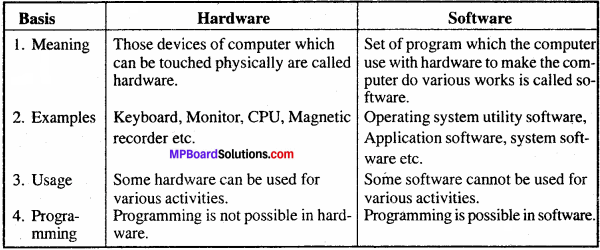
Chapter 19 Computers in Accounting and Computerised Accounting System 2

Question 12.
Draw a diagram showing the main parts of a computer in square shape.
Answer:
Chapter 19 Computers in Accounting and Computerised Accounting System 3
Question 13.
Write the names of three organs of Transaction Processing System (TPS).
Answer:
Transaction processing system (TPS) are among the earliest computerised system catering to the requirement of large business enterprises. TPS establish relationship with external and internal information of every enterprise and there is special arrangement of sequence for the solution of every problem. When the department request its own sales department to buy the required goods it is known as internal transaction. Whereas when the purchase department buy the goods from any outside seller then it is known as external transaction.

Three organ of transaction processing system are:

  1. Input
  2. Process
  3. Output.

Question 14.
What is the contribution of computer in Accounting?
Or
What is the role of computer in Accounting?
Answer:
Computer is an electronic device which collect the facts and figures, compare them, bring changes in them, assemble them and retrieve them, is nowadays widely used in Accounting. Computers have in built system of calculation, collection of related data, processing and give the results in the form of reports for taking decisions to the authorities. It is not restricted for making pay roll only but can do other work also like maintaining record, making entries, classification, analysis and interpreting the results.

In the following field of Accounting, Computer has important contribution:

  1. Collection of accounting transaction in a systematic manner.
  2. Proper classification and analysis of accounting transaction.
  3. Providing quick information related to debtors, creditors and other reserves.
  4. Show the flow of cash by preparing cash flow statement.
  5. Self balancing of ledger A/c and important contribution in the preparation of final accounts.
  6. Providing quick and accurate financial information for legal necessity in time.
  7. Computer also contribute in payroll accounting. Preparation of payroll in big company is very convenient.
  8. By the help of computer store Accounting can be easily and properly designed. By the help of computer, position of daily stock, value of stock, purchase requirement etc. can be easily maintained.

Question 15.
Discuss the different types of Accounting packages.
Answer:
Accounting packages are of three types:

  1. Readymade software/Ready to use software
  2. Customised software
  3. Tailor made software

1. Readymade Software:
Readymade software is available in the market to be used directly. Readymade software is used in large scale because it is prepared on the basis of normal conditions. At present in the market the following readymade software are available.

  • Tally
  • Example
  • BUSY
  • The professional Accountant.

Tally software is mostly used. Tally software is multi use software. This package is suitable for small concerns, whose accounting work is limited.

2. Customised Software:
When changes are done in readymade software to make a program useful to fulfil the specific objective of the user, it is called customised software. For example-according to demand of user changes made in the design of invoice. As in readymade software changes are made as per user’s requirements, expenses on such changes are beared by the user themselves.

3. Tailor made Software:
When software is prepared after mutual understanding be-tween the user and software maker as per user’s requirements, it is called Tailor made software.

MP Board Solutions

Question 16.
How many types of report are there?
Answer:
Various types of reports are:

  1. Customer Report – Such report which is prepared as required by the manager which shows first 20 customers, first 20 customers who have not paid or such customer’s name who have not purchased anything on last three years etc.
  2. Supplier’s Report – Such report in which various aspects related to suppliers are shown as per manager’s requirement.
  3. Summary Report – It is a brief report of all activities of the organization for example- Profit and Loss account.
  4. Responsibility Report – Responsibility report is prepared by responsible manager of the organization like a purchase officer prepare purchase report showing all aspects of purchases.
  5. Exceptional Report – This report is prepared in some special circumstances. For example – inventory report in which it is described that stock is less or more than required level.
  6. Financial Report – Managers demand quarterly financial statement for examining position.

Question 17.
As per working system, how many types of computer are there?
Answer:
As per working system computers can be classified into following 3 types:

1. Digital Computer:
Digital means number. Digital computer calculates numbers, generally computer are used to calculate. In Digital computer all instructions and figures are secured in the form of binary digits. Mostly digital computers are used.

2. Analog Computer:
Analog computer does not calculate numbers. Analog computer depends on measuring activity. In analog computer continuously information are received in form of signals converting which it present in figures. Speedometer, Voltmeter, Thermometer etc. are analog devices. In this signal received continuously are presented. Radar is an analog computer. Memory of analog computer is not very much. 100% pure result is not obtained from analog computer.

3. Hybrid computer:
Hybrid computer consiss of joint features of analog and digital computer. With hybrid computer both act of measuring current and calculating figures is done. It is mostly used by scientists. In satellite Hybrid computer works. ECG machine is also a hybrid computer.

Question 18.
On the basis of speed and storage capacity, how many types of computers are there? Explain them briefly.
Answer:
On the basis of speed and storage capacity computers are classified into four
categories:

  1. Micro Computer
  2. Mini Computer
  3. Main Frame Computer
  4. Super Computer.

1. Micro Computer:
Micro computer are the smallest in size. Their price is also very less. Generally micro computer is brought in use. Word length of micro computer is from 8 to 32 Bits. It can be used once by one person only. Its speed and storage capacity is very less. It is also called RC. or personal computers. Modern PCs are like pentium P5 and pentium P6 etc.

2. Mini Computer:
Mini computers are comparatively bigger than micro computer. It is used at large scale. Word length of it is 32 Bit or more. A’mini computer can be used by 40 per cent at the same time. PDP – 1111/45 VAX – II etc are mini computer. Its speed is 10 to 30 MIPS (Million Instruction Per Second)

3. Main Frame Computer:
Mainframe computer is comparatively big in size than mini computer. It is used in large scale to process figures and calculate complications. Its word length is up to 64 Bit. UNIVAC 1190, JBM 3020 etc. are mainframe computer

4. Super Computer:
They are very big in size. Speed of these computers and storing capacity is very large. This computer has speed of 400 to 10,000 MIPS. Its word length is about 96 Bit. In this CPU is parallely connected CRAY-1, CRAY – 2, HITACHI – 81020 etc. are foreign super computer and PARAM and ANURAG are Indian super computer.

Question 19.
State the four basic requirements of a Data base Application.
Answer:
The following are the four basic requirements of a Database Application :

  1. Front – end Interface: It acts as an interactive connecting link between the user and the database oriented software through which the user communicates or interacts to the back-end database.
  2. Back – end Database: It is the data storage system that is hidden from the users. It responds to the requirement of the users to the extent the user is authorised to access.
  3. Data Processing – It is a sequence of actions that are taken to transform the input data into useful information for taking various decisions.
  4. Reporting System – It is an integrated set of objects that includes all the relevant information that constitutes a report.

Question 20.
What is Entity Relationship Database?
Answer:
Under the database management system, the application of model database in commercial way is available in the database management system and it is the process of its application. Previously the commercial system was based on network approach. The ER model entity relationship model is actually the generalisation of this model. This relationship also permits the outsider also.

It is a popular conceptual data model, which is mostly used in database oriented applications. The major elements of ER model are entities, attributes, identifiers and relationship that are used to express a reality for which a database is to be designed. The model is best depicted with the help of ER symbols.

Question 21.
What do you mean by Structured Query Language?
Or
What do you understand by SQL?
Answer:
Main objective of SQL is to make enquiries from database. Till we cannot query or use the stored data in database it is useless to us. Query is a question which is written in SQL. It is very easy to work in SQL on this, instructions is to be given to the user that what and how is to be done. For example In IBM and DB7 in UNIFY Corporation in UNIFY at present SQL is used.

Question 22.
What do you mean by Accounting data? How does financial statements get to final stage after passing through various levels?
Answer:
Data related to accounting process based on computer is known as accounting data. Database is used to store the data related to recording in the computer. The format of database process begins with the reality, which is expressed in the form of conceptualisation of an Accounting reality. The process of database can be explained with the help of Flow chart which clarify how the reality i.e., conceptualisation of reality reaches to the final design of database through various level.
Chapter 19 Computers in Accounting and Computerised Accounting System 4

Question 23.
What is Normalization?
Answer:
Normalization is a process of transformation of the conceptual scheme of the database into a computer representable form. The main objective of normalization is to minimise unnecessary repetition of information. This meas that information should be stored only once. So normalization avoids wastage of storage or space and increase in the total size at the data stored.

Question 24.
Explain the symbols used in Entity Relationship Model.
Answer:
Chapter 19 Computers in Accounting and Computerised Accounting System 5

Question 25.
What is the meaning of Database? Describe the basic component of database in short.
Answer:
Data is such facts which are recorded and which has a definite meaning. Data is set of informations which is basis of all important managerial decisions. All such informations which are collected to prepare useful report is called database. Database is collection of related data.

Data are collected and stored in such a way that new data may be added to stored data in database, to make change in it and to obtain data a general and controlled method shall be sufficient. A database method is a complete method to store related files in which stored data’s detail and complete description are there. Database is an integrated collection of logical complete records and files.

According to G. M. Scott “Database is a computer file system which is necessary to use a special file organization to update quickly all personal records in all programmes, to update related records, make it possible to access easily all records which are necessary to be collected to prepare a special report or to prepare a report of special objective.”

Type of Database:

  1. Relational Database – This is main and important type of database. It is a detailed database in which data is shown in the way by which it can be accessed easily and it can be reconstituted in many ways.
  2. Distributed Database – This database is that database which is spread between two points in a net.
  3. Object Oriented Database – It is that database which shows object classes and sub classes together.

Basic component of Database:

  1. Bit or Binary Digit – Bit is one of Binary digits i.e., it may be 1 or 0.
  2. Byte – One row of eight bit is called byte.
    1 Byte = 8 Bits
    1 Kilobyte = 1024 bytes.
  3. Data – Collected few data which has logical meaning is called data. So data are three types:
    • Numeric data : It is in numbers like -1, 2, 3, – 2456, -23, 345608
    • Alpha data : They are in the form of Alphabets from A to Z. e.g., RAM, RAMESH, YES, NO.
    • Alphanumeric data : They are in both forms numbers and alphabets like 24 March, 2011.

MP Board Solutions

Question 26.
What is data processing cycle? Describe the stages of data processing.
Answer:
Data processing cycle:
Data processing involves the techniques of collecting, storing, relating, interpreting and computing data items so that meaningful and useful information for decision making may be obtained. In short, Data processing refer to the activities associated with generation of information. Various stages of data processing are:

  1. Collection of Data – Vouchers accounting data is collected by transactions by which necessary document which is called voucher is created.
  2. Input of Data – Accounting data included in voucher is feeded in storage device of computer.
  3. Storage of Data – After storing data in computer, it is processed.
  4. Manipulation of Data – Under data processing collected data is manipulated as per user’s requirement.
  5. Generation of Information – Required report of information obtain output which is useful and meaningful.

Question 27.
Explain and Define Database and discuss its types.
Answer:
Data is such facts which are recorded and which has a definite meaning. Data is set of informations which is basis of all important managerial decisions. All such informations which are collected to prepare useful report is called database. Database is collection of related data. Data are collected and stored in such a way that new data may be added to stored data in database, to make change in it and to obtain data a general and controlled method shall be sufficient.

A database method is a complete method to store related files in which stored data’s detail and complete description are there. Data base is an integrated collection of logical complete records and files. According to G. M. Scott “Database is a computer file system which is necessary to use a special file organization to update quickly all personal records in all programmes, to update related records, make it possible to access easily all records which are necessary to be collected to prepare a special report or to prepare a report of special objective.

Type of Database:

  1. Relational Database – This is main and important type of database. It is a detailed database in which data is shown in the way by which it can be accessed easily and it can be reconstituted in many ways.
  2. Distributed Database – This database is that database which is spread between two points in a net.
  3. Object Oriented Database – It is that database which shows object classes and sub classes together.

Question 28.
Write the objectives of Database Management System (DBMS).
Answer:
Following are the objectives of Database Management System:

  1. Due to Central Data Management there is reduction in complex information system of the organization.
  2. Additional and useless data are deleted. Such record where there is reoccurance of data are ended.
  3. By central control on creation of data and definition depending on program data reduces.
  4. Flexibility of information system increases.
  5. Once when data gets stored then various types of user use it. As required data are used various objectives.

Question 29.
Explain the demerits or limitations of Database Management System (DBMS).
Answer:
Disadvantages or limitation of DBMS are:

  1. Lack of expertise knowledge – For DBMS expert and experienced person is required so that it can be operated properly but there is lack of such persons everywhere or those who know programming they take high value for it.
  2. Costly – Database Management System software are costly.
  3. Higher Cost – Cost of hardware of Database Management System is high.
  4. Increase in Security Problem – Due to DBMS problem of reliability of security arises because many users have access to database.
  5. To apply this system many expenses are incurred.

MP Board Solutions

Question 30.
What do you mean by Database? How is it different from Database Management System (DBMS)?
Answer:
Database is a group of interrelated tables, files and structure which prepare its format to fulfil requirement related to various informations of the organization. Two advantages of Database are:

1. Integrity:
It clarifies that all the various data and information are organized in a logical way. Its purpose is to reduce the excess data or to put an end so that the data could be accessed easily.

2. Participation:
It means that all authorised person can easily access to the related data. From the above it is clear that database is a group of related data which express the opinion of the commercial world which is known as reality. Data base Management involves creating, storing, modifying, deleting and adding data in files and using this data to generate report. The software that allows to perform these functions is known as data base management system.

Computers in Accounting and Computerised Accounting System Long Answer Type Questions

Question 1.
Differentiate among various Accountig Software.
Answer:
Difference among Accounting Software:
Chapter 19 Computers in Accounting and Computerised Accounting System 6

Question 2.
Distinguish between a Manual and computerised Accounting System.
Answer:
The following are some point of differences between Manual and computerised Accounting systems:
Chapter 19 Computers in Accounting and Computerised Accounting System 7

Question 3.
What is Computer? What are its main characteristics?
Or
Define Computer and write down its characteristics.
Answer:
Meaning and Definitions of Computer:
Computer is that electronic device which takes very less time to do various types of work. Technically, Computer is such an electronic device which takes data, processes it and following some predetermined instructions provide meaningful results (useful data)

Process made by computer can be clarified from the following figure:
Chapter 19 Computers in Accounting and Computerised Accounting System 9

On the basic of above figure computer can be difined as follows:
“Computer is an electronic device which inputs any type of row data and with the help of pre – determined instructions input data is analysed and meaningful results or information is given.”

According to international standards Organization:
“A computer is a data processor that can perform substantial computations including numerous arithmetic and logic operations without intervention of human operator during the run.”

According to the U.S. Institute:
A computer is a device capable of solving problems by accepting data performing described operations on the datas and supplying the results of the’operations. Thus, computer is a device which works on figures which is called data in computer language.

Features of computer – Following are features of computer:

1. Automation:
Any data or instructions once give to computer it can then automatically operate the process i.e., further human interference is not requried.

2. Memory:
Inside computer there is internal memory of it which it can store data in large amount. Computer in subsidiary equipments like hard disc, floppy disc, megnetic tapes etc. stores additional data.

3. High speed:
Computer works at high speed. It can analyse lakhs of instructions in just few secorids. lt can make crores of calculations in one second.

4. Accuracy:
In working of computer cent per cent purity can be seen. Remember that if wrong or default data is provided then result will be wrong as well.

5. Versatility:
One computer is used for many works, like calculation, deleting data, machinery control, entertainment etc. It is main feature of computer and due to this feature it is used in various fields.

6. Deligence:
Due to being machinery computer does not get tired, neither it feels hungry nor it gets distracted from its aim. It does its work from begining to end without any mistake carefully. Human after working for many hours feels the mental and physical tiredness but a computer never gets tired like humans.

7. Scientific approach:
A computer works in scientific approach. It works impartially and it does not have affect of thinking and feelings of any person.

8. Logical Decisions:
Computer on the basis of a determined condition is capable of taking decision. Such decisions are called logical decisions. Selection of best alternative among all alternatives is logical decision.

Question 4.
Describe the main elements of computer system.
Answer:
There are six parts or element of computer system:

1. Hardware:
In computer means those physical elements which we can see, touch or feel. Various devices used in computer system jointly are called hardware. In hardware the following computer devices are included.

  • Input devices Keyboard, Mouse, Light pen, Scanner etc.
  • Central processing unit (CPU)
  • Output device – Monitor

2. Software:
To obtain any result from computer, computer has to be given instructions in a special language. Set of instruction is called program and set of programs is called software. By only changing of software of one computer many types of work can be done. Like from one computer by one software payroll can be prepared, by another software accounting work can be done. In market various types of software are available in form of program recorded in a floppy disc. With every floppy disc, a manual is also provided in which procedure to use the disc and detail of program recorded in disc is given.

There are six types of software

  • Operating Software
  • Utility Software
  • Application Software
  • System software
  • Language software
  • Connectivity Software.

3. People:
People are those person who uses computer hardware and software to make, improve and use information system existing in computer memory. Those main people who are related to computer system are:

  • System Analysis – They prepare design of data processing system.
  • Operators – They operate computers.
  • Programmers – They write the program by which data processing system can be operated.

4. Procedures:
Procedures are those various activities which can be done in a certain way by which determined results may be obtained. Basically there are three types of procedures which are part of a computer system :

  • Software Oriented
  • Hardware Oriented and
  • Internal procedure.

5. Data:
Generally facts are called data. Data can be anything like bio – data of various applicants when computer is used for appointment of employees or marks of various students in various subject by which their result may be prepared or details of various travellers like name, age, sex etc. when computer is used for reservation for air or rail tickets etc.

MP Board Solutions

Question 5.
Write down the advantages and importance of Database Management System (DBMS)
Answer:
Advantages and Importance of DBMS:

  1. Sharing the Data – In DBMS all data are stored at one place by which all persons can easily access this data who has right to use these data. So same data is used by many manager.
  2. Easy Storage of data – DBMS Simplifies manipulation in data and errors are also less in this.
  3. Simple programme can be developed – In DBMS Query Language is used by which its user can develop simple program as per their requirement.
  4. Greater Consistency – In DBMS most of the data is centralised at one place and by all managers these centralised data is used. In these data there is uniformity.
  5. Data Dictionary Management – In DBMS Data Dictionary Management is also included by which any change in database like increase in data, deleting data or changes in data etc. get changed automatically in data dictionary.
  6. Security – DBMS is helpful in maintaining security and updation of data.
  7. Reduced Cost – DBMS helps in preparing report also without error prepares report in less time.
  8. DBMS maintains independence of data.
  9. By DBMS User can easily use the data.
  10. Less time is taken in data processing and saves space for storage.
  11. Due to DBMS less program is required to keep.

Question 6.
Explain the main components of ER Model.
Answer:
Components of ER Model:
ER Model is basis of ER diagrams which in view of end user presents conceptual database. There are four components of ER Model.
Chapter 19 Computers in Accounting and Computerised Accounting System 10
1. Entity:
In the real world any thing which has free existence is called entity. So person, place, event or concept related to which we store information in the system is called entity. Every entity has different features. In ER model the world entity does not mean one, single occurring entity but set of entities. In relational environment entity means table and not row. For example in the fol-lowing figure student is an entity:
Chapter 19 Computers in Accounting and Computerised Accounting System 11

In context of Accounting there are five types of entities:

  1. Accounts
  2. Vouchers
  3. Employee
  4. Accounts Types
  5. Support Documents.

Accounting data are recorded by means of these entites.

2. Attributes:
Accumulated characteristics and features of entity are called attributes. For examples height of a person, weight, date of birth, education etc. are attributes. Similarly, code number of account’and their names will be called attributes.
Chapter 19 Computers in Accounting and Computerised Accounting System 12
Attributes, gets value from domain (or value sets). By these value obtained will be used as data in Relational Model. In the table below entities and attributes are given:

Each features of entity small measures which accumulated as data in database. Attributes may be of many types like:

  1. Composite v/s Simple Attributes,
  2. Single value v/s Multi Value,
  3. Store v/s Derived Attributes,
  4. Null Values when data are nine,
  5. Complex Attributes etc.

3. Identifier:
Each entity has its own feature which has some specific value by which entity gets identification. For example attribute of student as entity is Roll No. which has special measure by means of Roll No. Student will be identified. Similarly attribute of accounts as entity is Code No. because it measure of data is of special category.
Chapter 19 Computers in Accounting and Computerised Accounting System 13
Entity Type accounting Database
An entity Type voucher with V. No. as key attribute

MP Board Class 11 Accountancy Important Questions


MP Board Class 11th Accountancy Important Questions Chapter 16 Preparation of Final Accounts of Sole Trade

MP Board Class 11th Accountancy Important Questions Chapter 16 Preparation of Final Accounts of Sole Trade

Preparation of Final Accounts of Sole Trade Important Questions

Preparation of Final Accounts of Sole Trade Long Answer Type Questions

Question 1.
What adjustment are done in trading A/c? Prepare a format of trading A/c and show.
Answer:
MP Board Class 11th Accountancy Important Questions Chapter 16 Preparation of Final Accounts of Sole Trade img-1

Question 2.
Show the format of a Balance Sheet with adjustments.
Answer:
Pro forma of Balance Sheet as on ……………………

MP Board Class 11th Accountancy Important Questions Chapter 16 Preparation of Final Accounts of Sole Trade img-2

MP Board Class 11th Chemistry Solutions Chapter 14 पर्यावरणीय रसायन

MP Board Class 11th Chemistry Solutions Chapter 14 पर्यावरणीय रसायन

पर्यावरणीय रसायन NCERT अभ्यास प्रश्न

प्रश्न 1.
पर्यावरणीय रसायन की परिभाषा दीजिए।
उत्तर:
पर्यावरणीय रसायन विज्ञान की वह शाखा है जो पर्यावरण में रासायनिक परिवर्तनों से सम्बन्धित होती हैं। इसमें हमारा परिवेश सम्मिलित होता है, जैसे कि वायु, जल, मृदा, जंगल, सूर्य का प्रकाश आदि।

प्रश्न 2.
क्षोभमण्डलीय प्रदूषण की 100 शब्दों में व्याख्या कीजिए।
उत्तर:
क्षोभमण्डलीय प्रदूषण वायु में उपस्थित अवांछनीय ठोस अथवा गैस के कणों के कारण उत्पन्न होता है। क्षोभमण्डल में मुख्यतः निम्नलिखित गैसीय तथा कणिकीय प्रदूषण उपस्थित होते हैं

  1. गैसीय वायुप्रदूषक – ये सल्फर, नाइट्रोजन तथा कार्बन डाईऑक्साइड, हाइड्रोजन सल्फाइड, हाइड्रोकार्बन, ओजोन तथा अन्य ऑक्सीकारक होते हैं।
  2. कणिकीय प्रदूषक – ये धूल, धूम, कोहरा, फुहारा, धुआँ आदि होते हैं।

MP Board Solutions

प्रश्न 3.
कार्बन मोनोऑक्साइड, कार्बन डाइऑक्साइड की अपेक्षा अधिक खतरनाक होती है। क्यों?
उत्तर:
कार्बन मोनोऑक्साइड एक विषैली गैस है। यह रक्त में उपस्थित हीमोग्लोबिन के साथ संयुक्त होकर कार्बोक्सीहीमोग्लोबीन (COHb) बनाती है। यह ऑक्सीहीमोग्लोबिन की अपेक्षा 300 गुना अधिक स्थायी है। जब रक्त में कार्बोक्सीहीमोग्लोबिन की मात्रा 3-4% तक हो जाती है तब रक्त में ऑक्सीजन ले जाने की क्षमता अत्यधिक कम हो जाती है। ऑक्सीजन की इस न्यूनता से सिरदर्द, नेत्रदृष्टि की क्षीणता, तंत्रकीय आवेग में न्यूनता, हृदयवाहिका में तंत्र अवस्था आदि रोग उत्पन्न हो जाते हैं। कार्बन डाइऑक्साइड गैस हीमोग्लोबिन के साथ संयुक्त नहीं होती है। अतः यह एक कम हानिकारक प्रदूषक है। वातावरण में इसकी मात्रा में वृद्धि के कारण मुख्यतः वैश्विक गर्मी (भूमंडलीय ताप वृद्धि) हो रही है।

प्रश्न 4.
ग्रीन हाऊस प्रभाव के लिए कौन-सी गैसें उत्तरदायी हैं ? सूचीबद्ध कीजिए।
उत्तर:
निम्नलिखित गैसों द्वारा हरित गृह प्रभाव उत्पन्न किया जा सकता है, जो कि ऊष्मा ऊर्जा को रोकने में समर्थ होती है –

  1. कार्बन डाइऑक्साइड
  2. मेथेन
  3. ओजोन
  4. क्लोरोफ्लुओरोकार्बन के यौगिक (CFCs)
  5. जल वाष्प।

प्रश्न 5.
अम्लवर्षा मूर्तियों तथा स्मारकों को कैसे दुष्प्रभावित करती है?
उत्तर:
भारत में मूर्तियाँ तथा स्मारक संगमरमर अर्थात् CaCO3 के बने होते हैं। जिसके परितः वायु में मुख्यतः सल्फर तथा नाइट्रोजन के ऑक्साइडों की अधिक मात्रा होती है। इसका मुख्य कारण इन क्षेत्रों के आसपास औद्योगिक इकाइयों तथा ऊर्जा संयंत्रों की मात्रा अधिक होना है। सल्फर तथा नाइट्रोजन के ऑक्साइड अम्लीय होते हैं। SO2 तथा NO2 जल के साथ ऑक्सीकरण क्रिया करके खनिज अम्ल बनाते हैं जो अम्ल वर्षा के मुख्य स्त्रोत हैं।
2SO2(g) + O2(g) + 2H2O(l) → 2H2SO4(aq)
4NO2(g) + O2(g) + 2H2O → 4HNO3(aq)
यह अम्ल वर्षा, मूर्तियों तथा स्मारकों के संगमरमर के साथ क्रिया करके उन्हें नष्ट करती हैं।
CaCO3 + H2SO4 → CaSO4 + H3O+ CO2

प्रश्न 6.
धूम-कोहरा क्या है? सामान्य धूम-कोहरा, प्रकाश रासायनिक धूम-कोहरे से कैसे भिन्न है?
उत्तर:
धूम-कोहरा शब्द धूम तथा कोहरा से उत्पन्न हुआ है। यह विश्व के अनेक शहरों में पाया जाने वाला वायु प्रदूषक है। धूम-कोहरा निम्न दो प्रकार का होता है –

1. सामान्य धूम-कोहरा:
यह ठंडे आर्द्र वातावरण में उत्पन्न होता है। यह धुएँ, कोहरे तथा So, का मिश्रण है। रासायनिक रूप से यह अपचायक धूम-कोहरा है।

2. प्रकाश रासायनिक धूम-कोहरा:
यह गर्म, शुष्क तथा सूर्य की पर्याप्त रोशनी वाले वातावरण में उत्पन्न होता है। इसके मुख्य अवयव ओजोन, फॉर्मेल्डिहाइड, एक्रोलीन तथा परॉक्सीऐसीटिल नाइट्रेट (PAN) (असंतृप्त हाइड्रोकार्बनों पर सूर्य के प्रकाश की क्रिया से उत्पन्न) तथा नाइट्रोजन ऑक्साइड (वाहनों तथा कारखानों से उत्पन्न) होते हैं। रासायनिक रूप से यह ऑक्सीकारक धूम-कोहरा है क्योंकि इसमें ऑक्सीकारक अभिकर्मकों की सान्द्रता उच्च रहती है।

MP Board Solutions

प्रश्न 7.
प्रकाश रासायनिक धूम-कोहरे के निर्माण के दौरान होने वाली अभिक्रिया लिखिए।
उत्तर:
जब जीवाश्म ईंधनों का दहन होता है, तब पृथ्वी के वातावरण में कई प्रदूषक उत्सर्जित होते हैं। इनमें से दो प्रदूषक हाइड्रोकार्बन एवं नाइट्रिक ऑक्साइड (NO) है। जब इन प्रदूषकों का स्तर पर्याप्त ऊँचा हो जाता है, तब सूर्य प्रकाश से इसकी अन्योन्य क्रिया के कारण श्रृंखला अभिक्रिया होती है, जिसमें NO2 नाइट्रोजन डाइऑक्साइड NO2 में परिवर्तित हो जाती है। यह NO2 सूर्य प्रकाश से ऊर्जा ग्रहण कर पुनः नाइट्रिक ऑक्साइड एवं मुक्त ऑक्सीजन में विघटित हो जाती है।
NO2(g) \(\underrightarrow { hv } \) NO(g) + O(g) …(i)
ऑक्सीजन परमाणु अत्यधिक क्रियाशील होने के कारण O, के साथ संयुक्त होकर ओजोन में परिवर्तित हो जाता है।
O(g) + O2(g) → O3(g) ….(ii)
निर्मित O3, शीघ्रतापूर्वक अभिक्रिया (i) में विरचित NO(g) के साथ अभिक्रिया कर पुन: NO2 बनाती है। NO2 एक भूरी गैस है, जिसका उच्च स्तर धुंध का कारण हो सकता है।
NO(g) + O3(g) → NO2(g) + O3(g)
ओजोन एक जहरीली गैस है। NO, एवं 0, दोनों ही प्रबल ऑक्सीकारक हैं। जैसे –
MP Board Class 11th Chemistry Solutions Chapter 14 पर्यावरणीय रसायन - 1

प्रश्न 8.
प्रकाश रासायनिक धूम-कोहरे के दुष्परिणाम क्या है? इन्हें कैसे नियन्त्रित किया जा सकता है?
उत्तर:
प्रकाश रासायनिक धूम-कोहरे के दुष्परिणाम-प्रकाश रासायनिक धूम-कोहरा के प्रमुख घटक ओजोन, नाइट्रोजन के ऑक्साइड, एक्रोलीन, फॉर्मेल्डिहाइड और परॉक्सीऐसीटिल नाइट्रेट (PAN) आदि हैं। ये हानिकारक प्रभावों के लिए जिम्मेदार होते हैं। इनमें से कुछ निम्न हैं –

  1. ओजोन और नाइट्रिक ऑक्साइड नाक एवं गले में उत्तेजना पैदा करते हैं। इनके उच्च सान्द्रण से सिर और सीने में दर्द होने लगता है।
  2. प्रकाश रासायनिक धूम-कोहरा के संघटक गैसें सामान्यतः गले में शुष्कता पैदा करती है तथा ये श्वसन समस्याओं के लिए जिम्मेदार होती हैं।
  3. प्रकाश रासायनिक धूम-कोहरा पादप जीवन को बहुत क्षति पहुँचाती है।
  4. ये धातुओं, इमारती पदार्थों, रबर और रंजित सतह आदि के संक्षारण के लिए भी जिम्मेवार होती हैं।

प्रकाश रासायनिक धूम-कोहरा नियन्त्रित करने के उपाय:
निम्नलिखित उपायों द्वारा प्रकाश रासायनिक धूम-कोहरा से उत्पन्न प्रदूषण को कुछ मात्रा तक रोका जा सकता है –

  1. वाहनों के इंजनों में उत्प्रेरकीय परिवर्तकों के उपयोग से NO2 और कुछ हाइड्रोकार्बन जैसे प्राथमिक पूर्वगामी नियन्त्रित हो जाएंगे। इससे PAN जैसे द्वितीयक पूर्वगामी का विरचन स्वतः नियन्त्रित हो जाएगा।
  2. कुछ पादप जैसे पाईनस, पायरस, विटिस, क्वेरकस आदि काफी खतरनाक नाइट्रोजन के ऑक्साइडों का उपापचय करने में समर्थ होते हैं। इनका रोपण निश्चित रूप से वायुमण्डल में इन गैसों को फैलने से रोकने में सहायक होगा।

प्रश्न 9.
क्षोभमण्डल पर ओजोन-परत के क्षय में होने वाली अभिक्रिया कौन-सी है?
उत्तर:
समतापमण्डल में उपस्थित फ्रीऑन जैसे क्लोरोफ्लुओरोकार्बन ओजोन के साथ रासायनिक अभिक्रिया करते हैं। ये मुक्त मूलक प्रकृति के होते हैं तथा अभिक्रिया पराबैंगनी विकिरणों की उपस्थिति में होती है।
MP Board Class 11th Chemistry Solutions Chapter 14 पर्यावरणीय रसायन - 2
चूँकि ओजोन रासायनिक अभिक्रिया में भाग लेती है, इसलिए ओजोन परत का क्रमिक अवक्षय होता है।

प्रश्न 10.
ओजोन छिद्र से आप क्या समझते हैं? इसके परिणाम क्या हैं?
उत्तर:
ओजोन छिद्र हानिकारक पराबैंगनी विकिरणों द्वारा ओजोन परत के ध्वंश को सूचित करता है। इससे हमारे चारों ओर स्थित ओजोन की परत में वस्तुतः छिद्र हो जाएंगे। इसके परिणामस्वरूप, हानिकारक विकिरणों से त्वचा कैंसर, दृष्टिदोष आदि उत्पन्न होंगे और यह हमारे प्रतिरक्षा तंत्र (Immune system) को प्रभावित करेगा।

ओजोन पर्त के दुष्प्रभाव:

  1. पराबैंगनी किरणों का बिना रोकथाम के सीधे धरती पर प्रवेश होने पर विभिन्न रोगों का कारण हो सकता है। जैसे-कैंसर।
  2. पराबैंगनी किरणें शरीर की प्रतिरोधक क्षमता को कम कर देती हैं।
  3. C.EC. ग्रीन हाऊस प्रभाव को कम करती है, परिणामस्वरूप धरती के तापमान में वृद्धि होती है।

नियत्रंण:

  1. C.E.C. का उत्पादन कम करना।
  2. C.F.C. का विकल्प ढूँढ़ना।

प्रश्न 11.
क्या आपने अपने क्षेत्र में जल-प्रदूषण देखा है, इसे नियन्त्रित करने के कौन-कौन से उपाय हैं?
उत्तर:
पेपर, कपड़ा तथा रासायनिक उद्योगों से अनेक अपशिष्ट पदार्थ जल में मिलकर इसको प्रदूषित करते हैं। अत: जल प्रदूषण की रोकथाम के लिए उद्योग अपशिष्ट को नदी नालों में न डालकर इनका समुचित विस्थापन करना चाहिए। कपड़े धोने के जैव निम्नीकरण साबुन व अपमार्जक का प्रयोग करना चाहिए न कि जैव अनिम्नीकरण पदार्थों का। जल का pH मान ज्ञात करना चाहिए। शुद्ध जल का pH मान 7 है यदि जल का pH मान 7 से कम है तब इसमें उपस्थित अशुद्धियाँ अम्लीय है जैसे SO2, H2S आदि।

यदि जल का pH मान 7 से अधिक है, तब अशुद्धियों की प्रकृति क्षारीय है जैसे साबुन व अपमार्जक। ऐसी स्थिति में प्रदूषण नियंत्रक बोर्ड को सूचित कर रोकथाम करना चाहिए। रासायनिक उर्वरकों की बजाय देशी खाद का उपयोग करना चाहिए। DDT, मैलाथीआन आदि का उपयोग नहीं करना चाहिए। KMnO4 या विरंचक चूर्ण से जल का शुद्धिकरण करना चाहिए।

प्रश्न 12.
आप ‘जैव रासायनिक ऑक्सीजन आवश्यकता’ (B.O.D.) से क्या समझते हैं?
उत्तर:
इसे निम्न प्रकार से परिभाषित किया जा सकता है –

  1. यह जल में घुलित ऑक्सीजन की मिलीग्राम में वह मात्रा है, जो एक लीटर जल में उपस्थित कार्बनिक पदार्थ के 5 दिन तक 20°C ताप विघटन के लिए आवश्यक होती है।
  2. शुद्ध जल का B.O.D. 3 ppm तक होता है। यदि स्तर अधिक हो तो यह जल में कार्बनिक अपशिष्ट की उपस्थिति का सूचक है।

MP Board Solutions

प्रश्न 13.
क्या आपने आस-पास के क्षेत्र में भूमि-प्रदूषण देखा है ? आप भूमि-प्रदूषण को नियन्त्रित करने के लिए क्या प्रयास करेंगे?
उत्तर:
हाँ, इसको निम्नलिखित विधियों द्वारा नियंत्रित किया जा सकता है –

1. कीटनाशी तथा पीड़कनाशी जिनका प्रयोग फसलों की रक्षा के लिए किया जाता है भूमि प्रदूषण फैलाते हैं। शाकनाशी (दुर्बलनाशी) भी भूमि प्रदूषण फैलाते हैं। अतः इसके समुचित प्रयोग की आवश्यकता है।

2. द्वितीय विश्व युद्ध के पश्चात् डी.डी.टी. का प्रयोग कृषि में कीट, सेडेंट, खरपतवार तथा फसलों के अनेक रोगों को नियंत्रण के रूप में किया जाने लगा। इसके प्रतिकूल प्रभावों के कारण भारत में इसका प्रयोग प्रतिबंधित हो गया है। एल्ड्रीन तथा डाइएल्ड्रीन जैसे पीड़कनाशी वास्तव में जैव विष हैं। ये जल में अविलेय तथा अजैवनिम्नीकरण होते हैं। इनके कारण जीवों में उपापचयी तथा शरीर क्रियात्मक अवस्थाएँ उत्पन्न हो जाती हैं। आजकल ऑर्गेनो फॉस्फेट्स तथा कार्बोनेट्स को पीड़कनाशी के रूप में प्रयोग किया जा रहा है। ये अधिक जैवनिम्नीकरण वाले यौगिक हैं परन्तु ये गंभीर स्नायु जीव विष हैं अतः ये मानव के लिए हानिकारक हैं। अतः उर्वरक, डिटर्जेंट पीड़कनाशी, बहुलक आदि जैसे रसायनों का प्रयोग केवल तभी किया जाना चाहिए जबकि उनकी अति आवश्यकता हो।

3. जैवनिम्नीकृत घरेलू अवशिष्ट को जमीन के गड्ढों में दबाना चाहिए।

4. अजैवनिम्नीकृत अपशिष्टों का पुर्नचक्रण किया जाना चाहिए।

5. पॉलीथीन के प्रयोग से बचना चाहिए।

6. घरेलू अपशिष्ट, जैविक अपशिष्ट तथा रासायनिक अपशिष्टों को अधिकांशतः जला देना चाहिए। भस्मीकरण के फलस्वरूप अपशिष्ट पदार्थों का आयतन घट जाता है।

प्रश्न 14.
पीड़कनाशी तथा शाकनाशी से आप क्या समझते हैं? उदाहरण सहित समझाइए।
उत्तर:
पीड़कनाशी:
मुख्य रूप से संश्लेषित विषैले रसायन हैं जो पारिस्थितिकी प्रतिघाती हैं। पहले DDT का उपयोग फसलों में लगने वाले कीड़े-मकोड़ों की रोकथाम के लिए किया जाता था बाद में कीड़ों को DDT में प्रति, प्रतिरोधकता बढ़ गई । अतः दूसरे विषैले रसायन ऐल्ड्रीन और डाइएल्ड्रीन का उपयोग पीड़नाशी के रूप में होने लगा। लगभग सभी पीड़कनाशी जल में अघुलनशील तथा जैव अनिम्नीकरण होते हैं। आजकल जैव निम्नीकरण पदार्थ जो कार्बो-फॉस्फेट और कार्बामेट के नाम से उपयोग में लाए जाते हैं। परन्तु इनका उपयोग भी विषैला है तथा मानव जाति के लिए हानिकारक है। कृषि क्षेत्र में काम करने वाले लोग इसके शिकार हो चुके हैं।

प्रश्न 15.
हरित रसायन से आप क्या समझते हैं ? यह वातावरणीय प्रदूषण को रोकने में किस प्रकार सहायक है?
उत्तर:
हरित रसायन, रसायन विज्ञान तथा अन्य विज्ञानों के ज्ञात ज्ञान तथा सिद्धांतों के उपयोग की विधि है। जिससे पर्यावरण के दुष्प्रभावों को कम किया जा सके। हरित रसायन उत्पादन का प्रक्रम है जो पर्यावरण में न्यूनतम प्रदूषण या खराबी लाए। एक प्रक्रम में उत्पन्न होने वाले सह-उत्पादों को यदि लाभदायक तरीके से उपयोग नहीं किया जाए तो पर्यावरण प्रदूषण बढ़ाते हैं। ऐसे प्रक्रम न पर्यावरणीय दृष्टि से हानिकारक हैं, बल्कि महँगें भी हैं। उत्पादों के अपव्यय तथा इनका विसर्जन दोनों ही वित्तीय रूप से हानिकारक होते हैं। विकास कार्यों के साथ-साथ वर्तमान ज्ञान का रासायनिक हानि को कम करने के लिए उपयोग में लाना ही हरित रसायन का आधार है।”

प्रश्न 16.
क्या होता है, जब भू-वायुमण्डल में ग्रीन हाऊस गैसें नहीं होती ? विवेचना कीजिए।
उत्तर:
पृथ्वी की सतह से वापस विकरित सौर ऊर्जा को विभिन्न हरित गृह गैसों द्वारा अवशोषित कर लिया जाता है। इसके परिणामस्वरूप पृथ्वी का वायुमण्डल गर्म हो जाता है। यह वनस्पति की वृद्धि में सहायक होता है और जीवन का भी समर्थन करता है। इस प्रभाव की अनुपस्थिति में पृथ्वी की सतह पर पादप और जन्तु, दोनों का ही कोई जीवन नहीं होगा।

प्रश्न 17.
एक झील में अचानक असंख्य मृत मछलियाँ तैरती हुई मिली। इसमें कोई विषाक्त पदार्थ नहीं था, परन्तु बहुतायत में पादपप्लवक पाए गए। मछलियों के मरने का कारण बताइए।
उत्तर:
फाइटोप्लैंकटन में वृद्धि का कारण जल में पत्तियों, घास आदि जैसे कार्बनिक पदार्थ की उपस्थिति होती है। यह जल में घुलित बहुत-सी ऑक्सीजन का उपयोग कर लेते हैं, जो वास्तव में समुद्री जन्तुओं विशेष रूप से मछली के लिए बहुत आवश्यक है। यदि जल में घुलित ऑक्सीजन का स्तर 6 ppm से कम हो तो इसका तात्पर्य है कि यह ऑक्सीजन जल में रहने वाली विविध मछलियों के लिए पर्याप्त नहीं है। वे अन्ततः मर जाएँगी। हो सकता है कि इस स्थिति में भी ऐसा ही हुआ हो।

MP Board Solutions

प्रश्न 18.
घरेलू अपशिष्ट किस प्रकार खाद के रूप में काम आ सकते हैं?
उत्तर:
घरेलू अपशिष्ट में जैव निम्नीय और जैव अनिम्नीय दोनों घटक होते हैं। जैव अनिम्नीय घटक में प्लास्टिक, काँच, धातु की छीलन आदि होता है तथा इसे पृथक् किया जा सकता है। जैव निम्नीय अंश, जो कि कार्बनिक पदार्थ से बना होता है, को उचित विधियों द्वारा खादों में रूपान्तरित किया जा सकता है।

प्रश्न 19.
आपने अपने कृषि-क्षेत्र अथवा उद्यान में कम्पोस्ट खाद के लिए गड्ढे बना रखे हैं। उत्तम कम्पोस्ट बनाने के लिए इस प्रक्रिया की व्याख्या दुर्गन्ध, मक्खियों तथा अपशिष्टों के चक्रीकरण के सन्दर्भ में कीजिए।
उत्तर:
उद्यानों में पौधों एवं घासों के स्वस्थ विकास के लिए समय-समय पर कम्पोस्ट खाद की आवश्यकता पड़ती है। स्थान उपलब्ध होने पर कम्पोस्ट खाद के गड्ढों को नजदीक में ही बनाते हैं। स्थान की कमी के कारण शहरी क्षेत्रों में इस सन्दर्भ में समस्या आ सकती है। इन गड्ढों से सामान्यतः दुर्गन्ध निकलती रहती है एवं मक्खियाँ भिनभिनाती रहती है। यह स्वास्थ्य के लिए बहुत बुरा होता है। इससे बचने के लिए गड्ढे को अच्छी तरह से ढंक देते हैं। काँच के सामान, प्लास्टिक के थैले, पुराने समाचार-पत्र आदि नियमित रूप से कबाड़ी को देना चाहिए। अन्ततः ये पुनर्चक्रीकरण संयंत्रों में भेज दिए जाते हैं, जिससे प्रदूषण की समस्या उत्पन्न नहीं होती है।

पर्यावरणीय रसायन अन्य महत्वपूर्ण प्रश्न अति

पर्यावरणीय रसायन वस्तुनिष्ठ प्रश्न

प्रश्न 1.
सही विकल्प चुनकर लिखिए –

प्रश्न 1.
प्रदूषण रहित ऊर्जा का स्रोत है –
(a) जीवाश्म ईंधन
(b) सूर्य
(c) गैसोलीन
(d) नाभिकीय ऊर्जा
उत्तर:
(b) सूर्य

MP Board Solutions

प्रश्न 2.
कौन-से विकिरण O3, का निर्माण करते हैं –
(a) पराबैंगनी
(b) दृश्य प्रकाश
(c) अवरक्त
(d) रेडियो तरंगें
उत्तर:
(a) पराबैंगनी

प्रश्न 3.
कौन-से विकिरण हरित गृह प्रभाव देते हैं –
(a) अवरक्त
(b) दृश्य प्रकाश
(c) पराबैंगनी
(d) x-किरण।
उत्तर:
(a) अवरक्त

प्रश्न 4.
PAN उत्तरदायी है –
(a) ओजोन अपक्षय के लिये
(b) स्मॉग के लिये
(c) अम्ल वर्षा के लिये
(d) विषाक्त भोजन के लिये
उत्तर:
(b) स्मॉग के लिये

प्रश्न 5.
कौन-सा वायु प्रदूषक नहीं है –
(a) H2
(b) H2S
(c) NOx
(d) O3
उत्तर:
(a) H2

प्रश्न 6.
जेट विमानों से फ्लोरोकार्बन के रूप में निकलने वाला वायु प्रदूषक है –
(a) प्रकाश रासायनिक ऑक्सीकारक
(b) प्रकाश रासायनिक अपचायक
(c) ऐरोसॉल
(d) भौतिक प्रदूषक
उत्तर:
(c) ऐरोसॉल

प्रश्न 7.
अम्ल वर्षा में नहीं होता –
(a) H2SO4
(b) HNO3
(c) H2SO3
(d) CH3COOH
उत्तर:
(d) CH3COOH

MP Board Solutions

प्रश्न 8.
फेफड़ों की बीमारी के लिये उत्तरदायी है –
(a) O2
(b) N2
(c) CO2
(d) SO2
उत्तर:
(d) SO2

प्रश्न 9.
O3 का निर्माण किसमें होता है –
(a) ट्रोपोस्फीयर
(b) स्ट्रेटोस्फीयर
(c) मेसोस्फीयर
(d) थर्मोस्फीयर
उत्तर:
(b) स्ट्रेटोस्फीयर

प्रश्न 10.
अम्ल वर्षा के लिये ‘सिंक’ है –
(a) पत्तियाँ
(b) जलाशय
(c) चूने का पत्थर
(d) CO2
उत्तर:
(c) चूने का पत्थर

प्रश्न 11.
प्राथमिक प्रदूषक है –
(a) SO3
(b) NO2
(c) N2O
(d) NO
उत्तर:
(d) NO

प्रश्न 12.
सबसे खतरनाक है –
(a) धुआँ
(b) धूल
(c) स्मॉग
(d) NO
उत्तर:
(c) स्मॉग

प्रश्न 13.
निम्न में कौन-सा हीमोग्लोबिन से तीव्रता से संयोग करता है –
(a) CO
(b) NO
(c) O2
(d) CO2
उत्तर:
(b) NO

प्रश्न 14.
ऐरोमैटिक यौगिक जो कणिका पदार्थ के रूप में पाया जाता है –
(a) बेंजीन
(b) टॉलूईन
(c) नाइट्रोबेंजीन
(d) बहुवलय हाइड्रोकार्बन
उत्तर:
(d) बहुवलय हाइड्रोकार्बन

प्रश्न 15.
ओजोन के क्षय से निम्न रोग होता है –
(a) रक्त कैंसर
(b) फेफड़े का कैंसर
(c) त्वचा कैंसर
(d) छाती कैंसर
उत्तर:
(c) त्वचा कैंसर

MP Board Solutions

प्रश्न 2.
रिक्त स्थानों की पूर्ति कीजिए –

  1. जेट विमानों से ……………… फ्लोरोकार्बन के रूप में निकलने वाला प्रदूषक है।
  2. B.H.C. की तुलना में D.D.T. ………. खतरनाक प्रदूषक है।
  3. वायुमंडल के …………… स्तर में सर्वाधिक वायु प्रदूषक होते हैं।
  4. ओजोन परत ………….. किरणों से हमारा बचाव करती है।
  5. ……………… तथा …………. के ऑक्साइड अम्ल वर्षा कराते हैं।
  6. ……………. ओजोन परत क्षय का प्रमुख कारण है।
  7. वे घटक, जो प्रदूषण उत्पन्न करते हैं …………… कहलाते हैं।
  8. ……………. के कारण फेफड़ों पर हानिकारक प्रभाव पड़ता है।
  9. सल्फर डाइऑक्साइड प्रदूषक …………… की बीमारी के लिये उत्तरदायी हैं।
  10. पराबैंगनी प्रकाश …………… के लिये उत्तरदायी है।

उत्तर:

  1. ऐरोसॉल
  2. अधिक
  3. ट्रोपोस्फीयर
  4. पराबैंगनी
  5. नाइट्रोजन, सल्फर
  6. C.F.C.
  7. प्रदूषक
  8. प्रकाश रासायनिक स्मॉग
  9. फेफड़ों
  10. त्वचा कैंसर।

प्रश्न 3.
उचित संबंध जोडिए –
MP Board Class 11th Chemistry Solutions Chapter 14 पर्यावरणीय रसायन - 3
उत्तर:

  1. (b)
  2. (a)
  3. (d)
  4. (c)
  5. (g)
  6. (h)
  7. (e)
  8. (f).

प्रश्न 4.
एक शब्द/वाक्य में उत्तर दीजिए –

  1. दो वायु प्रदूषक के नाम लिखिए।
  2. दो प्रदूषकों के नाम बताइए जो ओजोन परत का क्षय करते हैं।
  3. ओजोन किस क्षेत्र में पायी जाती है?
  4. कोई दो ग्रीन हाऊस गैसों के नाम बताइए।
  5. P.A.N. क्या है?
  6. C.E.C. क्या है?
  7. दूषक क्या हैं?
  8. स्पेसियेशन क्या है?
  9. सिंक क्या है?
  10. पृथ्वी पर सबसे बड़े सिंक का नाम लिखिए।
  11. ग्रीन हाऊस प्रभाव क्या है?
  12. अम्ल वर्षा की क्रिया-विधि समझाइये।
  13. सन् 1984 में भोपाल त्रासदी में रिसने वाली गैस थी।
  14. ओजोन परत के क्षरण के लिये प्रमुख उत्तरदायी घटक का नाम क्या है?
  15. जल प्रदूषण के कारण होने वाली बीमारी का नाम लिखिए।

उत्तर:

  1. SO2, SO3
  2. (i) नाइट्रिक ऑक्साइड का चक्र (NO) तथा (ii) C.E.C. (क्लोरो- फ्लुओरोकार्बन) जिनमें फ्रीऑन प्रमुख है।
  3. समताप मण्डल में
  4. C.F.C. और CO2
  5. परॉक्सी-एसिल नाइट्रेट (PAN) है जो एक प्रकाश रासायनिक स्मॉग है।
  6. यह क्लोरो-फ्लुओरो कार्बन (C.F.C.) है, जो ओजोन परत के क्षय का मुख्य कारण है।
  7. ऐसे पदार्थ जो बाहर से अतिरिक्त रूप से पर्यावरण को दूषित करते हैं दूषक कहलाते हैं।
  8. एक ही तत्व से अनेक प्रदूषक निर्मित हो सकते हैं उनमें यह निर्धारण करना कि कौन-सा पदार्थ अधिक खतरनाक है, स्पेसियेशन कहलाता है।
  9. सिंक वह है जिसमें कोई वस्तु पूरी तरह से समा जाती है फिर भी सिंक पर कोई असर नहीं होता।
  10. पृथ्वी पर समुद्र से बड़ा कोई सिंक नहीं है।
  11. ऊष्मा विकिरणों (IR किरणें) का CO2 जैसी गैसों के कारण पृथ्वी की सतह पर ही बार-बार परावर्तित होकर तापमान में वृद्धि करना ग्रीन हाऊस प्रभाव कहलाता है।
  12. सभी प्रदूषक गैसों का धुएँ के रूप में विभिन्न प्रदूषण कण जीवाश्म तथा ईंधनों के जलने के कारण ही मुख्य रूप से फैलते हैं। कारखाने तथा अन्य इंजनों के अत्यन्त उच्च ताप के कारण N,तथा 0)के संयोग से नाइट्रोजन के ऑक्साइड भी वायुमंडल में फैलते हैं। ये विभिन्न गैसें वर्षा की बूंदों के रूप में पृथ्वी पर गिरती हैं, इसे अम्ल वर्षा कहते हैं।
  13. CH3-N = C = 0 (मेथिल आइसोसाइनेट)
  14. क्लोरो फ्लुओरो कार्बन
  15. कॉलरा, पेचिश, पीलिया इत्यादि।

पर्यावरणीय रसायन अति लघु उत्तरीय प्रश्न

MP Board Solutions

प्रश्न 1.
पर्यावरणीय रसायन शास्त्र को परिभाषित कीजिए।
उत्तर:
पर्यावरणीय रसायन शास्त्र, विज्ञान की वह शाखा है, जिसमें हमारे वातावरण पर रसायनों के परिणाम (जैसे-उत्पत्ति, परिवहन, अभिक्रियाएँ, प्रभाव तथा तथ्यों आदि) का अध्ययन किया जाता है।

प्रश्न 2.
ग्रीन हाऊस प्रभाव के कारण भूमण्डलीय ताप में वृद्धि हो रही है। ग्रीन हाऊस प्रभाव के लिए कौन-से पदार्थ उत्तरदायी हैं?
उत्तर:
ग्रीन हाऊस गैसें तथा कार्बनमोनोऑक्साइड, मेथेन, नाइट्रस ऑक्साइड, ओजोन तथा क्लोरोफ्लु ओरोकार्बन (C.E.C.S.) ग्रीन हाऊस प्रभाव के लिए उत्तरदायी हैं। ये गैसें पृथ्वी की सतह से जाने वाली विकिरणों को अवशोषित करके पृथ्वी का तापमान नियंत्रित करती हैं।।

प्रश्न 3.
ओजोन एक विषैली गैस तथा प्रबल ऑक्सीकारक अभिकर्मक है फिर भी ऊपरी समतापमण्डल में इसकी उपस्थिति अति महत्वपूर्ण है। यदि इस क्षेत्र से ओजोन को पूर्णतया हटा लिया जाए तो क्या होगा?
उत्तर:
ओजोन सूर्य की हानिकारक पराबैंगनी किरणों को पृथ्वी की सतह तक पहुँचने से रोकती है जिसके कारण यह पराबैंगनी किरणों के दुष्प्रभाव से जन-जीवन की रक्षा करती है। यदि ऊपरी समतापमण्डल से ओजोन को पूर्णतया हटा लिया जाए तो पराबैंगनी किरणें पृथ्वी पर पहुँच जाएगी तथा अनेकों बीमारियाँ जैसेत्वचा झुलसना, त्वचा कैंसर आदि बीमारियाँ उत्पन्न हो जाएंगी।

प्रश्न 4.
जल में विलेय ऑक्सीजन के स्रोत क्या हैं?
उत्तर:
जल में विलेय ऑक्सीजन के स्रोत निम्न हैं –

  1. प्रकाश-संश्लेषण
  2. प्राकृतिक ऐरेशन
  3. कृत्रिम ऐरेशन।

प्रश्न 5.
जल में घुली हुई ऑक्सीजन जलीय जीवन के लिए अत्यन्त महत्वपूर्ण है। जल में घुली ऑक्सीजन की कमी के लिए कौन-से कारक उत्तरदायी है?
उत्तर:
जल में घुलित ऑक्सीजन की कमी के लिए, फॉस्फेटी तथा नाइट्रेट उर्वरकों, अपमार्जक, मानवजन्तु मल का बहाव तथा भोजन, कागज, लुग्दी उद्योगों द्वारा कार्बनिक अपशिष्टों आदि का जल में अत्यधिक उत्सर्जन है। सूक्ष्मजीव जो कार्बनिक पदार्थों का ऑक्सीकरण करते हैं, वे भी जल में विलेय ऑक्सीजन का प्रयोग करते हैं। इसके साथ-साथ रात में प्रकाश-संश्लेषण तो रुक जाता है परन्तु जलीय जीव तथा पादप निरंतर श्वसन करते हैं, जिसके कारण जल में घुलित ऑक्सीजन की मात्रा में कमी आती है।

प्रश्न 6.
जैवनिम्नीकृत तथा अजैवनिम्नीकृत प्रदूषक कौन-कौन से हैं?
उत्तर:
जैवनिम्नीकृत प्रदूषक-जीवाणुओं द्वारा अपघटित हो सकने वाले पदार्थ हैं। उदाहरण-मल, पशुओं का गोबर, फल-सब्जियों के छिलके आदि। अजैवनिम्नीकृत प्रदूषक-जीवाणुओं द्वारा अपघटित न हो सकने वाले पदार्थ हैं। उदाहरण-मर्करी, लेड, डी.डी.टी. काँच एवं प्लास्टिक आदि।

MP Board Solutions

प्रश्न 7.
प्रदूषण किसे कहते हैं?
उत्तर:
संतुलित वातावरण में प्रत्येक घटक लगभग एक निश्चित मात्रा एवं अनुपात में रहता है। कभीकभी वातावरण में एक अथवा अनेक घटकों की मात्रा या तो आवश्यकता से अधिक बढ़ जाती है अथवा वातावरण में हानिकारक घटकों का प्रवेश हो जाता है जो जीवधारियों के लिये किसी-न-किसी रूप में हानिकारक सिद्ध होता है, प्रदूषण कहलाता है।

प्रश्न 8.
प्रदूषक किसे कहते हैं?
उत्तर:
ऐसे पदार्थ जिनकी मात्रा पर्यावरण में आवश्यकता से अधिक होने लगे तथा एक सीमा से अधिक बढ़ जाने के कारण मानव को, प्राणी जगत को या वनस्पति जगत को नुकसान पहुँचाने लगे, वे प्रदूषक कहलाते हैं। ये पदार्थ मुख्य रूप से निम्नलिखित हो सकते हैं – CO, CO2, NO, NO2, SO, इत्यादि।

प्रश्न 9.
दूषक किसे कहते हैं?
उत्तर:
कुछ पदार्थ ऐसे होते हैं, जो प्रकृति में तो नहीं पाये जाते किन्तु मानव द्वारा कृत्रिम रूप से निर्मित किये जाते हैं। ये पदार्थ नष्ट हुये बगैर पर्यावरण को दूषित करते हैं।

प्रश्न 10.
ओजोन पर्त क्षरण के लिये उत्तरदायी गैसों या रसायन के नाम लिखिए।
उत्तर:
ओजोन पर्त के क्षरण के लिये वायुमण्डल में उपस्थित नाइट्रिक ऑक्साइड, परमाणवीय ऑक्सीजन तथा क्लोरोफ्लुओरो कार्बन उत्तरदायी हैं।

प्रश्न 11.
ग्रीन हाऊस गैसें क्या हैं?
उत्तर:
CO2 ओजोन व जलवाष्प को ग्रीन हाऊस गैसें कहा जाता है। इनमें अवरक्त विकिरणों को अवशोषित करने का गुण होता है। अतः इन्हें ग्रीन हाऊस गैसें कहा जाता है।

MP Board Solutions

प्रश्न 12.
प्रदूषित वायु किसे कहते हैं?
उत्तर:
यदि वायु में ऐसे पदार्थ उपस्थित हो जो जीवों के स्वास्थ्य पर बुरा प्रभाव डालें तो उस वायु को प्रदूषित वायु कहते हैं। प्रदूषित वायु में मुख्यत: CO2, SO2, SO3, CO निलम्बित अणु रहते हैं।

प्रश्न 13.
अंटार्कटिका पर ही ओजोन का क्षय होता है, क्यों?
उत्तर:
क्योंकि समतापमण्डल के दूसरे भागों में मुक्त क्लोरीन अणुओं में बदल जाते हैं, जबकि अंटार्कटिका पर उत्पन्न यौगिक क्लोरीन मुक्त मूलकों से घिर जाते हैं जिससे ओजोन का क्षय होता है।

प्रश्न 14.
जल के किसी नमूने के BOD मापन की क्या उपयोगिता है?
उत्तर:
BOD जल के किसी दिए गए नमूने में उपस्थित कार्बनिक जैवनिम्नीकृत पदार्थ द्वारा जनित प्रदूषण का मापन है। BOD का कम मान संकेत करता है कि जल में कार्बनिक अपशिष्ट कम मात्रा में उपस्थित है।

प्रश्न 15.
सल्फर डाइऑक्साइड का उत्प्रेरक की अनुपस्थिति में सल्फर ट्राइऑक्साइड में ऑक्सीकरण एक मंद परिवर्तन है परन्तु इसका ऑक्सीकरण वायुमण्डल में शीघ्रता से होता है बताइये कि ऐसा क्यों होता है? SO2 में SO3, के परिवर्तन की रासायनिक समीकरण भी दीजिए।
उत्तर:
SO2 से SO3 के ऑक्सीकरण में, प्रदूषित वायु में उपस्थित कणिकीय द्रव्य उत्प्रेरक की भाँति कार्य करते हैं।
MP Board Class 11th Chemistry Solutions Chapter 14 पर्यावरणीय रसायन - 4

प्रश्न 16.
समतापमण्डल में ओजोन किस प्रकार निर्मित होती है?
उत्तर:
समतापमण्डल में ओजोन पराबैंगनी विकिरणों की डाइऑक्सीजन (O2) अणु पर क्रिया से उत्पन्न होती है। पराबैंगनी किरणें ऑक्सीजन अणु को ऑक्सीजन परमाणु में अपघटित कर देती है। ये ऑक्सीजन परमाणु, ऑक्सीजन अणु के साथ संयुग्मित होकर ओजोन अणु बनाते हैं।
MP Board Class 11th Chemistry Solutions Chapter 14 पर्यावरणीय रसायन - 5

प्रश्न 17.
क्लोरोसीन क्या है?
उत्तर:
पौधों में क्लोरोफिल पदार्थ धीमी गति से बनता है। यह SO की उपस्थिति के कारण होता है। यह प्रदूषण क्लोरोसीन कहलाता है।

प्रश्न 18.
मैटाथेसीज क्या है?
उत्तर:
मैटाथेसीज उस विज्ञान का नाम है, जिसमें वैज्ञानिक विधियों का सामान्य आदमी के लिए क्या उपयोग है, का अध्ययन किया जाता है।

MP Board Solutions

प्रश्न 19.
प्राथमिक एवं द्वितीयक वायु प्रदूषक किसे कहते हैं?
उत्तर:
प्राथमिक वायु प्रदूषक-जो वायु प्रदूषक प्राकृतिक या मानवीय कारणों से सीधे वायु को प्रदूषित करते हैं, प्राथमिक वायु प्रदूषक कहलाते हैं। जैसे – CO, NO, CO2, SO2.
द्वितीयक वायु प्रदूषक-ऐसे वायु प्रदूषक जो वायुमण्डल में ही प्रदूषकों के बीच रासायनिक क्रियाओं से या गैसों तथा प्रदूषकों के बीच क्रियाओं से बनते हैं, उन्हें द्वितीयक प्रदूषक कहते हैं। जैसे –
MP Board Class 11th Chemistry Solutions Chapter 14 पर्यावरणीय रसायन - 6

प्रश्न 20.
प्रकाश रासायनिक स्मॉग किसे कहते हैं?
उत्तर:
स्मॉग का अर्थ धुएँ और कोहरे का सम्मिश्रण है जब इस स्मॉग में ऑक्सीकारकों की उच्च सान्द्रता उपस्थित हो तो इसे प्रकाश रासायनिक स्मॉग कहते हैं। धुआँ एक वायु प्रदूषक है जिसमें ईंधन पदार्थों के अपूर्ण दहन के कारण अनेक ठोस कण वायुमण्डल में निलम्बित रहते हैं। गैसीय माध्यम में अति सूक्ष्म आकार के ठोस कणों के विक्षेपण से उत्पन्न बादल को वायु विलय कहते हैं और धुएँ व कोहरे के संयोग से धुन्ध बनती है।

प्रश्न 21.
अम्लीय वर्षा किसे कहते हैं?
उत्तर:
वायु प्रदूषण के कारण वायुमण्डल में विभिन्न गैसों जैसे – CO2, SO2, SO3, NO2, इत्यादि की सान्द्रता में वृद्धि होती है। ये विभिन्न गैसें वर्षा की बूंदों में अपनी-अपनी विलेयता के अनुसार विलेय होकर अम्ल बनाती हैं। वर्षा के रूप में गिरने वाली ये बूंदें ही अम्लीय वर्षा कहलाती हैं।
CO2 + H2O → H2CO3
SO3 + H2O → H2SO4

प्रश्न 22.
CO2 कब प्रदूषक कहलाती है?
उत्तर:
वायुमण्डल में CO2 की सामान्य मात्रा किसी प्रकार भी हानिकारक नहीं है। बल्कि जीव एवं पेड़-पौधे इससे अपने भोजन का निर्माण करते हैं। लेकिन जब विभिन्न प्रक्रियाओं के कारण जब वायुमण्डल में इसकी सान्द्रता आवश्यकता से अधिक हो जाती है तो प्राकृतिक संतुलन को बिगाड़ कर नुकसान पहुँचाती है।

प्रश्न 23.
ग्रीन हाऊस प्रभाव के लिये कार्बन डाइऑक्साइड को अधिक उत्तरदायी समझा जाता है, क्यों?
उत्तर:
जलवाष्प केवल पृथ्वी के अत्यधिक निकट पायी जाती है तथा ओजोन वायुमण्डल के ऊपरी भाग में पायी जाती है। इनकी तुलना में CO2 वायुमण्डल में समान रूप से सभी स्थान में पायी जाती है। इसलिये ग्रीन हाऊस प्रभाव के लिये CO2 अधिक उत्तरदायी है क्योंकि CO2 में सूर्य के अवरक्त प्रकाश की किरणों को अवशोषित करने की क्षमता होती है। इसके फलस्वरूप वातावरण में ग्रीन हाऊस प्रभाव उत्पन्न होता है।

प्रश्न 24.
अम्ल वर्षा को ताजमहल के लिए हानिकारक माना जाता है, क्यों?
उत्तर:
ताजमहल संगमरमर (CaCO3) से बना है। अम्लीय वर्षा में H2SO4 होता है, जो बहुत ही तनु अवस्था में होता है, जो संगमरमर से क्रिया करता है। अतः संगमरमर धीरे-धीरे क्षय हो जाता है।
CaCO3(aq) + H2SO4(aq) → CaSO4(aq) + CO2(g) + H2O(l)

MP Board Solutions

प्रश्न 25.
एक व्यक्ति नगर निगम द्वारा सप्लाई किए जल का उपयोग करता है। जल की कमी के कारण भू-जल का प्रयोग प्रारंभ कर देता है। उसे विरेचकता का अनुभव होता है। इसके क्या कारण हो सकते हैं?
उत्तर:
विरेचकता का अनुभव केवल तभी हो सकता है जब जल में उपस्थित सल्फेट की सान्द्रता 500 ppm से अधिक हो। अन्यथा माध्यमिक स्तर पर जल हानिरहित होता है।

प्रश्न 26.
फ्लाई ऐश प्रदूषण किसे कहते हैं?
उत्तर:
कोल में उपस्थित लाइम स्टोन राख में CaO के रूप में रहता है तथा राख के साथ धूल में उड़ सकता है। वातावरण में स्थित H2SO4 की सूक्ष्म बूंदें CaO से क्रिया कर CaSO4 के कण बना देती है। हवा में उपस्थित अमोनिया भी H2SO4 के साथ क्रिया कर (NH4)2SO4 के कणों में बदल जाता है। राख का हवा के साथ उड़कर प्रदूषण उत्पन्न करना फ्लाई ऐश प्रदूषण कहलाता है।

प्रश्न 27.
संक्रमित जल किसे कहते हैं? संक्रमित जल से होने वाली बीमारियों के नाम लिखिए।
उत्तर:
वह जल जिसमें प्रदूषण के कारण जीवों के विविध हानिकारक पदार्थ तथा सूक्ष्म जीव उपस्थित हैं, संक्रमित जल कहलाता है। संक्रमित जल से होने वाली बीमारियाँ निम्नलिखित हैं –

  1. हैजा
  2. पीलिया
  3. पेचिश
  4. चर्म रोग।

प्रश्न 28.
ग्लोबल वॉर्मिंग से क्या समझते हो?
उत्तर:
CO2 मेथेन, क्लोरो फ्लुओरो कार्बन आदि गैसों की वायुमण्डल में अधिक मात्रा में उपस्थिति के कारण सूर्य की गर्मी रुक जाने से पृथ्वी के तापमान में वृद्धि ग्लोबल वॉर्मिंग कहलाती है। ग्लोबल वॉर्मिंग ग्रीन हाऊस का दुष्परिणाम है।

प्रश्न 29.
आयनोस्फीयर किसे कहते हैं?
उत्तर:
पृथ्वी की सतह से 50 से 90 कि.मी. की ऊँचाई तक लगभग 40 कि.मी. की मोटाई वाली पर्त मेसोस्फीयर कहलाती है। इस क्षेत्र में सभी गैसें आयनित अवस्था में रहती हैं इसलिये इसे आयनोस्फीयर भी कहते हैं।
O2 + O+ → O2+ + O
O+ + N2 → NO+ + N
N2+ + O2 → N2 + O2+

पर्यावरणीय रसायन लघु उत्तरीय प्रश्न

प्रश्न 1.
कार्बन मोनोऑक्साइड हमारे शरीर पर क्या बुरा प्रभाव डालती है?
उत्तर:
कार्बन मोनोऑक्साइड का हीमोग्लोबिन पर अवशोषण ऑक्सीजन की तुलना में अधिक होता है। यह कार्बन मोनोऑक्साइड लाल वर्णक हीमोग्लोबिन से संयोग कर ज्यादा स्थायी यौगिक कार्बोक्सी हीमोग्लोबिन बनाता है जो स्थायी होने के कारण कोशिकाओं में पहुँचकर हीमोग्लोबिन को मुक्त नहीं करता है, अतः रक्त की ऑक्सीजन संवहन क्षमता कम हो जाती है। इसके कारण मामूली सिर दर्द, सुस्ती से लेकर अंत में मृत्यु तक हो सकती है।

प्रश्न 2.
सल्फर डाइऑक्साइड के दुष्प्रभाव लिखिए।
उत्तर:
SO2 के दुष्प्रभाव:

  1. SO2 श्वसन नली एवं फेफड़ों को नुकसान पहुँचाती है। इस कारण फेफड़ों की कई बीमारी, कैंसर आदि हो सकता है।
  2. यह पेड़-पौधों की वृद्धि को भी रोकती है। इसके कारण हरी पत्तियों का पीला पड़ना क्लोरोसिस कहलाता है।
  3. SO2 के कारण होने वाली अम्ल वर्षा कीमती इमारती पत्थरों को नुकसान पहुँचाती है।
  4. SO2 गैस कोरोसन (Corrosion) को बढ़ावा देती है।

MP Board Solutions

प्रश्न 3.
नाइट्रोजन ऑक्साइड के दुष्प्रभाव लिखिए।
उत्तर:
नाइट्रोजन ऑक्साइड के दुष्प्रभाव:

  1. वातावरण में NO, NO2 आदि गैसों की आवश्यकता से अधिक उपस्थिति आँखों में जलन उत्पन्न करती है।
  2. इसकी अधिकता से फेफड़ों एवं हृदय संबंधी रोग हो जाते हैं।
  3. नाइट्रोजन के ऑक्साइड धातुओं में संक्षारण को बढ़ा देते हैं।
  4. प्रकाश संश्लेषण की दर को कम करता है।
  5. रंजकों के चमक को कम कर देता है।

प्रश्न 4.
ग्रीन हाऊस प्रभाव के कुप्रभाव क्या हैं?
उत्तर:
ग्रीन हाऊस प्रभाव का मुख्य कारण वायुमण्डल में CO2 की अधिक मात्रा में उपस्थिति है। जो अवरक्त प्रकाश को अवशोषित कर वातावरण का ताप बढ़ाने में सहायक होती है। इस प्रकार ताप में वृद्धि के कारण मौसम में बदलाव आयेगा। सूर्य की किरणें कैंसर जैसे भयानक रोग को जन्म देती हैं। कहीं सूखा पड़ेगा, कहीं गर्म हवायें चलेंगी, कहीं भीषण तूफान एवं कहीं बाढ़ आयेगी। आर्कटिका एवं अंटार्कटिका के विशाल हिमखण्ड पिघल जायेंगे जिससे समुद्र के जल स्तर में वृद्धि हो जायेगी जिसके कारण समुद्र तटीय नगर समुद्र में डूब जायेंगे।

प्रश्न 5.
स्मॉग क्या है? इसके प्रकार लिखते हुये इसकी क्रियाविधि को समझाइये।
उत्तर:
धुएँ तथा कोहरे का सम्मिश्रण स्मॉग कहलाता है।

स्मॉग के प्रकार:

  1. रासायनिक स्मॉग – कोहरे के साथ मिली SO2 गैस का धुएँ से संयोग रासायनिक स्मॉग को जन्म देती है।
  2. प्रकाश रासायनिक स्मॉग – जहाँ तेज धूप पड़ती है वहाँ प्राथमिक वायु प्रदूषक प्रकाश रासायनिक क्रिया द्वारा द्वितीय प्रदूषक निर्मित करते हैं। इनकी प्रकृति ऑक्सीकारक होती है। जहाँ प्रदूषक गैस अधिक हो हवा रुकी हुई है, वहाँ धुएँ के साथ स्मॉग निर्मित होता है।

क्रियाविधि:

  1. सूर्योदय से पहले ऑटोमोबाइल इंजन का प्रयोग किया जा रहा हो तो मुख्य रूप से CO तथा NO गैस निकलती है। यह वायु के संपर्क में भूरे रंग की NO2 गैस बनाती है।
    2NO + O2 → 2NO2
  2. पराबैंगनी किरणों के प्रभाव से NO2 द्वारा क्रियाशील ऑक्सीजन मुक्त होती है।
    2NO + O2 → 2NO2
  3. यह क्रियाशील ऑक्सीजन इंजन से निकलने वाले हाइड्रोकार्बन को मुक्त मूलक में बदल देती है।
  4. ये कार्बनिक मुक्त मूलक कई शृंखला अभिक्रियाओं द्वारा अवांछित यौगिकों का निर्माण करते हैं और ये प्रदूषक ही स्मॉग का निर्माण करते हैं।

MP Board Solutions

प्रश्न 6.
जल प्रदूषण के कारणों का उल्लेख कीजिए।
उत्तर:

  1. बड़े-बड़े कारखानों के अपशिष्ट पदार्थों को समुद्रों, नदियों या झीलों में फेंका जाता है।
  2. खेतों में तरह-तरह के उर्वरक, खाद तथा कीटनाशकों का प्रयोग किया जाता है। ये सभी पदार्थ खेतों की मिट्टी में मिश्रित हो जाते हैं तथा वर्षा के जल में घुलकर नदियों तथा जलाशय में गिरते हैं।
  3. परमाणु विद्युत् केन्द्र जल को प्रदूषित करते हैं।
  4. जनसंख्या में वृद्धि के कारण नदियों के किनारे बस्तियाँ बन गई हैं इनके घर से निकलने वाले अपशिष्ट जल को प्रदूषित करते हैं।
  5. ग्रामीण क्षेत्रों में तालाब में लोग नहाते हैं, कपड़े धोते हैं जो जल को प्रदूषित करते हैं।

प्रश्न 7.
कृत्रिम ग्रीन हाऊस का निर्माण कैसे कर सकते हैं?
उत्तर:
काँच में यह गुण होता है कि वह दृश्य प्रकाश की किरणों को तो लगभग पूरी तरह अपवर्तित कर देता है परन्तु अधिक तरंग लंबाई के कारण IR किरणों को अपवर्तित कम तथा परावर्तित अधिक करता है। अतः काँच के अंदर उपस्थित IR विकिरणों का हिस्सा जो पृथ्वी से परावर्तित कर दिया जाता है। कुछ मात्रा में काँच द्वारा परावर्तित हो जाता है। इस प्रकार काँच द्वारा घिरा भाग गर्म होने लगता है।

प्रश्न 8.
जल प्रदूषण के कुप्रभाव लिखिए तथा इसका नियंत्रण कैसे करते हैं?
उत्तर:
जल प्रदूषण के कुप्रभाव:

  1. प्रदूषित जल के सेवन से हैजा, पीलिया, अतिसार, टायफाइड जैसे संक्रामक रोगों का प्रसार होता है।
  2. वाहितमल के कारण प्रदूषित जल में विलेय ऑक्सीजन की मात्रा घट जाती है, जिस कारण जलीय प्राणियों की मृत्यु हो जाती है।
  3. साबुन, डिटर्जेन्ट अपशिष्ट के कारण प्रदूषित जल मछलियों के लिये जानलेवा होता है।

नियंत्रण:

  1. वाहितमल को सीधे नदियों जलाशय में न फेंककर रासायनिक अभिक्रिया द्वारा खाद में परिवर्तित कर दिया जाये।
  2. समुद्र के नीचे परमाणु परीक्षण पर रोक लगाना चाहिये।
  3. पुनः चक्रण (Recycling) तरीकों द्वारा गोबर या मलमूत्र जैसे पदार्थों को उपयोगी पदार्थ में परिवर्तित किया जा सकता है।

प्रश्न 9.
मृदा प्रदूषण क्या है ? मृदा प्रदूषण पर किस प्रकार नियंत्रण किया जा सकता है?
उत्तर:
मृदा प्रदूषण:
मृदा के भौतिक, रासायनिक या जैविक गुणों में ऐसा कोई भी अवांछित परिवर्तन जिनका हानिकारक प्रभाव मनुष्य तथा अन्य जीवों पर पड़ता है या मृदा या भूमि की प्राकृतिक गुणवत्ता तथा उपयोगिता नष्ट हो जाये मृदा प्रदूषण कहलाता है।

नियंत्रण:

  1. औद्योगिक अपशिष्टों को कारखानों में उपचारित करके ही भूमि में डालना चाहिए।
  2. उर्वरक, कीटनाशी, कवकनाशी दवाओं का कम-से-कम प्रयोग करना चाहिए।
  3. मृदा अपरदन को रोकने के लिये वृक्षों का कटाव रोकना चाहिए जिससे भूमि की पर्त नष्ट न हो।

MP Board Solutions

प्रश्न 10.
ओजोन पर्त के क्षय की क्रियाविधि को समझाइये।
उत्तर:
1. नाइट्रोजन ऑक्साइड के द्वारा क्षय-स्ट्रेटोस्फीयर में कुछ मात्रा में NO उपस्थित है। यह परमाणवीय ऑक्सीजन से संयोग कर NO बनाता है।
N2O + O → 2NO
NO2 गैस O3 से संयोग कर NO2 बनाती है।
NO + O3 → NO2 + O2
NO2 परमाणवीय ऑक्सीजन से टूटकर पुनः NO देता है।
NO2 + O → NO + O2
यह NO का चक्र O3 के क्षय का कारण बनता है।

2. C.F.C. के द्वारा क्षय-प्रकाशीय विघटन द्वारा यह मुक्त मूलक उत्पन्न करता है।
MP Board Class 11th Chemistry Solutions Chapter 14 पर्यावरणीय रसायन - 7
मुक्त मूलकों का निर्माण ओजोन पर्त का निरंतर क्षय कर रहा है।

पर्यावरणीय रसायन दीर्घ उत्तरीय प्रश्न

प्रश्न 1.
वायुमण्डल को कितने भागों में बाँटा गया है? प्रत्येक क्षेत्र में होने वाली रासायनिक क्रियाओं को समझाइये।
उत्तर:
वायुमण्डल को चार भागों में बाँटा गया है –

  1. ट्रोपोस्फीयर
  2. स्टेट्रोस्फीयर
  3. मेसोस्फीयर
  4. थर्मोस्फीयर।

1. ट्रोपोस्फीयर:
पृथ्वी की सतह से 8 से 12 कि.मी. की ऊँचाई तक का क्षेत्र ट्रोपोस्फीयर कहलाता है। इसके मुख्य घटक N2, O2, CO2, तथा H2O हैं। जीवाश्म ईंधन ऑक्सीजन में जलकर CO2 बनाता है।
CH4 + 2O2 → CO2 + 2H2O ट्रोपोस्फीयर में विभिन्न जीवाणुओं द्वारा यौगिक का विघटन होता है।
जीवाणु यौगिक + O2 → CO2 + H2O प्रकाश संश्लेषण भी इसी पर्त में होती है।
MP Board Class 11th Chemistry Solutions Chapter 14 पर्यावरणीय रसायन - 8
2. स्ट्रेटोस्फीयर:
10 से 50 किमी तक की लगभग 40 कि. मी. मोटाई की पर्त स्ट्रेटोस्फीयर कहलाती है।
(a) ऑक्सीजन का प्रकाश रासायनिक अपघटन
O2 \(\underrightarrow { hv } \) O + O
O + O + O \(\underrightarrow { hv } \) O2 + O*
उत्तेजित ऑक्सीजन अणु O2 दृश्य प्रकाश क्षेत्र में 636, 630, 558nm तरंग लंबाई वाले विकिरण उत्सर्जित करता है। इसे वायु दीप्त कहते हैं।
O* \(\underrightarrow { hv } \) O+ + e
ऑक्सीजन परमाणु उत्तेजित होकर इलेक्ट्रॉन त्याग सकता है, जिससे धनावेशित ऑक्सीजन आयन बनता है।
O2 + O3 → O2 + O
पराबैंगनी किरणों से O3 का अणु पुनः विघटित हो जाता है।
O3 \(\underrightarrow { hv } \) O2 + O
O3 + O → O2 + O2
ओजोन को स्थायित्व प्रदान करने के लिये N2, O2 जैसा कोई दूसरा आवश्यक है, जो विकिरणों की अतिरिक्त ऊर्जा को अवशोषित कर O, के अपघटन को रोकता है।
O + O2, + M → O3 + M
इसके विपरीत स्ट्रेटोस्फीयर में NO या OH जैसे स्पीशीज हैं, तो वे Oz को विघटित कर देती हैं।
O3 + OH → O2 + HOO
O3 + NO → NO2 + O2
NO2 + O → NO + O2
N2 अणु स्वतः विकिरणों द्वारा अपघटित होता है तथा O2 से संयोग कर NO बनाता है।
N2 \(\underrightarrow { hv } \) N + N
O2 + N → NO + O

3. मेसोस्फीयर:
पृथ्वी की सतह से 50 से 90 कि.मी. की ऊँचाई तक लगभग 40 कि.मी. मोटाई वाली पर्त मेसोस्फीयर है।
O2 + O → O2 + O
O+ + N2 → NO+ + N
N2+ + O2 → N2 + O2+

4. थर्मोस्फीयर:
पृथ्वी की सतह से 90 कि.मी. की ऊँचाई से वायुमण्डल की यह पर्त प्रारम्भ होती है। 500 कि.मी. ऊँचाई तक का यह क्षेत्र थर्मोस्फीयर कहलाता है।

MP Board Solutions

प्रश्न 2.
पार्टिकुलेट कितने प्रकार के होते हैं? वर्णन कीजिए।
उत्तर:
वातावरण में अत्यंत सूक्ष्म कण भी प्रदूषण के कारण हैं। विभिन्न प्रकार के कण तथा उनके स्रोत निम्नलिखित हैं –

1. कालिख:
कार्बन युक्त ईंधन के अपूर्ण ज्वलन से धुएँ के साथ कार्बन के सूक्ष्म कण वातावरण में फैल जाते हैं। इस प्रकार का दहन प्रायः सभी जगह होता रहता है।

2. धूल:
प्राकृतिक तथा मानवीय स्रोतों में ज्वालामुखी के फूटने के कारण, आँधी के कारण, खनन कार्य के कारण, वाहनों के चलने के कारण धूल वातावरण में फैलती है।

3. धातुओं के कण:
सीसा, पारा, Cr, As, Zn, Fe, Ni, Cd धातुओं के कण विभिन्न प्रकार से धातु उपचार के कारण वातावरण में फैलते हैं। इनकी कम मात्रा भी अत्यन्त हानिकारक है।

4.धातु ऑक्साइड के कण:
ईंधन में उपस्थित धातु दहन के पश्चात् ऑक्साइड बनाती है जिनके कण वातावरण में फैल जाते हैं। प्राकृतिक तेल में उपस्थित V2O5 के कण कोल के दहन Fe3O4 के कण मुख्य रूप से फैल जाते हैं।

5. फ्लाई ऐश प्रदूषण:
कोल में उपस्थित लाइम स्टोन राख में CaO के रूप में बच जाता है। राख के साथ धूल में उड़ सकता है। वातावरण में स्थित H2SO4 की सूक्ष्म बूंदें CaO से क्रिया कर CaSO4 के कण बना देती है। हवा में उपस्थित NH3 भी H2SO4 के साथ संयोग कर (NH4)2SO4 के कणों में बदल जाती है। राख हवा के साथ उड़कर सूक्ष्म कणों में बदलकर प्रदूषण उत्पन्न करती है।

6. एस्बेस्टस कण:
उद्योग तथा कारखानों से निकलने वाले धुएँ में उपस्थित एस्बेस्टस के कण प्रदूषण उत्पन्न करते हैं।

7. P.A.H. तथा T.E.L.:
PAH – पॉलीसाइक्लिक ऐरोमैटिक हाइड्रोकार्बन, TEL – टेट्राएथिल लेड है। जीवाश्म ईंधन तथा पेट्रोलियम के अपूर्ण दहन से P.A.H. सूक्ष्म कणों के रूप में प्रदूषण उत्पन्न करते हैं। नोदन को कम करने के लिए T.E.L. का उपयोग करते हैं। T.E.L. का दहन के पश्चात् PbO में ऑक्सीकरण होता है तथा इसमें C2H4Br2 तथा C2H4Cl मिलाया जाता है। यह PbO को PbBr2 व PbCl3 में परिवर्तित कर देता है। इस प्रकार T.E.L. का प्रदूषण लैड हैलाइड के रूप में होता है।

प्रश्न 3.
अम्ल वर्षा क्या होती है? पर्यावरण पर इससे होने वाले दुष्प्रभावों का विस्तार से वर्णन कीजिए।
उत्तर:
वायुमण्डल में अनेक प्रकार के गैसीय ऑक्साइड उपस्थित रहते हैं। वायु प्रदूषण के कारण वायु में इनकी % मात्रा में वृद्धि हो रही है। जब वर्षा का जल नीचे आता है तो ये ऑक्साइड जल में विलेय होकर अम्ल बनाते हैं तथा पृथ्वी पर वर्षा की बूंदों के रूप में गिरते हैं इसे अम्लीय वर्षा कहते हैं।
CO2 + H2O → H2CO3
SO3 + H2O → H2SO4

अम्ल वर्षा के प्रभाव:

  1. अम्ल वर्षा जमीन में उपस्थित क्षार का उदासीनीकरण कर देती है जिसके फलस्वरूप मिट्टी अम्लीय हो जाती है। इससे जीवाणुओं, पौधों और नाइट्रोजन स्थिरीकरण पर प्रभाव पड़ता है।
  2. अम्लीय वर्षा से नदियों, सरोवरों का जल अम्लीय हो जाता है जिससे इनमें रहने वाले जीव-जन्तुओं पर हानिकारक प्रभाव पड़ता है।
  3. अम्लीय वर्षा के कारण वन संपदा तथा वनस्पतियों का क्षय हो रहा है जिससे पतझड़ शीघ्र आ रहा है और पौधे सूख रहे हैं।
  4. अम्लीय वर्षा के कारण मूर्तियाँ तथा भवन अपनी चमक खो रहे हैं क्योंकि उसमें उपस्थित धातुओं का क्षरण होता है। कोटिंग भी नष्ट होती है। आगरा के ताजमहल पर अम्लीय वर्षा के कारण संगमरमर का क्षय हो रहा है।
  5. अम्ल वर्षा का जल पौधों की पत्तियों को हानि पहुँचाकर प्रकाश संश्लेषण की दर को मंद कर देता है।
  6. अम्ल वर्षा द्वारा त्वचा, फेफड़े तथा गले पर हानिकारक प्रभाव पड़ता है।

अम्ल वर्षा का नियंत्रण:

  1. नदियों तथा तालाबों को अम्लीय वर्षा से नहीं बचाया जा सकता है पर इसमें चूना मिलाकर इसके प्रभाव को कम किया जा सकता है।
  2. खेतों में भी चूना डालने से अम्लीय वर्षा के प्रभाव को कम किया जा सकता है।
  3. कम गंधक युक्त कोयले या लेड रहित पेट्रोल का उपयोग करने से तथा संयंत्रों में ईंधन के दहन की प्रक्रिया को नियंत्रित करके अम्लीय वर्षा के प्रभाव को नष्ट किया जा सकता है।
  4. अम्ल प्रदूषण करने वाली गैस तथा अधजले हाइड्रोकार्बन को प्रभावहीन यौगिक में परिवर्तित करके इसके प्रभाव को नियंत्रित करने का प्रयास किया जा रहा है।

प्रश्न 4.
सल्फर तथा नाइट्रोजन के ऑक्साइडों की प्रदूषण प्रक्रिया समझाइये। इन पर नियंत्रण किस प्रकार किया जा सकता है?
उत्तर:
नाइट्रोजन के ऑक्साइड:
NO प्राथमिक प्रदूषक है जबकि N2O तथा NO2 अन्य ऑक्साइड द्वितीयक प्रदूषक हैं।

स्रोत:

  1. आसमान में बिजली चमकने के कारण उत्पन्न अत्यधिक ताप पर N2 तथा O2 के संयोग से NO का बनना।
  2. ताप विद्युत् केन्द्रों में तथा ऑटोमोबाइल इंजन में अत्यधिक ताप के कारण NO का बनना।
  3. विभिन्न उद्योग में NO तथा ऑक्साइड का बनना।
  4. प्राकृतिक तथा जैविक क्रियाओं द्वारा NO का बनना।

N2 + O2 → 2NO
2NO + O2 → 2NO2
2NO + N2 → 2N2O

दुष्परिणाम:

  1. CO की तरह NO भी हीमोग्लोबिन की क्षमता को घटाता है।
  2. सूर्य प्रकाश में NO2 विघटित होकर परमाणवीय ऑक्सीजन देता है जो खतरनाक स्मॉग तैयार करता है।
  3. प्रकाश संश्लेषण की दर को घटाता है।
  4. श्वसन संबंधी रोगों को बढ़ाता है।
  5. रंजकों की चमक को नष्ट कर देता है।

नियंत्रण:

  1. विभिन्न प्रकार के ईंधनों को जलाने के लिये कुछ कम वायु रखी जाये तो NO के निर्माण की साम्यावस्था पीछे जायेगी जिससे NO का उत्पादन कम होगा।
  2. नाइट्रोजन के ऑक्साइड अम्लीय होते हैं इसलिये क्षारीय विलयनों द्वारा दूर किया जा सकता है।
  3. नाइट्रोजन के ऑक्साइड को उत्प्रेरकों द्वारा N2 या NH3 में अपचयन किया जा सकता है।

सल्फर के ऑक्साइड:
SO2 प्राथमिक प्रदूषक है तथा SO3 व H2SO4 द्वितीयक प्रदूषक हैं।

स्रोत:

  1. ज्वालामुखी से निकलने वाली गैसों में SO2 की पर्याप्त मात्रा होती है।
  2. कई जीवाणु में जैविक क्रियाओं के दौरान H2S गैस मुक्त होती है जो वायु द्वारा ऑक्सीकृत होकर SO2 देती है।
  3. कई धातुओं के अयस्क भी सल्फाइड तथा पाईराइटीज के रूप में पाये जाते हैं। धातुओं के निष्कर्षण में SO2 गैस निकलती है।
    2ZnS + 3O2 → 2ZnO + 2SO2
    2PbS + 3O2 → 2PbO + 2SO2
  4. जीवाश्म ईंधन जैसे-कोल तथा पेट्रोलियम में भी सल्फर होता है, जो दहन के पश्चात् SO2 बनाती है।
    S + O2 → SO2

नियंत्रण:

  1. कारखानों से निकलने वाली SO2 युक्त गैसों के चूर्ण से उपचारित किया जाता है। जिससे यह CaSO4, में बदल जाती है।
    CaO + \(\frac{1}{2}\)O2 + SO2 → CasO4
  2. बुझा हुआ चूना Ca(OH)2 (लाइम स्लेटी) के द्वारा SO2 दूर कर सकते हैं।
    Ca(OH)2 + SO2 → CaSO3 + H2O
  3. NaOH के द्वारा भी SO2 दूर कर सकते हैं।
    2NaOH + SO2 → Na2SO3 + H2O

MP Board Solutions

प्रश्न 5.
कुछ समय पूर्व, अंटार्कटिका के ऊपर ध्रुवीय समतापमण्डलीय बादल बने थे। ये क्यों बने थे? जब ये बादल सूर्य की गर्मी से विखंडित होते हैं, तो क्या होता है?
उत्तर:
गर्मी के मौसम में नाइट्रोजन डाइऑक्साइड तथा मेथेन, क्लोरीन मोनोऑक्साइड तथा क्लोरीन परमाणुओं के साथ अभिक्रिया करके क्लोरीन सिंक बनाते हैं, जो ओजोन क्षय को काफी हद तक रोकता हैं।

सर्दी के मौसम में, अंटार्कटिका के ऊपर विशेष प्रकार के बादल, ध्रुवीय समतापमण्डलीय बादल बनते हैं। ये ध्रुवीय समतापीमण्डलीय बादल एक प्रकार के सतह प्रदान करते हैं। जिसमें क्लोरीन नाइट्रेट जलयोजित होकर हाइपोक्लोरस अम्ल बनाता है। यह हाइड्रोजन क्लोराइड के साथ क्रिया करके आण्विक क्लोरीन बनाता है।
MP Board Class 11th Chemistry Solutions Chapter 14 पर्यावरणीय रसायन - 9
बसंत में जब अंटार्कटिका पर सूर्य का प्रकाश लौटता है, तो सूर्य की गर्मी बादलों को विखंडित कर देती है तथा HOCI तथा Cl, सूर्य के प्रकाश द्वारा अपघटित हो जाते हैं।
MP Board Class 11th Chemistry Solutions Chapter 14 पर्यावरणीय रसायन - 10
इस प्रकार उत्पन्न क्लोराइड मूलक ओजोन क्षय के लिए श्रृंखला अभिक्रिया प्रारंभ कर देते हैं।

प्रश्न 6.
पौधों से प्राप्त कम-से-कम सात औषधियों का वर्णन कीजिए।
उत्तर:
1. नीम-वानस्पतिक नाम – Azadirachta indica.
उपयोग:

  1. वातावरण को शुद्ध रखता है।
  2. नीम की पत्ती कीटाणुनाशक है।
  3. नीम का तेल घाव के उपचार में होता है।

2. आँवला-वानस्पतिक नाम – Emblica officinalis.
उपयोग:

  1. त्रिफला चूर्ण औषधि के निर्माण में।
  2. आँवला के बीज का पाउडर बाल धोने के काम आता है।

3. तुलसी-वानस्पतिक नाम – Ocimum sanctum.
उपयोग:

  1. इसे घरों तथा मंदिरों में लगाया जाता है ताकि वातावरण स्वच्छ रहे।
  2. इनकी पत्तियों का उपयोग बुखार तथा खाँसी के उपचार में किया जाता है।
  3. एन्टीसेप्टिक गुण होता है।

4.महआ-वानस्पतिक नाम – Madhuca indica.
उपयोग:

  1. पत्तियों, बीजों तथा फूलों का उपयोग चर्म रोग के उपचार में किया जाता है।
  2. इसके फूल से शराब बनायी जाती है।

5. अरण्डी -वानस्पतिक नाम – Ricinus communis.
उपयोग:

  1. इसके तेल का उपयोग साबुन बनाने में, मोमबत्ती बनाने में।
  2. तेल का उपयोग औषधि में होता है।

6. हर्रा-वानस्पतिक नाम – Terminalia chebula.
उपयोग:

  1. चमड़े की रंगाई में होता है।
  2. औषधि के निर्माण में।
  3. फल के पाउडर का उपयोग दमा के इलाज में उपयोगी है।

7.खस-वानस्पतिक नाम – Veliveraziga nicucles.
उपयोग:

  1. तेल का उपयोग सौंदर्य प्रसाधन, इत्र तथा पेय बनाने में।
  2. एक कीट प्रतिकर्षी है।
  3. इनका उपयोग गठिया, वात, कमरदर्द तथा मोच के उपचार में होता है।
  4. यह उत्तेजक तथा प्रशीतक

प्रश्न 7.
आप निम्नलिखित के लिए हरित रसायन का प्रयोग किस प्रकार करेंगे –

  1. प्रकाश रासायनिक धूम-कोहरे के नियंत्रण में।
  2. कपड़ों की निर्जल धुलाई में हैलोजनीकृत विलायक तथा विरंजन में क्लोरीन के उपयोग से बचाव में।
  3. संश्लेषित अपमार्जकों के उपयोग को कम करने में।
  4. पेट्रोल तथा डीजल के उपयोग को कम करने में।

उत्तर:

  1. कुछ पौधे जैसे-पाइनस, जुनीपेरस, क्वेरकस, पायरस तथा विटिस, नाइट्रोजन ऑक्साइड (NO) का उपापचय कर सकते हैं। अत: इनके रोपण द्वारा प्रकाश रासायनिक धूम-कोहरे को नियंत्रित किया जा सकता है।
  2. कपड़ों की निर्जल धुलाई में हैलोजनीकृत विलायक के स्थान पर उचित अपमार्जक के साथ द्रवीकृत CO2 तथा कपड़ों, कागज के विरंजन में Cl2 के स्थान पर H2O2 के प्रयोग के अच्छे परिणाम आते हैं तथा जल का बहुत कम उपयोग होता है।
  3. साबुन 100% जैवनिम्नीकृत होते हैं अतः इनका प्रयोग अपमार्जकों के स्थान पर किया जा सकता है। आजकल जैव-निम्नीकृत अपमार्जक भी उपलब्ध हैं। अतः अजैवनिम्नीकृत कठोर अपमार्जक के स्थान पर इनका प्रयोग किया जाना चाहिए।
  4. C.N.G. (संपीडित प्राकृतिक गैस) का प्रयोग किया जाना चाहिए क्योंकि यह बहुत कम प्रदूषण करती है। साथ ही, विद्युतीय वाहन के प्रयोग द्वारा भी पेट्रोल तथा डीजल की खपत कम की जा सकती है।

प्रश्न 8.
लंदन (सामान्य) कोहरा व प्रकाश रासायनिक कोहरा में अंतर स्पष्ट कीजिए।
उत्तर:
लंदन (सामान्य) धूम कोहरा व प्रकाश रासायनिक धूम कोहरा में अंतर –
सामान्य धूम कोहरा

  1. इस प्रकार का धूम कोहरा प्रथम बार 1952 में में देखा गया था।
  2. यह SO2 आर्द्रता का H2SO4 से क्रिया करने पर बनता है, जो कणिकीय पदार्थ के रूप में जमा होता है।
  3. यह धुआँ और कोहरे से बनता है।
  4. वह सुबह के समय सर्दी के मौसम में बनता है।
  5. यह फेफड़ों में रोग उत्पन्न करता है।
  6. यह अपचायक गुणधर्म दर्शाता है।

प्रकाश रासायनिक धूम कोहरा

  1. यह धूम कोहरा प्रथम बार लॉस ऐंजिलीस में 19501 लंदन में देखा गया था।
  2. यह प्रकाश रासायनिक क्रिया से जो NO2 व हाइड्रोकार्बन के बीच संपन्न होती है।
  3. यह धुआँ या कोहरा नहीं रखता है।
  4. यह गर्मीयों के दिन के मध्यांतर में बनता है।
  5. इससे आँख में जलन उत्पन्न होती है।
  6. यह ऑक्सीकारक गुणधर्म दर्शाता है।

MP Board Solutions

प्रश्न 9.
(a) मृदा प्रदूषण के प्रमुख स्रोत क्या हैं?
(b) पर्यावरण प्रदूषण को कैसे नियंत्रित किया जा सकता है?
उत्तर:
(a) मृदा प्रदूषण के प्रमुख कारण निम्न हैं –

  1. औद्योगिक अवशेष
  2. कीटनाशी, पीड़कनाशी तथा शाकनाशी
  3. उर्वरक, D.D.T.., B.H.C., NaClO3, Na3AsO3, आदि,
  4. रेडियोधर्मी पदार्थ।

(b) पर्यावरणीय प्रदूषकों में घर में उत्पन्न कूड़ा-करकट, औद्योगिक अवशेष आदि हैं। जिन्हें निम्न विधियों द्वारा नियंत्रित किया जा सकता है –

  1. पुनः चक्रण करके, प्रयोग किया गया काँच, प्लास्टिक, लोहा, पॉलीथीन, कागज का पुनः चक्रण किया जावे।
  2. दहन से।
  3. सीवेज व्यवस्था से।
  4. अपशिष्टों का उचित प्रबंधन करके।
  5. हरित रसायन का प्रयोग करके।
  6. जन-जागृति द्वारा।
  7. पेड़-पौधों को अधिक मात्रा में लगाकर।
  8. नियंत्रक यंत्रों तथा युक्तियों को अपनाकर।
  9. प्रदूषक निकालने वाले यंत्रों को उच्च उन्नतांश तक लगाकर (ऊँची चिमनी के प्रयोग द्वारा)।

MP Board Class 11th Chemistry Solutions

MP Board Class 11th Biology Solutions Chapter 22 रासायनिक समन्वय तथा एकीकरण

MP Board Class 11th Biology Solutions Chapter 22 रासायनिक समन्वय तथा एकीकरण

रासायनिक समन्वय तथा एकीकरण NCERT प्रश्नोत्तर

प्रश्न 1.
निम्नलिखित की परिभाषा लिखिए –
(1) बहिःस्रावी ग्रंथियाँ
(2) अंतःस्रावी ग्रंथियाँ
(3) हॉर्मोन।
उत्तर:
(1) बहिःस्रावी ग्रंथियाँ (Exocrine glands):
ऐसी ग्रंथियाँ, जिनमें एपीथिलियल कोशाओं का स्तर हो तथा नलिकाएँ पायी जाती हों बहिःस्रावी ग्रंथियाँ कहलाती हैं। इन ग्रंथियों के द्वारा एन्जाइम का स्रावण होता है।

(2) अंतःस्रावी ग्रंथियाँ (Endocrine glands):
ऐसी ग्रंथियाँ जिनमें नलिकाओं का अभाव हो तथा वे अपने स्राव (हार्मोन) सीधे रक्त में मुक्त करते हो, अंत:स्त्रावी ग्रंथियाँ कहलाती है।

(3) हॉर्मोन (Hormones):
हार्मोन एक अपोषकीय (non-nutrient) रासायनिक पदार्थ है, जो थोड़ी मात्रा में उत्पन्न होकर कोशिकाओं के बीच मैसेंजर का कार्य करता है।

प्रश्न 2.
हमारे शरीर में पाई जाने वाली अन्तःस्रावी ग्रंथियों की स्थिति चित्र बनाकर प्रदर्शित कीजिए।
उत्तर:
MP Board Class 11th Biology Solutions Chapter 22 रासायनिक समन्वय तथा एकीकरण - 3

प्रश्न 3.
निम्न द्वारा स्रावित हॉर्मोन का नाम लिखिए –

  1. हाइपोथैलेमस
  2. पीयूष ग्रंथि
  3. थायरॉइड
  4. पैराथायरॉइड
  5. अधिवृक्क ग्रंथि
  6. अग्नाशय
  7. वृषण
  8.  अण्डाशय
  9. थायमस
  10.  एट्रियम
  11. वृक्क
  12. जठर-आंत्रीय पथ।

उत्तर:

  1. हाइपोथैलेमस (Hypothalamus) – थाइरोट्रॉपिन रिलीजिंग हॉर्मोन (TRH), एड्रीनोकॉर्टिकाट्रॉपिन रिलीजिंग हॉर्मोन (ARH), गोनेडोट्रोपिन रिलीजिंग हॉर्मोन (GnRH), मिलेनोसाइट रिलीजिंग हॉर्मोन (MRH), प्रोलैक्टिन रिलीजिंग हॉर्मोन (PRH).
  2. पीयूष ग्रंथि (Pituitary gland) – थायरॉइड स्टीमुलेटिंग हॉर्मोन (TSH), ग्रोथ हॉर्मोन (GH), एड्रीनो कॉर्टिको ट्रॉपिक हॉर्मोन (ACTH), गोनेडोट्रॉपिन (FSH, ICSH and LH). ऑक्सीटोसिन, वैसोप्रेसीन।
  3. थायरॉइड (Thyroid) – थायरॉक्सिन, कैल्सीटोनिन।
  4. पैराथायरॉइड (Parathyroid) – पैराथॉर्मोन (PTH).
  5. अधिवृक्क ग्रंथि (Adrenal gland) – एड्रीनेलीन, नोरएड्रीनेलीन, मिनरेलोकॉर्टिकॉइड, ग्लूकोकॉर्टिकॉइड।
  6. अग्नाशय (Pancrease) – इन्सुलिन, ग्लूकेगॉन।
  7. वृषण (Testes) – एन्ड्रोजन (टेस्टोस्टेरॉन)।
  8. अण्डाशय (Ovary) – एस्ट्रोजन एवं प्रोजेस्टीरॉन।
  9. थायमस (Thymus) – थायमोसीन।
  10. एट्रियम (Atrium) – एट्रियल नेट्रीयूरेटिक फैक्टर (ANF)।
  11. वृक्क (Kidney) – ऐरेथ्रोप्वाइटीन।
  12. जठर-आंत्रीय पथ (G.I. Tract) – गैस्ट्रीन, सेक्रेटीन, कोलीसिस्टोकाइनिन।

MP Board Solutions

प्रश्न 4.
रिक्त स्थानों की पूर्ति कीजिये –

हॉर्मोन – लक्ष्य ग्रन्थि

  1. हाइपोथैलैमिक हॉर्मोन – …………..,……………..
  2. थाइरोट्रॉपीन (टी.एस.एच.) – …………………….
  3. कार्टिकोट्रापीन (ए.सी.टी.एच.) – ………………….
  4. गोनैडोट्रॉपिन (एल.एच.एफ.एस.एच.) – ………………..
  5. मेलानोट्रॉफिन (एम.एस.एच.) – ………………………..

उत्तर:

  1. पीयूष ग्रन्थि
  2. थायरॉइड ग्रंथि
  3. एड्रीनल ग्रंथि
  4. वृषण एवं अण्डाशय
  5. हाइपोथैलेमस।

प्रश्न 5.
निम्नलिखित हॉर्मोन के कार्यों के बारे में टिप्पणी लिखिए –

  1. पैराथाइरॉइड हॉर्मोन (पी.टी.एच.)
  2. थायरॉइड हॉर्मोन
  3. थाइमोसिन
  4. एंड्रोजेन
  5. एस्ट्रोजेन
  6. इन्सुलिन एवं ग्लूकेगॉन।

उत्तर:
(1) पैराथाइरॉइड हॉर्मोन- पैराथायरॉइड ग्रन्थि से पैराथॉर्मोन नामक हॉर्मोन स्रावित होता है।
कार्य:
यह आँत की दीवार और वृक्क नलिकाओं में Ca अवशोषण की गति को बढ़ाता है। पेशी संकुचन, हृदय स्पन्दन, अस्थि निर्माण इत्यादि में सहयोग करता है । इसके अल्पस्रावण से टिटनस रोग होता है। बाल्यावस्था में कमी होने पर दाँत, हड्डियाँ व मस्तिष्क कम विकसित रह जाते हैं। हॉर्मोन के अतिस्रावण से ऑस्टियोपोरोसिस, हाइपर कैल्सिमिया एवं गुर्दे की पथरी जैसे रोग हो जाते हैं।

(2) थायरॉइड हॉर्मोन:

(1) थायरॉक्सिन या टेट्राआयोडोथायरोनिन या T. (Thyroxine or Tetraiodothyronine or T.) – केण्डॉल (1914) ने सबसे पहले इस हॉर्मोन के रवे प्राप्त किये। इस हॉर्मोन का लगभग 65% भाग आयोडीन होता है। यह हमारे शरीर तथा उनकी कोशिकाओं में निम्नलिखित कार्यों को करता

  • यह उपापचयी क्रियाओं पर नियन्त्रण करता है। थायरॉक्सिन मुख्यतः कोशिकाओं की माइटोकॉण्ड्रिया की संख्या तथा माप को नियन्त्रित कर ऑक्सीकरण उपापचयी क्रियाओं को नियन्त्रित करता है।
  • यह शरीर की वृद्धि एवं भिन्नन के लिए आवश्यक है। यदि मेढक के भेक शिशु की थायरॉइड ग्रन्थि को निकाल दिया जाये तो यह मेढक में रूपान्तरित नहीं हो पाता।
  •  उपापचयी नियन्त्रण के कारण यह शरीर के ताप का भी नियन्त्रण करता है।
  • यह सामान्य वृद्धि को नियन्त्रित करता है।
  • यह ऊतक में पाये जाने वाले अन्तरकोशिकीय पदार्थों की मात्रा को नियन्त्रित करता है।

(2) ट्राइआयोडोथायरोनिन (Tri-iodothyronine):
इसे T, भी कहते हैं। यह भी टायरोसीन अमीनो अम्ल और आयोडीन के मिलने से बनता है। इसका लगभग 10% भाग टायरोसीन अमीनो अम्ल का बना होता है, यह थायरॉक्सिन के समान ही है, लेकिन थायरॉक्सिन की अपेक्षा चार गुना अधिक प्रभावी होता है। कोशिकाओं में जाकर थायरॉक्सिन भी T, में बदल जाता है।

(3) थायरोकैल्सिटोनिन (Thyrocalcitonine):
यह हॉर्मोन प्रोटीन होता है और थायरॉइड के स्ट्रोमा में पायी जाने वाली पैरापुटिका कोशिकाओं द्वारा स्रावित होता है। यह हॉर्मोन रुधिर तथा मूत्र में Ca की मात्रा को नियन्त्रित करता है।

(3) थाइमोसिन-ये T:
लिम्फोसाइट के विभेदीकरण में मुख्य भूमिका निभाते हैं, जो कोशिका माध्य प्रतिरक्षा के लिए महत्वपूर्ण है । इसके अतिरिक्त थाइमोसिन तरल प्रतिरक्षा के लिए प्रतिजैविक के उत्पादन को भी प्रेरित करते हैं। जिसके फलस्वरूप वृद्धों की प्रतिरक्षा कमजोर पड़ जाती है।

(4) एंड्रोजेन (टेस्टोस्टीरॉन) के प्रमुख कार्य:

  • यह नर में द्वितीयक लैंगिक लक्षणों के विकास को प्रेरित करता है।
  • यह नर में बाह्य लैंगिक लक्षणों जैसे-हाथ-पैर में बाल उत्पन्न होने, मूंछों को उगाने, आवाज के भारी होने आदि को प्रेरित करता है।
  • यह वृषण में शुक्राणु के निर्माण को उत्तेजित करता है।
  • यह शरीर में ऊतकों के निर्माण को प्रभावित करता है।

(5) एस्ट्रोजेन-यह मुख्यतः
अण्डाशय द्वारा स्रावित होता है। इसके अलावा यह ऐड्रीनल ग्रन्थि एवं प्लैसेण्टा द्वारा भी अल्पमात्रा में स्रावित होता है। यह हॉर्मोन्स मादा के द्वितीयक लैंगिक लक्षणों को नियन्त्रित करता है। इसके प्रभाव से लड़कियों में गर्भाशय, योनि, भग तथा स्तनों का विकास एवं बगल तथा जघन क्षेत्रों में बालों का उगना, शरीर में वसा के जमाव के कारण चिकनाहट, विपरीत लिंग के प्रति आकर्षण, रजोधर्म के प्रारम्भ होने इत्यादि क्रियाओं का नियन्त्रण किया जाता है। इसकी कमी से लैंगिक परिपक्वता देर से, तथा अधिकता से जल्दी आती है।

(6) इन्सुलिन एवं ग्लूकेगॉन:
इन्सुलिन एक प्रोटीन युक्त हॉर्मोन है जो ग्लूकोज समस्थापन के नियमन में मुख्य भूमिका निभाता है। इन्सुलिन लक्ष्य कोशिकाओं में ग्लूकोज से ग्लाइकोजन बनने की प्रक्रिया को प्रेरित करता है। ग्लूकेगॉन एक पेप्टाइड हॉर्मोन है जो सामान्य रक्त शर्करा के स्तर के नियमन में मुख्य भूमिका निभाता है। ग्लूकेगॉन मुख्य रूप से यकृत कोशिकाओं पर कार्य कर ग्लाइकोजन अपघटन को प्रेरित करता है जिसके फलस्वरूप रक्त शर्करा का स्तर बढ़ जाता है।

MP Board Solutions

प्रश्न 6.
निम्न के उदाहरण दीजिए –

  1. हाइपरग्लाइसीमिक हॉर्मोन एवं हाइपोग्लाइसीमिक हॉर्मोन
  2. हाइपर कैल्सिमिक हॉर्मोन
  3. गोनेडोट्रॉपिक हॉर्मोन
  4. प्रोजेस्टीरॉन हॉर्मोन
  5. रक्तदाब निम्नकारी हॉर्मोन
  6. एंड्रोजेन एवं एस्ट्रोजेन।

उत्तर:

  1. ग्लूकेगॉन एवं इन्सुलिन
  2. पैराथायराइड हॉर्मोन
  3. ल्यूटिनाइजिंग हॉर्मोन (LH) और पुटिका प्रेरक हॉर्मोन (FSH)
  4. प्रोजेस्टीरॉन
  5. एट्रीयल नेट्रियूरेटिक कारक (ANF)
  6. एंड्रोजन मुख्य रूप से टेस्टेस्टीरॉन है तथा एस्ट्रोजेन का स्रावण अण्डाशय द्वारा होता है।

प्रश्न 7.
निम्नलिखित विकार किस हॉर्मोन की कमी के कारण होते हैं –

  1. मधुमेह
  2. ग्वॉयटर
  3.  क्रीटिनिज्म।

उत्तर:

  1. मधुमेह, इन्सुलिन हॉर्मोन की कमी से होती है।
  2. ग्वॉयटर, थायरॉक्सिन हॉर्मोन की कमी से होती है।
  3. क्रीटिनिज्म, थायरॉक्सिन हॉर्मोन की कमी से होता है।

प्रश्न 8.
एफ. एस. एच. (E.S.H.) की कार्यविधि को संक्षिप्त में समझाइये।
उत्तर:
फॉलिकल स्टिमुलेटिंग हॉर्मोन (ES.H.) मादाओं के अण्डाशय में पुटकों (Follicles) के परिपक्वन तथा अण्डाशय द्वारा एस्ट्रोजन के स्रवण को उत्तेजित करता है। पुरुषों में यह हॉर्मोन शुक्राणुजनन की क्रिया को प्रेरित करता है।

प्रश्न 9.
MP Board Class 11th Biology Solutions Chapter 22 रासायनिक समन्वय तथा एकीकरण - 4
उत्तर:

  1. (b) थायरॉइड
  2. (d) पैराथायरॉइड
  3. (a) हाइपोथैलेमस
  4. (c) पीयूष ग्रंथि

MP Board Solutions

रासायनिक समन्वय तथा एकीकरण अन्य महत्वपूर्ण प्रश्नोत्तर

रासायनिक समन्वय तथा एकीकरण वस्तुनिष्ठ प्रश्न

प्रश्न 1.
सही विकल्प चुनकर लिखिए –
1. डायबिटीज मैलीट्स किसके न बनने के कारण होता है –
(a) ग्लूकेगॉन
(b) इन्सुलिन
(c) कैल्सीटोनिन
(d) वैसोप्रेसिन।
उत्तर:
(b) इन्सुलिन

2. नर में द्वितीयक लैंगिक लक्षणों के लिए आवश्यक हॉर्मोन है –
(a) टेस्टोस्टीरॉन
(b) प्रोजेस्टीरॉन
(c) एस्ट्रोजेन
(d) रिलैक्सिन।
उत्तर:
(a) टेस्टोस्टीरॉन

3. मादा में द्वितीयक लैंगिक लक्षणों के लिए आवश्यक हॉर्मोन है –
(a) टेस्टोस्टीरॉन
(b) प्रोजेस्टीरॉन
(c) एस्ट्रोजेन
(d) रिलैक्सिन।
उत्तर:
(c) एस्ट्रोजेन

4. E.S.H. और L.H. दोनों हॉर्मोन को मिलाकर कहते हैं –
(a) आपातकालीन हॉर्मोन
(b)G.TH.
(c) न्यूरो हॉर्मोन
(d) दाबरोधी हॉर्मोन।
उत्तर:
(b)G.TH.

MP Board Solutions

5. निम्न में कौन-सी कोशिकाएँ प्रतिरक्षियों का निर्माण करती हैं –
(a)C – कोशिकाएँ
(b) T-कोशिकाएँ
(c) B-कोशिकाएँ
(d) उपरोक्त में से कोई नहीं।
उत्तर:
(c) B-कोशिकाएँ

6. हिस्टेमीन किसके द्वारा स्रावित होता है –
(a)R.B.Cs
(b) W.B.Cs
(c)(a) तथा (b) दोनों से
(d) उपरोक्त में से कोई नहीं।
उत्तर:
(b) W.B.Cs

7. एण्टीजन पर सीधे आक्रमण करती है –
(a) B-कोशिकाएँ
(b) C-कोशिकाएँ
(c)T- कोशिकाएँ
(d) उपरोक्त में से कोई नहीं।
उत्तर:
(c)T- कोशिकाएँ

8. B-लिम्फोसाइट कहाँ परिपक्व होती है –
(a) अस्थिमज्जा
(b) प्लीहा
(c) वृक्क
(d) थाइमस।
उत्तर:
(a) अस्थिमज्जा

9. किस रोगाणु के कारण इण्टरफेरॉन का स्त्रावण होता है –
(a) वायरस
(b) बैक्टीरिया
(c) प्रोटोजोआ
(d) फफूंद।
उत्तर:
(b) बैक्टीरिया

MP Board Solutions

10. हॉर्मोन्स होते हैं –
(a) अमीनो अम्ल के व्युत्पन्न
(b) पेप्टाइड्स
(c) स्टीराइड्स
(d) उपरोक्त सभी।
उत्तर:
(d) उपरोक्त सभी।

11. अंधेरे में कौन-सा हॉर्मोन ज्यादा स्त्रावित होता है –
(a) इन्सुलिन
(b) एड्रीनेलिन
(c) थायरॉक्सिन
(d) मिलैटोनिन।
उत्तर:
(d) मिलैटोनिन।

12. कुफ्फर कोशिकाएँ पाई जाती हैं –
(a) अग्न्याशय में
(b) यकृत में
(c) अण्डाशय में
(d) वृषण में।
उत्तर:
(b) यकृत में

13. इन्सुलिन उत्पन्न होता है –
(a) अल्फा कोशाओं से
(b) बीटा कोशाओं से
(c) एड्रीनल कॉर्टेक्स से
(d) वृषण से।
उत्तर:
(b) बीटा कोशाओं से

MP Board Solutions

प्रश्न 2.
रिक्त स्थानों की पूर्ति कीजिये –

  1. मेलेटोनिन हॉर्मोन ……………….. द्वारा स्रावित होता है।
  2. प्रोजेस्टीरॉन हॉर्मोन ……………….. द्वारा स्रावित किया जाता है।
  3. ………………… की कमी से घेघा रोग होता है।
  4. इन्सुलिन की कमी से ………………. रोग हो जाता है।
  5. सोमैटोट्रॉपिन के अल्पस्राव से ………………. होता है।
  6. ……………….. एक एण्टीडाइयूरेटिक।
  7. लैंगरहैन्स के द्वीप ……………….. में पाये जाते हैं।
  8. संकटावस्था में जीवन रक्षी हॉर्मोन ……………….. ग्रन्थि से स्रावित होते हैं।
  9. आमाशय द्वारा जठर रस के स्रावण का प्रेरक हॉर्मोन ……………… है।
  10. ……………….. हॉर्मोन की कमी से मानव बौना रह जाता है।
  11. T-लिम्फोसाइट का निर्माण …………….. में होता है।
  12. ……………….. सुरक्षा की द्वितीय पंक्ति बनाती है।
  13. ……………….. कोशिकाएँ हिस्टामीन का स्रावण करती हैं।
  14. एण्टीबॉडीज का निर्माण ……………….. में होता है।
  15. ……………….. प्रति विषाणु प्रोटीन है।

उत्तर:

  1. पीयूष ग्रन्थि
  2. कार्पस ल्यूटियम
  3. आयोडीन
  4. मधुमेह
  5. बौनापन
  6. वैसोप्रेसिन
  7. अग्नाशय
  8. अधिवृक्क
  9. गैस्ट्रिन
  10. सोमैटोट्रॉपिन हॉर्मोन
  11. बोन मैरो
  12. न्यूट्रोफिल्स
  13. मास्ट
  14. लिम्फोसाइट
  15. इण्टरफेरॉन।

प्रश्न 3.
उचित संबंध जोडिए –
MP Board Class 11th Biology Solutions Chapter 22 रासायनिक समन्वय तथा एकीकरण - 1
उत्तर:

  1. (c) थायरॉक्सिन
  2. (d) दुग्ध स्राव
  3. (e) प्रोजेस्टीरॉन
  4. (a) टेस्टोस्टीरॉन
  5. (b) सोमैटोट्रॉपिन

MP Board Class 11th Biology Solutions Chapter 22 रासायनिक समन्वय तथा एकीकरण - 2

उत्तर:

  1. (d) B-कोशिकाएँ
  2. (f) लिम्फोसाइट।
  3. (a) इसाक्स तथा लिण्डरमैन
  4. (b) हेल्पर
  5. (c) एण्टीबॉडी का संश्लेषण
  6. (e) जन्मजात

MP Board Solutions

प्रश्न 4.
एक शब्द में उत्तर दीजिए –
पश्च पीयूष ग्रन्थि के हॉर्मोन कहाँ संश्लेषित होते हैं ?

रुधिर के अन्दर Ca की मात्रा को नियन्त्रित करने वाले हॉर्मोन का नाम लिखिए।

  1. हमारे शरीर की सबसे बड़ी ग्रन्थि कौन-सी है ?
  2. पीयूष ग्रन्थि की अग्रपाली में बनने वाले दो हॉर्मोनों के नाम लिखिए।
  3. किस हॉर्मोन को प्रसव हॉर्मोन कहते हैं ?
  4. अग्न्याशय के अन्तःस्रावी भाग तथा उससे संबंधित हॉर्मोन के नाम लिखिए।
  5. टेस्टोस्टीरॉन स्रावित करने वाली कोशाओं के नाम लिखिए।
  6. उस हॉर्मोन का नाम तथा स्रोत बताइए, जो स्त्रियों के द्वितीयक लैंगिक लक्षणों एवं अंगों में परिवर्तन लाता है।
  7. मनुष्य की उस ग्रन्थि का नाम बताइए, जो पाचक प्रकोण्व और हॉर्मोन दोनों का स्राव करती है।
  8. उस हॉर्मोन का नाम बताइये जो दुग्ध स्रावण को प्रेरित करता है।
  9. न्यूरोहाइपोफाइसिस से क्या उत्पन्न होता है ?
  10. सीक्रिटिन हॉर्मोन किसके स्रावण को प्रेरित करता है ?
  11. किस ऊतक के कारण पशुओं की आँखें रात्रि में चमकती हैं ?
  12. यकृत में पायी जाने वाली भक्षी कोशिका का नाम क्या है ?
  13. एण्टीबॉडी का निर्माण किसकी उपस्थिति के कारण होता है ?
  14. किसी अस्थायी अन्तःस्रावी ग्रन्थि का नाम लिखिए।

उत्तर:

  1. थैलेमस की तंत्रिकीय संवेदी कोशिकाओं में
  2. पैराथॉर्मोन
  3. यकृत
  4. T.S.H. और S.T.H.,
  5. ऑक्सीटोसिन
  6. आइसलैट्स ऑफ लैंगरहैन्स, इन्सुलिन, ग्लूकेगॉन
  7. वृषण की अंतराली कोशिका
  8. एस्ट्रोजन
  9. अग्न्याशय
  10. प्रोलैक्टिन हॉर्मोन
  11. वैसोप्रेसिन और ऑक्सीटोसिन
  12. अग्न्याशय रस
  13. टैपीटम
  14. कुफ्फर कोशिकाएँ
  15. एण्टीजन
  16. प्लेसेण्टा।

रासायनिक समन्वय तथा एकीकरण अति लघु उत्तरीय प्रश्न

प्रश्न 1.
संकटकालीन हॉर्मोन किसे कहते हैं ? यह किस ग्रंथि से स्त्रावित होता है ?
उत्तर:
संकटकालीन हॉर्मोन एड्रीनेलीन हॉर्मोन को कहते हैं। यह अधिवृक्क ग्रंथि के मज्जा भाग से . स्रावित होता है।

प्रश्न 2.
थायरॉक्सिन के अल्पस्रावण से होने वाले दो रोगों के नाम लिखिये।
उत्तर:
थायरॉक्सिन के अल्पस्रावण से होने वाले दो रोग निम्न हैं –

  • जड़वामनता (Cretinism)
  • घेघा
  • हाशीमोटो
  • मिक्सीडीमा।

MP Board Solutions

प्रश्न 3.
अग्न्याशय के अंतःस्रावी भाग तथा उससे संबंधित हॉर्मोन का नाम बताइये।
उत्तर:
अग्न्याशय के अंतःस्रावी भाग हैं लैंगरहँस की द्वीप इनसे संबंधित हॉर्मोन हैं –

  • इंसुलिन
  • ग्लूकेगॉन
  • सामेटोस्टैटिन।

प्रश्न 4.
पीयूष की अग्रपालि में बनने वाले दो हॉर्मोन्स के नाम बताइए।
उत्तर:

  • थायरॉइड उत्प्रेरक हॉर्मोन (T.S.H.)
  • वृद्धि उत्प्रेरक हॉर्मोन (S.TH.)।

प्रश्न 5.
किस हॉर्मोन को प्रसव हॉर्मोन कहते हैं ?
उत्तर:
ऑक्सीटोसिन हॉर्मोन को प्रसव हॉर्मोन कहते हैं, क्योंकि यह गर्भावस्था के अन्तिम समय में गर्भाशय की अनैच्छिक पेशियों को संकुचित करके प्रसव को आसान बनाता है तथा प्रसव के बाद गर्भाशय को सामान्य अवस्था में भी लाता है।

प्रश्न 6.
स्तनधारियों में पायी जाने वाली अन्तःस्रावी ग्रन्थियों के नाम लिखिए।
उत्तर:
स्तनधारियों में निम्नलिखित अन्त:स्रावी ग्रन्थियाँ पायी जाती हैं –

  • पीयूष
  • थायरॉइड
  • पैराथायरॉइड
  • ऐड्रीनल
  • थायमस
  • अग्न्याशय
  • जनन ग्रन्थियाँ।

MP Board Solutions

प्रश्न 7.
प्रोजेस्टीरॉन एवं रिलैक्सिन हॉर्मोन्स कहाँ उत्पन्न होते हैं ? इनके कार्य लिखिए।
उत्तर:
प्रोजेस्टीरॉन हॉर्मोन कॉर्पस ल्यूटीयम से निकलता है। इस हॉर्मोन द्वारा गर्भधारण एवं स्तन ग्रन्थियों का विकास होता है। अण्डाशय, प्लैसेन्टा, गर्भाशय से गर्भावस्था में रिलैक्सिन हॉर्मोन का स्रावण होता है। इस हॉर्मोन द्वारा जनननाल (Birth canal) चौड़ी हो जाती है एवं शिशु जन्म में सरलता होती है।

प्रश्न 8.
मनुष्य में वृद्धि के लिए उत्तरदायी हॉर्मोन के नाम लिखिए।
उत्तर:
मनुष्य में वृद्धि के लिए उत्तरदायी हॉर्मोन पीयूष ग्रंथि के स्रावित होने वाला सोमैटोट्रॉपिक हॉर्मोन है। इसे वृद्धि हॉर्मोन भी कहते हैं। थॉयराइड ग्रंथि से स्रावित थायरॉक्सिन हॉर्मोन भी शरीर की वृद्धि व भिन्नन के लिए आवश्यक है।

प्रश्न 9.
हॉर्मोन की रासायनिक प्रकृति क्या है ?
उत्तर:
हॉर्मोन को तीन श्रेणियों में विभाजित किया गया है –

  • स्टीरॉइड हॉर्मोन (Steroid hormones) – एल्डोस्टीरॉन, कार्टीसॉल, प्रोजेस्टीरॉन, टेस्टोस्टीरॉन।
  • अमीनो अम्ल (Amino acid) – थायरॉक्सिन एवं एपिनेफ्रीन।
  • पेप्टाइड एवं प्रोटीन हॉर्मोन्स (Peptide and protein hormone) – कैल्सिटोनिन, पैराथॉर्मोन, इन्सुलिन, ग्लूकैगॉन।

प्रश्न 10.
ओसटाइसिस फाइब्रोसा सिस्टिका (Osteitis fibrosa cystica) क्या है ?
उत्तर:
पैराथॉर्मोन के अधिक स्रावण के कारण यह रोग होता है। रुधिर एवं मूत्र में Ca+2 आयन बढ़ते हैं। हड्डियों में कैल्सियम का जमाव अधिक होने लगता है।

MP Board Solutions

रासायनिक समन्वय तथा एकीकरण लघु उत्तरीय प्रश्न

प्रश्न 1.
निम्नलिखित हॉर्मोन के स्रोत एवं कार्य लिखिए –

  1. थायरॉक्सिन
  2. इन्सुलिन
  3. एड्रीनेलीन
  4. एस्ट्रोजन
  5. ऑक्सीटोसिन।

उत्तर:
हॉर्मोन्स के स्त्रोत एवं कार्य –

MP Board Class 11th Biology Solutions Chapter 22 रासायनिक समन्वय तथा एकीकरण - 5
प्रश्न 2.
इन्सुलिन स्त्रावित करने वाली कोशिका का नाम देते हुए इन्सुलिन के तीन कार्य लिखिए।
उत्तर:
इन्सुलिन अग्नाशय में स्थित आइसलेट्स ऑफ लैंगरहैन्स की बीटा कोशिकाओं द्वारा स्रावित किया जाता है। इन्सुलिन के प्रमुख कार्य निम्नलिखित हैं –

  • यह रक्त शर्करा की मात्रा को नियन्त्रित करता है तथा यकृत कोशिकाओं में ग्लूकोज को ग्लाइकोजन में बदलता है।
  • यह वसीय अम्ल और ग्लूकोज से ऐडिपोज ऊतक (Adipose tissue) के संश्लेषण की क्रिया में भाग लेता है। यह वसा के ऑक्सीकरण को रोकता है।
  • यह ऊतकों में अमीनो अम्लों से प्रोटीन संश्लेषण की क्रिया में भाग लेता है।
  • यह शरीर में प्रोटीन उपापचय की क्रिया को घटाता है।

प्रश्न 3.
फीरोमोन्स क्या हैं ? समझाइए।
उत्तर:
फीरोमोन्स शब्द का प्रयोग सर्वप्रथम कार्लसन और ब्यूटेनेण्ड्ट (Karlson and Butenandt, 1959) ने किया। ये हॉर्मोन्स से मिलते-जुलते, लेकिन बहिःस्रावी ग्रन्थियों में बनने वाले ऐसे रासायनिक पदार्थ हैं, जो कुछ सूचनाओं को उसी जाति के दूसरे जीवों को गन्ध या दूसरे उद्दीपनों द्वारा पहुँचा देते हैं। इन्हें एक्टोहॉर्मोन्स (Ectohormones) भी कहते हैं।

उदाहरणस्वरूप, मादा रेशम कीट बॉम्बीकॉल या जीप्लूर (Bombycol or Gyplure) नामक फीरोमोन्स का स्रावण करती है, जो नर को प्रजनन के लिए आकर्षित करता है। इसी प्रकार सामाजिक कीट जैसे-चींटियाँ, दीमक व मधुमक्खियाँ फीरोमोन्स के कारण एक स्थान पर सरलता से एकत्रित हो जाती हैं। फीरोमोन्स सूचनाओं को बहुत दूर तक संचरित करते हैं।

प्रश्न 4.
थायरॉइड की आत्महत्या (हाशीमोटो रोग) से आप क्या समझते हैं ?
उत्तर:
हाशीमोटो रोग ((Hashimoto’s disease):
जब कभी थायरॉक्सिन की कमी से होने वाले प्रभावों को दूर करने के लिए दी जाने वाली दवाएँ पदार्थ के समान व्यवहार करने लगती हैं, तब ऐसी स्थिति में शरीर में इनके प्रतिरक्षी (Antibodies) बनने लगते हैं, जो थायरॉइड ग्रन्थि को ही नष्ट कर देते हैं, इस स्थिति से उत्पन्न रोग को ही हाशीमोटो रोग कहते हैं। चूँकि इसमें थायरॉइड ग्रन्थि शरीर में बने पदार्थ के कारण समाप्त होती है इस कारण इसे ‘थायरॉइड की आत्महत्या’ कहते हैं।

MP Board Solutions

प्रश्न 5.
हॉर्मोन्स की क्रियाविधि समझाइए।
उत्तर:
हॉर्मोन्स निम्नलिखित दो प्रकारों से अपनी क्रिया को सम्पन्न करते हैं –
(1) कोशिकाकला के स्तर पर अधिकांश हॉर्मोन (प्रोटीन) कोशिकाकला से जुड़कर इसमें उपस्थित ऐड्रीनिल साइक्लेज नामक प्रकीण्व को प्रेरित कर देते हैं, जो कोशिकाद्रव्य के ATP अणुओं को विघटित कर देता है। ATP का अपघटन कोशिकाओं के उपापचय को कई प्रकार से प्रभावित करता है।

(2) जीन स्तर पर प्रोटीन का संश्लेषण करके-कुछ हॉर्मोन (स्टीरॉइड) लक्ष्य कोशिकाओं के केन्द्रक में पहुँचकर सुप्त जीन को सक्रिय या सक्रिय जीन को निष्क्रिय कर देते हैं । इनकी इस क्रिया से mRNA का निर्माण प्रभावित होता है। इसके बाद इसी mRNA के अनुसार कोशिकाओं में प्रोटीन तथा प्रकीण्वों का संश्लेषण होता है, जो कोशिका की उपापचयी क्रिया, वृद्धि, रचना और विकास इत्यादि को बदल देता है।

प्रश्न 6.
लिंग हॉर्मोन्स क्या हैं ? किन्हीं दो लिंग हॉर्मोन्स का वर्णन कीजिए।
अथवा
कॉर्पस ल्यूटीयम द्वारा स्रावित हॉर्मोन का नाम तथा कार्य लिखिए।
उत्तर:
लिंग हॉर्मोन्स-जीवों में लैंगिक क्रियाओं तथा द्वितीयक लैंगिक लक्षणों के विकास के नियन्त्रक हॉर्मोन्स को लैंगिक हॉर्मोन्स कहते हैं । एण्ड्रोजेन्स नर तथा एस्ट्रोजेन, प्रोजेस्टीरॉन व रिलैक्सिन मादा हॉर्मोन्स हैं।

(1) एस्ट्रोजेन: यह मुख्यतः
अण्डाशय द्वारा स्रावित होता है। इसके अलावा यह ऐड्रीनल ग्रन्थि एवं प्लैसेण्टा द्वारा भी अल्पमात्रा में स्रावित होता है। यह हॉर्मोन्स मादा के द्वितीयक लैंगिक लक्षणों को नियन्त्रित करता है। इसके प्रभाव से लड़कियों में गर्भाशय, योनि, भग तथा स्तनों का विकास एवं बगल तथा जघन क्षेत्रों में बालों का उगना, शरीर में वसा के जमाव के कारण चिकनाहट, विपरीत लिंग के प्रति आकर्षण, रजोधर्म के प्रारम्भ होने इत्यादि क्रियाओं का नियन्त्रण किया जाता है। इसकी कमी से लैंगिक परिपक्वता देर से, तथा अधिकता से जल्दी आती है।

(2) प्रोजेस्टीरॉन:
कॉर्पस ल्यूटीयम प्रोजेस्टीरॉन नामक हॉर्मोन स्रावित करता है। यह गर्भाशय को निषेचित अण्ड को ग्रहण करने के लिए तैयार करता है साथ ही वह गर्भधारण के बाद गर्भाशय तथा अण्डे की दीवार में सम्बन्ध बने रहने को प्रेरित करता है। गर्भधारण के बाद यह स्तनों के विकास को भी नियन्त्रित करता है। निषेचन हो जाने पर यह उपर्युक्त कार्यों के साथ अण्डाशयी पुटिका के निर्माण को रोकता है, लेकिन निषेचन न होने की स्थिति में यह गर्भाशय तथा स्तनों को प्रारम्भिक स्थिति में ले आता है।

प्रश्न 7.
प्रोटीनयुक्त हॉर्मोन स्रावण करने वाली अन्तःस्रावी ग्रन्थियों के नाम लिखिए। उत्तर-प्रोटीनयुक्त हॉर्मोन निम्नलिखित अन्तःस्रावी ग्रन्थियों द्वारा स्रावित होता है –

  • अन्तःस्रावी ग्रन्थि का नाम:
  • थायरॉइड
  • पैराथायरॉइड
  • अग्नाशय
  • पीयूष ग्रन्थि का अग्र पिण्ड
  • प्रोलैक्टिन पीयूष ग्रन्थि का मध्य पिण्ड
  • पीयूष ग्रन्थि का पश्च पिण्ड

हॉर्मोन का नाम:

  • थायरॉक्सिन
  • पैराथॉर्मोन
  • इन्सुलिन, ग्लूकेगॉन
  • TSH, ACTH, FSH, LH, GH,
  • M.S.H.
  • ऑक्सीटोसिन।

प्रश्न 8.
निम्नलिखित में अन्तर स्पष्ट कीजिए –

  1. हॉर्मोन एवं एन्जाइम
  2. तंत्रिकीय एवं अन्तःस्रावी नियमन।

उत्तर:
(1) हॉर्मोन एवं एन्जाइम में अन्तर –
हॉर्मोन (Hormone):

  • ये अमीनो अम्ल, प्रोटीन, पेप्टाइड और स्टीरॉइड होते हैं।
  • ये नलिकाविहीन ग्रन्थियों में बनते हैं।
  • इनका अणुभार बहुत कम होता है। इस कारण ये जैव झिल्लियों से परासरित हो जाते हैं।
  • ये क्रिया के बाद विघटित होकर नष्ट हो जाते हैं।
  • ये क्रिया को कम या अधिक करते हैं।

एन्जाइम (Enzyme):

  • ये हमेशा जटिल प्रोटीन होते हैं।
  • ये नलिकायुक्त ग्रन्थियों में बनते हैं।
  • इनका अणुभार बहुत अधिक होता है इस कारण ये जैव कलाओं से विसरित नहीं होते हैं।
  • ये क्रिया के बाद भी विघटित नहीं होते।
  • ये क्रिया को केवल अधिक करते हैं।

(2) तंत्रिकीय एवं अन्तःस्रावी नियमन में अन्तर –
तंत्रिकीय नियमन (Neuro system):

  • इसमें सूचनाओं का स्थानान्तरण ऐक्सॉनों में विद्युत् आवेग के रूप में तथा सिनॉप्सों में रसायनों द्वारा होता है।
  • इसमें सूचनाओं का प्रवाह तीव्र गति से होता है।
  • इसकी अनुक्रिया कम समय तक रहती है।
  • इसमें अनुक्रिया निश्चित स्थान पर होती है।

अन्तःस्रावी नियमन (Endocrinal system):

  • इसमें सूचनाओं का स्थानान्तरण रसायनों के द्वारा रुधिर के माध्यम से होता है।
  • इसमें सूचनाओं का प्रवाह धीमी गति से होता है।
  • इसमें अनुक्रिया अधिक समय तक रहती है।
  • इसमें अनुक्रिया बड़े क्षेत्र में होती है।

प्रश्न 9.
ऐडीनल कॉर्टेक्स द्वारा होने वाली विभिन्न अनियमितताओं को संक्षेप में समझाइए।
उत्तर:
ऐड्रीनल कॉर्टेक्स द्वारा उत्पन्न अनियमितताएँ निम्नलिखित हैं –
(1) ऐडीसन रोग (Addison disease):
इस रोग का अध्ययन थॉमस ऐडीसन ने किया था। यह ग्लूकोकार्टिकॉइड के अल्पस्रावण से होता है। इस रोग में रोगी की पेशियाँ शिथिल हो जाती हैं, त्वचा पर ताम्र रंग के चकते पड़ जाते हैं। शरीर में निर्जलीकरण के कारण रुधिर दाब घट जाता है और पाचन सम्बन्धी विकार पैदा हो जाते हैं।

(2) हाइपोग्लाइसीमिया (Hypoglycemia):
यह भी ग्लूकोकार्टीकॉइड की कमी के कारण होता है। इस रोग में मस्तिष्क, यकृत तथा हृदय की पेशियों की क्रिया घट जाती है। शरीर का ताप भी गिर जाता है।

(3) कॉन्स रोग (Conn’s disease):
यह मिनरलोकार्टिकॉइड की कमी से होता है। इसमें तन्त्रिकाओं में गड़बड़ी होकर पेशियों में अकड़न आ जाती है और मनुष्य की मृत्यु हो जाती है।

(4) कुशिंग रोग (Cushing syndrome):
यह रोग कार्टिसोल हॉर्मोन के अतिस्रावण द्वारा होता है। इस रोग में रोगी के वक्षीय भाग में असामान्य रूप से वसा का जमाव हो जाता है।

(5) ऐड्रीनल विरिलिज्म (Adrenal virilism):
यह रोग स्त्री में एण्ड्रोजन के अधिक बनने से होता है। इस रोग में स्त्रियों में पुरुषों के समान लक्षण जैसे-चेहरे पर दाढ़ी, मूंछों का आना, आवाज का भारी होना तथा बाँझ होना आदि हैं।

MP Board Solutions

प्रश्न 10.
निम्नलिखित कार्यों से सम्बन्धित हॉर्मोन्स के नाम लिखिये –

  1. शिशु के जन्म के समय पेल्विक स्नायु को नरम करना।
  2. शिशु जन्म के तुरन्त बाद स्तन ग्रन्थियों से दुग्ध का निकलना।
  3. नर तथा मादा में युग्मकजनन को प्रेरित करना।

उत्तर:

  1. रिलैक्सिन
  2. प्रोलैक्टिन
  3. एण्ड्रोजेन एवं एस्ट्रोजेन

प्रश्न 11.
थायरॉइड ग्रन्थि की अतिसक्रियता के मानव-शरीर पर प्रभाव लिखिये।
उत्तर:
थायरॉइड ग्रन्थि की अंतिसक्रियता से थायरॉक्सिन हॉर्मोन की अधिकता हो जाती है, जिसका शरीर पर निम्नलिखित प्रभाव पड़ता है –

  1.  उपापचयी क्रियाएँ बढ़ने के कारण शरीर का तापक्रम बढ़ जाता है, जिसके कारण मनुष्य को जाड़े में भी गर्मी महसूस होती है।
  2. थायरॉइड ग्रन्थि का आकार बढ़ जाता है, इसे ग्रेब्स रोग कहते हैं।
  3. पाचन तेजी से होने के कारण भूख अधिक लगती है तथा शरीर का भार बढ़ जाता है।
  4. मनुष्य चिड़चिड़ा हो जाता है।
  5. हृदय के धड़कन की गति तीव्र हो जाती है।
  6. आँखें चौड़ी, खुली व बाहर की ओर उभरी दिखाई देती हैं। इस रोग को एक्जोप्थैलिक ग्वॉइटर कहते हैं।

प्रश्न 12.

  1. वृषण की किस कोशिका द्वारा नर लिंग हॉर्मोन का स्त्रावण होता है ?
  2. LH हॉर्मोन को अन्तराकोशिकीय स्टीमुलेटिंग हॉर्मोन क्यों कहते हैं ?

उत्तर:
1. नर लिंग हॉर्मोन (Male sex hormones):
टेस्टोस्टीरॉन का स्रावण सेमीनीफेरस ट्यूब्यूल्स के चारों ओर पायी जाने वाली कोशिकाओं द्वारा होता है, इन्हें लेडिग कोशिकाएँ (Leydig cell) कहते हैं।

2. LH को ICSH कहते हैं, क्योंकि यह इण्टरस्टिशियल कोशिका एवं लेडिग कोशिका (Leyding cell) को टेस्टोस्टीरॉन के स्रावण के लिए उत्तेजित करती है।

MP Board Solutions

प्रश्न 13.
संकटकालीन हॉर्मोन किसे कहते हैं ? यह हॉर्मोन किस प्रकार संकटकालीन परिस्थिति में हमें बचाता है ?
उत्तर:
ऐड्रीनेलीन हॉर्मोन, अधिवृक्क ग्रन्थि के मज्जा भाग से स्रावित होता है, इसे संकटकालीन हॉर्मोन कहते हैं। यह हॉर्मोन अरेखित पेशियों को उत्तेजित करता है, जिससे शरीर के बाहर तथा अन्दर की ओर की रुधिर केशिकाओं की दीवार संकुचित हो जाती है, फलस्वरूप रुधिर दाब बढ़ जाता है, हृदय तेजी से धड़कने लगता है, शरीर के रोम खड़े हो जाते हैं; पुतली फैल जाती है, पसीना आने लगता है, आँसू गिरने लगते हैं, रुधिर का थक्का तेजी से बनता है तथा श्वसन की दर बढ़ जाती है। इन सब कारणों को एक साथ डर जाना कहते हैं। वास्तव में यह तब होता है, जब कोई संकट आ जाता है।

उस समय ऐड्रीनेलीन का स्राव तेजी से होने लगता है, जिससे उपर्युक्त लक्षण दिखाई देने लगते हैं। जब कभी संकट आता है या हम डर जाते हैं, उस समय अचानक ऐड्रीनेलीन का स्राव अधिक होने लगता है, जिससे उपर्युक्त लक्षण दिखाई देते हैं। साथ ही यकृत में ग्लाइकोजेन का ग्लूकोज में परिवर्तन तेजी से होता है और मनुष्य में संकट से लड़ने की क्षमता या भयभीत होने पर भागने की क्षमता आ जाती है। इसी कारण इस हॉर्मोन को संकटकालीन हॉर्मोन (Emergency hormone) भी कहते हैं।

प्रश्न 14.
निम्नलिखित हॉर्मोन्स किस अंतःस्रावी ग्रंथि से स्रावित होते हैं ? प्रत्येक हॉर्मोन के कार्य लिखिए –

  1. पैराथॉर्मोन
  2. कार्टीसोन
  3. सोमैटोट्रॉपिक
  4. मिलैटोनिन।

उत्तर:

MP Board Class 11th Biology Solutions Chapter 22 रासायनिक समन्वय तथा एकीकरण - 6

रासायनिक समन्वय तथा एकीकरण दीर्घ उत्तरीय प्रश्न

प्रश्न 1.
पीयूष ग्रन्थि की स्थिति रचना का वर्णन करते हुए इसके द्वारा स्रावित हॉर्मोन्स के नाम लिखिए।
अथवा
शरीर की मास्टर ग्रंथि कौन-सी है ? इसकी संरचना तथा इसके द्वारा स्रावित हॉर्मोन्स के कार्यों का वर्णन कीजिये।
अथवा
निम्न बिन्दुओं के आधार पर पीयूष ग्रंथि द्वारा स्रावित पाँच हॉर्मोन्स के नाम एवं कार्य लिखिये –

  1. नाम
  2. उद्भव स्थान
  3. उत्तेजित होने वाले अंग
  4. कार्य
  5. अधिकता या कमी का प्रभाव।

अथवा
पीयूष ग्रन्थि की अग्रपालि द्वारा स्रावित हॉर्मोन के नाम व कार्य लिखिए। (कोई पाँच)
उत्तर:
पीयूष ग्रन्थि (Pituitary gland):
स्थिति एवं संरचना (Position and Structure) – यह मटर के समान सबसे छोटी ग्रन्थि है, जो कि मस्तिष्क में स्थित होती है। यह अग्रमस्तिष्क के डायेनसैफेलॉन भाग के नीचे की दीवार से कपाल की स्फीनॉइड अस्थि के सेलाटर्सिका (Sellaturcica) नामक गड्ढे में लटकी रहती है। यह ग्रन्थि भ्रूण की ग्रसनी एवं मस्तिष्क के हाइपोथैलेमस से निकलती है। इस ग्रन्थि को मास्टर ग्रन्थि भी कहते हैं, क्योंकि यह ग्रन्थि अन्य सभी ग्रन्थियों के स्रावण पर नियन्त्रण रखती है।

संरचना (Structure):
यह 1 सेमी लम्बी, 5-6 ग्राम वजन वाली ग्रन्थि है। संरचनात्मक दृष्टि से यह तीन पिण्डों में विभाजित होती है।

(A) अग्रपालि (Anterior lobe):
पीयूष ग्रन्थि का 75% भाग बनाता है। इसमें तीन प्रकार की कोशिकाएँ पायी जाती हैं। परिधि-बेसोफिल्स, केन्द्रकीय-ऐसिडो- Pars tuberalis Brain floor फिल्स एवं बिखरी हुई अवस्था में क्रोमोफिल्स पायी जाती है। अग्रपालि द्वारा निम्नलिखित 6 हॉर्मोन स्रावित होते हैं –

  1. सोमैटोट्रॉपिकहॉर्मोन (STH);
    यह शरीर की वृद्धि को नियन्त्रित करता है। यदि यह STH हॉर्मोन अधिक बनता है, तो अधिक अमीनो अम्ल शरीर की कोशिका में पहुँचते हैं। STH के असाधारण स्राव से महाकायता, एक्रोमेगाली, बौनापन तथा साइमण्ड रोग होता है।
  2. थायरोट्रॉपिक हॉर्मोन (TSH):
    यह हॉर्मोन थायरॉइड ग्रन्थि के स्राव को नियन्त्रित करता है।
  3. एड्रीनोकॉर्टिकोट्रॉपिक हॉर्मोन (ACTH):
    यह हॉर्मोन अधिवृक्क ग्रन्थि के कॉर्टेक्स की वृद्धि तथा इसमें निकलने वाले हॉर्मोन्स के स्राव को नियन्त्रित करता
  4. फॉलिकल स्टीमुलेटिंग हॉर्मोन (FSH):
    यह हॉर्मोन स्त्रियों में अण्डाशय से अण्ड तथा पुरुषों में वृषण से शुक्राणुओं के बनने को उत्तेजित करता है।
  5. ल्यूटीनाइजिंग हॉर्मोन (LH):
    यह हॉर्मोन अण्डाशय में कॉर्पस ल्यूटीयम के बनने तथा वृषण में इण्टरस्टीशियल कोशिकाओं की क्रियाओं को उत्तेजित करता है।
  6. प्रोलैक्टिन या लैक्टोजेनिक या ल्यूटीयोट्रॉपिक हॉर्मोन (LTH):
    यह हॉर्मोन स्तन ग्रन्थियों से दूध के स्राव को उत्तेजित करता है।

(B) मध्य पालि (Middle lobe):
मनुष्य में यह भाग अल्पविकसित होता है एवं एक झिल्लीनुमा संरचना के रूप में पाया जाता है। MSH हॉर्मोन मध्य पालि से स्रावित होता है, परन्तु मनुष्य में यह अग्रपालि द्वारा स्रावित होता है।

MP Board Class 11th Biology Solutions Chapter 22 रासायनिक समन्वय तथा एकीकरण - 7

(C) पश्च पालि (Posterior lobe):
यह सम्पूर्ण ग्रन्थि का 1/4 भाग है। यह भाग तंत्रिका ऊतक के समान होता है, क्योंकि इसमें हाइपोथैलेमस के तंत्रिका स्रावी कोशिकाओं के ऐक्सॉन पाये जाते हैं, पश्च पालि द्वारा दो प्रकार के हॉर्मोन स्रावित होते हैं-1. वैसोप्रेसीन या प्रतिमूत्रक हॉर्मोन-यह प्रतिमूत्रक हॉर्मोन (ADH) वृक्क नलिकाओं के दूरस्थ छोर तथा संग्रह नलिकाओं में मूत्र के जल अवशोषण की दर बढ़ा देता है। इससे जल रुधिर परिवहन में पहुँच जाता है तथा मूत्र की मात्रा कम हो जाती है, किन्तु ADH की कमी से मूत्र अधिक मात्रा में बनता है।

2. ऑक्सीटोसिन हॉर्मोन:
यह हॉर्मोन माँ के गर्भाशय की अनैच्छिक पेशियों के सिकुड़ने को उत्तेजित कर शिशु जन्म में सहायक है। स्तन ग्रन्थियों से दूध के स्राव को भी उत्तेजित करता है।

MP Board Solutions

प्रश्न 2.
थायरॉइड ग्रन्थि की स्थिति, संरचना तथा इसके द्वारा स्रावित हॉर्मोनों के कार्यों का वर्णन कीजिए।
उत्तर:
थायरॉइड ग्रन्थि की स्थिति:
यह ग्रन्थि मनुष्य के गर्दन में श्वासनली व स्वर यन्त्र के जोड़ के अधर-पार्श्व तल पर दोनों तरफ एक-एक की संख्या में स्थित होती है। इसका उद्गम भ्रूण की ग्रसनी भाग के जिह्वा के आधार से होता है। संरचना-यह मनुष्य की सबसे बड़ी लगभग 30-35 ग्राम की अन्तःस्रावी ग्रन्थि है, जो दो पॉलियों की बनी होती है। दोनों पालियाँ श्वासनली के इधर-उधर स्थित होती हैं तथा संयोजी ऊतक की एक पतली अनुप्रस्थ पट्टी से जुड़ी होती है, जिसे इस्थमस (Isthmus) कहते हैं। स्त्रियों की थायरॉइड पुरुषों की अपेक्षा थोड़ी बड़ी होती है।

संरचनात्मक दृष्टि से इसके चारों तरफ संयोजी ऊतक का आवरण होता है, जिसके अन्दर संयोजी ऊतक के ही एक ढीले आधार स्ट्रोमा (Stroma) में गोल व खोखली पुटिकाएँ व्यवस्थित रहती हैं। पुटिकाओं (Follicles) की दीवार घनाकार ग्रन्थिल कोशिकाओं की बनी होती है। पुटिकाओं की गुहा में एक गाढ़े रंग का आयोडीन युक्त कोलॉडडी द्रव भगा रहता है. जिसे आयोडोथाय ग्लोब्यूलिन (Iodothy globulin) कहते हैं, जो जेली जैसा पारदर्शक द्रव है।

इसी में इस ग्रन्थि के हॉर्मोन निष्क्रिय अवस्था में रहते हैं। यह मनुष्य की एकमात्र ऐसी अन्तःस्रावी ग्रन्थि है, जो हॉर्मोन्स को निष्क्रिय अवस्था में पुटिका कोशिकाओं द्वारा स्रावित करते हैं। थायरॉइड ग्रन्थि में पुटिकाओं के अलावा कुछ कोशिकाओं के ठोस गुच्छे भी पाये जाते हैं, जिन्हें पैरापुटिकीय अथवा C कोशिकाएँ कहते हैं।
टीप-चित्र के लिए

थायरॉइड हॉर्मोन:

(1) थायरॉक्सिन या टेट्राआयोडोथायरोनिन या T. (Thyroxine or Tetraiodothyronine or T.) – केण्डॉल (1914) ने सबसे पहले इस हॉर्मोन के रवे प्राप्त किये। इस हॉर्मोन का लगभग 65% भाग आयोडीन होता है। यह हमारे शरीर तथा उनकी कोशिकाओं में निम्नलिखित कार्यों को करता

  • यह उपापचयी क्रियाओं पर नियन्त्रण करता है। थायरॉक्सिन मुख्यतः कोशिकाओं की माइटोकॉण्ड्रिया की संख्या तथा माप को नियन्त्रित कर ऑक्सीकरण उपापचयी क्रियाओं को नियन्त्रित करता है।
  • यह शरीर की वृद्धि एवं भिन्नन के लिए आवश्यक है। यदि मेढक के भेक शिशु की थायरॉइड ग्रन्थि को निकाल दिया जाये तो यह मेढक में रूपान्तरित नहीं हो पाता।
  •  उपापचयी नियन्त्रण के कारण यह शरीर के ताप का भी नियन्त्रण करता है।
  • यह सामान्य वृद्धि को नियन्त्रित करता है।
  • यह ऊतक में पाये जाने वाले अन्तरकोशिकीय पदार्थों की मात्रा को नियन्त्रित करता है।

(2) ट्राइआयोडोथायरोनिन (Tri-iodothyronine):
इसे T, भी कहते हैं। यह भी टायरोसीन अमीनो अम्ल और आयोडीन के मिलने से बनता है। इसका लगभग 10% भाग टायरोसीन अमीनो अम्ल का बना होता है, यह थायरॉक्सिन के समान ही है, लेकिन थायरॉक्सिन की अपेक्षा चार गुना अधिक प्रभावी होता है। कोशिकाओं में जाकर थायरॉक्सिन भी T, में बदल जाता है।

(3) थायरोकैल्सिटोनिन (Thyrocalcitonine):
यह हॉर्मोन प्रोटीन होता है और थायरॉइड के स्ट्रोमा में पायी जाने वाली पैरापुटिका कोशिकाओं द्वारा स्रावित होता है। यह हॉर्मोन रुधिर तथा मूत्र में Ca की मात्रा को नियन्त्रित करता है।

प्रश्न 3.
नलिकाविहीन ग्रन्थियाँ क्या हैं ? थायरॉइड, ऐड्रीनल, अण्डाशय एवं अग्नाशय ग्रन्थि का वर्णन कीजिए।
उत्तर:
नलिकाविहीन ग्रन्थियाँ ऐसी ग्रन्थियाँ हैं, जिसमें स्रावित पदार्थ हॉर्मोन नलिकाओं में प्रवाहित न होकर रुधिर परिवहन तंत्र द्वारा ऊतकों या अंगों में पहुँचते हैं।

(1) थायरॉइड ग्रन्थि (Thyroid gland):
यह शरीर के गर्दन में श्वासनली एवं स्वर यंत्र के अधर पार्श्वतल पर स्थित होती है। यह मनुष्य की सबसे बड़ी नलिकाविहीन ग्रन्थि है। इसके चारों ओर संयोजी ऊतक का स्तर पाया जाता है। संयोजी ऊतक से बने स्ट्रोमा भाग में गोल एवं खोखली संरचना पायी जाती है, जिसे पुटिका (Follicle) कहते हैं। यह घनाकार ग्रन्थिल ऊतक का बना होता है, जिसमें गाढ़े रंग का आयोडीनयुक्त कोलॉइडी द्रव भरा रहता है। इस ग्रन्थि द्वारा थायरॉक्सिन हॉर्मोन स्रावित होता है, जो शरीर की उपापचयी क्रियाओं का नियन्त्रण करता है।

MP Board Class 11th Biology Solutions Chapter 22 रासायनिक समन्वय तथा एकीकरण - 8

(2) एड्रीनल ग्रन्थि (Adrenal gland):
दोनों वृक्कों के शीर्ष पर टोपी के समान संरचना पायी जाती है, जिसे एड्रीनल या अधिवृक्क ग्रन्थि कहते हैं । इस ग्रन्थि का वजन 4-6 ग्राम होता है। यह ग्रन्थि तन्तुमय संयोजी स्तर द्वारा घिरी रहती है। इस ग्रन्थि को दो भागों में बाँटा गया है-(a) कॉर्टेक्स (Cortex), (b) मेड्यूला (Medulla).

(a) कॉर्टेक्स (Cortex):
यह मीजोडर्म से बनने वाला भाग है, जो कि सम्पूर्ण ग्रन्थि का 90% होता है। इसे तीन भागों में विभाजित किया गया है –

  1. जोना ग्लोमरुलोसा
  2. जोना फैसीकुलेटा
  3. जोना रेटिकुलेरिस। इसके द्वारा स्रावित हॉर्मोन स्टीरॉइड प्रकृति के होते हैं।

इसके द्वारा लिंग हॉर्मोन, मिनरैलोकॉर्टिकॉइड, कार्टीसोन ग्लूकोकॉर्टिकॉइड स्रावित होते हैं। ऐड्रीनेलिन हॉर्मोन को संकटकालीन हॉर्मोन कहते हैं। इस हॉर्मोन की कमी के कारण ऐडीसन रोग हो जाता है। इसका नियन्त्रण पीयूष ग्रन्थि द्वारा स्रावित ACTH करता है।
MP Board Class 11th Biology Solutions Chapter 22 रासायनिक समन्वय तथा एकीकरण - 9

(b) मेड्यूला (Medulla):
यह सम्पूर्ण ग्रन्थि का 10% भाग है। इसका नियन्त्रण स्वायत्त तंत्रिका तंत्र द्वारा होता है। इसके द्वारा ऐड्रीनेलिन एवं नॉर-ऐड्रीनेलिन हॉर्मोन का स्रावण होता है।

(3) अण्डाशय (Ovary):
स्त्रियों में अण्डाशय की संख्या 2 होती है। इसमें उपस्थित कॉर्पस ल्यूटीयम द्वारा निम्नलिखित हॉर्मोन का स्रावण होता है –

  1. एस्ट्रोजन
  2. प्रोजेस्टीरॉन
  3. रिलैक्सिन।

(4) अग्न्याशय (Pancreas):
इसकी उत्पत्ति भ्रूण के आँत से होती है। यह मिश्रित ग्रन्थि है। इसमें अग्न्याशय रस बनता है, जो नलिकाओं में प्रवाहित होता है। आइसलेट्स ऑफ लैंगरहैन्स कोशिकाओं द्वारा इन्सुलिन एवं ग्लूकेगॉन का स्रावण होता है। इन्सुलिन रुधिर में ग्लूकोज की मात्रा बनाए रखता है। इन्सुलिन की कमी से डायबिटीज रोग होता है।

MP Board Class 11th Biology Solutions

MP Board Class 11th Biology Solutions Chapter 20 गमन एवं संचलन

MP Board Class 11th Biology Solutions Chapter 20 गमन एवं संचलन

गमन एवं संचलन NCERT प्रश्नोत्तर

प्रश्न 1.
कंकाल पेशी के एक सार्कोमियर का चित्र बनाइए और विभिन्न भागों को चिन्हित कीजिए।
उत्तर:

MP Board Class 11th Biology Solutions Chapter 20 गमन एवं संचलन - 5

प्रश्न 2.
पेशी संकुचन के सी तंतु सिद्धान्त को परिभाषित कीजिए।
उत्तर:
पेशी संकुचन के सी तंतु (Sliding filament) सिद्धान्त के अनुसार पेशी संकुचन की क्रिया पतले पेशी तंतुओं के मोटे तंतुओं के ऊपर सरकने (Sliding) से होती है।

प्रश्न 3.
पेशीय संकुचन के प्रमुख चरणों का वर्णन कीजिए।
उत्तर:
प्रत्येक रेखित पेशी तन्तु की मोटाई 14 (म्यू) होती है इसमें गहरे एवं हल्के रंग की पट्टियाँ पाई जाती हैं। गहरे रंग की पट्टी को A एवं हल्के रंग की पट्टी को (Isotropic) I बैण्ड कहते हैं। I पट्टी के मध्य गहरे रंग की हल्की पट्टी होती है जिसे “Z” रेखा या क्राऊस की झिल्ली (Krause’s membrane) कहते हैं। दो पासपास “Z” रेखा के बीच का भाग सार्कोमीयर कहलाता है जो कि संकुचनशील होता है। A पट्टी के मध्य में एक हल्के रंग की पट्टी होती है । जिसे “H” क्षेत्र कहते हैं। संकुचन के समय “H” क्षेत्र गायब हो जाता है। “H” क्षेत्र को टेन्सन की रेखा भी कहते हैं।

पेशीय गति या संकुचन शिथिलन की क्रियाविधि:
पेशीय गति की क्रिया – विधि का सबसे मान्य सिद्धान्त हक्सले (1965) के द्वारा बताया गया है, इस सिद्धान्त को फिसलन तन्तु सिद्धान्त (Sliding filament theory) कहते हैं। इस सिद्धान्त के अनुसार पेशियाँ हमेशा किसी उद्दीपन के आवेग के कारण संकुचित या शिथिलित होती हैं जिसके कारण जन्तुओं में गति एवं प्रचलन की क्रिया होती है। जब कोई आवेग तन्त्रिका द्वारा पेशी को पहुँचाया जाता है तो यह उत्तेजित हो जाती है और इसमें उपस्थित ATPase.

MP Board Class 11th Biology Solutions Chapter 20 गमन एवं संचलन - 6

ATPase प्रकीण्व के कारण अपघटित होकर ऊर्जा को मुक्त कर देता है। इस ऊर्जा के कारण “I” बैण्ड्स पर . स्थित एक्टीन उसके सार्कोमीयर में स्थित मायोसीन के ऊपर आ जाता है और एक एक्टिन का सिरा दूसरे एक्टिन के सिरे के ऊपर चला जाता है जिसके कारण सार्कोमीयर की लम्बाई कम हो जाती है।

इस प्रकार से सार्कोमियर के संकुचित या छोटे होने से मायोफाइब्रिल्स भी संकुचित हो जाते हैं, फलतः पेशी भी संकुचित हो जाती है। इसके विपरीत जब एक्टिन तथा मायोसीन अपने स्थानों पर सरक जाते हैं तथा सार्कोमियर को पूर्णरूप से शिथिल कर देते हैं तब पेशियाँ शिथिल (फैल) हो जाती हैं।

प्रश्न 4.
सत्य / असत्य बताइए –

  1. एक्टिन पतले तंतु में स्थित होता है।
  2. रेखित पेशी रेशे का H – क्षेत्र मोटे और पतले, दोनों तंतुओं को प्रदर्शित करता है।
  3. मानव कंकाल में 206 अस्थियाँ होती हैं।
  4. मनुष्य में 11 जोड़ी पसलियाँ होती हैं।
  5. उरोस्थि शरीर के अधर भाग में स्थित होती है।

उत्तर:

  1. सत्य
  2. सत्य
  3. सत्य
  4. असत्य
  5. सत्य।

MP Board Solutions

प्रश्न 5.
इनके बीच अंतर बताइए –

  1. एक्टिन और मायोसिन पेशी तन्तु।
  2. श्वेत और लाल पेशी तन्तु।
  3. अंस और श्रोणि मेखला।

उत्तर:
(i) ऐक्टिन एवं मायोसिन पेशी तन्तु में अन्तर –
ऐक्टिन तंतु (Actin filament):

  • रेखित पेशी में हल्के रंग की पट्टी जिसे ‘I’ पट्टी कहते हैं, ऐक्टिन प्रोटीन की बनी होती है।
  • ‘I’ पट्टी के मध्य में गहरा भाग या रेखा पायी जाता है, जिसे ‘H’ क्षेत्र कहते हैं।
  • संकुचन के समय ‘I’ पट्टी गायब हो जाती है एवं दो ‘Z’ रेखाएँ पास-पास आ जाती हैं।

मायोसिन तन्तु (Myosin filament):

  • रेखित पेशी तन्तु में गहरे रंग की पट्टी जिसे ‘A’ पट्टी कहते हैं, मायोसिन प्रोटीन की बनी होती है।
  • ‘A’ पट्टी के मध्य हल्के रंग का एक भाग पाया जाती है, जिसे ‘Z’ रेखा कहते हैं।
  • संकुचन के समय ‘A’ पट्टी में कोई परिवर्तन नहीं होता है, परन्तु ‘H’ क्षेत्र गायब हो जाता है।

(ii) श्वेत पेशी तन्तु एवं लाल पेशी तन्तु में अन्तर –

श्वेत पेशी तन्तु (White muscle fibres):

  • मोटे आकार की होती है।
  • हीम प्रोटीन मायोग्लोबिन के कारण लाल रंग की होती है।
  • संकुचन तेजी से होता है।
  • इनमें माइटोकॉण्ड्रिया अधिक संख्या में पाये जाते हैं।
  • ऑक्सीजन संरक्षण की क्षमता कम होती है।
  • लैक्टिक अम्ल का निर्माण होता है, जिससे पेशीय थकान उत्पन्न होती है।
  • अनॉक्सी श्वसन द्वारा ऊर्जा उत्पन्न होती है।

लाल पेशी तन्तु (Red muscle fibres):

  • पतले आकार की होती है।
  • हीम प्रोटीन मायोग्लोबिन नहीं पाया जाता है।
  • संकुचन धीरे-धीरे होता है।
  • इनमें माइटोकॉण्डिया कम संख्या में पाये जाते हैं।
  • ऑक्सीजन संरक्षण की क्षमता अधिक होती है। लैक्टिक अम्ल का निर्माण नहीं होता है।
  • ऑक्सी श्वसन द्वारा ऊर्जा उत्पन्न होती है।

(iii) अंस मेखला एवं श्रोणि मेखला में अन्तर –

अंस मेखला (Pectoral girdle):

  • यह वसीय गुहा के अन्तरांगों की रक्षा करती है।
  • अग्रपाद को जुड़ने का स्थान देती है।
  • शरीर के अग्र भाग को जुड़ने का स्थान देती है।
  • यह पेशियों को जुड़ने का स्थान प्रदान करती है।

श्रोणि मेखला (Pelvic girdle):

  • यह गर्भाशय तथा दूसरे अन्तरांगों को सुरक्षा देती है।
  • यह पश्चपाद को जुड़ने का स्थान देती है।
  • यह पेशियों को जुड़ने का स्थान देती है।
  • यह उछलने-कूदने में लगने वाले झटकों से सुरक्षा प्रदान करती है।

MP Board Solutions

प्रश्न 6.
स्तंभ-I का स्तंभ-II से मिलान कीजिए –

MP Board Class 11th Biology Solutions Chapter 20 गमन एवं संचलन - 7
उत्तर:

  1. (d) अनैच्छिक
  2. (b) पतले तंतु
  3. (a) मायोग्लोबिन
  4. (c) सीवन (Suture)

प्रश्न 7.
मानव शरीर की कोशिकाओं द्वारा प्रदर्शित विभिन्न गतियाँ कौन-सी है ?
उत्तर:
मानव शरीर की कोशिकाओं में मुख्यत: तीन प्रकार की गतियाँ पायी जाती है –

  1. अमीबीय
  2. पक्ष्माभी
  3. पेशीय।

1. अमीबीय गति:
मानव शरीर में कुछ विशिष्ट कोशिकाएँ जैसे-महाभक्षकाणु और श्वेताणु रुधिर में अमीबीय गति प्रदर्शित करते हैं। कोशिका कंकालतंत्र जैसे-सूक्ष्मतंतु की अमीबीय गति में सहयोगी होते हैं।

2. पक्ष्माभी गति:
मनुष्य के अधिकांश नलिकाकार अंगों में जो पक्ष्माभ से आस्तरित होते हैं, पक्ष्माभ गति होती है। श्वासनली में पक्ष्माभों की समन्वित गति से वायुमंडलीय वायु के साथ प्रवेश करने वाले धूल कणों एवं बाह्य पदार्थों को हटाने में मदद मिलती है। मादा में प्रजनन मार्ग डिंब का परिवहन पक्ष्माभ गति की सहायता से होती है।

3. पेशीय गति:
मनुष्यों में पादों, जिव्हा, जबड़ों आदि की गति के लिये पेशीय गति आवश्यक है। पेशियों के संकुचन के गुण का प्रभावी उपयोग मनुष्य और अधिकांश बहुकोशिकीय जीवों के चलन और अन्य प्रकार की गतियों में होता है। चलन के लिये पेशीय, कंकाल और तंत्रिका तंत्र की पूर्ण समन्वित क्रिया की आवश्यकता होती है।

प्रश्न 8.
आप किस प्रकार से एक कंकाल पेशी और हृदय पेशी में विभेद करेंगे?
उत्तर:
ऐच्छिक पेशी, अनैच्छिक पेशी तथा हृदयक पेशी में अंतर –

MP Board Class 11th Biology Solutions Chapter 20 गमन एवं संचलन - 8

प्रश्न 9.
निम्नलिखित जोड़ों के प्रकार बताइए –

  1. एटलस / अक्ष(ऐक्सिस)
  2. अँगूठे के कार्पल / मेटाकार्पल
  3. फैलेंजेस के बीच
  4. फीमर/ ऐसिटाबुलम
  5. कपालीय अस्थियों के बीच
  6.  श्रोणि मेखला की प्युबिक अस्थियों के बीच।

उत्तर:

  1. धुराग्र संधि (PivotJoint)
  2. सैडल संधि (Saddle Joint)
  3. ग्लाइडिंग संधि (Gliding Joint)
  4. कंदुक-खल्लिका संधि (Boll and Socket Joint)
  5. तंतुमय संधि (Fibrous Joint)
  6. उपास्थिमय संधि (Cartilagenous Joint)

MP Board Solutions

प्रश्न 10.
रिक्त स्थानों की पूर्ति कीजिए –

  1. सभी स्तनधारियों में (कुछ को छोड़कर) ………….. ग्रीवा कशेरुक होते हैं।
  2. मायोफाइब्रिल के पतले तंतुओं में 2 ‘F’ ऐक्टिन और दो अन्य दूसरे प्रोटीन जैसे ………….. और …………. होते हैं।
  3. प्रत्येक मानव पाद में फैलेंजेस की संख्या ……………
  4. पेशी रेशा में कैल्सियम ……………. में भंडारित होता है।
  5. ……………… और …………… पसलियों की जोड़ियों को प्लावी पसलियाँ (Floating ribs) कहते हैं।
  6. मनुष्य का कपाल ……………….. अस्थियों से बना होता है।

उत्तर:

  1. 7
  2. ट्रोपोमायोसीन, ट्रोपोनीन
  3. 14
  4. पेशीद्रव्य जालिका (सार्कोप्लाज्मिक रेटीकुलम)
  5. 11वीं और 12 वीं,
  6. 8.

MP Board Solutions

गमन एवं संचलन अन्य महत्वपूर्ण प्रश्नोत्तर

गमन एवं संचलन वस्तुनिष्ठ प्रश्न

प्रश्न 1.
सही विकल्प चुनकर लिखिए –
1. बॉल एवं सॉकेट सन्धि में दो अस्थियों की आपस की रगड़ निम्नलिखित में किस पदार्थ से कम होती है –
(a) पेरीकार्डियल द्रव
(b) म्यूसिन
(c) साइनोवियल द्रव
(d) सीलोमी द्रव।
उत्तर:
(c) साइनोवियल द्रव

2. मनुष्य के कन्धे की सन्धि होती है –
(a) हिन्ज सन्धि
(b) कन्दुक-खल्लिका सन्धि
(c) अचल सन्धि
(d) पाइवोट सन्धि।
उत्तर:
(b) कन्दुक-खल्लिका सन्धि

3. साइनोवियल सन्धि का एक उदाहरण वह है जो –
(a) दो कशेरुकाओं के बीच पाया जाता है
(b) दो करोटि अस्थियों के बीच पाया जाता है
(c) ह्यूमरस और अल्ना के बीच पाया जाता है
(d) पूँछ की कशेरुकाओं के बीच पाया जाता है।
उत्तर:
(c) ह्यूमरस और अल्ना के बीच पाया जाता है

4. बाइसेप्स एवं ट्राइसेप्स के विषय में क्या सही है
(a) ये इच्छा के नियन्त्रण में हैं पर थकती नहीं हैं
(b) इनमें रेखित और अरेखित पेशियों के लक्षण हैं और वे थकती नहीं हैं
(c) ये अग्रपाद और पश्चपाद में पायी जाती हैं और सार्कोलेमा से संबद्ध नहीं होती हैं
(d) ये सार्कोलेमा से परिबद्ध होती हैं और थक सकती हैं।
उत्तर:
(d) ये सार्कोलेमा से परिबद्ध होती हैं और थक सकती हैं।

5. स्तनियों में ग्रीवा कशेरुका की संख्या होती है –
(a) 5
(b) 7
(c) 10
(d) 12.
उत्तर:
(b) 7

MP Board Solutions

6. स्तनियों में अंस मेखला का प्रत्येक अर्धभाग बना होता है –
(a) इलियम का
(b) आसनास्थि का
(c) जंघनास्थि का
(d) उपर्युक्त सभी।
उत्तर:
(d) उपर्युक्त सभी।

7. स्तनियों में नीचे का जबड़ा बना होता है –
(a) दंतकास्थियों का
(b) जंभिका का
(c) जंभिका पूर्वी का
(d) तालव का।
उत्तर:
(a) दंतकास्थियों का

8. हैवर्सियन नाल क्या कार्य करती है –
(a) अस्थि की लम्बाई का
(b) अस्थि में कोमल ऊतक का निर्माण
(c) रुधिर वाहिनियों, तन्त्रिका व अन्य गतिशील कोशिकाओं के अस्थि के भीतरी लैमेली में स्थान बनाना
(d) वोल्कमान नाल बनाना।
उत्तर:
(c) रुधिर वाहिनियों, तन्त्रिका व अन्य गतिशील कोशिकाओं के अस्थि के भीतरी लैमेली में स्थान बनाना

9. पेशी संकुचन के लिए कौन-सा तत्व आवश्यक है –
(a) Na +
(b) K +
(c) Mg +
(d) Ca +
उत्तर:
Ca+

10. सार्कोमियर किन दो पट्टियों के बीच का भाग है –
(a) H – पट्टियाँ
(b) Z – पट्टियाँ
(c) A – पट्टियाँ
(d) I – पट्टियाँ।
उत्तर:
(b) Z – पट्टियाँ

MP Board Solutions

प्रश्न 2.
रिक्त स्थानों की पूर्ति कीजिए –

  1. खोपड़ी की. अस्थियों में ……………. संधि पाई जाती है।
  2. कंकालीय गति ……………. पेशियों के कारण होती है।
  3.  ……………. मानव शरीर की सबसे छोटी अस्थि होती है।
  4. मायोग्लोबिन ……………. को संचित करने का कार्य करती है।
  5. हैवर्सियन तंत्र ……………….. में पाया जाता है।
  6. उपास्थि …………….. प्रोटीन की बनी होती है।
  7. पेशियों का लाल रंग ……………… के कारण होता।
  8. मनुष्य की पसलियाँ .. ……………… से जुड़ी होती हैं।
  9. लिगामेन्ट ……………….. को जोड़ने का कार्य करता है।
  10. साइनोवियल द्रव ………………. में उपस्थित होता है।

उत्तर:

  1. अचल संधि
  2. ऐच्छिक पेशियाँ
  3. स्टेपीस
  4. ऑक्सीजन
  5. अस्थियों में
  6. कॉण्ड्रिन
  7. मायोग्लोबिन
  8. उरोस्थि
  9. अस्थियों
  10. स्वतंत्र चलायमान अस्थि में।

प्रश्न 3.
उचित संबंध जोडिए –
MP Board Class 11th Biology Solutions Chapter 20 गमन एवं संचलन - 3
उत्तर:

  1. (c) स्पर्शक
  2. (d) नाल पाद
  3. (e) कूटपाद।
  4. (a) सिलिया
  5. (b) सीटी

MP Board Class 11th Biology Solutions Chapter 20 गमन एवं संचलन - 4
उत्तर:

  1. (b) कंदुक-खल्लिका संधि
  2. (c) कब्जा संधि
  3. (d) अस्थि-अस्थि
  4. (e) अस्थि-मांसपेशी
  5. (a) कर्ण

MP Board Solutions

प्रश्न 4.
एक शब्द में उत्तर दीजिये –

  1. एक युवा पुरुष के शरीर में कितनी हड्डियाँ पायी जाती हैं ?
  2. ह्यूमरस तथा रेडियो अल्ना के बीच किस प्रकार की संधि पाई जाती है ?
  3. केंचुआ और तारामछली के प्रचलन अंगों के नाम लिखिए।
  4. किस मसल में अधिक माइटोकॉण्ड्रिया होते हैं ?
  5. मनुष्य में पसलियों की संख्या कितनी होती है ?
  6. ग्लीनॉइड गुहा कहाँ पाई जाती है ?
  7. एसीटाबुलम कहाँ पायी जाती है ?
  8. मनुष्य के कंकाल तंत्र की सबसे छोटी अस्थि का नाम बताइये।
  9. मनुष्य के शरीर की सबसे लम्बी अस्थि का नाम बताइये।
  10. अस्थि और पेशियों को जोड़ने वाले ऊतक का नाम लिखिए।
  11. अस्थि किस प्रोटीन की बनी होती है ?
  12. कंकालीय गति किन पेशियों के कारण होती है ?
  13. पेशियों के संकुचन के लिए आवश्यक तत्व का नाम लिखिए।
  14. पेशियों में थकान किसके कारण होती है ?
  15. अमीबा का प्रचलन अंग कौन-सा है ?

उत्तर:

  1. 206 हड्डियाँ
  2. कब्जा संधि
  3. केंचुआ-सीटी, तारामछली-ट्यूब फीट
  4. लाल मसल फाइबर,
  5. 12 जोड़ी
  6. अंस मेखला के पार्श्व में
  7. श्रोणि मेखला में
  8. कर्ण की स्टेपीस
  9. फीमर
  10. टेन्डन
  11. ओसीन
  12. ऐच्छिक पेशियाँ
  13. कैल्सियम
  14. लैक्टिक अम्ल के कारण
  15. कूटपाद।

MP Board Solutions

गमन एवं संचलन अति लघु उत्तरीय प्रश्न

प्रश्न 1.
पेशी स्फुट (Muscle Twitch) क्या है ?
उत्तर:
जब किसी पेशी तन्तु को एक बार उद्दीपन प्राप्त होता है, तो उसमें एक बार संकुचन होता है,यही केवल एक बार पेशी तन्तु का संकुचन पेशी स्फुट कहलाता है। इस प्रक्रिया के तुरन्त बाद पेशी में शिथिलन होता है।

प्रश्न 2.
मानव शरीर में सबसे लम्बी अस्थि का नाम लिखिए।
उत्तर:
मानव शरीर की सबसे लम्बी अस्थि फीमर (Femur) अस्थि है।

प्रश्न 3.
मनुष्य में कशेरुकाओं एवं पसलियों की संख्या कितनी होती है ?
उत्तर:
मनुष्य में कशेरुकाओं की संख्या 26 एवं पसलियों की संख्या 24 है।

प्रश्न 4.
ऑर्थाइटिस क्या है ?
उत्तर:
ऑर्थाइटिस वास्तव में संधियों में होने वाला प्रकार का शोथ (Inflammation) है । यह रोगाणुओं के संक्रमण, ऐलर्जी अथवा हॉर्मोनल असन्तुलन के कारण होता है।

प्रश्न 5.
निम्नलिखित जन्तुओं के प्रचलन अंगों के नाम लिखिये (i) पैरामीशियम, (ii) हाइड्रा, (iii) केंचुआ, (iv) ऑक्टोपस, (v) स्टार फिश।
उत्तर:

  1. पक्ष्माभिका
  2. स्पर्शक
  3. सीटी (शूक)
  4. मांसल पाद
  5. ट्यूब फीट।

MP Board Solutions

गमन एवं संचलन लघु उत्तरीय प्रश्न

प्रश्न 1.
अस्थि संधि क्या है ? निम्न अस्थियों से संबंधित संधियों के नाम लिखिए –

  1. घुटने की संधि
  2. अंस मेखला की ग्लीनॉइड गुहा तथा श्रोणि मेखला की एसीटाबुलम के साथ ह्यूमरस तथा फीमर अस्थि की संधि,
  3. कोहनी की संधि
  4. खोपड़ी की अस्थियों की संधि
  5. अँगूठे के कार्पल्स एवं मेटाकार्पल्स के बीच की संधि
  6. एड़ी की संधि।

उत्तर:
वह स्थान जहाँ पर दो या दो से अधिक अस्थियाँ आपस में इस प्रकार मिलें कि उनमें गति हो सके या नहीं हो सके तो इस स्थान को अस्थि संधि या संधि कहते हैं।

  1. घुटने की संधि – कब्जा संधि
  2. अंस मेखला की ग्लीनॉइड गुहा तथा श्रोणि मेखला की एसीटाबुलम के साथ ह्यूमरस तथा फीमर अस्थि की संधि – कंदुक-खल्लिका संधि
  3. कोहनी की संधि – कब्जा संधि
  4. खोपड़ी की अस्थियों की संधि – अचल संधि
  5. अँगूठे के कार्पल्स एवं मेटाकार्पल्स की संधि – सैडल संधि
  6. एड़ी की संधि – कब्जा संधि।

प्रश्न 2.
पेशियों द्वारा कंकाल में गति कैसे होती है ?
उत्तर:
हमारे शरीर के कंकाल ऐच्छिक पेशियों के द्वारा एक-दूसरे से जुड़े होते हैं। जब पेशी तन्तु कंकाल को किसी पेशी से जोड़ते हैं, तब इन्हें टेण्डन कहते हैं, लेकिन जब पेशी तन्तु कंकाल से कंकाल को जोड़ते हैं। तब इन्हें लिगामेण्ट्स कहते हैं। पेशी कोशिकाएँ पेशी तन्तुओं की बनी होती हैं, जिनमें संकुचन तथा शिथिलन का गुण पाया जाता है। इसी कारण पेशी कोशिकाओं में भी संकुचन तथा शिथिलन का गुण पाया जाता है। इन्हीं पेशियों के संकुचन तथा शिथिलन के कारण कंकाल में गति होती है।

प्रश्न 3.
कंकाल तन्त्र के कार्य लिखिए।
उत्तर:
एक कशेरुकी जन्तु का अन्त:कंकाल निम्नलिखित मुख्य कार्यों को करता है –

  1. यह शरीर के कोमल अंगों जैसे-हृदय, मस्तिष्क इत्यादि की रक्षा करता है।
  2. यह शरीर को आधार प्रदान करके उसको एक निश्चित आकार देता है।
  3. कंकाल तन्त्र उत्तोलक की तरह कार्य करके गति तथा प्रचलन की क्रिया को सम्पादित करता है।
  4. इसकी मोटी अस्थियों की मज्जा में R.B.Cs और W.B.Cs. का निर्माण होता है।

MP Board Solutions

प्रश्न 4.
लाल पेशी तन्तु श्वेत पेशी तन्तु की तुलना में लम्बे समय तक कार्य करते हैं, क्यों?
अथवा
लाल पेशी तन्तु क्या हैं ? ये बिना थके लम्बे समय तक संकुचित रह सकते हैं, क्यों ? कारण बताइए।
उत्तर:
हमारे शरीर की कुछ पेशियों में ऑक्सीजन को संगृहीत करने के लिए मायोग्लोबीन नामक प्रोटीन पाया जाता है । यह अपने अन्दर O2 को संगृहीत करके रखता है। इसका रंग लाल होता है, इस कारण इसको धारण करने वाली पेशियाँ लाल दिखाई देती हैं इन पेशियों को ही लाल पेशी तन्तु कहते हैं। जया पेशियों का मायोग्लोबीन O2 को संगृहीत करके ऑक्सी मायोग्लोबीन बना देता है।

जब इन पेशियों को देर तक संकुचन शिथिलन करना होता है, तब भी उन्हें मायोग्लोबीन के कारण बराबर 0, मिलती रहती है, जिससे इनमें लैक्टिक अम्ल का निर्माण नहीं हो पाता, इस कारण ये पेशियाँ बिना थके लम्बे समय तक कार्य करती रहती हैं। श्वेत पेशी तन्तुओं में मायोग्लोबीन नहीं होता, जिसके कारण इनमें लैक्टिक अम्ल का जमाव हो जाता है और ये देर तक कार्य नहीं कर पातीं।

प्रश्न 5.
पेशियों को संकुचन के लिए ऊर्जा कहाँ से प्राप्त होती है ?
उत्तर:
पेशी संकुचन के लिए ऊर्जा ATP से प्राप्त होती है। मायोसीन ATPase एन्जाइम की उपस्थिति में ATP का विखण्डन होता है –

MP Board Class 11th Biology Solutions Chapter 20 गमन एवं संचलन - 1

एक अन्य उच्च ऊर्जा युक्त यौगिक क्रिएटिन फॉस्फेट (CP) पेशियों में पाया जाता है। यह यौगिक ATP की निरन्तरता को बनाए रखता है। क्रिएटिन फॉस्फेट ADP से क्रिया करके ATP एवं क्रिएटिन बनाता है।
MP Board Class 11th Biology Solutions Chapter 20 गमन एवं संचलन - 2

जब संकुचन पूर्ण हो जाता है, तब क्रिएटिन ATP से क्रिया करके क्रिएटिन फॉस्फेट बना लेता है –
ATP + क्रिएटिन → ADP + क्रिएटिन फॉस्फेट (CP)

MP Board Solutions

प्रश्न 6.
अचल सन्धि एवं सिनोवियल सन्धि में अन्तर लिखिए।
उत्तर:
अचल सन्धि एवं सिनोवियल सन्धि में अन्तर –
अचल सन्धि (Fixed joint):

  • इस प्रकार की सन्धि में अस्थियाँ तन्तुमय संयोजी ऊतक के बन्ध द्वारा जुड़ी रहती हैं, इसे सीवन (Suture) कहते हैं।
  • इस प्रकार की सन्धि में किसी प्रकार की गति नहीं पायी जाती है।
  • खोपड़ी (Skull) में उपस्थित सन्धियाँ अचल होती हैं।

सिनोवियल सन्धि (Synovial joint):

  • लिगामेण्ट का बना सन्धि कैप्स्यूल पाया जाता है।
  • इसमें सिनोवियल गुहा पायी जाती है, जिसमें सिनोवियल द्रव पाया जाता है। इस कारण इस सन्धि को सिनोवियल सन्धि कहते हैं।
  • इस प्रकार की सन्धि गतिशील होती है।
  • गति करने वाली सभी अस्थियों में इस प्रकार कीसन्धि पायी जाती है।

प्रश्न 7.
ऑक्सीजन ऋण (Oxygen debt) क्या है ?
उत्तर:
भारी काम या कसरत करते समय पेशियाँ ऊर्जा की पूर्ति के लिए पर्याप्त ऑक्सीजन प्राप्त नहीं कर पातीं। इस कारण ये ग्लाइकोलिसिस के द्वारा अनॉक्सी रूप से ATP का उत्पादन करने लगती हैं और पेशियों में लैक्टिक अम्ल जमा होने लगता है। इस समय सामान्य अवस्था के अनुपात में O2 की खपत बढ़ जाती है। इसी O2 की अतिरिक्त खपत को पेशियों का 02 ऋण कहते हैं।

इस अतिरिक्त O2 का उपयोग लैक्टिक अम्ल के ऑक्सी-ऑक्सीकरण में किया जाता है, जिसके द्वारा ATP और क्रिएटिन फॉस्फेट का उत्पादन किया जाता है। कुछ मात्रा में ऑक्सीजन ऋण की पूर्ति मायोग्लोबीन के द्वारा की जाती है, जो O2 को भविष्य के उपयोग के लिए बाँधकर रखता है। एथलीटों की ट्रेनिंग उनकी पेशियों के ऑक्सी संकुचन की दर को बढ़ा देती है। इसी कारण एथलीटों में नॉनएथलीटों की अपेक्षा ऑक्सीजन ऋण की कम आवश्यकता होती है।

प्रश्न 8.
श्रोणि मेखला का नामांकित चित्र बनाइये।
उत्तर:
श्रोणि मेखला
MP Board Class 11th Biology Solutions Chapter 20 गमन एवं संचलन - 10

प्रश्न 9.
मानव कंकाल तंत्र के विभिन्न भागों के नाम एवं हड्डियों की संख्या बताइए।
उत्तर:
मानव कंकाल तंत्र के विभिन्न भागों के नाम एवं हड्डियों की संख्या को निम्न प्रकार व्यक्त किया जा सकता है –

MP Board Class 11th Biology Solutions Chapter 20 गमन एवं संचलन - 11

प्रश्न 10.
‘पेशी स्फुट’ व ‘टीटेनस’ शब्द से क्या अभिप्राय है?
उत्तर:
पेशी स्फुट (Muscle twitch):
जब किसी पेशी को एक बार उद्दीपन प्राप्त होता है, तो उसमें एक बार संकुचन होती है। पेशी तन्तु के इस एक बार हुए संकुचन को पेशी स्फुट (Muscle twitch) कहते हैं। इस क्रिया के तुरन्त बाद पेशी में शिथिलन होता है।

टीटेनस (Tetanus):
इन पेशियों की एक बार स्थायी संकुचन अवस्था है, जो कई लगातार पैदा होने वाले आवेगों के संलयन से पैदा होती है। वास्तव में जब पेशियों में संकुचन पैदा करने वाले आवेग स्थायी रूप से पैदा होने लगते हैं, तब पेशियाँ संकुचित ही रह जाती हैं। इसी अवस्था को टीटेनस कहते हैं। इसके कारण मृत्यु भी हो सकती है।

MP Board Solutions

गमन एवं संचलन दीर्घ उत्तरीय प्रश्न

प्रश्न 1.
सन्धि क्या हैं ? मनष्य के शरीर में पायी जाने वाली विभिन्न प्रकार की सन्धियों का वर्णन कीजिए।
उत्तर:
सन्धि (Joints):
वह स्थान जहाँ पर दो या अधिक सन्धियाँ आपस में इस प्रकार मिलें कि उनमें गति हो सके, वह स्थान सन्धि कहलाता है। सन्धि के प्रकार (Types of Joints)-गति के आधार पर सन्धियाँ तीन प्रकार की होती हैं –

(A) पूर्ण सन्धि
(B) अपूर्ण सन्धि
(C) अचल सन्धि।

MP Board Class 11th Biology Solutions Chapter 20 गमन एवं संचलन - 12

(A) पूर्ण सन्धि (Perfect joint):
इस प्रकार की सन्धि में सन्धि स्थान पर पाई जाने वाली हड्डियाँ गतिशील होती हैं। इसमें सन्धि कैप्सूल पाया जाता है। सन्धि कैप्सूल में सिनोवियल गुहा पाई जाती है जो चारों ओर से सिनोवियल झिल्ली द्वारा घिरी रहती है। इस गुहा में सिनोवियल द्रव पाया जाता है। लिगामेण्ट द्वारा दोनों अस्थियाँ आपस में जुड़ी रहती हैं एवं अपने स्थान से नहीं हटती हैं।

(1) गेंद एवं प्याला सन्धि (Ball and Socketjoint):
इस सन्धि में एक अस्थि का सन्धि सिरा गेंद के समान होता है जो दूसरी अस्थि के प्याले के समान संरचना वाले भाग पर फिट रहता है। इस प्रकार गेंद वाली अस्थि चारों दिशाओं में आसानी से घूम सकती है। जैसे-अंस मेखला की ग्लीनॉइड गुहा, जो प्याले के समान होती है, में ह्यूमरस का गेंद वाला भाग फिट रहता है। श्रोणि मेखला की एसीटाबुलम का आकार प्याले के समान है जिस पर फीमर का गेंद वाला भाग फिट रहता है।

(2) कब्जा सन्धि (Hinge joint):
इस प्रकार की सन्धि में गति केवल एक दिशा में होती है, जैसेकुहनी, घुटना एवं कलाई की सन्धि।

(3) प्रसर सन्धि (Gliding joint):
इस प्रकार की सन्धि में अस्थियाँ आसानी से एक-दूसरे के ऊपर फिसल जाती हैं, जैसे रेडियो-अल्ला एवं कलाई के बीच पाई जाने वाली सन्धियाँ।

(4) खूटीदार सन्धि (Pivot joint):
इस प्रकार की सन्धि में अस्थि का एक भाग नुकीला उभारयुक्त होता है एवं दूसरी अस्थि में इस उभार के लिए गड्ढा पाया जाता है। इस सन्धि में एक अस्थि गोलाई में चारों ओर घूम सकती है, जैसे-करोटि एवं मेरुदण्ड के बीच पाई जाने वाली सन्धि।

(5) सैडल सन्धि (Saddle joint):
यह गेंद एवं प्याला सन्धि के समान होती है, परन्तु यह कम विकसित होती है, जैसे-अँगूठे में कार्पल एवं मेटाकार्पल के बीच पाई जाने वाली सन्धि।
MP Board Class 11th Biology Solutions Chapter 20 गमन एवं संचलन - 13

(B) अपूर्ण सन्धि (Imperfect joint):
इस प्रकार की सन्धि में लिगामेण्ट एवं सिनोवियल गुहा का अभाव होता है, जैसे-श्रोणि मेखला में दो प्यूबिस के बीच पाई जाने वाली सन्धि । इन सन्धियों पर मामूली गति होती है।

(C) अचल सन्धि (Immovable joint):
इस प्रकार की सन्धि में अस्थियाँ अपने स्थान से नहीं हटती हैं। खोपड़ी में पाई जाने वाली अस्थियों के बीच इसी प्रकार की सन्धि पाई जाती है।

MP Board Solutions

प्रश्न 2.
अक्षीय कंकाल क्या है ? मनुष्य के अक्षीय कंकाल में पायी जाने वाली विभिन्न अस्थियों का वर्णन कीजिए।
उत्तर:
अक्षीय कंकाल:
शरीर का मुख्य अक्ष बनाने वाले कंकाल को अक्षीय कंकाल कहते हैं। इसके अन्तर्गत करोटि, हाइऑइड, कशेरुक दण्ड, स्टर्नम तथा पसलियाँ आती हैं।

(1) करोटि या खोपड़ी:
सिर के कंकाल को करोटि या खोपड़ी कहते हैं। यह कुल 29 अस्थियों से मिलकर बना होता है। खोपड़ी की अस्थियाँ सीवनों (Sutures) के द्वारा आपस में दृढ़ता से जुड़ी होती हैं। खोपड़ी एक छिद्र के द्वारा कशेरुक दण्ड की केन्द्रीय नाल से जुड़ी रहती हैं, जिसे महारन्ध्र कहते हैं। मानव खोपड़ी निम्नलिखित भागों में विभाजित रहती है –

(i) क्रेनियम या मस्तिष्क बॉक्स (Cranium or Brain Box):
यह मस्तिष्क के चारों ओर पाया जाता है तथा 8 अस्थियों, 1 फ्रन्टल (Frontal), 2 पेराइटल (Parietal), 2 टेम्पोरल (Temporal) एवं 1-1 ऑक्सिपिटल (Occipital), स्फीनॉइड (Sphenoid) एवं एथिमॉइड (Ethemoid) से मिलकर बना होता है।

(ii) चेहरे की अस्थियाँ (Facial bones):
ये अस्थियाँ खोपड़ी में चेहरे का भाग बनाती हैं। इनकी कुल संख्या 14 होती हैं। 2 नेजल (Nasal), 2 मैक्जिलरी (Maxillary), 2 स्क्वेमोजल (Squamosal), 1 मैण्डिबल (Mandible), 2 लैक्राइमल (Lacrymal), 2 पैलेटाइन (Palatine), 2 टर्बिनल (Turbinals) एवं 1 वोमर (Vomer).

(iii) कर्ण अस्थियाँ (Ear bones):
खोपड़ी में उपस्थित कर्ण में 3 जोड़ी कर्णास्थियाँ, 2 मेलियस (Melleus), 2 इंकस (Incus) एवं 2 स्टेपिस (Stapes).

(2) हाइऑइड (Hyoid):
यह जीभ को आधार प्रदान करने वाली अस्थि है।

(3) कशेरुक दण्ड (Vertebral Column):
मनुष्य तथा शेष सभी कशेरुकियों की पृष्ठ सतह पर बीच में सिर से लेकर शरीर के एकदम पीछे या पूँछ तक एक मोटी छड़ के समान संयुक्त अस्थि पायी जाती है, जिसे कशेरुक दण्ड या मेरुदण्ड कहते हैं। यह भ्रूण के नोटोकॉर्ड (Notochord) से विकसित होता है और अनेक छोटी-छोटी अस्थियों का बना होता है, जिन्हें कशेरुकाएँ (Vertebrae) कहते हैं। मनुष्य के कशेरुक दण्ड में 26 कशेरुकाएँ पायी जाती हैं, लेकिन प्रारम्भिक अवस्था में इनकी संख्या 33 होती है। कशेरुक दण्ड की पहली कशेरुका को एटलस कहते हैं। इसी के ऊपर सिर टिका रहता है।

(4) स्टर्नम या उरोस्थि (Sternum):
वक्ष के अधर तल में मध्य रेखा में वक्ष की सम्पूर्ण लम्बाई में स्थित अस्थि को उरोस्थि (Sternum) कहते हैं । मनुष्य की उरोस्थि केवल एक छड़नुमा अस्थि की बनी होती है। इसके तीन भाग होते हैं-मैनूब्रियम (Manubrium), काय (Body) एवं जिफॉइड प्रवर्ध (Xiphoid process)। उरोस्थि से ही 12 जोड़ी पसलियाँ (Ribs) जुड़ी रहती हैं। उरोस्थि सीने (Chest) के अग्र भाग को आधार प्रदान करती है।

(5) पसलियाँ (Ribs):
वक्ष का पार्श्व भाग कई पतली-पतली मुड़ी अस्थियों का बना होता है, जिन्हें पसलियाँ कहते हैं। अधिकांश पसलियाँ कशेरुक दण्ड तथा स्टर्नम से जुड़ी होती हैं, जबकि कुछ केवल कशेरुक दण्ड से जुड़ी होती हैं। मनुष्य में कुल 24 पसलियाँ पायी जाती हैं।

MP Board Solutions

प्रश्न 3.
अनुबन्धीय कंकाल क्या है ? मानव शरीर में उपस्थित अनुबन्धीय कंकाल का वर्णन कीजिये।
उत्तर:
अनुबन्धीय या उपांगीय कंकाल (Appendicular skeleton):
शरीर के मुख्य अक्ष के इधर – उधर अर्थात् दोनों पार्यों में पाया जाने वाला कंकाल उपांगीय कंकाल कहलाता है। यह निम्नलिखित भागों अर्थात् अस्थि समूहों का बना होता है –

(1) भुजास्थियाँ (Limb bones):
मनुष्य के शरीर में दो प्रकार की भुजास्थियाँ पायी जाती हैं –

(I) अग्र भुजा की अस्थियाँ (Bones of fore arms):
मनुष्य के शरीर में दो अग्र भुजाएँ होती हैंप्रत्येक अग्रभुजा 27 अस्थियों से मिलकर बनी होती है – Bones of fore arms)-मनुष्य के शरीर में दो अग्र भुजाएँ होती हैंप्रत्येक अग्रभुजा 27 अस्थियों से मिलकर बनी होती है –

  • ह्यूमरस-अग्र बाहु की अस्थि – 1
  • रेडियस-पूर्व बाहु की अस्थि – 1
  • अल्ना-पूर्व बाहु की अस्थि – 1
  • कार्पल्स-कलाई की अस्थियाँ – 8
  • मेटाकार्पल्स-हथेली की अस्थियाँ-2
  • (f) अँगुलास्थियाँ या फैलेंजस-अँगुली की अस्थियाँ-14

(II) पश्च भुजा की अस्थियाँ (Bones of Hind arm):
पैर को पश्च भुजा कहते हैं। पश्चपाद (पैर) कई भागों जाँघ (Thigh), पिण्डली (Shank), घुटना (Knee), टखना (Ankle), तलवा (Sole) एवं उँगलियों (Fingers) का बना होता है। मनुष्य की प्रत्येक पश्च भुजा 30 अस्थियों से मिलकर बनी होती है।

(2) मेखलाएँ (Girdles):
कशेरुकी जन्तुओं में अग्रपाद तथा पश्चपाद को अक्षीय कंकाल पर साधने के लिए दो चाप पाये जाते हैं, जिन्हें मेखलाएँ कहते हैं। अग्र भुजा (हाथ) को साधन वाली मेखला अंस मेखला (Pectoral girdle) तथा पश्च पाद को साधने वाली मेखला श्रोणि मेखला (Pelvic girdle) कहलाती है।

(I) अंस मेखला (Pectoral girdles):
अंस मेखला कंधे वाले भाग में पायी जाती है तथा यह अग्र भुजा या हाथ को साधने का कार्य करती है। अंस मेखला के दोनों पार्यों में अग्र भुजा की ह्यूमरस (Humerus) अस्थि के जुड़ने के लिए एक – एक गुहा पायी जाती है, जिसे ग्लीनॉइड गुहा (Glenoid cavity) कहते हैं। ह्यूमरस इसी गुहा के साथ कन्दुक-उलूखल सन्धि (Ball and Socket joint) के द्वारा जुड़ा रहता है।

यह एक माध्यमिक संरचना के रूप में होती है, जिसके द्वारा शरीर का वजन अग्र भुजा में स्थानान्तरित रहता है। अंस मेखला दो प्रकार की अस्थियों 2 स्कैपुला (Scapula) एवं 2 क्लैविकल (Clavical) से मिलकर बना होता है।

(II) श्रोणि मेखला (Pelvic girdle):
यह पश्च पाद को साधने वाली मेखला है। श्रोणि मेखला के दोनों पार्यों में पैर की फीमर (Femur) अस्थि को जोड़ने के लिए एक गुहा पायी जाती है, जिसे ऐसीटाबुलम गुहा (Acctabulum cavity) कहते हैं। फीमर इसी गुहा के साथ कन्दुक – उलूखल सन्धि (Ball and Socket joint) के द्वारा जुड़ा रहता है। श्रोणि मेखला दो अर्द्धाशों (Halves) की बनी होती है। प्रत्येक अर्द्धाश में तीन प्रकार की अस्थियाँ पायी जाती हैं-

  • इलियम (Ilium) – पृष्ठ भाग में।
  • इस्चियम (Ischium) – अधर भाग में।
  • प्यूबिस (Pubis) – अधर भाग में।

MP Board Class 11th Biology Solutions

MP Board Class 11th General English Grammar Compound Sentences

MP Board Class 11th General English Grammar Compound Sentences

Basic Sentence Patterns IT Negatives a Interrogatives at 37 of Simple Sentences के बारे में हम विस्तृत चर्चा कर चुके हैं। हमने देखा कि simple sentences में एक subject व एक predicate होता है। Predicate में एक verb phrase में एक predicate की आन्तरिक संरचना में अहम भूमिका निभाता है : साथ ही उसमें (verb phrase में) एक finite verb होती है जो subject से number a person में agree करती है। अब हम देखेंगे कि दो या दो अधिक simple sentences को जोड़ कर किस प्रकार compound complex sentences बनाए जाते हैं। जोड़ने का यह काम conjunctions द्वारा किया जाता है। जोड़कर बनाए गए complex sentences में simple sentences का जो रूप रहता है उन्हें clauses कहा जाता है। Simple sentence के समान ही प्रत्येक clause में एक subject तथा एक predicate होता है तथा predicate के verb phrase में एक finite verb होती है जो अपने subject से number और person में agree करती है।

MP Board Solutions

Clause के status (प्रतिष्ठा) व जोड़ने वाले conjunction के आधार पर इस प्रकार बने sentences को compound या complex के रूप में वर्गीकृत किया जाता है :

  1. Compound sentences में clauses को co-ordinate conjunction जिन्हें coordinators भी कहते हैं-द्वारा जोड़ा जाता है तथा इसमें clause का status बैराबरी का होता है और उन्हें co-ordinate clauses कहा जाता है।
  2. Complex sentences A clauses ont sub-ordinate conjunction for sub ordinators भी कहते हैं द्वारा जोड़ा जाता है तथा इनमें clause का status बराबरी का नहीं होता। Clauses में से एक main clause तथा बाकी के subordinate clauses कहलाते हैं।

इस अध्याय में हम केवल compound sentences की चर्चा करेंगे। Complex sentences की चर्चा अगले अध्याय में करेंगे।

जैसा हमने ऊपर कहा है compound sentences में clauses को जोड़ने वाले conjunction को co-ordinate conjunctions या co-ordinators कहा जाता है। इन्हें दो समूहों में बाँट सकते हैं :

  1. Simple Co-ordinators, तथा
  2. Correlative Co-ordinators प्रमुख Simple Coordinators है :  and, but, or तथा nor प्रमुख Correlative Co-ordinators हैं :
    • either ……… or
    • both……..and
    • neither ……… nor
    • not only…….. but also.

Simple Co-Ordinators

अब हम simple co-ordinators का एक एक करके अध्ययन करेंगे

AND = Bits

And का उपयोग positive polarity (समान ध्रुवीयता) clauses को जोड़ कर उनकी अन्तर्वस्तु के बीच निम्न सम्बन्धों की अभिव्यक्ति के लिए किया जाता है :

  1. Mohan bought a new shirt.
    Sohan bought a new tie.
    Mohan bought a new shirt and Sohan bought a new tie.
    and = similarly (इसी प्रकार)
  2. He has a small family
    He gets a good salary. He has a small family and he gets a good salary.
    and = also (साथ ही)
  3. Sunil worked very hard.
    He got a first division. Sunil worked very hard and he got a first divişion.
    and = therefore (इसीलिए इसी कारण से)
  4. He wrote the address on the envelope.
    He posted the letter. He wrote the address on the envelope and he posted the letter.
    and = then (तब)
  5. Give them sufficient time.
    They will print it well. Give them sufficient time and they will print it well.
    and = then only (उसी स्थिति में)

Note : जब clauses को co-ordinating conjunctions से जोड़ा जाता है तो अधिकतर पुनरावृत्ति वाले शब्दों को delete (विलोपित) कर दिया जाता है:

1. जब दोनों clauses में verb के subjects या objects वही हों तो एक को विलोपित
He went to the market and (he) bought a new tie.
She typed (the letter) and (she) signed the letter.

2. जब दोनों clauses में auxiliary verb भी हो तो एक को विलोपित किया जाता है :
You could have come and (you could have) told me.

3. जब दोनों clauses में main verb भी हो तो एक को विलोपित किया जाता है :
He typed these letters and (he typed) those certificates.

4. Deletion के बाद,यदि आवश्यक हो तो वाक्य में अन्य परिवर्तन किये जाते है :
Rajesh is a hard-working boy.
Brijesh is a hard-working boy.

Rajesh and Brijesh are hard-working boys.
अत: (ii), (iii) व (iv) के compound sentences सामान्यतः इस रूप में होंगे :
(ii) He has a small family and gets a good salary.
(iii) Sunil worked very hard and got a first division.
(iv) He wrote the address on the envelope and posted the letter.

Exercise : 1
Join the following pairs of sentences to make compound sentences using and. Pay attention to the meaning as well as delete those parts which need to be deleted :
1. He is popular with the boys.
His teachers like him.

2. The boys heard the bell.
They rushed to the class.

3. She washed the shirt.
She ironed the shirt.

4. Do these exercises carefully.
You will get good marks.

5. Swapnesh is intelligent.
Swapnesh is hard-working.

6. Ravi sings well.
Sunita sings well.

7. He heard somebody knock. ,
He went to open the door.

8. The soldier walked to the Captain.
The soldier handed him the letter.

9. She will telephone you.
She will see you later.

10. Rita is an intelligent girl.
Mona is an intelligent girl.

MP Board Solutions

Note : When we join more than two clauses of positive polarity the conjunction and is used before the last clause and commas are used between the others :

The Principal opened the envelope. He took out the question papers.

He counted the question papers. The Principal opened the envelope, took out the question papers and counted them.

BUT = किन्तु

But का उपयोग clauses की अन्तर्वस्तु में विषमता की अभिव्यक्ति करता है, अतः इसका प्रयोग ऐसे clauses को जोड़ने के लिए किया जाता है जिनकी अन्तर्वस्तु में opposite polarity (विपरीत ध्रुवीयता) हो या जब एक clause की अन्तर्वस्तु के अनुसार दूसरे clause की अन्तर्वस्तु अनेपक्षित हो :
He is poor.
He is happy.
He is poor but (he is) happy.

दूसरे clause में जो अभिव्यक्ति है वह आज की मान्यताओं के अनुसार पहले clause की अभिव्यक्ति को देखते हुए अनपेक्षित है।

Exercise : 2
Join the following pairs of sentences to make compound sentences using but. Pay attention to the meaning as well as delete those parts which need to be deleted :
1. You accepted our invitation.
You did not come to the party.
2. Our team played extremely well.
Our team could not win the match.
3. Our forwards moved skilfully.
Our forwards moved slowly.
4. The queen fought very bravely.
She could not defend the fort.
5. He wrote the letters.
He did not post them.
6. Our land is rich.
Our people are poor.
7. A glider is a machine with wings.
It is without engine.
8. At school I used to play football.
I don’t play any games now.
9. Ashish used to walk to school.
Now he goes to school by bus.
10. I phoned you yesterday. You were not at home. [2014]

OR = या अन्यथा

Or का उपयोग एसे clauses को जोड़ने के लिये किया जाता है जिनकी अन्तर्वस्तु द्वारा अभिव्यक्त विकल्पों में से एक चुनाव किया जाना हो :
You can write in ink. You can write in pencil.
You can write in ink or (you can write) in a pencil.

Or का उपयोग negative condition की अभिव्यक्ति के लिए भी किया जाता है:
You must hurry up.
You will miss the train.
You must hurry up or you will miss the train.

Now pay attention to these examples :
(a) Work hard.
You will pass the examination.
Work hard and you will pass the examination.

(b) Work hard.
You won’t pass the examination.
Work hard or you won’t pass the examination.

Exercise : 3
Join the following pairs of sentences to make compound sentences using or. Pay attention to the meaning as well as delete those parts which need to be deleted :

1. You should buy a copy of this book.
You should borrow it from the library.

2. They can take a bus.
They can go in a taxi.

3. You must learn English well.
You won’t get a good job.

4. They should come to school on time.
They would be marked absent.

5. Say something worthwhile.
Keep quite.

6. Return my money.
‘I will file a suit against you.

7. Cut the grass.
Plant the plants.

8. Shut the windows.
Mosquitoes will enter.

9. You should begin the work.
The boss will fine you.

MP Board Solutions

Nor = न ही

Nor का उपयोग दो negative polarity (नकारात्मक ध्रुवीयता) वाले clauses को जोड़ने के लिए किया जाता है। दूसरे clause में, जिसके पूर्व nor आता है, Yes/No Type question के समान subject और finite verb को invert करना आवश्यक होता है :

They did not look at him.
They did not talk to him.
They did not look at him nor did they talk to him.

Note : क्योंकि nor स्वयं नकारात्मक अर्थ अभिव्यक्त करता है, अत: दूसरे वाक्य की polarity बदलकर positive करनी होती है।

Now pay attention to these examples :
(a) She washed the dishes.
She dried them.
She washed the dishes and (she) dried them.

(b) She washed the dishes.
She did not dry them.
She washed the dishes but (she) did not dry them.

(c) She did not wash the dishes.
She did not dry them.
She did not wash the dishes nor did she dry them.

Exercise : 4
Join the following pairs of sentences to make compound sentences using nor. Pay attention to the meaning :
1. They did not return the books.
They did not deposit their cost.

2. He did not do his homework.
He did not bring his notebook.

3. I won’t let you have this book.
I won’t give you my notes.

4. He does not play any outdoor games.
He is not interested in watching them.

5. The clerk did not come in time.
He did not type all the letters.

6. We do not lend anything.
We do not borrow anything.

7. He did not say ‘Yes’.
He did not say ‘No’.

8. The wife did not cry.
She did not shed tears.

9. You do not take food.
You do not eat fruits.

10. The officer did not come.
He did not send any message.

Correlative Co-ordinators

Correlative co-ordinators का उपयोग अभिव्यक्ति को emphatic बनाने के लिये किया जाता है। जैसा हम ऊपर कह चुके हैं, निम्न चार pairs of conjunction को correlative coordinators के अंतर्गत रखा जाता है:

  1. both ……. and
  2. not only ……. but also
  3. either …… or
  4. neither …….. nor.

Correlative co-ordinators का उपयोग अभिव्यक्ति को emphatic बनाने के लिए किया जाता है।
1. अर्थ की ओर ध्यान दें तो both …. and तथा not only ….. but (also) conjunction and के समान दो अभिकथनों को emphatic ढंग से जोड़ने का काम करते हैं और either …. or तथा neither …. nor conjunction or के समान विकल्पों के बीच चुनाव को emphasize करते हैं।

2. Correlative co-ordinators के द्वारा जोड़े गये clauses में balance (सन्तुलन) रखना पड़ता है अर्थात् पहले element के बाद जिस प्रकार का grammatical structure आता है उसी प्रकार का grammatical structure दूसरे element के बाद भी आना चाहिए

He does both, keeps long hair and wears jeans. (predicate)
She speaks not only French but also German. (noun phrase)
You can write either in ink or in pencil. (prep. phrase)
I can neither drive a car nor ride a scooter. (main verb)

Note :
(i) जब either और neither का main verb के पूर्व उपयोग किया जाता है तब or और nor के द्वारा introduce किये जाने वाला clause full clause हो सकता है :
They can either write in ink or they can write in pencil.
I can neither drive a car nor can I ride a scooter.

(ii) इस स्थिति में nor के बाद आने वाले clause में Yes/No type question के समान subject और finite verb को invert करना आवश्यक होता है जैसा ऊपर किया गया है।

3. Either…..or तथा not only….but (also) पूरे-पूरे clauses को जोड़ने के लिए भी काम में आते हैं। बाकी दो, both….and तथा neither….nor, केवल similar structure के phrases को जोड़ने के काम में आते हैं :
(i) Either she comes in time or she loses her job.
She either comes in time or loses her job.

(ii) Not only is he a good artist but he is also an excellent teacher.
He is not only a good artist but also an excellent teacher.

Note :
जब not only का उपयोग clause के शुरू में किया जाता है तब उस clause Yes/No type questions के समान subject और finite verb को invert करना आवश्यक होता है, जैसा, ऊपर (ii) के पहले वाक्य में किया गया है।

4. जबcorrelative coordinators द्वारा जोड़े गये sentence का subject both….and से जुड़ा हो तो verb के plural form का उपयोग किया जाता है :
Rajesh is playing for our team.
Suresh is playing for our team.
Both Rajesh and Suresh are playing for our team.

जब इस प्रकार का subject either….or अथवा neither…..nor से जुड़ा हो तो verb अपने पास वाले noun phrase के person और number से agree करती है :
(a) Neither his father nor his friend was allowed to see him.
(b) Neither his parents nor his friends were allowed to see him.
(c) Neither his father nor his friends were allowed to see him.
(d) Neither his friends nor his father was allowed to see him.

MP Board Solutions

Note- यदि सम्भव हो तो (d) के स्थान पर (c) के समान वाक्य जिसमें verb के पहले plural noun आता है, का उपयोग किया जाना चाहिए।

जब subject के second element के बाद personal pronoun आता है तब verb अपने पास वाले pronoun के person से agree करती है :
Neither Hari nor I have to go there.
Neither you nor he has to go there.
Neither you nor I have to go there.
अब हम एक-एक करके इनका अध्ययन करेंगे।

BOTH ….. AND = दोनों …… और

Both….. and conjunction and के समान दो अभिकथनों को जोड़ने का काम करता है। तब इसके द्वारा sentence के subject noun phrases को जोड़ा जाता है तो इसके बाद verb के plural form का उपयोग किया जाता है :

  • He is intelligent.
  • He is hard-working.
  • He is both intelligent and hard-working.
  • Sita was present.
  • Gita was present.
  • Both Sita and Gita were present.

Exercise : 5
Join the following pairs of sentences using both …. and :
1. The new clerk comes punctually.
The new clerk takes interest in her work.

2. They have time to spare.
They have money to spare.

3. The storm destroyed the crops.
The storm damaged the houses.

4. Sunil speaks English well.
His friend speaks English well.

5. You are going to get good marks.
He is going to get good marks.

6. They were criticised by their friends.
They were criticised by their enemies.

Not Only ………………. But (Also) = न केवल …………….. बल्कि (यह भी)

Not only…..but (also) भी conjunction and के समान दो अभिकथनों को जोड़ने का काम करता है। जब not only……..but (also) दो ऐसे clauses को जोड़ते subjects भिन्न हों तो not only पहले clause के शुरू में आता है तथा उसमें subject और finite का inversion :

Our team played well. Luck favoured them.
Not only did our team play well but luck also favoured them.

जब not only……but (also) दो ऐसे clauses को जोड़ता है जिनके subjects same extra emphasis के लिये not only को पहले clause के शुरू में रखा जा सकता है किन्तु तब उसमें subject और finite का inversion किया जाता है :

They come to school in time.
They do their homework regularly.
They not only come to school in time but they also do their homework regularly.
Or Not only do they come to school in time but they also do their homework regularly.

Exercise : 6
Join the following pairs of sentences using not only….but also :
1. He protested.
He refused to pay his taxes.

2. She is arrogant.
She is selfish.

3. The BBC reported the demonstration.
The BBC announced it in advance.

4. They must come to school in time.
They must do their homework regularly.

5. The statement is very unfair.
The statement is quite untrue.

6. My brother works hard.
His colleagues help him.

Either ….. OR = या तो…….या

Either…..or conjunction or के समान दो विकल्पों के बीच चुनाव को emphasize करता है। जब इसके द्वारा sentence के subject noun phrases को जोड़ा जाता है तो verb अपने पास वाले noun phrase से number तथा person में agree करती है :

(a) He is responsible for this mess.
His friends are responsible for this mess.
Either he or his friends are responsible for this mess.

(b) They are responsible for this mess.
Their father is responsible for this mess.
Either they or their father is responsible for this mess.

Exercise : 7
Join the following pairs of sentences using either…..or :
1. They must come to the class in time.
They must stay out for the whole period.

2. They must come to the class in time.
I will make them stay out for the whole period.

3. His father is coming to visit him.
His brothers are coming to visit him.

4. I left it on the table.
I left it in the drawer.

5. The pump is broken.
There is a blockage in the pipe.

6. We can meet this evening.
We can discuss the matter at dinner.

Neither………NOR = न तो ……. न ही

Neither…..nor conjunction or के समान दो नकारात्मक विकल्पों को emphasize करता है। जब इसके द्वारा sentence के subject noun phrases को जोड़ा जाता है तो verb अपने पास वाले noun phrase से number तथा person में agree करती है :

(a) The teacher does not like him.
The boys do not like him.
Neither the teacher nor the boys like him. [2008]

(b) His colleagues do not have a good word for him.
His boss does not have a good word for him. Neither his colleagues nor his boss has a good word for him.

MP Board Solutions

Exercise : 8.
Join the following pairs of sentences using neither….nor :

1. You don’t have to tell him about it.
She doesn’t have to tell him about it.

2. He hasn’t answered the queries.
You haven’t answered the queries.

3. The old man could not read.
He could not write. [2009]

4. The inspector did not accept any bribe.
The inspector did not show undue favour to anybody.

5. His doctor doesn’t allow him to drink.
His doctor doesn’t allow him to smoke.

6. Sita does not sing well.
She does not dance well. [2009]

Now look at these examples :
1. They are coming by bus.
They are coming by taxi.

(a) They are either coming by bus or they are coming by taxi.
(b) They are neither coming by bus nor are they coming by taxi.

2. He keeps long hair.
He wears jeans.
(a) He either keeps long hair or he wears jeans.
(b) He neither keeps long hair nor does he wear jeans.

जब पहले clause में either या neither का उपयोग main verb के पहले किया जाता है तो दूसरे clause में or या nor के बाद पूरे clause (subject और यदि auxiliary verbs हैं तो वे भी) का उपयोग किया जा सकता है। लेकिन nor के बाद clause में subject और finite का inversion किया जाता है, जैसा ऊपर 1(b) तथा 2(b) में।

Exercise : 9
Rewrite the following sentences using neither….. nor in place of either…..or making other necessary changes :
1. You can either bring your relatives or you can bring your friends.
2. She either works in an office or she teaches in a school.
3. They will either go there by a taxi or they will take their own car.
4. People either go there by air or they go there by sea.
5. We can either visit the fort or we can visit the dam.

MP Board Solutions

Exercise : 10
Combine each set of simple sentences into compound sentences with suitable conjunction :
(i) God made the country. Man made the town. [2009]
(ii) She is rich. She leads an unhappy life.
(iii) I called on you yesterday. You were not at home.
(iv) The sun rose. The fog disappeared.
(v) He works in a shop. He studies in a college.
(vi) The bell is about to go. We should go to our classes.
(vii) She will come here on Monday. If she cannot she will come on Tuesday.
(viii) I will not go to Mussorie. I will not go to Nainital.
(ix) Keep quiet. I shall turn you out of the class.
(x) We do not borrow money. We do not lend money,
Answers:
Join with-
(i) and,
(ii) but,
(iii) but,
(iv) and,
(v) but also not only,
(vi) but also,
(vii) therefore,
(viii) either
(ix) or,
(x) neither….nor.

MP Board Class 11th English Solutions

MP Board Class 11th Accountancy Important Questions Chapter 6 Subsidiary Books-II

MP Board Class 11th Accountancy Important Questions Chapter 6 Subsidiary Books-II

Subsidiary Books-II Important Questions

Subsidiary Books-II Objective Type Questions

Question 1.
Choose the correct answers:

Question 1.
Cash purchase of goods is recorded in –
(a) Purchase book
(b) Sales book
(c) Cash – book
(d) None of these.
Answer:
(c) Cash – book

Question 2.
Credit purchase of furniture shall be recorded in –
(a) Purchase book
(b) Journal book
(c) Cash – book
(d) None of these.
Answer:
(b) Journal book

MP Board Solutions

Question 3.
Who prepares a debit note –
(a) Saler
(b) Purchaser
(c) Cashier
(d) None of these.
Answer:
(b) Purchaser

Question 4.
Return of goods by a customer is recorded in –
(a) Purchase book
(b) Sales book
(c) Sales return book
(d) Purchase return book.
Answer:
(c) Sales return book

Question 2.
Fill in the blanks:

  1. The purchase of packing material along with goods purchased is recorded in ……………
  2. Such transactions for which no separate subsidiary books are maintained are recorded in ……………..
  3. Sub – division of Journal is called …………….
  4. Credit note is sent to …………….

Answer:

  1. Purchase book
  2. Journal book
  3. Subsidiary book
  4. Purchaser.

Question 3.
Match the following:
MP Board Class 11th Accountancy Important Questions Chapter 6 Subsidiary Books-II
Answer:

1. (c)
2. (d)
3. (b)
4. (e)
5. (a).

MP Board Solutions

Question 4.
Answer the following in one word/sentence:

  1. Mention the transaction which is not recorded in purchase book?
  2. Credit sale of goods is recorded in which book?
  3. Interest on capital is recorded in which subsidiary book?
  4. Which discount is recorded in purchase and sales book?

Answer:

  1. Cash transaction
  2. Sales book
  3. Journal book
  4. Trade discount.

Question 5.
State True or False:

  1. Purchase book is a principle book.
  2. Preparation of sales account is not essential when sales book is maintained.
  3. Goods received on consignment is recorded in purchase book.
  4. Cash sale of asset is recorded in main journal book.

Answer:

  1. False
  2. False
  3. False
  4. False.

Subsidiary Books-II Short Answer Type Questions

Question 1.
Why a purchases account is opened when a purchases day book is already kept in the business?
Answer:
Due to the following reasons, a purchases account is opened when a purchases day book is kept:

  1. In purchases day book, only credit purchases are entered. But in the business both cash and credit purchases take place usually. Hence, from purchases day book complete information regarding purchases is not obtained.
  2. The total of purchases day book is less than purchases account. This is because in purchases account both cash and credit purchases of goods are entered.
  3. By transferring the total of purchases returns book to purchases day book, the net purchases can be obtained.

Question 2.
Explain the advantages of subsidiary books.
Answer:
The various advantages of subsidiary books are as follows:

  1. Division of work – The accounting work will be divided amongst a number of clerks as there are so many subsidiary books.
  2. Saves time – By using a number of books, various accounting processes can be undertaken simultaneously. This helps the work to be completed quickly.
  3. Easy availability of information – Since a separate register is kept for each class of transaction, the information relating to each transaction will be available easily.
  4. Less chances of misappropriation – By division of work, there are no chances of misappropriation of accounts.
  5. Safety of accounts – There is no danger of loss of accounts even if one book of accounts is lost because relevant information may be obtained from other books.

MP Board Solutions

Question 3.
What do you understand by purchase and sales returns book?
Answer:
Purchase return book:
It is a subsidiary book where the purchased goods that are returned to the supplier are recorded. It is also known as return outward book.

Sales return book:
It is a subsidiary book where the sold goods that are returned by the purchasers are recorded. It is also known as return inward book.

Subsidiary Books-II Long Answer Type Questions

Question 1.
Prepare the format of a subsidiary Book and show the method of writing.
Answer:
MP Board Class 11th Accountancy Important Questions Chapter 6 Subsidiary Books-II 2

  1. Date – Date of transaction is mentioned.
  2. Particulars: Name of purchaser and seller is written.
  3. Invoice No. is written.
  4. Page No. (Ledger folio) is mentioned.
  5. Amount is written in which adjustments are done.
  6. Net amount after adjustment is written.

Question 2.
What is journal proper? Why it is prepared?
Answer:
According to the rules of Double Entry System, each transaction is to be entered in any of the subsidiary books. But there are some transactions which are not entered in any of the subsidiary books. They are to be entered in a separate book, which is known as journal proper.

The following transactions are entered there:

  1. Opening entries
  2. Transfer entries
  3. Rectifying entries
  4. Adjustment entries
  5. Closing entries
  6. Miscellaneous entries.

Thus, journal proper serves this purpose.

MP Board Solutions

Question 3.
What is the importance of sales and sales return book in the business? (Any five points)
Answer:
Importance of sales and sales return book:

  1. From, sales book – total credit sales can be known easily.
  2. Similarly total debtor can be known and accordingly credit sales can be controlled.
  3. Due to writing of credit sales separately, the chances of error minimises.
  4. From sales return book, it is known that how much goods are returned and for what reasons. This helps in checking and controlling these errors.
  5. Sales returns helps to know correct amount of debtors as the value of sales return is deducted from sundry debtors.

MP Board Class 11 Accountancy Important Questions