The Goal not Scored Question Answer Class 9 English The Rainbow Workbook Chapter 8 MP Board Solutions

Class 9th English The Rainbow Workbook Chapter 8 The Goal not Scored Question Answers

The Goal not Scored Class 9 Questions and Answers

The Goal not Scored Vocabulary and Pronunciation

A. What are the different meanings of the word ‘points’ in the following sentences :

1. We won the rugby match by 12 points to 3.
2. There were two or three points in your speech.
3. The bus stops at four or five points along this road.
4. I can’t see any weak points in your plan.
5. The dollar had fallen a few points on the money markets today.
6. What are the points to look for When you are buying a new computer?
7. If the engine isn’t working properly the points may speed cleaning.
Answer:

  1. Scores
  2. Opinions/ facts
  3. places,
  4. qualities
  5. a mark or unit
  6. purposes
  7. a place in a wall where a piece of equipment can be connected, of electricity.

B. Find out the words, phrases or lines that express the ideas given below :

  1. skillful performer : confident
  2. extremely important : phenomenal
  3. to forward :target
  4. clever plans: strategy
  5. a judge in hockey : referee
  6. a judge in cricket :umpire
  7. risk – cost

MP Board Solutions

C. Differentiate by using the following i. sentences of your own : recreation, games, sports, match, hobby

  • Recreation – We need recreation to revive life’s taste.
  • Gaines – Games teaches us to discipline our life.
  • Sports – I like sports.
  • Match – Today is the last cricket match of this serious.
  • Hobby – Hump creation is my hobby.

Listening Skill

Listen to this sentence from the lesson :

See workbook page 60.

Now listen to some more idioms and find out their meanings:
Answer:
Idioms – Meanings
give and take – exchange of things! words/ideas if
give or take – something is correct, give or take a particular amount it is approximately correct.
do or die – having or needing great determination. tit for tat a situation you do something bad to someone because they have done the some to you.
seeing is believing – eyewitness is the greatest proof.
kick the bucket – ignore hurdles.
kick the habit – use your senses.

B. Listen to a running commentary of a match and say about the following :
beginning of the match, running commentary, results/ conclusion
Answer:
Do yourself.

Speaking Skill

Have your ever had any attitudinal problems with people who work at different places like hospitals, banks, bus or railway stations, schools or colleges, gas agency or at some government or private office. Tell your friends the problem and your behaviour to tackle it.

See workbook page 61.
Answer:
Do yourself.

Read the passage carefully and answer the questions given below it.

See workbook pages 61-62.

Question 1.
You have read the passage. Now, fill in the blanks using the appropriate words.

(a) Rock climbing is an …………….. sports.
(b) It is an independent …………………. sports activity as well , as important part of
(c) …………….. and ……………. always pose challenge to the human sense of adventure.
(d) Antoine de Ville led a team of climbers to ……………….. in the Alps in 1492.
(e) ………………. the mountaineering headquarters of India based in New Delhi, took birth in 1958.
(f) India has vast ………………. in rock climbing.
(g) The IMF has played a major role in ……………… mountaineering and climbing activities in our country.
Answer:
(a) adventurous
(b) mountain, mountaineering
(c) rock, mountain
(d) ML Aigiuille
(e) IMF
(f) potential
(g) promoting.

MP Board Solutions

Question 2.
Write the relevant events against each date.
(a) 9th century
(b) 1492
(c) 16th and 18th century
(d) 1958.
Answer:
(a) 9th century : Mountaineering gained popularity in UK, Europe.
(b) 1492 : A team of climbers led by Antoine de Ville succeeded to climb the Alps.
(c) 16th and 18th century : A few more climbing records are found in the Alps.
(d) 1958 : IMF was established in New Delhi.

Question 3.
Find words from the passage which have the following meanings.
(a) Especially in the degree to which the ground slopes ……………..
(b) The ability to continue doing something painful or difficult for a long period of time without complaining
(c) very great….
(d) A long, hard walk lasting several days or weeks, especially in the mountains
Answer:
(a) gradient
(b) stamina
(c) immense
(d) mountaineering expedition.

Language Practice (Grammar)

Agreement of the verb with the subject.

See workbook pages 63-65.

A. Study these sentences.
In each of the following sentences supply a verb in agreement with its subject.

1. Shivaji and Rana Pratap ……………. Indian heroes.
2. My friend and benefactor ………….. come.
3. Early to bed and early to rise ………….. makes a man healthy, wealthy and wise.
4. She is one of the best mother that,…………….ever lived.
5. Each one of our houses,…….to let.
Answer:

  1. were
  2. has
  3. makes
  4. has
  5. is.

B. Subject veb concord :
Your friend has brought a pamphlet in which he found all sorts of mistakes. Rewrite the pamphlet correcting mistakes.

See workbook page 65.

For the last few months since the heavy rains. Agra-Mumbai road have been in a very bad conditions . The surface are badly broken and on dark nights it is dangerous for cycle-rickshaws, motorcars and buses. The travellers is often hurt and many an accident take place. The other day a child’s foot get caught in a pit causing injury to the bones. I hopes the corporation will attend to this just grievance and repairs the road without further delays.
Answer:
has, condition, is, are, takes, gets, hope, repair, delay.

Writing Skill

A. Collect some information about a legendary figure of sports. Use the information and write a biographical sketch of him/her.
(50 words)
Answer:
Do yourself.

MP Board Solutions

B. Write a letter to your younger sister mentioning in it the moral of the story ‘The Goal not Scored’.
Answer:
329
Shivaji Enclave
Bhopal
My dear Rakhi
I hope you are fine. I would like to tell you a story that I have just read. It is ‘The Goal not Scored’. It is an inspiring story. I have learnt a lot from it. From this story I learnt that there are many things which are more important than victory in a game. The friendly nature and helpful attitude of the players towards their rivals is a nobal quality. A pic yer should be a sportsman. A lion does not strike a wounded animal. In the same manner, a true player never strikes his injured rival. Fair play is the best play. Victory by foul tactics is sinful.

MP Board Class 9th English Solutions

The Rainbow Workbook Special English Class 9th Solutions

Bharat Our Land Question Answer Class 9 English The Rainbow Chapter 1 MP Board Solutions

Class 9th English The Rainbow Chapter 1 Bharat Our Land Question Answers

Bharat Our Land Class 9 Questions and Answers

Bharat Our Land Textual Exercises

Bharat Our Land Vocabulary

A. Match the following.
1. Gallant – (a) Upanishads
2. cowardly – (b) antiquity
3. golden – (c) warriors
4. sacred – (d) land
5. hoary – (e) indifference,
Answer:
1. (c), 2. (e), 3. (d), A. (a), 5. (b).

B. Find out from the poem the words which mean
1. equal to or better than another in strength.
2. having bright sunlight.
3. to speak of with admiration and approval.
4. showing a dishonourable lack of courage.
5. the state of being poor.
Answer:

  1. peerless
  2. sunny golden
  3. praise
  4. cowardly indifference
  5. poverty.

MP Board Solutions

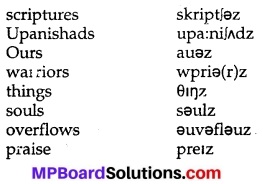
C. Notice how the letter ‘s’ is pronounced Is /or / z/ in the following words.
cups – ‘s’
dogs – ‘z’

Now pronounce the following words carefully :
MP Board Class 9th English The Rainbow Solutions Chapter 1 Bharat Our Land 1

Comprehension

A. Read the first stanza of the poem given below and answer the questions.

The mighty Himavant is ours –
there’s no equal anywhere on earth.
The generous Ganga is ours –
which other river can match her grace?
The sacred Upanishads are ours –
what scriptures else to name with them?
This sunny golden land is ours –
she’s peerless, let’s praise her!

Questions :
1. The sunny golden land of India makes it unique. Name two such things that make India unique.
2. The poet describes the Ganga as ‘generous.’ Suggest two more adjectives that can be used with the Ganga.
3. Name atleast two other holy scriptures of India.
Answer:
1. The mighty Himavant (Himalayas) and the generous Ganga make India unique.
2. The adjectives ‘holy’ and ‘graceful’ can be used with the Ganga.
3. The Ramayana, the Mahabharata and the Srimad-Bhagvad Gita are the holy scriptures of India.

B.Read the second stanza of the poem given below and answer. the questions.

Gallant warriors have lived here,
many a sage has sanctified this land.
The divinest music has been heard here,
and here all auspicious things are found.
Here Brahma-knowledge has taken root,
and the Buddha preached his dhamma here.
Of hoary antiquity is Bharat,
She’s peerless, let’s praise her !

Questions:
1. What is the contribution of the brave and the sages to this country?
2. What is the root of Indian philosophy and culture?
Answer:
1. The brave people have proved to be gallant warriors.
The sages have purified (sanctified) Bharat, our land.
2. The Brahma knowledge (knowledge or experience of Brahma, the supreme reality) is the root of Indian philosophy and culture.

MP Board Solutions

C. Read the third stanza of the poem given below and answer the questions.

Danger shall not scare us any longer,
and poverty shall not sear our souls.
Self-interest shan’t drive us to meanness,
and cowardly indiff’rence shall cease for ever.
Here our land overflows with milk and honey,
and perennial is the supply of fruit and corn.
Ours is the famed Aryan land of Bharat:
she’s peerless, let’s praise her !

Questions :
1. Find out the lines that express the idea of abundance of milk, honey, fruits and grain.
2. What negative qualities have we removed from us?
3. Name two specialities which made Bharat unique and famous.
Answer:
1. The following lines express the idea of abundance of milk, honey, fruits and grain.
‘Here our land overflows with milk and honey.1 and perennial is the supply of fruit .and corn.
or
Lines 5 and 6 of the above stanza express the idea of abundance of milk, honey, fruits and grain.
2. We have removed the negative qualities of danger, poverty, self-interest and cowardly indifference from us.
3. Abundance of food grains, fruits and potables and absence of danger, poverty etc. (are the specialities which) have made Bharat unique and famous.

Speaking Activity

A. Work in pair. One of the two students will say the following words from the poem and the other repeats the same along with the additional words as given in the text :
MP Board Class 9th English The Rainbow Solutions Chapter 1 Bharat Our Land 2
Answer:

  1. the generous Ganga
  2. the sacred upanishads
  3. the sunny golden land
  4. gallent warriors
  5. the divinest music.

B. Make two groups in the class. Group one will ask questions by rearranging the words given in column A and group two will respond as the example given.
MP Board Class 9th English The Rainbow Solutions Chapter 1 Bharat Our Land 3
Answer:

  1. Where is the Ganga? – The generous Ganga is in Bharat.
  2. What are the Upanishads? – The Upanishads are our sacred scriptures (religious texts).
  3. What music has been heard – The divinest music, has been here? heard here.
  4. Who lived here? – Gallant warriors lived here.

C. We are proud of our motherland. Say a few sentences in praise of Bharat. Some of the clues are given below :

  1. vast land
  2. from Kashmir to Kanyakumari
  3. beautiful land
  4. culture and civilization
  5. unity in diversity
  6. great rivers and mountains.
  7. great personalities.
  8. scientific achievements.

Answer:
Our Bharat.
Bharat is a vast and beautiful land. It extends from Kashmir to Kanyakumari. It has preserved the ancient Aryan culture and civilization. There are numerous religions, sects, castes and languages here. In spite of that there is perfect unity in diversity here. It is the land of sacred rivers and mighty mountains. Many saints, philosophers and scholars have taken birth in India. The Indians have made many achievements in the fields of science and technology. We are proud of our beloved Bharat.

MP Board Solutions

Writing Activity

A. Write a letter to your pen friend, living in another country, describing the Indian culture. (50 words)
Answers.
67/2 (Block C-19)
S.P. Mukharji Park,
New Delhi-110018
15 June, 2007
Dear Michael,
In my present letter, I am telling you about our (Indian) culture. The whole of South-East Asia received its culture from India. Buddhism in the product of India. It has influenced many civilizations of China, Japan, Korea and Tibet. We follow the ancient Indian religious literature. We believe in truth and non-violence. We respect our elders and serve them when they get old or sick. We have brotherly relations with the people of our neighbourly states. We believe in the policy of live and let live.
Yours sincerely,
Hardik Kaushik

B. Write a short speech to be delivered on the Independence Day. You may make use of the clues given below :
Mahatma Gandhi, 1947, freedom fighters, nationalism, sacrifice, non-violence, unity, brotherhood, education.
Answer:
Independence Day
15th August is a red letter day in the history of India. On this great day in 1947, India won back her freedom. The British rule came to an end on this day. Now, we have become the makers of our own country and destiny. We celebrate this day as a national festival or as a historical day. This day brings us joy and hope. It also reminds us of the sacrifices of our martyrs. They fought with the British empire. The sacrifices of our leaders like Gandhiji, Sardar Patel, Lala Lajpat Rai, Sardar ! Bhagat Singh, Chandra Shekhar Azad. Veer Savarkar, Subhash Chandra Bose etc. won us freedom. Truth and non-violence were Gandhiji’s weapons. The leaders created a sense of nationalism, unity and brotherhood among the people of different castes and religions.

Think it over

A. India is the country of diversity in natural riches. There are lofty mountains, lush green forests, dry hot desert, vast plains, plateaus and deep seas. What are the other diversities? Think over them. You can think of languages, dances, festivals, food habits etc.
Answer:
There is diversity of languages, dances, food habits etc. in India. India is a vast country. Many languages like English, Hindi, : Urdu, Gujrati, Marathi, Rajasthani, Dogri, Tamil, Malyalam, Assamese, Telugu, Bengali, Punjabi etc. are spoken by people of different regions and states. All types of dances like Kathak, Kathakali, Kuchipuri, x Bhangra, etc. are practised here. The people eat different food grains like wheat, grams, barley, millet, maize, soyabean, milk products or non-vegetarian diets like eggs and flesh. People of different-castes and religions celebrate the festivals like Diwali, Holi, Dussehra, Id, Christmas, Guru Parva etc. Hence, we can say that India is a country of vast diversity.

B. We are Indians, our love and dedication should be reflected not only in words but also in our deeds. What should guide our actions?
Answer:
Mahatma Gandhi once said, “We have to produce a society of those people who profess different religions, live in different regions with different climates but live like brothers.” In fact, the statement of Mahatma Gandhi has the essence of national integration in India. Lip service does not hold any importance in our life. We must keep harmony between on words, thoughts and actions. We are Indians first and last. We puts develop a sense of love and dedication for all the Indians. The people of all religions, eating practices and faiths should live together like real brothers. This is mine or others is the consideration, of low-minded people.

Things to do

Go to your library and collect some poems of similar theme and write them in your diary.
Answer:
Class-room Activity for self Attempt

Bharat Our Land Additional Questions

Short-Answer Questions, (about 25 words)

Question 1.
What are your ideas about your ‘Dear India’?
Answer:
I have a deep and undying love for my ‘Dear India’. She is my mother land. I can fulfil all my dreams here. I find myself fully secure here. Her thought instils joy and hope in us. Everybody is free to work, worship and think here. Even a child is respected like a God here.

Question 2.
What were the main characteristics of the Aryan (Vedic) Age?
Answer:
The main characteristics of the Aryan Age can be stated as under :

  1. It demonstrated the reversal of pastoral economy.
  2. It exhibited the predominance of the tribal system.
  3. It experienced the spread of agriculture throughout the country.
  4. It witnessed a civilization spread over the whole country.
  5. There was intermixing of the Aryan and the Dravidian culture.

Question 3.
Explain the meaning of the term ‘Upanishad’.
Answer:
‘Upanishad’ literally means ’the sitting down of the disciples near the preceptors for a confidential chat or communication. Later, it was baptised as a sacred doctrine (session). Upanishads, now impart the knowledge about Brahman.

Question 4.
Write a brief note on Hindu Civilization.
Answer:
Hindu civilization is immortal. The Bhagvad Gita and the Upanishads will ever go on inspiring the men of action and thought. Many unwanted features of Indian Civilization like animal sacrifice, widow burning, child marriage, joint family system and untouchability have disappeared.

Long Answer Type Questions

Question 1.
How can we say that India is a gloroious land?
Answer:
India is a land of great diversity in its physical features, people, languages and cultures. We have the evergreen luscious forests, rivers, valleys and fertile plains in the North and the South. We have the snowy peaks of the Himalayas in the North. It is surrounded by the mighty oceans on three sides. Uncountable communities live , in 26 states. The people speak different languages and different dialects ‘ for each language. India has a rich heritage, in science, architecture and literature. Our country produces practically everything. We export industrial goods. We are one of the world’s largest film-makers. Our musicians and dancers are appreciated all over the world. We can l call our country a glorious land.

MP Board Solutions

Question 2.
Which problems do the people of India face now?
Answer:
The people of India face a host of problems. There is widespread poverty and illiteracy. Also there is a wide gap between the rich and the poor. There are persons who cannot afford two square meals a day. On the other hand there are those who live in five- star luxury even in their own homes. They waste money carelessly. Both the rich and the poor are always in danger. The poor are scared of the rich and the rich are afraid of the robbers, kidnappers and dacoits. Even the custodians of law are mightily scared of the law breakers. Everybody is self-interested. Nuclear families have sprung up.

The aged people are neglected and left to suffer alone. Unemployment is the root cause of all problems. Terrorism, militant activities and, mental tensions are the order of the day. Exploitation, nepotism x and bribery have caused an atmosphere of stress and strain. Everybody has become indifferent to others’ welfare.

Bharat Our Land Summary in English

Bharat is our land. The mighty Himalayas, the generous Ganga and the sacred upanishads are India’s matchless possessions. It is a peerless, sunny golden land.Bharat is the land of heroic warriors, holy sages and heavenly music. It is the land of origin of many religions and sects. It has a well-known ancient past. Indians will no longer be a victim of danger, poverty, self-interest and cowardly indifference. They are rich and self-sufficient. The Aryan land deserves all praise.

Bharat Our Land Summary in Hindi

भारत हमारी भूमि है। शक्तिशाली हिमालय, उदार गंगा और पवित्र उपनिषद्, भारत की अतुलनीय सम्पत्ति हैं। यह धूपवाली तथा अनोखी सुनहरी भूमि है।

भारत, वीर योद्धाओं, पावन संतों और दिव्य संगीत की भूमि है। यह अनेकों धर्मों तथा मतों की उद्गगम भूमि है। इसका पुरातन भूतकाल प्रसिद्ध है। भारतीय खतरों, निर्धनता, स्वार्थ तथा भीरुतापूर्ण उदासीनता के और अधिक शिकार नहीं रहेंगे। वे धनी और आत्म-निर्भर हैं। आर्य-भूमि समूची प्रशसा की अधिकारी

Bharat Our Land Word-Meanings

MP Board Class 9th English The Rainbow Solutions Chapter 1 Bharat Our Land 4

MP Board Class 9th English Solutions

The Rainbow Textbook Special English Class 9th Solutions

The World is Too Much with Us Question Answer Class 9 English The Rainbow Workbook Chapter 7 MP Board Solutions

Class 9th English The Rainbow Workbook Chapter 7 The World is Too Much with Us Question Answers

The World is Too Much with Us Class 9 Questions and Answers

The World is Too Much with Us Vocabulary and Pronunciation

A. Quote a few lines from a poem where the poet express serious thought in simple, delightful and direct words.
Answer:
Little we see in Nature that is ours. We have given our hears away, a sordid boon. For this, for everything, we are out of tune. It moves us not – Great god I’d rather be.

B. What do you mean by ‘octave’?
Answer:
Octave : the difference between the first and last notes in a serious of eight notes on a scale.

MP Board Solutions

C. Match column ‘A’ column ‘B’
A – B

  1. sordid – everything that exists in the world
  2. howling – an open piece of grassy land
  3. nature – noise made by a strong mind
  4. lea – poor.

Listening Skill

Listen to the lines of the following poems.
After listening to the poem recollect the poem and answer the following questions .

Question 1.
What is the first line of the poem ?
Answer:
Dear water clear water, playful in all your streams.

Question 2.
What qualifying words have been used for water ?
Answer:
Clear, dear, playful, pure.

MP Board Solutions

Question 3.
‘The most well-spoken’, the words have been used for ……….
Answer:
The oldest servant.

Question 4.
Who is one of the older servants of Mrs. Nature ?
Answer:
Water.

Speaking Skill

Wordsworth, in his poem ‘The worlds is too much with us’ says that one should not merely think of earning and spending. What else one should and shouldn’t think?

See workbook page 55.

Reading Skill

Read the given stranzas carefully and answer the questions given below it.

See workbook page 56.
Question 1.
Complete the following statements :

(a) By the word ‘Care’ in line one, the poet means.
Answer:
Excess attention/ highly protective.

(b) When the poet say “No time to stand and stare”, he wants to convey that ……………….
Answer:
He has so many duties to discharge and therefore he does not get time to look at the beauty of nature.

(c) In stanza one ‘we’ refers to ……………..
Answer:
Human beings.

(d) The sheep and cows being free from have the time to …………….
Answer:
Worries, state as long as they wish.

Question 2.
Which words have been repeated several times? Why?
Answer:
No, time, stand, stare.

MP Board Solutions

Question 3.
The poet has used capital letter ‘B’ to talk about “Beauty” in the line “No time to turn at Beauty’s glance”. Why?
Answer:
Here, the poet personifies beauty.

Question 4.
Pick out the words from the poem which have the following meanings.
(a) a feeling of worry of anxiety of tension
(b) wait and watch.
(c) an area of trees or small forests
(d) casting of momentary looks
Answer:
(a) care
(b) stare
(c) wood
(d) glance.

Writing Skill

A. Find any advertisement from the Ministry of Health and Family Welfare, Delhi.
Write a letter to your uncle, in the light of that advertisement, suggesting him to follow the precautions (50 words).
Answer:
My Dear Uncle
You might have seen advertisement issued for public by the Ministry of Health and Family Welfare Delhi warning to be precautions against spread of Dengue. It is a deadly disease. So take safety measures. Avoid contamination of water. Use mosquito repellents. Keep all doors and windows dose in evening. I am very serious about it. Don’t worry for me.
Yours
Rakesh.

MP Board Solutions

B. Is money everything in life? Write your views. (150 words)
Answer:
Money has become the most vital factor of life these days. We can’t live without it. It is the basic need. In this materialistic
age we have to buy everything that. We need in our day to day life. There was a time when people used to get things through barker system. But it is not in practice. It has become an age old tale. We can’t think of a life if we have no money. Moreover it also establishes our identity in society. It gives a good status. It one has no money one will not get a good position do it is time to say money is everything in life.

MP Board Class 9th English Solutions

The Rainbow Workbook Special English Class 9th Solutions

How it all began Question Answer Class 9 English The Rainbow Chapter 15 MP Board Solutions

Class 9th English The Rainbow Chapter 15 How it all began Question Answers

How it all began Class 9 Questions and Answers

How it all began Textual Exercises

How it all began Vocabulary

A. What are the different meanings of the following words, nursery, glass, cricket, watch, collector, interest, couple, record, encounter, country, bank
Answer:
Word – Meanings
Nursery : Children’s quarters; a room for children and their nurse, a plot of ground in which young plants are reared for transplantation; a fish – rearing pond; a place where animal life is developed.
Glass : A transparent, lustrous, hard and brittle substance; a drinking vessel ; a mirror ; a pair of spectales.
Cricket : A jumping and chirping insect, an open air game with ball, bats and wickets.
Watch : The act of watching; a guard, close observation, the place where a guard in kept; a small timepiece for the pocket.
Collector : One who collects revenue, the chief administrative . official of a district.
Interest : A legal concern; title; right, profit, advantage; welfare1 pecuniary stake.
Couple : A pair, a leash for two hounds; a married or engaged pair; two; a brace.
Record : A recorded Tate; register; official report of proceedings; a public document; the plate of gramophone; facts known.
Encounter: A hostile meeting; to meet with a person; an obstacle.
Country : A region; a territory of a nation; the land of one’s birth; rural districts.
Bank : A raised shelf of ground; artificial slope; ground at the edge of a river; flat topped mass of cloud; establishment for safe custody of money.

MP Board Solutions

B. Use the following expressions in your own words.
large as lifer at large, by and large.
Answer:

  1. The old man’s poverty was as large as life.
  2. The robbers are still at Large.
  3. The people, by and large arc selfish.

C. Pronounce the following words given in pair and write their
meanings also. You can consult a dictionary.
place – palace
lake – lack
none – nun
years – ears
son – sun
people – pupil
show – shoot
poppy – puppy
fort – forte.
Answer:
MP Board Class 9th English The Rainbow Solutions Chapter 15 How it all began 1
MP Board Class 9th English The Rainbow Solutions Chapter 15 How it all began 2

D. Pronounce the following.
Wints, Oxford, The observer, Pen. Allegra, Rhododendron, Leggie, Fontainebleau, Salim All, V”titer, Tughiaquabad.
Answer:
MP Board Class 9th English The Rainbow Solutions Chapter 15 How it all began 3

Comprehension

A. Answer each of the following questions in about 25 words.
1. What did the author do at the cricket ground?
2. Why was the homeward journey longer?
3. How did the author increase his information about birds and trees?
4. Where did the author learn the names of English wild flowers from?
5. How did tire author spend his weekends with the little child?
6. How was the author motivated to know more about trees and birds?
Answer:
1. The author used to go to the University Cricket ground. Allegra, his friend’s three-years old daughter used to accompany him. There he would watch the cricket game for a while. He used to buy ice-cream for the little girl.

2. Allegra was a fond collector of wild flowers. The author had to pick whatever flower she wanted. He used to pick up snow-drops, bluebells, periwinkles, lilies and many others. It took him much time to collect a handful of flowers. Therefore, the homeward journey was longer. It took them a longer time.

MP Board Solutions

3. The author was unable to identify many birds and trees. He had little knowledge of the fauna and the flora. He was least interested in nature. He felt the lack of such information when he returned from abroad. He desired to increase his information. Therefore, he read books on trees, birds and insects minutely. He also accompanied , bird-watchers and horticulturists. Gradually, his fund of information increased.

4. The author was least interested in nature. He did not grow many flowers in his plot. His wife is in favour of growing vegetables. The author went abroad. There he used to go out for a walk with a three-year old girl. She asked him to pick up snow-drops and
bluebells. There were also periwinkles, lilies and many others. The author learnt the names of many English wild flowers from little Allegra.

5. The Wint family remained at home on weekends. The author spent most of the day sunning in their garden. He enjoyed hearing die chorus of thrushes and blackbirds from dawn to dusk. Lots of birds rested in their cherry and apple trees. He also played with
the little child.

6. The author was least interested in nature. He had little knowledge about the fauna and the flora so far as he remained in India. Oh his return from abroad, he left it. He was unable to identify more than a couple of dozen birds or trees. He felt that it was rewarding to know about them. His conscience motivated him to know more about trees and birds.

B. Answer each of the following questions in about 50 words.
1. What were the qualities of Allegra or Leggie?
2. Describe the private back garden of the author.
3. Justify the author’s visit to countryside on Sundays.
Answer:
1. Allegra (Leggi) was a three-year-old girl. She was the daughter of Mr. Guy Wint in Oxford. She was friendly to the author.  She gave him company She was fond of eating sandwiches and drinking milk. She was also fond of going on Walk with the author.
She watched the cricket game. She was fond of eating ice-cream. She was a keen collector of wild flowers. She used to urge the author to pick up the flowers of her choice. She used to climb the author’s shoulders and rest her chin on his head. She enjoyed the game of sticking flowers in the author’s turban and beard. She was of ever demanding type. She was a great chatterbox also.

2. The author had a private back garden. It was a small rectangular plot of green. It was enclosed on two adjacent ’sides by a barbed wire fence. The hedge was covered by creepers. His own apartment and his neighbour apartment formed its two sides. There in a fencing wall of hibiseus. There are four avocado trees and a tall eucalyptus in it. There is also a small patch of grass. They have grown more vegetables and less flowers in it. Many birds and stray cats share his bird – bath. The garden faces a squarish lawn. It is shared by other residents of the colony.

MP Board Solutions

3. The author used to spend Sunday mornings in winter in the countryside. He carried a pair of binoculars and books on Indian birds. He used to visit the banks of the Jamuna behind Tilpat village. He also visited Surajkund. It is a dam which supplies water to its pool. The ruins of Tughlaqabad Fort were also his favourite haunts. He saw the troops of rhesus monkeys there His visit to countryside on Sundays is justified. It renews his acquaintance with birds and wild plants grown in Delhi.

How it all began Grammar

A. Study the following sentences.

  • Their son, Ben, was at a boarding school.
  • In the mornings I worked in my room.
  • His wife had converted to Buddhism..
  • I gave her a glass of molk.
  • The other two sides are formed by my neighbour’s and my own apartments.

The underlined words are prepositions. A preposition is a word that relates nouns, pronouns and noun clauses (small sentences inside a bigger one, working as nouns) in space, time, order and direction.
Now, pick out prepositions from the following sentences.
1. I spend Sunday mornings in my garden.
2. Surajkund supplies water to its pools.
3. There was a variety of wild plants.
4. I couldn’t identify more than a couple of dozen birds.
5. For the last many years I have maintained a record of the natural phenomena.
6. He always writes letters to his friends in ink.
7. What’s time by your watch ?
Answer:
1 (in), 2 (to), 3 (of), 4 (of), 5 (For, of), 6 (to, in), 7 (by).

Speaking Activity

A. Present an oral report of the natural phenomena around you. You can base your report on the details given in the lesson.
Answer:
New Delhi 28th July, 2007
I live in a village. It is located in the lap of nature. It is surrounded by woods and green fields. Cattle graze in the pastures. Birds perch and chirp on the trees. The snakes come out of their holes in the dark or when the holes are flooded with water. There ; are pools along the sandy paths. The trees blossom and birds come out of the flower plants. Bees collect honey from various flowers. The sight of the oxen and camels dragging carts or ploughing the fields is pleasant. We can see heaven on earth on a cloudy or rainy day.

B.Below are given some natural phenomena, visualise them and express your ideas orally. sunrise, sunset, rainbow.
Answer:
Sunrise, sunset and rainbow are a vital part of natural phenomena. The people awake at sunrise, pray to God and busy themselves in their daily chores. A sunny morning is an ideal morning during winter and rainy reason. The whole nature comes to life.
The workers in the fields and factories long for sunset. They finish their assigned jobs and return home to take rest. Even the animals grazing in the fields wait for the sunset. They meet their young ones then. The rainbow provides a pleasant sight. It is an arch of different colours that is formed in the sky when the sun shines through rain. Poets have praised these natural phenomena to the sky.

Writing Activity

A. Prepare a short introductory radio talk on ‘bird watching (50 words)
Answer:
Bird-watching is a pleasant activity. We see many birds in our day-today life. I am fond of seeing birds. I have seen many kinds of birds. They are of all kinds and colours. The ostrich is as large as a camel. I see a large number of bright red little robins singing in the garden every day. Black, white and red, big and small monkeys frighten the children. The dancing peacocks attract the passers-bys’ attention. The thrushes, black birds, sparrows, weaverbird, pigeons, parrots, eagles, wood peckers, cuckoos and nightingales enrich the atmosphere with their presence. Owls and crows are considered as ominous birds.

MP Board Solutions

B. Make entries in your diary of the flora and fauna of your area.
Answer:
Gurgaon 24th August, 2007
I live in the rural area of Haryana. My house is located a few kilometres away from Sultanpur Jheel. I visit the lake almost every week to renew my acquaintance with the flora and fauna of our area.

Our area abounds in flora (or regional plants, flowers or trees) Apples, apricots, balsom, banana, black berry, bokhara plum, cobra flower, coconut, crab apple, daisy, date, fig, grapes, guava, Japanese plum, jasmine, lemon, lichi, lime, magnolia, malta, mango, marigold, mosamibi, mulberry, orange, papaya, pears, pineapple, plum, rose, sapodilla, sour cherry, sweet cherry, tamarind, are found here or there.

We can include apes, asses, buffaloes, bears, hounds, boars, bullocks, cats, chimpanzees, deer, elephants, foxes, giraffes, horses, hyenas, jackals, kangaroos, lambs, leopards, lions, mares, colts, mongooses, muskdeer, panthers, pigs, porcupines, rabbits, rams, rhinos, sheep, tiger, wolf and zebras in the list of fauna of our area.

Think it over

A. Just ponder over the inter-relations and interdependence among man, animals and plants.
Answer:
On the basis of our personal experience we can say with certainly that there is inter-relation and inter-dependence among man, animals and plants. Man drinks the milk of certain animals. He use the animals for his service in carrying loads or plugging his fields. He eats the flesh and sells the hides and turks of animals. He takes honey, medicines and oils from many plants. He uses the dung of animals for manure. Animals are reared by men. They feed on certain plants. Plants also depend on men for their proper upkeep. They would die if they are not properly taken care of. They also need the manure, given by the animals. Man benefits the most by selling animals and plants.

Things to do

Prepare a list of flowering plants and birds found in your surroundings also note down their distinctive features.

Name of
flowering Plants
Distinctive
features
Name of birds Distinctive
features
Morning glory Bell shaped violet flower Parrot red beak, green
feathers
Marigold golden yellow
flowered plant
Starling Small bird noted
for chatter
Petunia Funnel shaped
white, violet,
purple flower.
Peacock Splendid plumages and fanlike tail.

How it all began Additional Questions

Short Answer Type Questions (In about 25 words)

Question 1.
Where and with whom did the author spend a summer as a young man?
Answer:
As a youngman the author spent a summer with his friends, the Wints, in Oxford. Guy Wint was an official on the staff of the observer. His wife’s name was Freda. Their son was Ben and their daughter was Allegra (Leggie).

Question 2
Why did the author give company to Allegra for a walk everyday.
Answer:
The author’s friends, Guy Wint was on the staff of the observer. He remained in London most of the day. His wife Freda spent her day outside in meeting her fellow Buddhists. Their son was in boarding school. The author used to be alone at home when Allegra returned from the nursery school. He gave her a sandwich and a glass of milk. Nobody else was there at home. Therefore, the author gave her company for a walk everyday.

Question 3
How did the author reach the University Cricket grounds?
Answer:
The author was new in Oxford. He had no knowledge about the shortcuts there. Allegra knew the neighbourhood well. She led the author’s way. The paths ran through woods of oak, beech and rhododendron. Finally they reached the University Cricket grounds.

MP Board Solutions

Question 4
What happened when Leggie (Allegra) felt tired on the return journey?
Answer:
On the return journey Leggie (Allegra) felt tired. The author made her climb up on his shoulders. She dangled her legs round her neck and rested her chin on his head. She stuck flowers in the author’s turban and beard. She enjoyed her game until they got home.

Long-Answer Type Question

Question 1.
Write a paragraph on ‘Grow More Trees.’
Answer:
Trees and forests precede man. They are the greatest purifiers in the world. They are the sanctuaries not only of animals and birds but also of many tribals and forest people. They give us fruit and herbs, wood and timber. They are the green lungs of the world. The poets call the trees as green gold. They maintain the ecological balance in the world. Trees give out oxygen and absorb carbon dioxide in the air. They provide shade and shelter to animals, birds and human beings in the scorching heat of summer. They bring rain and hold the soil tightly. Above all, they keep the land safe from soil erosion, floods and droughts.

How it all began Summary in English

The narrator Khushwant Singh was a youngman. He had his friend the Wints in Oxford. Guy Wint was working with the observer. He stayed in London most of the day. His wife, Freda had converted to Buddhism. Their son, Ben was at a boarding school.
The narrator’s companion was Allegra (Leggie). She was Wint’s three-years old daughter. The narrator worked in his room in the mornings. He, then walked with Allegra to University Cricket Grounds. He watched the game for a while and followed her back homewards. Allegra was an avid collector of wild Flowers.

The narrator had to pick the flowers of her choice in plenty. Then he , seated her on his shoulders. She stuck flowers in his turban and . beard. The narrator learnt the names of many English wild flowers from her. On weekends, the narrator spent most of the day sunning in the garden with Wint’s family. Their cherry and apple trees invited lots of birds. They sang through the day. Freda told him the difference between thrushes and blackbirds. The thrush sang each song twice. The songs of a variety of birds became familiar to the narrator. He also heard nightingales.

The narrator had no interest in nature before he went abroad. He foiled to identify many birds and trees. On returning to Delhi, he bought books, accompanied bird-watchers and horticulturists. His information about flora and fauna increased a great deal.
The narrator maintained a record of the natural phenomena he encountered in his private back-garden. It was a small rectangular plot of green enclosed by barbed wire fence and creepers. He had four avocado trees and a tail eucalyptus.

MP Board Solutions

There was also a small patch of grass with some trees. He did not grow many flowers. They grew vegetables. His bird bath remains crowded with birds and stray cats. A squarish lawn was shared by other residents of Sujan Singh park. There were many large trees in it. Several nurseries in the neighbourhood attracted large number of birds. There were many wild trees and bushes Which attracted insects.

The narrator spent Sunday mornings in winter in the countryside at the banks of the Jamuna, Surajkund and the ruins of Tughlaqabad Fort. He visited those places every year to renew his familiarity with many birds and wild plants which grow all round Delhi.

How it all began Summary in Hindi

लेखक (खुशवंत सिंह) नवयुवक था। ऑक्सफोर्ड में विन्टज परिवार से उसकी मित्रता थी। गाई विन्ट, ऑब्जर्वर के साथ काम करता था। वह दिन में अधिकांश समय लन्दन में रहा करता था। उसकी पत्नी, फ्रेडा, ने बौद्ध धर्म कबूल कर लिया था। उनका बेटा बेन, एक छात्रावास स्कूल में था। अलेग्रा (लेनी), लेखक की साथिन थी। वह विन्ट की तीन वर्षीय लड़की थी। प्रातः के समय, लेखक, अपने कमरे में काम किया करता था। फिर वह अलेग्रा के साथ पैदल यूनिवर्सिटी क्रिकेट ग्राऊण्डज तक जाया करता था। थोड़ी देर तक वह खेल देखी करता था और फिर उसके पीछे-पीछे घर की तरफ चल देता था। अलेग्रा को जंगली फूल इकट्ठे करने का बड़ा चस्का था।

लेखक को ढेर सारे उसकी पसंद के फूल चुनने पड़ते थे। फिर वह उसे अपने कंधे के ऊपर बैठाता। वह उसकी पगड़ी। और दाढ़ी में फूल अटका देती। लेखक ने बहुत-सारे अंग्रेजी जंगली फूलों के नाम उसी से सीखे थे। सप्ताहान्त पर, लेखक, दिन का अधिकांश भाग विन्ट परिवार के साथ बाग में धूप सेकने में बिताता था। उनके चेरी और सेब के वृक्ष ढेर सारे पक्षियों को लुभाते थे। वे दिन भर गीत गाते रहते थे। थ्रशों और काले पक्षियों के बीच का अन्तर, फ्रेडा ने उसे समझाया। थ्रश, हर गीत को-दो बार गाता था। कवि, विभिन्न पक्षियों के गीतों से परिचित हो गया। उसने बुलबुलों को भी सुना। विदेश जाने से पहले, लेखक की प्रकृति में रुचि नहीं थी। वह बहुत से पक्षियों और वृक्षों की पहचान करने में असमर्थ था। दिल्ली लौटकर उसने पस्तकें खरीदीं तथा पक्षी निरीक्षकों और बागवानी के ज्ञाताओं की संगत की। वनस्पतियों तथा पशुवर्ग के बारे में उसका काफी ज्ञान बढ़ गया।

MP Board Solutions

वह प्राकृतिक गोचर पदार्थों का रिकार्ड रखता था जिनके साथ उसके निजी पिछवाड़े वाले बाग में उसकी भेंट होती थी। यह काँटेदार तारों और बेलों से घिरा हुआ, हरियाली वाला छोटा-सा प्लाट था। उसके Avocadoकेचार वृक्ष तथा eucalyptus का एक लम्बा पेड़ था। कुछ वृक्षों वाला घास का एक छोटा-सा टुकड़ा भी था, उसने अधिक फल नहीं उगाए। वे सब्जियां उगाते थे। उसके पक्षी स्नानगृह में पक्षियों और आवारा बिल्लियों की भीड़ रहती थी। एक वर्गाकार घास के मैदान में सुजान सिंह पार्क के दूसरे निवासियों की भी साझेदारी थी। उसमें बहुत से विशाल वृक्ष थे। पड़ोस में स्थित कई नर्सरियाँ विशाल संख्या में पक्षियों को आकर्षित करती थीं। बहुत-से जंगली वृक्ष और झाड़ियाँ, कीड़े-मकोड़ों को आकर्षित करती थीं।
सर्दी के मौसम में लेखक ग्रामीण क्षेत्रों में जैसे जमुना के किनारे सूरजकुण्ड में और तुगलकाबाद किले के खण्डहरों में रविवार का प्रातःकाल बिताया करता था। बहुत से पक्षियों और समूची दिल्ली में उगने वाले जंगली पौधों के साथ अपने परिचय को ताजा करने के लिए वह उन स्थानों पर प्रत्येक वर्ष जाया करता था।

How it all began Word-Meanings

MP Board Class 9th English The Rainbow Solutions Chapter 15 How it all began 4
MP Board Class 9th English The Rainbow Solutions Chapter 15 How it all began 5

MP Board Class 9th English Solutions

The Rainbow Textbook Special English Class 9th Solutions

Noise Question Answer Class 9 General English The Spring Blossom Chapter 17 MP Board Solutions

Class 9th General English The Spring Blossom Chapter 17 Noise Question Answers

Noise Class 9 Questions and Answers

Noise Textual Exercises

Word Power

(a) Make new words from the following root words by adding the suffix-er/r/or.
(प्रत्यय जोड़कर नए शब्द बनाओ।)
Answer:
write – writer
read – reader
teach – teacher
sell – seller
supervise – supervisor
create – creator
pollute – polluter
vote – voter

(b) Look into the dictionary and find out the meanings of the words above made by adding the suffix.
(प्रत्यय जोड़कर बनाए गये शब्दों के अर्थ ढूँढ़िए।)
Answer:
Students can do themselves.
(छात्र स्वयं करें।)

II. Find out the words from the text which mean the following.
(अध्याय में से निम्नार्थक शब्द ढूँढ़ो।)

  1. To crush into fine powder – pulverize.
  2. One who teaches – teacher.
  3. One who goes from place to place to sell things – hawker.
  4. Someone whose job is to find out secret information about a country – spy.
  5. Bright and cheerful – festive.

MP Board Solutions

How Much Have I Understood?

(A) Answer the following questions in one or two sentences
(निम्न प्रश्नों के उत्तर एक या दो वाक्यों में दीजिए।)

Question 1.
What are the things that create noise in this age?
(व्हॉट आर दि थिंग्स दैट क्रिएट नॉइज़ इन दिस एज?)
वे कौन सी चीजें हैं जो आज के युग में शोर उत्पन्न करती हैं?
Answer:
Radio, tape-recorders, television, loudspeakers, machines in the factories motor vehicles especially motorcycles, present day babies, hawkers on the streets etc. are the things that create noise.
(रेडियो, टेपरिकॉर्डर्स, टेलिविज़न, लाउडस्पीकर्स, मशीन्स इन द फैक्ट्रीज़, मोटर वेहिकल्स एस्पेश्यली मोटरसाइकिल्स, प्रेजेन्ट डे बेबीज, हॉकर्स ऑन द स्ट्रीट्स ऐटसेट्रा आर द थिंग्स दैट क्रियेट नॉइज़।)
रेडियो, टेपरिकॉर्डर, टेलीविजन, लाउडस्पीकर, कारखानों की मशीनें, मोटरगाड़ियाँ विशेषकर-मोटरसाइकिल, आज के बच्चे, फेरी वाले आदि शोर उत्पन्न करते हैं।

Question 2.
Why do we create noise?
(व्हॉय डू वी क्रिएट नॉइज़?)
हम शोर क्यों करते हैं?
Answer:
We create noise not only to show that we are in a happy and festive mood but also to canvass votes, to advertise a commodity or a point of view and also for its own sake.
(वी क्रिएट नॉइज़ नॉट ओनली टू शो दैट वी आर इन अ हैप्पी एण्ड फैस्टिव मूड बट ऑल्सो टू कैनवस वोट्स, टू एडवरटाईज़ अ कमोडिटी और अपॉइन्ट ऑफ वियू एण्ड ऑल्सो फॉर इट्स ओन सेक।)
हम अपनी खुशी जाहिर करने के लिए ही शोर उत्पन्न नहीं करते, बल्कि प्रचार द्वारा वोट प्राप्त करने, किसी वस्तु या विचार को विज्ञापित करने और इसको बनाए रखने के लिए भी शोर करते हैं।

Question 3.
Name the different kinds of noises.
(नेम द डिफ्रेन्ट काइन्ड्स ऑफ नॉइज़ेज़।)
विभिन्न प्रकार के शोर के नाम बताओ।
Answer:
Necessary noise, unnecessary noise, purposeful noise and purposeless noise are various types of noises.
(नेसेसरी नॉइज़, अननेसेसरी नॉइज़, परपजफुल नॉइज़ एण्ड परपजलेस नॉइज़ आर वेरिअस टाइप्स ऑफ नॉइज़ेज़।)
जरूरी शोर, अनावश्यक शोर, उद्देश्यपूर्ण शोर व अनुद्देश्यपूर्ण शोर विभिन्न प्रकार के शोर हैं।

Question 4.
How does a motor cyclist create agitation? How long does it last?
(हाउ डज़ अ मोटर साइक्लिस्ट क्रिएट एजिटेशन? हाउ लाँग इज इट लास्ट?)
मोटर साइकिल चालक किस प्रकार अशान्ति उत्पन्न करता है? वह कितनी देर तक रहती है?
Answer:
Motor cyclist creates agitation by starting the motor cycle and testing its engine. The agitation lasts half an hour even after the machine itself has gone out of sight.
(मोटर साइक्लिस्ट क्रिएट्स एजिटेशन बाइ स्टार्टिंग द मोटर साइकिल एण्ड टेस्टिंग इट्स एन्जिन। द एजिटेशन लास्ट्स हॉफ एन आवर ईवन आफ्टर द मशीन इटसेल्फ हैज गॉन आउट ऑफ साईट।)
मोटर साइकिल वाला मोटर साइकिल चलाकर व उसके इंजन की जाँच करके अशान्ति उत्पन्न करता है। वह अशान्ति उसके चले जाने के बाद आधे घण्टे तक भी रहती है।

Question 5.
Why did the author abandon a very comfortable house?
(व्हॉय डिड द ऑथर अबैन्डन अ वेरी कम्फर्टेबल हाऊस?)
Answer:
The author abandoned a very comfortable house because of a neighbour who switched on his radio every morning at five, long before even the gates were unlocked in any radio station.
(द ऑथर अबैन्डन्ड अवैरी कम्फर्टेबल हाऊस बिकॉज ऑफ अ नेबर हू स्विच्ड ऑन हिज रेडियो एवरी मॉर्निंग एट फाइव, लाँग बिफोर ईवन द गेट्स वर अनलॉक्ड इन एनी रेडियो स्टेशन।)
लेखक ने एक बहुत आरामदेह घर छोड़ा क्योंकि उसका पड़ोसी सुबह 5 बजे से अपने रेडियो को चालू कर देता था जबकि शायद किसी रेडियो स्टेशन के गेट भी न खुले हों।

Question 6.
Which factory did the author visit that he mentions?
(व्हिच फैक्ट्री डिड द ऑथर विज़िट दैट ही मैन्शन्स?)
लेखक किस कारखाने को देखने गया था?
Answer:
The author visited a gold factory.
(द ऑथर विज़िटिड अ गोल्ड फैक्टरी।)
लेखक स्वर्ण कारखाना देखने गया था।

Question 7.
What is that the author longs for?
(व्हॉट इज़ दैट द ऑथर लॉग्स फॉर?)
लेखक की क्या इच्छा थी?
Answer:
The author longs for a zone of silence.
(द ऑथर लांग्स फॉर अ जोन साइलेंस।)
लेखक शान्त क्षेत्र की इच्छा करता है।

(B) Answer the following questions in two or three sentences :
(निम्न प्रश्नों के उत्तर दो या तीन वाक्यों में दीजिए।)

Question 1.
What do you mean by noise pollution? How does noise create pollution?
(व्हॉट डू यू मीन बाइ नॉइज़ पॉल्यूशन? हाउ डज़ नॉइज़ क्रियेट पॉल्यूशन?)
ध्वनि प्रदूषण से तुम क्या समझते हो? ध्वनि कैसे प्रदूषण पैदा करती है?
Answer:
Noise pollution is caused by creating unwanted sound that disturbs others. Every moment it distracts our lives. The noise in an around us is wearing us out at a terrific pace, creating pollution.
(नॉइज़ पॉल्यूशन इज़ कॉज्ड बाइ क्रिएटिंग अनवॉन्टेड साउण्ड दैट डिस्टर्ब अदर्स। एवरी मोमेन्ट इट डिस्ट्रैक्ट्स आर लाइव्स। द नॉइज़ इन एन अराउण्ड अस इज़ वियरिंग अस आउट एट अ टैरिफिक पेस, क्रियेटिंग पॉल्यूशन।)
ध्वनि प्रदूषण वह अनचाहा शोर है जो दूसरों को विचलित करता है। हर पल हमारा जीवन उससे विचलित होता है। हमारे चारों ओर का शोर हमें तेजी से थका रहा है व प्रदूषण फैला रहा है।

Question 2.
Why is the whole locality. converted into a sort of gold factory?
(व्हाय इज़ द होल लोकेलिटी कन्वर्टिड इन टू अ सॉर्ट ऑफ गोल्ड फैक्ट्री?)
हमारे चारों ओर का वातावरण किस प्रकार सोने की फैक्ट्री है?
Answer:
Whole locality around us is creating so much noise that it seems to be converted into a gold factory. A gold factory is the most deafening place on earth when the ore is pulverized before being treated with cyanide.

(होल लोकैलिटी अराऊण्ड अस इज़ क्रियेटिंग सो मच नॉइज़ दैट इट सीम्स टू बी कनवर्टिड इन्टू अ गोल्ड फैक्ट्री। अ गोल्ड फैक्ट्री इज़ द मोस्ट डैफनिंग प्लेस ऑन अर्थ व्हेन द ओर इज़ पलवरइज्ड बिफोर बीइंग ट्रीटेड विद साइनाइड।)

हमारे आस-पास के वातावरण में इतना शोर उत्पन्न होता है कि ऐसा लगता है कि वह एक सोने का कारखाना है। सोने का कारखाना इस धरती पर सबसे शोरगुल वाला स्थान होता है जब कच्ची धातु को संसाधित करने से पूर्व उसका चूरा बनाया जाता है।

Question 3.
What type of pollution does your school have and what steps do you take to keep your school pollution free?
(व्हॉट टाइप ऑफ पॉल्यूशन डज़ योर स्कूल हैव एण्ड व्हॉट स्टेप्स डू यू टेक टू कीप योर स्कूल पॉल्यूशन फ्री)
तुम्हारे विद्यालय में किस प्रकार का प्रदूषण है और तुम अपने विद्यालय को प्रदूषण रहित करने के लिए क्या कदम उठाओगे?
Answer:
Our school has noise pollution. The vehicles on the street create a lot of noise pollution and the shops in front of our school play tape recorders at high volume. We have complained the collector to stop the shopkeepers from playing music at such large volume as they did not.stop it at our request.

(अवर स्कूल हैज़ नॉइज़ पॉल्यूशन। द वेहिकल्स ऑन द स्ट्रीट क्रिएट अ लॉट ऑफ नॉइज़ पॉल्यूशन एण्ड द शॉप्स इन फ्रन्ट ऑफ अवर स्कूल प्ले टेप रिकॉर्डर्स एट हाइ वॉल्यूम। वी हैव कम्प्लेंड द कलैक्टर टू स्टॉप द शॉपकीपर्स फ्रॉम प्लेइंग म्यूज़िक एट सच लार्ज वॉल्यूम एज़ दे डिड नॉट स्टॉप इट एट अवर रिक्वेस्ट।)

हमारे विद्यालय में ध्वनि प्रदूषण है। सड़क पर वाहन ‘अत्यधिक ध्वनि प्रदूषण फैलाते हैं व हमारे विद्यालय के समक्ष जो दुकानें हैं वहाँ बहुत तेज, ध्वनि पर टेप रिकॉर्डर बजता है। हमने शहर के जिलाधिकारी को शिकायत की है कि वे दुकानदारों को तेज आवाज में संगीत बजाने से रोकें क्योंकि वे हमारे कहने पर नहीं माने।

Question 4.
Why are we surrounded by a moving loud market all the time?
(व्हाय आर वी सराउन्डेड बाइ अ मूविंग लाऊड मार्केट ऑल द टाइम?)
हम हर समय अपने को एक चलते-फिरते बाजार में घिरा क्यों पाते हैं?
Answer:
We are surrounded by a moving loud market all the time because we hear the loud sounds of different street vendors trying to sell their things, anywhere within the house. They are shouting at their highest pitch.

(वी आर सराउण्डेड बाइ अ मूविंग लाऊड मार्केट ऑल द टाइम बिकॉज़ वी हिअर द लाऊड साउण्ड्स ऑफ डिफ्रेन्ट स्ट्रीट वेन्डर्स, ट्राइंग टू सैल देयर थिंग्स, एनीव्हेयर विदिन द हाऊस। दे आर शाऊटिंग एट देयर हायेस्ट पिच।)

हम एक चलते-फिरते बाजार से घिरे हुए हैं, क्योंकि हम हर समय फेरी वालों को अपना माल बेचने के लिए जोर-जोर से चिल्लाने की आवाज सुनते हैं। वे बहुत तेज चिल्ला रहे होते हैं।

Question 5.
Every noise is not necessary. What would you consider as necessary noise?
(एवरी नॉइज़ इज़ नॉट नैसेसरी। व्हॉट वुड यू कन्सिडर एज नैसेसरी नॉइज़?)
हर आवाज आवश्यक नहीं होती। कौन-सी आवाज को तुम आवश्यक समझते हो?
Answer:
Sound that is created at a medium volume for communication purpose in the necessary noise.
(साउण्ड दैट इज़ क्रियेटिड एट अ मीडियम वॉल्यूम फॉर कम्युनिकेशन्स परपज इज़ द नैसेसरी नॉइज़।)
आवश्यक उद्देश्य से मध्यम आवाज में की गई ध्वनि आवश्यक शोर होता है।

MP Board Solutions

(C) Choose the correct option
(सही विकल्प चुनिए।)

(1) We don’t create a noise when we :
(a) canvass for votes
(b) advertise a commodity
(c) read loudly
(d) read silently.
Answer:
(d) read silently.

(2) The noisiest creatures on the earth are :
(a) animals
(b) birds
(c) insects
(d) children.
Answer:
(d) children.

(3) A moving loud market means :
(a) a market on wheels
(b) many markets selling different things
(c) a voice which fills the entire area
(d) cry loudly.
Answer:
(a) a market on wheels

(4) ‘Hawking’ means :
(a) go from place to place to sell things
(b) to call
(c) street sellers
(d) poor workers.
Answer:
(a) go from place to place to sell things

(5) Noise pollution can be controlled by :
(a) the government
(b) the police
(c) The citizens
(d) all of them.
Answer:
(c) The citizens.

Language Practice

(A) Combine the pair of sentences into one using nouns clause as an object of the verb :
(1) I think.
He has done his work.
Answer:
I think that he has done his work.

(2) He says.
He is a doctor.
Answer:
He says that he is a doctor.

(3) You assure.
You will attend the meeting.
Answer:
You assure that you will attend the meeting.

(4) They say.
The students are hard working.
Answer:
They say that the students are hard working.

(5) The teacher feels.
I am sick.
Answer:
The teacher feels that I am sick.

(B) Combine the following pair of the sentences to make a noun clause as a subject of the verb.
(निम्नलिखित वाक्य जोड़िए)

(1) He is my friend.
It is true.
Answer:
That he is my friend is true.

(2) When does he go to school?
It is not known to us.
Answer:
When he goes to school is not known to us.

(3) What do you mean by this?
It is clear to me.
Answer:
What do you mean by this is clear to me.

(4) Who do you like most?
It is still not clear.
Answer:
Whom you like most is still not clear.

(5) How are you preparing?
It is not known to me.
Answer:
How you are preparing is not known to me.

MP Board Solutions

Listening Time

I. Listen carefully to your teacher and tick the correct word given in the sentences.
(सही शब्द चिह्नित करो।)

(1) I can see myself/myshelf.
Answer:
myself.

(2) Ram had a big sock/shock.
Answer:
shock.

(3) Sow/show the dress.
Answer:
show.

(4) She went down to the seasore/seashore.
Answer:
seashore.

(5) She was a short/sort girl.
Answer:
short.

(6) The sea/see was shallow.
Answer:
sea.

II. Listen carefully to your teacher reading the passage below and underline the words in which the letter ‘a’ is pronounced as in the word ‘cart.
(A अक्षर के ‘आ’ उच्चारण वाले शब्द छाँटिए)
Answer:
In the afternoon the farmer went into his garden and cut some flowers. He put them in his cart and took them to the market. He sold the flowers and bought a duck which he put in the basket. Then he started to go home. But it , was dark and the path was hard. Suddenly a dog barked loudly and this alarmed him very much.

Speaking Time

Complete the following conversation :
(निम्न वातोलाप को पूरा करो।)
Answer:
1. Rohan : Excuse me did you drop this purse?
Lady : I beg your pardon.
Rohan : I said, ‘Did you drop this purse?’
Lady : Could you be a little bit louder?
Rohan : I’ve found this purse. Is it yours?
Lady : I’m sorry. I’m a little deaf. I couldn’t hear what you said. Any purse? Yes, that’s mine. I must have dropped it.
Lady : Thank you for your kindness.
Rohan : It’s a pleasure.

2. Mala : Excuse me I want to know the address of Mrs. Mishra
Gentleman : I beg your pardon.
Mala : May I know the address of Mrs. Mishra?
Gentleman : You walk to a short distance and turn to the right. The house in the corner is of Mr. Mishra.
Mala : Thank you sir.
Gentleman : It’s pleasure.

Writing Time

Write an article for your school magazine entitled “Living safely”.
(विद्यालय की वार्षिक पत्रिका के लिए दिए गए शीर्षक पर एक लेख लिखिए।)
Answer:
Living Safely

Safety is very necessary in our lives. There is a saying “Precaution is better than cure.’ So, one should take safety or precaution to prevent injuries and accidents that may be fatal to our lives.

We should take precautions both at home and outside. While on road we should drive carefully at slow speed, wear helmet and avoid using mobile phones. We should also obey traffic signals as it prevents accidents. Pedestrians should use overhead bridges and walk on the footpath, cross at Zebra crossing following traffic signals.

At home children most often come across accidents. Care should be taken to prevent them from accidents. Medicines should be kept out of their reach and matches and sharp objects like blade etc., should also be kept away from them. Hence, to live safely safety is essential so that one may not come across accidents.

MP Board Solutions

Things to do

How can crowded scenes on the road to school or in the market be avoided? Prepare a list of suggestions.
(स्कूल के रास्ते व बाजार से भीड़ किस प्रकार हटाई जा सकती है?)
Answer:
To prevent crowd on road and in market following steps can be taken-

  1. Parking of vehicles on the road should be avoided.
  2. Street vendors and hawkers should be prevented on busy roads and markets.
  3. Large vehicles like buses, trucks and cars should be prevented on such roads,
  4. Footpath shops should be removed from the market.
  5. Traffic signals should be followed on road.

Noise Difficult Word Meanings

canvass (केनवास)-to ask somebody to support a particular person, political party etc. किसी चीज के लिए समर्थन माँगना, चुनाव प्रचार; peculiar (पिक्युलिअर)-strange or unusual विशेष, खास; elegant (एलिगेन्ट)graceful and attractive भव्य व आकर्षक; hawk (हॉक)-to try to sell things going from place to place asking people to buy them जगह-जगह जाकर चीजें बेचना; anguish (एनिवश)-severe pain तीव्र वेदना; abandon (अबैन्डन)-to leave a thing or place स्थान त्यागना; skewer (स्कवर)-to push a thing or object through something किसी तीखी वस्तु को किसी में घुसाना।

Noise Summary, Pronunciation & Translation

[1] This age will probably be known as the noisiest in human history. We create a lot of noise not only to show that we are in a happy, festive mood, to canvass votes, to advertise a commodity or a point of view, but also for its own sake. Noise is the greatest bane of modern life. Every moment of our lives we are being distracted by it, necessary noise, unnecessary noise, purposeful noise and the purposeless, enough to weaken our nerves and madden us. The noise in and around us is wearing us out at a terrific pace.

(दिस ऐज़ विल प्राबेब्ली बी नोन एज़ द नॉइजिएस्ट इन ह्यूमन हिस्ट्री। वी क्रीएट अ लॉट ऑफ नॉइज़ नॉट ओनली टु शो दैट वी आर इन अ हैप्पी, फेस्टिव मूर्ड, टु केनवास बोट्स, टु एडवरटाइज़ं अ कमोडिटी और अ पॉइन्ट ऑफ विउ, बट ओल्सो फोर इट्स ओन सेक। नॉइज़ इज़ द ग्रेटेस्ट बेन ऑफ मॉडर्न लाइफ। एवी मॉमेन्ट ऑफ अवर लाइब्ज वी आर बीईंग डिस्ट्रेक्टेड बाय इट, नेसेसरी नॉइज़, अननेसेसरी नॉइज़, पर्पजफुल नॉइज़ एण्ड द परपज़लेस, इनफ टु वीकन अवर नज एण्ड मेडन अस। द नॉइज़ इन एण्ड अराउण्ड अस इज़ वीअरिंग अस आउट एट यू टेरिफिक पेस।)

हिन्दी अनुवाद :
यह युग सम्भवतः मानव इतिहास में सबसे ज्यादा शोरगुल वाला युग जाना जाएगा। हम बहुत शोरगुल केवल यह बताने के लिए नहीं करते हैं कि हम खुशी में हैं, उत्सवी मड में हैं, वोट माँगने के लिये या किसी वस्तु अथवा दृष्टिकोण के प्रचार के लिए अपितु केवल शोर करने के लिए शोर करते हैं। शोरगुल आधुनिक जीवन का अभिशाप है। हमारे जीवन का प्रत्येक क्षण इसके द्वारा भटकाया जाता है। आवश्यक शोरगुल, अनावश्यक शोरगुल, उद्देश्यपूर्ण व अनुद्देश्यपूर्ण शोरगुल हमारी मस्तिष्क की नसों को कमजोर बनाने के लिए व हमें पागल बनाने के लिये पर्याप्त है। हमारे घर और बाहर शोरगुल हमें शीघ्रता से नष्ट कर रहा है।

[2] Someone noted recently that present-day babies are peculiarly loud-throated. They look elegant and sweet, no doubt, but the moment they open their mouths they let out a shattering volume of sound. School teachers do their best from the beginning by ordering every few seconds in the classroom, ‘silence, silence’. But it does not appear to have any effect on children. They remain the noisiest creatures on the earth. I think there will be an all-round benefit if a period of absolute silence is introduced in every class time table with a prize at the end of the year for the softest spoken person in the school.

(समवन नोटेड रिसेन्टली दैट प्रेजेन्ट डे बेबीज़ आर पिक्युलरली लाउड थ्रोटेडा दें लुक इलेजान्ट एण्ड स्वीट, नो डाउट, बट द मोमेन्ट दे ओपन देअर माउथ्स दे लेट आउट अ शेटरिंग वॉल्यूम ऑफ साउन्ड। स्कूल टीचर्स डू देअर बेस्ट फ्रॉम द बिगनिंग बाय ऑर्डरिंग एव्री फिउ सेकण्ड्स इन द क्लास रूम, ‘साइलेन्स, साइलेन्स।’ बट इट डज़ नॉट अपीयर टु हैव. एनी इफेक्ट ऑन चिल्ड्रन। दे रिमेन द नॉइजिएस्ट क्रीएचर्स ऑन द अर्थ। आई थिंक देअर विल वी एन ऑल राउण्ड बेनीफिट इफ अपीरियड ऑफ अब्सोल्यूट ‘साइलेन्स’ इज़ इन्ट्रोड्यूस्ड इन एव्री क्लास टाइम टेबल विद अ प्राइज़ एट द एन्ड ऑफ द यीअर योर द सॉफ्टेस्ट स्पोकन पर्सन इन द स्कूल।)

हिन्दी अनुवाद :
किसी ने अभी-अभी यह नोट किया कि आजकल के बच्चे खासकर जोर से बोलने वाले गले वाले हैं। वे बेशक, बहुत आकर्षक और मीठे दिखते हैं, पर जिस क्षण वे अपने मुँह खोलते हैं वे बहुत कानफाड़ ध्वनि का शोर करते हैं। स्कूल के शिक्षक कक्षा में निरन्तर “शान्ति शान्ति” का आदेश देने का भरसक प्रयास करते हैं। परन्तु इसका बच्चों पर कोई प्रभाव नहीं दिखता। वे इस पृथ्वी पर सबसे ज्यादा शोरगुल मचाने वाले प्राणी हैं। मैं सोचता हूँ कि हमें सब तरह से लाभ होगा यदि प्रत्येक कक्षा के टाइमटेबल में एक वादन “पूर्णतः शान्ति” का हो तथा प्रत्येक वर्ष के अन्त में “सबसे कोमल ध्वनि” वाले व्यक्ति के लिए स्कूल में एक इनाम रखा जाए।

MP Board Solutions

[3] Hawking in the streets has, of late, become a little too much. It seems impossible to concentrate on any study.or writing at home,particularly if one’s window looks over’a street. Even if one retires to the back of the house, one may not be saved, since the hawker seems to set the pitch of his voice on the basis that you should be searched out and pierced through and through, even if you are hiding in the innermost recess of the house.

(हॉकिंग इन द स्ट्रीट्स हेज़, ऑफ लेट, बिकम ए लिटिल टू मच। इट सीम्स इम्पॉसिबल टु कन्सेन्ट्रेट ऑन एनी स्टडी और राइटिंग एट होम, पर्टिक्युलरली इफ वन्स विन्डो लुक्स ओवर अ स्ट्रीट। इवन इफ वन रिटायर्स टु द बैक ऑफ द हाउस, वन मे नॉट बी सेव्ड, सिन्स द हॉकर सीम्स टू सैट द पिच ऑफ हिज़ वॉयस ऑन द बेसिस दैट यू शुड बी सर्ल्ड आउट एण्ड पीअर्ल्ड श्रू एण्ड थू, इवन इफ यू आर हाइडिंग इन द इनरमोस्ट रिसेस ऑफदा हालस।)

हिन्दी अनुवाद :
गर्मियों में जोर-जोर से आवाज लगाकर फेरी लगाना (सामान बेचना) कुछ ज्यादा ही बढ़ गया है। घर पर अध्ययन करना या लिखना भी असम्भव प्रतीत होता है, विशेष रूप से यदि खिड़की गली या सड़क पर खुलती हो। यदि कोई अपने पीछे के कमरे में विश्राम भी कर रहा है तो, भी बच नहीं सकता क्योंकि फेरीवाला अपनी आवाज को इतनी ऊँची कर देता है कि वह आवाज आपको खोज ले और आपको पूरी तरह बेच दे, चाहे आप घर के सबसे अन्दरूनी कोने में ही क्यों न छिपे हों।

[14] At the moment I am writing this I see and hear two plantain-sellers coming on each other’s heels, almost trying to bark each other out of existence. I fear that ‘Grow More Food’ campaign has brought in only more plantains since I notice two more hawkers coming in with the same commodity. Now for a variation, I suppose, a seeker of old paper and empty bottles is expressing his wish in a rich, space-filling voice, a knife-grinder is employing an anguished cry like one caught in a trap and many others follow; all that we understand is that they are shouting something, it may be anything from gingerly oil-cake to lotus flowers, brinjals and bangles. We are surrounding by a moving loud market all the time.

(एट द मोमेन्ट आई एम राइटिंग दिस आई सी एण्ड हीअर टू प्लेनटेन सेलर्स कमिंग ऑन ईच अदर्स हील्स, अलमोस्ट ट्राइंग टु बार्क ईच अदर आउट ऑफ एक्ज़िस्टन्स। आई फिअर दैट – “ग्रो मोर फूड” केम्पेन हेज़ ब्रॉट इन ओनली मोर प्लेनटेन्स सिंस आई नोटिस टू मोर हॉकर्स कमिंग इन विद द सेम कमोडिटी। नाउ फोर ए वेरिएशन, आई सपोज़, ए सीकर ऑफ ओल्ड पेपर एण्ड एम्प्टी बॉटल्स इज़ एक्सप्रेसिंग हिज़ विश इन अ रिच, स्पेस फिलिंग वॉइस, अ नाइफ ग्राइन्डर इज़ इम्प्लॉइंग एन एंग्विश्ड क्राय लाइक वन कॉट इन अ ट्रेप, एण्ड मेनी अदर्स फॉलो; ऑल दैट वी अन्डरस्टेण्ड इज़ दैट दे आर शाउटिंग समथिंग, इट मे बी एनीथिंग फ्रॉम जिन्जरली ऑइल केक, टु लोट्स फ्लावर्स, ब्रिन्जाल्स एण्ड बेंगल्स। वी आर सराउन्डिंग बाय ए मूविंग लाउड मार्केट ऑल द टाइम।)

हिन्दी अनुवाद :
जिस क्षण मैं यह लिख रहा हूँ, मैं देखता व सुनता हूँ दो केले विक्रेताओं का बिल्कुल एक के पीछे एक, वें इतनी जोर से चिल्लाते हैं मानो वे एक-दूसरे का अस्तित्व ही खत्म कर देंगे। मुझे डर है कि अधिक अन्न उपजाओ’ आन्दोलन केवल अधिक केलों को उपजाया है क्योंकि मैंने महसूस किया कि दो और हॉकर्स इसी माल को लेकर आ रहे हैं। अब थोड़े परिवर्तन के लिए, मैं अनुमान करता हूँ कि, एक रद्दी पेपर व खाली बोतलों को पाने वाला अपनी भरपूर आवाज से उस स्थान को गुंजाता है, एक चाकू तेज करने वाला एक वेदनापूर्ण आवाज करता है जैसे कि कोई किसी जाल में फंस गया हो, और अन्य भी आ रहे हैं, सभी जैसा कि हम समझते हैं वे किसी चीज के लिए आवाज कर रहे हैं वो कुछ भी हो सकता है अदरक के तेल वाली केक से लेकर कमल के फूल, बैंगन और चूड़ियाँ। हम हर समय चलते-फिरते शोर भरे मार्केट से सदैव घिरे रहते हैं।

[5] I have dread of living next to a man owning a motor cycle. When a motor cyclist starts out, the agitation he creates lasts half-an-hour, even after the machine itself has gone out of sight. On Sundays this enthusiast tests and touches up his engine, whereupon the whole locality is converted into a sort of gold factory. I say gold factory because, in my experience, it is the most deafening place on earth when the ore is pulverized before being treated with cyanide. This was all I could catch of the whole process when I visited a gold-mine some years ago. My guide was explaining everything to me in great detail, but I could only see his lips move, there was such a clatter all around. It has been the same experience for me in any factory.

(आई हैव अ ड्रेड ऑफ लिविंग नेक्स्ट टु अ मैन ओनिंग अ मोटर साइकिल। व्हेन अ मोटर साइक्लिस्ट स्टार्ट्स आउट द एजिटेशन ही क्रीएट्स लास्टस हॉफ-एन-अवर, ईवन ऑफ्टर द मशीन इटसेल्फ हैज गोन आउट ऑफ साइट। ऑन सन्डेज दिस एन्थूजियास्ट टेस्ट्स एण्ड टचेस अप हिज़ इंजिन, व्हेअर अपॉन द होल लोकेलिटी इज़ कनवर्टेड इन टू ए सॉर्ट ऑफ गोल्ड फेक्ट्री। आई से गोल्ड फेक्ट्री बिकॉज़, इन माय एक्सपीरियन्स, इट इज़ द मोस्ट डीफनिंग प्लेस ऑन अर्थ व्हेन द ओर इज़ पल्वेराईज्ड बिफोर बीईंग ट्रीटेड विद सायनाइड। दिस वॉज़ आल आई कुड केच ऑफ द होल प्रोसेस व्हेन आई विज़िटेड अ गोल्ड-माइन सम यीअर्स एगो। माय गाइड वॉज़ एक्सप्लेनिंग एवरीथिंग टु मी इन ग्रेट डिटेल, बट आई कुड ओनली सी हिज़ लिप्स मूव, देयर वॉज़ अक्लेटर ऑल अराउन्ड। इट हेज बीन द सेम एक्सपीरियन्स फोर मी इन एनी फेक्ट्री।)

हिन्दी अनुवाद :
मुझे पड़ोस में रहने वाले व्यक्ति जिसके पास एक मोटर बाइक है, के लिए डर रहता है। जब कोई बाइक चलाने वाला व्यक्ति अपनी गाड़ी चलाना आरम्भ करता है उससे उत्पन्न परेशानी व कष्ट कम से कम आधे घंटे तक रहता है जब तक कि वह मशीन आँखों के सामने से ओझल न हो जाए। रविवार के दिन जब अपनी मशीन पर वह यह जोश भरे परीक्षण करता है तो पूरा क्षेत्र एक सोने का कारखाना बन जाता है। मैं इसे सोने का कारखाना कह रहा हूँ क्योंकि मेरा अनुभव यह है कि जब सायनाइड के साथ खनिज का प्रयोग होने से पहले धातु अथवा खनिज छोटे-छोटे टुकड़ों में बदलता है तब यह पृथ्वी का सबसे अधिक वधिर (बहरा) कर देने वाला स्थान हो जाता है। यह पूरी विधि मैंने देखी क्योंकि कुछ वर्ष पूर्व मैं एक सोने की खदान में भ्रमण करने गया था। मेरा गाइड (पथप्रदर्शक) मुझे सब कुछ विस्तारपूर्वक बता रहा था, परन्तु मैंने केवल उसके होंठ हिलते ही देखे क्योंकि चारों तरफ इतना कोलाहल (खड़खड़ाहट) था। मेरे लिए वह अनुभव ऐसा था जैसे कि मैं किसी कारखाने में हूँ।

MP Board Solutions

[6] I have often been taken around many types of factories, but as my guides move their lips. I give up all attempts at knowing how cotton or silk is converted into yarn and fabric. The noise of machinery is always at a higher scale than the voice of the guide, a fact which is generally overlooked by those who take people around factories. While all the explanation is going on, my mind keeps feasting on visions of a zone of silence.

(आई हैव ऑफन बीन टेकन अराउन्ड मेनी टाइप्स ऑफ फेक्ट्रीज़, बट एज़ माय गाइड्स मूव देअर लिप्स, आई गिव अप ऑल अटेम्पट्स एट नोइंग हाउ कॉटन और सिल्क इज़ कनवर्टेड इन्टू यार्न एण्ड फेब्रिक। द नॉइज ऑफ मशीनरी इज़ आलवेज़ एट द हायर स्केल देन द वॉयस ऑफ द गाइड, अ फेक्ट विच इज़ जनरली ओवरलुक्ड बाय दोज़ हू टेक पीपुल अराउन्ड फेक्ट्रीज़। व्हाइल ऑल द एक्सप्लेनेशन इज गोइंग ऑन, माय माइन्ड कीप्स फेयस्टिंग ऑन विजन ऑफ अ जोन ऑफ साइलेन्स।)

हिन्दी अनुवाद :
मुझे कई प्रकार की फैक्ट्रियों में ले जाया गया परन्तु मेरे गाइड केवल अपने होठों को ही हिलाते थे। मैं कपास या रेशम को किस तरह सूत और कपड़े में बदला जाता है इसे समझने के सभी प्रयास त्याग देता हूँ। मशीनरी का शोरगुल गाइड की आवाज से बहुत तीव्र होता है, यह तथ्य उन लोगों द्वारा उपेक्षित कर दिया जाता है जो लोगों को फैक्ट्रियों में ले जाते हैं। जबकि सारा वर्णन चलता रहता है, मेरा मस्तिष्क किसी शान्ति क्षेत्र के मानसिक दृश्यों में विचरण करता रहता है।

[7] I abandoned a very comfortable house once because of a neighbour who switched on his radio every morning at five, long before even the gates were unlocked in any radio station. The result of such an early switching on was that the radio (the neighbour’s) kept up a sort of humming, a most harassing accompaniment, unbroken like the humming of a thousand bees. I fear that this simile may mislead my readers by its poetic association, but, far from it, this humming was like the skewering of one’s brain by many instruments of torture, something like a pneumatic drill operating at one’s temples.

(आई अबैन्डन्ड अ वेरी कम्फर्टेबल हाउस वन्स बिकॉज़ ऑफ अ नेबर हू स्विच्ड ऑन हिज़ रेडियो एवी मॉर्निंग एट फाइव, लॉग बिफोर इवन द गेट्स वर अनलॉक्ड इन एनी रेडियो स्टेशन। द रिज़ल्ट ऑफ सच एन अर्ली स्विचिंग ऑन वॉज़ दैट द रेडियो (दे नेबर्स) केप्ट अप अ सॉर्ट ऑफ यूमिंग, अ मोस्ट हेरासिंग अकम्पनीमेंट अनब्रोकन लाइक द यूमिंग ऑफ अ थाउजन्ड बीज। आई फियर दैट दिस सिमिल मे मिस्लीड माय रीडर्स बाय इट्स पोएटिक असोसिएशन बट फार फ्रॉम इट, दिस यूमिंग वॉज़ लाइक द स्कीविरंग ऑफ वन्स ब्रेन बाय मेनी इंन्स्ट्रमेंटस ऑफ टॉरचर, समथिंग लाइक अ न्यूमेटिक ड्रिल ऑपरेटिंग एट वन्स टेम्पल्स।)

हिन्दी अनुवाद :
मैंने एक बहुत ही आरामदेह घर को त्याग दिया क्योंकि एक पड़ोसी था जो अपने रेडियो को प्रात: 5 बजे चालू कर देता था, किसी रेडियो स्टेशन के गेट के ताले खुलने से बहुत पहले। परिणाम था कि पड़ोसी का रेडियो एक प्रकार की गुनगुनाहट करता रहता था, जो कि एक प्रकार पीड़ादायी साथी था, बिना रुके हजारों मधुमक्खियों की गुनगुनाहट के समान था। मुझे डर है कि वह उपमा मेरे पाठकों को उसके कविता के साथ जुड़े होने से गलतफहमी पैदा करेगी किन्तु इससे दूर तक, यह गुनगुनाहट किसी व्यक्ति के कानों में कई यन्त्रों द्वारा किसी व्यक्ति के मस्तिष्क भेदन के समान लगती थी। एक प्रकार की वायु चलित बरमें के द्वारा खोपड़ी में भेदन करने के समान।

[8] Why my neighbour should have queued up so early in the day in order to receive a radio programme was a thing I could never understand. Its only effect was to make me get up early since I did not like to lie in bed wallowing in uncheritable neighbourly thoughts the first thing in the day. Moreover I was not without hope since a friend who knows all about radios told me that my neighbour’s habit of switching on the radio when the transmitter was still cold was the surest way of destroying the valves, if not the radio itself ………. But nothing occurred along those happy lines, and I had to move on.

(व्हॉय माय नेबर शुड हैव क्यूउड अप सो अर्ली इन द डे इन ऑर्डर टु रिसीव अ रेडियो प्रोग्राम वॉज़ अ थिंग आई कुड नेवर अण्डरस्टैण्ड्। इट्स ओनली इफेक्ट वॉज़ टु मेक मी गेट अप अर्ली सिन्स आई डिड नॉट लाइक टू लाइ इन बेड वेलोइंग इन अनचेरिटेबल नेबरली थॉट्स द फर्स्ट थिंग्स इन द डे। मोरओवर आई वॉज़ नॉट विदाउट होप सिन्स अ फ्रेन्ड हू नोज ऑल अबाउट रेडियोज टोल्ड मी दैट माय नेबर्स हैबिट ऑफ स्विचिंग ऑन द रेडियो व्हेन द ट्रांसमिटरं वॉज़ स्टिल कोल्ड वॉज़ द स्युअरेस्ट वे ऑफ डिस्ट्रॉइंग वाल्व्ज, इफ नॉट द रेडियो इट सेल्फ …….. बट नथिंग आकर्ड एलांग दोज हैप्पी लाइन्स, एण्ड आई हैड टू मूव ऑन।)

हिन्दी अनुवाद :
मेरा पड़ोसी इतनी जल्दी दिन में रेडियो कार्यक्रम को प्राप्त करने में लाइन में लग जाता है मैं कभी समझ नहीं पाया। इसका मुझ पर इतना ही प्रभाव मेरे ऊपर हुआ कि मुझे भी जल्दी उठ जाना पड़ता था क्योंकि मैं इतनी देर तक बिस्तर में पड़ा पड़ोसी के प्रति द्वेषपूर्ण विचारों में सुबह-सुबह लिपटा नहीं रहना चाहता था और मैं इस उम्मीद में नहीं था क्योंकि मेरे एक मित्र ने जो कि रेडियो के बारे में सब कुछ जानता था कहा कि रेडियो जो ट्रांसमिटर के ठंडे बने रहने के वक्त रेडियो को ऑन करना यदि रेडियो को नहीं तो उसके वॉल्ब्ज को नष्ट करना है …….. किन्तु कुछ भी नहीं हुआ और मुझे वहाँ से चले जाना पड़ा।

MP Board Solutions

[9] I sometimes feel that God, who constructed the human body with so much forethought seems to have become weary when he came to the ears, and left them as the most vulnerable portion of a human being. The result is that we spend all our hours longing for something that we cannot attain, namely silence.

(आई समटाइम्स फील दैट गौड, हू कन्स्ट्रक्टेड द ह्यूमन बॉडी विद सो मच फोरथॉट सीम्स टू हैव बिकम वीअरी वेन ही केम टु द इअर्स, एण्ड लेफ्ट देम-एज द मोस्ट वलनरेवल पोर्स ऑफ ए ह्यूमन बीइंग। द रिजल्ट इज दैट वी स्पेन्ड ऑल अवर आवर्स लाँगिंग फॉर समथिंग दैट वी कैननॉट एटेन, नेमली साइलेन्स।)

हिन्दी अनुवाद :
कभी-कभी मैं सोचता हूँ कि ईश्वर जिन्होंने मानव संरचना इतने सोच विचार के पश्चात् की है, भी परेशान व चिन्तित हो गये होंगे जब ईश्वर ने कानों के विषय में सोचा होगा और फिर उसे मानव का सर्वाधिक आघात करने योग्य वाला भाग समझकर छोड़ दिया। परिणामस्वरूप हम अपना सारा समय कुछ पाने की इच्छा में, जिसे हम प्राप्त नहीं कर सकते में बिता देते हैं और जो है शान्ति।

MP Board Class 9th English Solutions

The Spring Blossom Textbook General English Class 9th Solutions
The World is Too Much with Us Question Answer Class 9 English The Rainbow Chapter 7 MP Board Solutions

Class 9th English The Rainbow Chapter 7 The World is Too Much with Us Question Answers

The World is Too Much with Us Class 9 Questions and Answers

The World is Too Much with Us Textual Exercises

The World is Too Much with Us Vocabulary

A. ‘late and soon’, ‘Getting and spending’ are the expressions used in the poem. Write some more expressions of this type. Example : ‘coming and going’
Answer:
MP Board Class 9th English The Rainbow Solutions Chapter 7 The World is Too Much with Us 1

B. Use the words ‘heart’ and ‘hearts’ in some sentences. The words used in sentences should have different meanings.
Answer:

1. My house is in the heart of the city.
Do not take it to heart.
2. She has a large heart.
3. I shall help you heart and soul. The prime minister is the heart of the country.
4. I cannot read what is in your heart.
1. Most of the persons have no hearts.
2. Have you done this work with hearts?
3. Give me ten of hearts.
4. Don’t prick the poor men’s hearts.

C. Find out the odd one boon, soon, noon, horn, moon.
Answer:
horn.

MP Board Solutions

Comprehension

A. Read the first four lines of the poem given below and answer the following
questions :

The World is too much with us ; late and soon,
Getting and spending, we lay. waste our powers
Little we see in Nature that is ours;
We have given our hearts away, a sordid boon.

Questions :
1. Find out the lines expressing the following idea : we waste
our energy in worldly affairs without realising that Nature belongs to us.
2. What is the effect of materialism as shown in the first stanza?
Answer:

  1. The lines ‘Getting and spending, we lay waste our powers. Little we see in nature that is ours’ express this idea.
  2. The effect of materialism is that die people waste whatever they earn in idle pursuits. They try to run after sensual pleasures and fulfill their wordy needs.

B. Read the next five lines of the poem given below and answer the following questions :

This sea that bares her bosom to the moon.
The winds that will be howling at all hours
And are up-gathered now like sleeping flowers,
For this, for everything, we are out of tune
It moves us not-Great God I’d rather be

Questions :
1. What makes the poet unhappy?
2. What do you understand by the following :
a. ‘This Sea that bares her bosom to the moon
b.’A Pagan suckled in a creed outworn’
Answer:

  1. It makes the poet unhappy that man has no time to view or enjoy the beauty of the sea and the wind or other objects of nature.
  2. (a) Nature does not hide her treasure from other objects of nature.
    (b) a non-religious fellow who takes pleasure in conventional beliefs.

C. Read the next five lines of the poem given below and answer the following questions :

A Pagan suckled in a creed outworn,
So might, I standing on this pleasant lea,
Have glimpses that would make me less forlorn;
have sight of Proteus rising from the sea;
Or hear old Triton below his wreathed horn.

Questions :
1. Why does the poet say that we have become out of time?
2. What does the poet mean by ‘sleeping flowers’?
3. Describe the feelings of the poet after looking at ‘Proteus rising from the sea’.
Answer:

  1. We have become out of time because we stick to our conventional beliefs and neglect nature.
  2. By ‘sleeping flowers’ the poet means careless persons and dead ” objects like the wreathed or withered flowers.
  3. After looking at ‘Proteus rising from the sea’, the poet feels himself in the lap of nature and rejoices its sight.

MP Board Solutions

Speaking Activity

A. Talk in pairs about two persons : one who lives in a city and the other who lives in a village, in the lap of nature.
Talk about their life styles, availability of fresh air, vehicles, pomp and show in life, simplicity, crowd, peace, hustle and bustle, size of the houses
Answer:

A man who lives in a city A man who lives in a village
Life in a eity in full of hazards. Traffic jams, smoke, pollution, factory wastes din and noise, over population, slums, make the atmosphere full of foul smell and dirt. There is always a fear of epedemic, crimes, accidents and adulteration. Life is full of problems. The people believe in pomp and show. It is always over croweded. The people live in small houses. Everybody is selfish and full of tension. People own their own vehicles. The village life is simple. The people help one another in times of need. There is no hustle and bustle there. The atmosphere is pollution free. We live in the lap of nature. There the world is not too much with us. There’s fresh air, green grass and blossoming nature. There is no pomp and show or noise of horns. Life is peaceful and tension free. The houses are big and spacious. Gardens and farms add to the beauty of villages. People have no conveyance of their own.

B. Discuss among the members of your group the title of the poem. Justify the title mentioning your own personal experiences.,
Answer:
The title of the poem is quite justified. We are unhappy in spite of all material advancement because the world is too much with us. The objects of nature do “not touch our heart. We do not accept nature as a guide and teacher. It is my personal experience that big buildings, cars, and other modern luxuries do not lend one inner joy. Nature never betrays the heart that loves her.

Writing Activity

A. Write to your friend about your attitude towards the nature. (50 Words)
Answer:
Uggar Sain Park Najaf Garh,
New Delhi
7th November, 2007
Dear Kusum
I live in a village in the lap of nature. The objects of nature appeal to my heart. For me, nature is a better teacher than the sages and seers. Nature fills me with lofty thoughts. It teaches me to be regular and useful to others. Nature is my God. Nature is my everything. It has never betrayed me.
Yours sincerely
Jai Prakash

B. Compare the creations of God and man-made-things. Write your observations. (150 words) .
Answer:

Man-made things Creation of God
All the things produced in fields, work-shops, factories and shops are man-made. Cars, buildings, cosmetics, textiles, jewellery, sweets, oils, medicines, etc. are all man-made things. God made the earth. The rivers, mountains, springs, water- falls, deserts, forests, hills, avalanches, glaciers, the plants, wind, sky, snow etc. are all the creations of God.

Think it over

A. How can you see a thing with your eyes and mind both?
Answer:
Eyes are the organs which see outwards. Mind is an inner organ. Eyes can see whatever is within our visual range. Mind can imagine anything on earth, above or below. Eyes can not create anything. Mind can form its own concept. Eyes do not see in the dark but mind can see every time. Mind can visualise future but eyes can riot do so. Even a blind man can be mentally skilled and sound.

B. Why do you feel happy in the company of nature?
Answer:
Nature is vast. Rivers, hills, valleys, forests, fields, pastures, lakes, streams, trees, meadows, groves, plants and bushes form nature. We go to some hill station or river side to ward off our stress and tension. We learn many lessons from nature. Nature provides us cool shade, flowers, and fruits. They are cute. Therefore, we feel happy in the company of nature as a child in the lap of his mother.

MP Board Solutions

Things to do

Collect some pictures which show that the things of the nature are beautiful.
Answer:
For self-attemp.

The World is Too Much with Us Additional Questions

Short Answer Questions (25 words)

Question 1.
Where did Wordsworth find satisfaction closer at hand?
Answer:
Wordsworth was a poet of nature. Nature was his God and first love. He found satisfaction in the common place objects and simplicities of everyday life. An ordinary sunset, the fleecy clouds, a morning walk over the hills, a cottage girl, the song of the nightinagle and so forth gave him satisfaction close at hand.

Question 2.
Give a brief account of Words’ worth.
Answer:
Wordsworth is the senior most of fall romantics. He is also the high priest of nature. Nature was everything to Wordsworth.
The French Revolution disillusioned him. Then he sought the healing power of nature. The Reign of Terror in France sent him reeling into the lap of nature. His desire to seek comfort in nature was unique. He found peace and contentment in rural retirement. God and nature became one for him.

Question 3.
What is the responsibility of an educator?
Answer:
We have lost all sense of relation- ship, affection arid communion with other people and objects. We kill birds, insects and animals and even cut the trees for our personal benefit. We have no feeling that we are all human beings living on the extraordinary beautiful earth. An educator is not supposed to teach only mathematics or how to run a computer. He should teach others how to set up communion with other human beings who suffer, struggle and bear pain and sorrow of poverty. He should help others in becoming sensitive to other people’s sorrows, struggles, anxieties and worries.

MP Board Solutions

Question 4.
Why do you love trees?
Answer:
Trees are the lovelies it creation of Mother Earth. They are * important source of life. They provide us with basic necessities of life. Trees maintain ecological balance. They give us rains. They prevent soil erosion. We get oxygen from them. We get several medicines from them. We get fruits to eat. We also get gum and sap from trees. They give shelter to birds and animals. Therefore, I love trees.

Long-Answer-Type Questions (in about 50 words)

Question 1.
Give some specialities of the birds.
Answer:
Birds alone have feathers. Feathers give them warmth and protect them from the adverse weather. They also help them in flying.
The bones of the birds are very light. Birds do not have teeth. All birds have scales. The forelimbs of the birds are modified into, wings which enable them to fly. The humming birds can fly backwards, forwards, sideways and upside down. Birds spread their wings and sail in the sky by the flap of wings. The birds land safely with the Kelp of’fanned tail and windpipes (as brakes). Birds fly to escape from the enemy, to catch their prey or to migrate to different places,The beak acts both as the nose as well as the mouth. The ostrich lays the biggest and the humming bird lays the smallest egg. Birds walk oh toes.

Question 2.
What should be our attitude towards nature?
Answer:
Nature is a part of our life. Unfortunately, we are behaving like animals. We are least sensitive towards nature and its creatures like trees, plants, weeds and creepers. We do not protect animals, birds, the whales and dolphins. We do not communicate with nature and feel ourselves to be its part. By harming nature, we are harming ourselves. We are so deeply engrossed in our problems, desires of pleasure and worries that we never look around to appreciate the beauty of nature. We have no time to watch the trees, bushes, blades of grass, miracles of fresh morning, a deer, a lizard, a withered flower, the evening star, the new moon, the light on the leaf, the dry river, the grazing animals. To develop relationship with human beings is possible when we have communion with nature.

The World is Too Much with Us Summary in English

Wordsworth accuses the modern age of having lost its connection to nature and everything meaningful. The people waste their energy in worldly affairs. They have become materialistic. Even when the sea bares her bosom to the moon, the winds howl and flowers, are wreathed, humanity is still put of tune. He curses them in the name of God. He wishes to be a pagan. He would stand on the pleasant lea and see images of ancient gods rising from the waves. He imagines that Triton would blow his wreathed horn. This sight would cheer him because he would be in the lap of nature and not lonely.

MP Board Solutions

The World is Too Much with Us Summary in Hindi

वर्ड्सवर्थ वर्तमान युग को दोषी ठहराता है क्योंकि वह प्रकृति तथा सभी सार्थक पदार्थों के साथ अपना नाता खो बैठा है। लोग अपनी ऊर्जा को सांसारिक विषयों में नष्ट कर देते हैं। वे भौतिकवादी बन चुके हैं। यहाँ तक कि जब समुद्र, चाँद को अपनी छाती दिखाता है, हवा गुर्राती है और फूलों को माला में पिरोया जाता है, तो मानवता उसमें रुचि नहीं लेती है। वह भगवान (ईसा) के नाम पर उन्हें लानत देता (कोसता) है।

वह धर्मविमुख (पगान) बनना चाहता है। वह खुशनुमा खुली भूमि पर खड़ा होगा और लहरों के बीच से निकलते हुए प्राचीन देवताओं की छवि को देखेगा। वह कल्पना करता है कि ट्रिटॉन (समुद्र का एक देवता) अपना हार वाला हॉर्न बजाएगा। यह नजारा उसे आनन्द-विभोर करेगा क्योंकि वह प्रकृति की गोद में होगा, अकेला नहीं।

The World is Too Much with Us Word-Meanings
MP Board Class 9th English The Rainbow Solutions Chapter 7 The World is Too Much with Us 2

MP Board Class 9th English Solutions

The Rainbow Textbook Special English Class 9th Solutions

Arise, Awake Question Answer Class 9 English The Rainbow Workbook Chapter 6 MP Board Solutions

Class 9th English The Rainbow Workbook Chapter 6 Arise, Awake Question Answers

Arise, Awake Class 9 Questions and Answers

Arise, Awake Vocabulary and Pronunciation

A.The word ‘let’ is used for different purpose like request, offering help, making suggestions, wishing etc. Keeping in view the purpose, use it in sentences.

  • Let (request) : Let me have your report by Thursday.
  • Let (offering help) : Let me do this work.
  • Let (making suggestions) : Let’s go to the park.
  • Let (wishing) : Let the child regain his health.

B. The word ‘misery’ has different synonyms. Use different synonyms in sentences of your own. Example : She was in great distress after the attack.

  • The evil of poverty has not removed as yet.
  • That man is facing untold sufferings.
  • She always looks unhappy.
  • People suffer many hardships.

MP Board Solutions

C. Mark if these words are stressed on the first or second syllables then listen, check and practise them. arise, every, enough, forward, fearless, hundred, about, repay, sister, hopeless;
Answer:
Do yourself.

Listening Skill

A. Being a citizen we think of our country very often.
What are your dreams about your motherland?
Request your teacher to explain you the following points : my motherland
cultural and traditional elements moral values Indian spiritualism geographical features
A notion devoted for peace and prosperity in the world.
Answer:
For self attempt.

Speaking Skill

A. Work in pairs. Student ‘A’ will ask a question and student ‘B’ will respond to it choosing the correct one from the alternatives given.

A : What was the name of Swami Vivekananda in his childhood?
B : Mahendra/ Narendra/ Surendra
Answer:
Narendra.

A : Who was his spiritual teacher ?
B : Swami Ramkrishna Paramhans/ Swami Dayananda/ Swami Ramtirtha.
Answer:
Swami Ramkrishna Paramhansa.

A : Do you think that Swami Vivekananda went to many a saints before becoming the disciple of His Guru?
B : No. I don’t/ I’m doubtful/ Yes, I do.
Answer:
No, I don’s.

MP Board Solutions

A : It is said that when Swami Vivekananda first met his Guru he asked him a strange question. What was it?
B : Do you know me?/ Have you ever seen God?/ Have you learn to meditate?
Answer:
Have you ever seen God.

A : What’s that place where Swami Vivekananda delivered his famous and historic speech?
B : Chicago/ Washington/ Tokyo
Answer:
Chicago.

B. After completing the above exercise say a few sentences about Swami Vivekanad.
Answer:
Do yourself.

Reading Skill

Read the following passage carefully and answer the questions given below it.

See workbook page 48.

Question 1.
On the basis of your reading of the above passage, complete the following statements. Write your answers in the given blank space.
(a) Mankind has strived for peace because
Answer:
We are aware that we can thrive only-where there is peace all around?

(b) War in the mane of religion can only dead to
Answer:
More hatred and more wars.

(c) Human suffering is often caused by…
Answer:
Just a handful of people because of their brutal interpretation of religions.

(d) Man has turned the world into
Answer:
A theatre of war.

MP Board Solutions

Question 2.
Answer the following questions briefly. Write answers in the space given.

(a) Why do we need peace?
Answer:
We need peace because we are aware that it is only peace that can bring prosperity in our life.

(b) Peace loving people don’t believe in harming anyone. Yet, what is done in their name.
Answer:
Yet, in their name armies are raised, armament are Sold, war crise sounded and people killed en masse.

Question 3.
Find words in the passage which mean the same as the words/ phrases given below. Write your answer in the given blank space.
(a) that has existed for longer than people can remember.
(b) to spread an idea/ a belief or a piece of information among many people
(c) altogether/usually in large numbers
(d) to become and continue to be successful/ strong/ healthy.
Answer:
(a) immemorial
(b) propagate
(c) majority
(d) thrive.

Language Practice (Grammar)

Future time reference

A. Study these sentences.

See workbook page 49-50.

Now, construct sentences denoting future time using the following:
can, may, going to+ infinitive, if, should, am, is, are

  • I can help you if you meet me again.
  • You may take here if you like.
  • I am going to Kolkata in the next week.
  • I am not interested in the even if you force me.
  • They are going to meet the CM if they get permission.

Will/Shall

1. When we are simple giving information about the future, or talking about possible future events which are not already decided or obviously on the way, we usually use will (or 1/ we shall) + infinitive.

See workbook pages 50-52.

Now, erwrite the sentences using ‘going to’.

Question 1.
The educational institutes of Madhya Pradesh open in July.
Answer:
The educational institutes of Madhya Pradesh are going to open in July.

Question 2.
Neha spends her next summer holidays in Ujjain.
Answer:
Neha is going to spend her next summer holidays in Ujjain.

Question 3.
You were meeting him the next day.
Answer:
You were going to meet him the next day.

Question 4.
The meeting was to be held the following week.
Answer:
The meeting is going to be held the following week.

Question 5.
He is certain to address the meeting.
Answer:
He is going to address the meeting.

Question 6.
They are to be married soon.
Answer:
They are going to be married soon.

MP Board Solutions

Question 7.
I was meeting him in Mumbai the next day.
Answer:
I was going to meet him in Mumbai the next day.

Writing Skill

A. In the light of this lesson prepare a patriotic speech to be delivered by you. (50 words)
Answer:
Our country is great. I love my country. It had been the ‘world guru’ since its inception. It is known for its unity in diversity. Right from Kashmir to Kanyakumari there are a lot of customs, religions, festivals, languages etc. Still India is one with its national spirits. It has one National Song, one national flag, and one constitution. I feel proud to be a citizen of this country.

B. Write a composition on ‘Service to Humanity is the worship of God’. (150 words)
Answer:
Man is the supreme creation of God. God has bestowed all his blessings to man. So man rules the word. But there are two aspects of life. One is good and the other is evil. Evil always hindes the.path of good. We should protect our self from evil. So the worship to god is the ultimate way to achieve peace of life. Humanity is a virtue of human being. It makes us love to other creatures. Noble virtues like love, compassion, sympathy, honesty, truth etc. are the human qualities. We must have kindness. We must serve humanity. It is the worship to God.

MP Board Class 9th English Solutions

The Rainbow Workbook Special English Class 9th Solutions

King Vikram in Disguise Question Answer Class 9 General English The Spring Blossom Chapter 12 MP Board Solutions

Class 9th General English The Spring Blossom Chapter 12 King Vikram in Disguise Question Answers

King Vikram in Disguise Class 9 Questions and Answers

King Vikram in Disguise Textual Exercises

Word Power

(1) Match these words in column ‘A’ with their meanings in column ‘B’
(सुमेलित करो।)
MP Board Class 9th General English The Spring Blossom Solutions Chapter 12 King Vikram in Disguise 1
Answer:
(1) → (d)
(2) → (c)
(3) → (e)
(4) → (a)
(5) → (b)

(2) Use the letters of the given word, in any order, to derive five new words.
(दिए गए शब्दों से पाँच नए शब्द बनाइए।)
Answer:

  1. accompanied – pain, panic, come, coined, maid.
  2. administrative – trait, minister, sad, man, name.
  3. persuasion – super, son, sun, person, run
  4. graciously – rag, lag, soil, coil, soul
  5. subjects – set, but, sect, tub, best
  6. consequent – use, consent, quote, sent, count.

(3) Find words from the lesson which mean the following
(अध्याय में से वे शब्द ढूँढ़िए जिनके अर्थ निम्नवत् हों।)
Answer:

  1. to behave in a particular way to make other people believe something that is not true – pretend.
  2. a person whose job was to walk through a town shouting news, official announcements, etc. – town crier.
  3. sadness that one shows and feels because somebody had died – mourning.
  4. the act of persuading somebody to do something or to believe something. – persuasion
  5. to impress somebody a lot with you beauty or skill – perfect presentation.

MP Board Solutions

How Much Have I Understood?

(1) Answer these questions in one or two sentences.
(निम्न प्रश्नों के उत्तर एक या दो वाक्यों में दो।)

Question 1.
Who was king Vikramaditya?
(हू वॉज़ किंग विक्रमादित्य?)
राजा विक्रमादित्य कौन थे?
Answer:
King Vikramaditya was a just and fair ruler of the kingdom of Ujjain.
(किंग विक्रमादित्य वॉज़ अ जस्ट एण्ड फेयर रुलर ऑफ द किंगडम ऑफ उज्जैन।)
राजा विक्रमादित्य उज्जैन राज्य के न्यायप्रिय शासक थे।

Question 2.
What did the king see through the crack in the wall of the hut?
(व्हॉट डिड द किंग सी श्रू द क्रैक इन द वॉल ऑफ द हट?)
राजा ने झोंपड़ी की दरारों में से क्या देखा?
Answer:
The king saw a weeping old man in a corner, a head shaven women dancing and a young man who appeared to be in mourning singing.
(द किंग सॉ अ वीपिंग ओल्ड मैन इन अ कॉर्नर, अ हैड शेवन वुमन डान्सिंग एण्ड अ यंग मैन हू अपीयर्ड टू बी इन मोर्निंग सिंगिंग।)
राजा ने एक बूढ़े आदमी को एक कोने में रोते देखा एक मुंडे बाल वाली स्त्री को नाचते व एक शोकाकुल नवयुवक को गाते देखा।

Question 3.
Why was the young man mourning?
(व्हाय वॉज़ द यंग मैन मोर्निग?)
नौजवान मातम क्यों मना रहा था?
Answer: The young man was mourning because his father had spent all his money on educating him so that he could get a job of a scribe in the court but no post was available. So he was jobless and they were hand to mouth.
(द यंग मैन वॉज़ मोर्निग बिकॉज हिज़ फादर हैड स्पैन्ट ऑल हिज़ मनी ऑन एजुकेटिंग हिम सो दैट ही कुड गेट अ जॉब ऑफ अ स्क्राइब इन द कोर्ट बट नो पोस्ट वॉज़ अवेलेबल। सो ही वॉज़ जॉबलेस एण्ड दे वर हैण्ड टू माऊथ।)
नौजवान मातम मना रहा था क्योंकि उसके पिता ने अपना सारा धन उसकी शिक्षा पर खर्च कर दिया था ताकि वह दरबार में नकलनवीस का पद पा सके। परन्तु कोई पद खाली न था। इसलिए वह बेकार था और वे भूखे मर रहे थे।

Question 4.
Who were the members of the young man’s family?
(हू वर द मेम्बर्स ऑफ द यंग मैन्स फैमिली?)
Answer:
The members of the young man’s family were his father and a wife.
(द मैम्बर्स ऑफ द यंग फैमिली वर हिज़ फादर एण्ड अ वाईफ।)
नौजवान के परिवार में उसके पिता व एक पत्नी थी।

Question 5.
What was the topic given by the king for the examination?
(व्हॉट वॉज़ द टॉपिक गिवन बाइ द किंग फॉर द इग्जैमिनेशन?)
परीक्षा के लिए राजा द्वारा कौन-सा शीर्षक दिया गया था?
Answer:
The topic was ‘a young widow dancing to the time of merry songs sung by a young man in mourning while an old man wept.’
(द टॉपिक वॉज़ ‘अ यंग विडो डान्सिंग टू द ट्यून ऑफ मैरी साँग्स संग बाइ अ यंग मैन इन मोर्निंग एन ओल्ड मैन वेप्ट।)
शीर्षक था ‘एक नौजवान विधवा एक शोकाकुल नौजवान द्वारा गाये गए गीतों पर नाच रही है व एक बूढ़ा रो रहा है।

(II) Answer these questions in three or four sentences
(निम्न प्रश्नों के उत्तर तीन या चार वाक्यों में दीजिए।)

Question 1.
What did the king hear that night? What did he do then?
(व्हॉट डिड द किंग हिअर दैट नाईट? व्हॉट डिड ही डू देन?)
राजा ने उस रात क्या सुना? उसने फिर क्या किया?
Answer:
The king heard a strange music from a hut in a poor locality. He reached the cottage and peeped in through a crack.
(द किंग हर्ड अस्ट्रेन्ज म्यूजिक फ्राम अ इट इन अ पूअर लोकैलिटी। ही रीच्ड द कॉर्टेज एण्ड पीप्ड् इन श्रू अ क्रैक।)
‘राजा ने एक गरीब मोहल्ले में एक झोंपड़ी से आते संगीत को सुना। वे उस झोंपड़ी के पास गए व दरारों से अन्दर झाँका।

Question 2.
What did the king pretend to be? Why?
(व्हाट डिड द किंग प्रिटेन्ड टू बी? व्हाय?)
राजा ने क्या होने का नाटक किया? क्यों?
Answer:
The king pretended himself to be a traveller from Java. He wanted to know the reason of all what he saw.
(द किंग प्रिटेन्डिड हिमसेल्फ टू बी अ ट्रैवलर फ्रॉम जावा। ही वॉन्टेड टू नो द रीजन ऑफ ऑल व्हॉट ही सॉ।)
राजा ने अपने आपको जावा से आया यात्री बताया ताकि उसने जो कुछ देखा था उसका कारण जान सके।

Question 3.
In your opinion why did the king announce the examination for a royal scribe immediately?
(इन योर ओपिनियन व्हाय डिड द किंग एनाउन्स द इग्जैमिनेशन फॉर अ रॉयल स्क्राइब इमीडिएटली?)
आपकी राय में राजा ने शाही नकलनवीस के लिए तत्काल परीक्षा लेने की घोषणा क्यों की?
Answer:
The king was moved by the plight of the family and especially the young man. He wanted to help him, so he immediately announced the examination for a royal scribe.
(द किंग वॉज़ मूव्ड बाइ द.प्लाईट ऑफ द फैमिली एण्ड इस्पैशली द यंग मैन। ही वॉन्टेड टू हैल्प हिम, सो ही इमीडिएटली एनाउन्सड द इग्जैमिनेशन फॉर अ रॉयल स्क्राईब।)
राजा उस परिवार के दुःख से द्रवित हो गये थे और वे उस नवयुवक की सहायता करना चाहते थे। अतएव उन्होंने तुरन्त ही शाही नकलनवीस के लिए परीक्षा की घोषणा की।

Question 4.
What was the old man’s dream? Was it fulfilled? How?
(व्हॉट वॉज़ द ओल्ड मैन्स ड्रीम? वॉज़ इट फुलफिल्ड? हाउ?)
बूढ़े आदमी का स्वप्न क्या था? क्या वह पूरा हुआ? कैसे?
Answer:
The old man’s dream was that the royalty was going to visit them at night. Yes, it was fulfilled. The king had visited them in disguise.
(द ओल्ड मैन्स ड्रीम वॉज़ दैट द रॉयलटी वॉज़ गोइंग टू विजिट देम एट नाईट। यस, इट वॉज़ फुलफिल्ड। द किंग हैड विजिटिड देम इन डिस्गाईज़।)
बूढ़े का स्वप्न था कि शाही परिवार का कोई सदस्य रात को उनके घर आयेगा। यह स्वप्न सच हुआ.क्योंकि राजा छद्मवेश में वहाँ गये।

Question 5.
Why did the young woman sell her tresses?
(व्हॉय डिड द यंग वुमन सैल हर ट्रेसेस?)
युवा महिला ने अपने बाल क्यों बेच दिए?
Answer:
The old man wanted that when royalty visited them, they should present him a silver bowl. They had no money for this. So the young woman sold her tresses.
(द ओल्ड मैन वॉन्टेड दैट व्हेन रॉयलेल्टी विजिटिड़ देम, दे शुड प्रेजेन्ट हिम अ सिल्वर बाउल। दे हैड नो मनी फॉर दिस। सो द यंग वुमन सोल्ड हर ट्रेसेस।)
बूढ़ा आदमी चाहता था कि जब शाही परिवार का सदस्य आये तो उसे चाँदी का कटोरा दिया जाय। उनके पास इसके लिए धन नहीं था। इसलिए युवा महिला ने अपने बाल बेच दिए।

MP Board Solutions

(III). Choose the correct alternative
(सही विकल्प चुनो।)

(i) Vikramaditya-was the king of ……
(a) Indore
(b) Ujjain
(c) Bhopal
(d) Dhar
Answer:
(b) Ujjain

(ii) The king went out in disguise because he wanted to check on his
(a) subjects
(b) neighbours
(c) ministers
(d) princess.
Answer:
(a) subjects

(iii) The young man wanted to become the king’s
(a) friend
(b) scribe
(c) minister
(d) town-crier.
Answer:
(b) scribe

(iv) The topic for the examination was selected by
(a) the king
(b) the minister of education
(c) the competitors
(d) the health minister.
Answer:
(a) the king

(v) The king and his servant pretended to be the travellers from
(a) Sri Lanka
(b) Surinam
(c) Java
(d) Sumatra.
Answer:
(c) Java

(IV) Arrange the following sentences in the order they occurred in the story
(निम्नलिखित वाक्यों को सही क्रम में लगाओ।)

  1. They were hand to mouth.
  2. The young man came out asked them what they wanted.
  3. King Vikramaditya was a just and fair ruler of the kingdom of Ujjain.
  4. At midnight they set out for ‘Baragaza’ via the west gate.
  5. King Vikramaditya was deeply moved by the young man’s plight.

Answer:

  1. King Vikramaditya was a just and fair ruler of the kingdom of Ujjain.
  2. At midnight they set out for ‘Bargaza’ via the west gate.
  3. The young man came out and asked them what they wanted.
  4. They were hand to mouth.
  5. King Vikramaditya was deeply moved by the young man’s plight.”

Language Practices

Make meaningful sentences from the given table.
Use Passive Voice.
( तालिका से सही वाक्य बनाओ।)
Answer:

  1. The children were taken to the zoo.
  2. A cricket match was organised at the stadium.
  3. The injured was rushed to the hospital.
  4. The advertisement was published in a newspaper.
  5. My uniform was stitched by the tailor.
  6. The toys were sold at the shop.

MP Board Solutions

Listening Time

Answer the questions based on the given passage.
(दिए गए गद्यांश पर आधारित प्रश्नों के उत्तर दो।)

Question 1.
Is the Kashi Express running late?
Answer:
Yes, Kashi Express is running late by three hours.

Question 2.
What time is the train expected to arrive?
Answer:
The train is expected to arrive at 17 hours.

Question 3.
What is the number of the train?
Answer:
The number of the train is 3075.

Question 4.
Which platform will it come at?
Answer:
It will come on platform number two.

Speaking Time

With the help of given flow chart, tell how to get reservation.
(दिए गए चार्ट की मदद से बताओ कि आरक्षण कैसे कराते हैं।)
Answer:
To get the reservation of a berth for the journey in a train, firstly go to the reservation office at the railway station. Take the reservation form or application form from there and fill it completely giving all the information about the date of travelling, train’s name and number, class in which you want to travel, name, age, sex etc. Handover this form to the booking clerk. If the berths are available on the given date, reservation is given otherwise the status is told. If the berths are available pay the desired sum. The clerk will then hand over the reservation ticket to you.

Writing Time

Frame a story based on the picture in the book with the help of the given clues.
(कहानी बनाओ।)
Answer:
One day a woodcutter was cutting wood in the forest. Suddenly he found a bag of gold coins there. He was an honest person. He immediately took the bag to the king. The king was very pleased to see his honesty. He returned the bag to him only.

Things to do

Question 1.
Find the kingdoms and the rulers of Central India.
(मध्य भारत के राज्य व शासकों के नाम लिखिए।)
Answer:
Student should do themselves.
(छात्र स्वयं करें।)

Question 2.
Find out any famous and interesting story related to any of the above king or queen.
(उपरोक्त दिए गए राजा या रानी से जुड़ी कोई कहानी लिखो।)
Answer:
Students should do themselves.
(छात्र स्वयं करें।)

Question 3.
Draw a picture of the throne of Vikramaditya and colour it properly.
(राजा विक्रमादित्य के सिंहासन का चित्र बनाओ व उसमें रंग भरो।)
Answer:
Students can draw and colour themselves.
(छात्र स्वयं बनाएँ।)

King Vikram in Disguise Difficult Word Meanings 

fair (फेअर)-acceptable and appropriate in a particular situation उचित; subject (सब्जेक्ट)-a person who has the right to a particular country esp. one with a king or a queen ऋण; set out (सैट आउट)-leave a place and begin a journey यात्रा पर रवाना होना; pretend (प्रिटेन्ड)-to behave in a particular way, in order to hide truth सब छुपाने के लिए एक खास ढंग से व्यवहार करना, ढोंग करना; mourning (मोनिंग)- sadness that you show and feel because somebody has died family करना; persuasion (परस्युएशन)-the act of persuading somebody to do something or to believe something आग्रह करना; scribe (स्क्राइब)-a.person who made copies of written documents before printing was invented नकलनवीस; royalty (रॉयल्टी)-one or more members of a royal family शाही परिवार के सदस्य; bowl (बोल)-a deep round dish with a wide open top प्याला, कटोरा; plight (प्लाइट)-a difficult and sad situation एक कठिन स्थिति; merry (मेरी)-happy and cheerful प्रसन्न; consequently (कॉन्सिक्वेंटली)-as a result परिणामस्वरूप; tresses (ट्रैसिस)-woman’s long hair बालों की लट; unresolved (अनरिजॉल्वड)-notresolved जिसका समाधान नहीं हुआ।

MP Board Solutions

King Vikram in Disguise Summary, Pronunciation & Translation

[1] King Vikramaditya was a just and fair ruler of the kingdom of Ujjain. Besides his administrative duties he would also go in disguise to check on his citizens.

One day he said to his servant, “Be ready tonight. I would like to see for myself whether my subjects are safe or not. I wish to inspect areas outside the walls of the city.” It was decided by the king that he himself would play the role of a servant. Only one servant was, allowed to accompany the king. This servant would play the role of the king.

(किंग विक्रमादित्य वाज़ अजस्ट एण्ड फेअर रूलर ऑफ द किंगडम ऑफ उज्जैन। बिसाइड्स हिज़ एडमिनिस्ट्रेटिव ड्यूटीज़ ही वुड अल्सो गो इन डिस्माइज टु चैक ऑन हिज़ सिटीजन्स।

वन डे ही सेड टु हिज़ सर्वेण्ट, “बी रैडी टु नाइट। आई वुड लाइक टु सी माईसेल्फ वेदर माय सब्जेक्ट्स आर सेफ और नाट। आई विश टु इंस्पेक्ट एरियाज आउट साइड द वाल्स ऑफ द सिटी। इट वाज़ डिसाइडेड बाय द किंग दैट ही हिमसेल्फ वुड प्ले द रोल ऑफ अ सर्वेण्ट ओनली वन सर्वेण्ट वाज़ अलाउड टु ‘एकम्पनी द किंग। दिस सर्वेण्ट वुड प्ले द रोल ऑफ द किंग।)

हिन्दी अनुवाद :
राजा विक्रमादित्य उज्जैन राज्य के एक न्यायप्रिय व अच्छे राजा थे। अपनी शासकीय दायित्वों के अलावा वे अपने नागरिकों का हाल जानने के लिए भेष बदलकर जाया करते थे।

एक दिन उन्होंने अपने नौकर को कहा-“आज रात तैयार रहना। मैं स्वयं देखना चाहता हूँ कि मेरी प्रजा सुरक्षित है या नहीं। मैं शहर की दीवारों के बाहर निरीक्षण करना चाहता हूँ।” यह निश्चित हुआ कि राजा खुद नौकर की भूमिका निभायेंगे। केवल एक नौकर को ही राजा के साथ रहने की अनुमति होगी। यह नौकर राजा की भूमिका निभायेगा।

[2] At midnight they set out for Baragaza via the west gate. They pretended to be travellers from Java. There was silence everywhere except the occasional dog’s bark or an owl’s hoot. All of a sudden strange music was listened by the king. It was coming out from a hut in a poor locality. He thought why anyone so poor would be entertaining himself at that hour in the night.

(एट मिड नाइट दे सैट आउट फोर बरगाजा वाया द वेस्ट गेट। दे प्रिटेण्डेड टु बी ट्रेवेलर्स फ्राम- जावा। देअर वाज़ साइलेन्स एव्रीव्हेअर एक्सेप्ट द आकेजनल डाग्स बार्क और एन आउल्स हूट। ऑल ऑफ ए सडन स्टेन्ज म्यूजिक वाज़ लिसन्ड बाय द किंग। इट वाज़ कमिंग आउट फ्राम अ हट इन अ पुअर लोकलिटी। ही थाट व्हाय एनीवन सो पुअर वुड बी इन्टरटेनिंग हिमसेल्फ एट दैट अवर इन द नाइट।)

हिन्दी अनुवाद :
अर्द्ध रात्रि होने पर वे पश्चिमी दरवाजे से होते हुए बरगाजा रवाना हुए। उन्होंने जावा से आये यात्रियों का स्वांग किया। किसी कुत्ते के भौंकने या किसी उल्लू की आवाज के सिवाय चारों तरफ सन्नाटा छाया था। अचानक राजा के द्वारा अजीब तरह का संगीत सुना गया। वह आवाज एक गरीब इलाके. की एक झोंपड़ी से आ रही थी। उसने सोचा कि रात्रि के उस पहर में कोई निर्धन व्यक्ति अपने आपका मनोरंजन क्यों कर रहा होगा।

[3] When the king reached near the hut he was surprised to see a broken hut where someone was singing merrily. Out of curiosity the king peeped into the hut through a crack. He saw a weeping old man in a corner. There was a woman who seemed to be a widow as her head was shaven, was dancing and a young man who appeared to be in a mourning was singing. The servant was, then, asked by the king to peep inside. The servant was of the opinion that it was these people’s idea of fun, and they should not intrude there. But the king was bent upon an explanation so he called out to the owner of the house.

(व्हेन द किंग रीच्ड नियर द हट ही वाज़ सरप्राइज्ड टु सी अ ब्रोकन हट व्हेअर, समवन वाज़ सिमिंग मेरिली। आउट ऑफ क्यूरिओसिटी द किंग पीप्ड इन टू द हट श्रू अ क्रेक। ही सा अ वीपिंग ओल्ड मैन इन अ कॉर्नर । देअर वाज़ अ वोमन हू सीम्ड टु बी अ विंडो एज़ हर हैड वाज़ शेवन, वाज़ डांसिंग एण्ड अ यंग मैन, हू अपीअर्ड टू बी इन अ मोर्निंग वाज़ सिंगिंग। द सर्वेट वाज़ देन, आस्कंड बाइ वाय किंग टु पीप इनसाइड। द सर्वेण्ट वाज़ ऑफ द ओपिनियन दैट इट वाज़ दीज़ पीपुल्स आइडिया ऑफ फन, एण्ड दे शुड नाट इन्ट्रड देअर बट द किंग वाज़ बेण्ट अपॉज़ एन एक्सप्लेनेशन सो ही काल्ड आउट टू द ओनर ऑफ द हाउस।)

हिन्दी अनुवाद :
जब राजा झोंपड़ी के पास पहुँचा तो उसे एक टूटी-फूटी झोंपड़ी को देखकर आश्चर्य हुआ जहाँ कोई मजे से गा रहा था। उत्सुकतावश राजा ने एक छेद से झोंपड़ी में झाँका। उसने एक कोने में एक बूढ़े आदमी को रोते देखा। एक औरत थी जो कि उसके सिर मूड़े हुए होने से विधवा लग रही थी, नाच रही थी और एक नौजवान जो कि बहुत विलाप करता लग रहा था, गा रहा था। फिर राजा ने नौकर को अन्दर झाँकने को कहा। नौकर की राय थी कि यह इन लोगों के मनोरंजन का तरीका था और उन्हें वहाँ दखल नहीं देना चाहिए। किन्तु राजा उसका खुलासा चाहता था अतः उसने घर के बाहर से घर के मालिक को बाहर बुलाया।

MP Board Solutions

[4] The young man came out and asked them what they wanted. The servant said, “We are travellers from Java. We are looking for an inn to rest.” The young man replied that there was no inn because it was a poor locality and they couldn’t stay in his home because his house was in mourning. The king asked him, “Why are you mourning ?” After long persuasion the reason was disclosed by the young man. He said that his father had spent all his money on educating him so that he could get the job of a scribe in the court.

(द यंग मैन केम आउट एण्ड आस्क्ड दैम व्हाट दे वांटेड। द सर्वेण्ट सैड, “वी आर ट्रेवेलर्स फ्राम जावा। वी आर लुकिंग फोर एन इन टु रेस्ट।” द यंग मैन रिप्लाइड दैट देअर वाज़ नो इन बिकॉज़ इट वाज़ अ पुअर लोकेलिटी एण्ड दे कुडण्ट स्टे इन हिज़ होम बिकॉज हिज हाउस वेज़ इन मोर्निंग। द किंग आस्कड हिम, “व्हाय आर यू मोर्निंग?” ऑफ्टर लांग परस्युएशन द रीज़न वाज़ डिस्क्लोज्ड, बाय द यंग मैन। ही सैड दैट हिज फादर हैड स्पेण्ट ऑल हिज़ मनी ऑन एजुकेटिंग हिम सो दैट ही कुड गेट द जॉब ऑफ अ स्क्राइब इन द कोर्ट।)

हिन्दी अनुवाद :
नौजवान बाहर आया और उसने पूछा कि वे क्या चाहते हैं। नौकर ने कहा कि हम यात्री जावा से आये हैं। हम यहाँ आराम करने के लिए एक सराय खोज रहे हैं। नौजवान ने उत्तर दिया कि वहाँ कोई सराय नहीं है क्योंकि वह एक गरीब इलाका है और वे उसके घर में नहीं रह सकते क्योंकि उसका घर मातम में है। राजा ने पूछा, “तुम मातम क्यों मना रहे हो?” काफी आग्रह के बाद नौजवान ने इसका कारण बताया। उसने कहा कि उसके पिता ने उसकी लिखाई-पढ़ाई पर सारी रकम खर्च कर दी ताकि वह दरबार में एक लिपिक की नौकरी कर सके।

[5] No examination had been held for a long time, since no post was available. Now they were hand to mouth. On that day his father had a dream that the royalty was going to visit them at night. So his father asked his daughter-in-law to get a silver bowl from the market. But the night was almost over and none had come to visit them. His father was crying because his foolish dream had made the young man’s wife look like a widow. Now she was dancing and he himself was singing to make the old man feel better but he still wept.

(“नो इक्जामिनेशन हैड बीन हैल्ड फोर अ लांग टाइम, सिन्स नो पोस्ट वाज़ अवेलेबल। नाउ दे वर हैण्ड टु माउथ। ऑन दैट डे हिज़ फादर हैड अ ड्रीम दैट द रॉयल्टी वाज गोइंग टु विजिट देम एट नाइट। सो हिज़ फादर आस्क्ड हिज़ डाटर इन लॉ टु गेट अ सिल्वर बाउल फ्राम द मार्केट। बट द नाइट वाज़ अल्मोस्ट ओवर एण्ड नन हैड कम टु विजिट देम। हिज़ फादर बाज़ क्राइंग बिकाज़ हिज फुलिश ड्रीम एण्ड हैड मेड द यंग मेन्स वाइफ लाइक अ विंडो। नाउ सी वाज़ डांसिंग एण्ड ही हिमसेल्फ वाज़ सिंगिंग टु मेक ओल्ड मैन फील बेटर बट ही स्टिल वेप्ट।)

हिन्दी अनुवाद :
काफी लम्बे समय से कोई परीक्षा नहीं हुई है क्योंकि कोई भी पद उपलब्ध नहीं था। अब वे बड़ी मुश्किल से गुजारा कर रहे हैं। उस दिन उसके पिता ने स्वप्न देखा कि रात को कोई शाही मेहमान उनके यहाँ आ रहा है। इसलिए उसने अपनी बहू को शाही मेहमान को भेंट देने के लिए एक चाँदी का प्याला लाने को कहा। किन्तु रात लगभग समाप्ति पर है और कोई नहीं आया। उसके पिता रो रहे हैं क्योंकि उस मूर्खतापूर्ण स्वप्न के कारण उन्होंने अपनी बहू को विधवा का स्वरूप दिया। अब बहू नाच रही है और वह स्वयं गा रहा है ताकि उसके पिता अच्छा महसूस कर सकें पर वे रोये जा रहे हैं।

[6] King Vikram was deeply moved by the young man’s plight. The family was admired by the king. Then the king informed them that there was going to be a court examination next morning. The young man was surprised to know this and was equally happy to have an opportunity to prove his worth. He bade his unusual visitors farewell after thanking them sincerely for their useful information.

(किंग विक्रम वाज़ डीपली मूव्ड बाय द यंग मेन्स म्लाइट। द फैमिली वाज़ एडमायर्ड बाय द किंग। देन द किंग इन्फार्ड देम दैट देअर वाज़ गोइंग टु बी अ कोर्ट इक्जामिनेशन नेक्स्ट मार्निंग। द यंग मैन वाज़ सरप्राइज्ड टु नो दिस एण्ड वाज़ इक्वली हैप्पी टु हैव एन अपोर्चुनिटी टु यूव हिज़ वर्थ। ही वेड हिज़ अनयुज्वल विजिटर्स फेअर वैल आफ्टर थेकिंग दैम सिन्सिअरली फोर देअर यूजफुल इन्फार्मेशन।)

हिन्दी अनुवाद :
राजा विक्रम नौजवान के भारी दु:ख को देखकर गहराई से द्रवित हो गए। उस परिवार के प्रति राजा का मन सम्मान से भर उठा। फिर राजा ने उन्हें सूचित किया कि अगली सुबह दरबार में एक परीक्षा होने वाली है। नौजवान को यह जानकर आश्चर्य हुआ और उसे अपनी योग्यता को सिद्ध करने का एक अवसर मान कर हर्ष हुआ। उसने अपने असाधारण मेहमानों को इस उपयोगी सूचना के लिये हृदय से धन्यवाद देकर विदा किया।

[7] The king returned to the palace. The first order that was issued by the king was to the towncriers. They were to announce the time of the court examination for a royal scribe to be held that very day. The town crier’s call was heard by the young man. He immediately made his way to the great hall of the Ujjain University where the examination was to be held. The competitors had to write an essay on a given topic. The strange topic was chosen by the king himself. The topic was a young widow dancing to the tune merry songs sung by a young man in mourning while an old man wept.

(द किंग रिटर्ड टु द पेलेस। द फर्स्ट ऑर्डर दैट वाज़ इस्यूड बाय द किंग वाज़ टु द टाउन-क्रायर्स। दे वर टु अनाउन्स द टाइम ऑफ द कोर्ट इक्जामिनेशन फोर अ रॉयल स्क्राइब टु बी हैल्ड दैट वेरी डे। द टाउन क्रायर्स काल वाज़ हर्ड बाय द यंग मैन। ही इमिजिएटली मेड हिज़ वे टु द ग्रेट हाल ऑफ उज्जैन यूनिवर्सिटी व्हेअर द इक्जामिनेशन वाज़ टु बी हैल्ड। द काम्पिटिटर्स हैड टु राइट एन एसे ऑन अ गिवन टॉपिक। द स्ट्रेन्ज टॉपिक वाज़ चोज़न बाय द किंग हिमसेल्फ। द टॉपिक वाज़ ‘अ यंग विडो डान्सिंग टु द ट्यून ऑफ मेरी सांग्ज बाय अ यंग मैन इन मोर्निंग व्हाइल एज़ ओल्ड मैन वेप्ट।)

हिन्दी अनुवाद :
राजा महल की ओर लौट गया। राजा के हाथ पहला आदेश शहर के दीन-दुखी लोगों के लिए जारी किया गया। उन्होंने उसी दिन दरबार के लिए शाही लिपिक के लिए परीक्षा की उद्घोषणा की। नवयुवक ने शहर के दीन-दुखियों के आमंत्रण को सुना। वह तुरन्त ही उज्जैन विश्वविद्यालय के बड़े हॉल की ओर चल दिया जहाँ परीक्षा आयोजित होनी थी। प्रतियोगियों को दिये गये विषय पर एक निबन्ध लिखना था। अद्भुत विषय का चुनाव स्वयं राजा द्वारा किया गया था। विषय था-एक युवा विधवा एक युवक के दुख भरे गीत के ऊपर प्रसन्नचित्त होकर नृत्य कर रही है जबकि एक वृद्ध व्यक्ति रो रहा था।”

MP Board Solutions

[8] Everyone was confused about the odd topic but the young man made a perfect presentation. Consequently, he was awarded the first place by the examiners. He was duly appointed as the royal scribe. Then he was taken to the king. The king smiled graciously. He was totally unrecognizable from the way he had looked the previous night in the faded clothes of a humble servant. He congratulated the young man on being awarded the high office and told him he could now afford to buy his wife’s tresses back. Later recounting the dazzle of the court of Ujjain to his happy wife, the young man wondered aloud, “How did king Vikram know about your shaven head?”

To him the mystery remained unresolved. He did not know that his father’s dream of having royal visitors the previous night had actually come true.

(एवीवन वाज कन्फ्यूज्ड अबाउट द ऑर्ड टापिक बट द यंग मैन मेड अ परफेक्ट प्रेजेन्टेशन। कानसिक्वेन्टली ही वाज़ अवार्डेड द फर्स्ट, प्लेस बाय द इक्जामिनर्स। ही वाज़ ड्यूली अपाइन्टेड एज़ द रॉयल स्क्राइब। इन ही वाज़ टेकन टु द किंग। द किंग स्माइल्ड ग्रेशियसली। ही वाज़ टोटली अनरिकानिंजबल फ्राम द वे ही हैड लुक्ड द प्रीवियस नाइट इन द फेडेड क्लॉथ्स ऑफ अ हम्बल सर्वेन्ट। ही कांग्रेचुलेटेड द यंग मैन ऑन बीईग अवार्डोड द हाई ऑफीस एण्ड टोल्ड हिम ही कुछ नाउ अफोर्ड टु बाब हिज़ बाइफ्स ट्रेसेस बैक लैटर रिकाउटिंग द डेजल आफ द कोर्ट ऑफ उज्जैन टु हिज़ हैप्पी वाइफ, द यंग मैन वॉन्डर्ड अलाउड, “हाउ डिड किंग विक्रम नो अबाउट युअर शेवन हैड।”

टु हिम द मिस्ट्री रिमेन्ड अनसालव्ड। ही डिड नाट नो दैट हिज़ फादर्स ड्रीम ऑफ रॉयल विजिटर्स द प्रिवीयस नाइट हैड एक्चुअली कम टू।)

हिन्दी अनुवाद :
प्रत्येक व्यक्ति उस विचित्र विषय के बारे में भ्रमित था किन्तु उस नवयुवक ने एक यथार्थ चित्रण प्रस्तुत किया। परिणामस्वरूप उसे परीक्षा के द्वारा प्रथम स्थान से सम्मानित किया गया। उसे शाही लिपिक के पद पर नियुक्ति दी गई। फिर उसे राजा के पास ले जाया गया। राजा कृपा पूर्वक मुस्कराया। पिछली रात्रि से वह पूर्णतः भिन्न (न पहचानने योग्य) लग रहा था जब उसने एक नौकर के फीके हो चुके कपड़ों को पहन रखा था। उसने उच्च पद पर सम्मानित होने के लिए बधाई दी और कहा कि वह अपनी पत्नी के लम्बे बालों को फिर से खरीदने की योग्यता रखता है। बाद में उज्जैन दरबार की भव्यता में अपनी प्रसन्न पत्नी को नवयुवक ने अवाक् होकर कहा, “राजा विक्रम को तुम्हारे गंजे सिर के होने की बात कैसे पता है?” उसके लिए यह रहस्य ही रह गया। वह नहीं जानता था कि उसके पिता का पिछले रात को देखा गया शाही मेहमान का सपना वास्तव में सच हो चुका है।

MP Board Class 9th English Solutions

The Spring Blossom Textbook General English Class 9th Solutions

The Never – Never Nest Question Answer Class 9 English The Rainbow Workbook Chapter 18 MP Board Solutions

Class 9th English The Rainbow Workbook Chapter 18 The Never – Never Nest Question Answers

The Never – Never Nest Class 9 Questions and Answers

The Never-Never Nest Vocabulary and Pronunciation

A. What does ‘rise’ mean in the following sentences :

1. The court will rise at 4.30.
2. The river Rhine rises in Switzerland.
3. The Sun rises in the east.
4. There’s been a sharp rise in the cost of living.
5. There’s a slight rise in the road just before our house.
6. We all got a rise last month.
7. Unhygienic conditions give rise to diseases.
Answer:

  1. start
  2. begins
  3. appears above the horizon
  4. increase
  5. upward movement
  6. become more successful or powerful
  7. increase.

B. Use the following expression in your own sentences.

Question 1.
now-a-days
Answer:
Now-a-days my friend is working hard.

Question 2.
now
Answer:
Now I am going to start a business.

MP Board Solutions

Question 3.
every’ now and then
Answer:
Don’t disturb me every now and then.

Question 4.
now that
Answer:
Now that I have got it I feel relaxed.

D. Read and learn how to say the following words.
aunt, aren’t, two, too, pretty, pity, nest, next, dears, deers, cheque, check, made, mad
Answer:
For self attempt.

E.When and why do you say the following?
Good heavens!
Answer:
When we are happy and want to show our good inner feelings.

Listening Skill

A. “Listen to a biographical artical on the famous write Charles ‘ Dickens. He worked in a factory as a labour and suffered a 1 lot in his boyhood.
See workbook page 138.
Group Work
Tell your friend the following pieces of information on the basis of the text, about Charles Dickens’ boyhood.
Answer:
Do yourself.

B. Listen to the passage again and pay attention to the facts available.

Question 1.
What was the age of Charles Dickens when his father had gone to prison?
Answer:
He was only eleven when his father had gone to prison.

Question 2.
What work did , Charles Dickens do in the factory ?
Answer:
He washed bottle.

MP Board Solutions

Question 3.
How many hours did Charles work in the factory ?
Answer:
He worked ten hours.

Speaking Skill

Jack and Jill showed their home to aunt Jane. Now using the following word clues describe your own home before the class:
cosy little room, lounge, pretty furniture, kitchen, wonderful, lovely, costs a great deal, owner, various commodities in the home.
Answer:
Do yourself.

Reading Skill

Read the following passage carefully and answer the questions given below it
See workbook page 139.

Question 1.
Based on your reading of the above passage, complete the notes given below. Write your answer in the space given.

(a) What can money do ?
Answer:
Motiey can buy everything.

(b) What can money not do ?
Answer:
But money can not buy peace or happiness or a ticket to heaven.

Question 2.
Based on your reading of the above passage, fill in the blanks.
(a) Man should realize that
(b) Provide him real
Answer:
a. money is not everything
b. happiness.

MP Board Solutions

Question 3.
Find words/ phrases from the passage which have the following meanings :
(a) Who first gave the name rupia to the silver coins?
Answer:
Sher Shah Suri

(b) When was the last silver coin minted?
Answer:
1940.

(c) What replaced the silver coin?
Answer:
Cupro-nicked coin.

(d) What were the defects in early coins before 200 B.C ?
Answer:
The coins were neither of any standard weight nor had any
1′ face or value printed on them.

Language Practice (Grammar)

II Narration (Imperative Sentences)

A. Study these sentences.
See workbook pages 140-141.

Rewrite the following in indirect speech.

Question 1.
He said to his servants, “Go away at pnce.”
Answer:
He asked his servants to go away at once.

Question 2.
He said to his friend, “Work steadily.”
Answer:
He asked his friend to work steadily.

Question 3.
He said to his master, “Pardon me, sir.”
Answer:
He requested his master to pardon him.

MP Board Solutions

Question 4.
Mohan said to his servant, “Go and post this letter at once.”
Answer:
Mohan asked his servant to go and post that letter at once,

Question 5.
The teacher said to Yash, “Don’t tear off pages from your note-book.”
Ans.
The teacher asked Yash not to tear off pages from his note book.

Question 6.
I said to children, “Go away and don’t disturb me.”
Answer:
I asked children to go away and not to disturb me.

Question 7.
I said to my friend, “Please lend me your bicycle for an hour.”
Answer:
I requested my friend to lend me his bicycle of an hour.

B. Exclamatory sentences

Study these sentences.
See workbook page 142.
Rewrite the following in indirect speech.

Question 1.
He said, 1 May God pardon this sinner!
Answer:
He wished that God might pardon that sinner.

Question 2.
He said, “Alas! how foolish I have been.”
Answer:
He exclaim with regret that he had been great foolish.

Question 3.
The boys said, “How easy the question paper is!”
Answer:
The boys exclaimed with joy that the question paper was very easy.

Question 4.
I said to Shanta, “What a powerful shot it is.”
Answer:
I exclaimed with surprise that it was a very powerful shot.

MP Board Solutions

Question 5.
She said, “Hurrah! my sister has won the first prize.”
Answer:
She exclaimed with joy that her sister had won the first prize.

Question 6.
Yash said, “What a beautiful toy!”
Answer:
Yash exclaimed with surprise that it was a beautiful toy.

Question 7.
She said to the king, “May you live long!”
Answer:
She wished the king that he might live long.

Writing Skill

A. Write what you would do if a friend borrowed money from and didn’t return it. (50 words)
Answer:
If a friend of mine borrows money from me and doesn’t return it 1 would be really in trouble. But I won’t compel him to it because he might have done so far some unavoidable reasons. So ’ I would give him time to manage it to return comfortably.

MP Board Solutions

B. Extend the idea contained in ‘All that glitters is not gold” (150 words)
Answer:
‘All that glitters is not gold’ has been said about the false appearance.We are living in a maturiaHstic age. Most of the things are fake with false identity. It is really very difficult to recognise what is real and what is fake. Everything, everyman is polished. What on says or what are looks is not that what one in fact is. It is the sad phenomena of our life. It puts us in trouble also. We are cheated and deceived. But we can’t help it because it has become the way of the world.

MP Board Class 9th English Solutions

The Rainbow Workbook Special English Class 9th Solutions

Dead Man’s Riddle Question Answer Class 9 English The Rainbow Workbook Chapter 5 MP Board Solutions

Class 9th English The Rainbow Workbook Chapter 5 Dead Man’s Riddle Question Answers

Dead Man’s Riddle Class 9 Questions and Answers

Dead Man’s Riddle VocabuIary and Pronunciation

A. The adverbs ‘often’ means ‘many times’ and ‘in many cases’ also. Now use the word ‘often’ in different sentences.
Answer:
Often

  • I often go to my friends house.
  • I often wondered what happened to him.
  • I meet him quite often.
  • We should meet for lunch more often.
  • Children arc often afraid of dogs.

MP Board Solutions

B. Use these words in your sentences.
rarely, hardly, ever, seldom, occasionally, sometimes, often,frequently, usually, nearly, always, never.
Answer:

  • Rarely : He rarely come to my home.
  • Hardly : Ramesh hardly does his work.
  • Ever: I ever get tired.
  • Seldom : Ram seldom cook food.
  • Occasionally : I occasionally go to the temple.
  • Sometimes : Her mood ‘varies sometimes it is good and sometimes had.
  • Often : I often visit parks.
  • Frequently : My friend frequently come to me.
  • Usually : Usually we live together.
  • Nearly : He was nearly to drown but was save luckily.
  • Always : I always do my work punctually.
  • Never : My sister never tells a lie.

C. The Words ‘oft’ means ‘often’. list some more words of this type. Example ‘lo’ means ‘look’.
Answer:
MP Board Class 9th English The Rainbow Workbook Solutions Chapter 5 Dead Man’s Riddle 1

D. Often there are many silent letters in the spellings of English words. Here are some such words. Practise saying them, debt, hard, walk, autumn, bomb, curd
Now, write some more words like these and pronounce them.
Answer:
Thumb, Talk, Listen, Honour, Comb, Write.

E. Cross the silent letters in the following words, osalm, night, writer, short, listen
Answer:
o, ht, w, i t.

Listening Skill

Listen to the passage which inform the ways of invitations. How do Canadians and Americans invite their friends for a cup of coffee or dinner?

See workbook page 37-38

Divide the class into two groups. Ask each group alternatively. What do we say :

  • When we depart.
  • When somebody invites us for a dinner at his home.
  • When you refuse an invitation, politely.
  • When you request your friends to join your birthday party at your residence.
  • When you make apologies tor some slips.
  • When you greet your acquaintance on the occasion of new year.

Answer:
Do yourself.

Speaking Skill

You have heard that, in olden days, people Used to settle their disputes in Panchayats. Just talk, how did they do it. Discuss with your tends about the life of people some hundred years ago, on the basis of following questions :

See workbook page 39.

Answer:
For self practice

Reading Skill

Read the passage carefully and answer the questions given below it.

See workbook page 39 – 40

Question 1.
Why did Mullah hate his neighbour’s dog ? Give two reasons.
Answer:

  • The dog enjoyed howling without any reason,
  • It often broke into fits of barking after midnight.

Question 2.
Why did Mullah wake up after midnight ? Mention the reason.
Answer:

  • The neighbour’s dog began to bark.
  • The dog’s barking disturbed him in his sleep.

MP Board Solutions

Question 3.
Mullah got up in rage. How did he treat the dog.
Answer:
He picked up his walking stick and began to beat the dog severely.

Question 4.
What happened after the first blow to the dog ?
Answer:
At the first blow the dog let out a very loud howl and started jumping and barking at the top of its voice.

Question 5.
How did the master of the dog react ?
Answer:
The master of the dog should at Mullah angrily. He told him to stop beating the dog.

Question 6.
How did the master of the dog intend to take his revenge?
Answer:
If Mullah hit the dog’s back, the master would break his (Mullah’s) back and if he break the dog’s leg, he would break (Mullah’s) leg.

Question 7.
How did Mullah reply innocently ?
Answer:
He would hit only the dog’s tail.

Question 8.
Pick out the words/phrases from the passage which mean the same
(a) very bad or unpleasant
(b) a sudden attack of an illness/ a short period of very strong feeling
(c) a feeling of violent anger that is difficult to control
(d) made somebody slightly angry,
(e) replied quickly to a comment; in an angry, offended or humorous way……
Answer:
(a) nasty
(b) temper
(c) break into fits
(d) temper
(e) retorted.

MP Board Solutions

Language Practice (Grammar)
Comparisons

A. Study these sentences.

See workbook page 41-42.

Rewrite the following sentences changing the degrees of comparison as indicated :

Question 1.
Forgiveness is the noblest form of revenge.(Positive)
Answer:
Forgiveness is a noble form of revenge.

Question 2.
Quinine is best of all medicines of Malaria (comparative)
Answer:
Quinine is a better medicine of Malaria.

Question 3.
A wise enemy is better than a foolish friend.(positive)
Answer:
A wise enemy is good.

Question 4.
A bird can’s fly so fast as an aeroplane. (comparative)
Answer:
A bird cant fly faster than an aeroplane.

MP Board Solutions

Question 5.
Nitin Is biler than Pankaj. (positive)
Answer:
Nitin is a tall.

Question 6.
Gold is one of the heaviest of metals. (positive)
Answer:
Gold is a heavy metal.

Question 7.
Very few countries are as hot as India. (comparative)
Answer:
Very few countries are hotter then India.

Verbs, Verb Patterns and Medals

B. Study these sentences.

See workbook page 43 – 44.

Fill in the blanks with appropriate modal verbs.
I. You have the money next week. (promise)
2. 1 punish you if you don’t behave yourself. (threat)
3. You do as you are told. (obligation)
4. I told him that he to do it, so he did it. (duty)
S I borrow your pen ? (permission)
6. Your father be nearly eighty now. (likelihood)
7. It rain tomorrow. (possibility)
Answer:

  1. shall
  2. will
  3. should
  4. has
  5. may
  6. may
  7. may.

writing Skill

A. You are the Sarpanch of a village. Prepare a notice for the villagers to attend the meating of the panchayat regarding the
dispute on a property. Give time and date for the assembly. (50 words)

Office Of The Sarpanch
Gram Panchayat Abc
Notice

All the villagers are notified to assemble in the Panchayat office at 3 pm on 25 Aug 2008 for the hearing and final decision on the dispute of Property of Mr. Rajiv Singh and brothers.

Satendra Pal Singh
Sarpanch .

B. Write a dramatic presentation of the story told by the sarpanch Som Gowda. (150 words)
Ans.
I am the Sarpanch of my village. Once there was disagreement in the division of property of a certain family. I could not make the brothers agree to the division. Therefore, I had to till them the story of a rich man. The rich man left the will that his seventeen horses should be distributed among his three sons. The elder son would get one-half of them. The second son would get two-third of the remaining horses. The young son would get two- third horses which still remained to be divided. This, division should be made only by killing two horses. The dead man’s friend made his own horse stand along with the seventeen horses. Now the horses were divided without killing any horse. It was the magical solution of the riddle.

MP Board Class 9th English Solutions

The Rainbow Workbook Special English Class 9th Solutions